Good news for history teachers: NY Times drops fees

September 18, 2007

The New York Times announced it will stop charging for access to much of its archives, from 1987 to the present, and from the paper’s inception through 1922.

Other articles from 1922 to 1987 will be available for a reduced fee, or free.

Access opens to much of the archived material at midnight tonight, September 18, 2007 (probably Eastern Time).

History, economics and science teachers especially now can get news stories of key events that were previously difficult to find and often expensive. Now-free periods of history include the periods covering the Spanish-American War, the entire administrations of Theodore Roosevelt and Woodrow Wilson, World War I, the administrations of George H. W. Bush, Bill Clinton and the current administration, the end of the Cold War, nullification and destruction of the Berlin Wall and reunification of Germany, breakup of the Soviet Union, the first Gulf War, and much more.

Still behind a proprietary shield will be World War II, the Great Depression and the New Deal, the rise of the Cold War, the Korean War, the development of atomic bombs and nuclear reactors, the discovery of the structure of DNA, the trial of John Scopes, the trial of the Rosenbergs, the McCarthy era, and the administrations of John F. Kennedy and Lyndon Johnson.

The Times said the policy change makes sense because of links from other internet sources that drive people to the Times’ site. The newspaper can make more money from advertising to those referral clicks than from charging an access fee.

This makes a great deal of high quality information about events in history available to teachers and students. One danger for the light-hearted: It may confuse students about the meaning of “free press.”


History online, from Oxnard HS

September 18, 2007

Complete outline of U.S. history, high school version from Civil War to the present, for on-line use.  Be sure to note the disclaimer!

From Oxnard High School, Oxnard, California.


Geography alert! This APOD is for you

September 18, 2007

Astronomy Picture of the Day for September 18, 2007:

Tungurahua Volcano, in 2006 eruption

[Text from APOD website, edited]

Tungurahua Erupts
Credit & Copyright: Patrick Taschler
Explanation:
Volcano Tungurahua erupted spectacularly last year. Pictured above, molten rock so hot it glows visibly pours down the sides of the 5,000-meter high Tungurahua, while a cloud of dark ash is seen being ejected toward the left. Wispy white clouds flow around the lava-lit peak, while a star-lit sky shines in the distance. The above image was captured last year as ash fell around the adventurous photographer. Located in Ecuador, Tungurahua has become active roughly every 90 years since for the last 1,300 years. Volcano Tungurahua has started erupting again this year and continues erupting at a lower level even today.

Tungurahua, Ecuador, c Patrick Taschler

Click thumbnail for larger image

More information:

Tungurahua, Ecuador
Location: 1.467 S, 78.44 W
Elevation: 16,475 ft. (5023 m)

Tungurahua is an active stratovolcano also known as the “The Black Giant.” It has a 600 ft. (183 m) wide crater. Most of the volcano is covered by snow. It causes many tremors in the nearby city of Banos. Tungurahua’s lava is mostly composed of basalts. Tungurahua has had at least seventeen eruptions in historical times, its most recent occurring in 1944 when it erupted explosively from its central crater. Located about 25 miles (~40 km) west of Tungurahua is the largest volcano in Equador, Chimborazo and to the north about 50 miles(~80 km ) is Cotopaxi volcano.

APOD banner graphic


Starbucks controversy: The Way I See It #289 (global warming)

September 17, 2007

Found this on my coffee cup today:

The Way I See It #289

So-called “global warming” is just

a secret ploy by wacko tree-

huggers to make America energy

independent, clean our air and

water, improve the fuel efficiency

of our vehicles, kick-start

21st-century industries, and make

our cities safer and more livable.

Don’t let them get away with it!

Chip Giller
Founder of Grist.org, where
environmentally-minded people
gather online.

Starbucks Coffee Cup, The Way I See It #289

Add to FacebookAdd to NewsvineAdd to DiggAdd to Del.icio.usAdd to StumbleuponAdd to RedditAdd to BlinklistAdd to TwitterAdd to TechnoratiAdd to Furl

Save


Utah voucher advocates take low road

September 17, 2007

Utah’s voucher referendum vote is just over six weeks away. From here in Dallas, it appears the anti-voucher forces are leading.

Why do I say that without looking at a single poll? The pro-voucher forces have gone dirty, by Utah political standards: They’re pushing an opinion piece that says God and the Mormon pioneers favor vouchers, according to an AP report via KSL.com (radio and television).

It the occasionally peculiar language of Utah politics, it’s a desperate move, intentionally below the belt, in hopes of crippling the opposition so a win by default must be declared, even over the foul.

A conservative think tank is distributing a lengthy essay on the history of education in Utah that implies that if Mormons don’t vote in favor of the state’s school voucher law that they could face cultural extinction.

The “conservative think tank” is the Sutherland Institute (SI), which would be a far-right wing group in most other places. SI published a 40-page brief in favor of the Utah voucher plan, and its director, Paul Mero, is on the road in Utah speaking before every Rotary Club, Chamber of Commerce and gathering of checkers players he can find. An excerpt appears at their website, and this appears to be the subject of the current controversy.

Education is one of the key values of the Latter-day Saints Church (LDS or Mormon). “Knowledge is the glory of God,” reads one inscription on a gate leading to the church’s flagship school in Provo, Brigham Young University (BYU).  Schools were always among the first things built in new Mormon settlements.  The University of Utah — originally the University of Deseret — is the oldest public university west of the Missouri, founded in 1850.  Mormons take pride in their getting of education, and in the education establishments they’ve created.

Mero’s argument is that the Mormons were forced to give up their private schools for public schools in the anti-polygamy controversies leading up to Utah statehood in 1896.  This is a weak hook upon which to hang the voucher campaign.  He’s trying to appeal to Mormons who worry about government interference in religion.

The foundations of his argument do not hold up well.  “[LDS] Church spokesman Mark N. Tuttle issued a two-sentence response to the essay, saying the church hasn’t taken a position on school vouchers,” the AP article notes.

Utah’s voucher program is the standard vampire voucher structure, taking money away from public schools in favor of private and sectarian schools, and not putting any new money into public schooling.  When the Utah legislature passed the program, public opposition was so strong that a petition to put in on the ballot as a referendum captured a record number of signatures in a record period of time.

More to come, certainly.


Stone of Destiny and Ian Hamilton

September 17, 2007

For U.S. students there is an uncomfortable nexus between mythology of the Arthurian style legend, Biblical mythology and history, and British history that fascinates me. The Stone of Destiny has a provenance stretching back 5,000 years to the Jewish patriarch Jacob, and which features a blog by one of the last men to steal the stone — with several stops along the way to open the story to trickery, hoaxes and uncertainty. It’s a fabulous story that too few people know.

Ian Hamilton, as pictured in his blog's masthead

And, as I noted, one of the last men to steal the thing is blogging away on politics today — on the topic of Iraq and how we treat our veterans, for example. Is history great, or what?

This is a long way of getting to recommending Ian Hamilton’s blog for an interesting read, which we’ll do below the fold, after a bit of history.

Read the rest of this entry »


On-line textbooks: Economics and history

September 16, 2007

Text publishers for Texas generally provide websites to accompany their texts. In several cases the on-line version’s chief virtue is offering the full text on-line, in case students leave their books in their locker. Most of the texts offer a few brilliant on-line sources.

In most cases, features of an on-line text are limited so those school districts that purchase the publisher’s books. Access is restricted by sign-in codes and passwords.  In many cases the on-line books are a bit clunky.

Textbook Revolution is a site that claims to be “taking the bite out of textbooks.”  I hope they don’t mean the intellectual bite.

The site points to textbooks available on-line with no serious restrictions.  There are five history texts, four for U.S. history and one with a focus on world history. Economics is a hotter field, with 14 listings, including one from the Ludwig von Mises Institute which promises links to “dozens” of texts.  Geography doesn’t have its own category, but a search of the site for “geography” turns up seven texts.  The search for “government” is much less successful, turning up a hodge podge that includes chemistry and a rant, “Nudity and Smartfilter.”

See the hopeful little stub on open course-ware, too.  (It features the MIT catalog mentioned here earlier.)

Great idea, good execution for an infant or tyro website.  What on-line texts have you used and found useful?


DDT as snake oil

September 15, 2007

“It’ll cure what ails ya!”

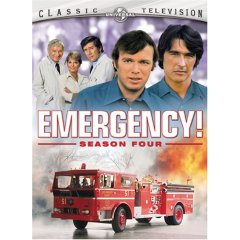
emergency-dvd-cover-51cea8wqbkl_aa240_.jpg

My first year in college, we spent Saturday nights watching “Emergency!” I don’t recall now whether it was on NBC or ABC, but after we saw it once, we were all hooked, Al, Ben and me.

No, it wasn’t great drama. An hour-long drama about paramedics in Los Angeles probably has a lot of potential — this wasn’t that drama. Jack Webb, of “Dragnet” fame, directed. It had a cast amazing for its “how-did-HE- get-there” quality: Bobby Troup, the jazz pianist and composer of “Route 66″ (” . . . get your kicks on . . .”) played a doctor; his wife, jazz vocalist Julie London, played a nurse. Loved Julie London. Beautiful, but she had all the acting chops of David Janssen (“the man of a thousand faces” of “The Fugitive” fame). Martin Milner was there, too — he actually starred earlier in NBC’s “Route 66” which featured Corvettes, but not Bobby Troupe’s hit song (go figure) — and so was Kevin Tighe and Randolph Mantooth. And Robert Fuller, and Kent McCord. Whew!

For undergraduate college students, the show was a riot. We noticed early on that the script writers were defibrillator happy. Every time the paramedic truck showed up, the first thing off was the defibrillator. Heart attacks seemed to be a big problem in LA at the time — maybe Jack Webb’s own mortality subconsciously sneaking into the scripts — so the defib unit got a lot of use.

But it also came out at all the wrong times. Drowning victim? Defibrillator first, THEN artificial respiration. Poison victim? Defib. Auto accident? Defibrillate the victim, THEN worry about the spurting, arterial bleeding (if it’s spurting, is the defib necessary?). Classic kitten in the tree? Defib the tree, THAT will get that kitten down. Read the rest of this entry »


Constitution Day! Monday, September 17, 2007

September 14, 2007

Are you ready for it, teachers?

Howard Chandler Christy's painting of the Scene at the Signing of the Constitution


Bring back the OTA!

September 14, 2007

Imagine the United States government had an agency that was staffed with experts who were respected by scientists and policy makers of all political stripes.

Imagine this agency did studies on serious issues that would affect the nation in the future, and recommend policies that would allow our nation to take advantage of technology to promote human welfare and our economy, and that would allow our nation to resolve issues that threaten our health, domestic welfare and national security.

Imagine that, because the agency had such strong support and credibility, policy makers would enact recommendations the agency made.

Imagine!?! No, all you need to do is remember the Office of Technology Assessment (OTA), an arm of Congress that provided powerful information, insight and recommendations on technology policies for about two decades, from about 1974 to 1995.

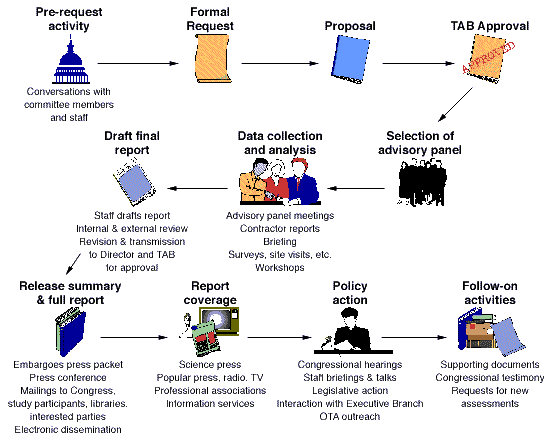
OTA assessment steps Click on thumbnail for chart of the assessment process used by the Office of Technology Assessment to advise Congress on important technology issues.

Now, think about how useful it would be to have such an agency back, to advise our nation on climate change, emergency preparedness, weapons of mass destruction in the post-Soviet era, malaria eradication policies, internet safety and security, and other key issues.

It’s time to bring back the OTA.

Mark Hoofnagle at the Denialism Blog started sounding the conch:

The fact of the matter is that our government is currently operating without any real scientific analysis of policy. Any member can introduce whatever set of facts they want, by employing some crank think tank to cherry-pick the scientific literature to suit any ideological agenda. This is truly should be a non-partisan issue. Everybody should want the government to be operating from one set of facts, ideally facts investigated by an independent body within the congress that is fiercely non-partisan, to set the bounds of legitimate debate. Everybody should want policy and policy debates to be based upon sound scientific ground. Everybody should want evidence-based government.

Go read what he said. Check in with P. Z. Myers’ view. See what John Wilkins says. Hoofnagle lists actions you can take, today, to get the ball rolling.

In the meantime, wander over to the Princeton University site where the OTA’s reports are now archived (I understand the government was going to take it offline, sort of a latter-day burning of the library at Alexandria). Noodle around and look at the report titles. Notice that, though the agency was killed dead by 1995, the agency had reports on climate change. Notice that the agency was a decade or two ahead in urging policies to encourage the internet. Look at the other issues the agency dealt with, look at the legislation that resulted — and you’ll lament with me that we don’t have the agency around today, when the issues are tougher, the technology more difficult to understand, and politics more driven by rumor than fact.

Killing the OTA was the Pearl Harbor of the present war on science. It’s time we started to fight back, to take back the scientific Pacific — our nation’s future is no less in peril now from the war on science, than it was then from hostile nations.

Resources:


On-line workshop: How to do good oral history

September 13, 2007

Here’s what you need to get going on oral histories, especially for student projects:  A how-to guide (warning — 16 megabytes in .pdf), a workshop on doing oral histories, suggested questions to get you started, a budget sheet, interviewer and interviewee release forms — instant oral history project for your class, complete with lesson plans.

The T. Harry Williams Center for Oral History is a branch of the Louisiana State University (LSU) Library.  These materials are offered in workshops the library will do for you, but there is no reason not to use them yourself.

An important issue for student projects is where the oral histories they do should be archived — these are not just student projects, after all, but real, live, semi-pro history.  If you’re in Louisiana, the Williams Center will be happy to take some submissions (see their guidelines).  The Library of Congress is looking for interviews with veterans.  What other depositories invite submissions, and what local archives should you grace with new oral histories?  The LSU site offers links to dozens of other oral history depositories and sources.  See for example the University of North Texas Oral History Program, which has a focus on World War II veterans,  and The Center for American History at the University of Texas at Austin.


Making history class interesting: A lesson plan

September 12, 2007

Getting kids to dive into history can be a chore — but a chore well worth the effort.

Here’s what it might look like, if the kids dive in:

ON the kind of humid summer day that sends visitors to Washington running for cool cover, not even free air-conditioning could lure more than a trickle of tourists into the art museums lining the National Mall.

But 35 miles south at the National Museum of the Marine Corps near Quantico, Va., visitors in a virtual boot camp tested their mettle against drill instructors and their marksmanship on an M-16 laser-rifle range.

Up the Potomac at Mount Vernon, crowds spilled onto a four-acre replica of George Washington’s working farm, while inside the Revolutionary War Theater the rumble of cannons and the cold prick of snow falling overhead lent verisimilitude to the re-enactment of his troops crossing the Delaware River.

And at the International Spy Museum in downtown Washington, visitors with $16 advance tickets snaked out the door as they waited their turn to practice fantasy espionage, complete with assumed identities, pen cameras, shoe phones and the kind of super-spy cars Q might have dreamed up for 007.

Admit it. Learning about history has rarely been so much fun.

You’re not close to Quantico, nor to Washington, D.C.?  How about you get your kids to invent a museum.

The New York Times collaborates with Columbia University’s Bank Street College of Education to produce lesson plans based on stories from the Times, every week day.

You may subscribe to get a lesson plan to your e-mail box every dayOr you can track them down at the Times’ website.

Below the fold, without editing, I list the lesson plan sent out September 10, as an example.  Sounds like a good day in class, to me.

Read the rest of this entry »


Update on Seeger: Critics dig deeper holes

September 12, 2007

It’s not exactly breaking news, but I probably should have caught it earlier — that Ron Radosh article in the New York Sun in which he noted Pete Seeger had condemned Stalin, ‘finally, after all these years?’ The article that made Instapundit exclaim it’s about time?

The New York Times noted that Seeger had made the confession in his book in 1993. Pete was probably too polite to embarrass his former banjo student, Radosh, with Radosh’s being at least a decade behind the times. But of course, the harpy right wing pundits can’t resist taking a swipe at Seeger anyway. I have to wonder whether earlier examples can be found.

Sour grapes articles were expectorated at NewsBusters, by P. J. Gladnick, Hard Country (which inexplicably extolls the virtue of Pete’s music and offers links to several videos of Pete’s performances), Andrew Sullivan (who even more inexplicably links to the NY Times article pointing out Seeger did it at least a decade ago), Dean’s World, Classically Liberal, Assistant Village Idiot (bucking for promotion?), Moonbattery, Mona Charen at NRO (who confesses to having it wrong in the 1970s, too), Dictators of the World, Jim-Rose.com, Synthstuff — whew! Here’s a pre-Radosh column sour grapes swipe from David Boaz in The Guardian.

See also The Philadelphia Inquirer, Walter Weiss, and the AP story in the Miami Herald. And this: The Peekskill riots?

To get the bad taste out of your mouth, see what Marketing Begins at Home has to say, and see the photos. And see this piece on the Highlander School.


Fun history: Great blunders, literature division

September 12, 2007

People in literature are different from you and me.

University of Texas history professor David Oshinsky pulled back the curtain on some of the biggest blunders in the history of literature, in an article for the New York Times a couple of days ago: “No Thanks, Mr. Nabokov.”

He documents rejection letters that, in retrospect, perhaps publisher Alfred A. Knopf would rather had not been written — despite the fact that Knopf was enormously successful otherwise. For example, about a book on teen-aged angst:

In the summer of 1950, Alfred A. Knopf Inc. turned down the English-language rights to a Dutch manuscript after receiving a particularly harsh reader’s report. The work was “very dull,” the reader insisted, “a dreary record of typical family bickering, petty annoyances and adolescent emotions.” Sales would be small because the main characters were neither familiar to Americans nor especially appealing. “Even if the work had come to light five years ago, when the subject was timely,” the reader wrote, “I don’t see that there would have been a chance for it.”

Knopf wasn’t alone. “The Diary of a Young Girl,” by Anne Frank, would be rejected by 15 others before Doubleday published it in 1952. More than 30 million copies are currently in print, making it one of the best-selling books in history.

The goof examples roll out of the files:

Nothing embarrasses a publisher more than the public knowledge that a literary classic or a mega best seller has somehow slipped away. One of them turned down Pearl Buck’s novel “The Good Earth” on the grounds that Americans were “not interested in anything on China.” Another passed on George Orwell’s “Animal Farm,” explaining it was “impossible to sell animal stories in the U.S.A.” (It’s not only publishers: Tony Hillerman was dumped by an agent who urged him to “get rid of all that Indian stuff.”)

Thousands of high school students would agree with the difficulty of selling animal stories.

Oshinsky is working from the files of Knopf, recently donated to the Harry Ransom Humanities Research Center (HRC) at the University of Texas, in Austin. University libraries push and shove each other to get troves of private correspondence, and the HRC has worked to get special grants to help things along. Sometimes these treasures lie buried in library archives. In this case, a grant from the National Endowment for the Humanities helped fund the cataloging operation.

And Oshinsky, who won the Pulitzer for his book Polio: An American Story, has done a bit of history mining. The few nuggets of history gold he reveals in the newspaper will be “classic examples” of why authors, and students and people in the pews of a church, should keep trying in the face of adversity. You’ll see these examples in Readers Digest and inspirational speeches for years to come, count on it.

Literature teachers should find these quotes useful in comforting students who don’t like the classics they are assigned to read. Preachers will find them useful for a variety of reasons. Others of us will like them for the goofiness, and sheer acidity of harsh criticism that, often, proved wrong. We’re Americans; we like it when the underdog wins, and when the pundits get so exactly wrong.

More examples from Oshinsky’s article, below the fold.

Read the rest of this entry »


Millard Fillmore at the National Portrait Gallery

September 11, 2007

Part of the Smithsonian Museums, the National Portrait Gallery remains one of my favorite museums in Washington. It is off the Mall, tucked away at Eighth and F Streets, NW, D.C., (above the Gallery Place-Chinatown Metrorail station – Red, Yellow and Green lines). Free admission, great art, but far enough out of the way to almost guarantee no crowds.

If you Google “National Portrait Gallery,” you also get the gallery of the same name in London, which is not part of the Smithsonian. Another great gallery, but don’t confuse the two.

My continuing search for images of Millard Fillmore turned up this one at the NPG:

Millard Fillmore at the NPG, unnamed artist, circa 1840

The artist is unknown. It’s oil on canvas, and rather a specialty of the NPG — it’s not the official White House portrait. Some of the portraits of presidents come with cheeky commentary or history, since they are not the official portraits usually approved by the president in question himself.

Fillmore’s portrait by an unidentified artist dates from about the time he retired from the House of Representatives in the early 1840s. In the years following, he devoted himself to reconciling the growing differences among fellow Whigs in his native New York State a task for which this hulking and amiable politician was well suited.

“Hulking?”

Check out the other president’s portraits for a usually different view (Lyndon Johnson hated the portrait the NPG has of him, and Richard Nixon never looked better, nor Thomas Jefferson younger); see what else is there that you might use in the classroom.

The NPG has the added advantage of being a short walk from Washington’s China Town, where we used to dine happily at a restaurant named Szechuan, when such cuisine was rather new in the U.S. Several eateries in the area feature dim sum on Sunday mornings, for those days one would rather commune with good friends over delectable tidbits and a good Sunday newspaper, instead of sitting in a pew. Debra Winstead, a former colleague from the University of Arizona, introduced me to the joy of dim sum in D.C. a few years ago.

Good art, good food, good friends. No wonder Washington is such a livable city these days.