Legendary hoaxes: Neiman Marcus cookie recipe

September 30, 2007

Neiman Marcus cookies, Evans Caglage/Dallas Morning News photo, food styling by Jane Jarrell

[Substitute photo from Desserts by Juliette, dessertsbyjuliette.com]

Photo: Evans Caglage for the Dallas Morning News; food styling by Jane Jarrell [photo no longer available; substitute photo from Desserts by Juliette]

Caption: “When the legend wouldn’t die, Kevin Garvin created a cookie worthy of the Neiman Marcus name.”

Snopes.com and other sites debunk the old urban legend about the woman who was charged “two-fifty” for a chocolate chip cookie recipe at Neiman Marcus’ stores — but in defense of mainstream media, let it be noted that the Dallas Morning News does it up right, repeating the recipe, fact-checking the story, and actually baking the cookies and providing that mouth-watering photo above (et tu, Pavlov?)

The story began circulating in the late ’80s and spread quickly.

Although Neiman’s denied the story – in fact, the company said it had never served cookies in its restaurants – it kept gaining momentum. Finally, with the help of the Internet and e-mail, it became The Urban Legend That Would Not Die.

Inquiries about the costly recipe kept coming in until, finally, the store tasked its bakers to come up with a recipe worthy of the NM reputation. It was perfected in 1995 by Kevin Garvin and is on the company Web site, www.neimanmarcus.com. Free. It also is in the Neiman Marcus Cookbook (Clarkson Potter, $45) by Mr. Garvin and John Harrisson.

The store served cookies made from the recipe as part of its 100th anniversary celebration this month.

When victimized by a hoax, make a cookbook and make some money off of it. Of course, it’s a lot nicer being “Neiman Marcus cookied” than being “swift-boated.”

Here’s the Neiman Marcus version of the Neiman Marcus cookie made famous in the hoax:

  • ½  cup (1 stick) butter
  • 1 cup light brown sugar
  • 3 tablespoons granulated sugar
  • 1 large egg
  • 2 teaspoons vanilla extract
  • 1 ¾ cups all-purpose flour
  • ½ teaspoon baking powder
  • ½ teaspoon baking soda
  • ½ teaspoon salt
  • 1 ½ teaspoons instant espresso coffee powder
  • 1 ½ cups semi-sweet chocolate chips

Preheat oven to 300 F. Cream the butter with the sugars until fluffy using an electric mixer on medium speed (approximately 30 seconds).

Beat in the egg and vanilla extract for another 30 seconds.

In a mixing bowl, sift together the flour, baking powder and baking soda and beat into the butter at low speed for about 15 seconds. Stir in the espresso coffee powder and the chocolate chips.

Using a 1-ounce scoop or 2-tablespoon measure, drop cookies onto a greased cookie sheet about 3 inches apart. Gently press down on the dough with the back of a spoon to spread out into a 2-inch circle.

Bake for about 20 minutes, or until nicely browned around the edges. Bake a little longer for a crispy cookie.

Makes 2 dozen cookies.

PER SERVING: Calories 154 (43% fat) Fat 8 g (5 g sat) Cholesterol 20 mg Sodium 119 mg Fiber 1 g Carbohydrates 21 g Protein 2 g

More:

Read the rest of this entry »


Former Arkansas teacher remembers, long before 1957

September 27, 2007

Poignant story from the Associated Press, via Teacher magazine, about the Emancipation Proclamation, picking cotton, Brown v. Board of Education, and education.


50 years after Little Rock: Lesson plans

September 27, 2007

Tolerance.org features a solid lesson plan on what the nation should have learned from the events in Little Rock, Arkansas, in 1957 — when nine African American students challenged segregation and sought to enroll at Little Rock’s Central High School. It’s timely — the actual anniversary is this month. This is a key point for Texas’s U.S. history standards:

September 2007 – This month, our nation marks the 50th anniversary of the Little Rock Nine’s attempt to integrate schools. Have we really learned how to break down barriers?

This lesson plan is excerpted from the 2007-2008 Mix It Up Planner. Learn more about national Mix It Up at Lunch Day, to be held on Nov. 13, 2007!

Objectives:

  • Students will draw conclusions about boundary crossing from history and literature.
  • Students will identify boundaries in their classroom or school, cross those boundaries, report back and reflect on what they learned.

Tolerance.org carries several lesson plans teachers will find useful.


Nuclear bombs, game theory, the Cold War to the brink

September 27, 2007

John von Neumann died prematurely at 54, in 1957. He was very much a polymath, acknowledged first for his mathematical abilities, eventually contributing to physics, computer science and economics. His contributions in nuclear physics and game theory especially deserve better recognition than they’ve gotten among the public at large.

John von Neumann, NAS photo

Princeton University commemorates von Neumann’s life on the 50th anniversary of his death, with an afternoon and a night of lectures and discussion by scientists, economists and historians, October 5 and 6, 2007.

It should be good fun, and if you’re in the neighborhood of Princeton, New Jersey on October 5 and 6, you should go.

Here’s the biographical overview of von Neumann from the National Academy of Sciences, showing him to be the sort of guy we would have been happy to keep around another 40 years or so:

John von Neumann (1903-1957). When he was elected a member of the Academy in 1937, von Neumann was known for his contributions to the fields of mathematical logic and the foundations of quantum mechanics. But his interests were wide-ranging, and he went on to do distinguished work in other fields, including economics and strategic thinking. He is perhaps best known for his work in the early development of computers. As director of the Electronic Computer Project at Princeton’s Institute for Advanced Study (1945-1955), he developed MANIAC (mathematical analyzer, numerical integrator and computer), which at the time was the fastest computer of its kind. Built at a time long before the invention of the silicon chip, MANIAC was run on thousands of vacuum tubes. Von Neumann was born in Budapest, Hungary, in 1903, and studied in Berlin, Zurich, and Hamburg. In 1930 he joined the Princeton Institute for Advanced Study. He became a US citizen in 1937, and during the Second World War distinguished himself with his work in weapons development. In 1955 he was named a Commissioner of the Atomic Energy Commission, a position he held up to his death from cancer in 1957.

Free Lecture No. 1:

Budapest: The Golden Years

Early Twentieth Century Mathematics Education in Budapest and Lessons for Today

Free and Open to the Public
Panel Discussion
October 5, 2007
3–6 p.m.
219 Aaron Burr Hall
Princeton University

The starting point for the discussion is The Social Construction of Hungarian Genius, 1867–1930, a paper by Professor Tibor Frank, an historian of Hungarian exiles. The paper will be available for distribution at the event.

Free Lecture No. 2:

“Living in von Neumann’s World: Scientific Creativity, Technological
Advancement, and Civilization’s Accelerating Dilemma of Power”

Lecture and Panel Discussion
8 pm, Saturday October 6, 2007
McCosh 50 Lecture Hall
Princeton University

Introduction by Charles Harper

Lecturers:
Thomas Schelling, University of Maryland College Park,
Nobel Laureate, Economics
George Dyson,
von Neumann biographer

Panel Moderator:
Eric Gregory, Princeton University

Panelists:
Freeman Dyson, Institute for Advanced Study
Martin Nowak, Harvard University
Robert Wright, Princeton University

Banner for von Neumann Lectures, 2007


Public education entrenched in Utah

September 25, 2007

From the Utah History Encyclopedia on-line, we get a solid if brief description of the highlights of public education in Utah.

Here are the roots of the deep opposition to vouchers in Utah.  Several times Utah communities started their own private schools, only to turn them over to public entities, especially after 1890.  Utahns regard public schools as their own.  Voucher advocates seem unable to notice that an assault on the public schools is an assault on Utah communities, for that reason.

Plus, as The Deseret Morning News reported Sunday, Utah’s schools often achieve excellence.  Utah parents don’t like the idea of taking money away from successful schools their kids attend to fund untested, unregulated private schools.


Neuroscience, culture, and practical application

September 23, 2007

The oak tree at Jena's high school -- now cut down

My hypothesis is that a normal person may not peruse this site, The Situationist, without finding something of use for the person’s work or homelife — or at a minimum, something extremely intrigueing about a problem the person has in an organization to which the person belongs.

For example, check out these discussions:

  1. On the Jena 6
  2. On l’affaire Chemerinsky at UC-Irvine
  3. On college debt
  4. On confronting mistakes — especially one’s own

It’s a project at Harvard, interdisciplinary so far as I can tell.  Here’s the explanation:

There is a dominant conception of the human animal as a rational, or at least reasonable, preference-driven chooser, whose behavior reflects preferences, moderated by information processing and will, but little else. Laws, policies, and the most influential legal theories are premised on that same conception. Social psychology and related fields have discovered countless ways in which that conception is wrong. “The situation” refers to causally significant features around us and within us that we do not notice or believe are irrelevant in explaining human behavior. Situationism” is an approach that is deliberately attentive to the situation. It is informed by social science—particularly social psychology, social cognition, and related fields—and the discoveries of market actors devoted to influencing consumer behavior—marketers, public relations experts, and the like. The Situationist is a forum for scholars, students, lawyers, policymakers, and interested citizens to examine, discuss, and debate the effect of situational forces – that is, non-salient factors around and within us – on law, policy, politics, policy theory, and our social, political, and economic institutions. The Situationist is associated with The Project on Law and Mind Sciences at Harvard Law School. To visit the Project’s website, click here.

Go see, and report back, if you don’t mind.


Texas earthquake!

September 23, 2007

Epicenter of Texas earthquake

Really. A Texas earthquake. September 15, 2007.

Missed it? Well, it was at the dinner hour, 06:16:42 PM (CDT). You may have thought it was Bubba’s great sauce for the barbecue, or the raspberry in the iced tea.

US Geological Survey provides a state-by-state listing of latest earthquakes. Texas is not a particularly active zone — but there are quakes, even here.

This last one, just over a week ago, was a 2.7 on the Richter scale, too weak to merit much news coverage even in the flatlands. It shook Milam County and surprised people there, but it didn’t do much damage:

In terms of destruction, the earthquake was hardly significant.

Emergency responders said they knew of only one report of damage: A teapot fell off of a woman’s stove.

In California, people probably wouldn’t have even noticed the tremor. But this earthquake happened in the Lone Star State and left Brazos Valley residents baffled.

“You just don’t expect your house to shake,” said Burleson County resident Karen Bolt. She was in her trailer home cleaning dishes when the temblor began.

USGS provides more details than you can use:

Magnitude 2.7
Date-Time
  • Saturday, September 15, 2007 at 23:16:42 (UTC) – Coordinated Universal Time
  • Saturday, September 15, 2007 at 06:16:42 PM local time at epicenter
  • Time of Earthquake in other Time Zones

    Location 30.74N 96.74W
    Depth 5.0 kilometers
    Region CENTRAL TEXAS
    Distances 35 km (20 miles) W of Bryan, Texas
    65 km (40 miles) ENE of Taylor, Texas
    110 km (70 miles) ENE of AUSTIN, Texas
    170 km (105 miles) NW of Houston, Texas
    Location Uncertainty Error estimate: horizontal +/- 16.2 km; depth fixed by location program
    Parameters Nst=4, Nph=4, Dmin=123.3 km, Rmss=1.25 sec, Erho=16.2 km, Erzz=0 km, Gp=130.4 degrees
    Source USGS NEIC (WDCS-D)
    Remarks Felt in the Caldwell-Rockdale area.
    Event ID ushhc

    Still, Texans should be relieved it was a small one. The largest recorded Texas earthquake was in 1931, with an epicenter near Valentine. At 5.7 magnitude and VII intensity, it nearly destroyed the little town of Valentine.

    In terms of magnitude and damage, this is the largest earthquake known to have occurred in Texas. The most severe damage was reported at Valentine, where all buildings except wood-frame houses were damaged severely and all brick chimneys toppled or were damaged. The schoolhouse, which consisted of one section of concrete blocks and another section of bricks, was damaged so badly that it had to be rebuilt. Small cracks formed in the schoolhouse yard. Some walls collapsed in adobe buildings, and ceilings and partitions were damaged in wood-frame structures. Some concrete and brick walls were cracked severely. One low wall, reinforced with concrete, was broken and thrown down. Tombstones in a local cemetery were rotated. Damage to property was reported from widely scattered points in Brewster, Jeff Davis, Culberson, and Presidio Counties. Landslides occurred in the Van Horn Mountaiins, southwest of Lobo; in the Chisos Mountains, in the area of Big Bend; and farther northwest, near Pilares and Porvenir. Landslides also occurred in the Guadalupe Mountains, near Carlsbad, New Mexico, and slides of rock and dirt were reported near Picacho, New Mexico. Well water and springs were muddied throughout the area. Also felt in parts of Oklahoma, New Mexico, and in Chihauhua and Coahuila, Mexico.

    Texas history courses could make some use of these data, for map reading exercises, and for general geography about the state. Click on the map below, the isoseismal map of the 1931 Valentine, Texas quake, and geography teachers will begin to dream of warm-up exercises right away.

    Isoseismal map of 1931 earthquake near Valentine, Texas

    USGS offers a wealth of information on Texas’ geology and geography — stream flow information, drought information — collected in one spot for each state in a “Science in your backyard” feature.

    Pick your state, pick your topic, and go.


    Quote of the moment: Washing hands of the matter

    September 23, 2007

    Ignaz Semmelweiss

    This is one of the classic stories of public health, an issue that most U.S. history and world history texts tend to ignore, to the detriment of the students and the classroom outcomes.

    This is the story as retold by Christopher Cerf and Victor Navasky in The Experts Speak:

    In the 1850s a Hungarian doctor and professor of obstetrics named Ignaz Semmelweis (pictured at left) ordered his interns at the Viennese Lying-in Hospital to wash their hands after performing autopsies and before examining new mothers. The death rate plummeted from 22 out of 200 to 2 out of 200, prompting the following reception from one of Europe’s most respected medical practitioners:

    “It may be that it [Semmelweis’ procedure] does contain a few good principles, but its scrupulous application has presented such difficulties that it would be necessary, in Paris for instance, to place in quarantine the personnel of a hospital during the great part of a year, and that, moreover, to obtain results that remain entirely problematical.”

    Dr. Charles Dubois (Parisian obstetrician), memo to the French Academy
    September 23, 1858

    Semmelweiss’ superiors shared Dubois’ opinion; when the Hungarian physician insisted on defending his theories, they forced him to resign his post on the faculty.

    Update, September 26, 2007: Stephen J. Dubner at the Freakonomics blog pointed to a video, to an essay by Semmelweis, and to a column he and Steven D. Levitt had done earlier on handwashing. Maybe things aren’t as good as we had hoped.


    Meanwhile, creationist oppression rolls on

    September 22, 2007

    While Mark Mathis was leading a bumbling raid on rationalists at Baylor University, Biblical literalists took another scalp in Iowa, of a college instructor this time. Maybe it’s time to beef up tenure, and make it easier to get.

    (Maybe I need to add a new category along with “voodoo science” and “voodoo history”: “Voodoo literature.”)

    Tip of the old scrub brush to Pharyngula.

    Petraeus vs. Westmoreland

    September 22, 2007

    Santayana’s ghost sends links: The Horse’s Mouth via The Good Democrat.

    Who are these guys? What did they say?

    Gen. William Westmoreland, circa 1967

    Gen. David Petraeus, 2007

    Left, Gen. William Westmoreland, testifying before Congress, circa 1967; right, Gen. David Petraeus, testifying to the Senate Committee on Foreign Relations, September 11, 2007


    Historic maps: Florida and the Gulf of Mexico

    September 21, 2007

    Go to the University of Florida Smathers Library site, and admire the beauty of these old maps of Florida and the Gulf of Mexico. (While I think fair use would cover it, I’m holding back on posting an image until copyright permission comes through — you’re licensed to use them in the classroom, however.)

    What else would you expect from a library named after Sen. George A. Smathers, who was part of that legendary 1950 Senate campaign in Florida?

    The maps featured on the first page include Spanish, Dutch, English, Belgian, French and Italian maps of the early explorers, suitable certainly for Texas history courses, and also for Florida, Louisiana and U.S. history units on European exploration.

    This site is quite Florida-centric, but it’s links also provide some interesting and valuable resources, such as the link to satellite imagery of the areas, like the NOAA map, below.

    NOAA map of ocean water temperatures around Florida, satellite image

    Tip of the old scrub brush to A Cracker Boy Looks at Florida


    1872 Mining Act – Amend it now?

    September 20, 2007

    Sherffius cartoon on Bush administration mining regulations

    Few people know about the law. Since 1872, mineral extraction from the public lands of the United States has been governed by a law designed to make it easy for miners to get minerals out. The law is essentially unchanged, though some mining operations are now bound by other laws to protect the environment and other uses of public lands, such as grazing, tourism, scientific study, wood production, grazing, wildlife management and hunting.

    The Senate Committee on Energy and Natural Resources opens hearings on reforming the law next Thursday, September 27. The hearing will be webcast, most likely.

    The House of Representatives has already had a couple of field hearings.

    Watch your claims!

    Resources:


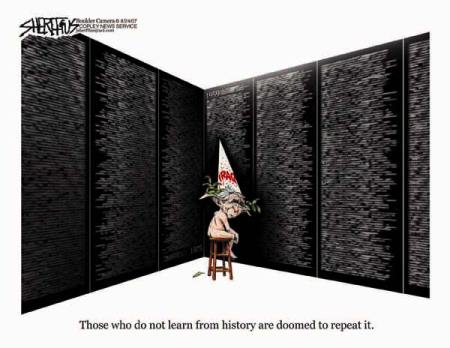
    Political cartoons: Powerful images, powerful ideas

    September 20, 2007

    Sherffius in the Boulder Daily Camera, August 2007 - copyright Sherffius

    Sherffius in the Boulder Daily Camera, August 2007 - copyright Sherffius

    Sherffius, in the Boulder (Colorado) Daily Camera

    The deadline for cartoonists to enter the Ranan Lurie Prize competition at the United Nations is October 1. The winning cartoon from 2006, from Argentinian cartoonist Alfredo Sabat, is one of the most popular images in Google’s image search for “cartoon.”

    Images pack a punch. If a pen is mightier than a sword, a cartoonist’s pencil and ink drawing can be more powerful than a cannon.

    While we wait for the winners of the Lurie competition, we can look around to see other great cartoonists’ work. Earlier I tried to call attention to the work of John Sherffius at the Boulder (Colorado) Daily Camera. Since then, he’s won the James Aronson Social Justice Award for Graphics for the body of his work. The power of his drawings should be clear from the cartoon above.

    Do you have a favorite cartoonist, especially one from a smaller newspaper who has not yet received the kudos she or he is due? Tell us about it in comments — and give links, if you can.

    And share the word with others:

    Add to FacebookAdd to NewsvineAdd to DiggAdd to Del.icio.usAdd to StumbleuponAdd to RedditAdd to BlinklistAdd to TwitterAdd to TechnoratiAdd to Furl


    Science history slips away: Ralph Alpher and Big Bang

    September 20, 2007

    Looking for something else in an old newspaper, I came across a small obituary for Ralph Alpher. Alpher died August 12, 2007, in Austin, Texas, at the home of his son, Dr. Victor S. Alpher.

    Ralph Alpher, physicist who co-hypothesized the Big Bang

    Ralph Alpher, physicist who co-hypothesized the Big Bang

    Ralph Alpher gave us the Big Bang. We let him slip away, almost unnoticed. Odds are you don’t recall ever hearing of Alpher. Here’s your mnemonic: The alphabet paper.

    In 1948, as a graduate student under George Gamow at the George Washington University, Alpher and Robert Herman of Johns Hopkins laid the groundwork for what would become Big Bang theory, calculating how matter could arise in the Universe. Gamow, exhibiting the sense of humor for which physicists are famous, listed the authors of the paper as Alpher, Bethe, Gamow and Herman — a play on the Greek alphabet’s first three letters (alpha, beta, gamma), and a joke invoking the name of the great physicist Hans Bethe. Bethe liked the joke, consulted on the paper, and the theory of Big Bang was published.

    Ralph Alpher, in Florida, 2006; Alpher home page

    The name “Big Bang” was applied a few years later; Sir Frederick Hoyle and his colleagues favored a “steady state” universe, and at the time both hypotheses could accurately predict most of what was observed, and neither could be disproven. Hoyle, hoping to poke ridicule at the competing hypothesis, belittled it as “a big bang.” The name stuck. The name misleads the unwary; the theory posits a rapid expansion at the beginning of the universe and time, but not an explosion, per se.

    Alpher wrote the mathematical model; the model predicted Big Bang, and specifically, it predicted the cosmic background radiation that would have been left over; it was this background radiation, the “echo” of Big Bang, that Arno Penzias and Robert Wilson stumbled across in 1965. Robert H. Dicke had invested several years in trying to discover this signature, and had to explain to Penzias and Wilson what they had found. Penzias and Wilson won the Nobel Prize for their discovery; Dicke, Alpher, Herman and Gamow, did not get Nobel Prizes. This is generally regarded as one of the great miscarriages of justice in Nobel Prize awards, not that Penzias and Wilson did not deserve an award, but that the chief theorists and the man who unveiled the discovery were overlooked.

    This is another story of rejection leading to great discovery; it is also a rather sad story of a momentous achievement, mostly overlooked through the years.

    Alpher was the son of Jewish émigrés from the Russian pogroms. His high school achievements merited a scholarship to the Massachusetts Institute of Technology, in 1937. MIT had a rule at the time that scholarship recipients could not work outside the school. Alpher assisted his father in building houses in the Washington, D.C. area; the family had little money, and Alpher would be unable to pay room and board without working. Discussions with MIT broke down — the offer of a scholarship was withdrawn, according to most accounts when MIT discovered he was a Jew. As so many great people of the post World War II era, he enrolled at the George Washington University.

    At GWU, Alpher found Gamow as a mentor, and much of the rest is history.

    The New York Times:

    The paper reported Dr. Alpher’s calculations on how, as the initial universe cooled, the remaining particles combined to form all the chemical elements in the world. This elemental radiation and matter he dubbed ylem, for the Greek term defining the chaos out of which the world was born.

    The research also offered an explanation for the varying abundances of the known elements. It yielded the estimate that there should be 10 atoms of hydrogen for every one atom of helium in the universe, as astronomers have observed.

    Months later, Dr. Alpher collaborated with Robert Herman of the Applied Physics Laboratory at Johns Hopkins University on a paper predicting that the explosive moment of creation would have released radiation that should still be echoing through space as radio waves. Astronomers, perhaps thinking it impossible to detect any residual radiation or still doubting the Big Bang theory, did not bother to search.

    The Alpher-Bethe-Gamow paper, or αβγ paper, as explained by the American Institute of Physics:

    When Alpher and Gamow prepared a paper on the subject, Gamow mischievously added the name of the noted nuclear physicist Hans Bethe to the list of authors so it would be called the “Alpher-Bethe-Gamow paper,” mimicking the “alpha-beta-gamma” of the first letters of the Greek alphabet. Unknown to Gamow, Bethe was a reviewer for the journal to which Gamow submitted the article. Bethe took it in good humor, later explaining, “I felt at the time that it was rather a nice joke, and that the paper had a chance of being correct, so that I did not mind my name being added to it.” Gamow also urged Herman to change his name to Delter to match delta, the next letter in the Greek alphabet. Despite Herman’s refusal, in a paper in a major scientific journal Gamow referred to “the neutron-capture theory…developed by Alpher, Bethe, Gamow and Delter.” Not least among his notable characteristics was his sense of humor.

    Alpher continued in this work for a time, but joined General Electric’s labs in the 1950s. When he retired from GE, in 1986 he joined the faculty at Union College in Schenectady, New York, and taught there until 2004.

    Alpher was largely overlooked for awards even while his theory was big news in astronomy and physics for the last 40 years of the 20th century. I regret that I was wholly unaware he was in Austin; how many other great contributors to science and history live among us, unrecognized, uncelebrated, and their stories unrecorded?

    Alpher, Herman and Gamow - and the famous Cointreau bottle

    Photo caption from AIP: A 1949 composite picture with Robert Herman on the left, Ralph Alpher on the right, and George Gamow in the center, as the genie coming out of the bottle of “Ylem,” the initial cosmic mixture of protons, neutrons, and electrons from which the elements supposedly were formed. [The Cointreau bottle from which the three drank a toast upon the acceptance of the paper, is now in the collection of the Smithsonian Institution.]

    Alpher was an Eagle Scout. I wonder whether anyone has a history of his time in Scouting?

    While the Nobel Prize eluded Alpher, he collected a host of other prestigious awards and honors. Earlier this year, President Bush announced that Alpher had been awarded the National Medal of Science, which is administered by the National Science Foundation and is the highest honor for science.

    . . . [T]he citation reads in part:

    “For his unprecedented work in the areas of nucleosynthesis, for the prediction that universe expansion leaves behind background radiation, and for providing the model for the Big Bang theory.”

    Note from George Gamow, on confirmation of Big Bang Gamow’s humor again on display — an undated note from Gamow upon the confirmation of the Big Bang, with a punny reference to Steady State backer Sir Frederick Hoyle. Image from the American Institute for Physics.

    Online sources for Ralph Alpher:

    More:

    Help others hear the echo:

    Add to FacebookAdd to NewsvineAdd to DiggAdd to Del.icio.usAdd to StumbleuponAdd to RedditAdd to BlinklistAdd to TwitterAdd to TechnoratiAdd to Furl


    Soon to be famous rejection: Harvard to Warren Buffett

    September 19, 2007

    A California woman donated $128 million to a Quaker boarding school.  Her fortune is the result of her father’s wise investment with one of his former students, Warren Buffett.

    Barbara Dodd Anderson made the gift to the George School in Bucks County, Pennsylvania.  She is the daughter of Buffett’s former professor at Columbia University’s graduate business program, David L. Dodd.  Dodd invested with Buffett, having been impressed with Buffett’s acumen as a student.

    But Buffett owed Dodd a lot, too.  It was Dodd who got Buffett into Columbia, after Harvard rejected him.  Here’s the gist of that part of the story, from the New York Times:

    In an interview, Mr. Buffett said Professor Dodd had turned his life around in 1950, when he graduated from the University of Nebraska and was applying to business school. Harvard rejected his application, and that August, well after Columbia’s application deadline, Mr. Buffett wrote to Professor Dodd, whom he admired as the author of a respected financial text.

    “Dear Professor Dodd, I thought you were dead, but now that I know that you’re alive, I’d like to come study with you,” Mr. Buffett said he wrote in his letter.

    “And he admitted me to Columbia!” Mr. Buffett said. “I would not be who I am today without David Dodd. If in response to my letter he’d said, ‘Sorry, its too late,’ I’d never be where I am.”

    “Harvard did me a big favor by turning me down,” he said. “But I haven’t made any contributions to them in thanks for that.”