Hall of Fame: Debunking the Moon landing hoax hoax

December 10, 2006

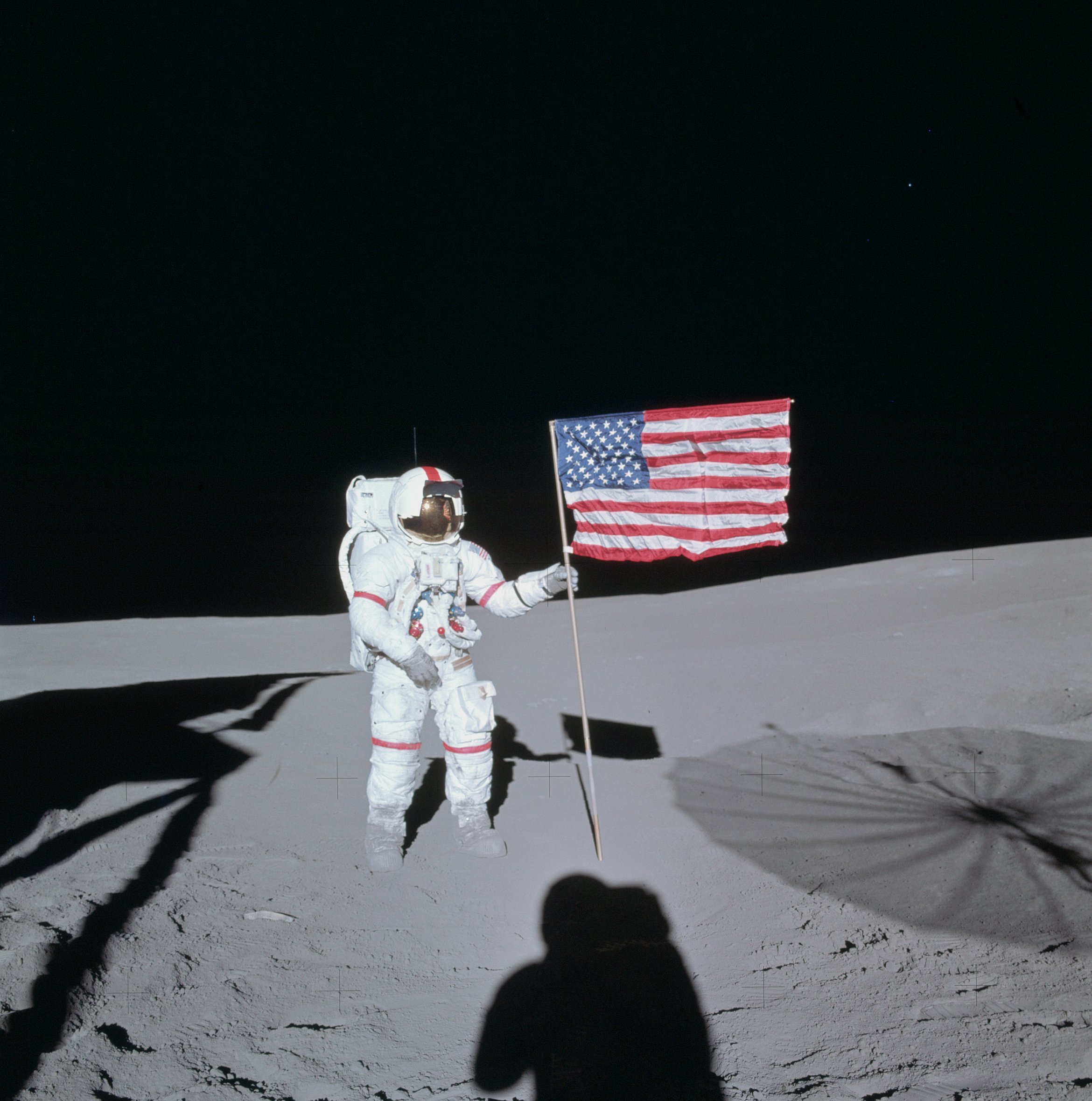
Apollo 14 on the moon - Alan Shepard?

Photo from Apollo 14 Moon Mission


In a classroom discussion of “how do we know what we know” about history, another student brought up the allegations that the National Aeronautics and Space Administration (NASA) faked the manned Moon landings. That makes about a dozen times this year a kid has mentioned this claim (who thinks to start counting these things?). The kid was pretty unshakable in his convictions — after all, he said, how can a flag wave in a vacuum?

I usually mention a couple of things that the fake claimers leave out — that dozens, if not hundreds, of amateur astronomers tracked the astronauts on their way to the Moon, that many people intercepted the radio transmissions from the Moon, that one mission retrieved debris from an earlier unmanned landing, etc. Younger students who lack experience in serious critical thinking have difficulty with these concepts. They also lack the historic background — the last manned Moon landing occurred when their parents were kids, perhaps. They didn’t grow up with NASA launches on television, and the whole world holding its breath to see what wonders would be found in space.

Phil Plait runs a fine blog called Bad Astronomy. Five years ago he got fed up with the Fox Television program claiming the Moon landings were hoaxes, and he made a significant reply that should be in some hall of fame for debunking hoaxes. Since the claim that the Moon landings were hoaxes is, itself, a hoax, I have titled this “Debunking the Moon landing hoax hoax.”

In any case, if you’re wondering about whether the Moon landings were hoaxes, you need to see Phil Plait’s post. Phil writes:

From the very first moment to the very last, the program is loaded with bad thinking, ridiculous suppositions and utterly wrong science. I was able to get a copy of the show in advance, and although I was expecting it to be bad, I was still surprised and how awful it was. I took four pages of notes. I won’t subject you to all of that here; it would take hours to write. I’ll only go over some of the major points of the show, and explain briefly why they are wrong.

Also, consider these chunks of evidence, which Phil does not mention so far as I know:

First, the first Moon landing left a mirror on the surface, off of which Earth-bound astronomers may bounce laser transmissions in order to measure exactly the distance from the Earth to the Moon. Read the rest of this entry »


Pearl Harbor, 65 years ago today

December 7, 2006

1941 AP file photo, small boat rescues victims from U.S.S. West Virginia

Associated Press 1941 file photo of a small boat assisting in rescue of Pearl Harbor attack victims, near the U.S.S. West Virginia, as the ship burns.

Today is the 65th anniversary of Japan’s attack on the U.S.’s Pacific Fleet at Pearl Harbor, Hawaii.

Our local newspaper, The Dallas Morning News, has a front-page story on survivors of the attack, who have met every five years in reunion at Pearl Harbor. Today will be their last official reunion. The 18-year-olds who suffered the attack, many on their first trips away from home, are in their 80s now. Age makes future reunions impractical.

From the article:

“We’re like the dodo bird. We’re almost extinct,” said Middlesworth, now an 83-year-old retiree from Upland, Calif., but then – on Dec. 7, 1941 – an 18-year-old Marine on the USS San Francisco.

Nearly 500 survivors from across the nation were expected to make the trip to Hawaii, bringing with them 1,300 family members, numerous wheelchairs and too many haunting memories.

Memories of a shocking, two-hour aerial raid that destroyed or heavily damaged 21 ships and 320 aircraft, that killed 2,390 people and wounded 1,178 others, that plunged the United States into World War II and set in motion the events that led to atomic bombings of Hiroshima and Nagasaki.

“I suspect not many people have thought about this, but we’re witnessing history,” said Daniel Martinez, chief historian at the USS Arizona Memorial. “We are seeing the passing of a generation.”

Another article notes the work of retired history professor Ron Marcello from the University of North Texas, in Denton, in creating oral histories from more than 350 of the survivors. This is the sort of project that high school history students could do well, and from which they would learn, and from which the nation would benefit. If you have World War II veterans in your town, encourage the high school history classes to go interview the people. This opportunity will not be available forever.

There is much to be learned, Dr. Marcello said:

Dr. Marcello said that in doing the World War II history project, he learned several common themes among soldiers.

“When they get into battle, they don’t do it because of patriotism, love of country or any of that. It’s about survival, doing your job and not letting down your comrades,” he said. “I heard that over and over.”

Another theme among soldiers is the progression of their fear.

“When they first got into combat, their first thought is ‘It’s not going to happen to me.’ The next thought is ‘It might happen to me,’ and the last thought is ‘I’m living on borrowed time. I hope this is over soon,’ ” Dr. Marcello said.

Dr. Marcello said the collection started in the early 1960s. He took charge of it in 1968. Since Dr. Marcello has retired, Todd Moye has taken over as the director.

Other sources:

While this is not one of the usual dates listed by Congress, you may fly your U.S. flag today.


To the Carnivals!

December 6, 2006

Carnival of the Liberals! (at Neural Gourmet)

Carnival of Education #96! (at History is Elementary, which is a blog you probably should be reading)

History Carnival! (at Barista)

(Can any of them really be carnivals without a bearded lady, or the human frog boy?)


Nominate a history book

December 4, 2006

Remember to nominate your favorite history books for the list of all-time great history books. You can do it most easily here, at the original post.


Millard Fillmore hospital to close, perhaps

December 3, 2006

Millard Fillmore

Being named after the last Whig president this nation ever had doesn’t carry much water with a government cost-cutting commission in New York. The commission recommendd that Millard Fillmore Hospital in Buffalo be closed, according to the Buffalo News.

Millard Fillmore counted Buffalo as his base of operations. The hospital was named after Fillmore in 1923, though the hospital dates back to facilities that first opened in 1872. Declining population in Buffalo has made traffic easier, the newspapers note, but also made it necessary to consolidate some public facilities.

Population declines in some places are temporary, like  recent now-reversed declines in Dallas and Houston. Other declines may be permanent, like some of those in west Texas. Into which category does Buffalo’s decline fall?

While one namesake of Fillmore closes, at the other end of New York, Moravia’s Cayuga-Owasco Lakes Historical Society has a gift from Nucor Steel which will allow the Society to construct a 25-by-40-foot building to house Fillmore memorabilia, according to the Auburn (New York) Citizen. Buffalo was the haunt of the adult Fillmore, but the nation’s 13th president was born in Moravia in 1800.

If I am not careful, this blog could become for Millard Fillmore what the old Salt Flat News was for that part of Utah and Nevada that includes the famous Bonneville Salt Flats. The area’s largest city is Wendover, a city that straddles the Utah-Nevada border. It is famous for long, lonely drives. And the slogan for the Salt Flat News which flourished in Salt Lake City during the 1970s was, “The only newspaper in the world that gives a damn what happens on the Salt Flats.”


Death of books, and history on video

December 3, 2006

In the Eisenhower administration some wise person noted that through history, libraries have been essential to civilization. In that wisdom-tinged era, the federal government started a program to establish in every county in the U.S. a library which would contain practical information on farming, industry, health care, and government and philosophy, so that in the event a nuclear exchange wiped out great libraries in Chicago, New York, Philadelphia, Washington and Los Angeles, among other places, the knowledge and wisdom needed to rebuild America would be available to people easily, locally.

It was a good idea, I think, but chiefly because of the side effect of putting good information close to people, even without nuclear destruction. I wonder whether we have strayed.

Today, libraries abandon books in favor of electronic media, film and on-line applications at a prodigious rate. Million-book libraries, once the hallmark of a good university, now represent dated data and a backwater center of scholarship, to many.

Libraries missed the first video wave. Thinking they were about books and not television presentation of information, libraries missed the opportunity to attract customers for videos. Instead, here in the U.S. a company named Blockbuster did badly (by my estimation) the promulgation and protection of culture, for profit, that libraries should have done for free. Determined not to miss the next evolution or revolution in media, libraries now plan to adopt new media when possible, and store information in new electronic formats.

In the U.S., college libraries turn to coffee bars and advanced internet access to attract students to . . . where the stacks used to be. (audio story from NPR’s Saturday Edition)

In the Netherlands, libraries plan to archive local video productions and photographs, and to digitize the data to make it more widely available. Plans are to spend 173 million euro (more than $230 million U.S. at today’s exchange rate), to archive 285,000 hours of film, video and radio recordings, and nearly 3 million photos.

Will civilization survive?

Tip of the old scrub brush to If:book, from the Institute for the Future of the Book.


The rise of David Barton and bogus history

November 28, 2006

Some people were relieved when voodoo history maven Davin Barton’s term as vice chair of the Texas Republican Party expired.

Dallas Morning News editorial writer and occasional columnist William McKenzie warns that we have not seen the last of Barton’s involvement in politics — and textbooks are in Barton’s gunsights.

McKenzie wrote about Barton in the November 28 paper:

Pay attention to his work, because, as Newsweek reported after the election, the religious right is at a crossroads. With big-name leaders declining, lesser-knowns like Mr. Barton will fill the gap. And they will come with their own approach.

The most interesting thing I learned from him was that the next wave will revolve around networks of activists, not the big names who lobby Washington. Look for e-mail blasts that start with a small group upset about a comment or decision about abortion, homosexuality or textbooks. In the decentralized technological world, a David Barton doesn’t need the podium of a Jerry Falwell or a Ralph Reed to trigger a prairie fire.

In other words, watch him.


Finding serious, academic, history blogging

November 26, 2006

A few people have begun to understand that the internet probably can be a tool for historians, both for research and publication, and for teaching.

This column by Ralph Luker is ancient internet history — the original column ran in August 2005, more than a year ago. It names names and lists urls for serious history blogs, however. If you’re serious about history or teaching it, you’ll find something useful in it.


National Humanities Medal to Bernard Lewis . . .

November 26, 2006

Generally there is just too much going on to follow all of it in the news, let alone understand it.

PanArmenian.net complains that historian Bernard Lewis’ being honored with the National Humanities Medal is a problem, labeling him a denier of the Armenian genocide. He was found to be so by a French court (does that increase his appeal to Bush?).

Lewis’ work is influential — here is a 2004 Washington Monthly piece by Newsweek correspondent Michael Hirsch, pointing out that Lewis is the guy who probably first coined the phrase “clash of civilizations” with regard to international relations with modern Islamic nations. Is he just one more Princeton University faculty member, like Ben Bernanke, who happens to have the ear of the President?

Teachers of history certainly should be familiar with the controversy over the Armenian genocide, its relation to post-World War I history, its salience in European politics today, and its effects on U.S. history (and especially U.S. literature — think William Saroyan, George Deukmejian, etc.). I admit I know very little about Lewis. I don’t know enough about him to make a judgment on whether the charges of the Armenian partisans are fair.

In my previous post I noted the rise of a superstar natural history prof, in England. Here in the U.S. the National Humanities Medal was awarded to nine people and one institution — one of the people is a Nobel Prize winner — and the news sank like a small, round stone in a small pond, without making much of a ripple.

If we can’t name some of the stars among historians and others in the humanities, are we doing our jobs? Are our newspapers and broadcasters doing their jobs if we don’t get this news?

Did President Bush honor a denier of the Armenian genocide? Our future relations with Islamic nations and peoples may depend on the answer. I don’t know. Do you?

Here is Lewis’ biography from the awards press release:

Bernard Lewis is considered by many to be the greatest living historian of the Muslim world. He has pursued his primary interest, the history of the Ottoman Empire, producing groundbreaking works including The Emergence of Modern Turkey, The Political Language of Islam, The Muslim Discovery of Europe, The Jews of Islam, and Islam and the West. His most recent publication is From Babel to Dragomans: Interpreting the Middle East. Other titles by Lewis: The Crisis of Islam: Holy War & Unholy Terror; What Went Wrong: The Clash Between Islam and Modernity in the Middle East; Western Impact and the Middle Eastern Response; A Middle East Mosaic: Fragments of Life, Letters and History; The Multiple Identities of the Middle East; and The Middle East: A Brief History of the Last 2,000 Years. Born in London, England, in 1916, Lewis became attracted to languages and history at an early age. Lewis’s interest in history was stirred thanks to his bar mitzvah ceremony, during which he received as a gift a book on Jewish history. He graduated in 1936 from the then School of Oriental Studies (SOAS, now School of Oriental and African Studies) at the University of London with a B.A. in history with special reference to the Near and Middle East, and obtaining his Ph.D. three years later, also from SOAS, specializing in the history of Islam. During the Second World War, Lewis served in the British Army in the Royal Armoured Corps and Intelligence Corps in 1940-41, and was then attached to a department of the Foreign Office. After the war he returned to SOAS, and in 1949 he was appointed to the new chair in Near and Middle Eastern history at the age of 33. In 1974 Lewis accepted a joint position at Princeton University and the Institute for Advanced Study, marking the beginning of the most prolific period in his research career. In addition, it was in the United States that Lewis became a public intellectual. After his retirement from Princeton in 1986 as the Cleveland E. Dodge Professor of Near Eastern Studies, Lewis held many visiting appointments. Lewis has been a naturalized citizen of the United States since 1982.


The Naked Historian

November 26, 2006

Superstar historians rare get recognized on the street. The BBC’s use of historians, even natural history professors, however, has made a few stars in Britain. Neil Oliver is one of the latest, dubbed “The Naked Historian” for reasons I haven’t figured yet.

The Sunday Times has a profile on November 26:

Neil Oliver is draped languidly over a sofa in Glasgow’s Millennium Hotel. He is fully clothed and only doing the photographer’s bidding, but it is easy to see why the presenter of the hit series Coast has been dubbed the Naked Historian.

It’s not just a surname he shares with television’s sexiest chef. Both were “discovered” by screen queen Pat Llewellyn, of Optomen Television, and both exude that unquantifiable essence that can be detected only through the lens of a camera.


It’s partly enthusiasm, partly a lack of self-consciousness and partly hair. You could bet your last tub of Brylcreem that a bald Jamie Oliver, Alan Titchmarsh or Gordon Ramsay would be unable to command their multi-million-pound fees. Neil Oliver’s Jacobite locks — stereotypical among his fellow archeologists — give him an instant recognition factor on television.

It’s not all fluff; Oliver gets down to talking history and the importance of studying history:

Oliver, 39, says Scots’ knowledge of their history is generational, with people over 40 being the most well-informed. But most of them were taught in a system that favoured British and world history. The resurgence of Scottish history in schools is a recent phenomenon. So why are young people so ill-informed? It may be they have lost sight of the bigger picture as history is taught in modules without an overview.

Oliver, whose perspective goes back to the Palaeolithic, is concerned about this. “If you have a generation without that broad framework, it fundamentally changes how things are viewed,” he says. “History affects the way you understand the world. People who don’t have that education drummed into them become dislocated.”

Could such a thing happen in America, could historians become media stars? Historians can dream about a future, too.


A different view of Chile and Milton Friedman

November 25, 2006

Especially the last couple of paragraphs may give you a sobering double-take on what has been going on in the U.S. economically and politically — go read this commentary in the on-line Counterpunch. Author Greg Grandin has a different view of Friedman’s role in Chile’s economics than you will read almost anywhere else.

It especially contrasts with the view in Daniel Yergin’s television production, Commanding Heights (go to the site, click on Friedman’s name, go for the video on “Chicago Boys and Pinochet”).

Tip of the old scrub brush to Leiter Reports.


Nominate your favorite history book!

November 24, 2006

Still looking for nominations for your favorite history books of all time. You can leave nominations in the comments to this post, or here.

Please do.


JFK assassination, 43 years on

November 24, 2006

Texas history teachers got either a reprieve or a roadblock, depending on their view, when most schools scheduled vacation during the week of the anniversary of the assassination of President Kennedy. Generally news outlets highlight the anniversary, and it becomes a good time to discuss the events in history classes.

Classroom discussion openings are available for a broad range of topics in social studies: general government, presidential succession, politics and history of the 1960s, Vietnam, Cuba, the Cold War, U.S. international relations, Lyndon Baines Johnson, racism, civil rights, etc., etc. I have not yet been able to arrange a field trip to the 6th Floor Museum during the week, but I still hope to do that some time.

The assassination and the rumors of conspiracies that have swirled for years offer a good opportunity to discuss the methods and tools of historians, and just how we know what we claim to know about history. It’s a good opportunity to discuss how science can be used to increase our knowledge of history, and it’s a great way to introduce kids to the sort of skepticism that keeps all academic inquiry honest.

How is the day commemorated in Dealey Plaza, the site of the attack? Generally there are no formal activities, though often a wreath is placed there or at the JFK memorial a block away. Tourists come. Vendors try to sell them stuff.

One of the oddest sets of vendors for any historical site, I think, is the “newspaper” hawkers who sell tabloids touting favorite conspiracy ideas. The Dallas Morning News featured a page 1 story on this strange business, on the Sunday prior to the anniversary. Vendors dodge cops because they are unlicensed — which also means that technically they cannot sell the papers, but must ask for donations.

Another key milestone is close to passing: Only one member of the Dallas Police Department remains who was on duty that day. Again, The Dallas Morning News carried the story. Sgt. Graham H. Pierce is not yet retired, but with 43 years on the force, he will be retiring soon.

History sources pass continually. Who will capture their stories for posterity? A class might make a year-long project of interviewing such a man, preparing a document to give him at retirement, to reside in local libraries, and to provide the grist for future historians looking into whatever wild conspiracy claims might be made in the next decade, or century.


Quirks of history: Customer service circa 1909

November 24, 2006

Interesting correspondence with a railroad regarding a misapprehended hat, in 1909.

1. Can you imagine any common carrier institution taking such care with a customer today?

2. Can you imagine any such chain of correspondence in e-mail, or by telephone?

3. Can you build a lesson plan for a history class around this correspondence?

Further thoughts: This story puts me in mind of two others that turned out quite differently. The first is the (possibly apocryphal) story of Abraham Lincoln’s borrowing a book to read, and stashing it between the logs of the cabin when he put out the candle. After a nighttime rain in which the water ran down the side of the cabin and soaked the book, Lincoln returned the book to its owner and at great personal expense replaced it, the story goes — meriting the the “Honest Abe” moniker. The book was reputed to have been a biography of George Washington.

The second story is that of American businessman William Boyce, lost in a London fog and late for a business appointment in 1909. Out of the fog came a boy in uniform who offered to guide Boyce to his appointment, and did — and then refused a tip because, as he explained, he was a Scout, and Scouts did not take payment for good deeds. The legend is that Boyce later met with the founder of Scouting in Britain, Lord Baden-Powell, and then carried Scouting to the United States, incorporating the Boy Scouts of America on February 8, 1910. The Scout was never identified, but is instead honored in Scout lore as the “unknown Scout.”

Buffalo tribute to unknown Scout at Gilwell ParkStatue of an American Bison, erected at Scouting’s training center in Gilwell Park, England, in honor of the unknown Scout who helped businessman William D. Boyce find his way, and thereby played a key role in the founding of Boy Scouting in the U.S.


Carnival of Bad History #11

November 24, 2006

Yes, it’s called “Carnival of Bad History,” but it’s really dedicated to smoking out, and smoking, bad history.  It’s rather in the spirit in which this blog got started, to straighten out the bent and crooked stories of history that lead away from the truth (which is almost always much, much more interesting).

So go see the latest, Carnival of Bad History No. 11, over at Philobiblon — a blog by a journalist named Natalie Bennett.

There is an interesting skew to non-U.S. material in this version.  U.S.-ophiles will be left pondering this post on “unknown” Islam in America prior to the current era, however.   World history and world geography teachers will find sources on Stonehenge in this post, lamenting a Goose & Grimm cartoon.

Go check it out.