At Boston 1775, J. L. Bell discusses what is known about the accuracy of reports that Gen. George Washington had a vision of an angel while the Continental Army camped at Valley Forge, Pennsylvania. I cannot improve on Mr. Bell’s telling of the story, so go read it there.
Washington’s Valley Forge vision that never was
January 2, 2007
 7 Comments |
  1776, Accuracy, America's founding, Bogus history, George Washington, History, History blogs, History Revisionism, Hoaxes |
  Permalink
 Posted by Ed Darrell
Churchill, on war and executions
January 2, 2007“When you have to kill a man it costs nothing to be polite.”
- Winston Churchill, The Second World War: Moral of the Work, vol. III, The Grand Alliance (1950)

- Sir Winston Churchill, 1946 portrait by Douglas Chandor, courtesy of Smithsonian Institution, National Portrait Gallery, Washington, D.C.
Leave a Comment » | Accuracy, Good Quotes, History, Iraq, Winston Churchill | Permalink
Posted by Ed Darrell
Special on Presidents’ funerals
January 2, 2007The White House Historical Association recently published a special feature on presidents’ funerals. Their website has an interactive display worth checking out. I predict the network anchors will have this site up on their computers while they talk — it carries details of several presidents’ funerals, and a nice photo display.
I found the link through an article in the Austin American-Statesman. It mentions the print version of the historical journal, but I cannot find a link to it, nor any other mention of it (if you go to the paper’s story, note that their link to the White House Historical Association site was incorrect as of early on January 2).
Some tidbits gleaned from Ms. Faulkner’s article: The official government name for pall bearers is “body bearers.” The official name for a rifle honor corps is “firing party.” On the day after the death of a president or ex-president, a gun is fired every half hour at Army installations from reveille to retreat. On the day of burial, those installations fire a 21-gun salute at noon and a 50-gun salute (one per state) at five-second intervals following the lowering of the flag.
The Army’s Military District of Washington has prime responsibility for presidential funerals, but ex-presidents and their families are involved in the planning.
“Like most men my age, I have given a thought or two to my funeral,” Ford said in a November 2005 eulogy for presidential historian Hugh Sidey. “As a former president, I’m almost required to since the military periodically updates its own plans and each presidential family is solicited for personal touches.”
Ford had originally asked retired Time Magazine correspondent Hugh Sidey to deliver the euology at the funeral, a tip of respect to journalists in general. Unfortunately, Sidey died last year. (I also cannot find Ford’s tribute to Sidey; if you find the link, please send it along.)
Leave a Comment » | Current History, Gerald Ford, History, Presidents | Permalink
Posted by Ed Darrell
Gerald Ford, National Park Ranger
January 1, 2007Gerald Ford was a very likable guy. Since his death last week, I have been impressed with the number of people who have stepped forward with different stories about how Ford was just a regular guy called to duty.
Researching the updating of the story about the sale of creationist books in the Grand Canyon, I stumbled into a press release from the National Park Service. It turns out that Ford is the only president ever to have worked as a National Park Ranger (well, the National Park Service itself has only been around since 1901, so that lets out about half the presidents from even the possibility — though, of course, Yellowstone was established in 1862 1872).
In the summer of 1936 Ford worked in Yellowstone National Park. He had duties that sound rather quaint and definitely antiquated today: Ford was a guard on the bear feeding truck. Bears have to fend for themselves in today’s National Parks. No, it’s not due to budget cuts in bear food. Bears do better as wild creatures, and so feeding was stopped to discourage them from becoming tame and dependent on humans.
Gerald Ford, ranger mensch.
2 Comments | Boy Scouts of America, Current History, Gerald Ford, History, Leadership, National Parks, Natural history, Natural resources, Presidents | Tagged: Boy Scouts of America, Gerald Ford, History, Leadership, National Parks, Presidents | Permalink
Posted by Ed Darrell
After the end, Hoover showed the way for Bush
December 28, 2006
Herbert Hoover, White House Portrait
Herbert Hoover is one of the great foils for U.S. history courses. The Great Depression is on national standards and state standards. Images from the dramatic poverty that resulted win the rapt attention of even the most calloused, talkative high school juniors. Most video treatments leave students wondering why President Hoover wasn’t tried for crimes against humanity instead of just turned out of office.
In most courses, Hoover is left there, and the study of Franklin Roosevelt‘s event-filled twelve years in office (with four elected terms) takes over the classroom. If Hoover is mentioned again at all in the course, it would likely be for his leading humanitarian work after World War II.
But there is, hiding out in California, the Hoover Institution. Hoover’s impact today? Well, consider some recent fellows of the Hoover Institution: Condaleeza Rice, Milton Friedman, George Shultz, E. D. Hirsch, Jr., Gary Becker, Diane Ravitch, Chester Finn. The Hoover Institution, “at Stanford University,” is the conservatives’ anchor in the intellectual and academic world.
Hoover’s legacy is being remade, constantly, through his post-Presidential establishment of an institution to promote principles of conservatism (and liberalism in its old, almost archaic education sense). The Hoover Institution has carried Hoover’s ideas and principles back into power.
Dallas has been wracked recently with the shenanigans and maneuvers around the work of Southern Methodist University to be named as the host for the George W. Bush Presidential Library. In a humorous headline last week the Dallas Morning News (DMN) said such a library could lead Dallas’s intellectual life in the future (the headline is different in the on-line version — whew!).
Humor aside, there is grist for good thought there. Read the rest of this entry »
2 Comments | Business Ethics, Dissent, Economics, Franklin Roosevelt, Freedom - Economic, Freedom - Political, Great Depression, Herbert Hoover, History, Politics, Presidents | Tagged: Business Ethics, Economics, FDR, Franklin Roosevelt, freedom, George W. Bush Library, Gordon Lloyd, Great Depression, Herbert Hoover, History, Hoover Institution, Politics, Southern Methodist University, Two Faces of Liberalism | Permalink
Posted by Ed Darrell
Gerald Ford: Too nice a guy
December 27, 2006CBS Nightly News tonight featured a short snippet from a series of interviews reporter Phil Jones conducted with Gerald Ford in 1984 — interviews granted on the condition they not be shown until after Ford’s death. They talked about Ford’s first speech as president, in which he declared, “Our long, national nightmare is over.”
Ford hadn’t wanted to use that line. His speechwriter, Bob Hartman, insisted on it. It’s the line that is quoted most — but at the time it set the tone that Ford was a straight talker.
Hartman himself is 89 now. CBS tracked him down, too. His memory of Ford’s not wanting to use the phrase correlated exactly. Hartman said that Ford did not want to say anything that reflected badly on anyone, not only then, but any time. Referring to the Watergate scandals and crises as “a nightmare” could be interpreted negatively on President Nixon or any number of other people. Ultimately, Hartman’s judgment of what needed to be said prevailed.
Hartman had something else to say about Ford, which is also quotable:
Gerald Ford had only one fault.
He was too nice a guy.
Mark that one down; it should be in the next Bartlett’s, or the next Yale collection. Should be.
- Post script: It was nice to see our old friend Phil Jones again. He was the Capitol Hill correspondent for CBS for much of my time on the Hill, a man of great patience, great insight, and solid reporting.
- More CBS coverage: Here.
Leave a Comment » | Gerald Ford, Good Quotes, History, Politics, Presidents | Permalink
Posted by Ed Darrell
Battle of Medina (Texas) entry revised
December 23, 2006Since I posted on the Battle of Medina last August, the entry has consistently been hit by educational institutions and what appear to be students looking for information on the events. I have updated the entry, correcting a couple of minor errors and some narrative difficulties, and adding links to sources students and teachers should find useful.
You’ll find the improved post here, “Forgotten Texas History: The Battle of Medina.”
Leave a Comment » | Famous Battles, Freedom - Political, History, Lesson plans, TEKS, Texas | Permalink
Posted by Ed Darrell
Ranan Lurie cartoon competition: Sabat, African tsunami
December 22, 2006Most readers here are from the United States. I wager you didn’t see this cartoon when it was first published:
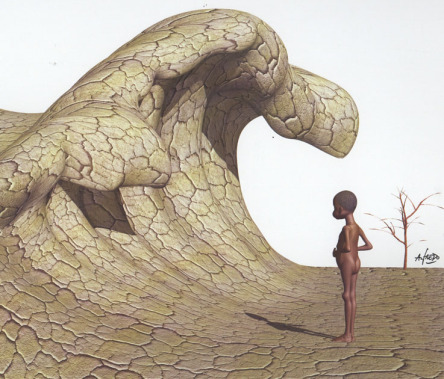
“Tsunami,” by Alberto Sabat, La Nacion in Argentina
This cartoon won the 2006 Ranan Lurie Award for editorial cartooning, an international competition supported by the United Nations Correspondents Association (other 2006 winners here). The title of the cartoon is “African Tsunami.”
The cartoonist is Alberto Sabat, the cartoon was published in La Nacion in Argentina. The award is named after the outstanding cartoonist Ranan Lurie, who himself was once nominated for a Nobel Peace Prize for his cartoons that promoted peace and understanding.
Political cartoons make classrooms interesting, and often provoke students to think hard and talk a lot about things they should be thinking and talking about. These links provide more sources of classroom material — please remember to note copyright information.
Tip of the old scrub brush to Reclaiming Space.
Update, December 2007: 2007 Lurie Awards announced; my post here, all the 2007 winners at the Lurie Awards site here.
Update, December 2008: 2008 awards post.
Update December 2009: 2009 awards listed here.
Share this post:


23 Comments | Africa, Cartoons, Drought, Geography - Economic, Geography - Political, History, hunger, Newspapers, Political cartoons, Poverty | Tagged: Africa, African Tsunami, Alberto Sabat, Cartoons, drought, hunger, Lurie Award, Newspapers, Political cartoons, Ranan Lurie | Permalink
Posted by Ed Darrell
Carl Sagan
December 22, 2006I’m a day behind — but, that just makes it more like real history, no?

Carl Sagan and the Mars “Viking” Lander, NASA/JPL photo
Yesterday was the tenth anniversary of Carl Sagan’s death. Several bloggers are blogging to commemorate his memory.
I’ll borrow wholesale; John Pieret at Thoughts in a Haystack pulled out a passage from Sagan’s book, Demon-Haunted World, that has rung true for me. Here it is:
Pieret wrote: For this passage (pp. 414-15), Sagan begins by discussing George Orwell’s 1984 and its roots in Stalinism:
Soon after Stalin took power, pictures of his rival Leon Trotsky — a monumental figure in the 1905 and 1917 revolutions–began to disappear. Heroic and wholly anhistoric paintings of Stalin and Lenin together directing the Bolshevik Revolution took their place, with Trotsky, the founder of the Red Army, nowhere in evidence. These images became icons of the state. You could see them in every office building, on outdoor advertising signs sometimes ten stories high, in museums, on postage stamps.
New generations grew up believing that was their history. Older generations began to feel that they remembered something of the sort, a kind of political false-memory syndrome. Those who made the accommodation between their real memories and what the leadership wished them to believe exercised what Orwell described as “doublethink.” Those who did,not, those old Bolsheviks who could recall the peripheral role of Stalin in the Revolution and the central role of Trotsky, were denounced as traitors or unreconstructed bourgeoisie or “Trotskyites” or “Trotsky-fascists,” and were imprisoned, tortured, made to confess their treason in public, and then executed. …
In our time, with total fabrication of realistic stills, motion pictures, and videotapes technologically within reach, with television in every home, and with critical thinking in decline, restructuring societal memories even without much attention from the secret police seems possible. What I’m imagining here is not that each of us has a budget of memories implanted in special therapeutic sessions by state-appointed psychiatrists, but rather that small numbers of people will have so much control over news stories, history books, and deeply affecting images as to work major changes in collective attitudes.
We saw a pale echo of what is now possible in 1990-1991, when Saddam Hussein, the autocrat of Iraq, made a sudden transition in the American consciousness from an obscure near-ally — granted commodities, high technology, weaponry, and even satellite intelligence data — to a slavering monster menacing the world. I am not myself an admirer of Mr. Hussein, but it was striking how quickly he could be brought from someone almost no American had heard of into the incarnation of evil. These days the apparatus for generating indignation is busy elsewhere. How confident are we that the power to drive and determine public opinion will always reside in responsible hands?
Good things for historians to ponder.
3 Comments | Bogus history, History, Science, Science and faith, Voodoo history | Permalink
Posted by Ed Darrell
“Yes, Virginia,” most famous editorial ever, Newseum says
December 21, 2006
Is this the man who really saved Santa Claus?
The Newseum itself doesn’t open until autumn of 2007, but some exhibits are already up, online.
Among other things already up is this explanation for the 1897 editorial in The New York Sun, with the famous line: “Yes, Virginia, there is a Santa Claus.” It is “history’s most reprinted editorial,” the Newseum says.
While you’re there, look at other exhibits already in place. This is a good source for kids’ reports and for teachers’ lectures.
Update: Parallel Divergence is at it again (remember the “how Hubble killed God?”) Here it is: “How Google Earth Killed Santa Claus.”
Update May 2007: Coverage of the Newseum’s pending opening.
1 Comment | First Amendment, Good Quotes, History, Newspapers | Permalink
Posted by Ed Darrell
Another test for bogus science and bogus history
December 21, 2006In a post I missed back then, science writer Chet Raymo sets a standard for how science can leave the “bogus” category: He says intelligent design can start to be called “science” when the first paper is published retracting another, previous paper, that was since found to be in error. Raymo wrote:
Here is my litmus test for science.
In the October 7 issue of Science, the weekly journal of the American Association for the Advancement of Science, Robin Allshire, of the prestigious Wellcome Trust Centre for Cell Biology at the University of Edinburgh, offers a retraction for a paper previously published in the journal, titled “Hairpin RNAs and retrotransponson LTRs effect RNAi and chromatin-based gene silencing.” He admits that his laboratory and others have been unable to reproduce the results reported in the paper.
When we see the first peer-reviewed experimental data supporting intelligent design or astrology that is reproducible in other laboratories by skeptics and believers alike, then these hypotheses can make a legitimate claim to being sciences.
When we see the first published retraction, we will know that intelligent design or astrology has reached maturity as a science.
Of course, the same is true for bogus history. Corrections made when error is found suggest that there is care for accuracy, and that the author has no great stake in the story other than getting the facts right to get the correct understanding.
I’ll have to revise the list, here, and here.
Tip of the old scrub brush to Catholic Sensibility.
Leave a Comment » | Accuracy, Bad Quotes, Bogus history, History, Hoaxes, Voodoo history | Permalink
Posted by Ed Darrell
A hard drive in 1956
December 21, 2006

1 Comment | History, Technology | Permalink
Posted by Ed Darrell
Student project sources: Influenza in Alaska
December 21, 2006This would be a good AP History project, or a cross-discipline project for history and biology.
The influenza pandemic of 1918 killed millions, between 20 million and 40 million people by good estimates — it is estimated that 16 million died in India, alone. Soldiers returning from Europe and World War I carried the plague to hundreds of towns and villages where it might not have gone otherwise. The flu was a particularly deadly one for some people, striking them dead within 24 hours of the onset of symptoms.
Public health issues are largely disregarded in most U.S. and world history texts. This story, of the 1918 flu pandemic, needs to be told and studied carefully, however, because of the danger that such a thing could occur again. Small villages and towns need to be ready to deal with the effects, to try to prevent further spread, and to handle the crisis that occurs when many people in a small community die.
Leave a Comment » | Capturing history, Creationism, Evolution, History, Influenza, Lesson plans, Public health, Science, Student projects, World War I | Permalink
Posted by Ed Darrell
More atomic history: Uranium tailings
December 20, 2006
Photo at left shows work to install a permeable reactive barrier (PRB) to help clean up contamination from arsenic, molybdenum, nitrate, vanadium and uranium wastes at an EPA Superfund Site managed by the U.S. Department of Energy near Monticello, Utah. The cleanup was done under the Comprehensive Environmental Response, Compensation and Liability Act (CERCLA), the law better known as Superfund. (DOE photo)
GOAT, the blog of High Country News, carried a short story that brought me nasty flashbacks.
Families in Monticello, Utah, wonder whether there is a connection between local clusters of leukemia the old, abandoned uranium works at the edge of town.
“Each depth had its own color. If the sun was just right, it was really pretty.” That’s how Steve Pehrson described the ponds he and his friends swam in as kids, as told to the Grand Junction Daily Sentinel. He and other Monticello, Utah, kids commonly cooled off in the tailings ponds at the uranium mill that sat on the edge of town. The kids also dug into the tailings piles, and the tailings were used in gardens and even sandboxes. Now, people in Monticello are looking into the link between these habits and cases of leukemia and other diseases that have cropped up amongst the citizenry.
If you follow that link to the Grand Junction (Colorado) Daily Sentinel, you find more stories, and more horrifying stories. Read the rest of this entry »
Leave a Comment » | Accuracy, Atomic Bomb, Boy Scouts of America, Cold War, Current History, Environmental protection, History, Public health, Science | Permalink
Posted by Ed Darrell
Finn of Fordham: Read the commission report
December 16, 2006I’m a bit surprised. Chester Finn, president of the Fordham Foundation, recommends we read and take seriously the recommendations of the New Commission on Skills of the American Workforce. I had thought he’d be a lot more skeptical a lot earlier.
Which means a couple of things: One, we ought to read and take seriously the report, as Finn urges; two, Finn continues to think originally about problems of education, and can’t be pigeon-holed into positions that he personally finds difficult to defend on the evidence, or into positions that others “think” he ought to have.
Leave a Comment » | Books, Curricula, Education, Education blogs, Education reform, Education spending, History, Teacher Pay, Teaching | Permalink
Posted by Ed Darrell




