Oklahoma statehood, November 16, 1907; Oklahomans fly your flags today

November 16, 2016

U.S. Flag Code urges citizens of states to fly the U.S. flag on the anniversary of statehood.

President Theodore Roosevelt signed the Oklahoma statehood proclamation on November 16, 1907. Oklahoma became the 46th state, with New Mexico and Arizona to come later to fill out the contiguous 48 states.

Mike Wimmer's 2003 painting of President Theodore Roosevelt's signing of the proclamation that made Oklahoma a member of the union. Oklahoma Arts Council image.

Mike Wimmer’s 2003 painting of President Theodore Roosevelt’s signing of the proclamation that made Oklahoma a member of the union. Oklahoma Arts Council image.

Oklahoma’s pre-history is long, complex and fascinating; the road to statehood is similarly complex and winding, lined with broken promises to Native Americans, tragedy and other drama. Does the state require Oklahoma history be taught in public schools?

Fly your flags today, Sooners!

More: 

Front page of the Daily Oklahoman on November 16, 1907, anticipating President Roosevelt's proclamation to come that morning. Daily Oklahoman image.

Front page of the Daily Oklahoman on November 16, 1907, anticipating President Roosevelt’s proclamation to come that morning. Daily Oklahoman image.


From Jeff R. Bridgman Antiques: 46 star American national flag, made in the period between 1907 and 1912, in small and desirable scale. The 46th state, Oklahoma, joined the Union on November 16th, 1907, during Teddy Roosevelt’s presidency. Roosevelt had many friends in the Oklahoma Territory from his Rough Rider days, and pushed it through to statehood. The 46 star flag became official on July 4th, 1908 and remained so until July 3rd, 1912. Many 46 star flags were made earlier, however, in great anticipation of the future addition of the state, which had previously been appointed to Native Americans.

From Jeff R. Bridgman Antiques: 46 star American national flag, made in the period between 1907 and 1912, in small and desirable scale. The 46th state, Oklahoma, joined the Union on November 16th, 1907, during Teddy Roosevelt’s presidency. Roosevelt had many friends in the Oklahoma Territory from his Rough Rider days, and pushed it through to statehood. The 46 star flag became official on July 4th, 1908 and remained so until July 3rd, 1912. Many 46 star flags were made earlier, however, in great anticipation of the future addition of the state, which had previously been appointed to Native Americans.

Save

Save

Save

Save


On November 14, 1960, Ruby Bridges went to school

November 14, 2016

American Experience reminds us:

On November 14, 1960, 6-year-old Ruby Bridges walked into William J. Frantz Elementary School in New Orleans.

This is an encore post I put up then, happy to have an excuse to repeat historic photos, great art from a great American painter, Norman Rockwell, and remind students of history.

This came on Twitter, back in 2014:

You don’t recognize her there?

How about in Norman Rockwell’s illustration?

The Problem We All Live With,” Norman Rockwell, 1964; oil on canvas, Norman Rockwell Museum, Stockbridge, Massachusetts

Ruby Bridges with President Barack Obama, in 2011:

President Obama and Ruby Bridges viewing Normal Rockwall's painting, "The Problem We All Live With," at the White House in 2011. Photo by Pete Souza, public domain.

President Obama and Ruby Bridges viewing Normal Rockwall’s painting, “The Problem We All Live With,” at the White House in 2011. Photo by Pete Souza, public domain.

Ms. Bridges tells some of her story:

Yes, this is mostly an encore post. Fighting ignorance requires patience.

Yes, this is mostly an encore post. Fighting ignorance requires patience.


President Obama’s Veterans Day Proclamation, 2016

November 11, 2016

A message written by First Lady is seen on a U.S. Marine Corps flag at Walter Reed National Military Medical Center in Bethesda, Md., April 4, 2012.

A message written by First Lady is seen on a U.S. Marine Corps flag at Walter Reed National Military Medical Center in Bethesda, Md., April 4, 2012. From a White House blog post, “5 Ways You Can Thank a Veteran.”

Fly your U.S. flags today for Veterans Day.

From the office of the Press Secretary of the White House:

The White House
Office of the Press Secretary
For Immediate Release, November 08, 2016

Presidential Proclamation — Veterans Day, 2016

VETERANS DAY, 2016

BY THE PRESIDENT OF THE UNITED STATES OF AMERICA

A PROCLAMATION

America has long stood as a beacon of hope and opportunity, and few embody that spirit here at home and beyond our borders more than the members of our Armed Forces. Soldiers, Sailors, Airmen, Marines, and Coast Guardsmen are part of an unbroken chain of brave patriots who have served our country with honor and made tremendous sacrifices so that we may live free. On Veterans Day, we salute the women and men who have proudly worn the uniform of the United States of America and the families who have served alongside them, and we affirm our sacred duty as citizens to express our enduring gratitude, both in words and in actions, for their service.

Our country has the best-trained and best-equipped military force in the world, and we need to make sure we have the most supported and respected veterans in the world. We are a Nation that leaves no one behind, and my Administration has made historic investments to provide veterans access to the resources and education they need to share in our Nation’s promise when they return home. Partnering with community leaders across America, First Lady Michelle Obama and Dr. Jill Biden’s Joining Forces initiative works to ensure our country’s heroes can thrive by combatting veteran homelessness, promoting their emotional well-being, and advancing employment training and placement — and we have made great progress. Today, the unemployment rate for veterans is lower than the national average, and veteran homelessness has been nearly cut in half since 2010. We also recognize that some of these courageous men and women have faced and overcome profound challenges, both physically and emotionally, in defense of our freedom. We must continue to provide high quality health care to our veterans and make sure they have the support they have earned and deserve.

The example our Nation’s veterans set throughout their lives is a testament to the drive and perseverance that define the American character. Let us uphold our obligations to these heroic individuals and never forget those who paid the ultimate price for our liberty. On this day and throughout the year, may we sustain their lasting contributions to our Nation’s progress and carry forward their legacy by building a future that is stronger, safer, and freer for all.

With respect for, and in recognition of, the contributions our service members have made to the cause of peace and freedom around the world, the Congress has provided (5 U.S.C. 6103(a)) that November 11 of each year shall be set aside as a legal public holiday to honor our Nation’s veterans.

NOW, THEREFORE, I, BARACK OBAMA, President of the United States of America, do hereby proclaim November 11, 2016, as Veterans Day. I encourage all Americans to recognize the valor and sacrifice of our veterans through appropriate public ceremonies and private prayers, and by observing 2 minutes of silence for our Nation’s veterans. I call upon Federal, State, and local officials to display the flag of the United States and to participate in patriotic activities in their communities. I call on all Americans, including civic and fraternal organizations, places of worship, schools, and communities to support this day with commemorative expressions and programs.

IN WITNESS WHEREOF, I have hereunto set my hand this eighth day of November, in the year of our Lord two thousand sixteen, and of the Independence of the United States of America the two hundred and forty-first.

BARACK OBAMA

First Lady Michelle Obama, in support of the Joining Forces initiative, greets members of the military following remarks at Al Udeid Air Base in Qatar, Nov. 3, 2015. (Official White House Photo by Amanda Lucidon)

First Lady Michelle Obama, in support of the Joining Forces initiative, greets members of the military following remarks at Al Udeid Air Base in Qatar, Nov. 3, 2015. (Official White House Photo by Amanda Lucidon)

Save

Save

Save


What can we learn from election-day art?

November 8, 2016

Interesting contrasts, at least.

I love the “County Election” painting of George Caleb Bingham, showing an election in 1852, the year incumbent President Millard Fillmore could not get even the nomination of his party. I love the tension of Norman Rockwell’s painting of the 1944 election in Cedar Rapids, Iowa, with tensions we see only in retrospect. (That post also shows real tensions in a family, in the election of 1948, in another Rockwell painting).

What else does the world of art show about elections in America? What do you think?

Illustration from Harper's Weekly, showing election persuasion at the polls. Library of Congress collection

Illustration from Harper’s Weekly, November 7, 1857, showing election persuasion at the polls – politicians trying to buy votes. Library of Congress collection

If bribery didn’t work, there was always plain old fisticuffs.

Fighting at the polls. Illustration from Harper's Weekly, November 7, 1857. Library of Congress collections

Fighting at the polls. Illustration from Harper’s Weekly, November 7, 1857. Library of Congress collections

Here’s an unusual ritual, portrayed about the 1892 contest between William Henry Harrison and Grover Cleveland. Did this really happen? Did the loser pull the winner on a cart through the city?

“Lost Bet,” by John Klir, Library of Congress. Pearson’s education materials say this was common in the 19th century.

Louis Dalrymple noted a twist on the tradition four years later.

Puck Magazine, November 11, 1896.

Puck Magazine, November 11, 1896. “Print shows a bloated businessman holding an American flag labeled ‘Victory,’ riding in a wheelbarrow being pushed by another man; in the background, a young boy is telling a stranger that his Dad had a bet with the other man regarding the outcome of the presidential election. The stranger is uncertain who lost the bet.” Drawing by Louis Dalrymple for Puck. Library of Congress collections

Not sure how long that tradition of the loser pushing or pulling the winner hung on, but by 1904 election night was an occasion to walk about, socialize, and watch fireworks, if this print from the William Randolph Hearst organization is accurate. Teddy Roosevelt won the presidency on his own that year.

“Election night illumination at the Flatiron Building [New York City].” New York Sunday American & Journal, a Hearst newspaper. Library of Congress collections

“Politics in the Oyster House,” 1848 by Richard Caton Woodville. Image found at Wikiwand

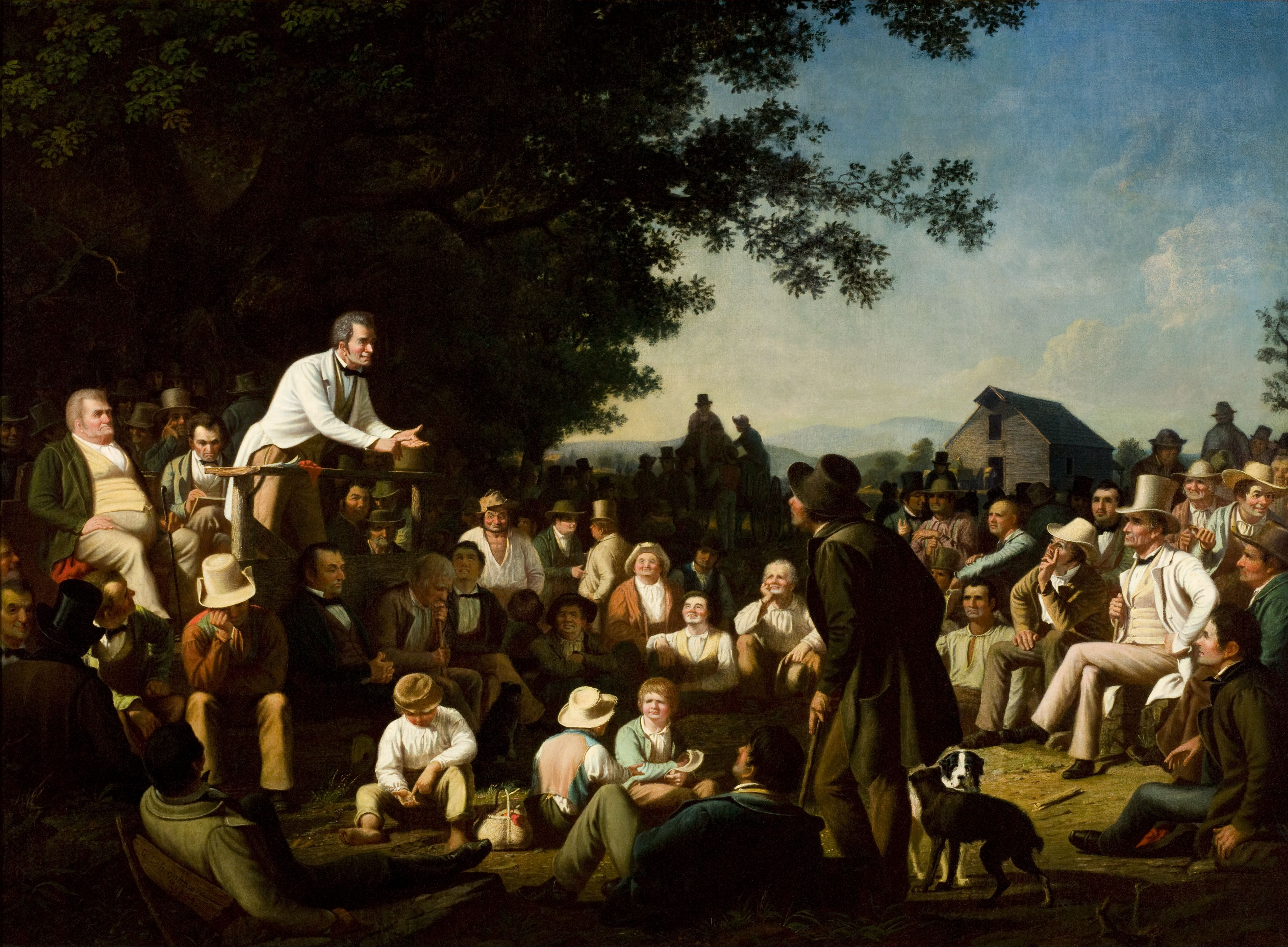
George Caleb Bingham's

George Caleb Bingham’s “Stump Speaking,” 1853-54. Image from Wikiwand

Not all election work involves a crowd.

George Caleb Bingham,

George Caleb Bingham, “Canvassing the Vote”

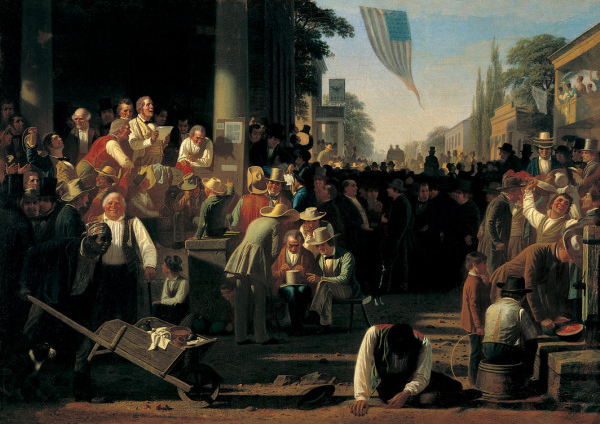
George Caleb Bingham,

George Caleb Bingham, “The Verdict of the People,” 1854-55. Wikiwand image

This looks more like the campaign party of a victorious candidate in the late 20th and early 21st centuries, though I’m not really sure this tradition survived much past the 2000 election.

John Sloan,

John Sloan, “Election Night,” 1907, an image from a New York drinking establishment. Collection of the Memorial Art Gallery of the University of Rochester.

Janie Price’s Evolution of American Painting said:

Here is the scene of Election Night written in Sloan’s Journal:

“Took a walk in the afternoon and saw boys in droves, foraging for fuel for their election fires this evening. . . . after dinner . . . out again and saw the noisy trumpet blowers, confetti throwers and the “ticklers” in use—a small feather duster on a stick which is pushed in the face of each girl by the men, and in the face of men by the girls. A good humorous crowd, so dense in places that it is impossible to control one’s movement.” (John French Sloan)

Women voted for the first time nationwide in 1920, after the ratification of the 19th Amendment. J. F. Kernan’s painting for The Country Gentleman magazine in 1922 shows some of the tensions that remained after the national amendment.

J. F. Kernan in Country Gentleman magazine, November 4, 1922

J. F. Kernan in Country Gentleman magazine, November 4, 1922. Wikimedia image

Rockwall made great use of his time and photographs in Cedar Rapids. In addition to the painting there, he used the setting for his famous “Undecided,” which became the cover of the Saturday Evening Post. 1944 was the last time prior to 2016 that both major candidates came from New York.

“Undecided,” Norman Rockwell, 1944. Copyright Curtis Publications

One might wonder if Rockwell considered himself undecided, when one sees this “son” of the painting, from 1960, featuring Rockwell in the same voting booth.

“Norman Rockwell at the Voting Booth” painted in 1960, based on his 1944 studies in Cedar Rapids, it seems to me. Image from The Easel

“Norman Rockwell at the Voting Booth” painted in 1960, based on his 1944 studies in Cedar Rapids, it seems to me. Image from The Easel

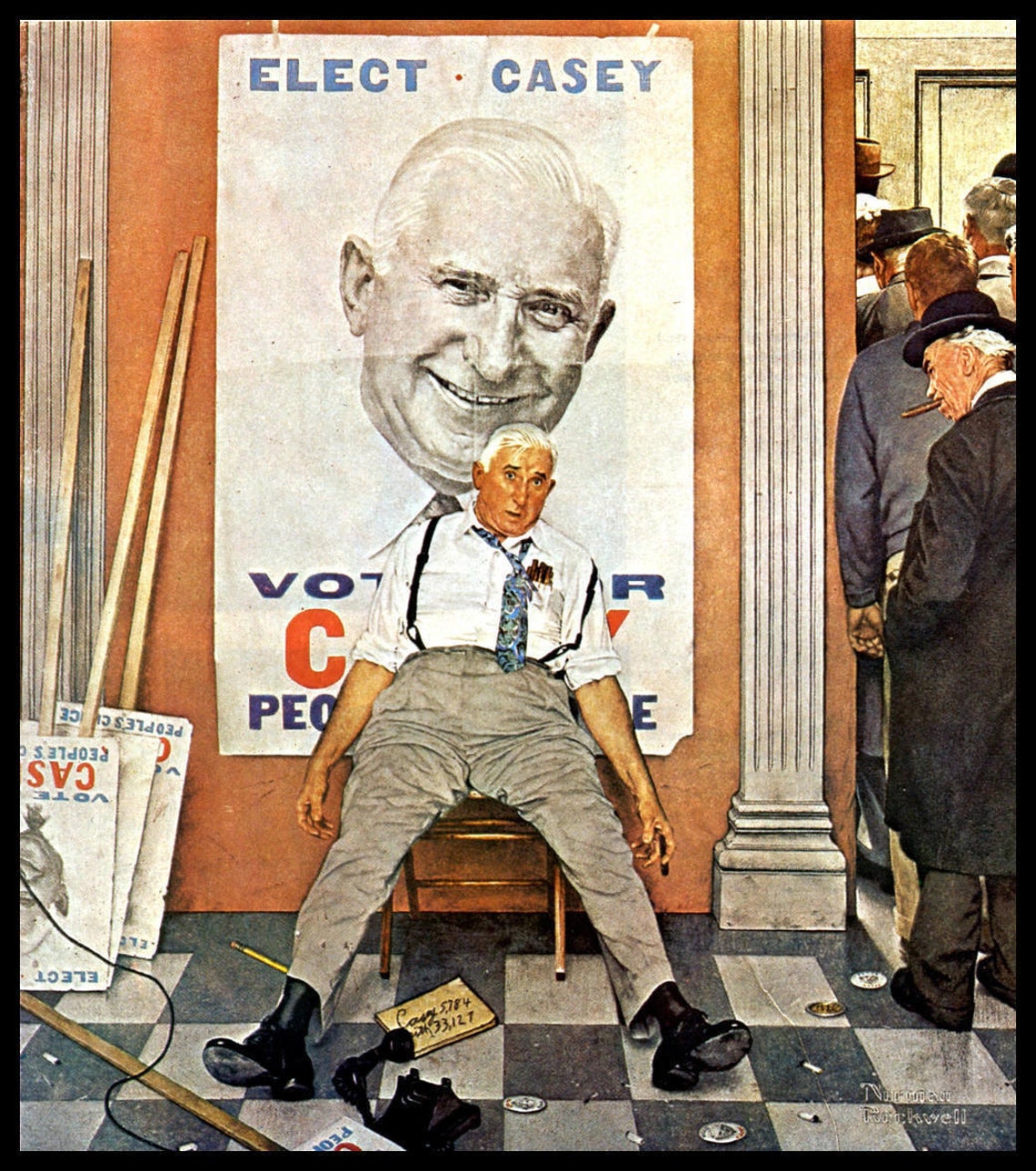
One last Rockwell to close out, one of my favorites, showing the happy candidate Casey, after having gotten the news that the voters were not so happy with him.

Norman Rockwall,

Norman Rockwall, “Elect Casey,” or “Before and After,” November 1958 for the Saturday Evening Post.

Legendary election jokester Dick Tuck once ran for the state legislature in California, on the slogan, “The job needs Tuck, and Tuck needs the job.” He lost, and he said what I can imagine the fictional Casey saying, “The people have spoken. The bastards!”

What are your favorite election day images? What are your memories of elections past?


2016: Election day art of Norman Rockwell, and unpredictability of elections

November 8, 2016

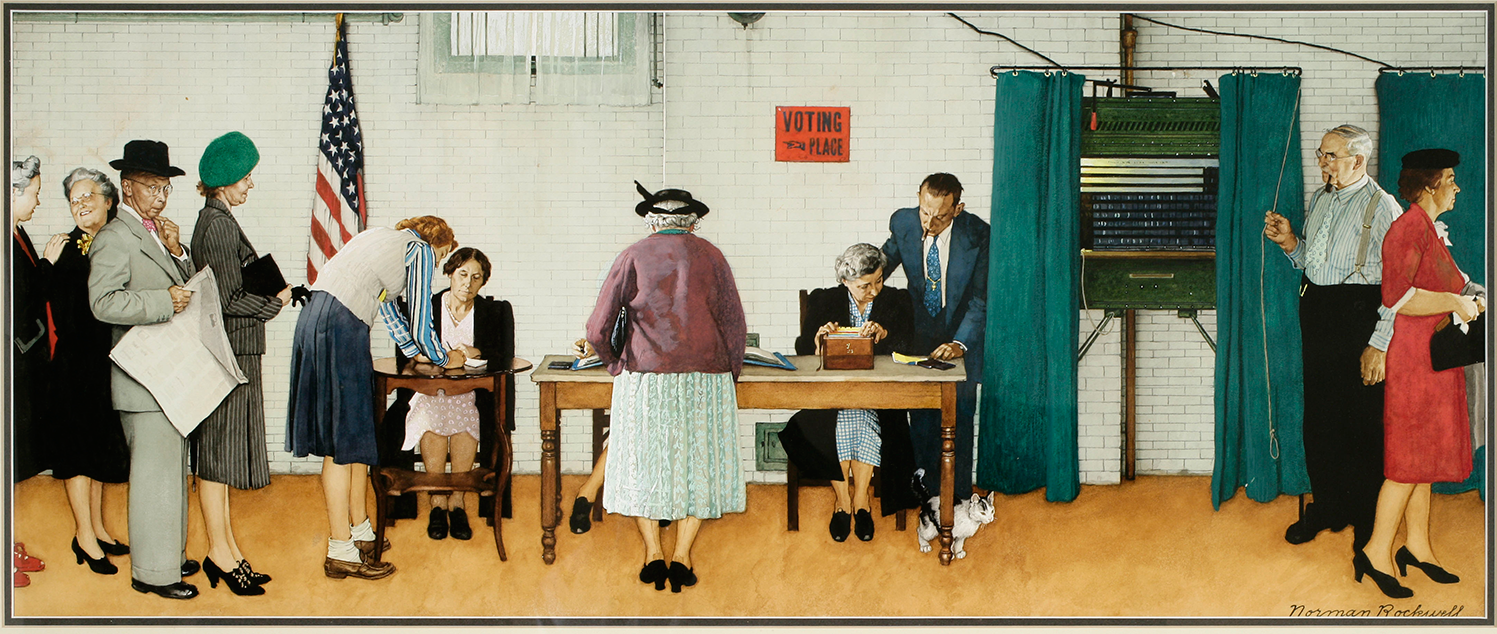
Especially in 2016, I think of this great, undersung painting by Normal Rockwell, “Election Day (1944)”:

Norman Rockwell, Election Day, 1944, watercolor and gouache, 14 x 33 1/2 in., Museum purchase, Save-the-Art fund, 2007.037.1.

Norman Rockwell, Election Day, 1944, watercolor and gouache, 14 x 33 1/2 in., Museum purchase, Save-the-Art fund, 2007.037.1.

Remember when people used to dress up to go to the polls?

In 1944 President Franklin Roosevelt ran for an unprecedented fourth term.  Most Americans did not know it, but he was deathly ill at the time.  He dropped Vice President Henry Wallace from his ticket — some argue it was a mutual disaffection at that time — and selected the relatively unknown young Missouri U.S. Sen. Harry S Truman for the vice president’s slot.

In November 1944, D-Day was known to be a successful invasion, and most Americans hoped for a relatively speedy end to World War II in both Europe and the Pacific.  Within the next ten months, the nation would endure the last, futile, desperate and deadly gasp of the Third Reich in the Battle of the Bulge, the liberation of Berlin in April 1945, and end of the war in the European Theatre on May 8; the Battle of Leyte Gulf, the Philippines Campaign, and the bloody, crippling battles of Iwo Jima and Okinawa in the Pacific Theatre, and then the first use of atomic weapons in war, at Hiroshima and Nagasaki (and we hope, the last use).

Voters in Cedar Rapids could not have known that.  They did not know that, regardless their vote for FDR or his Republican challenger, New York Gov. Thomas Dewey, Harry S Truman would be president within six months, nor that the entire world would change in August 1945.

This painting captures a time of spectacular moment, great naivity, and it pictures the way history got made.

For a 2007 exhibition, the Cedar Rapids Museum of Art offered this history:

Norman Rockwell: Fact & Fiction

September 12, 2009 – January 3, 2010

In 2007, the citizens of Cedar Rapids rallied together to purchase a series of watercolors destined for the auction block in New York. These five watercolors, by acclaimed 20th century American artist Norman Rockwell, depicted scenes associated with an election day and were created specifically for the November 4, 1944 issue of the Saturday Evening Post. To complete the Post commission, Rockwell traveled to a quintessential Midwestern town, Cedar Rapids, to study local citizens as models for his series of images.

In the 65 years since his visit, numerous anecdotes and stories have arisen about the artist’s time in Cedar Rapids and the creation of this work. This exhibition uses these five, newly conserved and restored watercolors and a related oil painting from the Norman Rockwell Museum, along with numerous photographs taken by local photographer Wes Panek for Rockwell, to investigate the many facts and fictions associated with Rockwell’s visit and this set of watercolors.

Norman Rockwell: Fact & Fiction has been made possible in part by Rockwell Collins, Candace Wong, and local “Friends of Norman Rockwell.” General exhibition and educational support has been provided by The Momentum Fund of the Greater Cedar Rapids Community Foundation.

Friends of Norman Rockwell: Wilma E. Shadle, Howard and Mary Ann Kucera, Jean Imoehl, Ben and Katie Blackstock, Marilyn Sippy, Chuck and Mary Ann Peters, Phyllis Barber, Ann Pickford, Anthony and Jo Satariano, Barbara A. Bloomhall, Virginia C. Rystrom, Jeff and Glenda Dixon, Robert F. & Janis L. Kazimour Charitable Lead Annuity Trust, Fred and Mary Horn, Mrs. Edna Lingo, John and Diana Robeson, Jewel M. Plumb, Carolyn Pigott Rosberg, Mr. and Mrs. Robert J. Buchacek, Dan and Anne Pelc, Mary Brunkhorst, and John and Diana Robeson.

I am amused and intrigued that this scene also closely resembles the scene when I voted in Cheverly, Maryland, in 1984 — down to the dog in the picture.  Oh, and most of the women didn’t wear dresses, none wore hats, and I was the only guy in the room with a tie.

Roosevelt won the 1944 election in an electoral college landslide, 432 to 99, but Dewey won Iowa, and we might assume Dewey won Cedar Rapids, too.

And that Truman guy?  Rockwell came back to the topic of elections four years later, when Truman was running for election to the office he’d filled for nearly four years, with another classic, American election portrayal.

“Election Day,” by Norman Rockwell, 1948

More:

This is an encore post.

Yes, this is an encore post. Defeating ignorance takes patience and perseverance.


Election Day 2016: Fly your flag, and VOTE!

November 8, 2016

Saint Louis Art Museum, St. Louis, Missouri George Caleb Bingham (American, 1811–1879). The County Election, 1852. Oil on canvas. 38 x 52 in. (96.5 x 132.1 cm). Gift of Bank of America.

The County Election, 1852. Saint Louis Art Museum, St. Louis, Missouri George Caleb Bingham (American, 1811–1879).  Oil on canvas. 38 x 52 in. (96.5 x 132.1 cm). Gift of Bank of America.

Every polling place should be flying the U.S. flag today.  You may fly yours, too.  In any case, if you have not voted already, go vote today as if our future depends upon it, as if our nation expects every voter to do her or his duty.

Today the nation and world listen to the most humble of citizens.  Speak up, at the ballot box.

Did you notice?  In George Caleb Bingham’s picture, there are no U.S. flags.  You should fly yours anyway.

The whole world is watching.

More:

This is an encore post.

Yes, this is an encore post. Defeating ignorance takes patience and perseverance. And I really like Bingham’s painting.


2016’s Dakota statehood days – fly your flags

November 2, 2016

North Dakota's commemorative quarter depicts the American bison, perhaps the quintessential prairie symbol.

North Dakota’s commemorative quarter depicts the American bison, perhaps the quintessential prairie symbol.

South Dakota's commemorative quarter interestingly focuses on human alterations to the area -- the carved presidential busts on Mt. Rushmore, wheat introduced by immigrant farmers, and the Chinese pheasant, an exotic species introduced for hunting.

South Dakota’s commemorative quarter interestingly focuses on human alterations to the area — the carved presidential busts on Mt. Rushmore, wheat introduced by immigrant farmers, and the Chinese pheasant, an exotic species introduced for hunting.

Residents of North Dakota and South Dakota should fly their U.S. flags today in honor of your states’ being admitted to the union, on November 2, 1889.

Most sites note simply that both states were admitted on the same day; some sites, especially those that lean toward North Dakota, claim that state is Number 39, because President Harrison signed their papers first, after shuffling to avoid playing favorites.

Does anyone really care?

How much do you really know about the Dakotas?

More:

Save


November 2016 dates to fly the flag

November 1, 2016

An election day in Philadelphia, 1815. Display of the national flag runs to the earliest days of the U.S. republic.

An election day in Philadelphia, 1815. Display of the national flag runs to the earliest days of the U.S. republic. “John Lewis Krimmel, ELECTION DAY AT THE STATE HOUSE, (1815). Courtesy the Historical Society of Pennsylvania”

Eight events spread over six different days come with urgings to fly the U.S. flag in November: Six states celebrate statehood, Veterans Day falls as always on November 11, and Thanksgiving Day on November 24.

Did I say eight? 2016 is a federal election year; we fly flags at polling places on election day, so that makes nine events — but election day falls on Montana’s statehood day, so it’s still just six days. You may fly your flag at home on election day, too.

Two states, North Dakota and South Dakota, celebrate their statehood on the same date. Washington’s statehood day falls on Veterans Day, November 11 — so there are only six days covering eight events.

In calendar order for 2015, these are the seven days:

  • North Dakota statehood day, November 2 (1889, 39th or 40th state)
  • South Dakota statehood day, November 2 (1889, 39th or 40th state) (shared with North Dakota)
  • Election day, November 8 (nationwide)
  • Montana statehood day, November 8 (1889, 41st state)
  • Veterans Day, November 11
  • Washington statehood day, November 11 (1889, 42nd state) (shared with Veterans Day)
  • Oklahoma statehood day, November 16 (1907, 46th state)
  • North Carolina statehood day, November 21 (1789, 12th state)
  • Thanksgiving Day, fourth Thursday in November (November 24 in 2016)

Most Americans will concern themselves only with Veterans Day and Thanksgiving Day. Is flying the U.S. flag for statehood day a dying tradition?

More:

Yes, this is mostly an encore post. Fighting ignorance requires patience.

Yes, this is mostly an encore post. Fighting ignorance requires patience.

Save

Save


October 31, we remember the sinking of the Reuben James

October 31, 2016

U.S.S. Reuben James (D-245) on the Hudson River in April 1939, over two years before she was sunk in the Battle of the Atlantic.

U.S.S. Reuben James (DD-245) on the Hudson River in April 1939, over two years before she was sunk in the Battle of the Atlantic. Photo from the Ted Stone Collection, Marines Museum, Newport News, Virginia, via Wikipedia

It was a tragedy in 1941, but before the U.S. could develop a serious policy response to Germany’s action, Japan attacked Pearl Harbor.  Within a week after that, our policy towards Germany was set by Germany’s declaration of war on the U.S.

It’s important history for a couple of reasons.

  • The sinking was part of the massive, years-long Battle of the Atlantic, which the Allies won only by building ships faster than Germany could sink them.  Had the Allies lost this battle, the war would have been lost, too.
  • While the USS Reuben James was a Navy destroyer, the key weapons of the Battle of the Atlantic were Merchant Marine cargo ships, carrying goods and arms to Britain and other Allied nations.  “Civilians” played a huge role in World War II, supplying the soldiers, armies, navies and air forces.
  • Recently, politicians took to making claims that the U.S. declared war on Germany without any hostile action having passed between them, without Germany having perpetrated any hostilities toward the U.S.  Look at the dates, it’s not so.
  • Woody Guthrie wrote a song about the event, giving us a touchstone to remember.

Millard Fillmore’s Bathtub covered the event with longer, detailed articles in past years, including these, which you should see especially if you are a student in a history class or a teacher of one:

Europe has changed. The world has changed.  The U.S. has changed.  War has changed.  We should remember, especially those people who died defending the merchants who defended the idea of the Four Freedoms.

Where did the ship get its name? From a Barbary War hero:

Reuben James was born in Delaware, Ohio about 1776. He joined the U.S. Navy and served on various ships, including the frigate USS CONSTELLATION. It was during the infamous Barbary Wars that the American frigate PHILADELPHIA was captured by the Barbary pirates. Having run aground in the pirate capital of Tripoli on the southern shores of the Mediterranean Sea, the crew had to abandon ship and formulate a plan of attack. Lieutenant Stephen Decatur, along with a group of volunteers which included Boatswain’s Mate Reuben James, entered Tripoli harbor under the cover of darkness in an attempt to set the PHILADELPHIA to the torch so that the pirates could not make use of her.

The American volunteers boarded the PHILADELPHIA on 16 February 1804 and were met by a group of the savage Barbary pirates who were guarding their prize. A furious battle ensued, and during the bloody chaos of hand-to-hand combat, a villanous pirate made ready to end the life of Lieutenant Decatur. Reuben James, with both of his hands already wounded, in an act of selfless dedication and courage did throw his hand before the pirate’s cleaving blade! Willing to give his life in defense of his captain, Reuben James took the blow from the sword!

Having proved to the world over the courage and dedication of United States Sailors, Reuben James also hammered home the fact that US Sailors are undefeatable by not only surviving, but recovering from his wounds and continuing his career in the U.S. Navy! After spending many more years with Decatur, James was forced to retire in January 1836 because of declining health brought on because of past wounds. He died on 3 December 1838 at the U.S. Naval Hospital in Washington, D.C.

More:

Yes, this is mostly an encore post. Fighting ignorance requires patience.

Yes, this is mostly an encore post. Fighting ignorance requires patience.


George H. W. Bush’s letter to Bill Clinton reminds us what we have lost

October 28, 2016

Do they make Republicans so patriotic and thoughtful any more?

1992’s election was unnecessarily nasty, I thought. Incumbent George H. W. Bush had fallen from record approval ratings after Gulf War I, due to economic problems. GOP campaigning targeted Bill Clinton’s failings in personal life, and imaginary policies — much of what were real issues were ignored, I thought.

Transition was relatively smooth. GOP continued the tactic’s they’d adopted in 1977 against Jimmy Carter, constant harping on small issues, some refusal to cooperate.

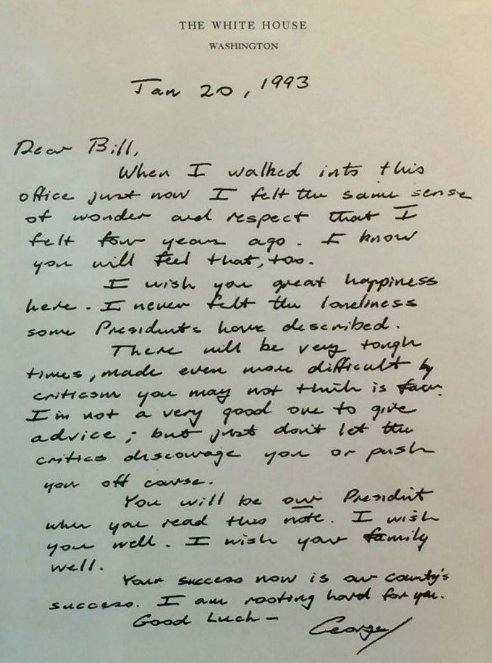
George H. W. Bush is always gracious. In his last hours in office, he penned a personal letter to the man who had defeated him, Bill Clinton. He left the letter on the President’s Desk in the Oval Office, one of the first things Clinton would see after the ceremonies, and as the weight of his new job began dragging him into reality.

Bush’s grace, then, shines now as an example of a lost time, when despite deep divisions, Washington politicians understood the nation needed to run, and were willing to compromise to make the laws and appointments necessary to help America.

Bush wrote:

Letter from President George H. W. Bush to President Bill Clinton, January 20, 1993. Image via NBC News.

Letter from President George H. W. Bush to President Bill Clinton, January 20, 1993. Image via NBC News.

Bush wrote to Clinton:

You will be our president when you read this note. I wish you well. I wish your family well.

Your success is now our country’s success. I am rooting for you. Good Luck.

Are there any such Republicans left in the party? Does anyone make Republicans like that now?

We need that grace, and resolve to make America a better and happier place, back again. Send a thank-you letter to someone you know today.

More:

Save

Save


Fly your flag for Navy Day, October 27, 2016

October 26, 2016

A reminder to fly your U.S. flags tomorrow in honor of the U.S. Navy.

We celebrate Navy Day each year on October 27, one of the score of dates designated in the U.S. Flag Code to fly Old Glory.

Navy Day may be eclipsed by Armed Forces Day, Memorial Day and Veterans Day in modern life, but it’s still in the law and the Navy still notes it.

So should we.

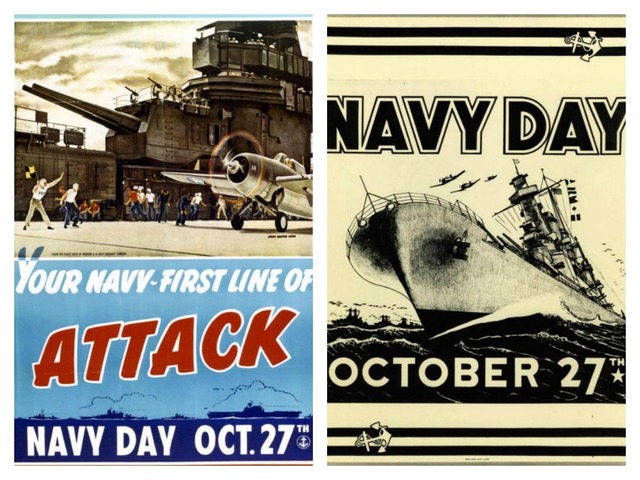
You get an idea of the celebrations from some of the old Navy Day posters. (If you can put a year on posters undesignated, please tell us in comments; if you know of a poster not shown here, please give a link in comments.)

Navy Day poster, after World War I

Navy Day poster, after World War I


This may have been used as a Navy Day poster after the death of Theodore Roosevelt, a former, popular Secretary of the Navy. Crasch McDuff blog

This may have been used as a Navy Day poster after the death of Theodore Roosevelt, a former, popular Secretary of the Navy. Crash MacDuff blog


Navy Day poster, post World War I, pre-World War II

Navy Day poster, post World War I, pre-World War II

Navy Day poster, 1931; Crash MacDuff blog

Navy Day poster, 1931; Crash MacDuff blog


Navy Day poster, early 1940s

Navy Day poster, early 1940s, featuring the battleship USS New Jersey.
Illustration by Matt Murphey


Navy Day poster, 1940s

Navy Day poster, 1940s


Two more 1940s Navy Day posters

Two more 1940s Navy Day posters


Navy Day poster, 1944

Navy Day poster, 1944


Billboard showing art similar to the poster, Navy Day 1944

Billboard showing art similar to the poster, Navy Day 1944. History 101 image


Navy Day Poster, 1945

Navy Day Poster, 1945


Navy Day Poster from after World War II (?)

Navy Day Poster from after World War II (?)


Navy Day poster, 1947, Crash MacDuff blog

Navy Day poster, 1947, Crash MacDuff blog. “Issued September 1947. Courtesy of the Naval Historical Foundation. NHHC Photograph Collection, NH 78860.”


Navy Day poster, 1940s, perhaps. From an eBay listing

Navy Day poster, 1940s, perhaps. From an eBay listing


Barack Obama: “Every vote matters.” Especially yours

October 21, 2016

You may have seen this one before. It probably came with a note you may want to have tissues handy. Good advice.

Better advice: Vote!

At I Agree to See, Andrew Cullen wrote:

The ad, “Progress is on the Ballot” is a two-minute mini-documentary of the Obama years. We hear the president sum up his administration nicely: “We know the progress we’ve made despite the forces of opposition,” he says in the ad – a not-so subtle dig to Republicans in Congress. “Despite the forces of discrimination, despite the politics of backlash. That doesn’t stop with my presidency. We’re just getting started.”

The ad ends with a shot of Clinton and Obama walking on stage together.
At the last White House Correspondents dinner, President Obama was introduced to Anna Kendrick’s song “You’re Going to Miss Me When I’m Gone.”

That seems about right.

president barack obama hillary clinton we miss obama progress is on the ballot barack obama

President Barack Obama in the Oval Office of the White House.


October 2016 dates to fly U.S. colors

October 4, 2016

Roosevelt look-alike Pietro Casini, an Italian merchant. Casini stands outside his Magazzino Roosevelt shop in Florence, Italy, holding a U.S. flag and a photo of Roosevelt. Oct. 26, 1915. George Grantham Bain Collection, Library of Congress Prints and Photographs Division. via Pinterest

Roosevelt look-alike Pietro Casini, an Italian merchant. Casini stands outside his Magazzino Roosevelt shop in Florence, Italy, holding a U.S. flag and a photo of Roosevelt. Oct. 26, 1915. George Grantham Bain Collection, Library of Congress Prints and Photographs Division. via Pinterest

October is not a big month for dates to fly the U.S. flag.  Only one state joined the union in October, and only two other dates have merited Congress’s designation for flag-flying.

Here are October’s three flag-flying days, in chronological order:

  • Columbus Day, October 12 —  tradition puts Columbus Day on October 12, but in law it is designated as the second Monday in October (to make a three-day weekend for workers who get a holiday); in 2016, October 10 is the second Monday of the month.
  • Navy Day, October 27
  • Nevada Statehood Day, October 31; Nevada joined the union during the Civil War, in 1864, the 36th state.

Federal law also designates October 9 as Leif Erickson Day, a concession to Scandanavian-descended Americans who argue Erickson beat Columbus to the Americas by a few hundred years. Congress’s recognition does not include an urging to fly the flag, though the President may issue such a proclamation.

Other notable stuff:

More:

Save

Save

Save


Random thoughts, and Twitter, on National Coffee Day

September 29, 2016

Found at Your Lighter Side Blog, 2014.

Found at Your Lighter Side Blog, 2014.

It’s a commercial and wag-created day of note, National Coffee Day. It’s not declared by Congress in a memorial resolution, nor honored by the President with a proclamation.

Doesn’t mean we can’t have fun

September 29 is National Coffee Day, or in many corners of the internet, #NationalCoffeeDay.

A few Twitterized thoughts.

Driving between Duncanville, Texas, and Appleton, Wisconsin, on one of those “visit the kid at college” trips, we encountered this truck. Despite its hopeful sign, it really carried gasoline, sort of a visual pun on coffee, I suppose.

http://twitter.com/EdDarrell/status/516619485487169537

We collect coffee mugs — not always consciously. They add up. There’s a story behind each mug pictured.

The nice oak racks were handcrafted by Kathryn’s father, Ken Knowles. Two of the racks hold 23 mugs, and a third holds 20. We also have a high shelf that holds the overflow mugs, including the seasonal favorites that get rotated in at appropriate times, like the Dracula and witch mugs for Halloween.

https://twitter.com/EdDarrell/status/781509749506396160

I used to be a tea guy. Off at college I didn’t take much pleasure in the cup o’ joe offered by the Huddle or Student Union at at the University of Utah (though I drank my share). Teas other than Lipton started showing up in small shops, Celestial Seasonings started up and took off. I had a variety of tea infusers, and cleaning the smaller tea paraphernalia was always easier than keeping up with a coffee pot or a Mr. Coffee with two years of rancid coffee oils built up on parts of the device.

Out in New York with the L. A. Jonas Foundation’s Camp Rising Sun (CRS), I ran into Greg Marley from Albuquerque (yeah, the irony), and we swapped methods and stories of brewing teas way out in the Southwestern deserts, where local “weeds” offered a variety of great things to supplement teas. They don’t call that plant “Mormon tea” without reason, you know? At CRS I often partook of Mama Glenn’s stout percolated brews, for the incredible caffeine jolts they offered. Mama Glenn always used sweetened condensed milk to lighten it, and if you tried it black, you understood why.

I’ve driven the length and width of the nation, had coffee over campfires, in diners and luxury hotels, in every state except Maine, North Dakota, Alaska and Hawaii. I’ve awakened to those tiny cups of dark, heavy Scandinavian brews in Denmark and Sweden; spent most of a week with English breakfast coffees and that infernal heated milk they lighten with. Tried some thick muds in Monterrey and Nogales, Mexico, and had pretty good cups from Vancouver to Toronto — coffee is almost always better in the mountains, by the way.

Tea still catches my fancy often, especially if I don’t want caffeine. But coffee is my drink of choice.

I was fortunate enough to get a trip to Seattle in the near-early days of the rise of the Northwest coffee culture that gave rise to Starbucks. In town for the Computer-Aided Manufacturing – International (CAM-I) convention (does the group still exist?), corporate consultant extraordinaire Roger Beynon and I sampled coffee all over town, and I knew things were looking up.

The successes of Peet’s, and the dramatic spread of Starbucks, put pressure on almost all commercial coffee sellers to step up their games. In most towns in America today, in most supermarkets, you can buy a very good cup of coffee or the beans and accoutrements to brew one on your own.

A couple of years ago son James and his wife Michelle took me to the weekly Friday fest in Louisville, Colorado. We had a grand night listening to the band, whose name I forget, and arguing with a couple of cheeky libertarians posing as the local Republican Party. On the way out, about 10:00 p.m. we stumbled on a woman brewing coffee in a Chemex drip, and giving out samples. What fortune!

The woman was Neige LaRue, proprieter of Snow Street Coffee, a roasting company. The coffee was an Ethiopian bean, Yirga Cheffe. It’s a medium roast, where I usually prefer a darker roast.

But that coffee! It was sweet, hot, aromatic, with only tasty hints of bitterness — struck me at the time as the best cup of coffee I’d ever had. Several pounds later, I think it still holds up, though Ms. LaRue can brew it better in her Chemex than I can in our Melitta (Kathryn’s brewing is better than mine, and I swear we do it exactly the same). In any case, I highly recommend it.

https://twitter.com/EdDarrell/status/781511607448854528

We may rankle at its corporateness, and its ubiquity, but Starbucks still does a good job of brewing a good cup. They’ve also changed how we think of coffee houses in America, and maybe around the world. I’m disappointed they don’t carry music CDs anymore. And I really wish they’d bring back that much maligned bit of putting controversial quotes on their cups. A hundred times I’ve wished I had a thousand of cup #289 in their “The Way I See It” series:

https://twitter.com/EdDarrell/status/516620496901644289


History in cartoons: Joseph Keppler on the need for the 17th Amendment

September 26, 2016

From the Historian of the U.S. Senate, a Joseph Keppler cartoon from Puck Magazine,

From the Historian of the U.S. Senate, a Joseph Keppler cartoon from Puck Magazine, “The Making of a Senator.” Print by J. Ottmann Lith. Co. after Joseph Keppler, Jr., Puck. Lithograph, colored, 1905-11-15. Image with text measurement Height: 18.50 inches (46.99 cm) Width: 11.50 inches (29.21 cm) Cat. no. 38.00624.001

This is a lithograph after a cartoon by Joseph Keppler in Puck Magazine, November 15, 1905. Keppler’s cartoons kept on the heat for some legislative solution to continuing corruption in state legislatures and the U.S. Senate, driven by the ability of large corporations and trusts to essentially purchase entire states’ legislatures, and tell legislators who to pick for the U.S. Senate.

Described by the Historian of the U.S. Senate:

The “people” were at the bottom of the pile when it came to electing U.S. senators, when Joseph Keppler, Jr.’s cartoon, “The Making of a Senator, ” appeared in Puck on November 15, 1905. Voters elected the state legislatures, which in turn elected senators. Keppler depicted two more tiers between state legislatures and senators: political bosses and corporate interests. Most notably, he drew John D. Rockefeller, Sr., head of the Standard Oil Corporation, perched on moneybags, on the left side of the “big interests. ”

This cartoon appeared while muckraking magazine writers such as Ida Tarbell and David Graham Phillips were accusing business of having corrupted American politics. The muckrakers charged senators with being financially beholden to the special interests. Reformers wanted the people to throw off the tiers between them and directly elect their senators–which was finally achieved with ratification of the 17th Amendment in 1913.

Recent scuttlebutt about repealing the 17th Amendment seems to me wholly unconnected from the history. The 17th Amendment targeted corruption in the Senate and states. It largely worked, breaking the course of money falling from rich people and large corporations into the hands of everyone but the people, and breaking the practice of corporate minions getting Senate seats, to do the bidding of corporations and trusts.

Anti-corruption work was part of the larger Progressive Agenda, which included making laws that benefited people, such as clean milk and food, pure drugs, and banking and railroad regulation so small farmers and businessmen could make a good living. Probably the single best symbol of the Progressive movement was “Fighting Bob” LaFollette, Congressman, Governor and U.S. Senator from Wisconsin. LaFollette was a great supporter of the 17th Amendment

Again from the Senate Historian:

Nicknamed “Fighting Bob,” La Follette continued to champion Progressive causes during a Senate career extending from 1906 until his death in 1925. He strongly supported the 17th Amendment, which provided for the direct election of senators, as well as domestic measures advocated by President Woodrow Wilson’s administration, including federal railroad regulation and laws protecting workers rights. La Follette worked to generate wider public accountability for the Senate. He advocated more frequent and better publicized roll call votes and the publication of information about campaign expenditures.

Criticism of the 17th Amendment runs aground when it analyzes the amendment by itself, without reference to the democracy- and transparency-increasing components from the rest of the Progressive movements’ legislative actions from 1890 to 1930.

No one favors corruption and damaging secrecy in politics. By pulling the 17th out of context, critics hope to persuade Americans to turn back the clock to more corrupt times.

More:

Save

Save

Save

Save

Save

Save

Save