100 years of Eagle Scouts

August 1, 2012

Today marks the 100th anniversary of the Eagle Scout rank, awarded first to Scout Arthur Eldred.  2.1 million Eagles so far.

Do you have an Eagle Scout in your family?  Tell us about it in comments.

Also:


Celebrate Social Security “birthday,” August 14, 2012 at FDR Library

August 1, 2012

Press release from the FDR Presidential Library and Home; some informational links added here:
FOR IMMEDIATE RELEASE
For press inquiries: Cliff Laube (845) 486-7745

FDR Presidential Library and Museum to host

2012 NATIONAL BIRTHDAY PARTY FOR SOCIAL SECURITY

August 14, 2012 at 11:00 a.m.
Henry A. Wallace Center at the FDR Presidential Library and Home

Reservations are required as seating is limited. For reservations call co-chair Stefan Lonce at (914) 629-4580.

HYDE PARK, NY — The Franklin D. Roosevelt Presidential Library and Museum will host a 2012 National Birthday Party for Social Security at 11:00 a.m. on Tuesday, August 14, 2012. Event co-chair Dr. Christopher Breiseth, Francis Perkins Center board member and former President and CEO of the Roosevelt Institute, will lead the festivities. The program will celebrate the 77th Anniversary of the signing of the Social Security Act by President Franklin D. Roosevelt with readings of the 1935 and 1983 social security signing statements, “A Promise to All Generations: Stories and Essays about Social Security and Frances Perkins” (co-edited by Dr. Breiseth), and “Driving with FDR: A Calendrical Biography.” The forthcoming book “Driving with FDR” is written by event co-chair Stefan Lonce, editor of The Montauk Sun newspaper.

Attendees will celebrate the occasion with refreshments — including two special birthday cakes — and free admission to the Roosevelt Library’s current special exhibition, “The Roosevelts: Public Figures, Private Lives,” the largest photography exhibit ever assembled on the lives and public careers of Franklin and Eleanor Roosevelt. This program will be held in the Henry A. Wallace Visitor and Education Center at the FDR Presidential Library and Home.

Reservations are required as seating is limited. For reservations call co-chair Stefan Lonce at (914) 629-4580.

The Franklin D. Roosevelt Presidential Library and Museum is dedicated to preserving historical material and providing innovative educational programs, community events, and public outreach. It is one of thirteen presidential libraries administered by the National Archives and Records Administration. For information about the FDR Presidential Library call (800) 337-8474 or visit www.fdrlibrary.marist.edu.

Historic Hyde Park is a group of government and private non-profit organizations based in Hyde Park, New York. Each has a unique mission, but all are united in their dedication to extending the legacy of Franklin and Eleanor Roosevelt to new generations. HHP includes the Franklin D. Roosevelt Presidential Library and Museum, the Home of Franklin D. Roosevelt National Historic Site, Eleanor Roosevelt National Historic Site, the Eleanor Roosevelt Center at Val-Kill, the Franklin and Eleanor Roosevelt Institute, and Vanderbilt Mansion National Historic Site. For more information about HHP visit www.HistoricHydePark.org.

# # #

Composite photo of people at FDR's signing of Social Security Act -- SSA image

From Social Security Administration: There were many photographs taken of the Social Security Act signing ceremony. The posing was different in many of the photographs and in no single photograph are all the participants visible. This composite photograph shows all of the participants in a single image. (See identification below)

People listed in the photograph, according to the Social Security Administration, “Who is who, and why they were there”:

1. Rep. Jere Cooper (D-TN). Cooper was a member of the House Ways and Means Committee and would go on in subsequent years to become something of an expert on Social Security topics and he was a major force in Social Security legislative developments during the 1940s to the mid-1950s. Mr. Cooper also rose to the position of Chairman of the Ways & Means Committee during the Eighty-fourth and Eighty-fifth Congresses.

2. Rep. Claude Fuller (D-AR). Fuller was a member of the Ways & Means Committee and was generally opposed to the Administration’s bill. During Committee consideration he made motions seeking to strike key provisions of the legislation. But when his efforts failed, he compromised with the Administration and joined in voting for passage of the bill.

3 . Rep. Robert Doughton (D-NC) was chairman of the House Ways and Means Committee. As such he was the principal official sponsor of the legislation in the House.

4. Rep. Frank Buck (D-CA) was a second-generation industrialist and fruit grower from California. He was a member of the House Ways & Means Committee, which had jurisdiction of the bill in the House. He graduated from Harvard Law School and served five terms in Congress, from 1933 until his death in 1942. (Representative Buck has often been misidentified in photos of the signing as being Edwin Witte. Witte, in fact, was not in the signing photographs.)

5. Rep. John Boehne, Jr.(D-IN) succeeded his father as a representative from Indiana. He was first swept into office in the 1932 elections with President Roosevelt and strongly supported FDR’s programs. At first, he was against the Social Security bill and wanted to exempt industrial employers with their own pension systems.

6 . Sen. Robert Wagner (D-NY) was born in Germany, immigrated to New York City, attended law school and was elected to the Senate in 1926. He served four terms. He was a close associate of Frances Perkins and helped draft several early New Deal measures. Wagner introduced the bill into the Senate. His son, Robert F. Wagner, was mayor of New York City for 16 years.

7 . Sen. Alben Barkley (D-KY) was a seven-term Congressman before being elected to the Senate in 1926. By 1937, he was Senate Majority Leader and a decade later, Vice President of the United States. He was an ardent New Dealer and helped shepherd the Social Security Act through the Senate. He argued for “a universal and uniform program in general.” He didn’t want to exempt certain private groups merely because they already had pension systems, as was proposed by some conservatives in the Congress.

8 . This individual is presently unknown.

9 . Sen. Robert LaFollette, Jr., (PROG-WI) was the eldest son of Robert LaFollette, a progressive Senator from Wisconsin and one-time presidential candidate. When his father died in 1925, Robert Jr., then only 30 years old, was appointed to succeed him. Initially elected as a Republican, LaFollette changed his party affiliation to the Progressive Party in 1934. LaFollette served on the House-Senate conference committee that drafted the final version of the Social Security bill. He served in the Senate until 1946, when he was defeated by Joseph McCarthy. In 1953, LaFollette committed suicide in Washington, D.C.

10 . Rep. John Dingell, Sr. (D-MI). Rep. Dingell was a member of the House Ways & Means Committee. He was a prominent leader in Congress in sponsoring social insurance legislation and teamed with Senator Wagner he authored a couple of important precursor bills to the Social Security Act. (Several authors have identified Dingell as “unidentified man” in some versions of the signing photo.)

11. Sen. Augustine Lonergan (D-CT) was a native of Connecticut and a graduate of Yale University. Although he was a four-term Congressman, he served only one term in the Senate. During the discussions on the Social Security bill, Lonergan gave information about various private insurance annuities to show how they compared to the social insurance program that was being proposed.

12 . Frances Perkins was appointed Secretary of Labor in 1933, making her the first woman to hold a cabinet-level position. Like FDR, she was a child of privilege, but became a strong advocate for the poor and working class. She began her career in New York City as a social worker and held several responsible State government jobs. She served as head of Roosevelt’s Committee on Economic Security, set up in 1934. The Social Security legislation sprang from this committee.

13. Rep. Frank Crowther (R-NY) was a Republican member of the House Ways & Means Committee;

14. Sen. William H. King (D-UT). King was a conservative Democrat and member of the Senate Finance Committee. King expressed persistent opposition to many features of the bill as it was being considered, and his support of the legislation was in doubt until the last possible minute. In the end, he voted for passage of the Social Security Act. (Senators King and Harrison have often been confused in the signing photos, including,we are embarrassed to admit, in SSA’s own OASIS magazine. Clue: King has a bowtie, Harrison has a regular long tie.)

15. Rep. David J. Lewis (D-MD) was a member of the House Ways & Means Committee and was probably the leading expert on social insurance legislation on the Committee. It was Lewis, a former coal miner and self-taught lawyer, who introduced the Social Security bill into the House on January 17, 1935. However, Chairman Doughton, exercising what he took to be the Chairman’s privileges, made a copy of Lewis’ bill and submitted it himself. Then he persuaded the House clerk to give him a lower number than Lewis’ copy. Newspapers then began calling the bill “The Wagner-Doughton bill.” When Lewis found out, he sputtered and swore, then went to work to understand every sentence and master the arguments in favor of the bill. And when David Lewis walked down the aisle of the House to debate on the bill’s behalf, he received a standing ovation–a subtle rebuke to Chairman Doughton’s high-handed treatment.

16 . Sen. Byron Patton “Pat” Harrison (D-MS) was a Congressman for 8 years before being elected to the Senate in 1918. In his book “The Development of the Social Security Act,” Edwin Witte gives Harrison credit for his “adroit” handling of the Social Security bill in the Senate Finance Committee. According to Witte, Title II would not have been approved by the Committee without Sen. Harrison’s help. Harrison went on to serve in the Senate for the rest of his life and was elected President pro tempore 6 months before his death in June 1941. (In other versions of the signing photo, Sen. Harrison can be more clearly seen wearing a white suit and tie and holding his trademark cigar.)

17. Sen. Joseph Guffey (D-PA) was 65 years old at the time the Social Security Act was passed, although he was only a first-term Senator. From Pennsylvania, he served two terms before being defeated in 1946. His vote on the Social Security bill was in doubt until the final roll call.

18. Senator Edward Costigan (D-CO), a member of the Finance Committee.

19. Rep. Samuel B. Hill (D-WA) was a member of the House Ways & Means Committee.

20. Rep. Fred Vinson (D-KY) was a member of the House Ways & Means Committee. He would go on to serve as Secretary of the Treasury and as a Justice and Chief Justice of the Supreme Court.

21 . President Franklin D. Roosevelt.

NOTE: For more biographical information on any of the members of Congress see the U. S. Senate Biographical Directory of the United States Congress on the Senate website

Astonishing to me that one person in the photograph remains unidentified.  Can you help identify the man?

More:


Desperate Republicans? Recycling four-year-old PhotoShop hoaxes . . .

July 31, 2012


This is an encore post, from August of 2008.  We need to recall, an issue early in the Democratic primaries was ‘who would you want on the Hotline at 2:00 a.m.’  Sometime before the end of the primaries, a jokester mashed up a photo of candidate Barack Obama, changed the line on the phone handpiece, and added a clock at 3:00 a.m. on the wall. 

Republicans picked up on the photo, and thinking it a real photo, shipped it around during the general campaign.  It was a hoax then, and it still is.  I found it today on Facebook, and found people defending the hoax photo as real.  Oy, it will be that kind of election as Republicans get more desperate and more crude.  The encore post:

Dennis at Thinking in a Marrow Bone — not an Obama supporter, mind you — posted a conversation he had with a guy who posted a hoaxed photo of Barack Obama, purporting to show him holding a landline telephone upside down.

This is the hoax photo

The real photograph. Notice there is no clock on the wall, and the phone works properly. By the way, the suit fits, too — Obama’s a very tall man, and that’s what a well-fitting suit looks like on a tall man sitting in a low chair.


Dennis called him on the hoax. After a few rounds of weak defense, and then moral waffling of significant proportion, the hoaxer deleted the comments from his blog. Dennis preserved the conversation at TMB.

Moral of the story: Don’t believe much of what you hear or see, without corroboration. If a claim casts aspersions on someone, and comes on the internet, check it out before granting credence. Thanks to Dennis, an honest guy, for exposing the hoax and preserving the record of it.

Hoaxers are malicious and will do almost anything to damage Obama, even if it requires bringing down the U.S. and burning the flag. No wonder George Washington wanted out of this sort of politics.

Question: What’s the deal with the clock in the doctored photo? [Oh – it says “3:00 o’clock”]

Honor roll: Bloggers and others who exposed the hoax:

Dishonor roll, the Little List, bloggers who tried to perpetrate and perpetuate the hoax, or who got suckered themselves:

Special Consideration:


Another stunning time-lapse study of Yosemite, from Shawn Reeder

July 31, 2012

Clearly I need to intern with Shawn Reeder.  His piece on Yosemite shows the natural objects of beauty in their best lights, over and over:  “Yosemite Range of Light.”

Reeder and his project were described at the Sierra Club website:

The two-year project, Yosemite Range of Light, uses nearly 7,000 high-resolution still photos to create an inspiring vision of light and granite, capturing rolling cloud formations and the rainbow-lit waterfalls of Yosemite.

Reeder first came to Yosemite after winning a local waiter contest where he grew up in Maryland. First prize was a trip to Napa Valley wine-country, but the 18-year-old convinced the prize committee to offer a change of venue. Choosing Yosemite as his destination instead, he brought along his best friend, who happened to have a camera. . . .

“I came out for a week and I did my first backpacking trip ever. We hiked to the top of Half Dome via the cables, which was an incredible experience. We hiked the whole South-Rim Trail from Glacier Point to Tunnel View. It to

More:

English: Panorama of view of Yosemite Valley i...

Panorama of view of Yosemite Valley including Half Dome and Diving Board as seen from Glacier Point in Yosemite National Park. (Photo credit: Wikipedia)


Quote of the moment: Hemingway, writers need “shock-proof, [excrement] detector”

July 30, 2012

Ernest Hemingway and cat Cristobal, Cuba; JFK Library collection

Ernest Hemingway with his cat, Cristobal, at his home, Finca Vigia, San Francisco de Paula, Cuba.  Date unknown (circa 1955?) Photo from Ernest Hemingway Collection, John F. Kennedy Presidential Library and Museum, Boston. (Copyright status unknown)

Was Ernest Hemingway the greatest writer in English of the 20th century?  Fortunately we don’t have to choose.  We can read Hemingway, and Faulkner (with whom he had a few bones to pick), and Hammett, and Parker, and Feynman, and Vonnegut, Bellow, Morrison, dos Passos,  Shaw, Kipling, Ford, Conrad and a dozen more, enjoying each for the gifts she or he demonstrated so well on a page.

Any way you stack it, though, Hemingway was a great one.

In an interview with George Plimpton, published in the Paris Review in 1958, Hemingway talked about what it takes to be a great writer.  Maybe it’s something one needs to be born with:

The most essential gift for a good writer is a built-in, shock-proof, shit detector. This is the writer’s radar and all great writers have had it.

If we could make a machine to substitute for that, a solid-gold, built-in, shock-proof [excrement] detector, we could improve writing, politics, government, business, and a hundred other fields of endeavor.

If we had a just and appropriately skeptical world, everyone would have one, a “solid gold, built-in, shock-proof [excrement] detector.”

What an enormous If.

Also at Millard Fillmore’s Bathtub:


Propaganda posters: J. C. Leyendecker’s Uncle Sam at bat (fit for August)

July 28, 2012

Get in the game with Uncle Sam, WWI poster by J. C. Leyendecker, Museum of Play image

“Get in the Game with Uncle Sam” poster from World War I, by J. C. Leyendecker in 1917 — image from National Museum of Play

No matter how much the Texas State Board of Education wishes to run away from America’s heritage, we can’t.

Nor should we want to.

Propaganda is not a bad word.  There is bad propaganda, stuff that doesn’t work.  There is propaganda for bad purposes, stuff that promotes bad policies, or evil.  But good propaganda is stronger, long-lasting, often full of great artistic merit, and instructive.

Images of Uncle Sam provide clear pictures of what Americans were thinking, from the oldest versions to today.

This poster above is a World War I poster designed to convince Americans to get involved in the war effort.  J. C. Leyendecker, a noted illustrator, cast Uncle Sam as a baseball player up to bat.  The poster says simply, “Get in the game with Uncle Sam.”  Perhaps uniquely, this poster showed Sam in yellow-striped pants, instead of the more traditional red-striped.  Could an artist take such liberty today?

Nicolas Ricketts at the Strong Museum of National Play offered a good, concise description of the politics and history of the poster at the blog for the Museum (links added for your convenience):

Meanwhile, then-president Woodrow Wilson, who had won reelection in 1916 on an anti-war platform, faced the need for American participation in the terrible “Great War” raging in Europe. He and his cabinet knew that American involvement loomed. But how could the government convince the American public that this was necessary? One idea was to create a poster that urged Americans to metaphorically “Get in the Game,” along with their patriotic national symbol, Uncle Sam.

Artist J. C. Leyendecker (1874-1951) designed the poster, commissioned by the Publicity Committee of the Citizens Preparedness Association, a pro-war organization with federal support which also sponsored “preparedness parades” and other nationalistic activities. Leyendecker himself emigrated from Germany at age eight and was approaching the pinnacle of his career in 1917 when he created this work.

The poster just preceded James Montgomery Flagg’s famous “I Want You” image of Uncle Sam, which later became the best-known likeness of the country’s unofficial symbol. Leyendecker’s version, in spite of his baseball bat, is possibly less affable to contemporary eyes than Flagg’s friendlier Sam. But the bat he holds connected him to many Americans, who perhaps then decided that America should “get in the game.”

Some of this older propaganda had a humorous twist I think is too often missing from modern posters.  It was more effective for that, I think.

The image of Sam at bat shows up in many places in the internet world, but most often stripped of its identifying links to Leyendecker.  That does disservice to the art, to history, and to Leyendecker, who was one of our nation’s better illustrators for a very long time.

Visit the National Museum of Play in Rochester, New York.

More posters, almost random, found through Zemanta:

English: Uncle Sam recruiting poster.

The most famous Uncle Sam recruiting poster, by James Montgomery Flagg (1917). (Photo credit: Wikipedia)

James Montgomery Flagg 1917 poster: "Boys...

James Montgomery Flagg 1917 poster: “Boys and girls! You can help your Uncle Sam win the war – save your quarters, buy War Savings Stamps” / James Montgomery Flagg . (Photo credit: Wikipedia)


Louisiana plans to use vouchers to teach creationism

July 27, 2012

News from the National Center for Science Education — I get e-mail, and it’s probably best to pass it along quickly, unedited, except for links in the text of the article, and the photo of Zack Kopplin, which I added:

VOUCHERS FOR CREATIONISM IN LOUISIANA?

Louisiana is about to spend almost twelve million dollars to fund the teaching of creationism, charges Zack Kopplin, famous for organizing the effort to repeal the so-called Louisiana Science Education Act. In Kopplin’s sights now is a controversial new voucher program in the state that uses public school funds to pay for tuition and certain fees at private schools for students who attend low-performing public schools and whose family income is below 250% of the federal poverty level. When the Board of Elementary and Secondary Education considered a set of accountability guidelines for such private schools at its July 24, 2012, meeting, Kopplin testified that of the roughly 6600 spaces available for students under the program, 1350 will be filled, as the Lafayette Independent Weekly(July 26, 2012) described it, “at private Christian schools that teach creationism and peg evolution as ‘false science.’”

Zack Kopplin, brave teen fighting for good science education in Louisiana

Zack Kopplin, brave teen fighting for good science education in Louisiana

According to the Alexandria Town Talk (July 25, 2012), “A number of the schools on the voucher list teach creationism, a doctrine that holds that God created all life out of nothing, and either don’t mention the theory of evolution or teach that it is false science. State Board of Elementary and Secondary Education [BESE] policy on teaching science requires that public schools teach what is in textbooks but they can supplement with BESE-approved material to promote ‘critical thinking’ on alternatives to evolution.” Superintendent of Education John C. White told the newspaper that BESE had approved the curriculum for all of the schools. “Not teaching evolution could show up in the required state testing for students receiving vouchers, he said, and there could be repercussions ‘if a school shows a fundamental disregard’ for conducting the test.”

Writing earlier in the New Orleans Times-Picayune (July 18, 2012) about Kopplin’s research on the private schools expected to receive new students through the voucher program, columnist James Gill commented, “It is impossible to prepare fully for such a massive reform as going voucher, and some undeserving private schools are bound to receive an OK from harried state officials. But a religious takeover on this scale cannot be accidental. Of the schools on Zack Kopplin’s list, one believes that scientists are ‘sinful men,’ and declares its view ‘on the age of the earth and other issues is that any theory that goes against God’s word is in error.’ Another avers that evolution is ‘extremely damaging to children individually and to society as a whole.’ A third tells students to write an essay explaining how ‘the complexity of a cell shows it must be purposefully designed.’ And so it goes.”

The creationist instructional material used by such schools include textbooks from Bob Jones University Press and A Beka Books — which were described by the University of California system in the ACSI v. Stearns case as “inappropriate for use as primary texts in college preparatory science courses due to their characterizations of religious doctrine as scientific evidence, scientific inaccuracies, failure to encourage critical thinking, and overall un-scientific approach” — and Accelerated Christian Education. A textbook from ACE that argued against evolution on the grounds that the Loch Ness monster not only exists but also is a living plesiosaur (incorrectly described as a dinosaur) understandably attracted the attention of The Scotsman (June 25, 2012) and was widely ridiculed nationally and internationally.

The voucher program is presently under legal challenge from the Louisiana Association of Educators and the Louisiana Federation of Teachers along with a number of local school boards. But the issue of the state’s funding the teaching of creationism is not part of the challenge. Rather, as the New Orleans Times-Picayune (July 10, 2012) explained, “Two key issues are at play in the voucher suit: whether providing private schools with money from the Minimum Foundation Program violates the [Louisiana state] constitution by redirecting those funds from public schools, and whether a last-minute vote setting the new MFP formula in place received enough support in the state House to carry the force of law.” The state will be allowed to implement the voucher program while the challenge works its way through the court system, the newspaper reported.

For the article in the Lafayette Independent Weekly, visit:
http://www.theind.com/news/11055-kopplin-state-paying-116m-to-schools-teaching-creationism

For the article in the Alexandria Town Talk, visit:
http://www.thetowntalk.com/article/20120725/NEWS01/120725003/Louisiana-vouchers-going-mainly-church-affiliated-schools

For James Gill’s column in the New Orleans Times-Picayune, visit:
http://www.nola.com/opinions/index.ssf/2012/07/vouchers_are_a_creationists_be.html

For NCSE’s collection of material from ACSI v. Stearns, visit:
http://ncse.com/creationism/legal/acsi-v-stearns

For the article in The Scotsman, visit:
http://www.scotsman.com/news/odd/loch-ness-monster-cited-by-us-schools-as-evidence-that-evolution-is-myth-1-2373903

For the article on the challenge to the voucher program in the New
Orleans Times-Picayune, visit:
http://www.nola.com/politics/index.ssf/2012/07/judge_denies_injunction_in_vou.html

And for NCSE’s previous coverage of events in Louisiana, visit:
http://ncse.com/news/louisiana

With all the troubles Louisiana has, with rebuilding from storms, a dysfunctional food distribution system, a dysfunctional health care distribution system, clean up from the Gulf oil spill of 2010, and erosion problems especially in the Gulf bordering parishes, why is Louisiana wasting time and brain power on creationism?


Obama a socialist? You’re kidding, of course . . . Milos Forman

July 24, 2012

Wrote movie director Milos Forman, for The New York Times:

Milos Forman, PBS image

Milos Forman, PBS image, American Masters

When I was asked to direct One Flew Over the Cuckoo’s Nest, my friends warned me not to go anywhere near it. The story is so American, they argued, that I, an immigrant fresh off the boat, could not do it justice. They were surprised when I explained why I wanted to make the film. To me it was not just literature but real life, the life I lived in Czechoslovakia from my birth in 1932 until 1968. The Communist Party was my Nurse Ratched, telling me what I could and could not do; what I was or was not allowed to say; where I was and was not allowed to go; even who I was and was not.

Now, years later, I hear the word “socialist” being tossed around by the likes of Rick Perry, Newt Gingrich, Rick Santorum, Sean Hannity, Rush Limbaugh and others. President Obama, they warn, is a socialist. The critics cry, “Obamacare is socialism!” They falsely equate Western European-style socialism, and its government provision of social insurance and health care, with Marxist-Leninist totalitarianism. It offends me, and cheapens the experience of millions who lived, and continue to live, under brutal forms of socialism.

. . . Whatever his faults, I don’t see much of a socialist in Mr. Obama or, thankfully, signs of that system in this great nation.

Tip of the old scrub brush to Fred Clark writing at Slacktivist.

More information:


July 24 – reflecting on a day of arrivals

July 24, 2012

July 24 – almost the end of the month, but not quite.  In Utah, July 24 is usually a state holiday, to celebrate the date in 1847 that the Mormon refugees arrived in Salt Lake Valley and began to set up their agriculture and schools.  In Salt Lake City, bands from across the state and floats from many entities form the “Days of ’47” Parade.  When I marched with the Pleasant Grove High School Viking Band, the route was  5 miles.  We had only one band uniform, for winter — I lost nearly 10 pounds carrying a Sousaphone.

Ah, the good old days!

From various “Today in History” features, AP, New York Times, and others:

Buzz Aldrin walks on the moon, July 20, 1969

Buzz Aldrin walks on the moon, July 20, 1969 (Photo credit: Wikipedia)

July 24, 1969: Apollo 11 returned to the Earth, and splashed down in the Pacific Ocean, Michael Collins, Buzz Aldrin and Neil Armstrong — Aldrin and Armstrong having landed on the Moon.

July 24, 1847: A larger contingent of Mormons, refugees from a literal religious war in Illinois and Missouri, entered into the Salt Lake Valley under the leadership of Brigham Young, who famously said from his wagon sick-bed, “This is the place; drive on!”

Mormon Tabernacle Choir, and organ

Would there be a Mormon Tabernacle Choir, and organ, had the Mormons settled somewhere other than Utah? Wikipedia photo

July 24, 1866: Tennessee became the first of the Confederate States, the former “state in rebellion,” to be readmitted fully to the Union, following the end of the American Civil War.

July 24, 2005: Lance Armstrong won his seventh consecutive Tour de France bicycle race.

English: Cropped image of Richard Nixon and Ni...

Nixon advance man William Safire claimed later than he’d set up the famous “debate” between Eisenhower’s Vice President Richard Nixon and Soviet Communist Party Premier Nikita Khrushchev, at the American National Exhibition in Moscow, 1959. Nixon argued that the technology on display made better the lives of average Americans, not just the wealthiest. (Photo credit: Wikipedia)

July 24, 1959: Visiting Moscow, USSR, to support an exhibit of U.S. technology and know-how, Vice President Richard Nixon engaged Soviet Communist Party Secretary and Premier Nikita Khruschev in a volley of points about which nation was doing better, at a display of the “typical” American kitchen, featuring an electric stove, a refrigerator, and a dishwasher.  Khruschev said the Soviet Union produced similar products; Nixon barbed  back that even Communist Party leaders didn’t have such things in their homes, typically, but such appliances were within the reach of every American family.  It was the “Kitchen Debate.”

Cover of Time Magazine, July 22, 1974, explaining the showdown between President Richard Nixon and the Special Prosecutor, playing out in the U.S. Supreme Court. Image copyright by Time Magazine.

July 24, 1974: In U.S. vs. Nixon, The U.S. Supreme Court ruled unanimously that President Richard Nixon had to turn over previously-secret recordings made of conversations in the White House between Nixon and his aides, to the special prosecutor appointed to investigate the Watergate affair and cover-up.  Nixon would resign the presidency within two weeks, the only president to leave office by resignation.

July 24, 1975: An Apollo spacecraft splashed down after a mission that included the first link-up of American and Soviet spacecraft.  (The Apollo mission was not officially numbered, but is sometimes called “Apollo 18″ — after Apollo 17, the last trip to the Moon.)

More information:


Typewriter anniversary: July 23, 1829, William Austin Burt’s “typographer”

July 23, 2012

An encore post, history we need to remember.

National Typewriter Day, July 23?  Type a letter to your mom, to celebrate.

William Austin Burt received a patent on a typographer on July 23, 1829 — signed personally by President Andrew Jackson.

First patent issued for a typewriter, July 23, 1829, to William Austin Burt -- signed by Andrew Jackson

Image of the first patent issued for a typewriter, July 23, 1829, to William Austin Burt, a Michigan surveyor and inventor. It was signed personally by President Andrew Jackson.

The typographer is considered the forerunner to the typewriter.

Burt’s chief reputation came from his work as a surveyor in Michigan. He discovered the massive iron ore deposits for which Michigan became famous, the iron that fueled much of American industrialization in the 19th and 20th centuries. He discovered one of the world’s largest deposits of copper, the Calumet and Hecla Mine. He invented the solar compass, to survey areas where iron deposits made magnetic compasses inaccurate.

English: Typographer patent 1829 by William Au...


Patent drawing of W. A. Burt’s typographer, the first patented typewriter – Wikimedia image

Some of Burt’s biographies do not mention his invention of the typewriter.

Burt was born in an era of great technological development and invention. People in all walks of life invented devices to aid their work, or just for the joy of invention. Even future president Abraham Lincoln invented a device to float cargo boats in shallow water, hoping to increase river commerce to his home county, Sangamon County, Illinois.

William Austin Burt

William Austin Burt (Photo: Wikipedia)

Burt invented devices to aid his work in surveying, a very important service industry in frontier America. Because surveyors often worked on the frontier, they were famous for discovering natural resources in the course of their work. So it was that Burt, working in the Upper Peninsula of Michigan, found his magnetic compasses spinning wildly. Suspecting a natural phenomenon, Burt ordered his crew to look for ferrous rocks, and they quickly determined they were in an area rife with iron deposits.

It was to further surverying in such areas that Burt invented the solar compass.

Even uninteresting frontiersmen could lead lives that fascinate us today. Was it Burt’s inventiveness that led him to such a life as a surveyor, or was it his work that pushed him to invent?

First typewritten letter, 1829 - Wikimedia Image

First letter ever written on a typewriter, in 1829 — to Martin Van Buren, then Vice President of the U.S., and future president. Notice the letter was written nearly two months prior to the patent being issued on the device upon which it was written. Wikimedia image


War is no piece of cake: First Battle of Bull Run, July 21, 1861

July 21, 2012

Only after the Civil War did Gen. William Tecumsah Sherman become famous for telling military academy graduates that “War is hell.”

In the summer of 1861, both Unionists and Confederates expected a short fight to settle what would come to be known as the American Civil War.  South Carolina fired on the Union Ft. Sumter in April.  But the first major action did not sully history until July.  Confederate forces and Union forces massed for a battle near Manassas, Virginia, at a little creek called Bull Run.

Spectators came out from Washington, D.C., bringing the family and picnic lunches, expecting a great drama to unfold — but they were surprised by the actual carnage.  What did they expect?

This battle gave rise to the famous story of farmer Wilmer McLean.  His house backed up on what would become the battlefield.  His summer kitchen took a cannonball.  Hoping to avoid further entanglement in the war, McLean moved his family and his farming farther south, to the unlikely-named town of Appomattox Court.

There, in 1865, Gen. U.S. Grant’s entourage asked to borrow McLean’s parlor, for the surrender of Gen. Robert E. Lee.  McLean was able to say, with some high accuracy, that the war began in his back yard, and ended in his front room.

Details from the Library of Congress:

The First Battle of Bull Run

Bull Run, 1st battle of, map from LOC

Battle field of Bull Run, Va. July 21st 1861, Showing the positions of both armies at 4 o’clock, P.M.,
Map Collections: Military Battles and Campaigns

On July 21, 1861, a dry summer Sunday, Union and Confederate troops clashed outside Manassas, Virginia, in the first major engagement of the Civil War, the First Battle of Bull Run.

Union General Irvin McDowell hoped to march his men across a small stream called Bull Run in the vicinity of Manassas, Virginia, which was well-guarded by a force of Confederates under General P. G. T. Beauregard. McDowell needed to find a way across the stream and through the Southern line that stretched for over six miles along the banks of Bull Run.

McDowell launched a small diversionary attack at the Stone Bridge while marching the bulk of his force north around the Confederates’ left flank. The march was slow, but McDowell’s army crossed the stream near Sudley Church and began to march south behind the Confederate line. Some of Beauregard’s troops, recognizing that the attack at Stone Bridge was just a diversion, fell back just in time to meet McDowell’s oncoming force.

First Battle of Bull Run- Bull Run, Virginia

View of the Stone House
Matthews’ or the Stone House

Ruins of Cub Run Bridge
Cub Run, with Destroyed Bridge
George N. Barnard, photographer,
March 1862.
Selected Civil War Photographs

These photographs of First Bull Run were not made at the time of the battle on July 21, 1861; the photographers had to wait until the Confederate Army evacuated Centreville and Manassas in March 1862. Their views of various landmarks of the previous summer are displayed here according to the direction of the Federal advance, a long-flanking movement along Sudley’s Ford.

When Beauregard learned of the attack, he sent reinforcements to aid the small group of Southerners, but they were unable to hold back the oncoming tide of Union troops. As more Union soldiers joined the fray, the Southerners were slowly pushed back past the Stone House and up Henry Hill.

The battle raged for several hours around the home of Mrs. Judith Henry on top of Henry Hill, with each side taking control of the hill more than once. Slowly, more and more Southern men poured onto the field to support the Confederate defense, and Beauregard’s men pushed the Northerners back.

At this point in the battle, Confederate General Barnard Bee attempted to rally his weary men by pointing to Brigadier General Thomas Jackson, who proudly stood his ground in the face of the Union assault. Bee cried, “There stands Jackson like a stone wall!” From that moment on, Thomas Jackson was known as “Stonewall” Jackson.

As the day wore on, the strength of McDowell’s troops was sapped by the continuous arrival of fresh Southern reinforcements. Eventually, the stubborn Confederates proved more than a match for McDowell’s men, and the Northerners began to retreat across Bull Run.

The Union pullout began as an orderly movement. However, when the bridge over Cub Run was destroyed, cutting off the major route of retreat, it degenerated into a rout. The narrow roads and fords, clogged by the many carts, wagons, and buggies full of people who had driven out from Washington, D.C., to see the spectacle, hampered the withdrawal of the Union Army. The Southerners tried to launch a pursuit, but were too tired and disorganized from the day’s fighting to be effective.

The morning of July 22 found most of the soldiers of the Union Army on their way back to Washington or already there. It was more than a year before the Northerners attempted once again to cross the small stream outside of Manassas named Bull Run.

Beauregard Bull Run Quick Step
J. A. Rosenberger, music,
1862.
Historic American Sheet Music, 1850-1920


Religious liberty in America: July 21, 1591, baptism of Anne Marbury (Hutchinson)

July 21, 2012

Do we overlook her because she was female?  Do we overlook her because she stands for religious freedom?  Either way, Anne Marbury Hutchinson gets the cold shoulder from most U.S. history texts used in high schools.

She was a woman to celebrate, and the Library of Congress explains why in detail:

Anne Marbury Hutchinson

Although her exact birth date is uncertain, on July 20, 1591, the infant Anne Marbury was baptized in Alford, Lincolnshire, England.1 The first female religious leader among North America’s early European settlers, Anne Marbury Hutchinson was the daughter of an outspoken clergyman silenced for criticizing the Church of England. Better educated than most men of the day, she spent her youth immersed in her father’s library.

At twenty-one, Anne Marbury married William Hutchinson and began bearing the first of their fourteen children. The Hutchinsons became adherents of the preaching and teachings of John Cotton, a Puritan minister who left England for America. In 1634, the Hutchinson family followed Cotton to New England, where religious and political authority overlapped.

The General Laws and Liberties of the Massachusetts Colony: Revised and Reprinted [right page]      The General Laws and Liberties of the Massachusetts Colony: Revised and Reprinted [left page]
The General Laws and Liberties of the Massachusetts Colony:
Revised and Reprinted,
Cambridge, Massachusetts: Samuel Green, 1672.
Religion and the Founding of the American Republic, Section I. Part 1
Many criminal laws in the early New England colonies were based on the Bible, especially the Old Testament. Often called “Bible Commonwealths,” the New England colonies sought guidance from the scriptures in regulating the lives of their citizens.

Serving as a skilled herbalist and midwife in the Massachusetts Bay Colony, Anne Hutchinson began meeting with other women for prayer and religious discussion. Her charisma and intelligence soon also drew men, including ministers and magistrates, to her gatherings, where she developed an emphasis on the individual’s relationship with God, stressing personal revelation over institutionalized observances and absolute reliance on God’s grace rather than on good works as the means to salvation. Hutchinson’s views challenged religious orthodoxy, while her growing power as a female spiritual leader threatened established gender roles.

Mary Dyer
Mary Dyer Led to Execution on Boston Common,
Color Engraving,
Nineteenth Century.
Courtesy of The Granger Collection.
Religion and the Founding of the American Republic, Section I. Part 2
Like Anne Hutchinson, Mary Dyer was banished from Massachusetts. Eventually, she was hanged for challenging Puritan orthodoxy.

Called for a civil trial before the General Court of Massachusetts in November 1637, Hutchinson ably defended herself against charges that she had defamed the colony’s ministers and as a woman had dared to teach men. Her extensive knowledge of Scripture, her eloquence, and her intelligence allowed Hutchinson to debate with more skill than her accusers. Yet because Hutchinson claimed direct revelation
from God and argued that “laws, commands, rules, and edicts are for those who have not the light which makes plain the pathway,” she was convicted and banished from the colony, a sentence confirmed along with formal excommunication in the ecclesiastical trial that followed.

Refusing to recant, Hutchinson accepted exile and in 1638 migrated with her family to Roger Williams’ new colony of Rhode Island, where she helped found the town of Portsmouth. After her husband died in 1642, Hutchinson moved to Dutch territory near Long Island Sound (an area now known as Co-op City, along New York’s Hutchinson River Parkway, which is named for Anne Hutchinson). There in 1643 Hutchinson and all but one of her younger children were killed by Siwanoy Indians, possibly with the encouragement of Puritan authorities. “Proud Jezebel has at last been cast down,” was the supposed comment of Hutchinson’s nemesis, Massachusetts Governor John Winthrop.

Learn more about early America in American Memory:

More:


Scouting: In Baden-Powell’s footsteps

July 20, 2012


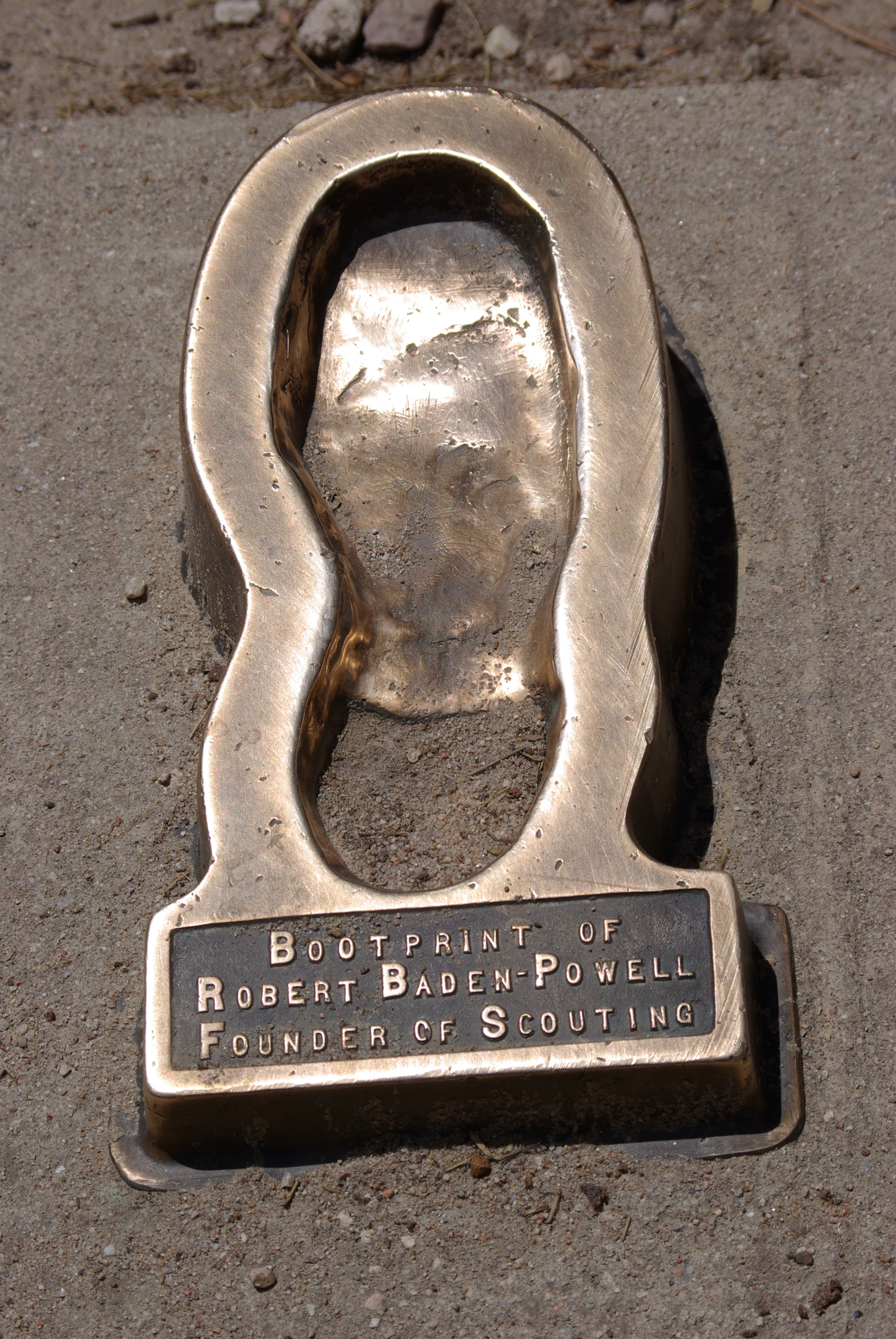
Cast of Baden-Powell's footprint, at Camp Chris Dobbins, Peaceful Valley Scout Ranch, Colorado

Cast of Baden-Powell’s footprint with the brass worn bright from Scouts seeing how they measure up, at Camp Chris Dobbins, Peaceful Valley Scout Ranch, Colorado

Another in a series of where and how people interact with sculpture.

At Peaceful Valley Scout Ranch in Colorado, at Camp Chris Dobbins, there is a cast of a footprint from Lord Robert Baden-Powell, the founder of the International Scouting Movement.

Of course, every Scout must check it out to see whether his or her foot measures up, you can tell from the bright brass color where the piece is touched by hundreds of boots.


July 19, 2012

Found this at Under the Lobsterscope — our incarceration rates form a testament to one of the greatest failures of the U.S. over the past two decades. Live links added here for your convenience.

(This may be the last time we use the reblog feature — it’s very clunky!)

btchakir's avatarUnder The LobsterScope


Here are the facts… you make your own conclusion. Personally, I think making prisons a private industry sucks— I wonder when they’ll be exporting the prisoners to China.


View original post


John Muir: The saving of 100 million acres begins with a first word on paper

July 19, 2012

John Muir’s place in American history endures constant assault.  Not only did businessmen and politicians of his own day find Muir’s policies anathema to their hopes of profiting from the destruction of the American wild, so today do we hear that profits cannot be had without the rape of the environment.

Muir knew better, and so should you!

On July 19, 1869 — in the middle of the administration of U. S. Grant, Muir began his journals on the beauty of life in the Sierras, to be published 42 years later as My First Summer in the Sierra.

It should be required reading in more American classrooms:

John Muir

Watching the daybreak and sunrise. The pale rose and purple sky changing softly to daffodil yellow and white, sunbeams pouring through the passes between the peaks and over the Yosemite domes, making their edges burn; the silver firs in the middle ground catching the glow on their spiry tops, and our camp grove fills and thrills with the glorious light. Everything awakening alert and joyful…John Muir,
Entry for “July 19 from
My First Summer in the Sierra, 1911.
“California As I Saw It”: First-Person Narratives of California’s Early Years, 1849-1900

John Muir
John Muir,
1902.
The Evolution of the Conservation Movement, 1850-1920

On July 19, 1869, naturalist John Muir set pen to paper to capture his experience of awakening in the Sierra Nevada Mountains of California. Published in 1911, My First Summer in the Sierra is based on Muir’s original journals and sketches of his 1869 stay in the vicinity of the Yosemite Valley. His journal tracks his three-and-a-half-month visit to the Yosemite region and his ascent of Mt. Hoffman and other Sierra peaks. Along the way, he describes the flora and fauna as well as the geography and geology of the area.

Muir immigrated from Scotland to Wisconsin as a child. He attended the University of Wisconsin and began working as a mechanical inventor. After an 1867 industrial accident nearly blinded him, he abandoned his career as an inventor to work as a naturalist.

California, El Capitan, Yosemite Valley
El Capitan,
Yosemite Valley,
California,
William Henry Jackson, photographer,
1899.
Touring Turn-of-the-Century America: Photographs from the Detroit Publishing Company, 1880-1920

An early defender of the environment, Muir in 1876 advocated adoption of a federal forest conservation program. His popular articles and books describing Yosemite’s natural wonders inspired public support for the establishment of Yosemite National Park in 1890 and expansion of the park in 1906.  At the same time, Muir continued to work and write as a serious scientist whose fieldwork in botany and geology enabled him to make lasting contributions. Alaska’s Muir Glacier is named for him. In 1892, Muir co-founded the as an association explicitly dedicated to wilderness preservation and served until 1914 as its first president, shaping it into an organization whose leadership in political advocacy for protection of the natural world continues to this day.

The popularity of President Theodore Roosevelt’s groundbreaking conservation program owed much to Muir’s writing. In 1903 Roosevelt and Muir visited the Yosemite region together. In 1908, Roosevelt issued a presidential proclamation establishing the Muir Woods National Monument in Marin County, California, in Muir’s honor. Muir died six years later. Although sorrow and disappointment at his failure to save Hetch Hetchy Valley from becoming a reservoir for San Francisco may well have contributed to his death, Muir had succeeded more than any other single individual in establishing the preservation of wild nature as a major American cultural and political value. The clarity of his vision and the eloquence of his writing continue to inspire environmentalists throughout the world.

Learn more about John Muir and the conservation movement in American Memory: