Millard Fillmore’s Bathtub, as poetry

August 25, 2013

Haiku, at that.

Mark Sackler at Millennium Conjectures is making haiku verses from the search terms used on his blog.  Haiku has some firm rules anyway, and this makes the challenge all the greater.

And it produces some interesting stuff, though this one may be just odd:

Existential Stench

I am alone in
Millard Fillmore’s Bathtub blog
with Pepe Le Pou*

(The asterisk notes that this is how the searcher spelled it.)

An unlinked reference — some sort of indication of making it into the bloggynet conscience!

Read more at Mark’s place. (And check out the Savage Chickens cartoon.)

More, maybe only tangentially-related:

Bust of Vice President Millard Fillmore, by Robert Cushing, U.S. Senate Chamber

Does the ghost of Millard Fillmore approve? Bust of Vice President Millard Fillmore, by Robert Cushing, U.S. Senate Chamber


Does a black cat know that it’s black?

August 21, 2013

Looking for the main cat, Luna Lovegood.*  Couldn’t find her.  Cats are like that.  They hide in wonderfully difficult-to-find places, and they resist entreaties to come out, even for dinner.  Luna wasn’t coming when called . . .

In the bedroom, looking around, calling, to no avail . . . 25th call (or thereabouts), a black plastic bag on the bed sorta came alive.  Luna opened her eyes, and outed herself.

Hiding in plain sight: Luna Lovegood remained invisible to me, until she opened her eyes.

Hiding in plain sight: Luna Lovegood remained invisible to me, until she opened her eyes.

Do black cats know that they are black cats?  I think they take advantage of their mono-color camouflage, and that they do it knowingly.

I also think they do it because they think its funny we can’t see them.

Does a black cat know she's a black cat?  Closing her eyes, she disappears.

Does a black cat know she’s a black cat? Closing her eyes, she disappears.

More:

_____________
* We adopted her from the pound, through Pet Medical Center of Duncanville.  As a black cat, she wasn’t much adoptable, and had spent six months waiting for a home.  She was named by the pound, or the vet.  Since she answered to the name, she kept it.


Lost history: Groucho Marx died on August 19, 1977

August 19, 2013

1958 Publicity photo of Groucho Marx from the television program You Bet Your Life.  NBC Television-NBC Photo/Photographer:  Elmer Holloway

1958 Publicity photo of Groucho Marx from the television program You Bet Your Life. NBC Television-NBC Photo/Photographer: Elmer Holloway

36 years ago?  Grouch Marx died on August 19, 1977? 

cropped version of Image:Grouchoicon.jpg - &qu...

The man became an icon, though too few know the great history behind the icon. “Self-made caricature of Groucho Marx” Wikipedia image


That means that not only have your high school history students probably never seen much, or anything, of Groucho Marx and his comic genius; it means their parents don’t know him, either.

What a great tragedy.

Groucho Marx brought genius to American comedy films, to radio, and then to television.  His genius was of a sort that does not age, but remains fresh to audiences of today — get a group of teenagers to view Duck Soup or A Day at the Races and you’ll find them laughing heartily at even some of Marx’s more cerebral jokes.  It is symbolic that the films that brought writer Norman Cousins to laughter, and a lack of pain, were Marx Brothers movies (in the day when one had to rent a projector to show the film, long before VCR).  Cousins went on to a grand second career talking about hope in healing, starting with the book, Head First: The Biology of Hope and the Healing Power of the Human Spirit.  I recommend these films to anyone seriously injured or ill, or recovering.  We got VHS, and then DVD copies of several of the films when our kids were ill, with great effect.

Groucho Marx should be in the pantheon of great Americans, of the 20th century, if not all time, studied by children in high school, for history and for literature purposes.

Groucho’s been gone for 36 years, and we are much poorer for his passing.

More:

Groucho grills Ray Bradbury and a woman named Leticia on You Bet Your Life in a 1955 episode:

English: Groucho Marx & anonymous blogging

“I intend to live forever, or die trying.” ― Groucho Marx (Wikipedia image)


Will Rogers and Wiley Post crashed in Alaska, August 15, 1935

August 15, 2013

Will Rogers, images from Will Rogers Museums, Oklahoma

Will Rogers, images from Will Rogers Museums, Oklahoma

August 15, the Ides of August, hosted several significant events through the years.  In 1935, it was a tragic day in Alaska, as an airplane crash took lives of Will Rogers and Wiley Post.  To refresh your memory, an encore post, with a few edits and additions.

After Mark Twain died, America found another great humorist, raconteur, story-teller, who tickled the nation’s funny-bone and pricked the collective social conscience at the same time. Will Rogers is most famous today for his sentiment that he never met a man he didn’t like. In 1935, he was at the height of his popularity, still performing as a lariat-twirling, Vaudeville comedian who communed with presidents, and kept his common sense. He wrote a daily newspaper column that was carried in 500 newspapers across America.  Rogers was so popular that Texas and Oklahoma have dueled over who gets the bragging rights in claiming him as a native son.

Will Rogers ready to perform.  Photo taken prior to 1900 - Wikimedia

Will Rogers ready to perform. Photo taken prior to 1900 – Wikimedia

Wiley Post was known as one of the best pilots in America. He gained fame by being the first pilot to fly solo around the world. Post was famous for his work developing new ways to fly at high altitudes. Post was born in Texas and moved to Oklahoma. He lost an eye in an oil-field accident in 1924, then used the settlement money to buy his first airplane. He befriended Will Rogers when flying Rogers to an appearance at a Rodeo, and the two kept up their friendship literally to death.

Post asked Rogers to come along on a tour of the great unknown land of Alaska, where Post was trying to map routes for mail planes to Russia. Ever adventurous, Rogers agreed — he could file his newspaper columns from Alaska by radio and telephone. On August 15, 1935, their airplane crashed near Point Barrow, Alaska, killing them both.

Wiley Post, first to fly solo around the world, in an early pressure suit for high-altitude flying - Wikimedia photo

Wiley Post, first to fly solo around the world, in an early pressure suit for high-altitude flying – Wikimedia photo

On August 15, 2008, a ceremony in Claremore, Oklahoma, honored the two men on the 73rd anniversary of their deaths. About 50 pilots from Oklahoma, Missouri, Kansas and Arkansas will fly in to the Claremore Airport for the Will Rogers-Wiley Post Fly-In Weekend. Oklahoma Lt. Gov. Jari Askins will offer a tribute.

Rogers was 56, leaving behind his wife, Betty, and four children. Post, 36, left a widow.

Rogers’ life is really quite legendary. Historian Joseph H. Carter summed it up:

Will Rogers was first an Indian, a cowboy then a national figure. He now is a legend.

Born in 1879 on a large ranch in the Cherokee Nation near what later would become Oologah, Oklahoma, Will Rogers was taught by a freed slave how to use a lasso as a tool to work Texas Longhorn cattle on the family ranch.
As he grew older, Will Rogers’ roping skills developed so special that he was listed in the Guinness Book of Records for throwing three lassos at once: One rope caught the running horse’s neck, the other would hoop around the rider and the third swooped up under the horse to loop all four legs.

Will Rogers’ unsurpassed lariat feats were recorded in the classic movie, “The Ropin’ Fool.”

His hard-earned skills won him jobs trick roping in wild west shows and on the vaudeville stages where, soon, he started telling small jokes.

Quickly, his wise cracks and folksy observations became more prized by audiences than his expert roping. He became recognized as being a very informed and smart philosopher–telling the truth in very simple words so that everyone could understand.

After the 10th grade, Will Rogers dropped out of school to become a cowboy in a cattle drive. He always regretted that he didn’t finish school, but he made sure that he never stopped learning–reading, thinking and talking to smart people. His hard work paid off.

Will Rogers was the star of Broadway and 71 movies of the 1920s and 1930s; a popular broadcaster; besides writing more than 4,000 syndicated newspaper columns and befriending Presidents, Senators and Kings.

During his lifetime, he traveled around the globe three times– meeting people, covering wars, talking about peace and learning everything possible.

He wrote six books. In fact he published more than two million words. He was the first big time radio commentator, was a guest at the White House and his opinions were sought by the leaders of the world.

Inside himself, Will Rogers remained a simple Oklahoma cowboy. “I never met a man I didn’t like,” was his credo of genuine love and respect for humanity and all people everywhere. He gave his own money to disaster victims and raised thousands for the Red Cross and Salvation Army.

Post’s legacy is significant, too. His employer, Oklahoma oil man F. C. Hall, encouraged Post to push for aviation records using Hall’s Lockheed Vega, and Post was happy to comply. Before his history-making trip around the world, he had won races and navigation contests. NASA traces the development of the space-walking suits worn by astronauts to Post’s early attempts for flight records:

For Wiley Post to achieve the altitude records he sought, he needed protection. (Pressurized aircraft cabins had not yet been developed.) Post’s solution was a suit that could be pressurized by his airplane engine’s supercharger.

First attempts at building a pressure suit failed since the suit became rigid and immobile when pressurized. Post discovered he couldn’t move inside the inflated suit, much less work airplane controls. A later version succeeded with the suit constructed already in a sitting position. This allowed Post to place his hands on the airplane controls and his feet on the rudder bars. Moving his arms and legs was difficult, but not impossible. To provide visibility, a viewing port was part of the rigid helmet placed over Post’s head. The port was small, but a larger one was unnecessary because Post had only one good eye!

Last photo of Will Rogers (in the hat) and Wiley Post, in Alaska in 1935 (from Century of Flight)

Last photo of Will Rogers (in the hat) and Wiley Post, in Alaska in 1935 (from Century of Flight)

Tip of the old scrub brush to Alaska bush advocate Pamela Bumsted.

Resources:


Signs: Cthulu’s return? Don’t kick jelly fish?

August 12, 2013

Don Knuth at Stanford University collects signs.

Actually he collects photos of signs, especially the diamond-shaped informational-warning signs.

What in the world is this one?

A sign photographed in Australia, in the Knuth Collection.

A sign photographed in Australia, in the Knuth Collection.

Your nominations for captions welcomed in comments.

More, sorta — or maybe, “tangentially related” is a better description:  

Donald Knuth at a reception for the Open Conte...

Donald Knuth at a reception for the Open Content Alliance, hosted by the Internet Archive. Taken October 25, 2005 by Jacob Appelbaum in San Francisco. (Wikipedia image)


Signs of Life: The bowtie on the Paul Simon Highway

August 7, 2013

Driving through Illinois around Chicago — as we had many opportunities to do while younger son James attended Lawrence University in Wisconsin — one can be delighted and amused by the signs marking parts of Interstate 55 as the Paul Simon Freeway.  Simon’s rise up through editorial ranks of small newspapers, to state legislator and U.S. Senator was fueled by his great common sense and very studious habits when it came to history and public policy.

You can’t put all that on a road sign.  But you can put a picture of his bowtie there.  Honestly, we laughed out loud when we saw one for the first time.

I never could find one of the signs where it might be safe to pull off get a good photograph.  Surely someone in Illinois would have one, right?

Just try to find a good picture of these great signs.  I finally found this one on Flickr:

Paul Simon Freeway Bowtie Sign on I-55 near Edwardsville, IL_DSCN9495c  - Flickr photo by Wampa-One

Paul Simon Freeway Bowtie Sign on I-55 near Edwardsville, IL_DSCN9495c – Flickr photo by Wampa-One

Paul Simon, the Illinois politician, was a great guy.  Search for photos of the Tom Landry Highway signs in Texas, you’ll get a boatload of close-up shots.  Come on, Illinois:  Somebody go get a photo of those “Paul Simon Freeway” signs worthy of the man, and post it on the ‘net!

U.S. Sen. Paul Simon, D-Illinois. Biographical Directory of the U.S. Congress

U.S. Sen. Paul Simon, D-Illinois. Biographical Directory of the U.S. Congress


Signs of life: Tufte’s signs that ought to be

August 7, 2013

From Edward Tufte:

Edward Tufte, Road Never Ends, print on canvas, 29 ½

Edward Tufte, Road Never Ends, print on canvas, 29 ½” x 29 ½”, edition of 3

Philosophy on road signs.  Will it catch on?  Has it caught on already?


Great obits: Scott E. Entsminger, and six Cleveland Brown pall bearers

July 28, 2013

Published in the Columbus Dispatch, July 7, 2013; highlighting the best part:

Scott E. Entsminger, at Corvette Forum

Scott E. Entsminger. According to Corvette Forum: The family also has requested that “everyone” wear their Browns clothing to Entsminger’s funeral Tuesday. Browns public relations director Zak Gilbert told ESPN.com that as soon as the Browns learned of Entsminger’s death they contacted his widow, Pat, to express their condolences. “She told us that Scott’s favorite player was Lou Groza, so we had a 76 jersey customized with Scott’s last name,” Gilbert said. A representative from the Browns’ front office will personally deliver it to Pat Entsminger at her husband’s memorial service Tuesday afternoon. Image from Corvette Forum

Entsminger — Scott E. Entsminger, 55, of Mansfield, died Thursday, July 4, 2013 at his residence. Born January 8, 1958 in Columbus, Ohio, he was the son of William and Martha (Kirkendall) Entsminger. He retired from General Motors after 32 years of service. He was an accomplished musician, loved playing the guitar and was a member of the Old Fogies Band. A lifelong Cleveland Browns fan and season ticket holder, he also wrote a song each year and sent it to the Cleveland Browns as well as offering other advice on how to run the team. He respectfully requests six Cleveland Browns pall bearers so the Browns can let him down one last time. Scott was a fun loving, kind and caring man who enjoyed gardening and fishing but his greatest enjoyment was spending time with his family. He is survived by his wife of 16 years, Pat Entsminger; a son, Aaron Entsminger of Columbus; a brother, Bill (Kathy) Entsminger of Grove City, Ohio; a sister, Lois Courtright of Galloway, Ohio; a sister-in-law, Carol Ferrall of Georgia; four nieces, Kristi Nunamaker, Allison Courtright, Emily Ferrall and Ashley Ferrall; a nephew, Benny Entsminger; his three dogs, Blackey, Shadow and Jezebel; his step mother, Lil Entsminger; a special aunt, Ginny Entsminger; and several cousins and other dear relatives. In addition to his parents, he was preceded in death by a brother-in-law Harry Courtright. Memorial services will be held at 2 p.m. Tuesday, July 9, 2013 at the Life Celebration Reception Center, 129 South Main Street, Mansfield, Ohio 44902. Friends may call one hour prior to the service, from 1-2 p.m., on Tuesday. The family also encourages everyone to wear their Cleveland Browns clothing to the service in honor of Scott. The family suggests that something be planted in his memory. Online guest registry at www.wappner.com

– See more at: http://www.legacy.com/obituaries/dispatch/obituary.aspx?n=scott-e-entsminger&pid=165695591

More:

Mr. Entsinger's favorite player was Lou Groza, who wore #76 for the old Cleveland Browns.

Mr. Entsminger’s favorite player was Lou Groza, who wore #76 for the old Cleveland Browns.


About Florida

July 14, 2013

I don’t know.  It seems a little extreme.

But I don’t see anybody trying to stop Bugs.  Bugs Bunny, Florida, Zimmerman Trial, Stand Your Ground

Bugs Bunny deals with Florida

Undoubtedly copyrighted by Warner Bros. This is fair use. Thanks to Coyote Crossing.

Tip of the old scrub brush to Chris Clarke at Coyote Creek.

More:

A depiction of Bugs Bunny's evolution through ...

A depiction of Bugs Bunny’s evolution through the years. Regardless how Bugs looks, he usually reflects some of the more popular views of the day. Wikipedia image


All is not lost, is it?

June 26, 2013

NPR moved offices earlier this year.

Tiny Desk Concerts provide a lot of fun in live performance in the offices of a radio network.  To document the move, musically, Tiny Desk called in OK Go.  OK Go is a favorite here at Millard Fillmore’s Bathtub — regular bathing music, you might say.

And in 223 takes, they recorded the move.

I’m especially fond of the elevator ride with Carl Kassell. (At least, that’s who I think it is.)

Who else can you recognize from NPR’s famous voices?

223 Takes – All Is Not Lost, OK Go

Details:

Published on Jun 3, 2013

The Tiny Desk has moved, and OK Go has helped make it so.

Earlier this year, we needed to figure out the best possible way to move my Tiny Desk from NPR’s old headquarters to our new facility just north of the U.S. Capitol. We wanted to go out with a bang and arrive at our new space in style, so our thoughts naturally turned to a catchy pop band we love: OK Go, whose unforgettable videos have been viewed tens of millions of times on YouTube.

Bandleader Damian Kulash used to be an engineer at an NPR member station in Chicago, so we figured he’d be up for helping us execute a simple idea: Have OK Go start performing a Tiny Desk Concert at our old location, continue playing the same song while the furniture and shelving is loaded onto a truck, and finish the performance at our new home. In addition to cameos by many of our NPR colleagues — Ari Shapiro, Audie Cornish, David Greene, Guy Raz, Scott Simon, Alix Spiegel, Susan Stamberg and more — this required a few ingredients: Number of video takes: 223; Percent used in final version: 50; Number of raw audio channels: 2,007; Percent used in final version: 50; Number of microphones: 5; Number of hard-boiled eggs consumed: 8, mostly by bassist Tim Nordwind; Number of seconds Carl Kasell spent in the elevator with OK Go: 98; Number of times Ari Shapiro played the tubular bells: 15; Number of pounds the tubular bells weighed: 300; Number of times the shelves were taken down and put back up: 6; Number of days it took to shoot: 2; Number of cameras: 1

OK Go played “All Is Not Lost” from Of the Blue Colour of the Sky, with words tweaked by the All Songs Considered team. And so begins a new era for the Tiny Desk, after 277 concerts (counting this one) in our old home. — BOB BOILEN

FEATURING
Dan Konopka, Damian Kulash, Tim Nordwind, Andy Ross

CREDITS
Producers: Bob Boilen, Mito Habe-Evans
Directors: Mito Habe-Evans, Todd Sullivan
Audio Engineer: Kevin Wait
Assistant Producer: Denise DeBelius
Camera Operator: Gabriella Garcia-Pardo
Supervising Producer: Jessica Goldstein
Editor: Mito Habe-Evans
Assistant Editor: Gabriella Garcia-Pardo
Production Assistants: Lorie Liebig, Lizzie Chen, Gabriella Demczuk, Marie McGrory, Andrew Prince
Executive Producers: Anya Grundmann, Keith Jenkins
Special Thanks: OK Go and our cast and crew of volunteers.

OK Go at the Albany Tulip Festival

OK Go at the Albany Tulip Festival. Wikipedia image

More:


If you don’t at least check Snopes.com first . . .

June 24, 2013

checking snopes.com before forwarding dumb e-mails.

Definition of “gullible” in a dictionary. Profile photo on Facebook for “checking snopes.com before forwarding dumb e-mails.”

Hannum said there’s a sucker born every minute (and suckers credit it to Barnum).  Do you think it’s that seldom, with the internet?


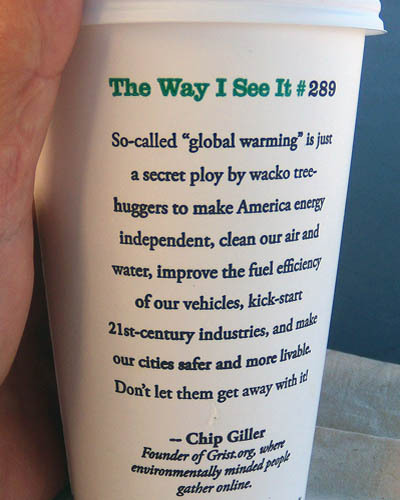
How about another cup of coffee? (Global Warming Conspiracy and Starbucks Cup #289)

June 19, 2013

Encore post from September 17, 2007, and August 2009 — maybe more appropriate today than ever before.

Found this on my coffee cup today (links added here):

The Way I See It #289

So-called “global warming” is just

a secret ploy by wacko tree-

huggers to make America energy

independent, clean our air and

water, improve the fuel efficiency

of our vehicles, kick-start

21st-century industries, and make

our cities safer and more livable.

Don’t let them get away with it!

Chip Giller
Founder of Grist.org, where
environmentally-minded people
gather online.

Starbucks Coffee Cup, The Way I See It #289 (global warming)

Look! Someone found the same cup I found!

I miss those old Starbucks cups — but then, they killed the Starbucks in our town.  I don’t buy the 100 cups of Starbucks coffee I used to get in a year.

More:

Save


How to tell testing is a monster in your local schools: “Test Menu”

June 18, 2013

This would be much funnier were it not so eerily close to stuff I’ve seen, even in great Texas school systems:

Details:

A :30 commercial created by The Canandaigua Film Society in Canandaigua, New York, to protest over-testing in schools in May 2013.

761

More:


Seen on the street: Where do gays come from?

June 11, 2013

Gay babies from straight couples street sign

Photo from George Takei’s Facebook page; can anyone tell us who took the photo?

From George Takei’s Facebook page.

Sign on the street said, “If you don’t like gay marriage, blame straight people.  They’re the ones who keep having gay babies.”


Moral Monday in Raleigh, North Carolina

June 11, 2013

Unidentified pProtester Thierry Wernaers in Raleigh, North Carolina,  in photo by an unnamed photographer:

Protester in Raleigh, North Carolina, on Moral Monday, June 11, 2013

Protester Thierry Warnaers in Raleigh, North Carolina, on Moral Monday, June 11, 2013; photographer unidentified

Love that sign:  OMG/GOP/WTF?

Tip of the old scrub brush to Devona Wyant. Thanks to Thierry Warnaers for writing in to identify himself (see comments).

More, but not all: