Good news, or great challenge? U.S. could help eliminate malaria

December 13, 2016

World Malaria Report 2016, published December 13, offers great hope in progress made against malaria in the past 16 years.

But it also notes a severe challenge: Funding to beat malaria works well, but funding pledges sometimes are not met, and progress against the disease slowed some in 2016.

In 2000, nearly a million people died from malaria worldwide. In 2015, the death toll had been cut to ~470,000, a 50% reduction in 15 years.

In 2016, ~429,000 people died from malaria. It’s 40,000 fewer people than the year before. Malaria fighters had hoped for more.

Most deaths occur in Africa, most deaths occur to children, and most deaths occur in areas where distribution of insecticide-impregnated bednets has not been complete. Distribution was slowed in 2016 by lack of funds at steps in the process, from manufacturing the nets (now done significantly in Africa) to distributing the nets, to educating people how to use them. Nets are more effective than pesticide spraying, with DDT or the other 11 approved pesticides, and considerably less expensive.

A child shows off the mosquito bednet that keeps him malaria-free. Image from Nothing But Nets.

A child shows off the mosquito bednet that keeps him malaria-free. Image from Nothing But Nets.

WHO’s press release on the Report laid out the problem, with hints at a solution.

Sustained and sufficient funding for malaria control is a serious challenge. Despite a steep increase in global investment for malaria between 2000 and 2010, funding has since flat-lined. In 2015, malaria funding totalled US$ 2.9 billion, representing only 45% of the funding milestone for 2020 (US$ 6.4 billion).

Governments of malaria-endemic countries provided about 31% of total malaria funding in 2015. The United States of America is the largest international malaria funder, accounting for about 35% of total funding in 2015, followed by the United Kingdom of Great Britain and Northern Ireland (16%).

U.S. funding was just over $1 billion. That may sound like a lot, but it’s not even a drop in the U.S. federal budget bucket.

With a doubling of the U.S. contribution to $2 billion, the U.S. could again lead the world in fighting malaria, and set a good example of American democracy in action.

In doing that, another 100,000 lives might be saved each year.

Then, U.S. would have high moral ground to urge other nations to contribute to fighting malaria, either directly through WHO or through non-governmental organizations whose work goes too-often unsung, such as Malaria No More, Nothing But ‘Nets, and the Clinton Foundation.

$10 buys a net and distribution, and a net protects a child from malaria better than spraying dangerous insecticides, for two to five years.

What are the odds the Trump administration could be recruited to beat malaria? Let’s increase those odds.


Why we need war on the mosquito, the deadliest animal – Bill Gates

October 16, 2016

World's Deadliest Animals, Gates Foundation

World’s Deadliest Animals, Gates Foundation

One could quibble, and point out that it’s the malaria parasite that does the dirty work, more than the mosquito; but it’s only a quibble.

Short film from Bill Gates explaining why he helps wage war on the lowly mosquito. Use of science to find ways to defeat mosquito-borne disease transmission is especially important in the post-DDT world, since DDT resistance now aids every mosquito on Earth.

GatesNotes said:

There are about a dozen different diseases that are spread to humans by mosquito bites including dengue, yellow fever, Zika, chikungunya, and malaria. This little mosquito actually kills more humans than any other thing.

Learn more at: http://b-gat.es/2cUd9Ff


DDT FAIL: Mosquito-borne diseases deplete medical care in DDT’s world capital

September 15, 2016

India News Today photo shows insecticide fogging in crowded Delhi neighborhoods to combat Chikungunya virus by striking down mosquitoes that transmit the disease from one human to another.

India News Today photo shows insecticide fogging in crowded Delhi neighborhoods to combat Chikungunya virus by striking down mosquitoes that transmit the disease from one human to another.

In the western world, libertarians, so-called conservatives and anti-science people call for a “return” of DDT to fight Zika virus spread.

But in the world’s DDT capital, India, where DDT is still made and more DDT is applied than in the rest of the world combined, DDT’s failures stand out. News reports say health care in key Indian cities is hamstrung by doctors and nurses getting mosquito-borne diseases.

Why don’t they just use “the magic powder,” DDT, to wipe out mosquitoes? Oh, Dear Reader, India has used DDT extensively, for everything, for 60 years. Mosquitoes that carry disease, and all other mosquitoes, and many other insect pests, developed resistance and immunity to DDT from that use.

Apart from the fact that DDT would be the WRONG pesticide to use for anything other than malaria-carrying mosquitoes from the genus Anopheles, it simply does not work.

If DDT advocates paid attention to news and history, they’d not call for more DDT anywhere for any reason.

India Today detailed the simmering crisis in Delhi in a story headlined, “Dengue-chinkungunya outbreak takes down doctor, nurses and sanitation workers”:

Subhead:

Apart from doctors, even nurses, other members of the medical staff and sanitation workers are going on leave at a time when the number of people afflicted by dengue and chikungunya this year in the city and its suburbs has crossed two thousand.

As outcry over an onslaught of viral diseases in the Capital reaches fever pitch and hospitals struggle in the face of an unrelenting tide of patients, the men in white too have started calling in sick.

Apart from doctors, even nurses, other members of the medical staff and sanitation workers are going on leave at a time when the number of people afflicted by dengue and chikungunya this year in the city and its suburbs has crossed two thousand.

Malaria is carried almost always by Anopheles, but chikungunya is carried by two species of Aedes, Aedes aegypti and Aedes albopictus. These mosquitoes also carry dengue fever and Yellow fever. A. aegypti is the principal carrier of the Zika virus, worldwide. Health workers being felled by dengue and chikungunya tells us the area would also be fertile territory for the spread of Zika virus, if it were introduced there.

Careful watchers, therefore, will understand that DDT has worn out its usefulness against a wide variety of mosquito-borne diseases including Zika.

“In our hospital, 10 per cent of the staff is currently down with fever,” said Dr Ramesh Chugh, medical superintendent of Pt Madan Mohan Malaviya Hospital in south Delhi. “We have over 100 doctors, and currently 7-8 doctors are down with fever.”

Experts say heavier than usual rainfall, a large number of construction projects and scores of open drains in Delhi are allowing mosquitoes to breed in stagnant water.

Far too many commenters fail to understand that DDT was never the chief tool in fighting malaria, or any other disease. Instead, DDT was used to knock down local populations of mosquitoes, temporarily, so health care and better housing and other measures could cure humans of the diseases and remove mosquito breeding areas from areas around human homes and human activities. India’s failure to provide good sewage drainage, good storm sewage drainage, and otherwise plug up potholes and even tiny water catching places allows mosquitoes almost free rein. India relied too long on poisoning everything with DDT, instead of building a mosquito-resistant urban area.

At Lok Nayak Hospital in central Delhi, 18 doctors are on leave. “Either the doctors are down with fever or somebody in their family is ill. The doctors are taking leave for at least 4-5 days. We have had cases where physicians were ill but returned to work early seeing the number of patients,” said a senior doctor.

NURSES AND SANITATION WORKERS ALSO ON LEAVE

In east Delhi’s Lal Bahadur Shastri Hospital, 18 members of the medical staff, including doctors, nurses and sanitation workers, are absent. “In a staff of nearly 1200, 10-15 doctors are on leave due to viral illnesses,” said Dr Punita Mahajan, medical superintendent of Baba Ambedkar Hospital in northwest Delhi. “We are not exerting pressure on the doctors to continue if they feel slightly unwell as it is very important for the hospital to ensure that they remain healthy.”

The Delhi government has asked hospitals to ensure that dengue and chikungunya patients are treated without distress.

Officials say the health department has already dedicated an additional 1,000 beds for those suffering from fever at the Rajiv Gandhi Super Speciality Hospital, Janakpuri Super Speciality Hospital and Deep Chand Bandhu Hospital.

These institutes have been designated nodal hospitals for fever in the city. All hospitals- government and private – in the National Capital Territory have been directed to increase their surge capacity.

“While doctors are trying their best to remain on duty till the effect of vector-borne diseases recedes the city, the shortage in staff and the new directions from the government would add to the existing burden,” said a doctor on condition of anonymity.

The Delhi government says it is fully prepared to battle with the onslaught of diseases and has denied in the city high court claims that the Capital is facing its worst dengue crisis.

In an affidavit filed in the court, it said strict surveillance of preparedness and impact of these diseases has been carried out for taking further preventive measures as, due to environmental conditions, the number of diseases such as dengue, chikungunya and malaria shows an upswing during July to October.

India continues to learn that DDT is not magic, not often useful, and sometimes detrimental to disease control efforts.

Will the rest of the world watch and learn? No, DDT will not and cannot help in the fight against Zika virus’s spread to humans. Waste no more time wondering, but get on with the hard work of draining mosquito breeding places, improving houses with window screens and other improvements, and developing vaccines and other medicines. Now.

More:

http://twitter.com/EdDarrell/status/776266151349235713


DDT use plunged to just 10 nations in 2015; gone by 2020?

April 13, 2016

UN photo showing a mother and child protected from mosquito-borne disease by a bednet, the chief tool used in 2015 to prevent malaria transmission in endemic areas.

UN photo showing a mother and child protected from mosquito-borne disease by a bednet, the chief tool used in 2015 to prevent malaria transmission in endemic areas.

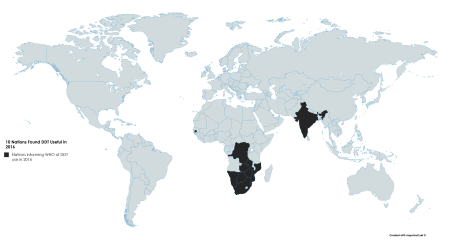
Just ten nations still used DDT in 2015, putting the planet on target to phase out all DDT use by 2020.

World Malaria Report 2015, published by the World Health Organization (WHO) in early December, notes those nations reporting that they use DDT in public health fights against disease. Under the Persistent Organic Pollutants Treaty, any nation may use DDT simply by notifying WHO.  Signatories of the treaty usually agree to stop all use of DDT once current use ends. Since 2003, most nations using it found DDT simply didn’t work well enough to continue use it to fight malaria or any other vector-borne diseases.

In the 2015 Report, Appendix 2A lists methods of vector control used in nations (“vector” being the fancy word for carrier of the disease, or mosquitoes in the case of malaria).  (See pages 234 to 237 of the .pdf.)

Nations in which DDT is used to fight malaria
World Malaria Report 2015 Appendix 2A

  1. Botswana
  2. Democratic Republic of the Congo
  3. Gambia
  4. Mozambique
  5. Namibia
  6. South Africa
  7. Swaziland
  8. Zambia
  9. Zimbabwe
  10. India

Ten nations total, nine in Africa, plus India.

Despite political calls to “bring back” DDT as a means of fighting mosquitoes that carry the Zika virus, no reports show any nation notified WHO it would do so. Most nations afflicted by Zika have been earlier afflicted by other diseases carried by the same species of mosquito, Aedes aegypti.  This species carries dengue fever, yellow fever and chikungunya, and perhaps others. Consequently, most of these nations have already tried DDT against the Zika carriers, and abandoned the projects when hoped-for results did not occur.

Every mosquito on Earth in 2016 carries at least a few of the alleles that make them resistant to, or even immune to DDT. DDT use also pushes mosquito populations to develop paths that make them quickly resistant to other pesticides. WHO guidelines urge public health officials never to use just one pesticide, but instead rotate among a dozen approved for vector use, in order to prevent the bugs from developing resistance. Resistance to pesticides remains one of the chief obstacles to eliminating disease, and a growing obstacle.

India is the world’s only known maker of DDT in 2015, and the heaviest user, using more of the pesticide than all other nations combined. Due to decreasing effectiveness of DDT as mosquito resistance to to it spreads and grows stronger, malaria has proliferated in India despite increased DDT application. In 2015, India announced to WHO it would suspend manufacture and use of DDT by 2020.

More:

In black, the ten nations who used DDT in 2016, nine in Africa, and India. 43 nations used DDT in 2001. India pledges to stop manufacturing DDT by 2020. Map by Ed Darrell, using Mapchart.net

In black, the ten nations who used DDT in 2016, nine in Africa, and India. 43 nations used DDT in 2001. India pledges to stop manufacturing DDT by 2020. Map by Ed Darrell, using Mapchart.net

Save


Report that malaria and DDT hoaxsters hope you never see

January 21, 2016

 Cover of World Health Organization's "World Malaria Report 2015," which reported dramatic progress controlling malaria.

Cover of World Health Organization’s “World Malaria Report 2015,” which reported dramatic progress controlling malaria.

World Malaria Report 2015 dropped in mid-December, with United Nations-style fanfare.

Which means, you probably heard little to nothing about it in U.S. media, and “conservatives” and anti-science hoaxsters hope you won’t ever see it, so they can claim contrary to the facts that liberals kill kids in Africa.

My cynicism about the fight against malaria dissipates some, but my cynicism about hoaxes substituting for political dialogue grows.

World Health Organization (WHO) releases an annual report near the end of every year, detailing the fight against malaria and progress or lack of it.

Good news this year: WHO estimates deaths to malaria fell below 500,000 per year in 2015. That’s at least a 50% reduction since renewed vigor in the malaria fight in 2000, and it’s a 90% reduction from peak DDT use years, 1958-1963, when WHO estimated 5 million people died each year from malaria.

About 80% of malaria deaths take children under the age of 5.

Bigger picture: Malaria is on the run. Humans are winning the fight against malaria. Much remains to be done, however. Plus, malaria fighters warn that malaria can come roaring back, if governments neglect to follow through on promises of funding, and with well-run programs to cure humans of malaria and prevent new cases.

World Malaria Report 2015 should influence policy discussions in U.S. elections. But generally, this report was ignored.

Millard Fillmore’s Bathtub will feature in-depth discussions of parts of the report, and simple repetition for the record of the report, as part our long-term battle against hoaxsters who claim the U.S. ban on use of DDT on U.S. farms somehow increased malaria in Africa, and killed millions, when malaria actually decreased and millions were saved from death.

Malaria loses only with hard work on the ground by medical people treating and curing humans of the disease, and by public health people working hard to prevent new infections. Most of that work is not glorious, occurs relatively anonymously and away from television cameras and photographers with access to social media.  Which is to say, the hard work of defeating malaria goes unsung around the world. We should work to change that.

What did others say about World Malaria Report?

A collection of Tweets, and other links, for your study.

http://twitter.com/bbbrieger/status/674591008139681793

http://twitter.com/wardhealth/status/674610775646978048

http://twitter.com/News__World/status/674612996484808704

http://twitter.com/DTNIndia/status/684830093085032448


How USA spends so much money to fight malaria in other nations

January 2, 2016

Fighting malaria is difficult, and complex, and expensive. No magic bullet can slow or stop malaria.

Reasonable people understand the stakes, not only for Africa, where $12 billion is lost every year to malaria illness and death, according to WHO records; but also for all nations who trade with Africa and other malaria endemic nations in the world.

What should we do about malaria?

Before we leap to solutions, let us look to see what the United States is already doing, according to USAID, the agency which has led U.S. malaria-fighting since the 1950s.

USAID explains on their website:

Fighting Malaria

A mother and child sit under the protection of malaria nets

A mother and child sit under the protection of malaria nets. Learn more about PMI’s contributions to the global fight against malaria. Maggie Hallahan Photography

Each year, malaria causes about 214 million cases and an estimated 438,000 deaths worldwide

While malaria mortality rates have dropped by 60 percent over the period 2000–2015, malaria remains a major cause of death among children. Although the disease is preventable and curable, it is estimated that a child dies every minute from malaria. In Asia and the Americas, malaria causes fewer severe illnesses and deaths, but antimalarial drug resistance is a serious and growing problem.

The U.S. Agency for International Development (USAID) has been committed to fighting malaria since the 1950s. Malaria prevention and control remains a major U.S. foreign assistance objective and supports the U.S. Government’s vision of ending preventable child and maternal deaths and ending extreme poverty. USAID works closely with national governments to build their capacity to prevent and treat the disease. USAID also invests in the discovery and development of new antimalarial drugs and malaria vaccines. USAID-supported malaria control activities are based on country-level assessments, and a combination of interventions are implemented to achieve the greatest public health impact – most importantly the reduction of maternal and child mortality. These interventions include:

  • Indoor residual spraying (IRS): IRS is the organized, timely spraying of an insecticide on the inside walls of houses or dwellings. It kills adult mosquitoes before they can transmit malaria parasites to another person.
  • Insecticide-treated mosquito nets (ITNs): An insecticide-treated mosquito net hung over sleeping areas protects those sleeping under it by repelling mosquitoes and killing those that land on it.
  • Intermittent preventive treatment for pregnant women (IPTp): Approximately 125 million pregnant women annually are at risk of contracting malaria. IPTp involves the administration of at least two doses of an antimalarial drug to a pregnant woman, which protects her against maternal anemia and reduces the likelihood of low birth weight and perinatal death.
  • Diagnosis and treatment with lifesaving drugs: Effective case management entails diagnostic testing for malaria to ensure that all patients with malaria are properly identified and receive a quality-assured artemisinin-based combination therapy (ACT).

The President’s Malaria Initiative (PMI) works in 19 focus countries in sub-Saharan Africa and the Greater Mekong Subregion in Asia. PMI is an interagency initiative led by USAID and implemented together with the U.S. Centers for Disease Control and Prevention. In 2015, PMI launched its next 6-year strategy for 2015–2020, which takes into account the progress over the past decade and the new challenges that have arisen. It is also in line with the goals articulated in the Roll Back Malaria (RBM) Partnership’s second generation global malaria action plan, Action and Investment to Defeat Malaria (AIM) 2016–2030: for a Malaria-Free World [PDF, 18.6MB] and The World Health Organization’s (WHO’s) updated Global Technical Strategy: 2016–2030 [PDF, 1.0MB]. The U.S. Government’s goal under the PMI Strategy 2015-2020 [PDF, 8.9MB] is to work with PMI-supported countries and partners to further reduce malaria deaths and substantially decrease malaria morbidity, toward the long-term goal of elimination. USAID also provides support to malaria control efforts in other countries in Africa, including Burkina Faso, Burundi and South Sudan, and one regional program in the Amazon Basin of South America. The latter program focuses primarily on identifying and containing antimalarial drug resistance.

Do you think the U.S. spends too much on foreign aid, even good aid to fight malaria? How much do you think is spent? Put your estimate in comments, please — and by all means, look for sources to see what the actual amount is.


Bednets enough enough to beat malaria in most places

October 8, 2015

Reuters caption:  A displaced child plays on a mattress under a mosquito net laid in the open at Tomping camp near South Sudan's capital Juba January 7, 2014. Reuters/James Akena/Files

Reuters caption: A displaced child plays on a mattress under a mosquito net laid in the open at Tomping camp near South Sudan’s capital Juba January 7, 2014. Reuters/James Akena/Files

Another blow to the DDT partisans.

In a report published last January, which I just reread, researchers found that bednets alone offer enough prevention of malaria that Indoor Residual Spraying (IRS) using DDT or one of the other 11 WHO-approved insecticides, offers no additional protection, but at additional cost.

Lancet study said bednets alone are effective against malaria transmission, and spraying insecticides gives no additional benefit.

Reuters reported:

Spraying insecticides indoors offers children no additional protection from malaria when bed nets are used, a study said on Tuesday, as malaria cases and deaths worldwide continue to fall.

A study by medical journal The Lancet said donors should invest their limited resources on additional bed nets as the most cost-effective solution to tackling malaria, costing an average of $2.20 per person compared to $6.70 for insecticide.

“High bed net use is sufficient to protect people against malaria in areas that have low or moderate levels of malaria,” lead author Steve Lindsay said in a statement.

Malaria, a mosquito-borne parasitic disease, kills more than 600,000 people a year, and most victims are children under five living in the poorest parts of sub-Saharan Africa.

The study coincided with the launch of the World Health Organisation’s (WHO) annual World Malaria Report, which said the number of global malaria deaths fell by 47 percent between 2000 and 2013, with malaria cases also steadily declining, due to improved access to testing, treatment and bed nets. (http://in.reuters.com/article/2014/12/09/health-malaria-nets-idINKBN0JN0YT20141209)


Reuters’s report is longer, at Reuters’s site.

But another report by June indicates that gains against malaria can still be tough to maintain, especially with global warming creeping up on us.

The fight’s not over.


India, world’s last DDT maker, heaviest user, plans to stop

August 29, 2015

DDT sprayed in a vegetable market in India. (Photo: rzadigi) Living on Earth image

DDT sprayed in a vegetable market in India. (Photo: rzadigi) Living on Earth image

Sometimes big news sneaks up on us, without press releases. We often miss it.

Quiet little Tweet from journalist I’d never heard of, who passed along news from an obscure journal:

As a journalist, this guy has a piece of a world-wide scoop.

India is probably the last nation on Earth producing DDT.  In the last decade other two nations making the stuff got out of the business — North Korea and China. For several years now India has been the largest manufacturer of DDT, and far and away the greatest user, spraying more DDT against malaria-carrying mosquitoes, sand flies, and agricultural and household pests than the rest of the world combined.

As if an omen, India’s malaria rates did not drop, but instead rose, even as malaria rates dropped or plunged in almost every other nation on Earth.

Under the 2001 Stockholm Convention on Persistent Organic Pollutants (POPs) signed by more than 150 nations (not including the U.S.), DDT was one of a dozen chemicals targeted to be phased out due to its extremely dangerous qualities, including long-term persistence in the environment and bioaccummulation, by which doses of the stuff increase up the food chain, delivering crippling and fatal doses to top predators.

A perfect substitute for DDT in fighting some disease-carrying insects (“vectors”) has never been developed. Health officials asked, and the Stockholm negotiators agreed to leave DDT legally available to fight disease. Annex B asked nations to tell the World Health Organization if it wanted to use DDT. Since 2001, as DDT effectiveness was increasingly compromised by resistance evolved in insects, fewer and fewer nations found it useful.

The site Mr. Nazakat linked to is up and down, and my security program occasionally says the site is untrustworthy. It’s obscure at best. Shouldn’t news of this type be in some of India’s biggest newspapers?

I found an article in the Deccan Herald, confirming the report, but again with some

India-United Nations pact to end DDT use by 2020

India-United Nations pact to end DDT use by 2020

New Delhi, August 26, 2015, DHNS:

It would be better to switch to another insecticide, says expert

India is the lone user of DDT, though only in the malaria control programme, while rest of the world got rid of the chemical that has a lasting adverse impact on the environment. DH file photo

India is the lone user of DDT, though only in the malaria control programme, while rest of the world got rid of the chemical that has a lasting adverse impact on the environment. DH file photo

India has launched a $53 million project to phase out DDT by 2020 and replace them with Neem-based bio-pesticides that are equally effective.

India is the lone user of DDT, though only in the malaria control programme, while rest of the world got rid of the chemical that has a lasting adverse impact on the environment.

India on Tuesday entered into a $53 million (Rs 350 crore) partnership with the United Nations Industrial Development Organisation (UNIDO), United Nations Environment Programme and the Global Environment Facility to replace DDT with safer, more effective and green alternatives.

“As per the plan, the National Botanical Research Organisation, Lucknow, tied up with a company to produce Neem-based alternatives for the malaria programme. The production will start in six months,” Shakti Dhua, the regional coordinator of UNIDO told Deccan Herald.

Till last year, the annual DDT requirement was about 6,000 tonnes that has now been cut down to 4,000 tonnes as the government decided to stop using it in the Kala-Azar control programme.

A recent study by an Indo-British team of medical researchers found that using DDT without any surveillance is counter-productive as a vector control strategy as sand flies not only thrive but are also becoming resistant to DDT.

“It would be better to switch to another insecticide, which is more likely to give better results than DDT,” said Janet Hemingway, a scientist at the Liverpool School of Tropical Medicine. While the Health Ministry wanted to bring in synthetic pyrethroids, the United Nation agencies supports the bio-pesticides because of their efficacy and long-lasting effects.

“The new initiative would help check the spread of malaria and other vector-borne diseases. These include botanical pesticides, including Neem-based compounds, and long-lasting insecticidal safety nets that will prevent mosquito bites while sleeping,” Dhua said.

Ending the production and use of DDT is a priority for India as it is a signatory to the Stockholm Convention on Persistent Organic Pollutants (POP) of 2002 that seeks to eliminate the use of these chemicals in industrial processes, drugs and pesticides. DDT is one of the POPs.

The clock is counting down the last years of DDT.  Good.

If events unroll as planned, DDT making will end by 2020, 81 years after it was discovered to kill bugs, 70 years after it was released for civilian years, 70 years after problems with its use was first reported by the U.S. Fish and Wildlife Service, 58 years after the publication of Rachel Carson’s Silent Spring, 50 years after European nations banned some uses, 48 years after the famous U.S. ban on agricultural use, 19 years after the POPs Treaty.

When will the news leak out?

More:

http://twitter.com/SciDevNet_SA/status/657529165357256704


Malaria Twitterstorm, summer of 2015

August 18, 2015

Several good developments in the War on Malaria, worldwide — along with some alarming signs.  Maybe there will be time to blog seriously about each of these things later. Let’s get them known, and keep discussion going for the best way to beat malaria in a post-DDT world.

QPharm Tweeted about DSM 265, an experimental, one-dose treatment developed by the Medicines for Malaria Venture (MMV); the video is useful for the background those new to the issue can get on the problems of treating malaria, which make great hurdles for campaigns to eradicate malaria.

Here’s the video the Tweet leads to.

MMV said:

DSM265 is a selective inhibitor of the plasmodial enzyme called DHODH. DHODH is a key enzyme in the replication of the parasite. If we can inhibit that enzyme with DSM265, we can stop the life of the parasite.

Voice of America reported on Rollback Malaria’s call for $100 billion to be spent in the next 15 years, to stamp out the disease.

Malaria deaths are, in 2015, at an “all time low.” Deaths hover around 500,000 per year, most in Africa, and most among children under the age of 5. A staggering total, until compared to the post-World War II estimates of more than 5 million deaths per year, or the more than 3 million deaths per year in 1963, the year the World Health Organization (WHO) had to stop its ambitious campaign to eradicate malaria when pesticide DDT, upon which the campaign was based, produced resistance in mosquitoes in areas where the campaign had not yet reached.

Beating malaria is one of the Millennium Development Goals of the United Nations; this year’s report on MDG acknowledged the great progress already made.

Another non-governmental malaria-fighting organization discussed the news; see the press release from Malaria No More.

Medical News Today Tweeted out a tout for its own coverage of malaria — notable for a good, basic explanation of malaria and how to fight it.  I wish critics of Rachel Carson and WHO were familiar with half of these basic facts.

Medical News Now's Fast Facts on Malaria

Medical News Now’s Fast Facts on Malaria. Notable, that annual deaths now are way below the million mark. Good news!

One malaria vaccine has won approval for final testing. Good news, though anyone who follows vaccines knows it will take a while to test, and anyone who knows malaria fighting knows there are four different parasites, and delivery of any medical care is tough in far too many parts of the world where any form of malaria is endemic. Even small good news is good news.

http://twitter.com/midasmedcomms/status/624491200905527296

http://twitter.com/SarahLMartinez1/status/629403365269635072

Are we better informed about malaria now? Do we understand spreading a lot more DDT is not the answer?


Wellcome Trust interactive on malaria parasites’ lifecycle

August 12, 2015

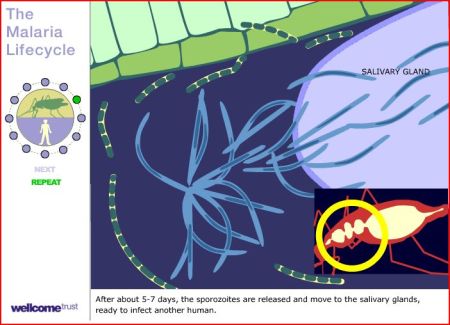
Screen capture of the Wellcome Trust HTML presentation on the life cycle of malaria parasites. Malaria fighters know all this almost instinctively; too often policy makers fail to understand it, and so they recommend policies that do not make medical or economic sense in fighting the disease. Click image to go to Wellcome Trust site for full presentation.

Screen capture of the Wellcome Trust HTML presentation on the life cycle of malaria parasites. Malaria fighters know all this almost instinctively; too often policy makers fail to understand it, and so they recommend policies that do not make medical or economic sense in fighting the disease. Click image to go to Wellcome Trust site for full presentation.

Britain’s Wellcome Trust takes as one of its key missions the fight against malaria.  The Trust is a charitable foundation created from profits of pharmaceutical development and sales.

Recently I found this HTML animation presentation on the life cycle of the malaria parasite, something all malaria fighters must know to be effective.

It’s also something that DDT advocates seem unable to comprehend.  Malaria is not a virus, nor is it a venom mosquitoes manufacture, but it is a parasite that infects (and disables) both mosquitoes and humans. Mosquitoes catch the parasite from an infected human host. After the malaria parasite completes a couple of cycles in the gut of the mosquito, the parasite can be transmitted back to humans by a mosquito bite. And the cycle continues.

Since complete eradication of malaria-carrying mosquitoes is practically impossible in almost all cases, beating malaria requires an interruption in the cycle of transmission of the parasite, plus the curing of the disease in infected human hosts.

For example, the old World Health Organization (WHO) malaria eradication campaign, which operated from 1955 to 1963, DDT was used to temporarily knock down a population of mosquitoes, with hopes human hosts would be ridded of malaria parasites so that, in six months or so, when the mosquito populations roared back, there would be no malaria in local humans to infect mosquitoes. Consequently, mosquitoes can’t transmit a parasite they don’t have.

Lost on far too many people: Humans must be cured of malaria to prevent transmission. Beating malaria takes a lot more than just killing mosquitoes.

Check out the interactive:  Malaria parasite life cycle

While you’re there, snoop around to see what else Wellcome Trust is up to in the malaria fight.


India, world’s top DDT user, socked with malaria increase

July 22, 2015

Were it true that DDT is a magic solution to malaria, by all measures India should be malaria free.

Not only is India not malaria-free, but the disease increases in infections, deaths, and perhaps, in virulence.

Map showing location of Odisha, or Orissa, state, in India. Wikipedia image

Map showing location of Odisha, or Orissa, state, in India. Wikipedia image

Since the late 1990s a small, well-funded band of chemical and tobacco industry propagandists conducted a campaign of calumny against Rachel Carson, environmentalists in general, scientists and health care workers, claiming that an unholy and wrongly-informed conspiracy took DDT off the market just as great strides were beginning to be made against malaria.

As a consequence, this group argues, malaria infections and deaths exploded, and tens of millions of people died unnecessarily.

That’s a crock, to be sure. Rachel Carson’s 1962 book, Silent Spring, inspired an already-established campaign against DDT. But the malaria eradication program begun with high hopes by the World Health Organization in 1955, foundered in 1963 when the campaign turned to central, tropical Africa. Overuse of DDT in agriculture and minor pest control had bred DDT-resistant and immune mosquitoes.  Malaria fighters could not knock down local populations of mosquitoes well enough to let medical care cure infected humans.  (The campaign was not helped by political instability in some of the African nations; 80% of houses in an affected area need to be sprayed inside to stop malaria, and that requires government organizational skills, manpower and money that those nations could not muster.)

Detail map of Odisha state, India; map by Jayanta Nath, Wikipedia image

Detail map of Odisha state, India; map by Jayanta Nath, Wikipedia image

That was just a year after Carson’s book hit the shelves. DDT had been banned nowhere. WHO’s workers tried to get a campaign going, but complete failures stopped the program in 1965; in 1969 WHO’s board met and officially killed the malaria eradication program, in favor of control.

Malaria infections and deaths did not expand with the end of WHO’s campaign.  At peak DDT use, roughly 1958 to 1963, malaria deaths are estimated by WHO to have been as high as 5 million per year, 4 million by 1963. Total malaria infections, worldwide, were 500 million.

The first bans on DDT use came in Europe. When the U.S. banned DDT use on crops in 1972, okaying use to fight malaria, malaria deaths had fallen to more than 2 million annually by optimistic estimates.  Death rates and infection rates continued to fall without a formal eradication campaign. By the late 1980s, malaria killed about 1.5 million each year, a great improvement over the DDT go-go days, but still troubling.

Beating malaria is a multi-step program.  Malaria parasites must complete a life cycle in a human host, and then when jumping to a mosquito, another cycle of about two weeks in the mosquito’s gut, before being transmissible back to humans. Knocking down mosquito populations helps prevent transmission temporarily, but that is only useful if in that period the human hosts can be cured of the parasites.

In the late 1980s, malaria parasites developed strong resistance and immunity to pharmaceuticals given to humans to cure them.  Regardless mosquito populations, human hosts were always infected, ready to transmit the parasite to any mosquito and send drug-resistant malaria on to dozens more.

From about 1990 to about 2002, malaria deaths rose modestly to more than 1.5 million annually.

New pharmaceuticals, and new regimens of administration of pharmaceuticals, increased the effectiveness of human treatments; coupled with much better understanding of malaria vectors, the insects that transmit the disease, and geographical data and other technological advances to speed diagnosis and treatment of humans, and increase prevention measures, WHO and private foundations started a series of programs in malaria-endemic nations to reduce infections and deaths. Insecticide-impregnated bednets proved to be less-expensive and more effective than Indoor Residual Spraying (IRS) featuring DDT or any of the other 11 pesticides WHO authorizes for home spraying.  (Home spraying targets mosquitoes that carry malaria, and limits expensive overuse of pesticides, plus limits and prevents environmental damage.)

Health care workers and most nations made dramatic progress in controlling and eliminating malaria, between 2000 and 2015, mostly without using DDT which proved increasingly ineffective at controlling mosquitoes, and which also proved unpopular among malaria-affected peoples whose cooperation is necessary to fight the disease.

By 2014, fewer than 220 million people got malaria infections, worldwide, a reduction of about 55% over DDT’s peak-use years. This is remarkable considering the population of the planet more than doubled in that time, and population in malaria-endemic areas rose even more. Malaria deaths were reduced to fewer than 600,000 annually, a reduction of more than 80% over peak DDT years. By 2015, malaria-fighters once again spoke of eradicating malaria from the planet.

In contrast, India assumed the position of top producer of DDT in the world, still making it even after China and North Korea stopped making it. But malaria control in India weakened, despite greater application of DDT.  The world watches as DDT, once the miracle pesticide used in anti-malaria campaigns, became instead a depleted tool, unable to stop malaria’s spread despite increasing application.

Were DDT the magic powder, or even “excellent powder” its advocates claim, India should be free of malaria, totally. Instead, Indians debate how best to get control of the disease again, and start reducing infections and deaths, again. Below is one story, rather typical of many that crop up from time to time in India news; this is from the Odisha Sun Times. (Note: Lakh is a unit in the Indian number system equal to 100,000; crore is a unit equal to 10,000,000.)

Odisha has 36% of malaria cases in India; ranks third in deaths

Odisha Sun Times Bureau
Bhubaneswar, Mar 15:

Odisha has earned the dubious distinction of having a hopping 36% share of all malaria cases in India and ranking third in the list of states with the most number of deaths leaving most of its neighbours way behind.

Malaria Mosquito

These startling revelations have been made in a report tabled by the Union Health and Family Welfare department in the Parliament.

What is more disturbing is that the number of persons getting afflicted with the disease in the state is rising every year despite the state government spending crores of rupees to arrest the spread of the disease.

The state government has been spending crores of rupees on a scheme christened ‘Mo Masari’ (“My Mosquito Net’) and has been claiming that the number of afflicted has been falling in the state. But the Central government report has exposed the hollowness of the claim.

According to the report, out of the 10.70 lakh people who were afflicted with malaria in India in the year 2014, about 3.88 lakh (36.26%) were from Odisha. In 2010, around 3.95 lakh were afflicted with the disease. The number had come down to 3.08 lakh in 2011 and had further scaled down to around 2.62 lakh in 2012, the report says.

But the number of malaria patients in Odisha is again rising at a faster pace since then, according to the Health Ministry report.

Even though the neighbouring states of Jharkhand and Chhattisgarh are identified as malaria prone states, much less people are afflicted with malaria in these states as compared to Odisha. In 2014, only 1.22lakh people were affected with the disease in Chhattisgarh while only 96,140 persons were affected by malaria in Jharkhand in the same year.

Statistics cited in the report also reveal that Odisha has left many states behind and has marched ahead of others in the matter of number of deaths due to malaria. It ranks third on this count in the country.

In the year 2014, a total of 535 persons had died of malaria across the country. Out of them 73 (13.64%) were from Odish while Tripura had the maximum number of deaths in terms of percentage at 96 (17.94%) followed by Meghalaya, another hilly state, with a toll count of 78 (14.58%).

Another disturbing fact that has emerged from the report is that out of those who have died of malaria in Odisha, 80 percent are from tribal dominated areas.

The districts of Gajapati , Kalahandi , Kandhamal, Keonjhar, Koraput, Malkangiri, Mayurbhanj, Nabarangpur, Nuapada, Rayagada and Sundargarh account for both the maximum number of deaths due to malaria and maximum number of persons afflicted with the disease.


Hoax victims afraid to discuss their misplaced DDT & malaria anger . . .

July 20, 2015

We see it almost daily — probably because we’ve got searches set to find comments on malaria and DDT.

British robin, or robin redbreast. Image found on Pinterest, and also ironically used to illustrate Pointman's screed for DDT.

British robin, or robin redbreast. Image found on Pinterest, and also ironically used to illustrate Pointman’s screed for DDT. Ironic, because Britain didn’t use as much DDT, and European robins were not so badly affected as U.S. robins. Not sure if Pointman knew that and used the photo to intentionally mislead, or if he’s just really bad at identifying species.

Some well-meaning guy (or woman) writes a long piece about conscience, and then claims to have lost respect for science, or medicine professionals, or the World Health Organization (WHO), or Rachel Carson or environmentalists, or all of them at once, because Rachel Carson’s ban on DDT meant malaria infections and deaths exploded, and libruls just won’t allow anyone to fix it.

If you’re a regular reader, you know that story is impossible, because:

The standard rant against Rachel Carson in favor of DDT is impossible in three ways:

  1. EPA’s regulation cannot travel back in time to cause an end to WHO’s malaria eradication campaign (1963) nine years before the rule was made (1972); nor can history and international law be changed to make EPA’s campaign stop the use of DDT outside the U.S.
  2. Mosquitoes do not migrate thousands of miles, across oceans. EPA’s ban on spraying U.S. crops with DDT, chiefly cotton, did not cause mosquitoes to migrate from Arkansas to Africa to spread malaria.  Had they done so, DDT in Africa had a pretty good chance to getting them, anyway.
  3. A reduction of malaria deaths from 4 million to 584,000, is not an increase in deaths.

These impossibilities do not even act as speed bumps to people in a hurry to condemn science, Rachel Carson, malaria fighters and environmentalists, in a mad rush to praise DDT, a deadly poison that doesn’t do what we hoped it would, any more.

Those undeterred from slandering Rachel Carson and environmentalists often don’t want to be informed of any errors in their rant. And so, Pointman, with a nasty false indictment of science, law and environmentalists, refuses to allow my posts to correct his errors.

His screed here.  It contains at least 6 gross errors, repeating all the impossibilities listed above, and slandering both Rachel Carson and William Ruckelshaus as “mass murderers,” with the false claim that EPA stopped DDT use against malaria.

My response, dealing with a small part of the errors, below (and here at Pointman’s blog; but in moderation, so you can’t see it, at the time of this posting).

EPA’s order banning DDT use in the U.S., on crops, specifically lifted the court-imposed ban on DDT manufacture, and specifically allowed use of DDT in the U.S. or anywhere else on Earth to fight vector-borne diseases — that is, malaria.

DDT manufacture continued in the U.S. until late 1984, when a new law made DDT manufacturers responsible for not poisoning their neighbors and neighborhoods. Most DDT manufacturing arms of larger chemical companies were spun off as separate enterprises, and they declared bankruptcy rather than assume any liability for the poisons they made for huge profits.

See description of EPA order and links to the original documents here: https://timpanogos.wordpress.com/2014/10/29/oh-look-epa-ordered-ddt-to-be-used-to-fight-malaria-in-1972/

I waited several days, and send two notices asking to spring the comment from moderation. I don’t think “Pointman” is interested in discussion.

[Update]
Further reflection, a further thought — “Pointman” probably is not interested in discussion, not because he fears it — he’s probably armed, what does he have to fear? — but because he no longer caresHe’s seen the effects of good intentions gone wrong, and if it ever occurs to him it’s not his intentions, nor his going, that might be wrong, he’ll never let on.

More:


Rachel Carson’s 108th birth anniversary

May 27, 2015

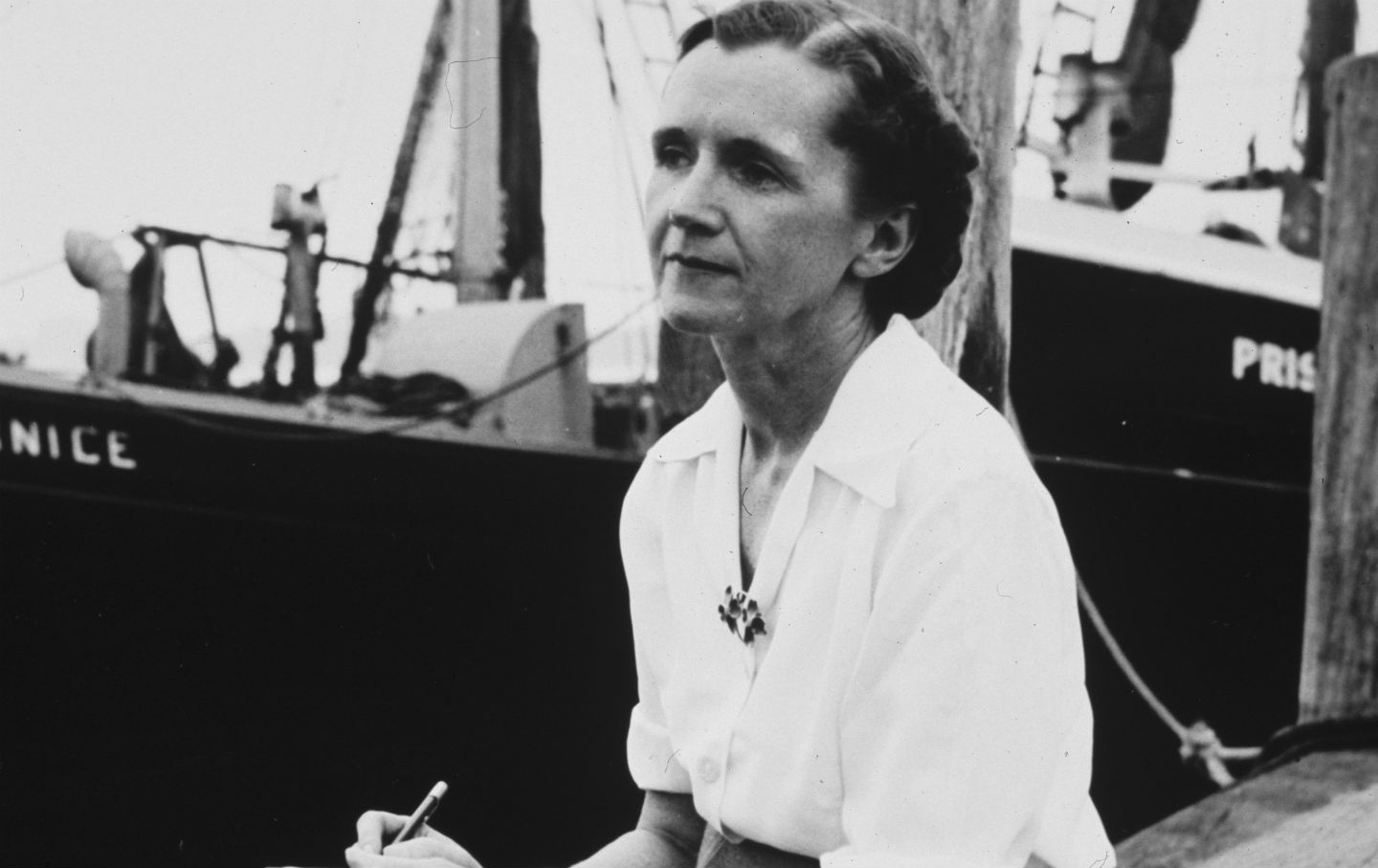
Rachel Carson, the great biologist and author, was born on May 27, 1907.

Last year, Google’s Doodle featured Ms. Carson, and the crazy, ill-informed, hoaxing and hoaxed right wing, came unglued.

Less flap this year, but I suspect it’s only because there’s been no great public recognition of the date.  Hoaxsters who insist DDT was always safe, or that banning DDT on cotton crops in Arkansas and Texas somehow caused malaria in Africa, or that Idi Amin became a great fan of Rachel Carson and stopped spraying DDT in Uganda to save American eagles, or other similarly silly-but-vicious things, or who just hate anything to do with protecting the environment, usually erupt on Earth Day, World Malaria Day, and Rachel Carson’s birthday.

Not much on her birthday this year (but stay tuned).

Meanwhile, our country’s sober liberal conscience, The Nation, looks back at their review of Silent Spring, and does a little cringing. Probably not necessary:

Rachel Carson, date unknown. (US Department of Agriculture) - via The Nation

Rachel Carson, date unknown. (US Department of Agriculture) – via The Nation

It is difficult not to cringe at the sight of the headline to the following review of Rachel Carson’s groundbreaking book, Silent Spring—“Man and Other Pests”—given that it was a review of what was then probably the most influential intellectual contribution by an American woman to date.

Miss Carson is indignant about the unexpected effects of our thoughtless broadcasting of pesticides. She writes persuasively, for she has taken great pains to gather and check her facts. Parts of the book were published in The New Yorker magazine last summer, and immediately provoked wide interest, discussion and controversy. This reaction will undoubtedly intensify with the publication of the book. No one is in a better position than Miss Carson to arouse the indignation of the public and the conscience of the chemical industry, and it may well be that she has made a real contribution to our salvation.

[At The Nation, you can read the entire review quoted from above.]

Happy birthday, Ms. Carson.  You have become a hero to thinking people, conservationists, scientists and women everywhere.

You’ll be pleased to know the American symbol, the bald eagle, is back from extinction’s verge, along with the brown pelican, peregrine falcons and osprey.  You’d be surprised to know that, despite gross abuse of DDT in the 1950s and 1960s that caused mosquitoes all over the world to carry alleles resistance and immunity, DDT was saved from complete worthlessness by a reduction in use, and is still used in a few places today, indoors to protect wildlife, to fight malaria.  You were right about DDT.

You were right about fighting malaria, too.  You said in Silent Spring we should use integrated pest management to battle the mosquitoes that provide a site for part of the life cycle of the malaria parasites, and who then spread the disease.  When DDT failed the malaria eradication campaign in the 1960s, malaria fighters were left with little else. Malaria deaths have plunged, from the 4 million to 5 million per year you knew, to fewer than 500,000 per year now.  Worldwide, we’ve cut malaria deaths 45% just since 1999, when a group of non-governmental organizations and the World Health Organization formally adopted integrated pest management as the best way to fight the disease, and began distributing mosquito nets in a big way.

You were right, Rachel Carson. Humanity is a part of nature, and if we fight nature we end up fighting and killing ourselves.

More:

One of my favorites from Gus Arriola (also appearing at the DDT Chronicles):

Save


Highlights from the World Health Assembly #68, in graphic form

May 26, 2015

World Health Organization (WHO) summary of the World Health Assembly #68, which met in Geneva last, May 18-26.

Not a peep about “more DDT to fight malaria.’

Graphic from the World Health Organization on major actions of the World Health Assembly 68, in Geneva, Switzerland, May 18-26, 2015

Graphic from the World Health Organization on major actions of the World Health Assembly 68, in Geneva, Switzerland, May 18-26, 2015


I get e-mail: Nothing But Nets needs your help with Congress, to fight malaria

May 26, 2015

Money, not DDT.

Among other goals of the hoaxsters who claim Rachel Carson was wrong and evil, and that the imaginary ban on DDT to fight malaria causes “millions of deaths,” is the erosion of trust in international  organizations that lead the fight against malaria, especially WHO, UNICEF and USAID.  Sadly, the hoaxsters have friends in Congress who threaten to withhold funding to fight malaria, often insisting that now-mostly-ineffective DDT be used instead of good, working preventive measures and medicines to cure humans of malaria.

And so, Nothing But Nets writes to ask for help:

Email your members of Congress and let them know that you support full funding for malaria prevention programs.                                       

Dear Ed,

Imagine this: working from 4:00 AM until well into the night, getting very little sleep, traveling along unpaved roads for hours at a time – all to deliver 2,000 bednets per day to the hardest-to-reach children and families.

Email your members of Congress and let them know that you support full funding for malaria prevention programs.

Take Action

In Mozambique, this is a typical day for health workers as they distribute nets to save lives as part of a campaign funded by the Global Fund to Fight AIDS, Tuberculosis and Malaria. Thanks to the work of the Global Fund and other partners – including UN agencies and local communities on the ground – bednet coverage in Mozambique has gone from less than 5 percent of the population in 2000 to an impressive 60 percent today.

But without continued support from Congress, the life-saving impact of these nets could be lost.

Your member of Congress will vote soon on how much assistance the U.S. will provide to the Global Fund, along with partners like the President’s Malaria Initiative and the United Nations, the core agencies leading the fight against malaria. By showing your support to your representatives in Washington, you can help to make them champions in the fight against malaria and ensure that these bednets continue to make it to families who need them the most.

Thousands of people have already asked their members of Congress to support the crucial work of the Global Fund and other partners in the fight against malaria—will you join them today?

From all of us at Nothing But Nets, thanks for helping community health workers reach the last mile!

Dan Skallman
Senior Campaign Associate, Nothing But Nets

Original story and photo from The Global Fund to Fight AIDS, Tuberculosis and Malaria.

Take Action