Great Beginnings Day, December 27: Darwin, Apollo

December 27, 2011

December 27 is one of those days — many of us are off work, but it’s after Boxing Day, and it’s not yet on to New Year’s Eve or Day. We should have celebrated, maybe.

We should celebrate December 27 as a day of portent: A good embarkation, and a good, safe end to a nation-encouraging trip to almost touch the Moon.

HMS Beagle, Darwin's ship

HMS Beagle, on a voyage of discovery

On December 27, 1831, Charles Darwin and H.M.S. Beagle set sail on an around-the-world voyage of discovery that would change all of science, and especially biology, forever.

December 27 1831
After a few delays, H.M.S. Beagle headed out from Plymouth with a crew of 73 under clear skies and a good wind. Darwin became sea-sick almost immediately.

Darwin never fully overcame his seasickness, but he fought it well enough to become the single greatest collector of specimens in history for the British Museum and British science, a distinction that won him election to science societies even before his return from the trip — and cemented his life in science, instead of in the church. Darwin’s discoveries would have revolutionized biology in any case. In analyzing what he had found, a few years later and with the aid of experts at the British Museum, Darwin realized he had disproved much of William Paley’s hypotheses about life and its diversity, and that another, more basic explanation was possible. This led to his discovery of evolution by natural and sexual selection.

Mini-sheet from the Royal Mail honoring Darwin's discoveries in the Galapagos Islands

Mini-sheet from the Royal Mail in 2009 honoring Darwin's discoveries in the Galapagos Islands

On December 27, 1968, Apollo 8 splashed down after a successful and heartening trip to orbit the Moon. The three crewmen, Commander Frank Borman, James A. Lovell, Jr., and William A. Anders, had orbited the Moon, a very important milestone in the methodological race to put humans on the Moon (which would be accomplished seven months later). 1968 was a terrible year for the U.S., with the North Korean capture of the U.S.S. Pueblo, assassinations of Rev. Martin Luther King, Jr., and Sen. Robert F. Kennedy during the presidential campaign, riots in dozens of American cities, nasty political conventions with riots at the Democratic Convention in Chicago, a contentious and bitter election making sore the nation’s divide over Vietnam policy, and other problems. On Christmas Eve, Borman, Lovell and Anders broadcast from orbit around the Moon, a triumphant and touching moment for the Apollo Program and Americans around the world. Their safe return on December 27 raised hopes for a better year in 1969.

Motherboard.tv has a great write up from Alex Pasternack:

In 1968, NASA engineers were scrambling to meet President Kennedy’s challenge to land a man on the moon by decade’s end. Because delays with the lunar module were threatening to slow the Apollo program, NASA chose to change mission plans and send the crew of Apollo 8 all the way to the moon without a lunar module.

Exactly 43 years ago, the three astronauts of Apollo 8 became the first humans to orbit another celestial object. As they came around the dark side of the Moon for the third time, Frank Borman, the commander, finally turned their capsule around. And then they saw the Earth.

Borman: Oh my God! Look at that picture over there! Here’s the Earth coming up. Wow, is that pretty.
Anders: Hey, don’t take that, it’s not scheduled.
Borman: (laughing) You got a color film, Jim?
Anders: Hand me that roll of color quick, will you…

One of the resulting photos taken by Anders on a Hasselblad camera became one of the world’s most iconic images.

As Bill Anders recalls it:

I just happened to have one with color film in it and a long lens. All I did was to keep snapping… It’s not a very good photo as photos go, but it’s a special one. It was the first statement of our planet Earth and it was particularly impressive because it’s contrasted against this startling horizon… After all the training and studying we’d done as pilots and engineers to get to the moon safely and get back, [and] as human beings to explore moon orbit, what we really discovered was the planet Earth.

Yeah, we missed toasting it on time in 2010. Plan to raise a glass today, December 27, 2011, to Great Beginnings Day for the human race. December 27 is a day we should remember, for these achievements.

Also on December 27:

  • 1927 – “Show Boat” with music by Jerome Kern and libretto by Oscar Hammerstein II, opened at the Ziegfeld Theater in New York City (AP)
  • 1932 – Radio City Music Hall opened for the first time, with a stage that, to me, looks like an old radio (AP)
  • 1945 – The World Bank was formed under the Bretton Woods Agreement of 1944, a key part of world finance structure following World War II
  • 1949 – Indonesia gained independence in a grant from Queen Juliana of the Netherlands; Netherlands had ruled Indonesia for three centuries

Adapted from a post from 2010.


Comet Lovejoy danced too close to the Sun — but defied death!

December 17, 2011

Great pictures from NASA’s Solar Dynamics Observatory.

A newly-discovered comet, Comet Lovejoy, orbited dangerously close to the Sun for a ball of ice.  Experts predicted it would be the last trip for the little planetoid.

But, then Lovejoy zoomed out from the other side of our home star.  Amazing.

See it for yourself:

How surprising was this?  Look at this earlier piece, inviting people to watch the end of the comet:

A wonderful fail, no?

See also:

Comet Lovejoy Plunges into the Sun and Survives

Dec. 16, 2011: This morning, an armada of spacecraft witnessed something that many experts thought impossible.  Comet Lovejoy flew through the hot atmosphere of the sun and emerged intact.

“It’s absolutely astounding,” says Karl Battams of the Naval Research Lab in Washington DC.  “I did not think the comet’s icy core was big enough to survive plunging through the several million degree solar corona for close to an hour, but Comet Lovejoy is still with us.”

The comet’s close encounter was recorded by at least five spacecraft: NASA’s Solar Dynamics Observatory and twin STEREO probes, Europe’s Proba2 microsatellite, and the ESA/NASA Solar and Heliospheric Observatory.  The most dramatic footage so far comes from SDO, which saw the comet go in (movie) and then come back out again (movie).

Comet Lovejoy (exit splash, 512px)

NASA’s Solar Dynamics Observatory caught Comet Lovejoy emerging from its scorching close encounter with the sun. [Entrance movie:Quicktime (22 MB), m4v (0.8 MB)] [Exit movie:Quicktime (26 MB), m4v (0.8 MB)]

In the SDO movies, the comet’s tail wriggles wildly as the comet plunges through the sun’s hot atmosphere only 120,000 km above the stellar surface. This could be a sign that the comet was buffeted by plasma waves coursing through the corona.  Or perhaps the tail was bouncing back and forth off great magnetic loops known to permeate the sun’s atmosphere.  No one knows.

“This is all new,” says Battams.  “SDO is giving us our first look1 at comets travelling through the sun’s atmosphere. How the two interact is cutting-edge research.”

Curiosity and the Solar Storm (signup)

“The motions of the comet material in the sun’s magnetic  field are just fascinating,” adds SDO project scientist Dean Pesnell of the Goddard Space Flight Center.   “The abrupt changes in direction reminded me of how the solar wind affected the tail of Comet Encke in 2007 (movie).”

Comet Lovejoy was discovered on Dec. 2, 2011, by amateur astronomer Terry Lovejoy of Australia.  Researchers quickly realized that the new find was a member of the Kreutz family of sungrazing comets.  Named after the German astronomer Heinrich Kreutz, who first studied them, Kreutz sungrazers are fragments of a single giant comet that broke apart back in the 12th century (probably the Great Comet of 1106).  Kreutz sungrazers are typically small (~10 meters wide) and numerous. The Solar and Heliospheric Observatory sees one falling into the sun every few days.

At the time of discovery, Comet Lovejoy appeared to be at least ten times larger than the usual Kreutz sungrazer, somewhere in the in the 100 to 200 meter range.  In light of today’s events, researchers are re-thinking those numbers.

Comet Lovejoy (coronagraph splash, 512px)

This coronagraph image from the Solar and Heliospheric Observatory shows Comet Lovejoy receding from the sun after its close encounter. The horizontal lines through the comet’s nucleus are digital artifacts caused by saturation of the detector; Lovejoy that that bright! [movie]

“I’d guess the comet’s core must have been at least 500 meters in diameter; otherwise it couldn’t have survived so much solar heating,” says Matthew Knight. “A significant fraction of that mass would have been lost during the encounter. The remains are probably much smaller.”

SOHO and NASA’s twin STEREO probes are monitoring the comet as it recedes from the sun. It is still very bright and should remain in range of the spacecrafts’ cameras for several days to come.

What happens next is anyone’s guess.

“There is still a possibility that Comet Lovejoy will start to fragment,” continues Battams. “It’s been through a tremendously traumatic event; structurally, it could be extremely weak. On the other hand, it could hold itself together and disappear back into the recesses of the solar system.”

“It’s hard to say,” agrees Knight.  “There has been so little work on what happens to sungrazing comets after perihelion (closest approach).  This continues to be fascinating.”
Author:Dr. Tony Phillips| Production editor: Dr. Tony Phillips | Credit: Science@NASA

More Information

Footnote:1“When SDO was launched we thought we would see nothing besides the Sun and the dark disks of the Moon, Earth, Venus, and Mercury in our images,” says SDO project scientist Dean Pesnell of GSFC. “No other bright object would be visible because our instruments are designed to look at the Sun. Now we are measuring the mass and composition of comets by turning the comet inside out.”


Japan and U.S. team up on new topographic map of the world

December 9, 2011

This will strike a note of joy in the heart of every Boy Scout and every orienteer in the world:  The U.S. and Japan have teamed up for new, super-accurate topographic maps.

Here’s the NASA press release:

RELEASE : 11-351

NASA, Japan Release Improved Topographic Map Of Earth

WASHINGTON — NASA and Japan released a significantly improved version of the most complete digital topographic map of Earth on Monday, produced with detailed measurements from NASA’s Terra spacecraft.

The map, known as a global digital elevation model, was created from images collected by the Japanese Advanced Spaceborne Thermal Emission and Reflection Radiometer, or ASTER, instrument aboard Terra. So-called stereo-pair images are produced by merging two slightly offset two-dimensional images to create the three-dimensional effect of depth. The first version of the map was released by NASA and Japan’s Ministry of Economy, Trade and Industry (METI) in June 2009.

“The ASTER global digital elevation model was already the most complete, consistent global topographic map in the world,” said Woody Turner, ASTER program scientist at NASA Headquarters in Washington. “With these enhancements, its resolution is in many respects comparable to the U.S. data from NASA’s Shuttle Radar Topography Mission (SRTM), while covering more of the globe.”

The improved version of the map adds 260,000 additional stereo-pair images to improve coverage. It features improved spatial resolution, increased horizontal and vertical accuracy, more realistic coverage over water bodies and the ability to identify lakes as small as 0.6 miles (1 kilometer) in diameter. The map is available online to users everywhere at no cost.

“This updated version of the ASTER global digital elevation model provides civilian users with the highest-resolution global topography data available,” said Mike Abrams, ASTER science team leader at NASA’s Jet Propulsion Laboratory in Pasadena, Calif. “These data can be used for a broad range of applications, from planning highways and protecting lands with cultural or environmental significance, to searching for natural resources.”

The ASTER data cover 99 percent of Earth’s landmass and span from 83 degrees north latitude to 83 degrees south. Each elevation measurement point in the data is 98 feet (30 meters) apart.

NASA and METI are jointly contributing the data for the ASTER topographic map to the Group on Earth Observations, an international partnership headquartered at the World Meteorological Organization in Geneva, Switzerland, for use in its Global Earth Observation System of Systems. This “system of systems” is a collaborative, international effort to share and integrate Earth observation data from many different instruments and systems to help monitor and forecast global environmental changes.

ASTER is one of five instruments launched on Terra in 1999. ASTER acquires images from visible to thermal infrared wavelengths, with spatial resolutions ranging from about 50 to 300 feet (15 to 90 meters). A joint science team from the United States and Japan validates and calibrates the instrument and data products. The U.S. science team is located at JPL.

NASA, METI, Japan’s Earth Remote Sensing Data Analysis Center (ERSDAC), and the U.S. Geological Survey validated the data, with support from the U.S. National Geospatial-Intelligence Agency and other collaborators. The data are distributed by NASA’s Land Processes Distributed Active Archive Center at the U.S. Geological Survey’s Earth Resources Observation and Science Center in Sioux Falls, S.D., and by ERSDAC in Tokyo.

Users of the new version of the ASTER data products are advised that while improved, the data still contain anomalies and artifacts that will affect its usefulness for certain applications.

Data users can download the ASTER global digital elevation model at:

https://lpdaac.usgs.gov/or

http://www.ersdac.or.jp/GDEM/E/4.html

For more information about NASA’s Terra mission, visit:

http://www.nasa.gov/terra

– end –

New topographical map of Earth from Ministry of Economy, Trade, and Industry (METI) of Japan and the United States National Aeronautics and Space Administration (NASA)

New topographical map of Earth released October 17, 2011, from the Ministry of Economy, Trade, and Industry (METI) of Japan and the United States National Aeronautics and Space Administration (NASA)

Save


Annals of Global Warming: Arctic ice at second lowest level ever measured

October 12, 2011

Two years ago warming denialists claimed the Earth is actually cooling, and they predicted dramatic cooling by late 2010.

Instead, warming continues, overcoming the temporary mediation caused by increased particulate and sulfate emissions from coal burned in uncontrolled fashion in China, as evidence by things like the continued shrinking of Arctic ice below 20th century averages.  See this press release from NASA:

RELEASE : 11-337 – October 4, 2011

 Arctic Sea Ice Continues Decline, Hits Second-Lowest Level

WASHINGTON — Last month the extent of sea ice covering the Arctic Ocean declined to the second-lowest extent on record. Satellite data from NASA and the NASA-supported National Snow and Ice Data Center (NSIDC) at the University of Colorado in Boulder showed that the summertime sea ice cover narrowly avoided a new record low.

The Arctic ice cap grows each winter as the sun sets for several months and shrinks each summer as the sun rises higher in the northern sky. Each year the Arctic sea ice reaches its annual minimum extent in September. It hit a record low in 2007.

The near-record ice-melt followed higher-than-average summer temperatures, but without the unusual weather conditions that contributed to the extreme melt of 2007. “Atmospheric and oceanic conditions were not as conducive to ice loss this year, but the melt still neared 2007 levels,” said NSIDC scientist Walt Meier. “This probably reflects loss of multiyear ice in the Beaufort and Chukchi seas as well as other factors that are making the ice more vulnerable.”

Joey Comiso, senior scientist at NASA’s Goddard Space Flight Center in Greenbelt, Md., said the continued low minimum sea ice levels fits into the large-scale decline pattern that scientists have watched unfold over the past three decades.

“The sea ice is not only declining, the pace of the decline is becoming more drastic,” Comiso said. “The older, thicker ice is declining faster than the rest, making for a more vulnerable perennial ice cover.”

While the sea ice extent did not dip below the 2007 record, the sea ice area as measured by the microwave radiometer on NASA’s Aqua satellite did drop slightly lower than 2007 levels for about 10 days in early September, Comiso said. Sea ice “area” differs from extent in that it equals the actual surface area covered by ice, while extent includes any area where ice covers at least 15 percent of the ocean.

Arctic sea ice extent on Sept. 9, the lowest point this year, was 4.33 million square kilometers (1.67 million square miles). Averaged over the month of September, ice extent was 4.61 million square kilometers (1.78 million square miles). This places 2011 as the second lowest ice extent both for the daily minimum extent and the monthly average. Ice extent was 2.43 million square kilometers (938,000 square miles) below the 1979 to 2000 average.

This summer’s low ice extent continued the downward trend seen over the last 30 years, which scientists attribute largely to warming temperatures caused by climate change. Data show that Arctic sea ice has been declining both in extent and thickness. Since 1979, September Arctic sea ice extent has declined by 12 percent per decade.

“The oldest and thickest ice in the Arctic continues to decline, especially in the Beaufort Sea and the Canada Basin,” NSIDC scientist Julienne Stroeve said. “This appears to be an important driver for the low sea ice conditions over the past few summers.”

Climate models have suggested that the Arctic could lose almost all of its summer ice cover by 2100, but in recent years, ice extent has declined faster than the models predicted.

NASA monitors and studies changing sea ice conditions in both the Arctic and Antarctic with a variety of spaceborne and airborne research capabilities. This month NASA resumes Operation IceBridge, a multi-year series of flights over sea ice and ice sheets at both poles. This fall’s campaign will be based out of Punta Arenas, Chile, and make flights over Antarctica.  NASA also continues work toward launching ICESat-2 in 2016, which will continue its predecessor’s crucial laser altimetry observations of ice cover from space.

To see a NASA data visualization of the 2011 Arctic sea ice minimum as measured by the Advanced Microwave Scanning Radiometer – Earth Observing System (AMSR-E) on Aqua, visit:

http://www.nasa.gov/topics/earth/features/2011-ice-min.html  [I have changed the link to one that works for me.]

Here is that visualization, presented by Cryosphere Program Manager, Tom Wagner:

On Sept. 9th, 2011, Arctic sea ice most likely hit its minimum extent for the year. On Sept. 20th, NASA’s Cryosphere Program Manager, Tom Wagner, shared his perspectives on the ice with television audiences across the country.

On the top of the world, a pulsing, shifting body of ice has profound effects on the weather and climate of the rest of the planet. Every winter as temperatures dip, sea ice freezes out of cold Arctic Ocean waters, and every summer the extent of that ice shrinks as warm ocean temperatures eat it away. Ice cover throughout the year can affect polar ecosystems, world-wide ocean currents, and even the heat budget of the Earth.

During the last 30 years we’ve been monitoring the ice with satellites, there has been a consistent downward trend, with less and less ice making it through the summer. The thickness of that ice has also diminished. In 2011 Arctic sea ice extent was its second smallest on record, opening up the fabled Northwest Passages and setting the stage for more years like this in the future. In this video, NASA’s Cryosphere Program Manager, Tom Wagner, shares his perspectives on the 2011 sea ice minimum.

More data and animation versions here, at Goddard Multimedia.


Tribute to the Space Shuttle — video of every mission

July 29, 2011

From the good folks at Nature:

Nature said:

NASA’s 30-year Space Transportation System (STS) program came to an end on 21st July 2011. The Space Shuttle fleet delivered the Hubble Space Telescope, the International Space Station, and dozens of satellites, space probes, crew and supplies. Two Shuttles were lost: Challenger in 1986 and Columbia in 2003. The touchdown of Atlantis at Kennedy Space Center marked the end of an era, after 135 missions. This video shows all of them in chronological order. http://www.nature.com/spaceshuttle

Soundtrack: ‘PX3’ and ‘Retreat! Retreat!’ by 65daysofstatic.

Frank Swain at Sciencepunk added:

No sooner than the smell of low Earth orbit had worn off the space shuttle Atlantis, Nature editor Adam Rutherford was stitching together footage of its final mission into this wonderful tribute to the golden age of manned spaceflight.

So long, Space Shuttle.  We miss you already.

(75,535)


Still U.S. flags on the Moon?

July 7, 2011

One of the most dramatic categories of evidence that the U.S. landed men on the Moon is the detritus and other stuff they left behind.  Now we have satellites orbiting the Moon that can send back images of the landing sites with an amazing amount of detail.

Around the 4th of July somebody usually wonders how those flags left behind, are doing.

CBS News reporter Jim Axelrod asked around; you can see his report at YouTube (CBS disallows embedding of these reports, so you’ll need to click the image a couple of times to go to the YouTube site for CBS):

(720 views of this report when I posted this; come on, news hounds, flag fliers and Moon and history buffs, you can boost that total.)


Blame global warming for wild weather? NASA says, “Blame La Nada”

June 27, 2011

Here’s what NASA said:

What’s to Blame for Wild Weather? “La Nada”

Such sheets of fire, such bursts of horrid thunder,
Such groans of roaring wind and rain, I never
Remember to have heard; man’s nature cannot carry
The affliction nor the fear
… from Shakespeare’s Tragedy of King Lear

June 21, 2011: Record snowfall, killer tornadoes, devastating floods: There’s no doubt about it. Since Dec. 2010, the weather in the USA has been positively wild. But why?

Some recent news reports have attributed the phenomenon to an extreme “La Niña,” a band of cold water stretching across the Pacific Ocean with global repercussions for climate and weather. But NASA climatologist Bill Patzert names a different suspect: “La Nada.”

“La Niña was strong in December,” he says. “But back in January it pulled a disappearing act and left us with nothing – La Nada – to constrain the jet stream. Like an unruly teenager, the jet stream took advantage of the newfound freedom–and the results were disastrous.”

Wild Weather (La Nina, 558px)

The blue and purple band in this satellite image of the Pacific Ocean traces the cool waters of the La Niña phenomenon in December 2010. (from Ocean Surface Topography Mission (OSTM)/Jason-2 satellite, Credit: NASA JPL)

La Niña and El Niño are opposite extremes of a great Pacific oscillation. Every 2 to 7 years, surface waters across the equatorial Pacific warm up (El Niño) and then they cool down again (La Niña). Each condition has its own distinct effects on weather.

The winter of 2010 began with La Niña conditions taking hold. A “normal” La Niña would have pushed the jet stream northward, pushing cold arctic air (one of the ingredients of severe weather) away from the lower US. But this La Niña petered out quickly, and no El Niño rose up to replace it. The jet stream was free to misbehave.

“By mid-January 2011, La Niña weakened rapidly and by mid-February it was ‘adios La Niña,’ allowing the jet stream to meander wildly around the US. Consequently the weather pattern became dominated by strong outbreaks of frigid polar air, producing blizzards across the West, Upper Midwest, and northeast US.”1

The situation lingered into spring — and things got ugly. Russell Schneider, Director of the NOAA-NWS Storm Prediction Center, explains:

“First, very strong winds out of the south carrying warm, moist air from the Gulf of Mexico met cold jet stream winds racing in from the west. Stacking these two air masses on top of each other created the degree of instability that fuels intense thunderstorms.”

Extreme contrasts in wind speeds and directions of the upper and lower atmosphere transformed ordinary thunderstorms into long-lived rotating supercells capable of producing violent tornadoes.2

Wild Weather (La Nada, 558px)

This satellite image, taken in April 2011, reveals La Niña’s rapid exit from the equator near the US coast. The cool (false-color blue) water was gone by early spring. (from Ocean Surface Topography Mission (OSTM)/Jason-2 satellite, Credit: NASA JPL)

In Patzert’s words, “The jet stream — on steroids — acted as an atmospheric mix master, causing tornadoes to explode across Dixie and Tornado Alleys, and even into Massachusetts.”

All this because of a flaky La Niña?

“La Niña and El Niño affect the atmosphere’s energy balance because they determine the location of warm water in the Pacific, and that in turn determines where huge clusters of tropical thunderstorms form,” explains Schneider. “These storms are the main energy source from the tropics influencing the large scale pattern of the jet stream that flows through the US.”

In agreement with Patzert, he notes that the very strong and active jet stream across the lower US in April “may have been related to the weakening La Niña conditions observed over the tropical Pacific.”

And of course there’s this million dollar question: “Does any research point to climate change as a cause of this wild weather?”

“Global warming is certainly happening,” asserts Patzert, “but we can’t discount global warming or blame it for the 2011 tornado season. We just don’t know … Yet.”3

What will happen next? And please don’t say, “La Nada.”

Author: Dauna Coulter | Editor: Dr. Tony Phillips | Credit: Science@NASA

End Notes

(1) Other atmospheric factors also contributed to the inflow of frigid polar air, says Patzert. One of the most significant was a weakening in the whirlpool motion of the air around the North Pole. As a result of this weakening, more cold air flowed away from the pole and down toward the states. Climatologists call this an “arctic oscillation.”

(2) Imagine a paddle wheel oriented like a Ferris wheel and placed in winds that that are much stronger at the top than at the bottom. The wheel will spin in the direction of the strong winds above. This spring, these strong, turning winds led to ongoing rotation of the supercells themselves. So we ended up with intense rotation and updraft close to Earth’s surface — conditions ripe for strong tornadoes.

(3) On May 26, 2011, Patzert posted a comment about this topic on Andrew Revkin’s The New York Times’ DOT EARTH Blog, “Demography, Design, Atom Bombs and Tornado Deaths.” See comment 6 at this URL.

Looks to me as if the people at NASA are saying we should go slow, and not rush to blame our weather woes on climate change. Climate change “skeptics” should be so skeptical.


Cool solar flare this week

June 9, 2011

Old Sol spoke out this week:  Huge solar flare on June 7.

For scientists, it was a cool deal — especially since the flair was on the side of the Sun facing us, and there were cameras of various types trained on the action.

But just watch:  The internet will light up with concerns about 2012, and those who deny warming occurs or that humans cause it, will find some reason to claim the solar flare shows that Al Gore is fat and Rachel Carson is a mass murderer, plus Darwin was the inspiration for Adolf Hitler.

If the Sun knew it would get such a reception, would it bother?

Take a look:

June 7, 2011 solar flare -- NASA/SDO

Still shot of the June 7, 2011 solar flare -- NASA/SDO via PopSci

Here’s a pixillated video of the event in UV at 304 Angstroms — it runs under 30 seconds, but the time covered is about two-and-a-half hours; from SOHO – SDO via TheSunToday.org:

Another view, again UV, but at 171 Angstroms:

Tip of the old scrub brush to PopSci.

Resources:


Annals of global warming: Al Gore didn’t invent it, Isaac Asimov explained in 1989

June 8, 2011

Amber Jenkins wrote over at NASA’s site:

I stumbled upon this video earlier today. It’s Isaac Asimov, famous science fiction writer and biochemist, talking about global warming — back in January 1989. If you change the coloring of the video, the facial hair style, and switch out Asimov for someone else, the video could pretty much have been made today.

Asimov was giving the keynote address at the first annual meeting of The Humanist Institute. “They wanted me to pick out the most important scientific event of 1988. And I really thought that the most important scientific event of 1988 will only be recognized sometime in the future when you get a little perspective.”

What he was talking about was the greenhouse effect, which, he goes on to explain, is “the story everyone started talking about [in 1988], just because there was a hot summer and a drought.” (Sound familiar, letting individual weather events drive talk of whether the Earth’s long-term climate is heating up or cooling down??)

The greenhouse effect explains how certain heat-trapping (a.k.a. “greenhouse”) gases in our atmosphere keep our planet warm, by trapping infrared rays that Earth would otherwise reflect back out into space. The natural greenhouse effect makes Earth habitable — without our atmosphere acting like an electric blanket, the surface of the earth would be about 30 degrees Celsius cooler than it is now.

The problem comes in when humans tinker with this natural state of affairs. Our burning of fossil fuels (coal, oil and gas) constantly pumps out carbon dioxide — a heat-trapping gas — into the atmosphere. Our cutting down of forests reduces the number of trees there are to soak up some of this extra carbon dioxide. All in all, our atmosphere and planet heats up, (by about 0.6 degrees Celsius since the Industrial Revolution) with the electric blanket getting gradually thicker around us.

“I have been talking about the greenhouse effect for 20 years at least,” says Asimov in the video. “And there are other people who have talked about it before I did. I didn’t invent it.” As we’ve stressed here recently, global warming, and the idea that humans can change the climate, is not new.

As one blogger notes, Asimov’s words are as relevant today as they were in 1989. “It’s almost like nothing has happened in all this time.” Except that Isaac Asimov has come and gone, and the climate change he spoke of is continuing.

Asimov’s full speech can be seen here.

Scientists have been on the job that long, yes.  Al Gore didn’t invent global warming or climate change, contrary to the working beliefs of much of the “no human warming” crowd.

One of the commenters at Jenkins’ blog put things in perspective:

Jim
January 8, 2011 – 10:22 PST

Interestingly, 1988 was
• the last year that we were not in ecological overshoot
• the last year we were at 350 Parts per million CO2
• the publication date of Joseph Tainter’s he Collapse of Complex Societies http://intersci.ss.uci.edu/wiki/index.php/The_Collapse_of_Complex_Societies


Scouts Shooting for the Moon: The story of twelve Moon walkers, and Scouting

April 30, 2011

1cernan_jump_salutes_flag_-_gpn-2000-001273_0

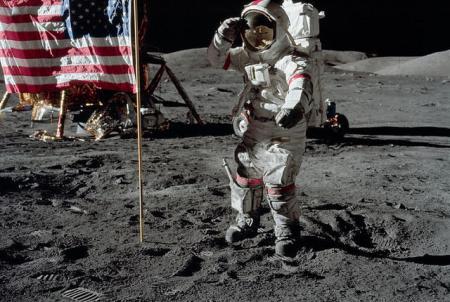
Astronaut and 2nd Class Boy Scout Eugene Cernan saluted the U.S. flag on the Moon, on the last Apollo mission, Apollo 17. Photography by Astronaut and Tenderfoot Scout Harrison Schmitt. NASA image.

A short piece I presented this morning to the Tom Harbin Scout Museum Symposium on Scout History, a great morning organized by Bob Reitz, the curator of the Tom Harbin Scout Museum at Camp Wisdom, in Dallas, Texas. Of course the material is copyrighted, but by all means you have permission to use the material at Courts of Honor or in recounting the better history of Boy Scouting.

Scouts Shooting for the Moon:  The story of twelve Moon walkers, and Scouting

This is a recreation with modern numbers of a presentation first used a decade ago. Searching for material for a speech to honor Eagles at our District Dinner, several people suggested in a short period of time, ‘Why not talk about the astronauts who landed on the Moon. I hear they were all Eagle Scouts.’  Was that accurate?  It would have been a good story if so. Research revealed something quite different. The true story can carry just as much inspiration, however. Scouting is shown to be a program that can lead to a lifetime of adventure and accomplishment. Also, Eagles may take some inspiration in knowing they have accomplished something most of the men who walked on the Moon did not.

Speakers constantly need good material for Eagle Scout Courts of Honor and other events honoring Scouts and Scouters. For one event honoring a group of new Eagle Scouts, several people urged that I research the facts behind the story they had heard, that most, or all of the men who walked on the Moon were Eagle Scouts. New Eagles would find comfort in knowing they had soared into the midst of such company, they reasoned.

So it came to pass that, before the advent of Wikipedia and Google, I spent hours on the telephone until a press person at NASA pointed out to me a collection of information on astronauts that NASA had thoughtfully put on-line. At some high cost I printed out the few pages that dealt with the Scouting experience of astronauts, and worked to correlate it with information about which of them had gone to the moon, and which had not.

Anyone can find that book online with ease, today. The NASA Astronaut Fact Book provides information on almost every detail about NASA’s crew of astronauts, past and present. It includes one-and-a-half pages on the Scouting background of people working as astronauts and payload specialists for NASA, and others NASA has launched into manned missions. Cross-indexing that information with lists of Apollo Mission astronauts, I created four short tables showing the Apollo astronauts who went to the Moon, their missions, and the Scout rank they achieved, if any.

Lunar Astronauts and Scouting Experience

Twelve Moon Walkers

Name Mission Dates on the Moon Scout Rank
1 Neil Armstrong Apollo 11 July 21, 1969 Eagle Scout
2 Buzz Aldrin Apollo 11 July 21, 1969 Tenderfoot Scout
3 Pete Conrad Apollo 12 November 19-20, 1969 Cub Scout
4 Alan Bean Apollo 12 November 19-20, 1969 1st Class
5 Alan Shepard Apollo 14 February 5-6, 1971 1st Class
6 Edgar Mitchell Apollo 14 February 5-6, 1971 Life Scout
7 David Scott Apollo 15 July 31-August 2, 1971 Life Scout
8 James Irwin Apollo 15 July 31-August 2, 1971 None
9 John Young Apollo 16 April 21-23, 1972 2nd Class
10 Charles Duke Apollo 16 April 21-23, 1972 Eagle Scout
11 Eugene Cernan Apollo 17 December 11-14, 1972 2nd Class
12 Harrison Schmitt Apollo 17 December 11-14, 1972 Tenderfoot Scout

Apollo 13

Name Mission Dates on the Moon Scout Rank
1 Jim Lovell Apollo 13 Lunar Swingby Eagle Scout
2 Jack Swigert Apollo 13 Lunar Swingby 2nd Class
3 Fred Haise Apollo 13 Lunar Swingby Star

Lunar Missions That Did Not Land

Name Mission Dates on the Moon Scout Rank
1 Frank Borman Apollo 8 Orbited only None
2 Jim Lovell Apollo 8 (&13) Orbited only Eagle Scout
3 William Anders Apollo 8 Orbited only Life Scout
4 Tom Stafford Apollo 10 Orbited only Star Scout
5 John Young Apollo 10 (& 16) Orbited only 2nd Class
6 Eugene Cernan Apollo 10 (& 17) Orbited only 2nd Class

Others Who Did Not Land

Name Mission Dates on the Moon Scout Rank
1 Michael Collins Apollo 11 Capsule pilot None
2 Dick Gordon Apollo 12 Capsule pilot Star Scout
3 Stewart Roosa Apollo 14 Capsule pilot None
4 Al Worden Apollo 15 Capsule pilot 1st Class
5 Ken Mattingly Apollo 16 Capsule pilot Life Scout
6 Ronald Evans Apollo 17 Capsule pilot Life Scout

In all, 24 men flew to the Moon. Twelve set foot on the lunar surface. Of the twelve, eleven were Scouts, two were Eagles. Of the 24, 20 were Scouts, three were Eagles.

At the time I originally researched, about 70% of all astronauts were alumni of Scouting, men and women. Officially, BSA lists 181 NASA astronauts as being alumni, 57.4%

NASA lists the colleges and universities astronauts attended. NASA lists military service, hometowns, and states of birth. But with the possible exception of a generic category of “public schools,” no category of astronauts is larger than the category of Scouting experience. If we were advising a young person on how to get to become an astronaut, we would be remiss if we did not advise him or her to join Scouting.

What can we conclude?

Three things became apparent to me in tracking these figures down. One, I learned once again that the true stories most often carry great value, more value than the stories people make up, or assume.

Two, I learned that Scouting by itself carries great value, without a Scout’s having earned Eagle. We know that not all the Moon walkers earned the Eagle rank. But we also notice that no flight ever went to the Moon without at least two Scouts aboard. Three of the 24 lunar voyagers are Eagles, 12.5%. Two of the dozen who actually set foot on the Moon are Eagles, 16.7%. Eleven of the twelve Moon walkers were Scouts, 91.7%. 21 of 24 lunar voyagers were Scouts, 87.5%.

So, while it was not necessary to be an Eagle, it certainly seemed to help. But simply having Scouting experience seemed to be the biggest help. There may be some magic in a boy’s having taken that oath that carries through his entire life, and spurs him to do daring and great things. That is important. A trend begins to emerge. Scouting by itself, without earning the highest rank, provides great value. When a boy signs up, he signs on for the adventure of a lifetime, and often that leads to a lifetime of adventure. That venturesome spirit carries on well past his Scouting years.

The story of Jim Lovell might carry some great weight with Scouts. Lovell is the only person to have gone to the Moon twice, but never set foot on it. He was the commander of Apollo 13, whose near-disaster was chronicled in the movie of the same name. Among other lessons that might be pulled out of the story:  When your Moon-bound spaceship explodes and loses power on the way to the Moon, it is often good to have an Eagle Scout handy to help get through the experience and return safely.

Is there inspiration here?

When I first presented these figures at a Scout meeting, a parent asked me whether these numbers would discourage boys from working for any rank advancement, since just being a Scout seems to carry such weight. This should not discourage Eagles, nor discourage any Scout from working to get the Eagle rank. We should look at it this way:  Every Scout who earns an Eagle has done what ten of the twelve who walked on the Moon did not do, perhaps could not do. Nine more Moon walkers started on that path to Eagle, but did not finish, or could not finish.

Not every Eagle can go to the Moon, but every Eagle has already won an award that most of those who did go to the Moon wish they had.

Especially in the circles of corporate and government leadership, character, what it is and how to get it, concerns people. What sort of character does it take to go to the Moon? Every Scout has a glimpse of what is required, and every Eagle can say, “I know what it takes to get such character.”

Bibliography

Human Spaceflight, “The Apollo Program,” NASA, July 2, 2009; accessed April 28, 2011; http://spaceflight.nasa.gov/history/apollo/

Astronaut Fact Book, NASA,  NP-2005-01-001JSC, January 2005; accessed April 27, 2011; spaceflight.nasa.gov/spacenews/factsheets/pdfs/astro.pdf

BSA, “Facts About Scouting,” 2009; accessed April 28, 2011; http://www.scouting.org/about/factsheets/scoutingfacts.aspx

“Astronauts With Scouting Experience,” Eagle Scout Information, U.S. Scouting Service Project, April 6, 2011; accessed April 29, 2011; http://www.usscouts.org/eagle/eagleastronauts.asp

About the author:

Ed Darrell teaches U.S. History at Moises E. Molina High School in Dallas. He has taught economics, government, world history and street law in high schools; he also taught at the University of Utah, University of Arizona, and DeVry University. He is a former speech writer for politicians. His degree in Mass Communication came from the University of Utah, and his law degree from George Washington University. This was presented to the Jack Harbin Museum Symposium of Scout History, April 30, 2011.

World Scout badge carried to the Moon by Astronaut Neil Armstrong.

World Scout badge carried to the Moon by Astronaut Neil Armstrong.


Save


Depending on your perspective, the world looks pretty good

January 2, 2011

If you’re a few dozen miles from the Earth, for example:

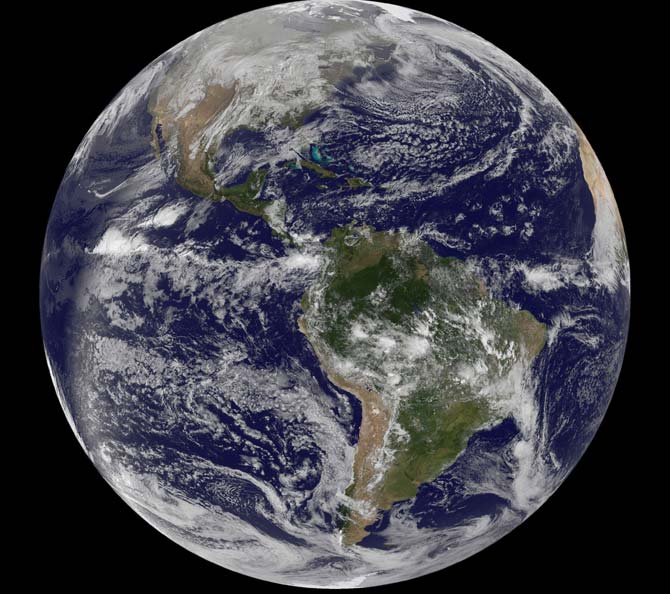
Earth full disc, December 30, 2010 - NASA, GOES

From NASA: The GOES-13 satellite captured a "full-disk image" of North and South America in an image created December 30 at 1445 UTC (9:45 a.m. EST), as the world awaits the new year. Credit: NOAA/NASA GOES Project; click on picture for larger view

Press information from NASA:

As the World Turns to 2011 GOES Satellites Watch its Approach and Look Back at 2010

The GOES series of satellites keep an eye on the weather happening over the continental U.S. and eastern Pacific and Atlantic Oceans and had a busy time with wild weather in 2010. Today, GOES-13 captured one of the last images of North and South America in 2010 as the world continues to turn toward 2011.

The Geostationary Operational Environmental Satellite called GOES-13 satellite captured a “full-disk image” of North and South America in an image created December 30 at 1445 UTC (9:45 a.m. EST) as the world awaits the new year. The stunning image shows cloud cover associated low pressure areas over the upper Midwestern U.S. and Colorado’s Rocky Mountains.

NASA’s GOES Project, located at NASA’s Goddard Space Flight Center in Greenbelt, Md., procures and manages the development and launch of the GOES series of satellites for NOAA on a cost-reimbursable basis. NASA’s GOES Project also creates some of the GOES satellite images and GOES satellite imagery animations. NOAA manages the operational environmental satellite program and establishes requirements, provides all funding and distributes environmental satellite data for the United States.

NASA’s GOES Project was very busy this year. GOES-13 monitors the eastern continental U.S., Atlantic Ocean, Gulf of Mexico and Caribbean, while GOES-11 monitors weather conditions over the western U.S. and the Eastern Pacific Ocean.

In 2010, GOES satellites were busy providing images and animations of weather systems from nor’easters to tropical cyclones that caused blizzards, flooding and wind damage.

Most recently, the GOES project used satellite data to create an impressive animation of the great Christmas weekend blizzard that pummeled the northeastern U.S. Prior to that, GOES imagery showed travel conditions for the holiday weekend when that low was over the Colorado Rockies.

On Dec. 19, the GOES-11 satellite captured an image of the famous “Pineapple Express.” Occasionally in the winter, a large jet stream forms across the mid-Pacific, carrying a continuous flow of moisture from the vicinity of Hawaii to California, bringing heavy rain and snow to the Sierra-Nevada for several days.

On Dec. 8 GOES-13 satellite imagery revealed a snow-covered, winter-like upper Midwest, several weeks before astronomical winter. On Nov. 24, GOES satellites helped Thanksgiving travelers figure out where delays may be happening.

During the summer, on July 25, GOES-13 imagery tracked one of the most destructive storms in years to strike Washington, D.C. and the surrounding area. Strong winds downed trees and power lines, leaving hundreds of thousands of residents without power, stopping elevators, and darkening malls and movie theaters. Falling trees killed at least two people. The NASA GOES Project created a satellite animation of the storm as moved through the region.

GOES-13 was busy in the Atlantic during the 2010 hurricane season. The Atlantic season started on June 1 and ended on November 30. The Atlantic season tied for third with two other years (1995 and 1887) as having the largest number of named storms at 19, and tied with two other seasons (1969 and 1887) for the second largest number of hurricanes, with 12. GOES-13 covered all of those tropical cyclones. GOES-11 didn’t see the action in the Eastern Pacific tropics that GOES-13 did, however. Because of a La Niña event, the 2010 Pacific hurricane season (which began May 15 and ended Nov. 30) was the least active season in terms of the number of named storms and hurricanes on record. All tropical cyclones can be seen at NASA’s Hurricane page archives for 2010 at: http://www.nasa.gov/mission_pages/hurricanes/archives/index.html.

On April 14, months before hurricane season started, GOES-13 became the official GOES-EAST satellite. GOES-13 was moved from on-orbit storage and into active duty. It is perched 22,300 miles above the equator to spot potentially life-threatening weather, including tropical storm activity in the Atlantic Ocean and Gulf of Mexico..

Before GOES-13 moved into the position previously occupied by GOES-12, GOES-12 captured a parade of three large storms the flooded the upper Midwest and Northeast in the second half of March. In the first half of March, GOES-12 covered storms as they dumped heavy rainfall in the Northeastern U.S.

On March 12, GOES-12 captured a very rare event in the tropics: the second–ever known tropical cyclone called Tropical Storm 90Q formed in the South Atlantic Ocean off the coast of Argentina.

During the first two weeks of February 2010, the GOES-12 weather satellite also observed a record-setting series of “Nor’easter” snow storms which blanketed the mid-Atlantic coast in two blizzards.

Whatever and wherever the weather in 2011, the GOES series of satellites will always go.

Related Links:

› GOES-POES web site
› NOAA web site

Rob Gutro
NASA’s Goddard Space Flight Center, Greenbelt, Md.


Last Space Shuttle mission: Help NASA pick the wake-up tunes

August 21, 2010

How about, “The Party’s Over” for the very last Shuttle wake-up call?

Press release from NASA, August 20, 2010:

RELEASE : 10-193

NASA Asks Public for Final Shuttle Missions’ Wakeup Songs

HOUSTON — If you like music, the space program and are a little nostalgic, NASA has the perfect opportunity for you. For the first time, the public can help choose songs to wake up the astronauts during the last two scheduled space shuttle missions.

Traditionally, the songs played to wake up the astronauts are selected by friends and family of the crews. For the last two scheduled missions, NASA is inviting the public to visit the “Wakeup Song Contest” website to select songs from a list of the top 40 previous wakeup calls or to submit original tunes for consideration. To vote or submit a song, visit:

https://songcontest.nasa.gov

The two songs with the most votes from the top 40 list will be played as crew wakeup calls on the final scheduled flight of space shuttle Discovery. Discovery’s STS-133 mission is targeted to launch on Nov. 1.

“We’re looking forward to hearing which songs the public wants played for us,” STS-133 Commander Steve Lindsey said. “It’s going to be a difficult choice, because there have been so many great songs played over the years.”

Original songs must have a space theme and be submitted to NASA by 4 p.m. CST on Jan. 10, 2011. The songs will be reviewed by agency officials and the top finalists put to a public vote. The top two songs will be used to wake space shuttle Endeavour’s STS-134 crew.
Endeavour’s mission is the last scheduled space shuttle flight. It is targeted to launch on Feb. 26, 2011.

“Space shuttle crews really enjoy the morning wake-up music,” STS-134 Commander Mark Kelly said. “While we don’t have the best quality speaker in the space shuttle, it will be interesting to hear what the public comes up with. We are looking forward to it.”

The song contest campaign follows NASA’s ongoing “Face in Space” project. It invites the public to send electronic images of their faces into orbit aboard one of the final remaining space shuttle missions. To submit your image, visit:

http://faceinspace.nasa.gov

For more information about the Space Shuttle Program and the STS-133 and STS-134 missions to the International Space Station, visit:

http://www.nasa.gov/shuttle

For more information about the space station, visit:

http://www.nasa.gov/station

– end –


NASA awards Global Climate Change Education grants

August 18, 2010

NASA announced a series of awards totaling $7.7 million to 17 agencies who will work to improve education on climate change. One of NASA’s goals and duties is to educate about NASA research.

These grants have been in the mill for a while, and should be welcomed by the winners of the awards. Wait for people convinced climate change isn’t happening or shouldn’t be prevented, to howl up a storm. 

Here’s the press release:

NASA Announces 2010 Global Climate Change Education Awards

WASHINGTON — NASA has awarded $7.7 million in cooperative agreements to 17 organizations across the United States to enhance learning through the use of NASA’s Earth science resources. The selected organizations include colleges and universities, nonprofit groups, and a community college. The winning proposals in the Global Climate Change Education Awards illustrated innovative approaches to using NASA content in elementary, secondary and undergraduate teaching, and lifelong learning. The proposals emphasized engaging students in NASA Earth observation data and Earth system models, and providing climate-related research experiences for teachers and undergraduate students. Each cooperative agreement is expected to leverage NASA’s unique contributions in climate and Earth system science. The grants support NASA’s goal of engaging students in the critical disciplines of science, technology, engineering and mathematics, and inspiring the next generation of researchers and explorers. The 17 proposals will fund organizations in Washington, D.C., and 13 states: California, Colorado, Florida, Idaho, Massachusetts, Minnesota, Nebraska, New Hampshire, New York, North Carolina, Ohio, Oregon and Pennsylvania. Winning proposals were selected through a merit-based, peer-reviewed competition. The performance period is up to three years and awards range in value from $300,000 to $700,000. For a list of selected organizations and projects descriptions, click on “Selected Proposals” and look for “Global Climate Change Education” at: http://nspires.nasaprs.com For information about NASA’s education programs, visit: http://www.nasa.gov/education

– end –

Winning proposals came from organizations across the nation (home state listed in parentheses; last name of principal investigator after the dash). Selected proposals in Funding Category D/M: Using NASA Earth system data, interactive models and simulations to Strengthen Teaching and Learning about Global Climate

  • American Meteorological Society – Brey
  • Columbia University – Chandler
  • Cayuga Community College (New York) – Coughlin
  • University of Toledo (Ohio) – Czajkowski
  • University of California at Riverside – Droser
  • University of North Carolina – Gray
  • Florida Atlantic University – Lambert
  • University of New Hampshire – Martin
  • Colorado State University – Moore
  • University of Idaho – Mulkey
  • University of Minnesota – Roehrig
  • University of Massachusetts – Rooney-Varga
  • SRI International (California) – Zalles

Selected proposals in Funding Category R: Global Climate Change Science Research Experiences for Pre- or In-Service Teachers

  • Institute for Earth Science Research and Education (Pennsylvania) – Brooks
  • Harvard University – Ellison
  • University of Nebraska – Gosselin
  • Oregon State University – O’Connell

Details of the winning proposals can be found here.


Power Line, on NASA and Islam: When you start believing your own fictions, you’re in trouble

July 8, 2010

Astronaut Charles Bolden, veteran of four space missions. President Barack Obama appointed Bolden to be NASA Administrator. NASA image.

Astronaut Charles Bolden, veteran of four space missions. President Barack Obama appointed Bolden to be NASA Administrator. NASA image.

Let go of the power line, step back, and no one else will get hurt.

Paul Mirengoff at the much-read, and as we shall see, too-much-trusted PowerLine, asks a heckuva a question:

As Scott points out in the post immediately below, the news that President Obama tasked NASA head Bolden, as perhaps his foremost mission, with raising Muslim self-esteem is entirely absent from the New York Times and the Washington Post, as well as the nightly newscasts of ABC, NBC, and CBS. Why?

It might be, as Mirengoff goes on to speculate wildly and without reason, because the news agencies are taking payoffs from Obama, or just so enthralled with him that they can’t bring themselves to report bad news.

Think about that for a moment:  News agencies unwilling to report bad news?  Is your Hemingway Sh__ Detector working yet?  Mine’s clanging something fierce.

Does Mirengoff seriously think the Poobahs at Disney sit around issuing orders that ABC news gatherers ignore bad news about Obama?  Has Mirengoff been in some sort of plastic bubble, deprived of newspapers and television for the past four years?

Why the silent treatment?  Because it’s very much a not-much-news story, Paul.  It doesn’t say what you think it says, or worse, what you know it doesn’t say, but claim it does for whatever trouble you can stir up.

Charles Bolden, NASA’s administrator, explained for a news channel that broadcasts to the Middle East, what his job is with regard to the Arabic and Islamic populations (this is the version reported by York):

“When I became the NASA administrator, [Obama] charged me with three things,” NASA head Charles Bolden said in a recent interview with the Middle Eastern news network al-Jazeera. “One, he wanted me to help re-inspire children to want to get into science and math; he wanted me to expand our international relationships; and third, and perhaps foremost, he wanted me to find a way to reach out to the Muslim world and engage much more with dominantly Muslim nations to help them feel good about their historic contribution to science, math, and engineering.”

Good reporters would look at the interview, and realize the PowerLine guys got the story dead wrong.  Not bothering to speculate on why part-time yahoos misreported the story, they’d go on to real news.

Note carefully what Bolden said, and then note carefully what he did not say.  Bolden didn’t say the mission of NASA had changed.  Bolden didn’t say Obama told him to ignore the mission of NASA.  Bolden said NASA, arguably our nation’s most famous and vanguard science agency, has a top duty to inspire children to do well in science in math, to cooperate with other nations in exploring space as we have done since at least the Reagan administration, and, for audiences in Arabic nations, to help them understand Arabic contributions to science.

“Let go of the power line, step back, and no one else will get hurt.” Downed powerline in New Jersey, in summer 2011. Photo by Saed Hindash, The Star-Ledger

Bolden did not say, as Hot Air misreported, “NASA’s spaced-out mission no longer includes  . . . space.”  Hot Air isn’t reporting.  This is a time-tested propaganda technique they engage in:  MSU, “making [stuff] up.”

Which of those goals does Power Line disagree with?  Each of them is a noble enterprise on its own.

But, pausing for just a moment to make liars out of Power Line and the Examiner, and others, ABC News got it right. How soon do you think Mirengoff or Scott Johnson at Power Line will update their story to note ABC reported it?  How much longer before others do?

Media Matters, who tend to be more careful and much, much more accurate, tells most of the story in the headline of their story:  “Yet again, an Obama official says ‘Muslim,’ right-wing media freakout follows.”

If ABC can get it right, why not these other guys?

Yellow journalism was bad enough the first time around.  PowerLine, could you at least take the time to get the story right?  If you don’t have a Hemingway to help you out, you can always use the old Cheech and Chong Excrement Detection Method.  I don’t recommend it, but it tends to make reporters more careful if they ever use it once.

You gotta wonder why these people spread easily-falsified, malignant rumors.  Who are they working for?  It’s pretty clear they don’t have much respect for their readers.

This is a hoax, people.  NASA has not changed its mission.  The president cannot change NASA’s mission since that is dictated by law (it requires an “act of Congress,” literally).  NASA’s chief did not say that stupid thing others claim — he’s not stupid. Don’t pretend it’s news, don’t pretend it’s a problem when the head of NASA says he’s trying to promote interest in science, math and history, and international cooperation.  That’s his job.

No one was assigned the job to get the story wrong.  I wish people would quit working so hard at it.

What is Obama’s policy on NASA?  Here’s the 2011 Budget Message.

Here’s the full Al Jazeera interview these guys misreported:

Here’s the Wall of Shame of blogs, reporters and news outlets who screwed up the reporting, in addition to Powerline, twice.

Also see this:  Obama:  A bold new course for NASA

Save

Save


July 4, 2010 – Fly your flag today

July 4, 2010

Fourth of July:  NPR has already read the Declaration of Independence, PBS has the Capitol Fourth concert this evening (8:00 p.m. Eastern — check your local listings), your town has a parade somewhere this weekend, and fireworks are everywhere.

Remember to put your flag up today.

Astronaut Eugene Cernan and the U.S. Flag -- Apollo 17 on the Moon (NASA photo)

Last flag on the Moon: Astronaut Eugene Cernan and the U.S. Flag -- Apollo 17 on the Moon (NASA photo)

Also:

Lunar Reconnaissance Orbiter photo of Apollo 17 landing site

Lunar Reconnaissance Orbiter photo of Apollo 17 landing site