Toad mapping – another cool tool

August 16, 2007

What amphibians can be found in your local biome? Great Plains toad, Bufo cognatusWhat is the range of a particular amphibian, say the Great Plains toad? What does that toad look like? How does it sing?

hear call (10337.1K WAV file)

Great source to supplement geography lessons: Amphibiaweb, a special project at the University of California – Berkeley.

Quite student friendly — get to the world map, click on your continent (ooh! kids gotta know what continent they’re on! see social studies TEKS, World geography 4.C, U.S. history 8, World history 11), click on your country, if you’re in the U.S., click on your state. Photos, maps of the range, scientific names, sound recordings of their calls, description, conservation status.

Read the rest of this entry »


Power of a community with common purpose

August 12, 2007

There is a lesson in here about common purpose, maybe even one about democratic action as opposed to a rigid patriarchy (though I confess, I don’t know that water cape buffalo don’t also have a rigid patriarchy).

In any case, the large, gentle creatures beat out two competing, sharp-toothed predators, to save a calf. Parents uniting can do great things.

Amazing video, really:

Tip of the old scrub brush to Telic Thoughts — the most thoughtful post they’ve had there in some time.


Saving Texas’s only natural lake

August 3, 2007

Aptly named, Salvinia molesta threatens to choke Caddo Lake to death. As Caddo Lake is the only natural lake in Texas, and a site of outstanding beauty and great natural treasure, the friends of Caddo Lake are fighting back.

Spraying Salvinia molesta on Caddo Lake - NY Times photo by Michael Stravato

The New York Times features a lengthy story on the lake and the fight to save it in this week’s Science section (July 31, 2007 – Science is part of the Times every Tuesday).

Every Texas social studies teacher should know Caddo Lake and its stories as well as anything else. It’s the stuff memorable classes are made of.

1. It’s the only “natural” lake in Texas, though it is formed by a dam. The “only honest lake in Texas,” in the local lingo. The original lake was formed by a monumental log jam on the Red River, probably trees blown down by a massive hurricane several hundred years ago.

2. Caddo Lake is named after the Caddo Tribe, the tribe whose word for friend, “tejas,” gave the state its name. (See my earlier post on Caddoland.)

3. Caddo Lake straddles what was once “no man’s land,” or the Neutral Territory, a buffer zone between English/French, then American, and Spanish, then Mexican settlements. It was a haven for criminals, scalawags, filibusterers and revolutionaries. The area plays a large role in the decades of fighting to steal Texas from the Spain, and later from Mexico. Texas history is much better understood when one knows the lake.

4. Caddo Lake once was the means to make Jefferson, Texas, a port city. Until Col. Shreveport dynamited the logjam that made the lake in 1873, Jefferson was a bustling center of commerce. Today Jefferson boasts some wonderfully preserved historic remnants of that era, many converted to bed and breakfast inns, a great weekend getaway. Fishing is good, photography is great.

5. Ladybird Johnson was born nearby, and her family still lives in the area.

6. The Hughes Tool Company had its beginnings on Caddo Lake, where Howard Hughes, Sr., tested his drill bit, “the rock eater,” designed to cut through mud and rock to where the oil was; this is the home of the fortune that Howard Hughes, Jr., inherited, to build to one of the greatest fortunes in the world. That the younger Hughes was a rake, a mechanical genius, an air pioneer, daring movie producer, and weird as hell only makes the story better. Hughes named his movie production company after the lake, Caddo Productions.

6. Contrary to most of Texas’s political leanings, local people around Caddo Lake have rallied to efforts to protect the lake and conserve its rare beauty. The area is designated for protection as a Ramsar Treaty critical wetlands site — a designation that most conservative Texans ridicule and fear (at one point the Texas Republican Party platform opposed conservation easements to protect the lake bizarre). Latter-day Caddoans welcome the designation, and when we toured the area they sang the praises of Don Henley, the rock and roll musician who is aiding their efforts to save the lake. It’s an odd combination for any political work — uniquely Texas. (Here’s your chance to play the Eagles for your classes, teachers!)

7. When it comes to Texas botany, zoology, and biology in general, Caddo Lake provides the local angle for water quality, water shortages (one proposal is to steal water from the lake for Texas cities far away), wildlife management, and of course, the invasion of exotic species.

8. Everything about this area screams Texas quirkiness. Uncertain, Texas? An often-told story (accurate?) is that when the town applied for a post office, there was a dispute about what to call the town. The fellow who filled out the application wrote “uncertain” in the blank for the town’s name — and that’s how the U.S. Postal Service approved it. Another story holds that the name “Uncertain Landing” caught on because the landing was treacherous mooring for boats. You got a better story about your town’s name? I doubt it.

Save the article from the Times, teachers! You’ll be glad you have it later this year.

Add to FacebookAdd to NewsvineAdd to DiggAdd to Del.icio.usAdd to StumbleuponAdd to RedditAdd to BlinklistAdd to TwitterAdd to TechnoratiAdd to Furl


Disasters, on sale

August 3, 2007

Cover of NYTimes book on disastersFollow-up on yesterday’s post on disasters:  Looking at the sale books at the New York Times site, I discovered this one on sale:  The New York Times Book of Natural Disasters.  $8.48, while supplies last.

Tuesday’s Science sections in the Times are weekly delights.  This series of books on one topic contains several that I use regularly (especially archaeology and fossils).  Generally these books hold some of the best articles by the stable of thoroughbred science writers on the topic at hand.

Did I say “science?”  Social studies teachers need to know science, too.


Disasters!

August 2, 2007

Popular Mechanics features the “Ten Worst Disasters of the Century,” showing how Americans fought back after natural disasters in — roughly — the 20th century.

It’s an odd century used — it leaves out the Galveston, Texas, hurricane disaster of 1900, but it includes Hurricane Katrina in 2005 (maybe it would more accurately be titled “disasters of the last 100 years”). The list is limited to natural disasters, so the Texas City harbor disaster of 1947 isn’t even considered, and the New London, Texas, school explosion doesn’t make the list. Those are quibbles; Texas teachers, and others, can supplement the list to accommodate other local, national and man-made disasters.

The Dust Bowl, which I would argue was greater than any of the other disasters listed, is also left off — too long a disaster?

The Popular Mechanics list is still a treasure trove for geography and history teachers. You might want to go out today to find the magazine at a newsstand, and pick up a copy or two. Throughout this post I sprinkled several links to the website of Popular Mechanics.

Here is the Popular Mechanics list of top 10 natural disasters, in chronological order:

1. 1906 San Francisco Earthquake

2. The Big Burn of 1910

3. 1918 Spanish Flu Epidemic

4. Tri-state tornado of 1925 (one tornado across Missouri, southern Illinois and Indiana)

5. The New England Hurricane of 1938

6. The Great Alaskan Earthquake and Tsunami of 1964

7. 1974 Super Tornado Outbreak

8. Mt. St. Helens Eruption, 1980

9. 1993 Storm of the Century (snow)

10. Hurricane Katrina, 2005

There you have ten disasters of the 100 years between 1905 and 2005. For a geography or history class, that could be ten days of study — a map each day, a history timeline each day featuring especially who was president at the time (and how the president reacted), a story of geology or meteorology or public health each day. At the end of a ten-day unit the class could have made ten different maps covering most of the U.S. but Hawaii, covering the technology developments of the 20th century, especially the development of radio, air travel, and space technology (weather satellites), and covering the development of human institutions to cope with disasters and prevent future disaster, especially communication, transporation, medical care, banking and other investments (the rise of the Bank of America from the San Francisco Earthquake is a great little piece of history all by itself), and government.

This is not the curriculum most of the state testing authorities envision. Students will remember the geography, history and technology of these ten days with a lot more clarity and depth than most other units a teacher might cover.

Alternatively, these could be ten Disaster Fridays, reinforcing geography and history in particular. I’m sure I’ve just scratched the surface — how do you use disasters, especially these ten, in your classroom now? Tell us about it in the comments, please.

Other disasters?

No rule says you have to stick with ten, or that you need to stick with the 20th century, or with natural disasters. Here are several other disasters that you may want to include in your curricula, again in chronological order:

The Great Chicago Fire of 1871 (October 8), which every school kid ought to know about; coupled with the fire in Peshtigo, Wisconsin, the same night, which was the deadliest fire in American history; news was slow to get out because nearly every person in Peshtigo died, and the town was literally burned off the map.

The blizzards of 1888 — the Schoolhouse Blizzard of January 12, which killed more than 200, mostly school students, and the Great Blizzard of 1888 which paralyzed much of the nation a couple of months later, from March 12 to March 14.

The Johnstown Flood, May 31, 1889 — a disaster seriously compounded by the folly of men and a leaky dam.  2,200 dead.

The Galveston Hurricane of 1900, memorialized in the best-selling history Isaac’s Storm. At least 8,000 people died in Galveston, Texas’s largest city — and maybe as many as 15,000. There were too many bodies to count. Galveston invented a new form of government to help recover from the storm, the city commission style of government, which has been adopted widely throughout the U.S. Another large hurricane struck Galveston in 1915, killing 235 people — but it was so small in comparison, it is usually forgotten.

The 1909 Cherry Mine Fire (Bureau County, Illinois) — 259 men and boys died in a coal mine fire.

Dawson, New Mexico, Mine Disaster, October 22, 1913. 263 dead.

The Sinking of the Steamer Eastland on Lake Michigan, July 24, 1915. 840 people died.

The Boston Molasses Disaster of 1919, which featured walls of hot molasses 35 feet high careening through the streets of Boston — 21 died.

The Tulsa Riot, 1921 — a race riot that killed 300 people and destroyed the African American “Wall Street.”

The Great Mississippi Flood of 1927, which shook the social and civic foundations of riverside cities and towns.

The Dust Bowl, 1931-1939

The Ohio River Flood of 1937, which killed over 200 and pushed a million people out of their homes.

The New London, Texas, School Explosion, March 18, 1937.  In Texas’s richest school district, a gas pipeline heated the building for free.  In the era before odorfactants were added to natural gas to alert people of leaks, no one suspected the leak.  Nearly 300 died in the explosion, mostly children.

The 1946 Aleutian Islands Earthquake and Tsunami, and the April Fools Tsunami in Hawaii. An earthquake registering 7.8 struck the Aleutian Islands in far western Alaska. Six people died there. 159 people died in Hawaii when the resulting tsunami struck several hours later — the death toll perhaps increased because many people thought the warnings of a coming wave to be an April Fool’s prank.

The Texas City Explosion, 1947

The Montana-Yellowstone Earthquake, 1959, a 7.3 shaker which killed 28 people and created a new lake, Quake Lake, on the Madison River.

The Watts Riots, August 1965.

The Detroit and Newark Riots, 1967. Yes, it was “the Summer of Love.” Still, there were 164 “civil disorders” (riots) in 128 different U.S. cities. Detroit and Newark were the worst.

The Yellowstone Fires, 1988.

The Great Flood of 1993 (Mississippi River).

The 1997 Red River Flood (North Dakota, Minnesota and Manitoba, Canada).

Good heavens. That’s a depressing list. Still, I wonder — have I left anything off? Tell me in the comments, if you see something missing.

Other sources:


Tracking hurricanes for classrooms

July 31, 2007

This image of Tropical Storm Chantal depicts wind speed in color and wind direction with small barbs. White barbs point to areas of heavy rain. The highest wind speeds, are shown in purple. The data were obtained by NASA’s QuikSCAT satellite on August 1, 2007, as it was just south of Newfoundland, Canada. NASA image

This image of Tropical Storm Chantal depicts wind speed in color and wind direction with small barbs. White barbs point to areas of heavy rain. The highest wind speeds, are shown in purple. The data were obtained by NASA’s QuikSCAT satellite on August 1, 2007, as it was just south of Newfoundland, Canada. NASA image

Here in North Texas, most of our classrooms see refugees from coastal storms from time to time — in fact, most schools still have refugees from Hurricane Katrina, or Hurricane Rita. Plus, sitting close to Tornado Alley, everyone understands that weather is no abstraction here. Weather is personal.

Maps of weather offer teachers a good way to make geography personal, too — or at least more relevant. Those little clouds swirling west from the coast of Africa today could be the hurricane that swamps the Texas coast in a couple of weeks.

An e-mail correspondent sent a link to the Weather Channel’s Hurricane Central, suggesting I might want to track storms for my personal safety (Tropical Storm Chantal is far off in the Atlantic, and racing away; no problems from that storm).

Why not have kids track storms in class? The map above, for example, should be a basic foundation for much of Texas history (the explorers and Spanish colonization, for example), for U.S. history (explorers and the slave trade, the Triangle Trade, the Battle of the Atlantic in World War II, and so on). Get students used to using maps to track important and interesting things, and map use will become second nature, as it should be. The Weather Channel and other sources create updates on that basic map several times a day.

What sorts of storms did the explorers face? The slave ships? How big was the storm that shipwrecked Esteban in Texas? What is one likely source of the massive forest blowdown that created the greater Caddo Lake?

Hurricane season runs through October. There should be a lot of grist for the learning mill just in the daily weather reports. You might also use the weather maps in the daily newspaper (most local newspapers will give you a classroom set for a week for under $20.00 under the Newspapers in Education (NIE) project) (NIE offers an interactive quiz on geography weekly, by the way).

Is there any kid who isn’t fascinated by the weather? That’s your hook. Maps are freely available from the Weather Channel site, and from dozens of others.

Caption from NASA: The third tropical depression of the Atlantic hurricane season formed around 11:00 p.m. EDT on Monday, July 30 west of Bermuda. Exactly 12 hours later on Tuesday, July 31, at 11:00 a.m. EDT, the storm strengthened into a tropical storm with sustained winds of 40 mph and higher gusts. At that time, the storm was named Tropical Storm Chantal. Chantal was located near latitude 40.2 north and longitude 62.7 west, about 330 miles (530 km) south of Halifax, Nova Scotia and is moving rapidly toward the northeast near 23 mph (37 km/hr). Chantal is not a threat to the United States.

Caption from NASA: The third tropical depression of the Atlantic hurricane season formed around 11:00 p.m. EDT on Monday, July 30 west of Bermuda. Exactly 12 hours later on Tuesday, July 31, at 11:00 a.m. EDT, the storm strengthened into a tropical storm with sustained winds of 40 mph and higher gusts. At that time, the storm was named Tropical Storm Chantal. Chantal was located near latitude 40.2 north and longitude 62.7 west, about 330 miles (530 km) south of Halifax, Nova Scotia and is moving rapidly toward the northeast near 23 mph (37 km/hr). Chantal is not a threat to the United States.

Save

Save

Save


DDT out, eagles back in Michigan Upper Peninsula

July 30, 2007

Another story of the success of the restrictions on use of DDT:  The recovery of eagles in Michigan; from the Escanaba Daily Press.


Eagles at edge of Escanaba River


Alfred Hitchcock? In Austin?

July 26, 2007

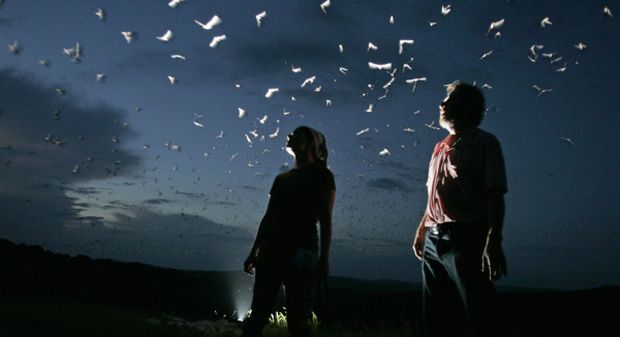
It’s a twist on the story the Mormons in Utah have a monument to — in the Mormon version, it was birds that saved them from the crickets.

Read the rest of this entry »


Cicadas, cicada-killer wasps are back!

July 20, 2007

Cicada killer wasp, from Purdue University

Extensive rains delayed them a bit, but our annual cicada cycle started up with vigor sometime in the last ten days. For the past three years, we get the announcement at our house, not from the cicadas singing from the trees, but from the cicada-killer wasps that buzz our back patio area, scouting the yard for good places to bury their prey.

It started with one female burying cicadas under the patio; perhaps another joined her by the end of the first season. But last year, we had about a dozen buzzing about the yard. We have plenty of cicadas, so it should be good pickings for the wasps — so long as no one sprays insecticide on them.

These wasps are larger than most wasps, as long as 2.5 inches, and big enough to muscle a cicada around. The cicadas are twice as big, volume wise, but I suspect they weigh less. In any case, the wasps show outstanding strength and coordination in zooming around carrying their paralyzed victims to their holes — yesterday I saw a wasp rocket into a hole in the garden without the usual stop to drop the cicada and tug it in. The hole was a perfect fit. Jet air delivery.

The wasps leave us alone as we watch. We’ve never been stung, and I don’t know that these guys sting humans (unless attacked, and I assume they’d fight back).

Their ability to move dirt is amazing. We usually get a pile of soil about a foot around and three to six inches high at each hole.

So far as I know, down here in Dallas we don’t get any massive infestations of the the 13- or 17-year cicadas. I cannot imagine how such a feast might affect these industrious little guys, other than they might fly themselves to death. We lived through a double hatching of the 13- and 17-year cicadas in Maryland. Corpses of the cicadas made some streets slick enough they were dangerous to drive. Man, what I wouldn’t have given for a few thousand cicada killers then!

Cicada killers, or cicada hawks, sting and paralyze cicadas, then inter the still-living cicada with one egg laid in it for male larvae, or one egg with two cicadas, for female larvae. The wasp egg hatches and the larva consumes the fresh cicada; some of the wasps survive the winter, and I don’t know if the cicada is kept fresh the entire time, or if a few of the wasps hatch and go dormant.

My photos didn’t turn out as well as those from Purdue and Michigan State — the buggers are fast and restless. The photos could easily have come from our yard, with the massive blossoming of the yellow composites right now (“DYCs” in local horticultural parlance).

Watch your yard — you probably have these tiny “True Life Adventures” going on in your own backyard. You can encourage them with careful plantings, and especially by not spraying poisons (did I mention that between the predatory insects and the now-large geckoes that have taken up residence here, we don’t have cockroaches and other nasty house pests?).

The photo below shows a wasp carrying a cicada.

Cicada killer carrying cicada, from Michigan State U Extension

Update on resources (7-30-2008):

Add to FacebookAdd to NewsvineAdd to DiggAdd to Del.icio.usAdd to StumbleuponAdd to RedditAdd to BlinklistAdd to TwitterAdd to TechnoratiAdd to Furl


4 Stone Hearth #19

July 19, 2007

Prehistory and archaeology fans will want to check out the latest archeaology carnival from the 4 Stone Hearth series — Number 19 is up at Sherd Nerd.

Texans may want to pay particular attention to the links to John Hawks’s blog, where he talks about the coming display of Lucy, in Houston, with further links.  Hawks notes controversy among the U.S. community of Ethiopians; Texans may worry more about complaints from Texas creationists.

Either way, you need to check it out.  You can link back here, to my post on stories and history, too (thanks, Sherd Nerd!).


Use the work of local photographers

July 19, 2007

The Dallas Morning News offers a column by a mensch named Steve Blow two or three times a week. Most good daily papers in America have something like it — a column by a reporter or former reporter, or sometimes just someone in the community who can write, that covers the beat of being alive in This Town, wherever this town is.

About half the time the columns stake out positions on issues that make a few people angry enough to write letters demanding the column be burned and the author be dangled by the toes from the flagpole jutting out of the third story window of the newspaper building. The rest of the time, to careful readers, these columnists tell stories of the city, or talk about people you ought to know.

On July 12, Steve Blow wrote about a guy who takes pictures of birds at Dallas’ White Rock Lake. Texas has three major bird migration flyways coursing through it, offering opportunities for Texans to see hundreds of different species through the year.  J R Compton takes advantage of this, photographing birds and then posting the photos at his website.

Egret, from J. R. Compton

These are great photos for use in geography, biology and environmental science classes.  Heck, a Texas history course ought to note Texas’ great bird viewing, too, since it’s an important industry (if somewhat smaller than oil or auto customizing).

Most kids I see in school know almost nothing about birds.  Following bird migration routes is a fun and sneaky way to get kids thinking about geography, about paths of commerce for economics and history, and just to get them looking around their world to see what’s going on.

Particularly for Dallas and North Texas, these photos offer kids a chance to see what they should be looking for, literally in their own backyards.

Black-crowned night heron at White Rock Dam

Compton’s photos can also be found at his websites, such as J R’s Birds, and Addlepated Birder.  His chief site is www.jrcompton.com.

Especially with digital cameras so common, it is likely someone in your town is recording natural events, or pictures of the city that you can use in your classroom, too.  Be sure to credit them, to set an example for your students.

  • Photo of egret in flight and night crowned heron both taken at White Rock Lake in Dallas, Texas, photos copyright by J R Compton.
  • Update, April 19, 2010:  Mr. Compton wishes to be contacted before you use his photos (see his note in comments); if you’re using these in a classroom PowerPoint, drop him a note.  Students can probably claim fair use for papers, but you should encourage them to ask, too.

Lady Bird Johnson, 94

July 12, 2007

Did I mention that we considered Lady Bird Johnson to be a family friend?

Ladybird Johnson among wildflowers

  • Ladybird Johnson in a field of Texas wildflowers, gaillardia and probably coriopsis, 2001; photo by Frank Wolfe, MacNeil/Lehrer Productions and KLRU-TV production, “Lady Bird”

We didn’t know her that well, really. But for the two years prior to our move to Texas, when I staffed the President’s Commission on Americans Outdoors, she was a solid presence. A passionate advocate of wildflowers, she was well aware of the possibilities that the commission might make recommendations regarding gardening and walking and hiking, and preserving natural beauty. She had already convered Tennessee Gov. Lamar Alexander to the cause — he issued an executive order that Tennessee should not cut down wildflowers along roadsides, saving the state a bunch of money on mowing and adding to the beauty of the state’s roads all at once. Alexander chaired the commission.

But she went to work on the vice chair, too — Gil Grosvenor, the president of the National Geographic Society. And she worked on the commission director, Victor Ashe, who had recently lost a U.S. Senate campaign to Al Gore and would go on to be mayor of Knoxville and chairman of the National Conference of Mayors. Lady Bird did not want to let any potential ally go unpersuaded. She had the phone numbers, and she made the calls, especially the late-in-the-day-catch-the-big-fish-without-a-secretary calls. Some of the people who go out of channels that way are very obnoxious. Lady Bird always produced smiles.

She persuaded them and the other commissioners to her cause, the commission staff, and probably anyone who ever bothered to read the reports of the commission or who attended any of the several public hearings where the joys and value of wildflowers was discussed.

And then we moved to Texas, and in the spring time we could see what Lady Bird’s passion was all about. It helped that Kathryn decided to chase her own passion for horticulture, and fell in with a great bunch of landscape designers and nursery people who emphasized Texas native plants. We joined the wildflower center Lady Bird set up in Austin, and actually met her on a couple of occasions. Kathryn and I both worked in the U.S. Senate, and we know stuffy people. Lady Bird was not stuffy, but always a woman of infinite charm and grace.

Most recently, when our son James earned his Eagle rank in Scouting, Lady Bird’s name was on the list of those public figures who would be gracious enough to drop a note of congratulations if asked. We know how to recognize the letters signed by machines, and we know how to recognize letters written by software that mimics handwriting. So it was a pleasant surprise to get a hand-addressed note from Austin, and see that the handwriting on the note matched the envelope. That’s the way a lady does it.

In Texas now, in the spring time there are bluebonnet watches, maps in newspapers showing a path to drive to see the best blooms, festivals, and trinkets galore. An entire industry of photographers revolves around getting families to sit among the flowers at the side of the road for a portrait. The flowers, other than the bluebonnets, show brilliantly to incoming airplanes. A flight from Houston or Austin to Dallas gives a passenger a floral sendoff and a floral welcome at the other end.

You can read the stories. Lady Bird was the financial manager of the Lyndon Johnson family fortune. She was also the peacemaker, the one who got LBJ calmed down from his frequent flights of passion, calm enough that he could be the best legislator our nation ever had, including James Madison, and a great legislative master even as president, as no president before or since.

Steel magnolias have nothing on Lady Bird Johnson, who understood the power of a blanket of flowers, the importance of roots and family, and how much grace can mean to those who get it.

Teachers in Texas should hit the newstands today and get the papers with the special features — the Dallas Morning News front page and front section are full of good stories. Teachers should get to the news websites and get the stories that will disappear in a week downloaded for later use. U.S. history teachers would do well to do the same, to get the information about the American environmental movement, and to pick up additional history on Lyndon Johnson, Vietnam, the successes of the civil rights movement, and the amazing decade of the 1960s.

America is better because of Lady Bird Johnson. She worked to be, and was, a family friend to the entire nation.

Here are sources you can check from contemporary news:

Dallas Morning News coverage


Former first lady dies at 94

LBJ trusted Lady Bird with his true self, warts and all

Lady Bird cultivated natural beauty from Western wilderness to inner cities

Journalist remembers her friend

Remembering Lady Bird

Editorial: She showed world grace, gentleness

Timeline: Her life and times

Services planned for Lady Bird Johnson

Statement from President George W. Bush

Statement from former President Bill Clinton and Sen. Hillary Clinton

Submit: Sign the online guestbook

Photos: The life of Lady Bird Johnson

Video:
Remembering Lady Bird Johnson (WFAA-TV)
Kay Bailey Hutchison on Lady Bird Johnson (WFAA-TV)
John Cornyn on Lady Bird Johnson (WFAA-TV)
Mrs. Johnson’s impact on Central Texas (KVUE-TV)
Lady Bird Johnson’s Legacy (KVUE-TV)
Family friend and spokesman Neal Spelce shares his memories of Mrs. Johnson (KVUE-TV)
Reaction from the LBJ Library and Museum staff (KVUE-TV)

Links
Lady Bird Johnson Final Tribute
Lady Bird Johnson Wildflower Center
Lady Bird Johnson biography
Lyndon Baines Johnson Library and Museum

Tip of the old scrub brush to O’Folks.


Update: War against science and Rachel Carson

July 11, 2007

Some links you should check out, in the continuing fight for reason against the bizarre campaign against the reputation of Rachel Carson, against the World Health Organization, and against fighting malaria, and for unwise use of DDT:

1.  Alan Dove, at Dove Docs, notes an entirely new way of thinking about immunity against malaria:  “A New Twist on Herd Immunity”

2.  Insight from Bug Girl:  “Scientists, media, and political activism;”  also check out her post on new research on mosquito bed nets.

3.   Deltoid posted several good pieces since last I linked; go here, and here.  Be ready:  Tinfoil hat brigade comes out in the comments to the first piece.


Nutshell: The case against the critics of Rachel Carson

July 9, 2007

Mothers who read Rachel Carson’s book asked supermarkets to stop carrying produce or other products laced with DDT, as a precaution against damage to their children. It’s appropriate that a mom’s blog would make the case against Carson’s critics so succinctly, so go read it.


Another reason why DDT use damages mosquito control: Bats

July 9, 2007

Erich Schlegel photo, bats leaving a cave near Frio, Texas, U of Tenn researchers look on

UTenn grad student Noa Davidai (L) and Prof Gary McCracken watch bats come out of Frio Cave

  • Photos by ERICH SCHLEGEL/DMN

University of Tennessee graduate student Noa Davidai (left) and professor Gary McCracken watch freetail bats emerge from the Frio Cave near Uvalde, Texas. They study the range and value of bats, such as insect control for farmers. And ‘fecal rain’? That enriches soil, Dr. McCracken says. (Dallas Morning News, July 9, 2007, p. 1)

It’s easy to understand. Look at the on-line Dictionary.com definition of the Mexican free-tailed bat, for example:

Mexican free-tailed bat

–noun

any of several small, insect-eating bats of the genus Tadarida, of Mexico and the southwestern U.S., inhabiting limestone caves: residual DDT has reduced most populations.

Dictionary.com Unabridged (v 1.1)
Based on the Random House Unabridged Dictionary, © Random House, Inc. 2006.

Was that difficult? It’s right there in the definition of the animal: DDT kills bats.

Bats eat mosquitoes, those things that carry malaria and other diseases. A Mexican free-tailed bat eats about 70% of its body weight in mosquitoes, every night.

This morning’s Dallas Morning News has a front page story, with great photo, on the value of bats in Texas, “Taking bats to the bank.”

Researchers have long known that bats in Texas caves dine on insect pests. But just how many bats there are and the value of their feeding had proved elusive until a five-year, $2.4 million National Science Foundation study by scientists from Boston University, the University of Tennessee, the U.S. Department of Agriculture and Texas Parks and Wildlife.

From sundown to sunup, the freetail bats consume a staggering 400 metric tons of insects a year in the Winter Garden, or 2 million pounds each night. They range over a radius of 75 miles and feed from ground level to 10,000 feet.

The bats help save $1.7 million annually by preventing crop damage and additional pesticide use in the eight-county Winter Garden, which produces $6 million in cotton each year, according to the report by the Boston University team.

“Most people think of bats as ugly or vile, but there is a real value they provide humankind,” said principal investigator Tom Kunz of Boston University. “The bats are a literal shield for this crop region. But until this project, no one developed a means to measure the specific economic value of bats to agriculture.”

From my experience with agriculture, that $1.7 million figure looks low, way low. Scientific studies like this tend to be very conservative, though, so we can say with great confidence that this is a floor figure.

DDT kills bats, and those bats who don’t die from eating DDT-laced insects often provide meals for predator birds, who then get a greater dose of the next-generation-killing chemical.

Studies have shown that the pesticide DDT often used by farmers in the 1950s and 1960s may also have led to the depletion of large numbers of Mexican free-tailed bats (Clark).The Carlsbad Caverns colony decreased steadily in size from nearly 20 million down to only a couple hundred thousand during the 1960s due to DDT use (Wilson 110).A study in 1974 documented levels of the toxin in fat stores the bats would accumulate before migration, and found that when those fat stores were metabolized during the long flight, DDT levels were high enough to kill many of the bats (Wilson 110).In addition, DDT ingested by mother bats was passed along to their young causing most of them to die before reaching maturity (Wilson 110).Clark’s follow up study in 2001 also showed levels of DDT in bat specimens from the 1950s and 1960s to be considerably higher than in specimens from later decades (Clark).These kinds of toxin levels would account for the dramatic decrease in the Carlsbad bat population.

All of this adds up to a conclusion that critics of Rachel Carson who make the wild claims that DDT is harmless, and that but for DDT mosquito control would have been achieved, and therefore malaria would be wiped out do not have a clue what they are talking about, and probably have some skullduggery in mind when they go after Rachel Carson. Ironically, overuse of DDT actually benefits mosquitoes in the U.S., killing the predators of mosquitoes and other crop and human pests, allowing the mosquitoes to breed and feed uninhibited.

In her book Silent Spring, Rachel Carson had noted a pesticide spill in Austin, Texas, which occurred in 1961 and virtually cleaned out all the fish in the Colorado River downstream — fish, of course, prey on mosquito larvae. DDT use in Texas, therefore, hammers mosquito abatement possibilities at both ends. Read the rest of this entry »