Monk parakeets in the locusts Chinese pistache

August 10, 2010

Terri Potts Smith showed up bright and early for work — was it in the spring? — and we talked in our first floor Dirksen Senate Office Building office about the grind we faced ahead with the hearing schedule for the Senate Labor Committee and subcommittees.  Suddenly she was transfixed by something out the window.

Having just recently learned that terrorists favored that particular corner for planting bombs under cars, I started a bit.  Terri explained, astonished, that a red bird flew into the tree out the window.

It was a cardinal (Cardinalis cardinalis), a common bird, but not one common to Utah, where both of us had grown up.

I think of that often these days, and am still constantly startled, to see green birds flit across the streets of Duncanville, Texas.

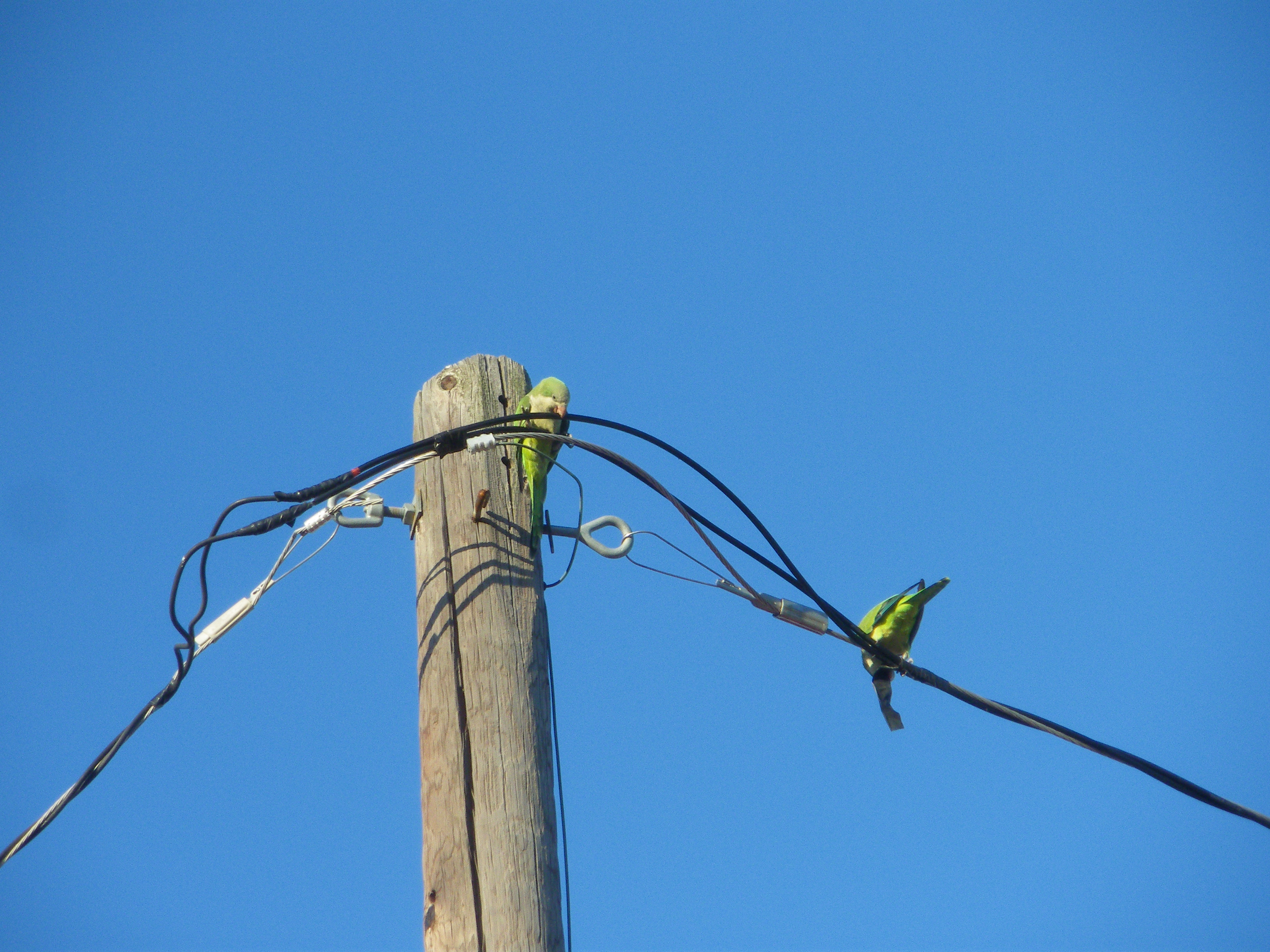
Monk parakeetsMyiopsitta monachus. Also known as the Quaker parrot.

Monk parakeets in the locusts, Duncanville, Texas, August 10, 2010 - photo by Ed Darrell, use with attribution encouraged

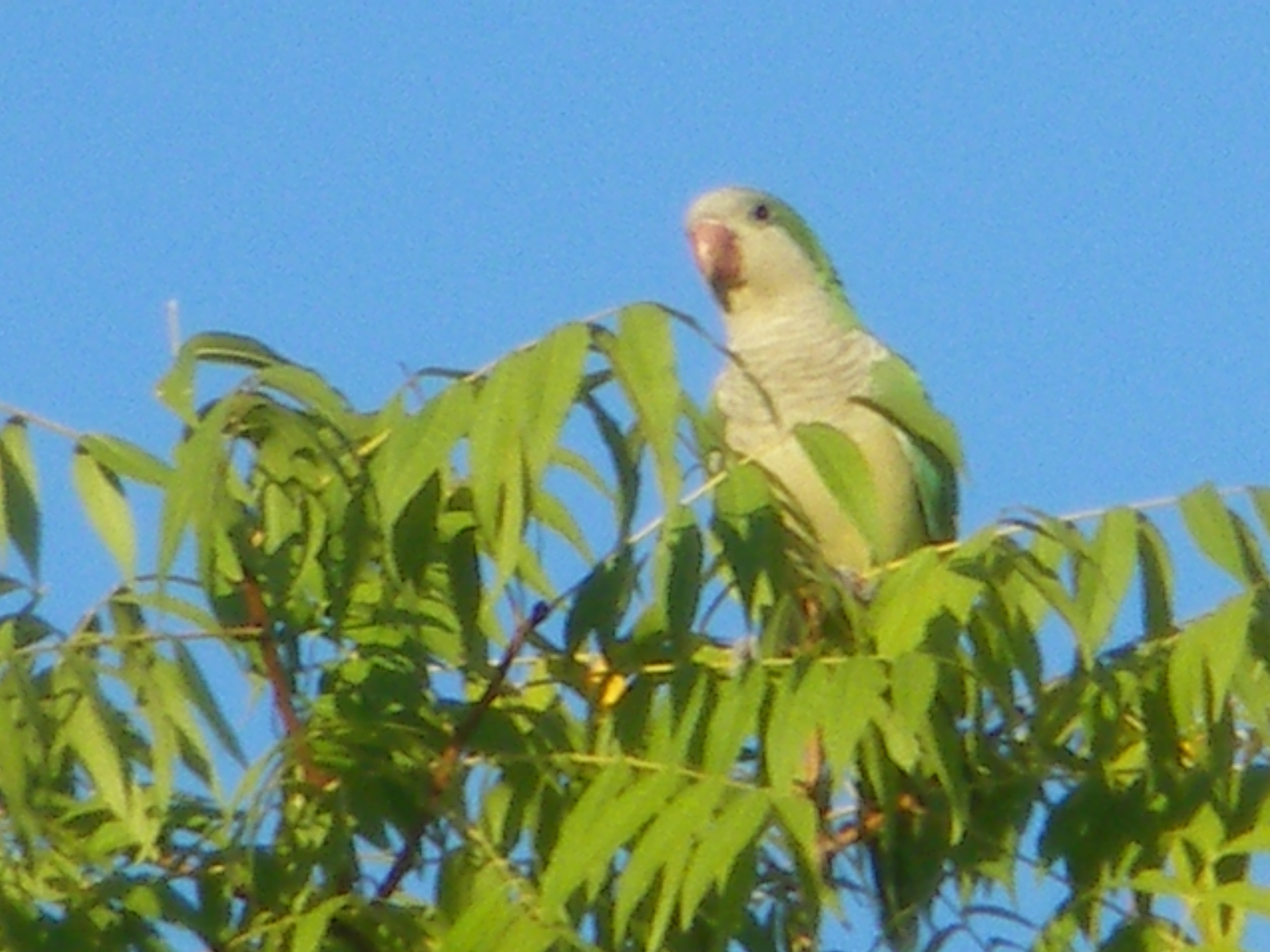
Monk parakeets profiled in the Chinese pistache, Duncanville, Texas, August 10, 2010 - photo by Ed Darrell; more than a dozen birds are hidden deeper in the tree.

Monk parakeets are invasive in Texas — it is thought the wild flocks developed from a few dozen escapees in the past three decades.  They favor nesting on tall electrical poles — the stadium lights of the high school and college football stadia host a lot, as do electrical transmission lines.  At Verizon Wireless we had at least one occasion when one of our cell tower climbers was attacked by one of the birds, apparently a mother just after the chicks had hatched.  Cell towers provide excellent habitat for the birds.

At the best sitings I’ve had, previously I lacked a camera.  Today I happened to have the small Pentax Optio V20.  20 to 30 of the birds roosted along an electrical wire.  They were happy to see me until I pulled out the camera.  (Pure conjecture:  They’re smart.  They’ve seen people with cameras before — and frequently, shortly after that some crew appears with a cherry-picker to destroy their nests.  Camera-shyness is a survival function for the birds.)

Cute little beggars.

Monk parakeets flocking -- collecting nesting materials?  Photo by Ed Darrell

Monk parakeets flocking -- collecting nesting materials?

All I observed was social activity and some preening, except for the one bird flitting around with a stick in its bill.

And the two who were trying to pull tape off of electrical transmission wires.

Monk parakeets assaulting an electrical transmission line.  Photo by Ed Darrell

Monk parakeets working to get a charge out of life, picking at insulation on an electrical wire.

Troublemakers.

Truth be told, I’ll take the monk parakeets in greater profusion, if we can reduce the populations of starlings, grackles and cowbirds.

Is there any evidence of the parakeets preying on songbirds?

Monk parakeet in the <del>locust</del> Chinese pistache tree - photo by Ed Darrell - IMGP2237

Monk parakeet in the Chinese pistache tree. All photos by Ed Darrell, use with attribution encouraged.

[Update: Oops.  Looked like a locust tree on a quick look.  A longer look, I wasn’t so sure.  Kathryn confirmed that it’s really a Chinese pistache, Pistacia chinensis.]

Add to FacebookAdd to NewsvineAdd to DiggAdd to Del.icio.usAdd to StumbleuponAdd to RedditAdd to BlinklistAdd to TwitterAdd to TechnoratiAdd to Furl


Gulf fritillary on blue porterweed

August 9, 2010

Gulf fritillary on blue porterweed - photo by Ed Darrell - copy free with attribution IMGP4824

Gulf fritillary butterfly on blue porterweed, Dallas, Texas — photo by Ed Darrell — use free with attribution

A gulf fritillary (Agraulis vanillae (Linnaeus, 1758)) on blue porterweed, Stachytarpheta urticifolia, also known as blue rats tail, or nettleleaf velvetberry.  Dallas, Texas, August 9, 2010.

Gulf fritillary on blue porterweed - photo by Ed Darrell, use permitted with attribution IMGP4820

This fritillary hung around for a few minutes.

Kathryn plants butterfly-attracting plants — a concept that was new to me when she introduced it at our home in Cheverly, Maryland, with several plants that acted like butterfly magnets, to my astonished delight.  We first ran into the brilliant orange gulf fritillaries in 1988 or 1989 here in Dallas.  For the past few summers, fritillaries have not been frequent visitors in our yard.

Kathryn stepped up the butterfly plantings this spring, including passion vine (Passiflora incarnata).  The passion vine twines toward one of the bird feeders, but in the past week or so has been losing leaves — to caterpillars of the gulf fritillary, it turns out.  Blue porterweed attracts all sorts of butterflies, but the fritillaries have been rather common, no doubt hoping to give their progeny a little boost with the passion vine, their favored food.

Butterfly afficianadoes in Dallas are urged to plant milkweed and butterfly bush to help the monarchs, whose populations are stressed by the recent cold winter, dramatic reductions in habitat, and destruction of their sanctuary trees in Mexico where they migrate each winter.  But all butterflies could use some habitat help, I think.  The rewards are great.

Gulf fritillary on blue porterweed - photo by Ed Darrell, use permitted with attribution - IMGP4822

Gulf fritillary on blue porterweed, catching the morning sun

Gulf fritillary butterfly on blue porterweed - photo by Ed Darrell, use permitted with attribution - IMGP4823

Butterfly plantings will attract butterflies, guaranteed. Gulf fritillary enjoys some blue porterweed nectar.


Vegetarian fireworks: Fruit and vegetable MRIs

July 19, 2010

Fireworks!

Broccoli, in an MRI

Broccoli, as seen by MRI

Looks like fireworks to me.

From Inside Insides, a site dedicated to MRIs of food.

Oddly beautiful.  Interesting.  Nerdy.

Tip of the old scrub brush to P. Z. Myers at Pharyngula.


First cicada killer sighting of 2010

July 19, 2010

Cicada killer wasps appeared as early as July 7, in our yard.  This year we had a cold winter, with snows that appear to have stymied even the nasty, invasive Argentine fire ant.  But June was dry and hot.  July came with rains, and cicada killers don’t like wet soil to dig in.

For that matter, we don’t have many cicadas, either.

Plus, we had to tear down a planter box attached to the dining room window, since it hid termites too well.  No doubt that planter had young from the cicada killers in it.

Early yesterday evening, as we finished dinner, we watched the house finches (Carpodacus mexicanus) escorting their young to the bird feeders, the cardinal “babies” (Cardinalis cardinalis) breaking out of their baby feathering, we looked for the family of red-bellied woodpeckers (Melanerpes carolinus) — and there it was:  One lone cicada hawk zooming across the patio, yellow-and-black striped abdomen standing out among the other paper wasps (almost certainly Sphecius speciosa).

They’re back!

Earlier at Millard Fillmore’s Bathtub:

More:


Snail zombies in our garden!

July 6, 2010

It became really apparent during the rains last week.

Snails crawl up the walls and plants around our patio, and appear to wait to die there.  We’ve moved them back down to the soil, and they climb up again.

Kathryn remarked at the army of snails on the garage wall, beneath a bird feeder . . . that was the clue.

I don’t think ours do that eye-stalk thing.  Worse for the parasites, most of the birds ignore the snails.

Tip of the old scrub brush to Kate at The Urban Primate.

MacDowell’s book kept me out of church for at least a decade.

In the later pages he talks about how many copies of the Bible there are, and he says that’s an indication of how accurate it is, and that it’s the truth.  That’s like saying any document I create becomes  more truthful the higher the number of Xerox copies I make.

I figured that was one of the stupidest claims ever made.  Maybe it was the crowd I was in with, but the more devout Christians (except for the Mormons, but that’s a different tale) swooned over the claim.  I thought that any belief system that was so devoid of logic, and which required adherents to abandon all reason, was foolish.

About five years ago I picked it up again when one of our youth ministers asked me about it, and I skimmed through it again looking for any cogent, careful and compelling argument.  Of course, this was long after law school and due diligence work in the law . . . I thought it more foolish than I had found it years before.

I summed it up this way for the youth minister:  If there were evidence, we wouldn’t need faith.  We call it a faith proudly, and we discuss the mysteries.  It’s a tragedy that MacDowell has been divorced from that sweet part of Christian discovery and leap of faith.  Were there evidence enough for a verdict, we’d not need faith, and it would be impossible to be anything other than an agnostic who has found the evidence.

Your mileage may differ, but if so, you need a tune-up.

Ed Darrell
Dallas


Adventures in Condor land: Moonrise over Hopper Ranch

June 8, 2010

Moon over Hopper Ranch, by Amanda Holland

Moon over Hopper Ranch, by Amanda Holland

Kathryn’s cousin Amanda Holland writes from her great adventure helping to rescue the California Condor, with this photo of the Moon, behind clouds and haze, over the mountains, from Hopper Ranch.

Here’s where I feel the pangs of leaving biology behind for rhetoric, then politics and law.  Probably the best part of research in biology was the places one had to go.  The best adventures involve getting to and back from the places researchers must go to get data or samples.

And now, with electronic cameras and cards that will easily accommodate 1,000 photos, images are easy to capture.

Some of the images I wish I could get back:  Moonrise over Shiprock*; the rattlesnake who liked to hide in the equipment box at the New Mexico Agriculture Experiment Station; the field of asparagus at the Experiment Station, poking up through the desert for the first time (I wonder if they decided to grow asparagus); thunderstorms at Shiprock and over Kimberly, New Mexico; sunrise in Huntington Canyon, Utah; looking nearly into Nevada through crystal air after a summer thunderstorm near Seeley Mountain.  There are a lot more, really.

Adventures past: We remember them warmly.  Getting out in the wild, doing the hard, grunt work necessary to learn about endangered species, or save them, or just improve conservation practices, is close to godliness, and among the greatest pleasures life can offer.

More:

  • See this photo of Shiprock and Moon, probably by a photography named William Stone; this photo of Shiprock and storm, by Radeka, is good, too; at one time my job was to drive from Farmington, New Mexico, past the Shiprock everyday, to get air pollution samples.  The Shiprock rivals Mt. Timpanogos in my personal pantheon of great mountains I grew up with.

I get e-mail, from the President on the Gulf oil eruption

June 5, 2010

First time in years I’ve gotten solid information from a politician that didn’t come wrapped in a plea for money. I got a message from President Obama today (I’m sure a few million of his closest friends got the same one):

Ed —

Yesterday, I visited Caminada Bay in Grand Isle, Louisiana — one of the first places to feel the devastation wrought by the oil spill in the Gulf of Mexico. While I was here, at Camerdelle’s Live Bait shop, I met with a group of local residents and small business owners.

Folks like Floyd Lasseigne, a fourth-generation oyster fisherman. This is the time of year when he ordinarily earns a lot of his income. But his oyster bed has likely been destroyed by the spill.

Terry Vegas had a similar story. He quit the 8th grade to become a shrimper with his grandfather. Ever since, he’s earned his living during shrimping season — working long, grueling days so that he could earn enough money to support himself year-round. But today, the waters where he has worked are closed. And every day, as the spill worsens, he loses hope that he will be able to return to the life he built.

Here, this spill has not just damaged livelihoods. It has upended whole communities. And the fury people feel is not just about the money they have lost. It is about the wrenching recognition that this time their lives may never be the same.

These people work hard. They meet their responsibilities. But now because of a manmade catastrophe — one that is not their fault and beyond their control — their lives have been thrown into turmoil. It is brutally unfair. And what I told these men and women is that I will stand with the people of the Gulf Coast until they are again made whole.

That is why, from the beginning, we have worked to deploy every tool at our disposal to respond to this crisis. Today, there are more than 20,000 people working around the clock to contain and clean up this spill. I have authorized 17,500 National Guard troops to participate in the response. More than 1,900 vessels are aiding in the containment and cleanup effort. We have convened hundreds of top scientists and engineers from around the world. This is the largest response to an environmental disaster of this kind in the history of our country.

We have also ordered BP to pay economic injury claims, and this week, the federal government sent BP a preliminary bill for $69 million to pay back American taxpayers for some of the costs of the response so far. In addition, after an emergency safety review, we are putting in place aggressive new operating standards for offshore drilling. And I have appointed a bipartisan commission to look into the causes of this spill. If laws are inadequate, they will be changed. If oversight was lacking, it will be strengthened. And if laws were broken, those responsible will be brought to justice.

These are hard times in Louisiana and across the Gulf Coast, an area that has already seen more than its fair share of troubles. The people of this region have met this terrible catastrophe with seemingly boundless strength and character in defense of their way of life. What we owe them is a commitment by our nation to match the resilience they have shown. That is our mission. And it is one we will fulfill.

Thank you,

President Barack Obama

Good news is that BP now reports some success in stopping the flow of oil.  Information flows increase, oil flows decrease — good trends.

Obama and Jindal, May 2, 2010 - Pete Souza, WH photo

Caption from the White House: President Barack Obama talks with U.S. Coast Guard Commandant Admiral Thad Allen, who is serving as the National Incident Commander, and Louisiana Gov. Bobby Jindal, aboard Marine One as they fly along the coastline from Venice to New Orleans, La., May 2, 2010. John Brennan, Assistant to the President for Homeland Security and Counterterrorism, is in the background. (Official White House Photo by Pete Souza). (This official White House photograph is being made available only for publication by news organizations and/or for personal use printing by the subject(s) of the photograph. The photograph may not be manipulated in any way and may not be used in commercial or political materials, advertisements, emails, products, promotions that in any way suggests approval or endorsement of the President, the First Family, or the White House.)

More information:


Red eared sliders

May 31, 2010

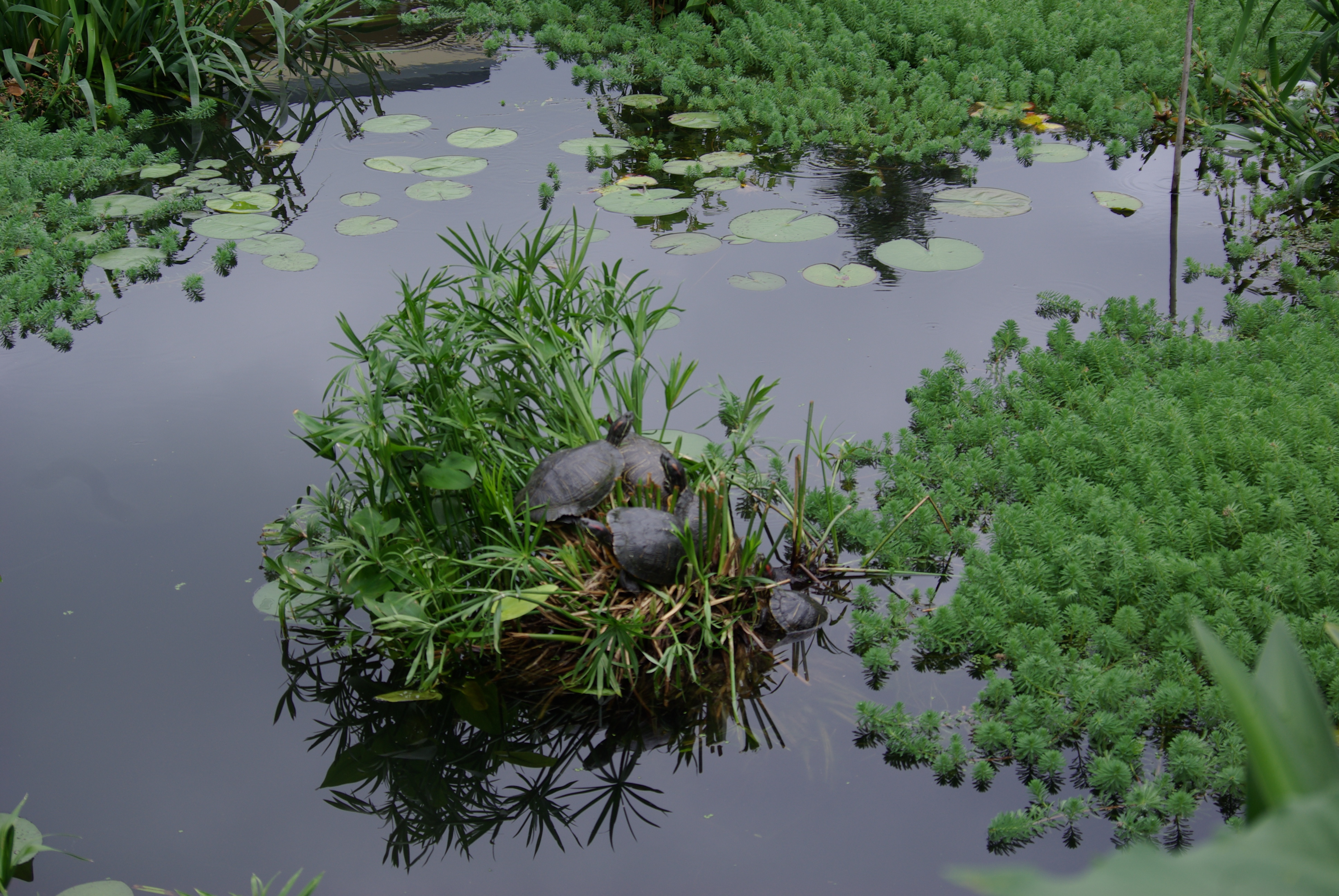
Red-eared sliders, turtles at Texas Discovery Gardens - photo by Ed Darrell

Red-eared sliders cluster together to catch the sun on a spring day at Texas Discovery Gardens at Fair Park in Dallas. Photo by Ed Darrell, 2010

Red-eared sliders (Trachemys scripta elegans), a common aquatic turtle in the southern U.S., caught sunning themselves at the Texas Discovery Gardens at Fair Park in Dallas.


Hummingbird moth in the lavender at 6:00 a.m.

May 25, 2010

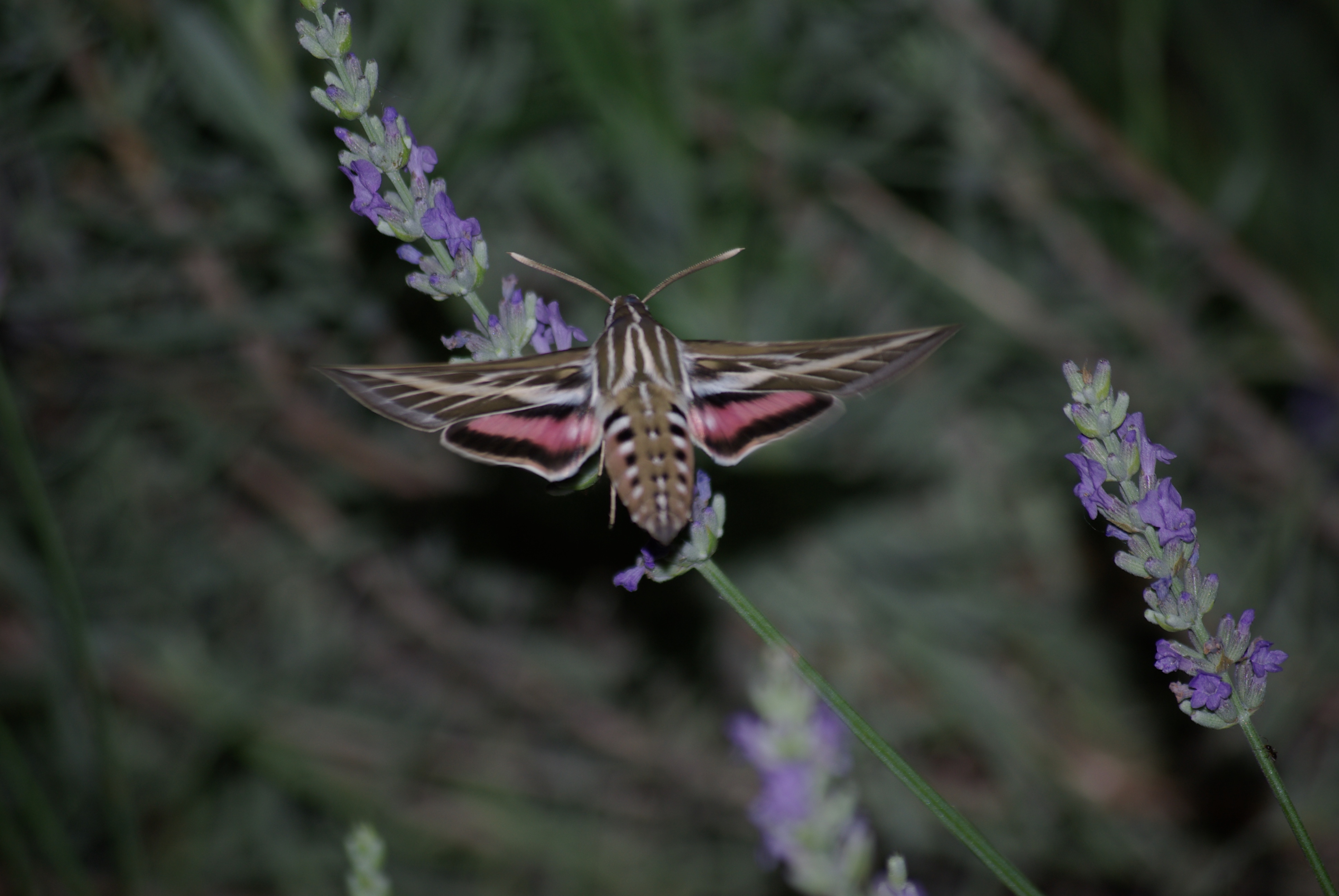
Hummingbird moth at the lavender, May 25, 2010

Hummingbird moth (Hyla lineata?) breakfasts at the lavender in the front yard - photo by Ed Darrell

Kathryn planted lavendar on the front walk.  It crowds the walk, so you have to brush by it coming in or going out of the house, and sometimes you get a great whiff of lavender.

On the way back from getting the newspaper this morning I was greeted by this hummingbird moth sipping its breakfast from the lavender blossoms.  It was too dark for natural lighting.  The flash froze the wings, and exposed colors that you can’t see as the little creature hovers.

Probably a Hyla lineata, no?

Hummingbird moth at the lavender, #2 - IMGP4107 - photo by Ed Darrell, all rights reservedHummingbird moth at the lavender, #2 - IMGP4107 - photo by Ed Darrell, all rights reserved

Hummingbird moth in the lavender in the morning


Wildflower Monday: Calfornia poppies

May 17, 2010

California poppies, near Bitter Creek - photo by Amanda Holland

California poppies, near Bitter Creek - photo by Amanda Holland

Kathryn got stuck in traffic on Spur 408 Friday evening.  She happily reported that a few bluebonnets remain, covered by now-taller grasses.  We’re in the seventh week of our Texas wildflower panorama.

But Amanda Holland’s shot of California poppies in the wild hills near Bitter Creek caught my eye.  Amanda’s out saving birds — the best photos of the wild almost always come while you’re on the way to do great stuff, I think.  That’s a good reason to find a job that gets you out of doors, and into the wild.

Notice that, even in the wild, in near-wilderness, there are still signs of human actions.  See the contrails?


Strange signs of wildlife

May 10, 2010

A good sign of wildlife recovery.  Photo by Amanda Holland, all rights reserved.

A good sign of wildlife recovery. Photo by Amanda Holland, all rights reserved.

A cousin-in-law spends a few months working on condor recovery in California.  We get photos from time to time.

This one isn’t particularly spectacular, but I love the irony, and the levels of meaning.


The Nature Conservancy: Rachel Carson

May 3, 2010

It’s way too short, but a great idea.

More:


Friday Fox, and Go vote! Defenders of Wildlife photo contest

April 2, 2010

Friday Fox will not be a regular feature — but, Wow! isn’t that a great photo?

Unless you’re the mouse.

Ron Charest photo of a red fox in the Bombay Hook National Wildlife Refuge (Delaware) - Defenders of Wildlife

Ron Charest photo of a red fox in the Bombay Hook National Wildlife Refuge (Delaware) - Defenders of Wildlife

Defenders of Wildlife called for entries for the 2010 wildlife and wilderness photography contest.  They got more than 10,000 entries, and they’ve got the top 10.  They want you to vote for the best one.  The photo above is just one of the spectacular nominees.

I predict one of the photos featuring animals will win, but the wild lands photos are great, too.

You may vote for three.  Voting ends Sunday, April 4, 2010.

Go see.  Go vote


Sage grouse non-listing: USDA offers $16 million to protect the birds

March 17, 2010

Remember the sage grouse? People groused because the U.S. Department of Interior Fish and Wildlife Service determined most populations of western sage grouse are threatened enough to earn listing as an endangered species under the Endangered Species Act — but then refused to list the bird, because other plants and animals are even more threatened, and need attention sooner.  (I was one of those people complaining.)

It’s a new administration.  U.S. Department of Agriculture offered $16 million for projects to protect the bird’s habitat.  This ruling put increased pressure on state wildlife agencies, in an interesting if not unique twist of the issue of federalism, state vs. federal responsibility for wildlife and wild lands.  Wyoming wants $3 million right away, for projects mostly on private land.

In other words, the administration will sometimes find ways to do the right thing without doing the most difficult or controversial thing.  Ranchers and energy developers cheered by original decision are also happy about Ag’s proposed spending.  Environmentalists unhappy with the first ruling shouled be cheered by Ag’s action, too.  State agencies that worked hard to make the case for listing the bird may be cheered, also.

Sage grouse habitat threatened by deveolopment, in Nevada - Las Vega Sun graphic

Sage grouse habitat threatened by deveolopment, in Nevada - Las Vega Sun graphic

Readers of the Las Vegas Sun learned about the program last week — the Sun has covered the sage grouse as part of its coverage of alternative energy programs.  Much sage grouse habitat in Nevada overlaps wind energy and geothermal energy development zones.

Ranchers across the west are being offered millions of dollars in aid from the federal government to make their operations more environmentally sustainable and reduce their impact on the sage grouse the U.S. Department of Agriculture announced today.

“USDA will take bold steps to ensure the enhancement and preservation of sage grouse habitat and the sustainability of working ranches and farms in the western United States,” Agriculture Secretary Tom Vilsack said. “Our targeted approach will seek out projects that offer the highest potential for boosting sage-grouse populations and enhancing habitat quality.”

The Department of Agriculture’s Natural Resources Conservation Service will soon begin accepting applications for two federal programs aimed at reducing threats to the birds such as disease and invasive species and improving sage-grouse habitat. The agency will have up to $16 million at its disposal for the programs.

The Wilderness Habitat Incentive Program provides up to 75 percent cost-share assistance to create and improve fish and wildlife habitat on private and tribal land.

Sage grouse face a difficult future.  State wildlife management agencies face a tough future, too, in trying to save the birds.  The nation needs energy resources found, often, where the sage grouse need lands to meet, mate and raise their young.  It’s a difficult balancing act.

More information:


Boulder and Fort Collins: Wise city action prevents global warming? WUWT misreports the story

March 15, 2010

This is a story of two cities located within 100 miles of each other in Colorado, in that paradise created by close mountain recreation, clean and clear western vistas, and local, great universities.  The question is, does this story tell a tale of urban growth that mistakenly shows up as global warming, or is it a story of wise planning that avoids the harms of global warming — or something else in between, or completely different?

Boulder at twilight - Wikipedia Image by Phil Armitage

Boulder, Colorado at twilight, at the foot of the Rockies – Wikipedia Image by Phil Armitage

Anthony Watts complained that I don’t read his blog closely enough, or often enough.  He may rue the day he made that complaint.

Browsing over there I found a post hidden under a headline, “A UHI Tale of Two Cities.” I say “hidden” because Watts once again falls victim to the Dunning-Kruger syndrome of using an acronym, UHI, which sounds sciency but is in fact confusing to anyone not following the debate closely.  I’m science literate, I’ve done research, I’ve done air pollution research, I’ve served state, federal and local governmental bodies working on environmental issues, and “UHI” didn’t ring any bells with me.  It’s a MEGO phrase, in other words:  My Eyes Glaze Over.

It took five clicks, but I discovered UHI is “urban heat island,” the well-worried-over effect of cities, with all their concrete, asphalt and steel, holding heat longer than surrounding countryside.  In some cases, it is hypothesized that these urban heat islands affect or create their own weather.  In the airline industry we worried about late afternoon thunderstorms that continued well past historical evening limits (and I suspect airline meteorologists and flight schedulers still worry about the issue, but I’ve been out of it for well over a decade).

For the study of global warming, the issues are simple but important:  Do temperature measures made in or near big cities inaccurately show warming that is wholly local, and mislead scientists into thinking there is global warming?  Or is some of the supposed heat island effect instead due to global warming?  And, if it the urban heat island effect is mostly local, should we worry about it when developing policies to combat global warming and preserve our forests, wildlands and wildlife, wildernesses. oceans, rivers, farmlands and urban areas, and modern life?

Southwest quadrant of Boulder Colorado, showing greenbelt and trails - image from city website with information on greenbelt use and open space regulations, and maps.

Southwest quadrant of Boulder Colorado, showing greenbelt and trails – image from city website with information on greenbelt use and open space regulations, and maps. Boulder’s greenbelt open space and wild lands may get more visitors than nearby Rocky Mountain National Park.

In the post at Watts’s site, this is stated (from Watts?  from someone else?  Who can tell?):

Conclusion:

We have two weather stations in similarly sited urban environments. Until 1965 they tracked each other very closely.  Since then, Fort Collins has seen a relative increase in temperature which tracks the relative increase in population. UHI is clearly not dead.

Watts misses much of the story.

In the middle 1960s and into the early 1970s Boulder, Colorado, made conscious and careful attempts to preserve its environmental quality.  In 1967 Boulder created a greenbelt plan that started the processes to preserve an open space belt around the city, to preserve wild lands and to provide a sink for air pollutants and other effects of the city.  In the early 1970s the city limited city growth to assure environmental quality.

Alternatives to Growth Oregon (AGO) featured an excerpt from a book detailing several growth-controlling actions by American cities as well and succinctly as anything else I’ve found (excerpted from Better Not Bigger by Eben Fodor)

In 1967, Boulder voters approved one of the nation’s first locally funded greenbelt systems. They used a local sales tax increase of 0.4 percent to finance open space land acquisitions. As of 1998, Boulder had raised $116 million and acquired 33,000 acres of greenways and mountain parks. The greenbelt system serves as a natural growth boundary, defining the limits of the city with open space and parkland. This natural boundary helps to block urban sprawl and “leapfrog” development. The greenbelt has also helped protect the quality of life in Boulder as the city has grown. It is said that more people use the greenbelt system each year than visit nearby Rocky Mountain National Park. As an added measure, Boulder established a building height limitation of 55 feet in 1971 to preserve the view of the Rockies. The city and surrounding county have cooperated on planning and growth-management policies and jointly adopted the Boulder Valley Comprehensive Plan. A city-county study in 1970 showed the area’s population doubling in 20 years to 140,000. This projection alarmed many residents and prompted discussions about optimum population size. A public opinion survey found that more than 70 percent of respondents favored population stabilization near the 100,000 level.

In November, 1971 Boulder citizens set another first when they placed an initiative on the ballot to create a charter amendment setting a maximum population limit for the city. Voters narrowly defeated the initiative. The defeat may have been partly due to an alternative referendum placed on the same ballot by the city council. This second referendum was approved by 70 percent of voters and directed local government to “take steps necessary to hold the rate of growth in the Boulder Valley to a level substantially below that experiences in the 1960’s.” This important decision has led to a number of experimental growth-management policies that are still being fine-tuned today.

More information on greenbelts, how they work and why they are such a great idea, can be found from the Trust for Public Lands (also here), among other sources.

Fort Collins is a college town, like Boulder, and loaded with people interested in preserving the environment.  Colorado State is the state’s Land Grant College (Morrill Act), the official repository of studies of protecting and wisely using the lands of Colorado.  But Fort Collins did not create a green belt.  Development in Fort Collins follows rules, but rules set by more traditional zoning and protection regulations than Boulder’s green belt.

Exploring Old Town Fort Collins by bicycle - City of Fort Collins photo

Exploring Old Town Fort Collins by bicycle – City of Fort Collins photo

Watts’s blog lays the differences in temperatures between Boulder and Fort Collins since 1965 entirely at the feet of rising population, and an assumption that rising population means more concrete, asphalt and steel (Watts writing, or someone else?).  Analysis of population growth from any serious statistical viewpoint, comparing Fort Collins-Loveland SMSA against the Boulder MSA (or Denver-Boulder SMSA) is lacking.  This is probably more a reminder that Watts’s blog is not engaged in serious scientific analysis global warming from a global view — nor even a national, state or regional view.  The comparison is simple, on population and temperature, and probably not sustainable to the point Watts suggests he wants to take it.

The population of the City of Boulder grew less than the population of the City of Fort Collins grew.  That appears to be enough for Watts.

Check with the public officials of Boulder, especially those in charge of development and zoning.  They’ll let you know in a hurry that Boulder’s slower-than-Fort-Collins growth is intentional.  While the Boulder plan technically has no upper limit, it slows growth so that environmental quality can be maintained, especially the greenbelt, with its manifold recreation opportunities.

Fort Collins has a lot of good recreation, too.  The Cache de Poudre River offers great river running within 40 minutes of downtown in the summer, and the local National Forests and other public lands offer camping, hiking, hunting, fishing, and I imagine, snowmobiling in winter.  There are bike paths through Fort Collins — but not the green, automobile-free style of trails available all around Boulder.

Scouts climbing at Camp Ben DelaTour, outside of Fort Collins - Longs Peak Council BSA photo

Scouts climbing at Camp Ben DelaTour, outside of Fort Collins – Longs Peak Council BSA photo

Perhaps most important, Fort Collins experiences “leapfrog” development that Boulder specifically spurned 40 years ago.  New businesses cluster along roads into town, frequently just out of the city limits and beyond the zoning rules of the city, at least until the city annexes the land and its problems.  This is the traditional growth model for American cities.  What it ensures is urban sprawl and suburban growth.  It also virtually guarantees that there will be no preserved greenlands around the city.  Green land, rural or more wild, get developed in sprawl.

Here’s the question Watts and his collaborators don’t deal with:  How much of Boulder’s cooler climate is due to the greenbelt, and how much due to the striving for wise development instead of sprawl?  Considering Boulder’s proximity to Denver and explosive growth there, the fact that Boulder’s climate is cooler than Fort Collins’s, according to Watts, suggests even more strongly that tough protection of the environment can work wonders, if not near-miracles.

Who is Anthony Watts to claim that Boulder’s cooler climate is not the result of careful planning to preserve the environment, initiated by Boulder’s visionaries 50 years ago?

Perhaps more critically:  Doesn’t Boulder demonstrate that planning that stops global warming, is feasible, practical, economical, and perhaps, preferable?  Doesn’t the greenbelt, and lower temperatures, suggest that we can kill the urban heat island effect, to the betterment of local living standards?

There is a moral to the story of development in Fort Collins and Boulder, Colorado.  That moral has very little, if anything, to do with heat islands.  It is instead a model to tell us that planning to avoid environmental disaster is the wise thing to do.  Anthony Watts has the charts to prove it.

Notes:

  • A serious study of the effects of the greenbelt, or effects of population growth, on local climate, or on global warming, in the area along the Front Range in Colorado and Wyoming would probably be strengthened with analysis of Greeley and Denver thrown in.  Denver is big enough to contain a couple of universities; Greeley is home to Northern Colorado University (as Fort Collins and Boulder are homes to Colorado State and the University of Colorado, respectively).  Growth in Greeley, a prairie, farming and beef ranching town (and former utopian destination of easterners headed west), differs markedly from Fort Collins, founded as a military outpost to protect the Overland Trail and other commerce routes through the Rockies, and Boulder, largely a mining town.  Similarities and differences between the cities could be instructive, especially considering the proximity of each to the others.
  • Boulder gets its water from a glacier, a point that shouldn’t be lost in discussions of global warming
  • City of Boulder’s officials and advisors, and Copenhagen 15 — the city took what it regarded as an active role to combat warming
  • Watts visited Boulder to check out its weather stations; his photos show the station, near the NOAA headquarters, close to the green belt.  “Sometimes people smack into the truth, and then pick themselves up and walk off as if nothing had happened.”  Watts said construction near the site demonstrated “expansion pressures.”
  • From Boulder, it’s 38 miles to Fort Collins, and 38 miles to Greeley.  Greeley and Fort Collins are 19 miles apart.  From Denver it’s 26 miles to Boulder, 47 to Greeley and 55 to Fort Collins.
  • Two-needled ponderosa pines live outside of Fort Collins, to the northwest.  Most pines have odd numbers of needles, and ponderosa typically have five needles.

Update, James Madison Day (3-16-2010): Watts still doesn’t get it.  In a post today he wrote:

My last few posts have described a new method for quantifying the average Urban Heat Island (UHI) warming effect as a function of population density, using thousands of pairs of temperature measuring stations within 150 km of each other. The results supported previous work which had shown that UHI warming increases logarithmically with population, with the greatest rate of warming occurring at the lowest population densities as population density increases.

Comparing Fort Collins with Boulder, and noting that Fort Collins grew faster, is an inadequate explanation for more warming in Fort Collins, about 40 miles north of Boulder.  Boulder has a greenbelt designed to frustrate global warming, locally and globally.  To fail to account for the effect of a massive green belt of 33,000 acres — more than double the size of the city’s 16,000 acres — is a failure of science.  If Watts’s methodology misses such factors that slap an unbiased viewer in the face, you’ve gotta wonder what else he’s missing.  If he can’t see a greenbelt twice the size of the city, surrounding the city, what else has he overlooked?

Plus there is this:  Assume for a moment that he proves a heat island effect exists (a proposal unquestioned in meteorology and atmospheric sciences for a generation, by the way) — the question he’s seeking to prove is that urban heat islands skew official temperature readings enough to falsely indicate global warming.  To skew measurements that include thousands of at-sea sensing devices, and rural areas around the world, there would have to be an massive effect that would be immediately obvious in the cities causing the effect:  They would melt.

Flatirons rock formations, on Green Mountain, near Boulder, Colorado - Wikimedia photo by Jesse Varner

Flatirons rock formations, on Green Mountain, near Boulder, Colorado – Wikimedia photo by Jesse Varner

Help others find wisdom for their cities:

Add to FacebookAdd to NewsvineAdd to DiggAdd to Del.icio.usAdd to StumbleuponAdd to RedditAdd to BlinklistAdd to TwitterAdd to TechnoratiAdd to Furl