On the night before Christmas: Untangling the history of a visit from St. Nick

December 24, 2007

Thomas Nast invented Santa Claus? Clement C. Moore didn’t write the famous poem that starts out, “‘Twas the night before Christmas, and all through the house . . . ?”

The murky waters of history from Millard Fillmore’s Bathtub soak even our most cherished ideas and traditions.

But isn’t that part of the fun of history?

  • Below: Thomas Nast’s first published drawing featuring Santa Claus; for Harper’s Weekly, “A Journal of Civilization,” January 3, 1863 Nast portrayed the elf distributing packages to Union troops: “Santa Claus in camp.” Nast (1840-1904) was 23 when he drew this image.

Santa Claus delivers to Union soldiers, "Santa Claus in Camp" - Thomas Nast, Harper's Weekly, Jan 3, 1863 Yes, Virginia (and California, too)! Thomas Nast created the image of Santa Claus most of us in the U.S. know today. Perhaps even more significant than his campaign against the graft of Boss Tweed, Nast’s popularization of a fat, jolly elf who delivers good things to people for Christmas makes one of the great stories in commercial illustration. Nast’s cartoons, mostly for the popular news publication Harper’s Weekly, created many of the conventions of modern political cartooning and modeled the way in which an illustrator could campaign for good, with his campaign against the graft of Tammany Hall and Tweed. But Nast’s popular vision of Santa Claus can be said to be the foundation for the modern mercantile flurry around Christmas.

Nast is probably ensconced in a cartoonists’ hall of fame. Perhaps he should be in a business or sales hall of fame, too.  [See also Bill Casselman’s page, “The Man Who Designed Santa Claus.]

Nast’s drawings probably drew some inspiration from the poem, “Account of a Visit from St. Nicholas,” traditionally attributed to Clement C. Moore, a New York City lawyer, published in 1822. The poem is among the earliest to describe the elf dressed in fur, and magically coming down a chimney to leave toys for children; the poem invented the reindeer-pulled sleigh.

Modern analysis suggests the poem was not the work of Moore, and many critics and historians now attribute it to Major Henry Livingston, Jr. (1748-1828) following sleuthing by Vassar College Prof. Don Foster in 2000. Fortunately for us, we do not need to be partisans in such a query to enjoy the poem (a complete copy of which is below the fold).

The Library of Congress still gives Moore the credit. When disputes arise over who wrote about the night before Christmas, is it any wonder more controversial topics produce bigger and louder disputes among historians?

Moore was not known for being a poet. The popular story is that he wrote it on the spur of the moment:

Moore is thought to have composed the tale, now popularly known as “The Night Before Christmas,” on December 24, 1822, while traveling home from Greenwich Village, where he had bought a turkey for his family’s Christmas dinner.

Inspired by the plump, bearded Dutchman who took him by sleigh on his errand through the snow-covered streets of New York City, Moore penned A Visit from St. Nicholas for the amusement of his six children, with whom he shared the poem that evening. His vision of St. Nicholas draws upon Dutch-American and Norwegian traditions of a magical, gift-giving figure who appears at Christmas time, as well as the German legend of a visitor who enters homes through chimneys.

Again from the Library of Congress, we get information that suggests that Moore was a minor celebrity from a well-known family with historical ties that would make a good “connections” exercise in a high school history class, perhaps (“the link from Aaron Burr’s treason to Santa Claus?”): (read more, below the fold)

Read the rest of this entry »


Allowable political satire, or attack on the President?

December 20, 2007

So, is this allowable parody, political satire, in the nature of a political cartoon?
Mug shotsOr, is this an untoward attack on the President?

Will children be confused if they find these photos in a display of political art at the New York Public Library?

Is it not acceptable satire?

Tip of the old scrub brush to Gallery of the Absurd.


Clay Bennett cartoons

December 13, 2007

I love Thomas Nast cartoons, partly for their dated look. They look like they are 100 years old from the style of the art.

For much the same reason, I love Herblock cartoons. They look like the middle of the 20th century. And Pat Oliphant cartoons look like post-Kennedy modern ideas.

Clay Bennett, winner of the 2007 Curie UN Cartoon Award

Clay Bennett, winner of the 2007 Curie UN Cartoon Award

Clay Bennett cartoons look like 21st century clean to me. There’s a smoothness, a silkiness of color that lends an immediacy to them. They really look good, and they look like they’d project well in a classroom (though I’ve not tried any of Bennett’s, actually).

All four of these cartoonists had or has something to say, too. I’ve enjoyed Bennett’s work in the Christian Science Monitor for some time. His work is clean, but it has a cutting edge that can’t be missed.

So, I was happy to see that he had won a commendation from the Ranan Lurie Cartoon Competition at the UN Correspondents’ Association dinner. Other people see good stuff in his drawings — I’m not alone.

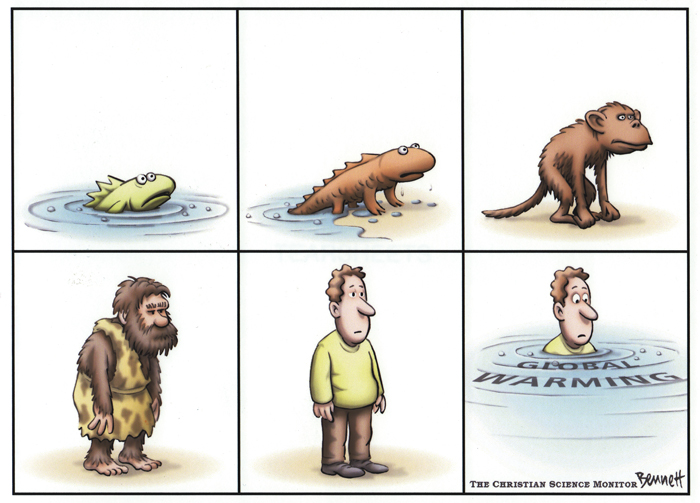
Here’s his UN Lurie award-winning cartoon:

Evolution of Man, to drowning by global warming

Cartoon winner of the 2007 Curie UN Cartoon Award

More of Bennett’s cartoons can be seen here, at the Clay Bennett Archives.

Bennett’s last cartoon in the Monitor was November 17.  The good news:  He’s moving to the Chattanooga Times-Free Press.  We can hope that means one more opening is available for a cartoonist.

One more, below the fold. Read the rest of this entry »


Ranan Lurie Award cartoon winners, 2007

December 12, 2007

Winning cartoons revealed.

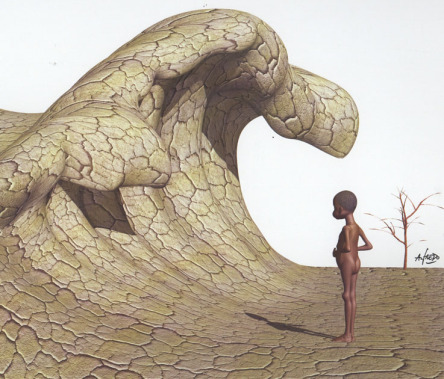
2007 Lurie Award Winner, 1st place, Ahmet Aykanat, Turkey

1st place to this haunting cartoon from Turkey’s Ahmet Aykanat, a free lancer.

Hunger, war and its unfair, collateral damage got attention from the cartoonists in the past year. Same themes as the previous years, actually. There is a lot of work to do.

The Ranan Lurie competition highlights cartooning on political and economic issues from around the world. Here in the U.S. we get some great cartoons — Oliphant, Sherffius, Grondahl, Telnaes, Toles, Sargent and dozens of others — but we miss out on great cartooning in Asia, South America, the Mediterranean, Europe and Africa.

One of my favorite North American cartoonists Clay Bennett of the Christian Science Monitor won a Citation for Excellence.

Cartoons carry a powerful punch. They make great lesson openers, or great lessons all in themselves.


Which cartoons won the 2007 Lurie Awards?

December 9, 2007

The United Nations Correspondents Association was scheduled to announce awards, including the Ranan Lurie Cartoon Awards for 2007, at a dinner on December 7.

I find nothing about the awards anywhere — does somebody have, or has somebody found, a list of the 2007 winners, preferably with a gallery of the cartoons?

(C’mon, New York Times, Washington Post, International Herald Tribune, CNN, NBC, CBS and ABC — where is the news on this? Cagle?)


Santayana as cartoonist

October 6, 2007

Okay, not George Santayana himself. Not even Santayana’s Ghost™. It’s really Wiley, with “Non Sequitur.”

This is close to the perfect cartoon. It would have been timely during the American Revolutionary War, at times in England, at times in America. It would have been timely during periods of the Texas fight for independence. It would have been timely in the early part of the War Between the States, for the Union into 1862, for the Confederacy later. It’s perfect for the Phillipines uprising during the Teddy Roosevelt and Woodrow Wilson administrations. It fits Korea. It fits Vietnam. Some argue it fits Iraq.

Is this guy really a political cartoonist hiding on the funny pages?

Probably not — I could use this cartoon in a corporate presentation with good effect, and to the point.  It’s a universal problem of human organizations.

See the cartoon below the fold.

Read the rest of this entry »


Political cartoons: Powerful images, powerful ideas

September 20, 2007

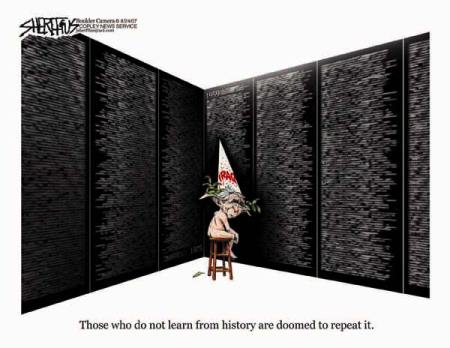
Sherffius in the Boulder Daily Camera, August 2007 - copyright Sherffius

Sherffius in the Boulder Daily Camera, August 2007 - copyright Sherffius

Sherffius, in the Boulder (Colorado) Daily Camera

The deadline for cartoonists to enter the Ranan Lurie Prize competition at the United Nations is October 1. The winning cartoon from 2006, from Argentinian cartoonist Alfredo Sabat, is one of the most popular images in Google’s image search for “cartoon.”

Images pack a punch. If a pen is mightier than a sword, a cartoonist’s pencil and ink drawing can be more powerful than a cannon.

While we wait for the winners of the Lurie competition, we can look around to see other great cartoonists’ work. Earlier I tried to call attention to the work of John Sherffius at the Boulder (Colorado) Daily Camera. Since then, he’s won the James Aronson Social Justice Award for Graphics for the body of his work. The power of his drawings should be clear from the cartoon above.

Do you have a favorite cartoonist, especially one from a smaller newspaper who has not yet received the kudos she or he is due? Tell us about it in comments — and give links, if you can.

And share the word with others:

Add to FacebookAdd to NewsvineAdd to DiggAdd to Del.icio.usAdd to StumbleuponAdd to RedditAdd to BlinklistAdd to TwitterAdd to TechnoratiAdd to Furl


Odd historical fact: Shortest term on the Supreme Court

August 4, 2007

Who served the shortest term as a justice on the U.S. Supreme Court?

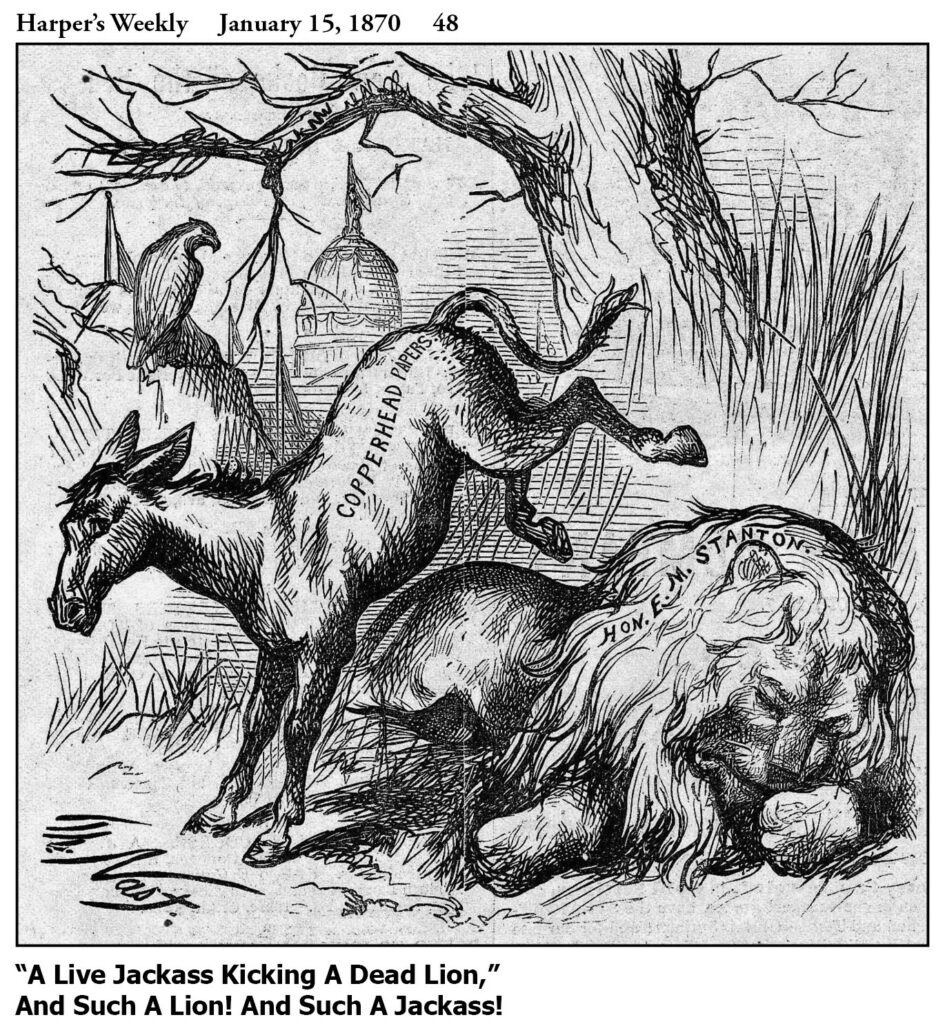
There is a clue in this famous cartoon by Thomas Nast (okay — the cartoon really gives it away, doesn’t it?):

Thomas Nast, Live Jackass kicking a Dead Lion,Harper's Bazaar, January 15, 1870

Cartoon depicting Democrats Thomas Nast, Live Jackass kicking a Dead Lion. Edwin Stanton was fired as Secretary of War by President Andrew Johnson, contrary to the Tenure of Office Act, and that action brought on the impeachment and trial of Johnson (who was acquitted by one vote). Later, President U. S. Grant appointed the financially and health ailing Stanton to the Supreme Court. Stanton was confirmed, but went home and died that night, December 24. Stanton’s opponents continued to try to smear him. Nast’s cartoon was the result. Harper’s Bazaar, January 15, 1870

Watch for the answer in a future post.

Image: Thomas Nast cartoon from Harper’s Weekly, January 15, 1870. Nast’s use in cartoons greatly popularized the use of a donkey as a symbol of the Democratic Party, whose official animal mascot is a rooster. Image in public domain, this one from the Thomas Nast Portfolio of The Ohio State University.

Also, note the explanation by Ray in comments, for historical accuracy.


Cartoon of note: Berryman on TR and fair play

May 24, 2007

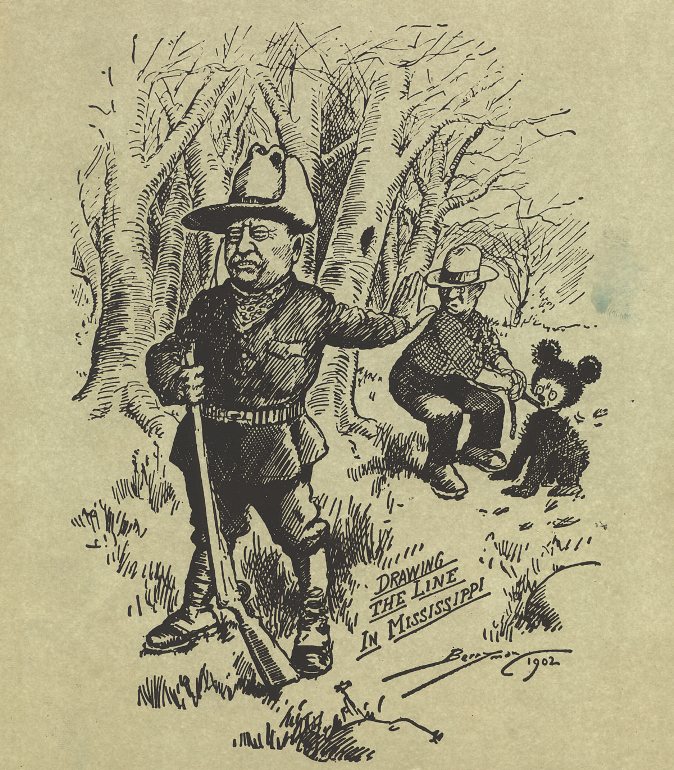
Clifford Berryman cartoon, "Drawing the Line in Mississippi, 1902"

Clifford Berryman cartoon, “Drawing the Line in Mississippi, 1902”

Berryman’s Bear: “Drawing the line in Mississippi.”

In 1902 Teddy Roosevelt hunted bear near Smedes, Mississippi. He didn’t get a bear, as he had hoped. Trip guides tracked a bear with dogs, clubbed it, and tied it up. The bear was offered to TR to shoot.

Teddy refused to shoot it, of course. It was tied up. It was not sporting, not fair, not a match — not the vigorous hunting Roosevelt wanted.

Clifford K. Berryman, a cartoonist for the Washington Post newspaper (he moved to the Washington Star in 1907), captured the moment in a drawing published November 16, 1902. This 1902 cartoon is among the most famous political cartoons ever done.

The good sportsmanship Roosevelt demonstrated echoed long and hard among Americans. His reputation for fair dealing and good sportsmanship increased his popularity immensely.

Candy store owners in New York City, Morris and Rose Michtom, made a stuffed bear, a “Teddy bear,” to commemorate the event. We still call them Teddy bears, today.

Berryman continued to use the bear cub in cartoons for the rest of his career.

Teddy Roosevelt cartoon sources:


Want the facts? Go buy a newspaper

March 21, 2007

Truman showing incorrect headline

President Harry S Truman shows a headline from the Chicago Tribune, a headline incorrectly calling the previous day’s election for Truman’s opponent.

If textbook fights, school curricula litigation and constant internet sniping got you thinking the clash between science and religion is a tough problem to work on, you should look at the clash between news gathering organizations and their financiers who argue that economics says news should be dead.

Not all should be doom and gloom in the news biz. Tim J. McGuire, dean of the Cronkite School of Journalism at Arizona State University, argues that the delivery of the news still needs newspapers, and that newspaper economics show that profits can be produced by good, mainstream news outlets: “Writing off newspapers is premature, irresponsible.”

McGuire doesn’t ignore the bad news:

The circulation declines are undeniable. Some metropolitan newspapers have lost 10 percent of their circulation in the past three years. Classified revenues at some big newspapers are off by $50 million to $100 million in the same period. Layoffs and news-hole reductions are breathtaking. Short-sighted corporations are trying to cut their way to better profit margins.

He points to a different view:   Read the rest of this entry »


Wow! Have you seen the cartoons from Sherffius?

February 26, 2007

John Sherffius draws for the Daily Camera in Boulder, Colorado. It might be something about the mountains — Pat Oliphant started out with the Denver Post. Sherfius often cartoons in color. His drawings pack a real punch, sometimes a gut punch.

Sherfius - Habeas Corpus

The Pulitzer Prize judges have not yet voted Sherffius as even a finalist, but with his cartoons over the past few months, such recognition should come.

Sherfius on Iraq-Iran similarities

In addition to the gallery at the Daily Camera website, you can look at Sherffius’ portfolio at Cagle’s Political Cartoon site, an excellent source of current political cartoons.

More cartoons below the fold. Read the rest of this entry »


State of the Union

January 23, 2007

Clay Bennett cartoon, Bush at SOTU

Clay Bennett cartoon, copyright Clay Bennett. Bennett is the editorial cartoonist for the Christian Science Monitor and winner of the Pulitzer Prize in 2002 for his editorial cartoons there.

Tonight President Bush delivers his State of the Union speech to Congress. State of the Union speeches are increasingly the only time we get to see presidents live, and that may lead to the extreme crabbiness about the speech Ed Brayton shows over at Dispatches from the Culture Wars. It’s a Constitution-required exercise (Article II, section 3), though the prime-time television broadcast and other pomp and ceremony are not mentioned.

Section 3. He shall from time to time give to the Congress information of the state of the union, and recommend to their consideration such measures as he shall judge necessary and expedient; he may, on extraordinary occasions, convene both Houses, or either of them, and in case of disagreement between them, with respect to the time of adjournment, he may adjourn them to such time as he shall think proper; he shall receive ambassadors and other public ministers; he shall take care that the laws be faithfully executed, and shall commission all the officers of the United States.

In our history as a republic, presidents have done everything from just sending the details in a letter to Congress to the current pageant. My recollection is that Richard Nixon gave the first prime-time speech — before that the speeches were given during the business day, and not broadcast live — and that Ronald Reagan was the first president to give all of his SOTUs in the evening. (I’m very willing to correct that information if you have better details.)

And while they have occasionally made history, such as Franklin Roosevelt’s 1941 SOTU (the “four freedoms”), my fondness for the events is mostly personal. Read the rest of this entry »


Cartooning on Gerald Ford’s head

December 28, 2006

Pat Oliphant, one of my favorite cartoonists since his days at the Denver Post, has a wonderful, funny tribute to Gerald Ford — go see, here.


Ranan Lurie cartoon competition: Sabat, African tsunami

December 22, 2006

Most readers here are from the United States. I wager you didn’t see this cartoon when it was first published:

"Tsunami," by Alberto Sabat, La Nacion in Argentina. Winner of the Lurie-UN Cartoon award, 2007.

“Tsunami,” by Alberto Sabat, La Nacion in Argentina

This cartoon won the 2006 Ranan Lurie Award for editorial cartooning, an international competition supported by the United Nations Correspondents Association (other 2006 winners here). The title of the cartoon is “African Tsunami.”

The cartoonist is Alberto Sabat, the cartoon was published in La Nacion in Argentina. The award is named after the outstanding cartoonist Ranan Lurie, who himself was once nominated for a Nobel Peace Prize for his cartoons that promoted peace and understanding.

Political cartoons make classrooms interesting, and often provoke students to think hard and talk a lot about things they should be thinking and talking about. These links provide more sources of classroom material — please remember to note copyright information.

Tip of the old scrub brush to Reclaiming Space.

Update, December 2007: 2007 Lurie Awards announced; my post here, all the 2007 winners at the Lurie Awards site here.

Update, December 2008:  2008 awards post.

Update December 2009:  2009 awards listed here.

Share this post:

Add to FacebookAdd to NewsvineAdd to DiggAdd to Del.icio.usAdd to StumbleuponAdd to RedditAdd to BlinklistAdd to TwitterAdd to TechnoratiAdd to Furl


Collateral damage: War is hell

September 2, 2006

“There is many a boy here today who looks on war as all glory, but, boys, it is all hell.” – Gen. William Tecumseh Sherman, from an address to the graduating class of the Michigan Military Academy, June 19, 1879, known as his “War is hell” speech (Wikipedia entry on Sherman).

(Query: Does anyone have an electronic link to the full text of Sherman’s address that day? Or, do you know where it might be found, even in hard copy?)

Jeff Danziger’s cartoons in The Christian Science Monitor kept me buying that paper for a while. I don’t know who carries his work now, but it’s still good, vital cartooning. I saw the caption to one of his cartoons as a signature line in an e-mail post, and just the caption caused me to pause and pray for an end to war. The whole cartoon is below the fold. Read the rest of this entry »