Missed Obama

February 27, 2008

Barack Obama came to Duncanville today. Bill Clinton was two miles away, at Mountain View Community College, yesterday. Texas hasn’t seen this level of attention from presidential candidates since we’ve been in the state (since 1987).

I had tickets to see Obama, but we had a called faculty meeting that ran long; they gave away my seat!

We’ll have to await reports from younger son James, who will be voting for his first time in the primary.

Older son Kenny, and Kathryn, caught Obama downtown, last week.

I think I’m the only one in the family who hasn’t committed to Obama. It’s a phenomenal campaign. More observations later tonight, I hope — off to symphony rehearsal.


Science advising and the founders: John Quincy Adams

February 21, 2008

Phot of ex-president John Quincy Adams

Photograph of ex-President John Quincy Adams; found at LawBuzz

Have you signed up to support Science Debate 2008?

Science policy has been critical to our nation’s defense and economic health and development from the founding. Historian Hunter Dupree presented 90 minutes of discussion on John Quincy Adams’ role as advisor in science to the founders, in 1989.

You can listen to the entire remarkable story at the University of Virginia’s Miller Center for Public Affairs website, or download it for your iPod/MP3 player.


Science Debate 2008 logo

Moyers on King, Johnson, Clinton and Obama, and civil rights

January 19, 2008

Moyers keeps the hammer solely on the head of the nail — again.

This video segment from Bill Moyers’ program should be suitable for classroom use — short, covering a lot of civil rights history, with great images.

From the video:

LYNDON JOHNSON: It’s all of us, who must overcome the crippling legacy of bigotry and injustice. And we shall overcome.

BILL MOYERS: As he finished, Congress stood and thunderous applause shook the chamber. Johnson would soon sign into law the Voting Rights Act of 1965 and black people were no longer second class citizens.  Martin Luther King had marched and preached and witnessed for this day.   Countless ordinary people had put their bodies on the line for it, been berated, bullied and beaten, only to rise, organize and struggle on, against the dogs and guns, the bias and burning crosses.  Take nothing from them; their courage is their legacy. But take nothing from the president who once had seen the light but dimly, as through a dark glass — and now did the right thing. Lyndon Johnson threw the full weight of his office on the side of justice. Of course the movement had come first, watered by the blood of so many, championed bravely now by the preacher turned prophet who would himself soon be martyred. But there is no inevitability to history, someone has to seize and turn it.  With these words at the right moment —  “we shall overcome”  — Lyndon Johnson transcended race and color, and history, too — reminding us that a president matters, and so do we.

♦ ♦ ♦ ♦ ♦

Just in case you missed Bill Moyers’ Journal on PBS this week.


Bathtubs in the White House 15 years before Fillmore

January 8, 2008

Is this the information which confirms Mencken’s writing was really a hoax? Can we confirm there was a bathtub in the White House before Millard Fillmore got there?

America’s premier building historian, William Seale, lists a timeline at the White House Historical Association that shows showers and baths installed in the White House about 15 years before Millard Fillmore could have the chance:

Caption from Smithsonian: An 1830s hand pump shower similar to those once used in the White House bathing room. Smithsonian Institution

Caption from Smithsonian: An 1830s hand pump shower similar to those once used in the White House bathing room. Smithsonian Institution


Running water was introduced into the White House in 1833. Initially its purpose was to supply the house with drinking water and to fill reservoirs for protection against fire. An engineer named Robert Leckie built the system of reservoirs, pumps, and pipes that supplied the White House, and the Treasury, State, War, and Navy buildings with water. Very soon, a “bathing room” was established in the east wing to take advantage of the
fine water supply. The room featured a cold bath, a shower, and a hot bath heated by coal fires under large copper boilers.

Source: William Seale, The President’s House, 199-200. (Photo: Hand pump shower, similar to those installed in the 1830s White House; from the Smithsonian’s collection)

In 1833, Andrew Jackson started his second term.  Regardless when in 1833 that plumbing work was done, Jackson was the president.

Seale also has Franklin Pierce improving the plumbing upstairs, in the family quarters (which may be the source of Scholastic’s claim that Pierce put the first tub in):

The 1850s saw many improvements and expansions to the mansion’s existing conveniences. By this time many Americans who had gaslight wondered how they had ever lived without it. President Zachary Taylor ordered an enlargement of the gas system into the White House’s offices, family quarters, and basement. Millard Fillmore determined that the house should be comfortable in any season and had the heating system improved. The White House of Franklin Pierce came to represent the best domestic technology of its time (1853). The heating plant was modified again with the addition of a hot-water furnace that was more efficient and healthful because the air was warmed directly by coils rather than “cooked” from outside the air chamber. Pierce also made significant improvements to the plumbing and toilet facilities, including the installation of a bathroom on the second floor with the first permanent bathing facilities. The new bathroom was luxurious in having both hot and cold water piped in. Before 1853 bathing on the second floor required portable bathtubs, and kettles of hot water had to be hauled up from the existing east wing bathing room.

Source: William Seale, The President’s House, 283, 291, 315-16; and William Seale, The White House: The History of an American Idea, 90.

And wouldn’t you know it: Seale is a native of Beaumont, Texas. It takes a Texan to get the details to dispel these hoaxes.


Leadership: Why not Bartlett, or Vinick, for president?

January 7, 2008

Often I ponder that there are few, if any, worthy models of bosses in popular media, especially in television. This realization struck me several years ago when a friend and I were working on a book on leadership (never published). Models of action are very powerful things. When people see other people doing things, people copy the behaviors, even unconsciously — ask any parent whose kid suddenly informed the in-laws or PTA of the parent’s ability to cuss in a fashion that would embarrass most sailors.

So, the models of what we see as bosses probably affect what we actually get in the workplace. This should trouble you: There are not a lot of good models of good bosses in any medium.

West Wing, 6th season DVD

In the comic strips, for example, we have Dagwood Bumstead and his boss Mr. Dithers, who wars with his wife, who seems to be an authoritarian despot who physically abuses his workers. Or in more modern strips, we have Dilbert’s pointy-haired boss, who is an incompetent at all human functions, and most management functions as well. Don’t get me going on Beetle Bailey with incompetents all the way up the line from Sgt. Snorkle.

On television we’ve had incompetents and yellers for years. Phil Silvers played Sgt. Bilko. In every incarnation of Lucille Ball’s programs, a boob boss was required — from Ricky Ricardo’s Cuban temper flareups through Gale McGee’s bosses whose manifold, manifest foibles made them great comic foils. Homer Simpson’s ultimate boss, Mr. Burns, anyone?

Generally, even where someone plays a pretty good boss — Crockett’s and Tubbs’ boss on the old Miami Vice, or the lab heads in any of the current CSI series — there is another boss above them who has some massive failing, or a vendetta against the good team.

Exceptions are rare. Some of the Star Treks did better than others. Jean-Luc Picard in Star Trek: Next Generation, was ideal as boss in many ways. It was particularly interesting to watch him give his “No. 1,” Riker, first choice in missions on foreign planets. The character Picard had a particular way of showing confidence in subordinates, in subtly demanding the best from them. He’d ask for opinions or ideas on what to do next; when someone came up with a workable idea, or even only the best idea of an apparently unworkable lot, Picard would look them in the eye and delegate to the team the authority to make it happen: “Make it so,” he’d say.

If only we could make it so.

Then there was The West Wing. I think it premiered when I was teaching at night. For whatever reason, I didn’t see a single episode until reruns shortly before the second season. I caught new episodes almost never. Read the rest of this entry »


Call the bakery: Millard Fillmore’s birthday is January 7

January 4, 2008

Monday, January 7, is the 208th anniversary of the birth of Millard Fillmore.

millare-fillmore-campaign-poster-american-party-loc-3a48894v.jpg
  • Campaign poster from the 1856 presidential election, when Fillmore ran on the American Party ticket. The American Party is better known as the Know-Nothing Party. Library of Congress image. Fillmore failed to win the nomination of the Whig Party in 1852; he lost in 1856 with the Know-Nothings, too.

The rumor is inaccurate that there will be a big celebration in the organizing offices of the George W. Bush Presidential Library, same as they also celebrate the births of James Buchanan, Franklin Pierce, and Warren G. Harding — those who bar the way of Bush’s being acclaimed as the worst president in U.S. history.

Watch a C-SPAN video on the Millard Fillmore map collection at the Library of Congress. Fillmore was a surveyor (a profession he shared with Washington, Jefferson and Lincoln, among others), and when he got the money, he collected maps. It’s a nice collection which I knew nothing about when I was in Washington, and which I would love to see. (I found the video via the American Presidents website.)

Fillmore was the last Whig Party president. So far as I can tell, the Whig Party has no plans to celebrate in any fashion. Peter Brimelow, Vox Day and Cleon Skousen were all unavailable for comment.

Fillmore Days in Cayuga, New York, are the last week in June.

The University of Buffalo organizes a gravesite commemoration, set for January 7, 2008, 10:00 a.m. Eastern Time at Buffalo’s Forest Lawn Cemetery, where Fillmore is interred. Fillmore founded the University of Buffalo and was its first chancellor. If you plan to attend, you should register for the event.

Near Buffalo, in East Aurora, the annual dinner commemoratng Fillmore’s birthday will be held Thursday night:

This year’s dinner at The Roycroft Inn will be held on Jan. 10 at 6 p.m., missing Fillmore’s 208th birthday (Jan. 7) by just a few days. The meal is said to be inspired by Fillmore’s early days in East Aurora, and features a “Know-Nothing stew.” Guests can also enjoy a birthday cake provided by Tops. The Greater East Aurora Chamber of Commerce hosts the event, which is sponsored this year by OPCS Federal Credit Union. Seating at the dinner is limited, and reservations are available by calling the [East Aurora] Chamber [of Commerce] at [716?] 652-8444.

How will you celebrate Fillmore’s birthday?

Should we also note March 8, the day that both Fillmore and William Howard Taft died? Forgotten Presidents Day? Bathtub Presidents Day?
Read the rest of this entry »


Quote mystery

January 3, 2008

Who said “There’s nothing so powerful as truth,” and was that what he really meant?


Bush continues push to make U.S. a banana republic

January 2, 2008

Some of us were still digesting the heart- and conscience-rending story of the Navy Judge Advocate General (JAG) who resigned rather than continue to work in an organization that unethically endorsed torture, when we also became aware of the Bush administration’s plan to politicize the justice operations of the U.S. military. (See Geneva Conventions, here.)

Jurist, a news organ from the University of Pittsburgh Law School, with the short version here (with a recounting of other political troubles in JAG); the Boston Globe has the longer version here.

It’s the sort of move one expects from Pakistan’s President Pervez Musharaf; it’s the sort of move one would expect President Hugo Chavez to try in Venezuela, before the college students and military shout him down. It’s a banana republic-style action. It’s a move beneath a U.S. politician. Or, it should be.

If Orrin Hatch and Arlen Specter were alive today, you can bet this proposal would be dead.

For high school history and government teachers, these are exciting times. Abuses of the Constitution and potential crises cross the headlines every day. Each of these stories tells students the importance of knowing government and where the levers of power are.

Jan Carlzon at SAS Airline used to say people armed with knowledge cannot help but act. We must be missing the boat — where is the action?

Tip of the old scrub brush to Ed Brayton at Dispatches from the Culture Wars.


In which we expose Leo Todd’s insults to President Fillmore

December 24, 2007

Dr. Bumsted sends us an alert to a site dedicated to President Franklin Pierce, the Franklin Pierce Pages. A delight to historians, no?

Not necessarily. The page designers chose Pierce, our 14th President, as the most obscure and trivial of the presidents. They claim Pierce as even more trivial and obscure than Millard Fillmore!

How close did we come to having “the Millard Fillmore Pages?” You’ll shudder to find out.

Leo Todd relates the story, here, The Great Franklin Pierce Debate.

The wonders of the intertubes: We can afford to have a set of pages dedicated to our 14th President, Franklin Pierce! Let’s see you do that on broadcast or cable television, or on radio.

Tip of the old scrub brush to Dr. Bumsted.


Beginning of the American experiment in freedom

December 23, 2007

On December 23, 1783, Commander of the Continental Army, Gen. George Washington resigned his commission, to the Continental Congress sitting in Annapolis, Maryland. Washington modeled his actions on the life of Roman general and patriot Cincinnattus. (See especially this site, the Society of the Cincinnati)

John Trumbull painting of Washington resigning his commission

Washington had been thought to be in a position to take over the government and declare himself king, if he chose. Instead, at some cost to himself he personally put down a rebellion of the officers of the army who proposed a coup d’etat against the Continental Congress, angered that they had not been paid. Washington quietly asked that the men act honorably and not sully the great victory they had won against Britain. Then Washington reviewed the army, wrapped up affairs, journeyed to Annapolis to resign, and returned to his farm and holdings at Mount Vernon, Virginia.

Because Washington could have turned into a tyrant, it is reported that King George III of England, upon hearing the news of Washington’s resignation, refused to believe it. If the report were true, George is reported to have said, Washington was the greatest man who ever lived.

Washington’s resignation set precedent: Civilian government controlled the military; Americans served, then went back to their private lives and private business; Americans would act nobly, sometimes when least expected.

Read the rest of this entry »


Let the candidates debate science!

December 12, 2007

Oh, yeah, good debates are hard to come by.

Still, wouldn’t you like to see the final presidential candidates debate science issues seriously?

Science Debate 2008 logo

Lawrence Krauss got through the muddle at the generally science-averse Wall Street Journal to make the case.

The day before the most recent Democratic presidential debate, the media reported a new study demonstrating that U.S. middle-school students, even in poorly performing states, do better on math and science tests than many of their peers in Europe. The bad news is that students in Asian countries, who are likely to be our chief economic competitors in the 21st century, significantly outperform all U.S. students, even those in the highest-achieving states.

While these figures were not raised in recent Democratic or Republican debates, they reflect a major challenge for the next president: the need to guide both the public and Congress to address the problems that have produced this “science gap,” as well as the serious consequences that may result from it.

♦ ♦ ♦ ♦ ♦

Almost all of the major challenges we will face as a nation in this new century, from the environment, national security and economic competitiveness to energy strategies, have a scientific or technological basis. Can a president who is not comfortable thinking about science hope to lead instead of follow? Earlier Republican debates underscored this problem. In May, when candidates were asked if they believed in the theory of evolution, three candidates said no. In the next debate Mike Huckabee explained that he was running for president of the U.S., not writing the curriculum for an eighth-grade science book, and therefore the issue was unimportant.

Apparently many Americans agreed with him, according to polls taken shortly after the debate. But lack of interest in the scientific literacy of our next president does not mean that the issue is irrelevant. Popular ambivalence may rather reflect the fact that most Americans are scientifically illiterate. A 2006 National Science Foundation survey found that 25% of Americans did not know the earth goes around the sun.

Our president will thus have to act in part as an “educator in chief” as well as commander in chief. Someone who is not scientifically literate will find it difficult to fill this role.

Chris Mooney makes the case in Seed Magazine.

Science is too important, too big a player in too many issues, to not have a major focus of its own in the final debates. Failing to have such a discussion is tantamount to failing to ask whether the candidates are capitalist or communist in economic policy (as if such a question could be unanswered by a wealth of other campaign material).

Science Debate 2008 argues for a science debate, lists supporters of the idea (it’s an impressive list, really), and offers advice on how you can help the campaign for science discussion at the presidential level. You can track the issue at the Intersection, or at Bora’s place, A Blog Around the Clock.

If nothing else, a science debate might make it clear to the candidates that we need to revive the Office of Technology Assessment, in addition to making the candidates aware that the president needs to have a strong, independent science advisor to whom the president actually pays attention.

Science literacy is to important to leave it up to chance, or partisans alone — in the case of our kids in school, and in the case of the person we elect president.


Listen to Bob Herbert

December 2, 2007

Here’s the trouble:

We’ve got the thunderclouds of a recession heading our way. We’re in the midst of a housing foreclosure crisis that is tragic in its dimensions. We’ve got forty-some-million people without health coverage. And the city of New Orleans is still on its knees.

So you tune in to the G.O.P. debate on CNN to see what’s what, and they’re talking about — guns.

To solve the problem, we have to admit we have a problem. Talk about guns doesn’t even get close to what the problems are.

Herbert has more to say.


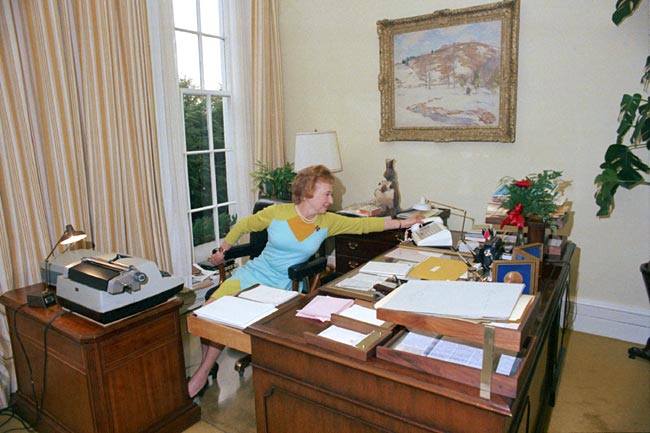
Typewriter of the moment: White House, Rosemary Woods

October 22, 2007

Rosmary Woods shows how she might have erased Nixon tapes

President Richard Nixon’s secretary, Rosemary Woods, demonstrates how she thought she might have accidentally erased 18-1/2 minutes of tape, when she reached to answer her phone and her foot extended to the “erase” footpedal, in 1974.

Ms. Woods’s typewriter is an electric, as best I can make out, an IBM. (Update, May 21, 2008: Ben Batchelor of etypewriters.com dropped by in comments to say it’s an IBM Model D Executive. Thanks, Ben!)

Good resource discovered in getting this image: The Watergate Files, presented by the Gerald R. Ford Presidential Library (at the University of Texas site). Image from the Gerald R. Ford Presidential Library.

Tip of the old scrub brush to Dr. Pamela Bumsted.


Effective presentations: Door knocking, phoning

October 9, 2007

It doesn’t matter what your politics are — Rob Reiner’s got a great little film here on effective presentations (the one at the campaign site is better quality than the one on YouTube). He’s pushing for Hillary Clinton for President. What he says applies to anything — selling Girl Scout cookies, selling Boy Scout popcorn, raising money to fight breast cancer, recruiting people to your organization, talking about the hero’s quest in Beowulf for your English 3 class, making a case for more computers for your classroom, whatever.

“She’d rather do laundry than talk to you.” That’s an acid test. If your audience would rather do laundry, you need to listen to Rob Reiner.

[Gee, I hope the Clinton campaign leaves that video up for a long time . . .]


Franklin Pierce? Wrong hoax, Scholastic

September 14, 2007

Maybe Fillmore fans should be offended.

Scholastic.com has a section, “Fun Facts to Know about the White House and its Residents, which contains this chesnut:

Franklin Pierce ordered the first bathtub for the White House. Many people were upset. They thought taking baths was not healthy and would make you sick!

Good heavens! They’ve got all the points of the Millard Fillmore/bathtub in the White House hoax — but they’ve attributed it to the wrong president!

It’s a hoax hoax!