Misrepresenting Christians in history

September 14, 2007

Oh! The scandal and shame!

No, not really. The Disciples of Christ, generally, have a pretty good sense of humor about stuff, which may be one reason why their rather small national sect has produced three presidents: James Garfield, the only preacher and first college president to be elected, Lyndon B. Johnson, whose family ranch hosts a chapel, and Ronald Reagan, who also attended one of the sect’s colleges (Eureka College) but fell a way a bit near the end.*

The fact that Reagan and Johnson could both be Disciples is a tribute to the wide door the church has for membership.

A hardy band of Disciples still participate in a list-serv discussion of church matters, DOCDISC (a list-serv is an ancient e-mail group discussion software set, used to avoid the public nature of alt.net discussions, substituting mass e-mails for bulletin board posts; read about it in your paleontology texts, kids).

A recent post pointed to a comic book biography of Ronald Reagan at Slate.com (okay, “graphic biography”) and lamented the inaccurate way the sect was portrayed (see section 1, page 12):

Panel from Slate.com bio of Reagan, showing his baptism at Disciples of Christ Church

Did you spot the problems?

The original post at DOCDISC complained first about the baptism. Horrors! It shows baptism by sprinkling! Well, not even sprinkling — more like a smearing on the forehead of young Ronald. Everybody knows Disiples dip! It should show baptism by immersion.

Once the tongue-in-cheek nature of the complaint became clear, other complaints surfaced. See the table of prayer votive candles over the left shoulder of the preacher? Some Disciples congregations have a rather high service, but no one knew of any so close to Catholicism as to host such a thing. One preacher whose father had been the pastor in the church in question suggested the sanctuary was a little fancy for the way the original was. And several suggested that the stole the pastor wears in the drawing is fancier by far than those used by most Disciples preachers (many Disciples preachers avoid such clerical garb altogether).

These are serious theological issues for Christians. The Disciples and what are now known as the Churches of Christ split in the early 20th century over the issue of musical instruments in worship, the Disciples being cool with all sorts of music, the Churches of Christ opting for a capella only, as they interpret one verse in scripture. In American colonial times, Anabaptists were reviled for their advocacy of immersion baptism and adult baptism — in Europe such advocates were disembowelled, but in American colonies only a few were hanged, and a few others sentenced to death by wolves (though some with this penalty, like Roger Williams, couldn’t find the wolves once put out into the wilderness, and had to found Rhode Island instead).

Even serious issues deserve a humorous look from time to time. Laughter eases the brain, makes it open to learning and creating. There are only about a million people in the U.S. who claim to be Disciples of Christ; we could probably use a lot more Christians with a good sense of humor.

We could use a lot more presidents with a good sense of humor, too.   (The “graphic biography” from Slate.com is a pretty good shtick, for Reagan’s life — anybody know how it works in the classroom?)

____________

* I don’t think Reagan ever attended a service at National City Christian Church in Washington, D.C., the closest Disciples church to the White House. If anyone knows differently, please let me know.


Alberto Gonzales resigned . . .

August 27, 2007

. . . Friday, but the president didn’t tell us about it until today.

According to the the New York Times (which broke the story):

“The unfair treatment that he’s been on the receiving end of has been a distraction for the department,” the official said.

Injustice even as he leaves. It’s the fair treatment Gonzales received that should have forced him out. The U.S. Justice Department is a mess above the political appointee level, with serious mismanagement, mal-management and lack of management threatening justice and the administration of law at several levels.

Other notable coverage: The Washington Post story now includes notes to Gonzales’s terse announcement, and links to recent stories in the Post which lend perspective and a lot of information.


Cheney calls Iraq “quagmire”

August 12, 2007

Santayana’s ghost* e-mailed to call attention to this interview with Vice President Dick Cheney, in which he tells the errors of invading Iraq and deposing Saddam Hussein.

Unfortunately, the interview was with Dick Cheney in 1994, when he was ex-Secretary of Defense, hanging out with the American Enterprise Institute.

Talk about condemned to repeat the errors of history!

* In this case, in the guise of son, Kenny.


August 7, 1964: Gulf of Tonkin Resolution

August 7, 2007

August 7 is the 43rd anniversary of the Gulf of Tonkin Resolution, the resolution which authorized President Lyndon B. Johnson to move troops into South Vietnam to defend U.S. interests.

The resolution passed Congress after what appeared to be attacks on two U.S. Navy ships in the Gulf of Tonkin.  At the time, and now, evidence is weak that such attacks took place.

Santayana’s ghost looks on in wonder.


When things get tough, the patriotic listen to Barbara Jordan

August 2, 2007

Whose voice do you hear, really, when you read material that is supposed to be spoken by God? Morgan Freeman is a popular choice — he’s played God at least twice now, racing George Burns for the title of having played God most often in a movie. James Earl Jones?

Statue of Barbara Jordan at the Austin, Texas, Airport

Statue of Rep. Barbara Jordan at the Austin, Texas airport that bears her name. Photo by Meghan Lamberti, via Accenture.com

For substance as well as tone, I nominate Barbara Jordan’s as the voice you should hear.

I’m not alone. Bill Moyers famously said:

When Max Sherman called me to tell me that Barbara was dying and wanted me to speak at this service, I had been reading a story in that morning’s New York Times about the discovery of forty billion new galaxies deep in the inner sanctum of the universe. Forty billion new galaxies to go with the ten billion we already knew about. As I put the phone down, I thought: it will take an infinite cosmic vista to accommodate a soul this great. The universe has been getting ready for her.

Now, at last, she has an amplifying system equal to that voice. As we gather in her memory, I can imagine the cadences of her eloquence echoing at the speed of light past orbiting planets and pulsars, past black holes and white dwarfs and hundreds of millions of sun-like stars, until the whole cosmic spectrum stretching out to the far fringes of space towards the very origins of time resonates to her presence.

Virgotext carried a series of posts earlier in the year, commemorating what would have been Jordan’s 71st birthday on February 21. (Virgotext also pointed me to the Moyers quote, above.)

Now, when the nation seriously ponders impeachment of a president, for the third time in just over a generation, Ms. Jordan’s words have more salience, urgency, and wisdom. It’s a good time to revisit Barbara Jordan’s wisdom, in the series of posts at Virgotext.

“There is no president of the United States that can veto that decision.”

“My faith in the Constitution is whole.”

“We know the nature of Impeachment. We’ve been talking about it a while now.”

“Indignation so great as to overgrow party interests.”

And finally:

The rest of the hearing remarks are all here. It’s a longer clip than the others but honestly, there is not a good place to cut it.

This is Barbara Jordan on the killing floor.

This was a woman who understands history, who illustrates time and again that we are, with every action, with every syllable, cutting the past away from the present.

She never mentions Nixon by name. There is the Constitution. There is the office of the Presidency. But Richard Nixon the president has already ceased to exist. By the time she finishes speaking, he is history.

“A President is impeachable if he attempts to subvert the Constitution.”

Also see, and hear:

Virgotext’s collection of Barbara Jordan stories and quotes is an excellent source for students on Watergate, impeachment, great oratory, and Barbara Jordan herself. Bookmark that site.

Barbara Jordan, in a pensive moment, in a House Committee room

Rep. Barbara Jordan sitting calmly among tension, at a House Committee meeting (probably House Judiciary Committee in 1974).

Update 2019: Here is the full audio of Barbara Jordan’s speech. It is still salient, and if you listen to it you will understand better what is going on in Congress today.

Barbara Jordan, Statement on the Articles of Impeachment, at AmericanRhetori.com.


Who was Millard Fillmore? No, really?

July 28, 2007

George Pendle’s hoax biography of Millard Fillmore sells okay — but Amazon lists 365,000 books selling better (July 28, 2007). That’s small solace to people who worry, as H. L. Mencken came too late to worry, about how hoaxes may spread. Mark Twain is reputed to have said that a lie can travel around the world twice before the truth can get its boots on.

So I was interested to find that somebody actually has a biography on Fillmore that ventures beyond the usual encyclopedia article. Big Mo’s Presidents Review featured Fillmore on July 15. According to the site, Big Mo is a journalist now stuck (or happy) in the corporate world. The biography is not so long that junior high (8th grade) U.S. history students will find it incredibly onerous, nor is it so short that it merely repeats the same old material.  It’s a good report.


Appointment of ____ to be ambassador to France; Fillmore and Daniel Webster signatures

The Big Mo report on Fillmore is good enough that other people are copying it wholesale (with attribution).

One gap:  Big Mo leaves out discussion of Fillmore’s boyhood, which is one area that students search on frequently, according to the statistics from this blog.  I think Fillmore’s early life, his change in careers after he threatened to kill the man he was indentured to if the fellow did not allow him to learn the trade, make some interesting discussion points about Fillmore’s character.  Minor quibbles.

On the plus side, he includes just about every image available on the internet, and cartoons about Fillmore, which are deucedly difficult to find in high resolution images.

Fillmore need not be a mystery.  Check it out.


Who is this man?

July 25, 2007

President Abraham Lincoln meeting soldiers following the Battle of Antietam

And, are you ready to celebrate the bicentennial of his birth in your classroom?

  • Photo: P_________ _______ _______ meets soldiers from the Union forces, following the Battle of Antietam, in Maryland, October 3, 1862. With the man in the hat are, from left, Col. Alexander S. Webb, Chief of Staff, 5th Corps.; Gen. George B. McClellan; Scout Adams; Dr. Jonathan Letterman, Army Medical Director; an unidentified person; and standing behind Lincoln, Gen. Henry J. Hunt. Photo and caption from _______ _______ Bicentennial 2009.
  • Read the rest of this entry »

Constitutional limitations on regal fantasies of presidents

July 24, 2007

Some people still defend the Madisonian view of the Constitution and its limits on the powers of the president (Adam Cohen in the New York Times):

The Constitution cannot enforce itself. It is, as the constitutional scholar Edwin Corwin famously observed, an “invitation to struggle” among the branches, but the founders wisely bequeathed to Congress some powerful tools for engaging in the struggle. It is no surprise that the current debate over a deeply unpopular war is arising in the context of a Congressional spending bill. That is precisely what the founders intended.

Members of Congress should not be intimidated into thinking that they are overstepping their constitutional bounds. If the founders were looking on now, it is not Harry Reid and Nancy Pelosi who would strike them as out of line, but George W. Bush, who would seem less like a president than a king.


Harsh judgment on Millard Fillmore

July 23, 2007

Missed this on Presidents’ Day:  The Forgettable Millard Fillmore (in The Los Angeles Times) .

Maybe more odd, or more damning, it’s written by George Pendle, who has written a book, The Remarkable Millard Fillmore.

Which is Fillmore, remarkable, or forgettable?

Read the rest of this entry »


Lady Bird Johnson, 94

July 12, 2007

Did I mention that we considered Lady Bird Johnson to be a family friend?

Ladybird Johnson among wildflowers

  • Ladybird Johnson in a field of Texas wildflowers, gaillardia and probably coriopsis, 2001; photo by Frank Wolfe, MacNeil/Lehrer Productions and KLRU-TV production, “Lady Bird”

We didn’t know her that well, really. But for the two years prior to our move to Texas, when I staffed the President’s Commission on Americans Outdoors, she was a solid presence. A passionate advocate of wildflowers, she was well aware of the possibilities that the commission might make recommendations regarding gardening and walking and hiking, and preserving natural beauty. She had already convered Tennessee Gov. Lamar Alexander to the cause — he issued an executive order that Tennessee should not cut down wildflowers along roadsides, saving the state a bunch of money on mowing and adding to the beauty of the state’s roads all at once. Alexander chaired the commission.

But she went to work on the vice chair, too — Gil Grosvenor, the president of the National Geographic Society. And she worked on the commission director, Victor Ashe, who had recently lost a U.S. Senate campaign to Al Gore and would go on to be mayor of Knoxville and chairman of the National Conference of Mayors. Lady Bird did not want to let any potential ally go unpersuaded. She had the phone numbers, and she made the calls, especially the late-in-the-day-catch-the-big-fish-without-a-secretary calls. Some of the people who go out of channels that way are very obnoxious. Lady Bird always produced smiles.

She persuaded them and the other commissioners to her cause, the commission staff, and probably anyone who ever bothered to read the reports of the commission or who attended any of the several public hearings where the joys and value of wildflowers was discussed.

And then we moved to Texas, and in the spring time we could see what Lady Bird’s passion was all about. It helped that Kathryn decided to chase her own passion for horticulture, and fell in with a great bunch of landscape designers and nursery people who emphasized Texas native plants. We joined the wildflower center Lady Bird set up in Austin, and actually met her on a couple of occasions. Kathryn and I both worked in the U.S. Senate, and we know stuffy people. Lady Bird was not stuffy, but always a woman of infinite charm and grace.

Most recently, when our son James earned his Eagle rank in Scouting, Lady Bird’s name was on the list of those public figures who would be gracious enough to drop a note of congratulations if asked. We know how to recognize the letters signed by machines, and we know how to recognize letters written by software that mimics handwriting. So it was a pleasant surprise to get a hand-addressed note from Austin, and see that the handwriting on the note matched the envelope. That’s the way a lady does it.

In Texas now, in the spring time there are bluebonnet watches, maps in newspapers showing a path to drive to see the best blooms, festivals, and trinkets galore. An entire industry of photographers revolves around getting families to sit among the flowers at the side of the road for a portrait. The flowers, other than the bluebonnets, show brilliantly to incoming airplanes. A flight from Houston or Austin to Dallas gives a passenger a floral sendoff and a floral welcome at the other end.

You can read the stories. Lady Bird was the financial manager of the Lyndon Johnson family fortune. She was also the peacemaker, the one who got LBJ calmed down from his frequent flights of passion, calm enough that he could be the best legislator our nation ever had, including James Madison, and a great legislative master even as president, as no president before or since.

Steel magnolias have nothing on Lady Bird Johnson, who understood the power of a blanket of flowers, the importance of roots and family, and how much grace can mean to those who get it.

Teachers in Texas should hit the newstands today and get the papers with the special features — the Dallas Morning News front page and front section are full of good stories. Teachers should get to the news websites and get the stories that will disappear in a week downloaded for later use. U.S. history teachers would do well to do the same, to get the information about the American environmental movement, and to pick up additional history on Lyndon Johnson, Vietnam, the successes of the civil rights movement, and the amazing decade of the 1960s.

America is better because of Lady Bird Johnson. She worked to be, and was, a family friend to the entire nation.

Here are sources you can check from contemporary news:

Dallas Morning News coverage


Former first lady dies at 94

LBJ trusted Lady Bird with his true self, warts and all

Lady Bird cultivated natural beauty from Western wilderness to inner cities

Journalist remembers her friend

Remembering Lady Bird

Editorial: She showed world grace, gentleness

Timeline: Her life and times

Services planned for Lady Bird Johnson

Statement from President George W. Bush

Statement from former President Bill Clinton and Sen. Hillary Clinton

Submit: Sign the online guestbook

Photos: The life of Lady Bird Johnson

Video:
Remembering Lady Bird Johnson (WFAA-TV)
Kay Bailey Hutchison on Lady Bird Johnson (WFAA-TV)
John Cornyn on Lady Bird Johnson (WFAA-TV)
Mrs. Johnson’s impact on Central Texas (KVUE-TV)
Lady Bird Johnson’s Legacy (KVUE-TV)
Family friend and spokesman Neal Spelce shares his memories of Mrs. Johnson (KVUE-TV)
Reaction from the LBJ Library and Museum staff (KVUE-TV)

Links
Lady Bird Johnson Final Tribute
Lady Bird Johnson Wildflower Center
Lady Bird Johnson biography
Lyndon Baines Johnson Library and Museum

Tip of the old scrub brush to O’Folks.


Insanity spreads through Article II agencies

June 26, 2007

From the Chicago Tribune:

White House press secretary Tony Snow said the president and vice president are not executive “agencies” and are therefore not covered under the executive order, but he stopped short of placing Cheney exclusively in the legislative branch. Snow He said the vice president has served “in an executive capacity delegated to him by the president” and noted that, constitutionally “there are no specified executive activities for the vice president,” and that his role “is a wonderful academic question.”

Chicago Tribune, “Emanuel seeks to cut funding for Cheney’s office, home,” June 26, 2007

Constitution of the United States, Article II, Section 1:

The executive Power shall be vested in a President of the United States of America. He shall hold his Office during the Term of four Years, and, together with the Vice President, chosen for the same Term, be elected, as follows . . .


Appropriate use of the Presidential Seal

June 14, 2007

The socks. Just look at the socks.

Bush in crocs and socks

Photo found at DailyKos.

18 USC Sec. 713 , governing the use of the presidential seal, and others, and Executive Order 11649, governing use of the presidential and vice presidential seals, below the fold.

Read the rest of this entry »


Quote of the Moment: Eisenhower at D-Day Eve

June 9, 2007

Eisenhower talks to troops of invasion force, June 5 -- before D-Day

Soldiers, Sailors, and Airmen of the Allied Expeditionary Force: You are about to embark upon the Great Crusade, toward which we have striven these many months. The eyes of the world are upon you.

Order of the Day, 6 June, 1944 (some sources list this as issued 2 June)


June 5, 1968: The day Bobby died

June 6, 2007

Jim Booth at Scholars and Rogues wrote about what the death of Bobby Kennedy meant to a 16-year old kid out to save the world from darkest North Carolina.

This is just the 39th anniversary of RFK’s death. Next year, 2008, will be the 40th, and will again feature an election in which the war-crippled lame duck president must be succeeded, and the early fields in both parties do not excite the incumbent party’s masses much.

But 1968 was a uniquely terrible year — we hope it was unique. One serious question is just how depressing will it be to hear the “40-years out” stories on the Pueblo crisis, Martin Luther King, Jr.’s death, the riots, RFK’s death, the convention riots, the money-and-morale-and-morality sapping war (Vietnam, not Iraq — we hope), etc., etc.

And so Mr. Booth’s close is a potent challenge: To rededicate ourselves to the hopes we felt in the first half of 1968, to see the implementation of those hopes now, two generations later — despite the cynicism that wells up whenever we see anyone touted as a great hope of needed change in the country’s direction, or whenever great hopes are dashed to pieces, as they have been in Iraq.

And every June 5th I stop for a few moments and remember how I believed in what America could be once – try to get some of that belief back – and, to use an old Boomer chestnut, “keep on keeping on.”

And I ask Bobby to forgive me – and my generation – for failing to pick up his torch….


Cartoon of note: Berryman on TR and fair play

May 24, 2007

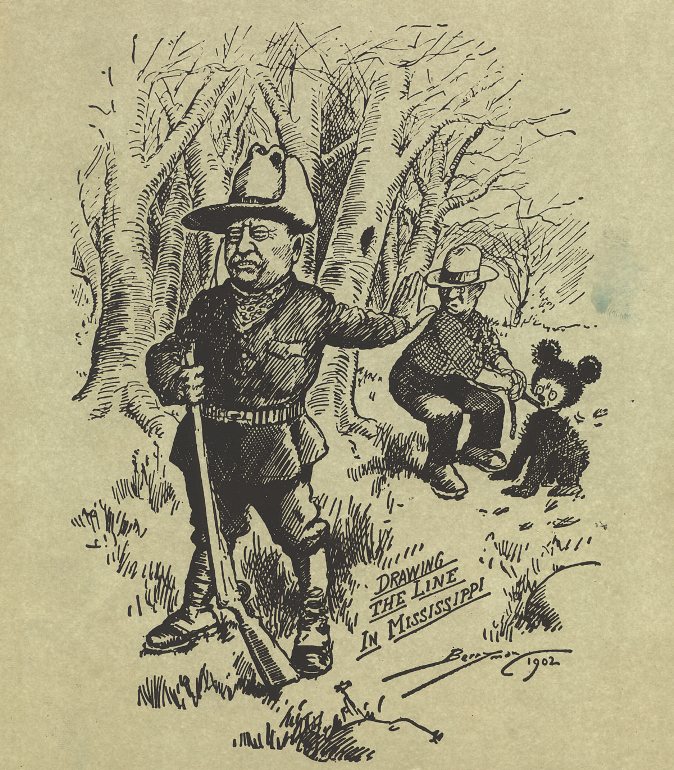
Clifford Berryman cartoon, "Drawing the Line in Mississippi, 1902"

Clifford Berryman cartoon, “Drawing the Line in Mississippi, 1902”

Berryman’s Bear: “Drawing the line in Mississippi.”

In 1902 Teddy Roosevelt hunted bear near Smedes, Mississippi. He didn’t get a bear, as he had hoped. Trip guides tracked a bear with dogs, clubbed it, and tied it up. The bear was offered to TR to shoot.

Teddy refused to shoot it, of course. It was tied up. It was not sporting, not fair, not a match — not the vigorous hunting Roosevelt wanted.

Clifford K. Berryman, a cartoonist for the Washington Post newspaper (he moved to the Washington Star in 1907), captured the moment in a drawing published November 16, 1902. This 1902 cartoon is among the most famous political cartoons ever done.

The good sportsmanship Roosevelt demonstrated echoed long and hard among Americans. His reputation for fair dealing and good sportsmanship increased his popularity immensely.

Candy store owners in New York City, Morris and Rose Michtom, made a stuffed bear, a “Teddy bear,” to commemorate the event. We still call them Teddy bears, today.

Berryman continued to use the bear cub in cartoons for the rest of his career.

Teddy Roosevelt cartoon sources: