Regulating guns as we regulate cars

May 29, 2023

A Nextdoor member complained that autos kill people, so we should ban some autos, just like calls to ban some guns. ‘It would be fair, no?’

I responded: Auto deaths are down from past years, and are much lower than the rate 30 years ago. Consider some of the rational safety steps taken to cut auto deaths, and ask whether they would not be applicable to guns, to reduce deaths.

1. A license is required to operate a vehicle, whether one owns the vehicle or not. Proficiency in vehicle operation must be demonstrated in a written test and driving test done by the state.

2. A license is required for the vehicle. In Texas, licenses must be renewed annually. Vehicles must undergo inspections for safety, and to be sure they meet air quality standards on emissions.

3. Drivers and owners are required to carry liability insurance, to pay for medical costs and property damage, or deaths, in the event the vehicle causes damage or injury.

4. There are numerous safety devices in vehicles; brakes must be maintained, by law; tires must be kept in good working order. Seatbelts are required for drivers and all passengers. Airbags are now required on almost all vehicles, passive injury-prevention devices. Bodies of cars and trucks must be built to preserve cab integrity and reduce injury in event of collision.

5. There are many safety warning devices. Vehicles must have working headlights and taillights, turn signals, emergency signals, running lights and horns. Law requires drivers to signal their intentions to other surrounding vehicles and pedestrians.

6. In almost all cases, vehicles must give way to pedestrians.

There are not exact analogs to all those safety devices and procedures in guns, but many would improve gun safety considerably.

There are about half as many vehicles as guns in the U.S. (educated guess); most of them get used every day. Most Americans ride in a vehicle every day.

Let us say there are 150 million vehicles driven 300 times a year. That’s 45 billion uses (mileage is not calculated). Of those 45 billion uses, 40,000 lives are lost every year. One death for every 1,125,000 uses.

300 million guns (again, educated guess; it’s a bit more than that); most guns get used how often? Once a year? Twice a year?

600 million uses, and 45,000 deaths, with guns. That’s one death for every 13,333 uses. Gun deaths are about 8 times more frequent than auto deaths, per use.

Obviously, guns are [at least] 8 times as dangerous as cars. Let’s consider that, too.

How can we bring gun deaths down?

While you’re at it, how can we bring auto deaths down?

Some time after I posted my response on May 10, 2023, the original poster took his post down. BESMART has good policies for gun safety in America. Maybe check out their suggestions, and support their work, at BeSmartforkids.org.

BESMART gun safety suggestions.
Five rules of gun safety to protect children, from BeSMARTforkids.org.

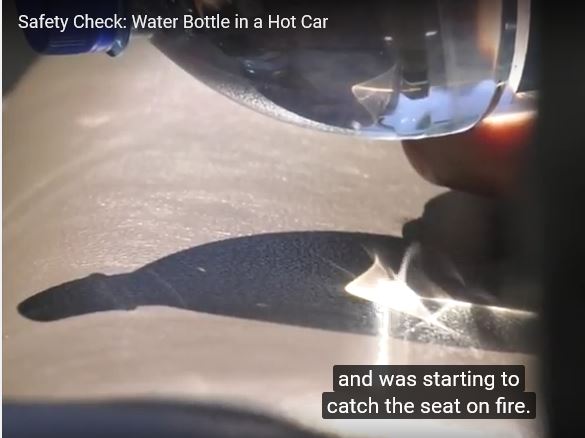
Science lessons applied for safety, in your car. Do you drink water?

August 17, 2017

Still image from Idaho Power's short video on water bottles causing fires in cars.

Still image from Idaho Power’s short video on water bottles causing fires in cars.

Idaho Power sends along this video, teaching how to avoid starting your car on fire on a sunny day.

Can you use this video in your classroom?

It demonstrates science, how lenses work, how light works. Science classes should be able to use it.

The video offers safety instruction, stuff elementary kids should know to improve the safety of their daily lives. Their parents should know about it, too. Instruction for the kids, and a safety flyer for kids to take home.  A short piece Boy Scouts can use for Safety merit badge instruction. Surely Girl Scouts can use the safety instruction for a badge.

What other uses can you find?

Basic science provides critical basis for living, for parenting, and for teaching and learning. Anyone opposed to science instruction should rethink the harms that ever result from ignorance, or even forgetfulness.

Save


Warning signs in Texas

September 7, 2014

On several Texas rivers one may rent a large tire inner tube, to float down the river on a good day.

Safety instructions sometimes are minimal, but effective.

Safety rules at a river float rental company, location unknown. Photo via Cathy Ordemann

Tip of the old scrub brush to Cathy Ordemann.


Birth of hydrogen phobia: May 6, 1937, the Hindenberg crash

May 6, 2014

May 6, 2014, is the 77th anniversary of the Hindenberg tragedy. Docking at its station in New Jersey, after crossing the Atlantic, a spark ignited the aluminum-based paint on the airship, and the entire craft exploded into flame.

35 people died on the airship, and one on the ground — did you know a few survived? The Associated Press interviewed a man who was 8-years old that day, and a passenger on the airship.

Werner Doehner, an 8-year-old passenger aboard the Hindenburg, saw chairs fall across the dining room door his father had walked through moments before the disaster. He would never see his father alive again.

“Just instantly, the whole place was on fire,” said Doehner, of Parachute, Colo., who is the last surviving passenger. “My mother threw me out the window. She threw my brother out. Then she threw me, but I hit something and bounced back. She caught me and threw me the second time out. My sister was just too heavy for her. My mother jumped out and fractured her pelvis. Regardless of that, she managed to walk.”

Hindenberg on fire

Hindenberg on fire, May 6, 1937.

The disaster erroneously condemned hydrogen in the public’s mind. Despite widespread use of hydrogen gas for cooking and some transportation during World War II (including in the U.S.), use of hydrogen as a fuel beyond that has always faced the hurdle of the “Hindenberg Syndrome,” the fear that the gas would explode.

Is the fear justified?  Fact is that gasoline is much more volatile, more explosive, and generally more dangerous, than hydrogen.  We move, and use, millions of gallons of gasoline in the U.S. every day, worldwide very hour, bound by laws enforcing strict liability, in relative safety.  Most people don’t think about the explosive power of the few gallons of gasoline stored under the rear seat of their car, where the children ride.

What other technologies do we fear irrationally?  What technologies do we irrationally fail to fear so much as we should?

This is mostly an encore post.


How kids get to school, New Delhi edition

March 19, 2014

From Twitter:

From Twitter: “Another e.g. pic to show that school transport in Asia needs attention on health & safety aspects pic.twitter.com/Mn2FbSSELX”

Do you think the students have wi-fi to finish their homework on the way to school?

(This is not necessarily representative of all Indian school buses.)

One wonders at the stories behind such “buses” and their use.  It might make an interesting geography assignment, to find out how students get to school in other nations.  What is the most exotic, bizarre, dangerous or luxurious ride?

More:


A sign to take seriously

September 7, 2013

jordanfhiggins  More good advice. #NASASocial

jordanfhiggins More good advice. #NASASocial

Sometimes signs just don’t command the attention they should.