Annals of global warming: NASA finds amplified greenhouse effects shift northern growing seasons

March 11, 2013

Global warming affects plants in northern hemisphere, NASA chart

From NASA: Of the 10 million square miles (26 million square kilometers) of northern vegetated lands, 34 to 41 percent showed increases in plant growth (green and blue), 3 to 5 percent showed decreases in plant growth (orange and red), and 51 to 62 percent showed no changes (yellow) over the past 30 years. Satellite data in this visualization are from the AVHRR and MODIS instruments, which contribute to a vegetation index that allows researchers to track changes in plant growth over large areas. Credit: NASA’s Goddard Space Flight Center Scientific Visualization Studio; click image for original view; click here for greater detail

Press release from NASA, March 10, 2013 (links in text added here):

RELEASE : 13-069


Amplified Greenhouse Effect Shifts North’s Growing Seasons

WASHINGTON — Vegetation growth at Earth’s northern latitudes increasingly resembles lusher latitudes to the south, according to a NASA-funded study based on a 30-year record of land surface and newly improved satellite data sets.

An international team of university and NASA scientists examined the relationship between changes in surface temperature and vegetation growth from 45 degrees north latitude to the Arctic Ocean. Results show temperature and vegetation growth at northern latitudes now resemble those found 4 degrees to 6 degrees of latitude farther south as recently as 1982.

“Higher northern latitudes are getting warmer, Arctic sea ice and the duration of snow cover are diminishing, the growing season is getting longer and plants are growing more,” said Ranga Myneni of Boston University’s Department of Earth and Environment. “In the north’s Arctic and boreal areas, the characteristics of the seasons are changing, leading to great disruptions for plants and related ecosystems.”

The study was published Sunday in the journal Nature Climate Change.

Myneni and colleagues used satellite data to quantify vegetation changes at different latitudes from 1982 to 2011. Data used in this study came from NOAA’s Advanced Very High Resolution Radiometers (AVHRR) onboard a series of polar-orbiting satellites and NASA’s Moderate Resolution Imaging Spectroradiometer (MODIS) instruments on the Terra and Aqua satellites.

As a result of enhanced warming and a longer growing season, large patches of vigorously productive vegetation now span a third of the northern landscape, or more than 3.5 million square miles (9 million square kilometers). That is an area about equal to the contiguous United States. This landscape resembles what was found 250 to 430 miles (400 to 700 kilometers) to the south in 1982.

“It’s like Winnipeg, Manitoba, moving to Minneapolis-Saint Paul in only 30 years,” said co-author Compton Tucker of NASA’s Goddard Space Flight Center in Greenbelt, Md.

The Arctic’s greenness is visible on the ground as an increasing abundance of tall shrubs and trees in locations all over the circumpolar Arctic. Greening in the adjacent boreal areas is more pronounced in Eurasia than in North America.

An amplified greenhouse effect is driving the changes, according to Myneni. Increased concentrations of heat-trapping gasses, such as water vapor, carbon dioxide and methane, cause Earth’s surface, ocean and lower atmosphere to warm. Warming reduces the extent of polar sea ice and snow cover, and, in turn, the darker ocean and land surfaces absorb more solar energy, thus further heating the air above them.

“This sets in motion a cycle of positive reinforcement between warming and loss of sea ice and snow cover, which we call the amplified greenhouse effect,” Myneni said. “The greenhouse effect could be further amplified in the future as soils in the north thaw, releasing potentially significant amounts of carbon dioxide and methane.”

To find out what is in store for future decades, the team analyzed 17 climate models. These models show that increased temperatures in Arctic and boreal regions would be the equivalent of a 20-degree latitude shift by the end of this century relative to a period of comparison from 1951-1980.

However, researchers say plant growth in the north may not continue on its current trajectory. The ramifications of an amplified greenhouse effect, such as frequent forest fires, outbreak of pest infestations and summertime droughts, may slow plant growth.

Also, warmer temperatures alone in the boreal zone do not guarantee more plant growth, which also depends on the availability of water and sunlight.

“Satellite data identify areas in the boreal zone that are warmer and dryer and ¬¬other areas that are warmer and wetter,” said co-author Ramakrishna Nemani of NASA’s Ames Research Center in Moffett Field, Calif. “Only the warmer and wetter areas support more growth.”

Researchers did find found more plant growth in the boreal zone from 1982 to 1992 than from 1992 to 2011, because water limitations were encountered in the latter two decades.

Data, results and computer codes from this study will be made available on NASA Earth Exchange (NEX), a collaborative supercomputing facility at Ames. NEX is designed to bring scientists together with data, models and computing resources to accelerate research and innovation and provide transparency.

For more information and images associated with this release, visit:

http://go.nasa.gov/12Amv2s

– end –


text-only version of this release

More:


Neil Tyson, still at it: We need to spend more in government research, in space, in science, in education

March 7, 2013

Here’s a guy who Paul Ryan, Eric Cantor and other “deficit hawks” refuse to debate.  Grover Norquist blanches when you mention his name, and hopes and prays you won’t listen to him:  Neil de Grasse Tyson.

The film was put together from several statements by Tyson, by Evan Schurr.

WRITE TO CONGRESS:
http://www.penny4nasa.org/take-action/

The intention of this project is to stress the importance of advancing the space frontier and is focused on igniting scientific curiosity in the general public.
Facebook cover: (not sure who made this but thank you!)
http://i.imgur.com/yqAGm.png

*FOR THOSE SAYING THE MUSIC IS TOO LOUD* This is the adjusted one http://youtu.be/Fl07UfRkPas

I give immense credit to The Sagan Series for providing the inspiration for this video.
http://www.youtube.com/user/damewse?f…

Copyright Disclaimer Under Section 107 of the Copyright Act 1976, allowance is made for “fair use” for purposes such as criticism, comment, news reporting, teaching, scholarship, and research. Fair use is a use permitted by copyright statute that might otherwise be infringing. Non-profit, educational or personal use tips the balance in favor of fair use. All copyrighted materials contained herein belong to their respective copyright holders, I do not claim ownership over any of these materials. In no way do I benefit either financially or otherwise from this video.

MUSIC:
Arrival of the Birds and Transformation by The Cinematic Orchestra http://www.amazon.com/The-Crimson-Win…

Credits
When We Left Earth http://dsc.discovery.com/tv/nasa/nasa…
The Daily Show with Jon Stewart http://www.thedailyshow.com/
HUBBLE 3D http://www.imax.com/hubble/
NASA TV http://www.nasa.gov/multimedia/nasatv…
The Amazing Meeting http://www.amazingmeeting.com/TAM2011/
“US Mint” http://www.youtube.com/watch?v=-ZzKDL…
“New $100 Note” http://www.youtube.com/watch?v=zgaytK…
Real Time with Bill Maher http://www.hbo.com/real-time-with-bil…
Pale Blue Dot – http://en.wikipedia.org/wiki/Pale_Blu…
STS-135 Ascent Imagery Highlights http://www.youtube.com/watch?v=ikzxtw…
CSPAN State of the Union Address http://www.c-span.org/
The Sagan Series http://www.facebook.com/thesaganseries
The Asteroid that Flattened Mars http://www.youtube.com/watch?v=JgMXPX…
University of Buffalo Communications http://www.communication.buffalo.edu/
Mars Curiosity Rover http://www.youtube.com/watch?v=hnlvvu…
Red Aurora Australis http://www.youtube.com/watch?v=hC7Qro…

Thank you to user florentgermain for the French subtitles

Hey, this is a year old.  Why are you sitting on your hands?  Our future, our children’s future, our great-great-grandchildren’s futures, are on the line.

Tip of the old scrub brush to Robert Krulwich at NPR, who pulled this out and started discussing it again.

More:


Punchline too brutal for work: Why it is that environmentalists are the real humanitarians (a necessary encore)

March 1, 2013

I wish it weren’t true.  I wish people didn’t appear to be getting stupider, less scientifically literate, and less knowledgeable of history (see Santayana‘s thoughts in the upper right-hand corner of the blog . . .).  My e-mail box is filling today with notes from people claiming environmentalists want to rid the Earth of humans, urging that we should oppose them and let poisoning of our air and water continue . . . oblivious to the irony of the claim coupled with their supposed opposition to the idea.  Here’s the truth, in large part, an encore post from several months ago (I apologize in advance for the necessary profanity):

The fictional but very popular memes that environmentalists hate humans, humanity and capitalism wouldn’t bother me so much if they didn’t blind their believers to larger truths and sensible policies on environmental protection.

One may argue the history of the environmental movement, how most of the originators were great capitalists and humanitarians — think Andrew Carnegie, Laurance Rockefeller, Theodore Roosevelt, Gifford Pinchot, and all the early medical doctors who warned of the dangers of pollution-caused diseases — but it falls on deaf ears on the other sides.

Here’s the 30-second response, from Humon, in cartoon form (or here, at Humon Comics):

First panel of cartoon by Humon at Deviant Art

Mother Gaia explains why environmental protection is important, from Humon at Deviant Art

Facts of life and environmental protection – from Humon at Deviant Art

Tip of the old scrub brush to P. Z. Myers, and Mia, whoever she is.  Myers noted, “Environmentalism is actually an act of self defense.”

More:

Wall of Shame; sites that don’t get it, or intentionally tell the error:

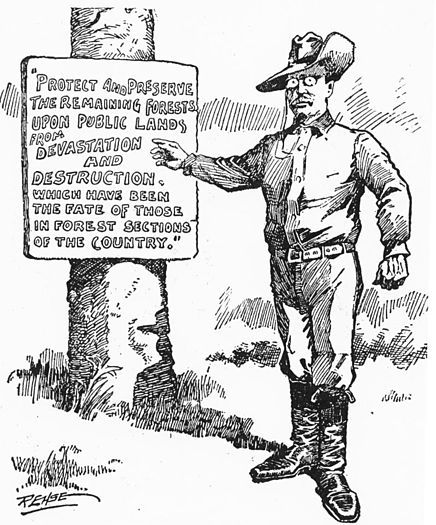
1908 editorial cartoon of President Theodore Roosevelt as “A Practical Forester.”  Source: St. Paul Minnesota “Pioneer Press”. Via GPO's Government Book Talk blog.

1908 Rense editorial cartoon of President Theodore Roosevelt as “A Practical Forester.” Source: St. Paul Minnesota “Pioneer Press”. Via GPO’s Government Book Talk blog.


Hog wild in Texas: Ranchers, guns, and science working against environmental disaster

February 25, 2013

Unusual?  No, this is really a typical marriage of agriculture, government agencies, science and hunters, working on problems of wildlife management, feral hogs in this case.

Notes from Texas Parks & Wildlife:

Feral hogs are running wild across Texas, at great cost to farmers, ranchers, and native wildlife. Hunters are helping, but science may prove critical to controlling the invasion on a broader scale. For more information on feral hogs and feral hog control, visit: http://www.tpwd.state.tx.us/huntwild/…

When it comes to feral hogs, every Texan turns environmentalist.

More:    

English: Sign for Texas Parks and Wildlife Dep...

Sign for Texas Parks and Wildlife Department headquarters – Wikipedia image


Darwin Day, around the cyber world

February 12, 2013

Phantasmagorical art at Pharyngula:

Darwin and life

Colorful Darwin rendering, from Pharyngula

P.Z. mentions that James Randi joins the celebration of Darwin Day at Broward College.

Digital Cuttlefish wrote a poem about Darwin — the usual brilliant Cuttlefish rhymes.

Panda’s Thumb reports on the special Darwin Day issue of Cell Reports.  Read down, you’ll find another post on a series of posts explaining evolution for average people, at BioLogos.  A great idea for Darwin Day, or any day.

Phil Plait at Bad Astronomy reported on the progress of the resolution in Congress to declare Darwin Day, and other matters.

Talk Nerdy To Me at Huffington Post carries a light little post of Darwin trivia.

Evolve, will ya?


Happy Darwin Day 2013! How to celebrate?

February 12, 2013

Charles Darwin

Darwin on Shakespeare: “I have tried lately to read Shakespeare, and found it so intolerably dull that it nauseated me.” (The Quote Blog) In the photo, Utah Valley University Prof. Daniel Fairbanks shows off a bust of Darwin he has sculpted while lecturing about evolution (Fairbanks is the son of sculptor Avard Fairbanks, and an accomplished sculptor himself.)

What to do for Darwin Day, and Evolution Sunday, and Darwin Week?

Wasatch Brewery's Evolution Amber Ale

Wasatch Brewery’s Evolution Amber Ale. Is this still being brewed in Salt Lake City?

Darwinian student's dream, Harper's Weekly, December 23, 1871

The Darwinian student’s after dinner dream. Harper’s Weekly, December 23, 1871; artist not identified; copyright Harper’s Weekly and HarpWeek

More:


Lincoln and Darwin, born hours apart, February 12, 1809

February 12, 2013

Is it an unprecedented coincidence?  204 years ago today, just minutes apart according to unconfirmed accounts, Abraham Lincoln was born in a rude log cabin on Nolin Creek, in Kentucky, and Charles Darwin was born into a wealthy family at the family home  in Shrewsbury, England.

Gutzon Borglums 1908 bust of Abraham Lincoln in the Crypt of the U.S. Capitol - AOC photo

Gutzon Borglum’s 1908 bust of Abraham Lincoln in the Crypt of the U.S. Capitol – Architect of the Capitol photo

Lincoln would become one of our most endeared presidents, though endearment would come after his assassination.  Lincoln’s bust rides the crest of Mt. Rushmore (next to two slaveholders), with George Washington, the Father of His Country, Thomas Jefferson, the author of the Declaration of Independence, and Theodore Roosevelt, the man who made the modern presidency, and the only man ever to have won both a Congressional Medal of Honor and a Nobel Prize, the only president to have won the Medal of Honor.  In his effort to keep the Union together, Lincoln freed the slaves of the states in rebellion during the civil war, becoming an icon to freedom and human rights for all history.  Upon his death the entire nation mourned; his funeral procession from Washington, D.C., to his tomb in Springfield, Illinois, stopped twelve times along the way for full funeral services.  Lying in state in the Illinois House of Representatives, beneath a two-times lifesize portrait of George Washington, a banner proclaimed, “Washington the Father, Lincoln the Savior.”

Charles Darwin statue, Natural History Museum, London - NHM photo

Charles Darwin statue, Natural History Museum, London – NHM photo

Darwin would become one of the greatest scientists of all time.  He would be credited with discovering the theory of evolution by natural and sexual selection.  His meticulous footnoting and careful observations formed the data for ground-breaking papers in geology (the creation of coral atolls), zoology (barnacles, and the expression of emotions in animals and man), botany (climbing vines and insectivorous plants), ecology (worms and leaf mould), and travel (the voyage of H.M.S. Beagle).  At his death he was honored with a state funeral, attended by the great scientists and statesmen of London in his day.  Hymns were specially written for the occasion.  Darwin is interred in Westminster Abbey near Sir Isaac Newton, England’s other great scientist, who knocked God out of the heavens.

Lincoln would be known as the man who saved the Union of the United States and set the standard for civil and human rights, vindicating the religious beliefs of many and challenging the beliefs of many more.  Darwin’s theory would become one of the greatest ideas of western civilization, changing forever all the sciences, and especially agriculture, animal husbandry, and the rest of biology, while also provoking crises in religious sects.

Lincoln, the politician known for freeing the slaves, also was the first U.S. president to formally consult with scientists, calling on the National Science Foundation (whose creation he oversaw) to advise his administration.  Darwin, the scientist, advocated that his family put the weight of its fortune behind the effort to abolish slavery in the British Empire.  Each held an interest in the other’s disciplines.

Both men were catapulted to fame in 1858. Lincoln’s notoriety came from a series of debates on the nation’s dealing with slavery, in his losing campaign against Stephen A. Douglas to represent Illinois in the U.S. Senate.  On the fame of that campaign, he won the nomination to the presidency of the fledgling Republican Party in 1860.  Darwin was spurred to publicly reveal his ideas about the power of natural and sexual selection as the force behind evolution, in a paper co-authored by Alfred Russel Wallace, presented to the Linnean Society in London on July 1, 1858.   On the strength of that paper, barely noticed at the time, Darwin published his most famous work, On the Origin of Species, in November 1859.

The two men might have got along well, but they never met.

What unusual coincidences.  Today is the first day of a year-long commemoration of the lives of both men.  Wise historians and history teachers, and probably wise science teachers, will watch for historical accounts in mass media, and save them.

Go celebrate human rights, good science, and the stories about these men.

Resources:

Charles Darwin:

Abraham Lincoln:

More:

Anybody know what hour of the day either of these men was born?

This is mostly an encore post.


Abraham Lincoln, inventor – only president with a patent?

February 10, 2013

Lincoln’s (and Darwin’s) birthday rolls around again next week. What do we know about our 16th president who was the subject of a great and a silly movie in the last year?

Some wag sent out this Tweet today.

Any visitor to Thomas Jefferson’s home at Monticello knows of Jefferson’s wide-ranging interests, and work in science and invention.  I was rather surprised to discover the depth of George Washington’s inventive work, in a seminar sponsorred by the Bill of Rights Institute at Mount Vernon a few years ago.

Abraham Lincoln, too?

Sangamon_River_near_Lincoln's_First_Home_in_Il...

Sangamon River near Lincoln’s first home in Illinois – Photo from Wikipedia

Lincoln lived along the Sangamon River, and he saw development of the river for commercial navigation to be a boon for his district’s economic growth.  Unfortunately, the Sangamon is not deep; boats had difficult times navigating over the many logs and snags, and shallows.

So, Mr. Lincoln offered a technical solution, for which he was granted a patent in 1849.  Details below, from Google Patents:

lincoln-patent-for-buoying_vessels_over_shoals

lincoln-patent-for-boat-buoying-in-jpg

Drawing for Abraham Lincoln’s patent of a boat bouying apparatus.

Was Lincoln the only president to get a patent?  Thomas Jefferson and George Washington worked hard at inventions.  Jefferson shared Ben Franklin’s view that new inventions should be for the benefit of all; does that mean he didn’t seek patents?  Washington’s inventions — including the 16-sided barn for threshing wheat — tended to be improvements on processes; I don’t know of any evidence he even thought of patenting any idea.

It’s possible that Lincoln was the only president so far to have held a patent.

Lincoln’s invention was never built, and that patent never used.

This is an encore post with additions.

More, and miscellany:


Anthony Watts’s political push poll, “Gore or Obama?”

February 9, 2013

Al Gore and Barack Obama together in Detroit, June 2012, Rebecca Cook photo for Reuters, via NBC News photo

Al Gore and Barack Obama don’t appear to be on the opposite side of most issues, especially not climate change. Here they appear together in Detroit, circa June 11, 2012 – Rebecca Cook photo for Reuters, via NBC News photo

Anthony Watts strays farther and further from science with every passing day, and most of his new posts.

At the moment he’s got a doozy of a post, citing a bovine excrement question on a CFACT billboard, and offering a push-poll with three choices designed to push Watts’s preferred political answer, that ‘Obama and Gore go in different directions on global warming and climate change, and maybe they are both wrong.’   The end message Watts pushes is wrong, as you can see in the full texts below.(Morgan, here’s the link so you don’t have to flounder around with Google.)

Who do you believe?

◊  Barack Obama
◊  Neither one
◊  Al Gore

It’s based on these two quote mine products from the CFACT billboard:

WHAT DO YOU BELIEVE?

“Hurricane Sandy is a disturbing sign of things to come.”  — Al Gore, 10/30/2012

“We can’t attribute any particular weather event to global warming.”  — Barack Obama, 11/14/2012

Lying with quotes, demonstrated by CFACT

Propaganda group CFACT’s quote mining billboard, on which Anthony Watts’s push-poll is based.

Watts doesn’t offer a “both correct” choice.  That would be the accurate answer.

Gore’s comment at his blog on October 30, 2012, noted that while we can’t attribute the formation of Sandy to climate change, the effects of the storm were magnified by climate change.  Gore called that “disturbing.”

Obama, noting that while we can’t say for certain that any particular storm is caused entirely from human-created global warming, the long-term effects clearly have human causation and we need to act to stop it.

In short, Gore and Obama take the same side on this issue, the side of science and making sound public policy.  Watts works the old tobacco company strategy, suggesting that wherever studies showing health harms from tobacco differ from each other in the slightest jot or tittle, that means scientists can’t decide whether tobacco is harmful — substitute “human-caused climate change” for tobacco in that argument, and you see what Watts is trying to do.

Meanwhile, the Earth still warms:

Gore’s blog post in full:

Statement on Hurricane Sandy October 30, 2012 : 1:21 PM

This week, our nation has anxiously watched as Hurricane Sandy lashed the East Coast and caused widespread damage–affecting millions. Now more than ever, our neighbors need our help. Please consider donating or volunteering for your local aid organizations.

The images of Sandy’s flooding brought back memories of a similar–albeit smaller scale– event in Nashville just two years ago. There, unprecedented rainfall caused widespread flooding, wreaking havoc and submerging sections of my hometown. For me, the Nashville flood was a milestone. For many, Hurricane Sandy may prove to be a similar event: a time when the climate crisis—which is often sequestered to the far reaches of our everyday awareness became a reality.

While the storm that drenched Nashville was not a tropical cyclone like Hurricane Sandy, both storms were strengthened by the climate crisis. Scientists tell us that by continually dumping 90 million tons of global warming pollution into the atmosphere every single day, we are altering the environment in which all storms develop. As the oceans and atmosphere continue to warm, storms are becoming more energetic and powerful. Hurricane Sandy, and the Nashville flood, were reminders of just that. Other climate-related catastrophes around the world have carried the same message to hundreds of millions.

Sandy was also affected by other symptoms of the climate crisis. As the hurricane approached the East Coast, it gathered strength from abnormally warm coastal waters. At the same time, Sandy’s storm surge was worsened by a century of sea level rise. Scientists tell us that if we do not reduce our emissions, these problems will only grow worse.

Hurricane Sandy is a disturbing sign of things to come. We must heed this warning and act quickly to solve the climate crisis. Dirty energy makes dirty weather.

President Obama’s statement, excerpted from his November 14, 2012, press conference:

THE PRESIDENT:  Mark Landler.  Where’s Mark?  There he is right in front of me.

Q    Thank you, Mr. President.  In his endorsement of you a few weeks ago, Mayor Bloomberg said he was motivated by the belief that you would do more to confront the threat of climate change than your opponent.  Tomorrow you’re going up to New York City where you’re going to, I assume, see people who are still suffering the effects of Hurricane Sandy, which many people say is further evidence of how a warming globe is changing our weather.  What specifically do you plan to do in a second term to tackle the issue of climate change?  And do you think the political will exists in Washington to pass legislation that could include some kind of a tax on carbon?

THE PRESIDENT:  As you know, Mark, we can’t attribute any particular weather event to climate change.  What we do know is the temperature around the globe is increasing faster than was predicted even 10 years ago.  We do know that the Arctic ice cap is melting faster than was predicted even five years ago.  We do know that there have been extraordinarily — there have been an extraordinarily large number of severe weather events here in North America, but also around the globe.

And I am a firm believer that climate change is real, that it is impacted by human behavior and carbon emissions.  And as a consequence, I think we’ve got an obligation to future generations to do something about it.

Now, in my first term, we doubled fuel efficiency standards on cars and trucks.  That will have an impact.  That will take a lot of carbon out of the atmosphere.  We doubled the production of clean energy, which promises to reduce the utilization of fossil fuels for power generation.  And we continue to invest in potential breakthrough technologies that could further remove carbon from our atmosphere.  But we haven’t done as much as we need to.

So what I’m going to be doing over the next several weeks, next several months, is having a conversation, a wide-ranging conversation with scientists, engineers, and elected officials to find out what can — what more can we do to make a short-term progress in reducing carbons, and then working through an education process that I think is necessary — a discussion, a conversation across the country about what realistically can we do long term to make sure that this is not something we’re passing on to future generations that’s going to be very expensive and very painful to deal with.

I don’t know what either Democrats or Republicans are prepared to do at this point, because this is one of those issues that’s not just a partisan issue; I also think there are regional differences.  There’s no doubt that for us to take on climate change in a serious way would involve making some tough political choices.  And understandably, I think the American people right now have been so focused, and will continue to be focused on our economy and jobs and growth, that if the message is somehow we’re going to ignore jobs and growth simply to address climate change, I don’t think anybody is going to go for that.  I won’t go for that.

If, on the other hand, we can shape an agenda that says we can create jobs, advance growth, and make a serious dent in climate change and be an international leader, I think that’s something that the American people would support.

So you can expect that you’ll hear more from me in the coming months and years about how we can shape an agenda that garners bipartisan support and helps move this agenda forward.

Q    Sounds like you’re saying, though, in the current environment, we’re probably still short of a consensus on some kind of attack.

THE PRESIDENT:  That I’m pretty certain of.  And, look, we’re still trying to debate whether we can just make sure that middle-class families don’t get a tax hike.  Let’s see if we can resolve that.  That should be easy.  This one is hard — but it’s important because one of the things that we don’t always factor in are the costs involved in these natural disasters; we just put them off as something that’s unconnected to our behavior right now.  And I think what — based on the evidence we’re seeing, is that what we do now is going to have an impact and a cost down the road if we don’t do something about it.

In context, can you point to any points of conflict between what Al Gore said in October, and what President Obama said a couple of weeks later?  To me it looks as if they’re singing very much from the the same hymnal or songbook, and they’re in harmony, if not unison, especially in what I’ve turned into red-letter text.

Here’s the video of the entire Obama press conference (climate question comes at 42:19 in the video transcript):

More:


Science project: Hello Kitty at 94,000 feet

February 8, 2013

GoPro cameras weigh so little, work so well and are so tough that they go anywhere.  How we would have loved to attach one to the kites we sent a couple thousand feet above the Utah mountains.

Only time stood between the cameras and their use in high-altitude photography from weather balloons — even the topic of a credit card advertisement.  And now, a middle school science project, for a Christian parochial school (what science could a religious school foul up in studying the atmosphere?).

Four Go-Pros, a styrofoam box, a bunch of duct tape, a GPS-equipped locater (you could use a cell phone), some high-technology-now-cheap sensing equipment from High Altitude Science for temperature and air pressure — even a 7th-grade science project can make Galileo, Newton and Goddard jealous.

You can tell it’s 7th grade from the choice of the astroKittynaut to the choice of music, no?

Details:

Cornerstone Christian school 7th grade science project.
The effects of Altitude on air pressure and temperature.
Cameras: GoPro Hero2 video footage.
Edited By: Eddie Lacayo elacayo212@gmail.com
Flight gear: High Altitude Science.
Flight computer / Data acquisition: High Altitude Science.
Tree Climber: Woodpecker Arborist.

music: We Are Young by: Fun (Feat Janelle Monáe)
We Do Not Own The Rights To This Song
buy at: http://www.amazon.com/Are-Young-feat-…

This isn’t an ad for High Altitude Science, nor for GoPro (although if they want to send some products along for review, I would review them with full disclosure, and return what isn’t used up), but if you are inspired to try this, look at some of the details.

From High Altitude Science, a sales-pitch on how easy it is:

  • If you’re interested in starting your own space program, click here.
  • If you’re interested in purchasing weather balloons, satellite trackers, and weather balloon kits, visit our Store.
  • If you already have a weather balloon kit, but need some training or a refresher, read our Tutorials.
  • If you’re an educator who wants to inspire your students, visit our Education Page.
  • If you would like to see our products in action, visit our Videos Page.

I got my GoPro at REI; there are other vendors, and the new ones are very impressive.  High Altitude Science uses a special mount for the GoPro, which they sell with the camera.  For the project above, some of the cameras were borrowed.  Some adult supervision is needed — this package drifted more than 40 miles from the launch site; you want to be sure to avoid air travel lanes at launch (a lot of the Dallas-Ft.Worth area would be off limits); launching from Salt Lake or Utah Valleys could put the touchdown site 5,000 feet up in a wilderness area.  There are considerations on safety and recovery that require some thought.  When CNN tried it, they ran into problems — their account could be useful background (with cool photos, too).

What else could you do with these cameras and science project kits?  How about flying a kite, just to look at your town.  Attach a camera to a radio-controlled aircraft (a drone), and see what you can’t see of a wilderness area or riparian environment, or forest canopy, or rockface on a mountain.  Get the water-tight case, and put the thing into a river or lake.

A 7th-grade kid doing real science measurements at a Christian school — ain’t technology wonderful?

Is there gyroscope device to keep these devices from spinning so wildly?  Will the new GoPros support a radio contact to get images live from the device?

More:

Film from the physics class at East Union High School in Afton, Iowa, showing more detail of the data collection and analysis:

A July 2012 launch from Austin, Texas:

A Vimeo version, for a launch from farther east (BrooklynSpaceProgram.org), that garnered coverage from the New York Times:

How many of these projects have there been?


Time machine! For Digital Learning Day

February 6, 2013

Screen shot from HHMI's iPad app, Earth Viewer -- the time machine function.

Screen shot from HHMI’s iPad app, Earth Viewer — the time machine function.

Stealing the entire post from P. Z. Myers at Pharyngula:

I’ve been playing with it for a while. It turns out that when you go back to Cretaceous Morris, you need to be able to swim really well, but Cambrian Morris is high and dry on a fairly small landmass (whoa, but oxygen is way down and carbon dioxide way up). You can have your own time machine, too — it’s the EarthViewer app for iPad, and it’s free from HHMI Here’s what it has:

• Data and continental reconstructions dating back billions of years

• Climate and carbon dioxide data for the last 100 years

• The ability to manipulate the globe and zoom to any location

• Track the location of modern cities back over 500 million years

• In depth features on major geological and biological events in Earth history

• Clickable details on geologic eons, eras, and periods

• Automated play modes

• An extensive reference list

• Suggestions for classroom use

• Tutorial videos

Did I mention that it’s free? This HHMI thing is pretty danged sweet.

There is no creationist/Noah’s Flood version.

No Windows version, yet, either.

Did we mention the Howard Hughes Medical Institute made this and related apps free?


So, you want to be an astronaut?

February 2, 2013

What’s it like to be an astronaut?

You gotta learn how to cook and eat snake.

A discovery engine for meaningful knowledge, fueled by cross-disciplinary curiosity.
Edited by Maria Popova for Lore.
Twitter: @explorer

Art & Design Science & Technology Culture & Society History & Literature Creativity & Innovation Media & Communication Thought & Opinion About

Science & TechnologyHistory & Literature
What’s it like to be an astronaut? An animated first-hand account by NASA’s Jerry Carr, who tells his fascinating life story.

Complement with Sally Ride’s first-hand account of what it’s like to take off on a Space Shuttle, and this illustrated chronology of the Space Age.

Do kids dream of being an astronaut any more?  It’s a great, character-building dream.

Tip of the old scrub brush to BrainPicker, at Explore.

More:


Eagles! We reduced DDT, and the eagles recovered

January 28, 2013

Love this photo, from the great folks at Yellowstone National Park:

Chris Daniel photo of a bald eagle in Yellowstone National Park, in the snow

From the Yellowstone NP Facebook site: An adult bald eagle perched along the Firehole River on New Year’s Day, near a trumpeter swan that it had either killed or was scavenging. Adult bald eagles usually remain in or near their nest territory throughout winter provided they have access to sufficient prey. Photo courtesy of Chris Daniel. (kd)

It’s a reminder of progress we’ve made in environmental protection.

While bald eagles may not have been the most endangered animal protected under the Endangered Species Act, or any other law, they became the most famous.  In the late 18th century Congress voted to designate the bald eagle as our national symbol.  At the time, the continent was still lousy with the creatures.  But from the arrival of Europeans after 1492, eagles had been hunted mercilessly.  By the early 20th century it was clear the animal was bound for extinction, like the great auk and other species (see here for technical information on the auk).

Ben Franklin complained the eagle was a dirty carrion eater, in a smart and funny polemic favoring the American turkey as the national bird.  Franklin couldn’t know how hunting and in-breeding would suck the nobility out of even wild turkeys over the next 200 years, until species protection laws and hunters pushed governments to invigorate stocks of wild turkeys again.  Compared to the eagle’s troubles, though, the turkey’s genetic torpor and limited habitat was almost nothing.

Americans tried to save the eagle.  After 1890, and during the run on great bird feathers that excited the fashion world and led to the senseless slaughter of millions of America’s most spectacular birds, we passed a federal law against hunting and shooting eagles for sport or no reason.  It was a toothless law, and the decline of eagle populations begun in the early 16th century continued unabated. Migratory bird treaties, providing more legal heft to bird protection, didn’t help the eagles either — not enough of them crossed borders, at least not that hunters and law enforcement could see.  The Bald Eagle Protection Act of 1940, kicking into action in 1941, provided teeth to eagle hunting restrictions, and hunters stopped shooting them so much.  Between 1940 and 1950, eagle populations stabilized, with a good bunch in Alaska, and a few nesting pairs spread from Oregon to Maine, Lake of the Woods to Florida Everglades.  There were so few eagles, and they were spread so far apart, that most Americans could not see one without major effort and travel.

Bird watchers noticed trouble in the 1950s.  Young eagles stopped showing up for the Audubon Christmas bird count, and at the Hawk Mountain migration counts.  Adults went through the motions, migrating, hunting, building nests, laying eggs for all anyone knew, and hatching young that had been seen, sometimes, to fledge — but then the young birds died.  Between leaving the nest, and returning to mate up and breed, the young birds simply disappeared.

Research showed deeper trouble.  On careful observation the birds were seen to be frustrated in hatching and raising chicks.  Sometimes the eggs wouldn’t hatch.  If they did hatch, the chicks died.  The few who lived to fly out, died soon after.

Rachel Carson called attention to the trouble in her 1962 claxon call on pesticide and chemical pollution, Silent Spring (50 years ago in 2012).

Doctor Science at Obsidian Wings wrote a paean to seeing bald eagles in the wild, with a brief and kind mention of this blog. You should go read it there.

Protecting birds?  The Steve Milloys, CEIs, AEIs, Heritage Foundations, CATO Institutes and other dens of smug cynicism and bad citizenship have it all wrong.  It’s not about power for environmentalists.  It’s nothing so cheap or mean.  Heck.  Often it’s not even about protecting the birds so much.

It’s about protecting our own dreams, and places we have to inspire those dreams.  Frederick Jackson Turner postulated that there is something mystical and magical in a frontier that helped form the American character and make us hard-working, smart, and noble.  He was right, of course.  Those frontiers are not simply frontiers of settlement in the wilderness anymore.  We have to work to find them, to declare Alaska the “Last Frontier,” or government reform and Cold War enterprise as the “New Frontier.”  But we still need frontiers.

Eagles still soar there.  Wherever eagles soar, in fact, we find those frontiers, those places to dream and inspire.  The Endangered Species Act isn’t about saving animals and plants.  It’s about saving our own souls.

More:


Carl Sagan explains how science works: Eratosthenes and the size of the planet

January 23, 2013

It’s not exactly a hoax.  It started out as just bad reporting of history.

In his search for an easier route from Spain to China, in which he stumbled into the Americas, Christopher Columbus knew with  certainty the Earth is a round ball.  The story that he proved the Earth round, or rather than he laid the foundations for Magellan to prove the Earth round, is only a story, mostly devoid of fact.  Sailors knew something was up just from their having watched things while sailing on the ocean.  One can deduce the ball shape of the planet by watching other ships as they sail away, and sink below the horizon.  Were sailors of a more scientific bent, they could have made much of the fact that the guy in the crow’s nest could see a ship moving away — or an island or a continent — for a time longer than those a few dozen feet below, on the deck of the ship.

Long before that a Greek librarian and polymath, Eratosthenes, figured out that the surface of the Earth is curved, deduced that the planet is basically a ball, and calculated very closely how big the ball is, merely by noting the different shadows cast by the sun at the Spring/Vernal Equinox.  Carl Sagan used this story way back in his famous PBS series, Cosmos.  It’s still interesting, informative and instructive today (surely Texas 9th grade geography teachers use this example all the time, no?  9th grade math teachers?  Say, what?).

You can find this and more Sagan videos at the Carl Sagan Portal on YouTube.

How did he do it?  Wikipedia — as usual — has a good, relatively lay explanation:

Visual representation of Eratosthenes's calculations of the size of the spherical Earth.

Bathtub Art Figure 1:  Eratosthenes’ measurement of the Earth’s circumference.

Eratosthenes calculated the circumference of the Earth without leaving Egypt. Eratosthenes knew that, on the summer solstice, at local noon in the Ancient Egyptian city of Swenet (known in Greek as Syene, and in the modern day as Aswan) on the Tropic of Cancer, the sun would appear at the zenith, directly overhead (he had been told that the shadow of someone looking down a deep well would block the reflection of the Sun at noon). Using a gnomon, he measured the sun’s angle of elevation at noon on the solstice in his hometown of Alexandria, and found it to be 1/50th of a circle (7°12′) south of the zenith. Assuming that the Earth was spherical (360°), and that Alexandria was due north of Syene, he concluded that the meridian arc distance from Alexandria to Syene must therefore be 1/50 = 7°12’/360°, and was therefore 1/50 of the total circumference of the Earth. His knowledge of the size of Egypt after many generations of surveying trips for the Pharaonic bookkeepers gave a distance between the cities of 5,000 stadia (about 500 geographical miles or 927.7 km). This distance was corroborated by inquiring about the time that it takes to travel from Syene to Alexandria by camel. He rounded the result to a final value of 700 stadia per degree, which implies a circumference of 252,000 stadia. The exact size of the stadion he used is frequently argued. The common Attic stadion was about 185 m,[9] which would imply a circumference of 46,620 km, which is off the actual circumference by 16.3%; too large an error to be considered as ‘accurate’. However, if we assume that Eratosthenes used the “Egyptian stadion”[10] of about 157.5 m, his measurement turns out to be 39,690 km, an error of less than 2%.[11]

Description of Bathtub Art Figure 1:

Syene (S) is located on the Tropic of Cancer, so that at summer solstice the sun appears at the zenith, directly overhead. In Alexandria (A) the sun is \varphi south of the zenith at the same time. So the circumference of earth can be calculated being \frac{360^\circ}{\varphi} times the distance \delta between A and S.

Erastothenes measured the angle \varphi to be 1/50 of a circle and his access to knowledge of the size of Egypt gave a north/south distance \delta between Alexandria and Syene of 5000 stadia. His circumference of the Earth was therefore 250 000 stadia. Certain accepted values of the length of the stadia in use at the time give an error of less than 6% for the true value for the polar circumference.

Tropic of Cancer sign in Western Sahara

Tropic of Cancer sign in Western Sahara, placed by trans-Sahara racers, in English and Hungarian Photo: Wikipedia

A fun little exercise, but a remarkable achievement for anyone about 240 years before the birth of of the Biblical Jesus.  Syene, now known as Aswan, is on what we now call the Tropic of Cancer (the “tropics” were named by the Greeks, but I am uncertain whether the line had that name in Eratosthenes’s time).  The date is probably not important, so much as the observation that the sun was vertical at noon on a given date — and then Eratosthenes’s experiment to see whether that were true in Alexandria, and then his understanding of what that might mean and his work to assemble the data to make the calculations.   High school students — heck, junior high school students — should be able to figure all that out today, if they had the basics down.  I suspect that knowing this story would be a spur to students to learn the elements of the mystery and how it was solved, and what it might mean for later navigators of the oceans, land and air, for astronomers, for farmers and for mathematics.

I also like this story because it presents a strange conundrum, a paradox about what people know, and what they may reason from the foundation of what they know.  Our friend and frequent commenter Morgan, whose blog he calls the House of Eratosthenes.  I suspect he thinks himself some latter-day Eratosthenian (“Latter-day Erats?”).  He says as much in his blog FAQ:

I’m just like Eratosthenes peeking into a well here, and I don’t know what it means yet.

It’s an entertaining read and more enlightening that one might think from his forays here, so you probably ought to go read the FAQ and the reasons Morgan misbelieves liberals miss out on Eratosthenes’s wisdom.  Morgan has an explanation of Eratosthenes and his discoveries which I find too brief to be accurate (and I’m not sure why Morgan finds the name “Beta” to be dubious; being a polymath was not a small thing then, or now; second best in everything means one is first in the All-Around, first in the academic centathlon or millathlon — no mean set of feats at all).  I find that funny because, while he makes a pretense and some effort to following Eratosthenes and scientific methods, to me he seems to find science and logic things to run away from, as in our recent discussion where he ends up defending Anthony Watts’s erroneous views because Watts’s critics didn’t link to Watts (see comments in “It’s raining crazy,” and see also Morgan’s own post, which defies explanation).  Eratosthenes would find that funny, too, I hope, but not a demonstration of Eratosthenian logic and calculation.

Does anyone doubt where Carl Sagan would be in the debate between the dozen serious scientists and hundreds of political wankers who deny climate change, and the thousands of scientists and good citizens who recognize that it occurs and think we should get on with saving the future?

(Did James Burke cover Eratosthenes in his brilliant series Connections?  Which episode?)

Tip of the old scrub brush to Fred Clark at Slacktivist, whose compilation posts often overflow with stuff you ought to know or see, and whose post today sent me to Joe at It’s Okay to Be Smart and “Top 10 Reasons We Know The Earth Is Round.”

More:


Annals of global warming: NASA data show warming continues through 2012

January 16, 2013

This is a press release from NASA, presented here for the record, text unedited except for formatting where necessary, and the deletion of the press office phone numbers (I hope that’s not necessary, but earnest information seekers have links to get the information they seek).  Images are inserted from other, related NASA sites.

Steve Cole
Headquarters, Washington
stephen.e.cole@nasa.gov

Leslie McCarthy
Goddard Institute for Space Studies, New York
leslie.m.mccarthy@nasa.gov

Jan. 15, 2013

RELEASE : 13-021

NASA Finds 2012 Sustained Long-Term Climate Warming Trend

WASHINGTON — NASA scientists say 2012 was the ninth warmest of any year since 1880, continuing a long-term trend of rising global temperatures. With the exception of 1998, the nine warmest years in the 132-year record all have occurred since 2000, with 2010 and 2005 ranking as the hottest years on record.

NASA’s Goddard Institute for Space Studies (GISS) in New York, which monitors global surface temperatures on an ongoing basis, released an updated analysis Tuesday that compares temperatures around the globe in 2012 to the average global temperature from the mid-20th century. The comparison shows how Earth continues to experience warmer temperatures than several decades ago.

[Caption to video] NASA’s analysis of Earth’s surface temperature found that 2012 ranked as the ninth-warmest year since 1880. NASA scientists at the Goddard Institute for Space Studies (GISS) compare the average global temperature each year to the average from 1951 to 1980. This 30-year period provides a baseline from which to measure the warming Earth has experienced due to increasing atmospheric levels of heat-trapping greenhouse gases. While 2012 was the ninth-warmest year on record, all 10 of the warmest years in the GISS analysis have occurred since 1998, continuing a trend of temperatures well above the mid-20th century average. The record dates back to 1880 because that is when there were enough meteorological stations around the world to provide global temperature data.
Data source: NASA Goddard Institute for Space Studies
Visualization credit: NASA Goddard’s Scientific Visualization Studio

› Download this video and related materials in HD formats

The average temperature in 2012 was about 58.3 degrees Fahrenheit (14.6 Celsius), which is 1.0 F (0.6 C) warmer than the mid-20th century baseline. The average global temperature has risen about 1.4 degrees F (0.8 C) since 1880, according to the new analysis.

Scientists emphasize that weather patterns always will cause fluctuations in average temperature from year to year, but the continued increase in greenhouse gas levels in Earth’s atmosphere assures a long-term rise in global temperatures. Each successive year will not necessarily be warmer than the year before, but on the current course of greenhouse gas increases, scientists expect each successive decade to be warmer than the previous decade.

“One more year of numbers isn’t in itself significant,” GISS climatologist Gavin Schmidt said. “What matters is this decade is warmer than the last decade, and that decade was warmer than the decade before. The planet is warming. The reason it’s warming is because we are pumping increasing amounts of carbon dioxide into the atmosphere.”

Carbon dioxide is a greenhouse gas that traps heat and largely controls Earth’s climate. It occurs naturally and also is emitted by the burning of fossil fuels for energy. Driven by increasing man-made emissions, the level of carbon dioxide in Earth’s atmosphere has been rising consistently for decades.

The carbon dioxide level in the atmosphere was about 285 parts per million in 1880, the first year in the GISS temperature record. By 1960, the atmospheric carbon dioxide concentration, measured at NOAA’s Mauna Loa Observatory, was about 315 parts per million. Today, that measurement exceeds 390 parts per million.

NASA map, global temperature anomalies averaged from 2008 to 2012 - Goddard Institute for Space Studies

This map represents global temperature anomalies averaged from 2008 through 2012. Data source: NASA Goddard Institute for Space Studies Visualization credit: NASA Goddard’s Scientific Visualization Studio

› Larger image
› Larger image (tif)
› Color bar scale (png)

While the globe experienced relatively warm temperatures in 2012, the continental U.S. endured its warmest year on record by far, according to NOAA, the official keeper of U.S. weather records.

“The U.S. temperatures in the summer of 2012 are an example of a new trend of outlying seasonal extremes that are warmer than the hottest seasonal temperatures of the mid-20th century,” GISS director James E. Hansen said. “The climate dice are now loaded. Some seasons still will be cooler than the long-term average, but the perceptive person should notice that the frequency of unusually warm extremes is increasing. It is the extremes that have the most impact on people and other life on the planet.”

The temperature analysis produced at GISS is compiled from weather data from more than 1,000 meteorological stations around the world, satellite observations of sea-surface temperature, and Antarctic research station measurements. A publicly available computer program is used to calculate the difference between surface temperature in a given month and the average temperature for the same place during 1951 to 1980. This three-decade period functions as a baseline for the analysis. The last year that experienced cooler temperatures than the 1951 to 1980 average was 1976.

The GISS temperature record is one of several global temperature analyses, along with those produced by the Met Office Hadley Centre in the United Kingdom and the National Oceanic and Atmospheric Administration’s National Climatic Data Center in Asheville, N.C. These three primary records use slightly different methods, but overall, their trends show close agreement.

For images related to the data, visit:

http://go.nasa.gov/10wqITW

– end –

Related Links [from NASA]

› Goddard Institute for Space Studies GISTEMP Analysis
› Science Summary of NASA’s 2012 Temperature Analysis (pdf)
› NOAA State of the Climate Global Analysis: 2012
› Slides for Jan. 15 media teleconference (pdf)
› Download related multimedia in broadcast-suitable HD formats

More, and resources: