NIH notes progress against malaria on World Malaria Day 2012

April 28, 2012

Press release from the National Institutes of Health, for World Malaria Day (April 25, 2012):

For Immediate Release
Tuesday, April 24, 2012

NIH statement on World Malaria Day – April 25, 2012

B. F. (Lee) Hall, M.D., Ph.D., and Anthony S. Fauci, M.D.
National Institute of Allergy and Infectious Diseases

On World Malaria Day, we stand at a critical juncture in our efforts to control a global scourge. This year’s theme “Sustain Gains, Save Lives: Invest in Malaria” stresses the crucial role of continued investment of resources to maintain hard-won gains. Lives have indeed been saved. According to World Health Organization (WHO) estimates, annual deaths from malaria decreased from roughly 985,000 in 2000 to approximately 655,000 in 2010. Improvements were noted in all regions that WHO monitors, and, since 2007, four formerly malaria-endemic countries — the United Arab Emirates, Morocco, Turkmenistan and Armenia — have been declared malaria-free. However, about half of the world’s population is at risk of contracting malaria, and the disease continues to exact an unacceptably high toll, especially among very young children and pregnant women.

The National Institute of Allergy and Infectious Diseases (NIAID), part of the National Institutes of Health (NIH), is committed to maintaining the research momentum needed to eradicate this mosquito-borne parasitic disease. Our investments include programs designed to strengthen research capacity in those countries most affected by malaria. For example, through the 2010 International Centers of Excellence for Malaria Research initiative, NIAID has established 10 research centers in malaria-endemic regions around the world. NIAID also provides access for U.S. and international scientists to multiple research resources as well as training for new investigators. Additionally, NIAID supports the Global Malaria Action Plan (GMAP), an international framework for coordinated action designed to control, eliminate and eradicate malaria.

NIAID’s research portfolio includes an array of projects aimed at better understanding the disease process and finding new and improved ways to diagnose and treat people with malaria, control the mosquitoes that spread it, and prevent malaria altogether through vaccination.

Earlier this month, an international team including NIAID-funded investigators reported that resistance to artemisinin — a frontline malaria drug — has spread from Cambodia to the border of Thailand and Burma, underscoring the importance of continued efforts to detect artemisinin resistance and slow its spread. Other grantees have identified a major region of the malaria parasite genome associated with artemisinin resistance, raising the possibility that scientists will have a new way to monitor the spread of drug resistance in the field.

The spread of artemisinin-resistant malaria highlights the need for new and improved malaria drugs. Two recently completed drug screening projects offer some hope. In one project, NIH scientists screened nearly 3,000 chemicals, and found 32 that were highly effective at killing numerous genetically diverse malaria parasite strains. Another screening project identified a new class of compounds that inhibits parasites in both the blood stage and in the liver. The research could lead to the development of malaria drugs that attack the parasite at multiple stages in its lifecycle, which would hamper the parasite’s ability to develop drug resistance.

Work continues on a novel anti-malaria compound, NITD609, first described by NIAID-supported researchers in 2010. A mid-stage clinical trial to assess NITD609’s activity in people began in Thailand this year. Research on NITD609 is a continuing collaboration among NIH-funded scientists, the pharmaceutical company Novartis, and the nonprofit Medicines for Malaria Venture.

Because the risk of childhood malaria is related to exposure before birth to the malaria parasite through infected mothers, NIAID scientists recently initiated a program on malaria disease development in pregnant women and young children that could yield new preventive measures and treatments for these most vulnerable groups.

The mosquitoes that spread malaria are also the target of NIAID-supported science. In 2011, researchers identified bacteria that render mosquitoes resistant to malaria parasites. Further study is needed, but it may one day be possible to break the cycle of infection by reducing the mosquito’s ability to transmit malaria parasites to people.

A vaccine to prevent malaria has been frustratingly elusive, and so initial positive results reported last year by the PATH Malaria Vaccine Initiative, GlaxoSmithKline Biologicals and their collaborators came as welcome news. In a late-stage clinical trial in approximately 6,000 African children, the candidate vaccine, known as RTS,S, reduced malaria infections by roughly half. Currently, eight other vaccine candidates are being tested in NIAID-supported clinical trials. One of them uses live, weakened malaria parasites delivered intravenously to prompt an immune response against malaria. An early-stage clinical trial of this vaccine candidate began at NIH earlier this year.

Whether the remarkable returns on investment in malaria control will continue in years ahead depends on our willingness to commit needed financial and intellectual resources to the daunting challenges that remain. On World Malaria Day, we join with our global partners in affirming that commitment and rededicating ourselves to the efforts to defeat malaria worldwide.

For more information on malaria, visit NIAID’s malaria Web portal.

Lee Hall, M.D., Ph.D., is Chief of the Parasitology and International Programs Branch in the NIAID Division of Microbiology and Infectious Diseases. Anthony S. Fauci, M.D., is Director of the National Institute of Allergy and Infectious Diseases at the National Institutes of Health in Bethesda, Maryland.

NIAID conducts and supports research — at NIH, throughout the United States, and worldwide — to study the causes of infectious and immune-mediated diseases, and to develop better means of preventing, diagnosing and treating these illnesses. News releases, fact sheets and other NIAID-related materials are available on the NIAID Web site at http://www.niaid.nih.gov.

About the National Institutes of Health (NIH): NIH, the nation’s medical research agency, includes 27 Institutes and Centers and is a component of the U.S. Department of Health and Human Services. NIH is the primary federal agency conducting and supporting basic, clinical, and translational medical research, and is investigating the causes, treatments, and cures for both common and rare diseases. For more information about NIH and its programs, visit www.nih.gov.

NIH…Turning Discovery Into Health


Feynman and Twain: How can a scientist appreciate the beauty of a flower, a pilot the beauty of a river?

April 25, 2012

Mark Twain wrote about how too much knowledge can spoil beauty for a beholder.  In Life on the Mississippi, Twain described how the natural beauty of the river changed for him once he started serious study to be a river pilot.  That wonderful sunset revealed the river was high, hiding objects of danger.  That beautiful little ripple told him a snag waited underwater to pierce his boat.

Cover of "Life on the Mississippi (Signet...

Cover via Amazon

     . . . The face of the water, in time, became a wonderful book — a book that was a dead language to the uneducated passenger, but which told its mind to me without reserve, delivering its most cherished secrets as clearly as if it uttered them with a voice. And it was not a book to be read once and thrown aside, for it had a new story to tell every day. Throughout the long twelve hundred miles there was never a page that was void of interest, never one that you could leave unread without loss, never one that you would want to skip, thinking you could find higher enjoyment in some other thing. There never was so wonderful a book written by man; never one whose interest was so absorbing, so unflagging, so sparkingly renewed with every re-perusal. The passenger who could not read it was charmed with a peculiar sort of faint dimple on its surface (on the rare occasions when he did not overlook it altogether); but to the pilot that was an ITALICIZED passage; indeed, it was more than that, it was a legend of the largest capitals, with a string of shouting exclamation points at the end of it; for it meant that a wreck or a rock was buried there that could tear the life out of the strongest vessel that ever floated. It is the faintest and simplest expression the water ever makes, and the most hideous to a pilot’s eye. In truth, the passenger who could not read this book saw nothing but all manner of pretty pictures in it painted by the sun and shaded by the clouds, whereas to the trained eye these were not pictures at all, but the grimmest and most dead-earnest of reading-matter.

Now when I had mastered the language of this water and had come to know every trifling feature that bordered the great river as familiarly as I knew the letters of the alphabet, I had made a valuable acquisition. But I had lost something, too. I had lost something which could never be restored to me while I lived. All the grace, the beauty, the poetry had gone out of the majestic river! I still keep in mind a certain wonderful sunset which I witnessed when steamboating was new to me. A broad expanse of the river was turned to blood; in the middle distance the red hue brightened into gold, through which a solitary log came floating, black and conspicuous; in one place a long, slanting mark lay sparkling upon the water; in another the surface was broken by boiling, tumbling rings, that were as many-tinted as an opal; where the ruddy flush was faintest, was a smooth spot that was covered with graceful circles and radiating lines, ever so delicately traced; the shore on our left was densely wooded, and the somber shadow that fell from this forest was broken in one place by a long, ruffled trail that shone like silver; and high above the forest wall a clean-stemmed dead tree waved a single leafy bough that glowed like a flame in the unobstructed splendor that was flowing from the sun. There were graceful curves, reflected images, woody heights, soft distances; and over the whole scene, far and near, the dissolving lights drifted steadily, enriching it, every passing moment, with new marvels of coloring.

I stood like one bewitched. I drank it in, in a speechless rapture. The world was new to me, and I had never seen anything like this at home. But as I have said, a day came when I began to cease from noting the glories and the charms which the moon and the sun and the twilight wrought upon the river’s face; another day came when I ceased altogether to note them. Then, if that sunset scene had been repeated, I should have looked upon it without rapture, and should have commented upon it, inwardly, after this fashion: This sun means that we are going to have wind to-morrow; that floating log means that the river is rising, small thanks to it; that slanting mark on the water refers to a bluff reef which is going to kill somebody’s steamboat one of these nights, if it keeps on stretching out like that; those tumbling ‘boils’ show a dissolving bar and a changing channel there; the lines and circles in the slick water over yonder are a warning that that troublesome place is shoaling up dangerously; that silver streak in the shadow of the forest is the ‘break’ from a new snag, and he has located himself in the very best place he could have found to fish for steamboats; that tall dead tree, with a single living branch, is not going to last long, and then how is a body ever going to get through this blind place at night without the friendly old landmark.

No, the romance and the beauty were all gone from the river. All the value any feature of it had for me now was the amount of usefulness it could furnish toward compassing the safe piloting of a steamboat. Since those days, I have pitied doctors from my heart. What does the lovely flush in a beauty’s cheek mean to a doctor but a ‘break’ that ripples above some deadly disease. Are not all her visible charms sown thick with what are to him the signs and symbols of hidden decay? Does he ever see her beauty at all, or doesn’t he simply view her professionally, and comment upon her unwholesome condition all to himself? And doesn’t he sometimes wonder whether he has gained most or lost most by learning his trade?  (From Life on the Mississippi, Chapter 9; from the University of Virginia Library, Electronic Text Center)

Oh, it’s great literature.  But I’ve always been troubled by the anti-science nature of Twain’s complaint, that if you know something really well, you’ll lose respect for its beauty. What better way to discourage a young person from learning science, from learning about the stars, the trees, the rivers and mountains?

It was not so for me. The more I learned about western trees, and grasses and wildflowers, the better I grew to love the dry, hot western desert mountains.  The more I yearned to learn about the geology that carved spectacular canyons and isolated pinyon pines from ponderosa with a sea of sagebrush — and the more I learned, the more I appreciated how delicately balanced the whole thing was.

Then I found Feynman.  He put into a few words what I felt.  He described a continuing discussion he had with artists, about beauty and the relationship of science to the appreciation of it.  He recorded an interview for the BBC in which he reiterated much of the story, with the added advantage of his wry delivery.

I have a friend who’s an artist, and he sometimes takes a view which I don’t agree with. He’ll hold up a flower and say, “Look how beautiful it is,” and I’ll agree. But then he’ll say, “I, as an artist, can see how beautiful a flower is. But you, as a scientist, take it all apart and it becomes dull.” I think he’s kind of nutty. […] There are all kinds of interesting questions that come from a knowledge of science, which only adds to the excitement and mystery and awe of a flower. It only adds. I don’t understand how it subtracts.  (From What Do You Care What Other People Think? page 28)


Is the anti-vaccine movement dangerous?

April 24, 2012

I get e-mail from Bob Park, the physicist curmudgeon/philosopher at the University of Maryland (I’ve added links):

Robert L. Park

Robert L. Park (Photo credit: Wikipedia)

“DEADLY CHOICES”: PAUL OFFIT EXPOSES THE ANTI-VACCINE MOVEMENT.

There was never a time before people knew that falling trees and large animals with teeth can kill.  Microbes are another matter. They had been killing us for perhaps 200,000 years before Antonie van Leeuwenhoek showed them to us. Paul Offit and two colleagues worked for 25 years to develop a vaccine for the rotavirus, a cause of gastroenteritis that kills as many as 600,000 children a year worldwide, mostly in underdeveloped countries.  The vaccine is credited with saving hundreds of lives a day.  Offit wrote “Autism’s False Prophets” in 2008 exposing British physician Andrew Wakefield for falsely claiming the MMR vaccineis linked to autism.

H. Fred Clark and Paul Offit, the inventors of...

H. Fred Clark and Paul Offit, the inventors of RotaTeq. (Photo credit: Wikipedia)

Vaccination prevents more suffering than any other branch of medicine, but is still opposed by the scientifically ignorant who accept the upside-down logic of the alternative medicine movement.  Because vaccination of schoolchildren against virulent childhood infections is ubiquitous, crackpots, scoundrels and gullible reporters get away with linking it to unrelated health problems as they did in the 1980s with the ubiquitous power lines.  We still hear echoes of the power-line scare in the cell phone/cancer panic. Paul Offit has just written “Deadly Choices: How The Anti-Vaccine Movement Threatens Us All.”  We need to do everything we can to stop it.

You don’t subscribe to Bob Park’s “What’s New?”  You should.

THE UNIVERSITY OF MARYLAND.
Opinions are the author’s and not necessarily shared by the
University of Maryland, but they should be.

Archives of What’s New can be found at http://www.bobpark.org
What’s New is moving to a different listserver and our subscription process has changed. To change your subscription status please visit this link:
http://listserv.umd.edu/cgi-bin/wa?SUBED1=bobparks-whatsnew&A=1

You’ll be smarter for reading his little missiles missives missiles.

More:

Measles cases reported in the United States be...


Earth Day honors Earth, our majestic home — not Lenin (2012 version)

April 22, 2012

This is mostly an encore post — sad that it needs repeating.

You could write it off to pareidolia, once. Like faces in clouds, some people claimed to see a link. The first Earth Day, on April 22, 1970, coincided with Lenin’s birthday. There was no link — Earth Day was scheduled for a spring Wednesday. Now, years later, with almost-annual repeats of the claim from the braying right wing, it’s just a cruel hoax.

No, there’s no link between Earth Day and the birthday of V. I. Lenin:

One surefire way to tell an Earth Day post is done by an Earth Day denialist: They’ll note that the first Earth Day, on April 22, 1970, was an anniversary of the birth of Lenin.

Coincidentally, yes, Lenin was born on April 22 (new style calendar; it was April 10 on the calendar when he was born — but that’s a digression for another day).

It’s a hoax. There is no meaning to the first Earth Day’s falling on Lenin’s birthday — Lenin was not prescient enough to plan his birthday to fall in the middle of Earth Week, a hundred years before Earth Week was even planned.

My guess is that only a few really wacko conservatives know that April 22 is Lenin’s birthday (was it ever celebrated in the Soviet Union?). No one else bothers to think about it, or say anything about it, nor especially, to celebrate it.

Gaylord Nelson, Living Green image

Inventor of Earth Day teach-ins, former Wisconsin Governor and U.S. Senator Gaylord Nelson

Wisconsin’s U.S. Sen. Gaylord Nelson, usually recognized as the founder and father of Earth Day, told how and why the organizers came to pick April 22:

Senator Nelson chose the date in order to maximize participation on college campuses for what he conceived as an “environmental teach-in.” He determined the week of April 19–25 was the best bet; it did not fall during exams or spring breaks, did not conflict with religious holidays such as Easter or Passover, and was late enough in spring to have decent weather. More students were likely to be in class, and there would be less competition with other mid-week events—so he chose Wednesday, April 22.

In his own words, Nelson spoke of what he was trying to do:

After President Kennedy’s [conservation] tour, I still hoped for some idea that would thrust the environment into the political mainstream. Six years would pass before the idea that became Earth Day occurred to me while on a conservation speaking tour out West in the summer of 1969. At the time, anti-Vietnam War demonstrations, called “teach-ins,” had spread to college campuses all across the nation. Suddenly, the idea occurred to me – why not organize a huge grassroots protest over what was happening to our environment?

I was satisfied that if we could tap into the environmental concerns of the general public and infuse the student anti-war energy into the environmental cause, we could generate a demonstration that would force this issue onto the political agenda. It was a big gamble, but worth a try.

At a conference in Seattle in September 1969, I announced that in the spring of 1970 there would be a nationwide grassroots demonstration on behalf of the environment and invited everyone to participate. The wire services carried the story from coast to coast. The response was electric. It took off like gangbusters. Telegrams, letters, and telephone inquiries poured in from all across the country. The American people finally had a forum to express its concern about what was happening to the land, rivers, lakes, and air – and they did so with spectacular exuberance. For the next four months, two members of my Senate staff, Linda Billings and John Heritage, managed Earth Day affairs out of my Senate office.

Five months before Earth Day, on Sunday, November 30, 1969, The New York Times carried a lengthy article by Gladwin Hill reporting on the astonishing proliferation of environmental events:

“Rising concern about the environmental crisis is sweeping the nation’s campuses with an intensity that may be on its way to eclipsing student discontent over the war in Vietnam…a national day of observance of environmental problems…is being planned for next spring…when a nationwide environmental ‘teach-in’…coordinated from the office of Senator Gaylord Nelson is planned….”

Nelson, a veteran of the U.S. armed services (Okinawa campaign), flag-waving ex-governor of Wisconsin (Sen. Joe McCarthy’s home state, but also the home of Aldo Leopold and birthplace of John Muir), was working to raise America’s consciousness and conscience about environmental issues.

Lenin on the environment? Think of the Aral Sea disaster, the horrible pollution from Soviet mines and mills, and the dreadful record of the Soviet Union on protecting any resource. Lenin believed in exploiting resources, not conservation.

So, why are all these conservative denialists claiming, against history and politics, that Lenin’s birthday has anything to do with Earth Day?

Can you say “propaganda?”  Can you say “political smear?”

Good information for 2012:

Good information from 2011:

Good information from 2010:

Wall of Lenin’s Birthday Propaganda Shame from 2012:

Wall of Lenin’s Birthday Propaganda Shame from 2011:

Wall of Lenin’s Birthday Propaganda Shame from 2010:

Warn people not to be sucked in by the hoax:

Add to FacebookAdd to NewsvineAdd to DiggAdd to Del.icio.usAdd to StumbleuponAdd to RedditAdd to BlinklistAdd to TwitterAdd to TechnoratiAdd to Furl


Annals of DDT: Canada’s Earth Tones on the history of DDT’s harms

March 26, 2012

Earth Tones, a Canadian science program, covered the history of DDT control.

[Below the fold, because it plays automatically.  Grrrr.]

Read the rest of this entry »


Wegman Report plagiarism doesn’t bother George Mason University officials

March 18, 2012

Over at Desmogblog, John Mashey details problems with George Mason University’s conclusions that plagiarism did not really occur in  a report written for Congress that plagiarized several different sources.

If true, not only did GMU violate its own policies on duration, but on process, because they have ignored numerous well-documented complaints, including about 4 papers with Federal funding.  This process involved VP Research Roger Stough, Provost Peter Stearns and President Alan Merten, so it was certainly visible inside GMU.

See No Evil,

Hear No Evil

Speak No Evil … except about Ray Bradley [the fellow who filed the plagiarism complaint], who has yet to receive any report.

The attached report enumerates the problems that GMU managed not to see, shows the chronology of a simple complaint that took almost 2X longer than specified by policy and finally produced an obvious contradiction. People may find GMU’s funding and connections interesting, including similarities and relationships with Heartland Institute.  Finally, readers might recall the WR was alleged to be an attempt to mislead Congress, so this is not just an academic issue.

No e-mails stolen to expose the problem, but still no action against those who deny climate change occurs and will plagiarize papers to make their point.  It’s a not-pretty pass.

I suspect reporters get MEGO syndrome reading the stuff, but Desmogblog points to real problems, real difficulties in science, that deserve to be covered better than they have been.

Go read Mashey’s report and follow the links.

More:


Odd site to defend Peter Gleick’s exposing of Heartlandgate, citing the law that will let him skate

March 18, 2012

Much angst among Heartlandgate perpetrators over the increasingly obvious fact that Peter Gleick not only shouldn’t be prosecuted, but can’t be prosecuted under federal law, for duping Heartland employees into revealing their true intentions, to lie about global warming so people won’t “believe” it and support solutions.

Peter Gleick - World Economic Forum Annual Mee...

Peter Gleick, lifetime of informing the public accurately at a researcher's greatly diminished salary; Heartland Institute is spending thousands of dollars to convince people he changed suddenly. Who to believe? Here's Gleick at the World Economic Forum Annual Meeting Davos 2009 (Photo credit: World Economic Forum)

But this odd site cut through the clutter and posted the words of the relevant law, establishing Peter Gleick’s lack of criminality:

18 U.S.C. 1343:
Whoever, having devised or intending to devise any scheme or artifice to defraud, or for obtaining money or property by means of false or fraudulent pretenses, representations, or promises, transmits or causes to be transmitted by means of wire, radio, or television communication in interstate or foreign commerce, any writings, signs, signals, pictures, or sounds for the purpose of executing such scheme or artifice, shall be fined under this title or imprisoned not more than 20 years, or both….

Did you catch that, Dear Reader?  Gleick would be guilty of federal wire fraud had he asked the perpetrators of Heartlandgate to send him money or property.

But all Gleick asked for was a copy of their agenda for a meeting, and the supporting data.  No money, no property.  Nothing of value.  Nor did he intend to use, nor could he use, any of that information to get money or property.

You noted, of course, the site is one promulgated by the Heartland Institute itself.

(Did they really mean it that way?  Probably not.)

(By the way — you may want to read the actual law from an authoritative source like the Cornell University Law Library’s Legal Information Institute (LII), and not a version filtered by people who deny global warming, nor its severity, nor its causes, or who don’t work to hoodwink gullible politicians.)

Peter Gleick:  Deep Throat of the climate denial scandals.

How can you tell whether you should be concerned, Dear Reader?

For example, if you’re a teacher, should you be concerned that in Heartlandgate, the Heartland Institute reveals itself to be working to “dissuade” science teachers from teaching science?  Or, if you’re just a concerned citizen, should you be concerned that you’ve heard precious little about the analysis of the documents released, from major news outlets?

If you are in any degree confused about who to believe in this issue, or worse, if you are convinced that there is a pattern of skirting of the laws by scientists (contrary to the evidence), you should be concerned that you’re not getting the full story.

More, Resources, Further reading:


Belated birthday wishes to Albert Einstein!

March 15, 2012

Did you do what I did yesterday?  I got so wrapped up in Pi Day festivities that I forgot to offer birthday wishes to Albert Einstein.

So, an encore post.

E=mcc - logo from AIP
Einstein’s famous formula. “E” is energy. “m” is mass of the particle or particles; “c” is the speed of light, or a fantastically large number. Energy equals the mass multiplied by the speed of light squared. Accidentally very accurate, the equation notes the idea that matter and energy are the same thing, and can be converted one to the other. (Image from PBS)

Happy Einstein Day (a day late)! Almost fitting that he was born on π Day, no? I mean, is there an E=mc² Day?

Albert Einstein was born on March 14, 1879, in Ulm, Germany, to Hermann and Pauline Einstein. 26 years later, three days after his birthday, he sent off the paper on the photo-electric effect; that paper would win him the Nobel Prize in Physics in another five years, in 1921. In that same year of 1905, he published three other papers, solving the mystery of Brownian motion, describing what became known as the Special Theory of Relativity and solving the mystery of why measurements of the light did not show any effects of motion as Maxwell had predicted, and a final paper that noted a particle emitting light energy loses mass. This final paper amused Einstein because it seemed so ludicrous in its logical extension that energy and matter are really the same stuff at some fundamental point, as expressed in the equation demonstrating an enormous amount of energy stored in atoms, E=mc².

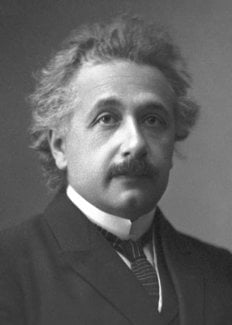
Albert Einstein as a younger man - Nobel Foundation image
Einstein in 1921, the year he was awarded the Nobel Prize in Physics for the photoelectric effect.

Any one of the papers would have been a career-capper for any physicist. Einstein dashed them off in just a few months, forever changing the field of physics. And, you noticed: Einstein did not win a Nobel for the Special Theory of Relativity, nor for E=mc². He won it for the photo electric effect. Irony in history.

106 years later Einstein’s work affects us every day. Relativity theory at some level I don’t understand makes possible the use Global Positioning Systems (GPS), which revolutionized navigation and mundane things like land surveying and microwave dish placement. Development of nuclear power both gives us hope for an energy-rich future, and gives us fear of nuclear war. Sometimes, even the hope of the energy rich future gives us fear, as we watch and hope nuclear engineers can control the piles in nuclear power plants damaged by earthquakes and tsunami in Japan.

If Albert Einstein was a genius at physics, he was more dedicated to pacifism. He resigned his German citizenship to avoid military conscription. His pacifism made the German Nazis nervous; Einstein fled Germany in the 1930s, eventually settling in the United States. In the U.S., he was persuaded by Leo Szilard to write to President Franklin Roosevelt to suggest the U.S. start a program to develop an atomic weapon, because Germany most certainly was doing exactly that. But Einstein refused to participate in the program himself, sticking to his pacifist views. Others could, and would, design and build atomic bombs. (Maybe it’s a virus among nuclear physicists — several of those working on the Manhattan Project were pacifists, and had great difficulty reconciling the idea that the weapon they worked on to beat Germany, was deployed on Japan, which did not have a nuclear weapons program.)

Einstein was a not-great father, and probably not a terribly faithful husband at first — though he did think to give his first wife a share of a Nobel Prize should he win it in the divorce settlement. Einstein was a good violinist, a competent sailor, an incompetent dresser, and a great character. His sister suffered a paralyzing stroke. For many months Albert spent hours a day reading to her the newspapers and books of the day, convinced that mute and appearing unconscious, she would benefit from hearing the words. He said he did not hold to orthodox religions, but could there be a greater show of faith in human spirit?

Einstein in 1950, five years before his death
Einstein in 1950, five years before his death.

When people hear clever sayings, but forget to whom the bon mots should be attributed, Einstein is one of about five candidates to whom all sorts of things are attributed, though he never said them. (Others include Lincoln, Jefferson, Mark Twain and Will Rogers). Einstein is the only scientist in that group. So, for example, we can be quite sure Einstein never claimed that compound interest was the best idea of the 20th century. This phenomenon is symbolic of the high regard people have for the man, even though so few understand what his work was, or meant.

A most interesting man. A most important body of work. He deserves more study and regard than he gets.

More, Resources:


Annals of Global Warming: Dramatic Links Found Between Climate Change, Elk, Plants, and Birds

March 14, 2012

Understanding the physics of the Earth’s atmosphere poses great problems — it is an astonishingly dynamic, fluid environment.  Understanding the relationships between species in ecosystems is no less complex, and no less vexing.

Wise followers of science recognize that when findings in biology, chemistry and physics, point the same direction, something powerful creates the convergence, and is not to be ignored.

So it is with these findings from the University of Montana and the U.S. Geological Survey, demonstrating clear links between climate change and the changing life patterns of large animals like elk, small animals like birds, and the plants the animals live in and consume.  This study is so complex that climate denialists haven’t figured out which part to deny, yet.  (This press release came out in January.)

From the USGS, with no adornment from the Bathtub, a press release on a letter in Nature Climate Change:

Dramatic Links Found Between Climate Change, Elk, Plants, and Birds

Released: 1/9/2012 11:30:00 AM

U.S. Department of the Interior, U.S. Geological Survey
Office of Communications and Publishing

In partnership with the University of Montana

Missoula, MT – Climate change in the form of reduced snowfall in mountains is causing powerful and cascading shifts in mountainous plant and bird communities through the increased ability of elk to stay at high elevations over winter and consume plants, according to a groundbreaking study in Nature Climate Change.

Red-faced warbler in Arizona, photo by Tom Martin, USGS

Red-faced warblers are one of the species affected by climate change in the form of reduced snowpack in the Arizona Mountains, according to a USGS Montana Cooperative Wildlife Research Unit study. Photo by Tom Martin, USGS, May 1998, in the Coconino National Forest

The U.S. Geological Survey and University of Montana study not only showed that the abundance of deciduous trees and their associated songbirds in mountainous Arizona have declined over the last 22 years as snowpack has declined, but it also experimentally demonstrated that declining snowfall indirectly affects plants and birds by enabling more winter browsing by elk. Increased winter browsing by elk results in trickle-down ecological effects such as lowering the quality of habitat for songbirds.

The authors, USGS Montana Cooperative Wildlife Research Unit scientist Thomas Martin and University of Montana scientist John Maron, mimicked the effects of more snow on limiting the ability of elk to browse on plants by excluding the animals from large, fenced areas. They compared bird and plant communities in these exclusion areas with nearby similar areas where elk had access, and found that, over the six years of the study, multi-decadal declines in plant and songbird populations were reversed in the areas where elk were prohibited from browsing.

Hermit thrushes in the Coconino National Forest, Arizona - 2005 photo by Tom Martin, USGS

Hermit thrushes are a songbird species that was strongly affected by plant community changes in mountains because of reduced snowpack and cascading ecological effects, according to a USGS Montana Cooperative Wildlife Research Unit study. 2005 photo by Tom Martin, USGS, in the Coconino National Forest

“This study illustrates that profound impacts of climate change on ecosystems arise over a time span of but two decades through unexplored feedbacks,” explained USGS director Marcia McNutt. “The significance lies in the fact that humans and our economy are at the end of the same chain of cascading consequences.”

The study demonstrates  a classic ecological cascade, added Martin. For example, he said, from an elk’s perspective, less snow means an increased ability to freely browse on woody plants in winter in areas where they would not be inclined to forage in previous times due to high snowpack. Increased overwinter browsing led to a decline in deciduous trees, which reduced the number of birds that chose the habitat and increased predation on nests of those birds that did choose the habitat.

Elk excluded, aspen growth increases - photo by Tom Martin, USGS, Coconino National Forest

When elk are excluded, aspen growth dramatically increases - Climate change in the form of reduced snowfall in mountains is causing powerful and cascading shifts in montane plant and bird communities through the increased ability of elk to stay at high elevations over winter and consume plants. Here, you can see an example of the difference in aspen growth inside versus outside a fence that excludes elk. Photo by Tom Martin, USGS, in Coconino National Forest

“This study demonstrates that the indirect effects of climate on plant communities may be just as important as the effects of climate-change-induced mismatches between migrating birds and food abundance because plants, including trees, provide the habitat birds need to survive,” Martin said.

The study, Climate impacts on bird and plant communities from altered animal-plant interactions, was published online on Jan. 8 in the journal Nature Climate Change.

Elk in winter at Camp Creek Feed Ground, Northwestern Wyoming - USGS photo

Elk in winter at Camp Creek Feed Ground, Northwestern Wyoming - USGS photo

More:


Good news about health care in the U.S.: The case for Obama’s health care reforms

March 7, 2012

Here’s a preview of another piece of television that many Republicans hope you will not bother to see, a piece that explains exactly how and why the health care reforms championed by President Obama will help you and millions of others:

Program: U.S. Health Care: The Good News

Episode: The Good News in American Medicine

Journalist T.R. Reid examines communities in America where top-notch medical care is available at reasonable costs and, in some instances, can be accessed by almost all residents. Included: Mesa County, Colo.; Seattle; Everest, Wash.; Hanover, N.H. In Mesa County, for instance, doctors, hospitals and insurers place an emphasis on prevention; and a program that offers pre-natal care to poor women has proved popular.

T. R. Reid’s report started airing on PBS stations in mid-February.  If you haven’t seen it, go to this site to view the entire production.

More, resources (suggested by PBS, mostly):


Annals of Global Warming: NASA film, Piecing Together the Temperature Puzzle

March 5, 2012

NASA describes the film, “Piecing Together the Temperature Puzzle”:

The past decade has been the hottest ever recorded since global temperature records began 150 years ago. This video discusses the impacts of the sun’s energy, Earth’s reflectance and greenhouse gasses on global warming.
Credit: NASA
Vital Signs of the Planet: Global Climate Change and Global Warming. Current news and data streams about global warming and climate change from NASA.

Vodpod videos no longer available.

Piecing Together the Temperature Puzzle, posted with vodpod

More NASA climate films, here, at Climate Reel.


Debunking claims of climate hoaxes, or evidence of the End of Civilization as We Know It

March 1, 2012

Found this on the Grist site today:

Grist infographic:  Idea of climate change hoax makes no sense

Grist infographic: Idea of climate change hoax makes no sense

The problem?  Far too many people not only don’t weigh ideas to see if they make sense, but instead they actively seek out ideas, no matter how crazy, just because they like the concept.

In short, the fact that such a chart is necessary at all suggests that it may not be useful.  Anyone who had the common sense to figure out that the globe is warming, and the scientists who say so are mostly honest as the day is long (and warm), won’t accept the judgment of Grist, either.

I mean, Peter Gleick exposed the immoral and perhaps illegal acts of the so-called Heartland Institute, virtually walking through the front door of the group’s offices and asking, “Will you show me all your dirty work?”  John Mashey’s painstaking work confirms Gleick’s blowing the whistle on Heartland, and Heartland’s fellow travelers.

What has Heartlandgate brought?  Heartland is spending thousands of dollars on a public relations campaign to impugn Gleick, and widely-read sites like the anti-science Watts Up get suckered in (well, Heartland was paying for Anthony Watts’ pet project . . . what should we expect?).  Even Andrew Revkin at his New York Times Blog can’t find his way to label actions as they should be labeled.

Will it make a difference to state the facts, the common sense version of reality?  My actual hope is that I am in error, and that such a graphic, if pasted around the internet, will make a difference.

Is my hope wholly misplaced?

Update:  At the Washington Post blogs, Stephen Stromberg wrote that Gleick erred by failing to follow the rule that climate scientists must be more than twice as morally straight as the “skeptics.”  I’m not convinced Gleick erred; he’s done yeoman service to exposing the truth.  I’m struggling to find any illegal act he committed.  Heartland claims there may be some fraud, but not all the elements of any crime of fraud are present.  If, as Heartland argues, the documents are fakes, there was no value lost.  If, as most of us suspect, the documents are not fakes, I still see no harm to Heartland in their having their feet held the fire on being honest with the IRS and the public.  Heartland claims an absolute right to fib to the public, and somehow Mr. Gleick interfered?  Where’s the harm to the public good?  Certainly not in exposing Heartland’s dark secrets.  No harm, no crime, in this case.


Rachel Carson in history — great post at Pop History Dig

February 22, 2012

It’s a long post, but it’s got great images and graphics, solid citations, and very few errors — go read Jack Doyle’s profile of Carson, featuring a solid and thorough discussion of the controversy over DDT.

Español: Fachada Rocsen-Rachel Carson

Statute honoring Rachel Carson at the Rocsen Museum, in Nono, Cordoba, Argentina

Jack Doyle, “Power in the Pen, Silent Spring: 1962,”
PopHistoryDig.com
, Feburary 21, 2012.

Doyle is a good writer and his site is a great idea with wonderful execution, The Pop History Dig.

Short of Linda Lear’s biography of Carson, Doyle’s piece presents the facts squarely, with no axes grinding.  (Steve Milloy, Rutledge Taylor, The Competitive Enterprise Institute, Roger Bate, Richard Tren, the astroturf group Africa Fighting Malaria, Anthony Watts, Jay Ambrose and Christopher Monckton, and other purveyors of anti-Carson and anti-science vitriol will not like Doyle’s piece and will claim it to be biased.)


Climate change deniers in high dudgeon as leaked memos reveal their deceptions

February 21, 2012

Previously:  John Mashey finished another epic analysis of the climate denialist world showing clear wrong-doing and potential violations of federal tax law on the part of denialists.  But as it was going to press, someone hacked the executive board of the anti-science Heartland Institute, and dropped the notes exposing the group as a propaganda bunch working hard against science into a couple of blogs.

Contrary to the stonewalling of the denialists, when scientists figured out who might have had access to the documents, the fellow confessed and resigned from several positions (honor on the science side, but not on the denialist side, once again).

News takes two or three years to penetrate to Rick Santorum, however, and he continued his soulless presidential campaign through the weekend claiming, contrary to the facts, that global warming is not happening.

Funny how he accuses those he opposes of doing the things his side does, isn’t it?

Anthony Watts, the leader of the anti-science mau-mauing breathlessly covered the resignation of Peter Gleick, the conscience-striken whistle-blower, but tended to ignore the evidence Gleick revealed.  So much for talking about real science.

(Watts also makes much of the California Institute of Science changing its exhibit on climate change after three years, as if when museums change exhibits, it means the science behind the old exhibit is no longer valid.  Is it just me, or is Watts really stretching to find the propaganda angle since his own data let him down, and demonstrated that warming, and the “hockey stick,” are real problems?)

Here are a few places you should visit to get the news and the facts:

This post likely will be updated.  Watch.  (Already updated to fix my error above about Seitz and SEPP.)


Annals of Global Warming: NOAA calls 2011 “year of climate extremes”

January 19, 2012

2011 saw 14 severe weather events that caused more than $1 billion in damage each.  The pre-Halloween snow disaster may push the total up to 15 such events.  NOAA is calling these billion-dollar-plus events “climate disasters.”

On top of the year 2011’s rating in the top 10 of warmest years on record, the sheer number of expensive weather extremes powerfully suggest that global warming already costs Americans billions of dollars in damage, lost production and disease.

NOAA: 2011 a year of climate extremes in the United States

NOAA announces two additional severe weather events reached $1 billion damage threshold, raising 2011’s billion-dollar disaster count from 12 to 14 events

January 19, 2012

Selected Annual Records

Selected Annual Climate Records for 2011 - Green dots show the wettest, yellow dots the driest, red dots the warmest and blue dots the coolest records. Click image for high resolution version from NOAA (NOAA image)

According to NOAA scientists, 2011 was a record-breaking year for climate extremes, as much of the United States faced historic levels of heat, precipitation, flooding and severe weather, while La Niña events at both ends of the year impacted weather patterns at home and around the world.

NOAA’s annual analysis of U.S. and global conditions, conducted by scientists at NOAA’s National Climatic Data Center, reports that the average temperature for the contiguous U.S. was 53.8 degrees F, 1.0 degree F above the 20th century average, making it the 23rd warmest year on record. Precipitation across the nation averaged near normal, masking record-breaking extremes in both drought and precipitation.

On a global scale, La Niña events helped keep the average global temperature below recent trends. As a result, 2011 tied with 1997 for the 11th warmest year on record. It was the second coolest year of the 21st century to date, and tied with the second warmest year of the 20th century.

Key highlights of the report include:

U.S. weather and climate disasters

Extreme Weather Events in 2011

From extreme drought, heat waves and floods to unprecedented tornado outbreaks, hurricanes, wildfires and winter storms, a record 14 weather and climate disasters in 2011 each caused $1 billion or more in damages — and most regrettably, loss of human lives and property. Click image for high resolution version. (NOAA image)

  • Tropical Storm Lee, which made landfall on the Gulf Coast on September 2, caused wind and flood damage across the Southeast, but considerably more damage to housing, business and infrastructure from record flooding across the Northeast states, especially Pennsylvania and New York. The storm occurred in an area that had experienced high rainfall from Hurricane Irene barely a week earlier.

    English: View of Tropical Storm Lee from the G...

    Tropical Storm Lee, on September 3, 2011 - Image via Wikipedia

  • A Rockies and Midwest severe weather outbreak, which occurred July 10-14, included tornadoes, hail and high winds. Much of the damage was from wind, hail, and flooding impacts to homes, business, and agriculture.
  • Together, these two events resulted in the loss of 23 lives (21 from Tropical Storm Lee, 2 from the Rockies/Midwest outbreak).

Nationally

  • Warmer-than-normal temperatures were anchored across the South, Mid-Atlantic and the Northeast. Delaware had its warmest year on record, while Texas had its second warmest year on record. The U.S. has observed a long-term temperature increase of about 0.12 degrees F per decade since 1895.
  • Summer (June-August) 2011 was the second warmest on record for the Lower 48, with an average temperature of 74.5 degrees F, just 0.1 degree F below the record-warm summer of 1936. The epicenter of the heat was the Southern Plains, where Louisiana, New Mexico, Oklahoma and Texas all had their warmest summer on record. The 3-month average temperatures for both Oklahoma (86.9 degrees F) and Texas (86.7 degrees F) surpassed the previous record for warmest summer in any state.
  • With the exception of Vermont, each state in the contiguous U.S. had at least one location that exceeded 100 degrees F. Summertime temperatures have increased across the U.S. at an average rate of 0.11 degrees F per decade. Much of this trend is due to increases in minimum temperatures (“overnight lows”), with minimum temperature extremes becoming increasingly commonplace in recent decades.
  • Despite a “near normal” national precipitation average, regional precipitation outcomes varied wildly. Texas, ravaged by exceptional drought for most of 2011, had its driest year on record. In contrast, seven states in the Ohio Valley and Northeast — Connecticut, Indiana, Kentucky, New Jersey, New York, Ohio, and Pennsylvania — had their wettest year on record.
  • The past nine years have been particularly wet across the Northeast region – since 2003, the annual precipitation for the region is 48.96 inches, 7.88 inches above the 20th century average. Precipitation averaged across the U.S. is increasing at a rate of about 0.18 inches per decade.
  • Precipitation extremes and impacts were most prevalent during spring (March – May) 2011. Across the northern U.S., ten states were record wet, and an additional 11 states had spring precipitation totals ranking among their top ten wettest. These precipitation extremes, combined with meltwater from a near-record snow pack, contributed to historic flooding along several major rivers across the central United States.
  • Meanwhile, drought rapidly intensified in the southern Plains, where Texas had only 2.66 inches of precipitation, its driest spring on record. This led to record breaking drought and wildfires, which devastated the southern Plains. Following 2010, during which drought across the country was nearly erased, the 12 percent of the continental U.S. in the most severe category of drought (D4) during July 2011 was the highest in the U.S. Drought Monitor era (1999-2011).
  • The spring brought a record breaking tornado season to the United States. Over 1,150 tornadoes were confirmed during the March-May period. The 551 tornado-related fatalities during the year were the most in the 62-year period of record. The deadliest tornado outbreak on record (April 25-28th) and the deadliest single tornado (Joplin, Missouri) contributed to the high fatality count.

Globally

  • This year tied 1997 as the 11th warmest year since records began in 1880. The annual global combined land and ocean surface temperature was 0.92 degrees F above the 20th century average of 57.0 degrees F. This marks the 35th consecutive year, since 1976, that the yearly global temperature was above average. The warmest years on record were 2010 and 2005, which were 1.15 degrees F above average.
  • Separately, the 2011 global average land surface temperature was 1.49 degrees F above the 20th century average of 47.3 degrees F and ranked as the eighth warmest on record. The 2011 global average ocean temperature was 0.72 degrees F above the 20th century average of 60.9 degrees F and ranked as the 11th warmest on record.
  • Including 2011, all eleven years of the 21st century so far (2001-2011) rank among the 13 warmest in the 132-year period of record. Only one year during the 20th century, 1998, was warmer than 2011.
  • La Niña, which is defined by cooler-than-normal waters in the eastern and central equatorial Pacific Ocean that affects weather patterns around the globe, was present during much of 2011. A relatively strong phase of La Niña opened the year, dissipated in the spring before re-emerging in October and lasted through the end of the year. When compared to previous La Niña years, the 2011 global surface temperature was the warmest observed.
  • The 2011 globally-averaged precipitation over land was the second wettest year on record, behind 2010. Precipitation varied greatly across the globe. La Niña contributed to severe drought in the Horn of Africa and to Australia’s third wettest year in its 112-year period of record.
  • Arctic sea ice extent was below average for all of 2011, and has been since June 2000, a span of 127 consecutive months. Both the maximum ice extent (5.65 million square miles on March 7th) and the minimum extent (1.67 million square miles on September 9th) were the second smallest of the satellite era.
  • For the second year running, NCDC asked a panel of climate scientists to determine and rank the year’s ten most significant climate events, for both the United States and for the planet, to include record drought in East Africa and record flooding in Thailand and Australia. The results are at http://www.ncdc.noaa.gov/climate-monitoring.

Scientists, researchers and leaders in government and industry use NOAA’s monthly and annual reports to help track trends and other changes in the world’s climate. This climate service has a wide range of practical uses, from helping farmers know what and when to plant, to guiding resource managers’ critical decisions about water, energy and other vital assets.

NOAA’s mission is to understand and predict changes in the Earth’s environment, from the depths of the ocean to the surface of the sun, and to conserve and manage our coastal and marine resources. Join us on Facebook, Twitter and our other social media channels.

Denialist bedbugs complain that there is no definition of “climate disaster” offered from the agency.  (Denialists are dictionary-challenged?)

More, Resources: