Annals of Global Warming: Chukchi ice melt 2018

February 24, 2018

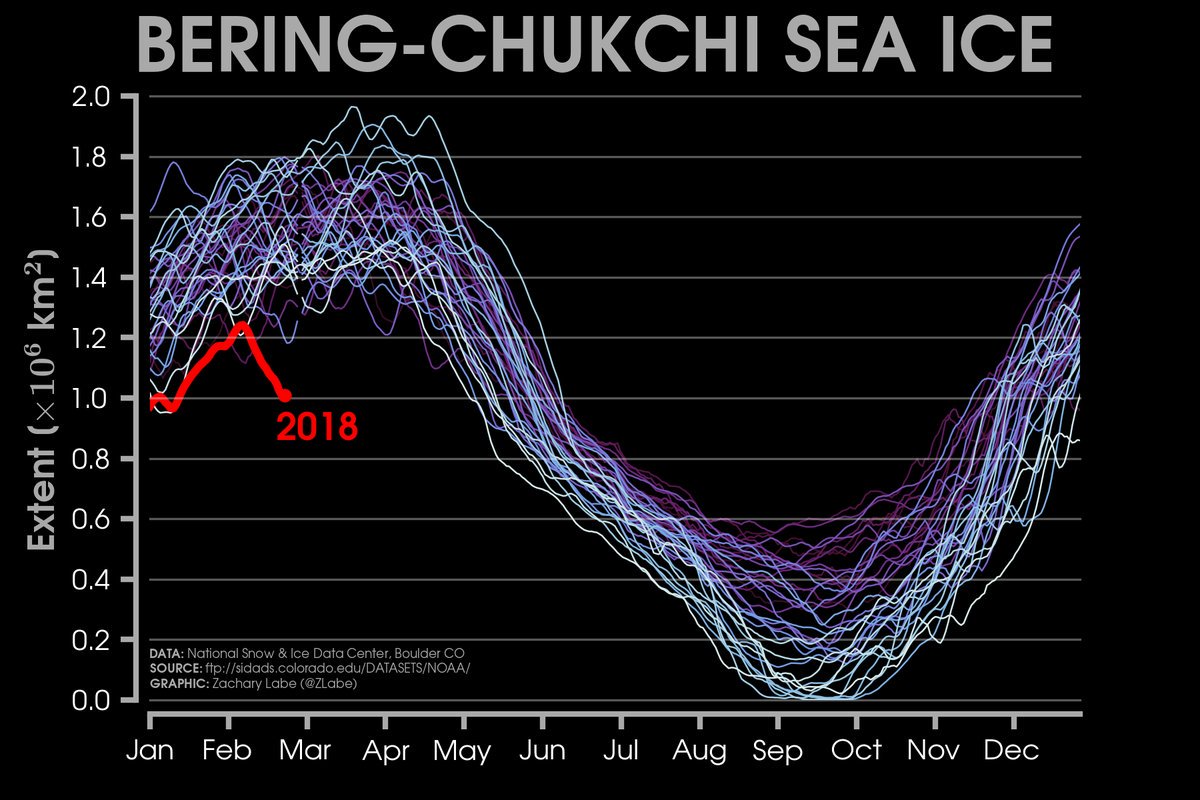
As Bill McKibben notes, something seems amiss with this chart.

Chart from data from the National Snow and Ice Data Center (NSIDC) showing sea ice in the Bering-Chukchi Sea; 2018's ice decline in red. Graphic by Zachary Labe.

Chart from data from the National Snow and Ice Data Center (NSIDC) showing sea ice in the Bering-Chukchi Sea; 2018’s ice decline in red. Graphic by Zachary Labe.

The U.S. National Snow and Ice Data Center in Boulder, Colorado, track ice in the Arctic. The chart shows extent of sea ice in square kilometers, with a comparison of about the past 20 years.

In red, you see what is happening to the ice in 2018 — a dramatic melt, a dramatic plunge in the amount of sea ice.

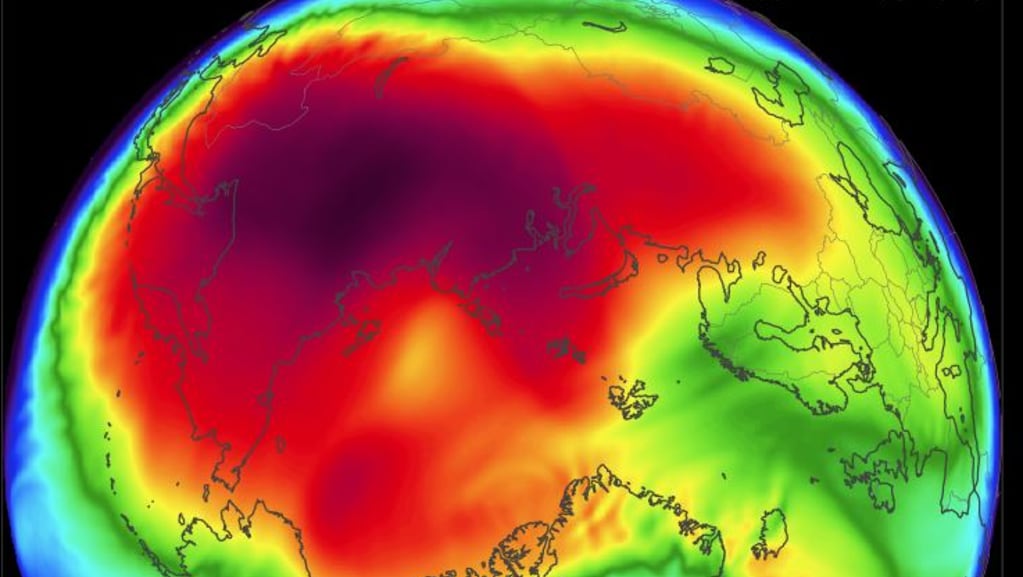
Arctic Circle area temperatures rose dramatically above normal temperatures for winter in the past few weeks, by 25 to 40 degrees Fahrenheit (see report in the Sydney Morning Herald). Such dramatic increases frequently result when a weakened jet stream fails to keep cold Arctic air in the Arctic — and the polar vortex slips to give some temperate latitude land incredible freezes. The colds that get reported on the news and touted by science dissenters as evidence Global Warming does not occur, are the result of those heat blobs in the Arctic.

Sydney (Australia) Morning Herald reports: Arctic temperatures in February 2018 are averaging well above normal, and peaking up to 25 degrees higher than normal. Photo: globalweatherlogistics.com

Sydney (Australia) Morning Herald reports: Arctic temperatures in February 2018 are averaging well above normal, and peaking up to 25 degrees higher than normal. Photo: globalweatherlogistics.com

Tipping points are not always discernable in real time. This may be an exception.

Time to act, people!


Tip of the old scrub brush to Bill McKibben, of course.


December 31 is Bright Idea Day, anniversary of the Day the Lights Went On

December 31, 2017

Between Christmas and New Year’s Day, here at Millard Fillmore’s Bathtub we celebrate a variety of historically holy days.  December 31, by tradition, is Bright Idea Day, the anniversary of the day Thomas Edison demonstrated for the public a working light bulb, in 1879.

100,000 people gather in Times Square, New York City (surely not the 1 million predicted by NBC!) tonight, and millions more around the world, in festivities for the new year made possible by the work of Thomas Alva Edison.

Here it is, the invention that stole sleep from our grasp, made clubbing possible, and launched 50,000 cartoons about ideas:

The light bulb Thomas Edison demonstrated on December 31, 1879, at Menlo Park, New Jersey - Wikimedia image

The light bulb Thomas Edison demonstrated on December 31, 1879, at Menlo Park, New Jersey – Wikimedia image (GFDL)

The light bulb. It’s an incandescent bulb.

It wasn’t the first bulb. Edison a few months earlier devised a bulb that worked with a platinum filament. Platinum was too expensive for mass production, though — and Edison wanted mass production. So, with the cadre of great assistants at his Menlo Park laboratories, he struggled to find a good, inexpensive filament that would provide adequate life for the bulb. By late December 1879 they had settled on carbon filament.

Edison invited investors and the public to see the bulb demonstrated, on December 31, 1879.

Thomas Edison in 1878, the year before he demonstrated a workable electric light bulb. Library of Congress image

Thomas Edison in 1878, the year before he demonstrated a workable electric light bulb. CREDIT: Thomas Edison, head-and-shoulders portrait, facing left, 1880. Prints and Photographs Division, Library of Congress. Reproduction number LC-USZ62-98067

Edison’s successful bulb indicated changes in science, technology, invention, intellectual property and finance well beyond its use of electricity. For example:

  • Edison’s Menlo Park, New Jersey, offices and laboratory were financed with earlier successful inventions. It was a hive of inventive activity aimed to make practical inventions from advances in science. Edison was all about selling inventions and rights to manufacture devices. He always had an eye on the profit potential. His improvements on the telegraph would found his laboratory he thought, and he expected to sell the device to Western Union for $5,000 to $7,000. Instead of offering it to them at a price, however, he asked Western Union to bid on it. They bid $10,000, which Edison gratefully accepted, along with the lesson that he might do better letting the marketplace establish the price for his inventions. Other inventive labs followed Edison’s example, such as the famous Bell Labs, but few equalled his success, or had as much fun doing it.  (Economics teachers:  Need an example of the marketplace in action?)
  • While Edison had some financial weight to invest in the quest for a workable electric light, he also got financial support, $30,000 worth, from some of the finance giants of the day, including J. P. Morgan and the Vanderbilts who established the Edison Light Company.
  • Edison didn’t invent the light bulb — but his improvements on it made it commercial. “In addressing the question ‘Who invented the incandescent lamp?’ historians Robert Friedel and Paul Israel list 22 inventors of incandescent lamps prior to Joseph Wilson Swan and Thomas Edison. They conclude that Edison’s version was able to outstrip the others because of a combination of three factors: an effective incandescent material, a higher vacuum than others were able to achieve (by use of the Sprengel pump) and a high resistance lamp that made power distribution from a centralized source economically viable.”
  • Edison’s financial and business leadership acumen is partly attested to by the continuance of his organizations, today — General Electric, one of the world’s most successful companies over the past 40 years, traces its origins to Edison.

Look around yourself this evening, and you can find a score of ways that Edison’s invention and its descendants affect your life. One of the more musing effects is in cartooning, however. Today a glowing lightbulb is universally accepted as a nonverbal symbol for ideas and inventions. (See Mark Parisi’s series of lightbulb cartoons, “Off the Mark.”)

Even with modern, electricity-saving bulbs, the cartoon shorthand hangs on, as in this Mitra Farmand cartoon.

Fusilli has an idea, Mitra Farmand, Fuffernutter

Brilliant cartoon from Mitra Farmand, Fuffernutter (regrettably, we note this site is no longer there; but with some hope, we find a new site here)

Or see this wonderful animation, a video advertisement for United Airlines, by Joanna Quinn for Fallon — almost every frame has the symbolic lightbulb in it.

Electrification of America, and the consequent spread of electric lighting and electrical machines to make domestic and industrial life more productive, and the spread of great public works to enable these and other inventions to spread, were made possible by a people roughly united in advancing progress, what historians now call “the progressive agenda” and the great advances of the Progressive Era.

Could we get such agreement among workers, corporate bosses and many levels of government today? When we celebrate anniversaries, like the demonstration of the light bulb, we celebrate the united polity that made such things possible, too.

Gee, I wonder who were the dignitaries to whom Edison demonstrated the electric light on that New Years Eve, in 1879. Anyone know? We can safely wager that there were representatives of the Vanderbilts and Morgans there, families who invested in Edison as an inventor.

Other resources:

Patent drawing for Thomas Edison's successful electric lamp. Library of Congress

Thomas Edison’s electric lamp patent drawing and claim for the incandescent light bulb CREDIT: “New Jersey–The Wizard of Electricity–Thomas A. Edison’s System of Electric Illumination,” 1880. Prints and Photographs Division, Library of Congress. Reproduction Number LC-USZ62-97960.

Even More:

This is an encore post.

Yes, this is an encore post. Defeating ignorance takes patience and perseverance.


We need to celebrate Hubble Day better! December 30, 2017, anniversary of the day we learned it’s a BIG universe

December 30, 2017

[Today is actually the day!  You may fly your flag if you choose.  This is the traditional Millard Fillmore’s Bathtub Hubble Day post.]

Lift a glass of champagne today in tribute to Edwin Hubble and his great discovery. Not sure what to call it — Hubble Day, Looking Up Day, Endless Possibilities Day — whatever, this is the anniversary of Edwin Hubble’s announcement that he had discovered the universe is much, much larger than anyone had imagined, containing far more stars than anyone had dared guess.

It’s a big universe out there.

Ultraviolet image of the Andromeda Galaxy. Wired caption: Photo: Edwin Hubble’s 1920s observations of Andromeda (whose ultraviolet spectrum is rendered here) expanded our notions of the size and nature of a universe that is itself expanding. Galaxy Evolution Explorer image courtesy NASA.

Ultraviolet image of the Andromeda Galaxy. Wired caption: “Photo: Edwin Hubble’s 1920s observations of Andromeda (whose ultraviolet spectrum is rendered here) expanded our notions of the size and nature of a universe that is itself expanding. Galaxy Evolution Explorer image courtesy NASA.”

So, today is a good day to celebrate the universe in all it’s glory – December 30. We haven’t done a good enough job of celebrating Hubble Day — we need to step up the festivities.

On December 30, 1924, Edwin Hubble announced he’d discovered other galaxies in distant space. Though it may not have been so clear at the time, it meant that, as a galaxy, we are not alone in the universe (whether we are alone as intelligent life is a separate question). It also meant that the universe is much, much bigger than most people had dared to imagine.

97 years ago today.

I keep trying to get people to celebrate.

In 2008 for Hubble Day, Wired picked up on the story (with a gracious link to 2007’s post here at the Bathtub). Wired includes several links to even more information, a good source of information. See Wired’s 2009 post here.

Hubble was the guy who showed us the universe is not only bigger than we imagined, it’s probably much bigger and much more fantastic than we can imagine. (See J. B. S. Haldane’s “queerer” quote.) Hubble is the guy who opened our imaginations to the vastness of all creation.

Hubble’s work would have been impossible without the earlier work of one of the great, unsung women of science, Henrietta Leavitt, as Wired explained:

He trained the powerful new 100-inch telescope at Mount Wilson in Southern California on spiral nebulae. These fuzzy patches of light in the sky were generally thought to be clouds of gas or dust within our galaxy, which was presumed to include everything in the universe except the Magellanic Clouds. Some nebulae seemed to contain a few stars, but nothing like the multitudes of the Milky Way.

Hubble not only found a number of stars in Andromeda, he found Cepheid variable stars. These stars vary from bright to dim, and a very smart Harvard computationist named Henrietta Leavitt had discovered in 1912 that you could measure distance with them. Given the brightness of the star and its period — the length of time it takes to go from bright to dim and back again — you could determine how far away it is.

Hubble used Leavitt’s formula to calculate that Andromeda was approximately 860,000 light years away. That’s more than eight times the distance to the farthest stars in the Milky Way. This conclusively proved that the nebulae are separate star systems and that our galaxy is not the universe.

How does one celebrate Hubble Day? Here are some suggestions:

  • Easier than Christmas cards: Send a thank-you note to your junior high school science teacher, or whoever it was who inspired your interest in science. Mrs. Hedburg, Mrs. Andrews, Elizabeth K. Driggs, Herbert Gilbert, Mr. Willis, and Stephen McNeal, thank you.
  • Rearrange your Christmas/Hanukkah/KWANZAA lights in the shape of the Andromeda Galaxy — or in the shape of any of the great photos from the Hubble Telescope (Andromeda Galaxy pictured above; Hubble images here)

    A few of the images from the Hubble Telescope

    A few of the images from the Hubble Telescope

  • Go visit your local science museum; take your kids along – borrow somebody else’s kids if you have to (take them along, too); in Dallas, you can visit the Perot Museum of Nature and Science — it’s a doozy.
  • Spend two hours in your local library, just looking through the books on astronomy and the universe
  • Write a letter to your senators and congressman; tell them space exploration takes a minuscule portion of our federal budget, but it makes us dream big; tell them we need to dream big, and so they’d better make sure NASA is funded well.  While you’re at it, put in a plug for funding Big Bird and the rest of public broadcasting, too.  Science education in this nation more and more becomes the science shows on NPR and PBS, watched by kids who learned to read and think by watching Big Bird.
  • Anybody got a good recipe for a cocktail called “The Hubble?” “The Andromeda?” Put it in the comments, please.  “The Hubble” should have bubbles in it, don’t you think?  What was it the good monk said?  He was working to make great wine, but goofed somewhere, and charged the wine with another dose of yeast.  When he uncorked the very first bottle of what would come to be called champagne, Benedictine Monk Dom Pierre Perignon said “I am drinking stars!”  Except, he said it in French.  In any case, a Hubble cocktail should have bubbles, some of Perignon’s stars.

The encore post, from 2007:

December 30, 1924, Edwin Hubble announced the results of his observations of distant objects in space.

PBS

Edwin Hubble, long before the Surgeon General’s 1964 report on smoking made taboo photos of people smoking pipes.

In 1924, he announced the discovery of a Cepheid, or variable star, in the Andromeda Nebulae. Since the work of Henrietta Leavitt had made it possible to calculate the distance to Cepheids, he calculated that this Cepheid was much further away than anyone had thought and that therefore the nebulae was not a gaseous cloud inside our galaxy, like so many nebulae, but in fact, a galaxy of stars just like the Milky Way. Only much further away. Until now, people believed that the only thing existing outside the Milky Way were the Magellanic Clouds. The Universe was much bigger than had been previously presumed.

Later Hubble noted that the universe demonstrates a “red-shift phenomenon.” The universe is expanding. This led to the idea of an initial expansion event, and the theory eventually known as Big Bang.

Hubble’s life offered several surprises, and firsts:

  • Hubble was a tall, elegant, athletic, man who at age 30 had an undergraduate degree in astronomy and mathematics, a legal degree as a Rhodes scholar, followed by a PhD in astronomy. He was an attorney in Kentucky (joined its bar in 1913), and had served in WWI, rising to the rank of major. He was bored with law and decided to go back to his studies in astronomy.
  • In 1919 he began to work at Mt. Wilson Observatory in California, where he would work for the rest of his life. . . .
  • Hubble wanted to classify the galaxies according to their content, distance, shape, and brightness patterns, and in his observations he made another momentous discovery: By observing redshifts in the light wavelengths emitted by the galaxies, he saw that galaxies were moving away from each other at a rate constant to the distance between them (Hubble’s Law). The further away they were, the faster they receded. This led to the calculation of the point where the expansion began, and confirmation of the big bang theory. Hubble calculated it to be about 2 billion years ago, but more recent estimates have revised that to 20 billion years ago.
  • An active anti-fascist, Hubble wanted to joined the armed forces again during World War II, but was convinced he could contribute more as a scientist on the homefront. When the 200-inch telescope was completed on Mt. Palomar, Hubble was given the honor of first use. He died in 1953.

“Equipped with his five senses, man explores the universe around him and calls the adventure Science.”

That news on December 30, 1924, didn’t make the first page of the New York Times. The Times carried a small note on February 25, 1925, that Hubble won a $1,000 prize from the American Academy for the Advancement of Science.

(Does anyone have a suitable citation for that video? Where did it come from? Who produced it? Is there more somewhere?)

Happy Hubble Day! Look up!

Resources:

Hubble Space Telescope - NASA image

Hubble Space Telescope, working homage to Edwin Hubble – NASA image

Even More Resources:

Andromeda as we can see it today. Wikimedia image: The Andromeda Galaxy is a spiral galaxy approximately 2.5 million light-years away in the constellation Andromeda. The image also shows Messier Objects 32 and 110, as well as NGC 206 (a bright star cloud in the Andromeda Galaxy) and the star Nu Andromedae. This image was taken using a hydrogen-alpha filter.

Andromeda as we can see it today. Wikimedia image: The Andromeda Galaxy is a spiral galaxy approximately 2.5 million light-years away in the constellation Andromeda. The image also shows Messier Objects 32 and 110, as well as NGC 206 (a bright star cloud in the Andromeda Galaxy) and the star Nu Andromedae. This image was taken using a hydrogen-alpha filter.


December 27, Great Beginnings Day 2017: Darwin, Apollo, and more

December 27, 2017

December 27 is one of those days — many of us are off work, but it’s after Boxing Day, and it’s not yet on to New Year’s Eve or Day. We should have celebrated, maybe.

It’s the end of the year, and yet it is also a day of great beginnings.

We should celebrate December 27 as a day of portent: A good embarkation, and a good, safe end to a nation-encouraging trip to almost touch the Moon.

HMS Beagle, Darwin's ship

HMS Beagle, on a voyage of discovery; painting of the Beagle in the Galapagos by John Chancellor

On December 27, 1831, Charles Darwin and H.M.S. Beagle set sail on an around-the-world voyage of discovery that would change all of science, and especially biology, forever.

December 27 1831
After a few delays, H.M.S. Beagle headed out from Plymouth with a crew of 73 under clear skies and a good wind. Darwin became sea-sick almost immediately.

Darwin never fully overcame his seasickness, but he fought it well enough to become the single greatest collector of specimens in history for the British Museum and British science, a distinction that won him election to science societies even before his return from the trip — and cemented his life in science, instead of in the church.

Darwin’s discoveries would have revolutionized biology in any case. But, in analyzing what he had found, a few years later and with the aid of experts at the British Museum, Darwin realized he had disproved much of William Paley’s hypotheses about life and its diversity, and that another, more basic explanation was possible. This led to his discovery of evolution by natural and sexual selection.

Mini-sheet from the Royal Mail honoring Darwin's discoveries in the Galapagos Islands

Mini-sheet from the Royal Mail in 2009 honoring Darwin’s discoveries in the Galapagos Islands

On December 27, 1968, Apollo 8 splashed down after a successful and heartening trip to orbit the Moon. The three crewmen, Commander Frank Borman, James A. Lovell, Jr., and William A. Anders, had orbited the Moon, a very important milestone in the methodological race to put humans on the Moon (which would be accomplished seven months later).

1968 was a terrible year for the U.S., with the North Korean capture of the U.S.S. Pueblo, assassinations of Rev. Martin Luther King, Jr., and Sen. Robert F. Kennedy during the presidential campaign, riots in dozens of American cities, nasty political conventions with riots at the Democratic Convention in Chicago, a contentious and bitter election making sore the nation’s divide over Vietnam policy, and other problems. On Christmas Eve, Borman, Lovell and Anders broadcast from orbit around the Moon, a triumphant and touching moment for the Apollo Program and Americans around the world. Their safe return on December 27 raised hopes for a better year in 1969.

Motherboard.tv has a great write up from Alex Pasternack, especially concerning the famous photo taken a few days prior to splashdown:

In 1968, NASA engineers were scrambling to meet President Kennedy’s challenge to land a man on the moon by decade’s end. Because delays with the lunar module were threatening to slow the Apollo program, NASA chose to change mission plans and send the crew of Apollo 8 all the way to the moon without a lunar module.

Exactly 43 [49] years ago, the three astronauts of Apollo 8 became the first humans to orbit another celestial object. As they came around the dark side of the Moon for the third time, Frank Borman, the commander, finally turned their capsule around. And then they saw the Earth.

Borman: Oh my God! Look at that picture over there! Here’s the Earth coming up. Wow, is that pretty.
Anders: Hey, don’t take that, it’s not scheduled.
Borman: (laughing) You got a color film, Jim?
Anders: Hand me that roll of color quick, will you…

One of the resulting photos taken by Anders on a Hasselblad camera became one of the world’s most iconic images.

As Bill Anders recalls it:

I just happened to have one with color film in it and a long lens. All I did was to keep snapping… It’s not a very good photo as photos go, but it’s a special one. It was the first statement of our planet Earth and it was particularly impressive because it’s contrasted against this startling horizon . . . After all the training and studying we’d done as pilots and engineers to get to the moon safely and get back, [and] as human beings to explore moon orbit, what we really discovered was the planet Earth.

Plan to raise a glass today, December 27, 2012, to Great Beginnings Day for the human race. December 27 is a day we should remember, for these achievements. (But if you’re raising a glass, consider Carrie Nation, too!)

Also on December 27:

More:

This is an encore post.

Yes, this is an encore post. Defeating ignorance takes patience and perseverance.


How can we not allow undeveloped nations and the poor to use fossil fuel energy?

December 18, 2017

Greenpeace and Tcktcktck volunteers raise a wind turbine on the beach at dawn in Durban, South Africa. Microgrid News image

Greenpeace and Tcktcktck volunteers raise a wind turbine on the beach at dawn in Durban, South Africa. Microgrid News image

How can we not allow undeveloped nations to catch the first world with fossil fuel energy? Katharine Hayhoe explains at Global Weirding.

More: 


She’s 11: America’s top young scientist works to help detect problems in Flint’s water supply, and yours

November 17, 2017

NPR caption: Gitanjali Rao, 11, says she was appalled by the drinking water crisis in Flint, Mich. — so she designed a device to test for lead faster. She was named

NPR caption: Gitanjali Rao, 11, says she was appalled by the drinking water crisis in Flint, Mich. — so she designed a device to test for lead faster. She was named “America’s Top Young Scientist” on Tuesday at the 3M Innovation Center in St. Paul, Minn. Andy King/Discovery Education 3M Young Scientist Challenge

Melinda Gates noticed; you should, too. (And check out the NPR story to which Gates links.)

NPR tells the story:

When the drinking water in Flint, Mich., became contaminated with lead, causing a major public health crisis, 11-year-old Gitanjali Rao took notice.

“I had been following the Flint, Michigan, issue for about two years,” the seventh-grader told ABC News. “I was appalled by the number of people affected by lead contamination in water.”

She saw her parents testing the water in their own home in Lone Tree, Colo., and was unimpressed by the options, which can be slow, unreliable or both.

“I went, ‘Well, this is not a reliable process and I’ve got to do something to change this,’ ” Rao told Business Insider.

Rao tells ABC that while she was doing her weekly perusal of MIT’s Materials Science and Engineering website to see “if there’s anything’s new,” she read about new technologies that could detect hazardous substances and decided to see whether they could be adapted to test for lead.

She pressed local high schools and universities to give her lab time and then hunkered down in the “science room” — outfitted with a big white table — that she persuaded her engineer parents to create in their home.

And she set about devising a more efficient solution: a device that could identify lead compounds in water and was portable and relatively inexpensive.

As she explains at lightning speed in her video submission for the Discovery Education 3M Young Scientist Challenge, her device consists of three parts. There is a disposable cartridge containing chemically treated carbon nanotube arrays, an Arduino-based signal processor with a Bluetooth attachment, and a smartphone app that can display the results.

(Film details:

Published on Jul 18, 2017
“Meet Gitanjali. Gitanjali hopes to reduce the time of lead detection in water by using a mobile app, to connect over Bluetooth to get status of water, almost immediately.”)

Stories like this should give you hope for our future. It’s clear that women should be encouraged to go into science and technology.

Stories like this should also get you out of your chair to yell at policy makers who cut funds for basic research, for education, and who rail against immigration. President Trump will not host the science fair that graced the White House for the past eight years. Time for you and me to stand up to demand support for science, and for women in science.

Tip of the old scrub brush to Melinda Gates.

More:


Missing Carl Sagan, on his birthday, November 9

November 10, 2017

Carl Sagan would have been 83 on November 9. Image from Cornell University.

Carl Sagan would have been 83 on November 9. Image from Cornell University.

It’s been one of those weeks, and I missed posting anything early for Carl Sagan’s birthday, a day on which many work to keep his memory and wisdom alive.

Here are a few of the tributes, from Twitter.


https://twitter.com/ChrisEvans/status/928609317959462913

https://twitter.com/AreoLucy/status/928579842064384000

https://twitter.com/aaronhuertas/status/928611653641494529


Milky Way at the Canyon of the Ancients National Monument

November 7, 2017

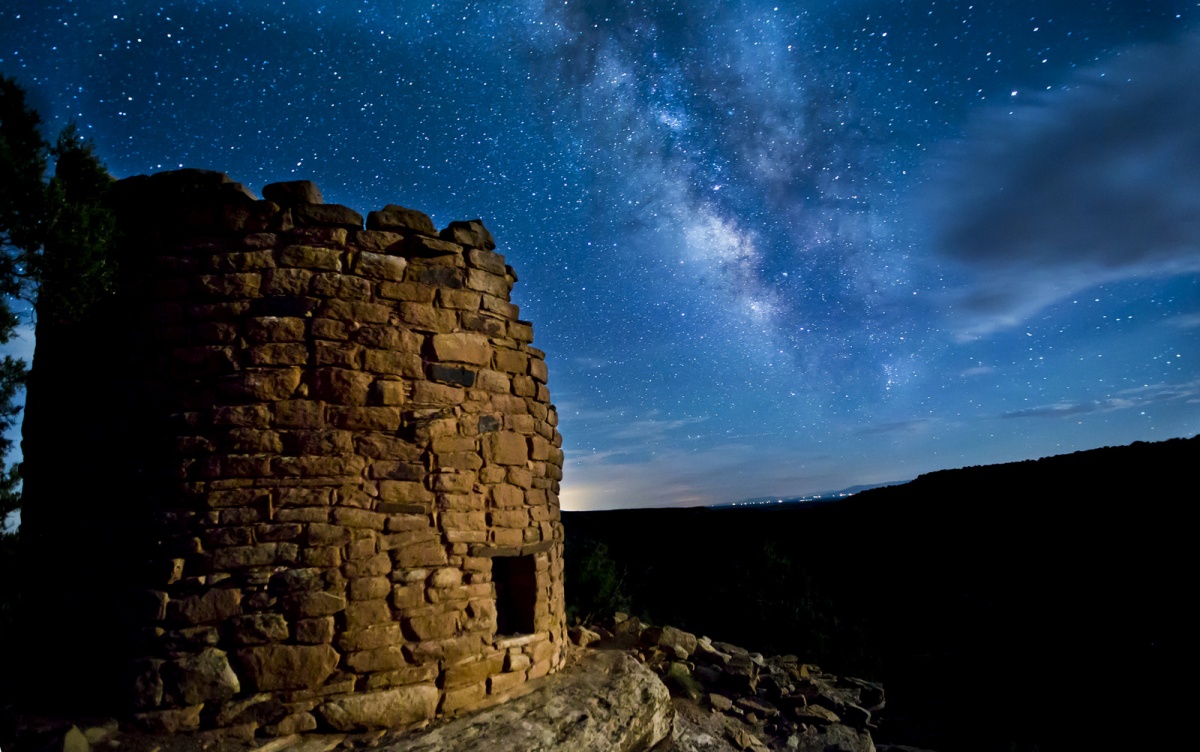
Interior’s great photographer Bob Wick is at it again, this time in Colorado:

Archaeological site at Canyon of the Ancients National Monument in Colorado. Photo by Bob Wick, Bureau of Land Management.

Archaeological site at Canyon of the Ancients National Monument in Colorado. Photo by Bob Wick, Bureau of Land Management.

This photo is featured in a story from the National Park Service about celebrating Native American Heritage month, which is November.


Carl Sagan’s “foreboding” of a dumb America; too late to stop it?

August 9, 2017

NASA photo of Dr. Carl Sagan with a model of the Mars Viking Lander, in Death Valley, California. Or was it taken on Mars? How could we tell, if we lacked sharpened and practiced critical thinking practices?

NASA photo of Dr. Carl Sagan with a model of the Mars Viking Lander, in Death Valley, California. Or was it taken on Mars? How could we tell, if we lacked sharpened and practiced critical thinking practices?

Are we already too late?

In The Demon-Haunted World in 1995, astronomer and thinker Carl Sagan worried about the directions America was heading, intellectually, and what it could mean for the future. He wrote:

Science is more than a body of knowledge; it is a way of thinking. I have a foreboding of an America in my children’s or grandchildren’s time—when the United States is a service and information economy; when nearly all the key manufacturing industries have slipped away to other countries; when awesome technological powers are in the hands of a very few, and no one representing the public interest can even grasp the issues; when the people have lost the ability to set their own agendas or knowledgeably question those in authority; when, clutching our crystals and nervously consulting our horoscopes, our critical faculties in decline, unable to distinguish between what feels good and what’s true, we slide, almost without noticing, back into superstition and darkness. The dumbing down of America is most evident in the slow decay of substantive content in the enormously influential media, the 30-second sound bites (now down to 10 seconds or less), lowest common denominator programming, credulous presentations on pseudoscience and superstition, but especially a kind of celebration of ignorance.

Sagan had hope. His book’s full title is The Demon-Haunted World: Science as a candle in the dark.

Should we hold that hope today? Elections in 2016 demonstrated that false news does sway the electorate, superstition can overcome knowledge. Worse, too many Americans cannot tell the difference. In a time when millions of Americans profess to work to find “the way,” we confront those same people wandering aimlessly through American culture, apparently with little clue as to how far off the path of reality they are, or any real understanding of what “the way” would even look like. Their compasses operate on faith, not magnetism; their compass needles point whichever way they want them to point, with no fixed power to guide them.

Sagan didn’t write that long ago. A child born in 1995 just voted in her first national election — we hope. Perhaps she didn’t bother to register, and did not vote. What causes our national lack of motivation to even vote, to push our government in the directions we think it should go?

How do we remove the barriers to that motivation? is a more important question.

Was Sagan right? Are we doomed?

We have cause to worry, I think.

  • 58% of Americans eligible to vote, voted in 2016. While that’s near a recent high-water mark, it’s a paltry percentage compared to other democracies in the world. Apathy was highest in key states Donald Trump carried; Hillary Clinton won the popular vote, but trailed President Barack Obama’s 2012 totals by 2 million votes, in those key states. 2016’s election was decided by people who did not vote.
  • While tensions run high in the Korean Peninsula, only about 36% of Americans can find Korea on a map. Most of those who can find Korea favor diplomacy to resolve tensions, not war. Who was the wag who said God gives us wars so Americans learn geography? (It was Rose-Belford’s Canadian Monthly in 1879, rephrased and repeated dozens of times by others.)
  • Flat Earthers? Oy.
  • Anti-vaccine movement. Chem-trails fearfuls. Climate change dissenters. Creationists. Moon-landing deniers. Racists. So-called non-racists who oppose immigration completely. Republican senators who imagined a tax cut for the wealthy would help working and poor Americans have better health. DDT advocates. “Libertarians” and so-called conservatives who fear “socialism” of the economics of John Maynard Keynes, one of the foremost capitalism defenders in economics.
  • Cuts to education. As a barometer, consider Texas, where 25 years ago the state provided 67% of funding for public schools. After decades of cuts, the state provides only 38% of public school funding in the 2017-2019 budget. Lt. Gov. Dan Patrick touts the total as an increase.
  • Cuts to science. Trump administration proposals slash all science research dramatically, as if we already have cures for cancer and the common cold, and Alzheimer’s disease.

To be sure, we can find pockets of hope. Girl Scouts demonstrate great success with new programs to attract girls to careers in science, with special camps for Science Technology Engineering and Mathematics (STEM). Boy Scouts have their own initiative. But the Texas legislature cut back on math, science and geography requirements for graduation. For every hopeful sign, there’s another sinister sign.

How can we tell civilization, and humanity, gain ground?


Pollsters for the New York Times asked 1,746 Americans to locate North Korea on a map. 36% could do it; many of the guesses are troubling, if not downright shocking. In the map above, from the New York Times, correct answers are marked in red, incorrect in blue.

Pollsters for the New York Times asked 1,746 Americans to locate North Korea on a map. 36% could do it; many of the guesses are troubling, if not downright shocking. In the map above, from the New York Times, correct answers are marked in red, incorrect in blue.

“Science as a candle in the dark” is a good image.

How can we provide light in the darkness, if we don’t have a candle, and we can’t find matches?

More:

The Tweet that piqued my interest tonight:
https://twitter.com/KStreetHipster/status/894574338409672708


Save

Save

Save

Save

Save


Annals of DDT: Eagles return to Buffalo, New York, in a big way

July 26, 2017

Caption from the Buffalo News: A bald eagle, one of a pair of eagles raising chicks in a nest on Strawberry Island in the Niagara River, fishes in the river, Saturday, March 9, 2013. (Derek Gee/Buffalo News)

Caption from the Buffalo News: A bald eagle, one of a pair of eagles raising chicks in a nest on Strawberry Island in the Niagara River, fishes in the river, Saturday, March 9, 2013. (Derek Gee/Buffalo News)

Among the greater chunks of powerful evidence for the damage the pesticide DDT did to birds is the dramatic recovery of some species as residual DDT levels drop, after DDT use ended in the U.S.

In 1970 only one nesting pair of bald eagles lived in New York state; I have not found whether they successfully fledged any young that year, but the odds are against it.

47 years later, eagles nest in after-recovery record numbers in New York, according to the venerable Buffalo News.

If you haven’t spotted the stark white head of a bald eagle somewhere in the Buffalo Niagara sky, it might be time to get out of the house more often.

Eagles are back in historically high numbers, according to a recent report by the state Department of Environmental Conservation.

The DEC reported a record-high 442 bald eagle breeding territories statewide in 2016, including 58 spots in six Western New York counties, including Erie, Niagara, Wyoming, Chautauqua, Cattaraugus and Allegany counties. That’s up from 38 spots in the region in 2012.

“It’s an astonishing number,” said Jim Landau, a count coordinator from the Hamburg Hawk Watch.

Recovery of bald eagles, and other endangered raptors including osprey, brown pelicans and peregrine falcons, is a great chapter in the book of successes of the Endangered Species Act and the rising conservation consciousness of the 1970s.

Recovery of all four species waited after EPA’s ban on crop use of DDT, until residual DDT levels in adult birds declined to a point the female birds could once again produce competent shells for the eggs they laid. DDT levels in fish and prey also had to drop to levels that would not poison chicks just hatched.

EPA banned DDT from U.S. farms in 1972, designating all DDT made in the country for export, to fight disease. Though DDT use declined world wide as resistance to the pesticide spread rapidly among mosquitoes and flies that were its target, most diseases DDT fought against declined. I estimate about 100 million fewer people died of malaria alone after the DDT ban. Birds were saved, and so were humans.

More:

Save

Save

Save


Do you remember when government gave humanity hope for the future? A giant leap for mankind on July 20, 1969

July 20, 2017

It’s a day to remember history.  Do you remember that day, the first time humans set foot on the Moon?

God knows we could use more Americans to have faith in the good intentions of NASA scientists today; we could use more dreams like those NASA gave us then, too.

Southwest Elementary in Burley, Idaho, existed in a world far, far away from the U.S. space program. We watched rocket launches on black and white televisions — the orbital launches were important enough my father let me stay home from school to watch, but when he dropped me off at school, I was in a tiny band of students who actually made it to school. Potato farmers and the merchants who supported them thought the space program was big, big stuff, worth missing school.

By John Glenn’s flight, a three-orbit extravaganza on February 20, 1962, a television would appear in the main vestibule of the school, or in the auditorium, and we’d all watch. There were very few spitballs. Later that year my family moved to Pleasant Grove, Utah.

Earthrise from Apollo 11, before the Moon landing

Moonrise from Apollo 11 prior to Moon landing.

Toward the end of the Gemini series, television news networks stopped providing constant coverage. The launch, the splashdown, a space walk or other mission highlight, but the nation didn’t hold its breath so much for every minute of every mission. Barry McGuire would sing about leaving the planet for four days in space (” . . . but when you return, it’s the same old place.”), then six days, but it was just newspaper headlines.

The Apollo 1 fire grabbed the nation’s attention again. Gus Grissom, one of the three who died, was one of the original space titans; death was always a possibility, but the U.S. program had been so lucky. Apollo’s start with tragedy put it back in the headlines.

The space program and its many successes made Americans hopeful, even in that dark decade when the Vietnam War showed the bloody possibilities of the Cold War. That darkest year of 1968 — see the box below — closed nicely with Apollo 8 orbiting the Moon, and the famous Christmas Eve telecast from the three astronauts, Frank Borman, Jim Lovell, and William A. Anders. The space program kept us hopeful.

By early 1969 many of us looked forward to the flight of Apollo 11 scheduled for July — the space flight that promised to put people on the Moon for the first time in history, the realization of centuries-old dreams.

Then I got my assignment for Scouting for the summer.  Out of nearly 50 nights under the stars, one of the days would include the day of the space walk. Not only was it difficult to get televisions into Maple Dell Scout Camp, a good signal would be virtually impossible. I went to bed Sunday night knowing the next day I’d miss the chance of a lifetime, to watch the first moon landing and walk.

Just after midnight my sister Annette woke me up. NASA decided to do the first walk on the Moon shortly after touchdown, at an ungodly hour. I’d be unrested to check Scouts in, but I’d have seen history.

And so it was that on July 20, 1969, Neil Armstrong became the first human to set foot on the Moon: “A small step for a man, a giant leap for mankind,” was what he meant to say in a transmission that was famously garbled (at least he didn’t say anything about jelly doughnuts).

NASA provided a video compilation for the 40th anniversary of Apollo 11 in 2009:

P. Z. Myers says he remembers a lawnmower going somewhere. It must have been very bright in Seattle. (Thanks for the reminder, P.Z., and a tip of the old scrub brush to you.)

2016 marks the 47th anniversary.

Texas Essential Knowledge and Skills (TEKS) lists 11 dates for U.S. history as the touchstones kids need to have: 1609, the founding of Jamestown; 1776, the Declaration of Independence; 1787, the Constitutional Convention; 1803, the Louisiana Purchase; 1861-1865, the American Civil War; 1877, the end of Reconstruction; 1898, the Spanish American War; 1914-1918, World War I; 1929, the Stock Market Crash and beginning of the Great Depression; 1941-1945, World War II; 1957, the launching of Sputnik by the Soviets. Most teachers add the end of the Cold War, 1981; I usually include Apollo 11 — I think that when space exploration is viewed from a century in the future, manned exploration will be counted greater milestone than orbiting a satellite; my only hesitance on making such a judgment is the utter rejection of such manned exploration after Apollo, which will be posed as a great mystery to future high school students, I think.)

* Why 1968 was such a tough year, in roughly chronological order: 1968 produced a series of disasters that would depress the most hopeful of people, including: the Pueblo incident, the B-52 crash in Greenland, the Tet Offensive in Vietnam, the nerve gas leak at the Army’s facility at Dugway, Utah, that killed thousands of sheep, Lyndon Johnson’s pullout from the presidential race with gathering gloom about Vietnam, the Memphis garbage strike, the assassination of Martin Luther King, Jr., riots, the Black Panther shoot-out in Oakland, the Columbia University student takeover, the French student strikes, the tornadoes in Iowa and Arkansas on May 15, the Catonsville 9 vandalism of the Selective Service office, the sinking of the submarine U.S.S. Scorpion with all hands, the shooting of Andy Warhol, the assassination of Robert F. Kennedy, the Buenos Aires soccer riot that killed 74 people, the Glenville shoot-out in Cleveland, the cynicism of the Republicans and the nomination of Richard Nixon and Spiro Agnew, the Warsaw Pact invasion of Czechoslovakia crushing the “Prague Spring” democratic reforms, the Chicago Democratic Convention and the police riot, the brutal election campaign, the Tlatololco massacre of students in Mexico City, Black Power demonstrations by winning U.S. athletes at the Mexico City Olympics, coup d’etat in Panama. Whew!

More, from Millard Fillmore’s Bathtub:

And even more:

Yes, this is mostly an encore post. Fighting ignorance requires patience.

This is a bit of a traditional July 20 post, and yes, this is mostly an encore post. Fighting ignorance requires patience.


Was Richard Feynman really an “unlikely leader?”

June 2, 2017

Richard Feynman, working with the Rogers Commission on the Challenger Shuttle Disaster, demonstrating effects of cold on the vital O-rings, with a glass of ice-water, a C-clamp and an O-ring. Open University film screen capture

Richard Feynman, working with the Rogers Commission on the Challenger Shuttle Disaster, demonstrating effects of cold on the vital O-rings, with a glass of ice-water, a C-clamp and an O-ring. Open University film screen capture

Interesting series of films from The Open University, on “unlikely leaders.” The film on Richard Feynman is a good introduction to his work in a few minutes.

Who the hell is “The Open University?” Their website offers a lot of free courses, but no clue about who finances the bunch, or even where it’s physically headquartered. I gather it’s a British group, but find little substantial information beyond that. Website copyright 2014; it’s got a modest track record.

Nice piece on Feynman. But is it a stealth piece to sucker people in? Feynman would be cautious about jumping on the Open University bandwagon. Or is Open University straight up? Enjoy Feynman.

More: 


Save


110th anniversary of Rachel Carson’s birth, May 27, 2017

May 28, 2017

Rachel Carson at Hawk Mountain, Pennsylvania. USFWS photo.

Rachel Carson at Hawk Mountain, Pennsylvania. USFWS photo.

Rachel Carson’s birth anniversary in 2017 was remarkably free from attacks by DDT advocates or other people misinformed about her life and work.

Not that those attacks don’t continue on other days, still, but that the critics did not use the occasion of the anniversary of her birth to gang up on news media.

Some of the nice things said on Twitter:

Over the years, Maria Popova at Brainpickings (@brainpicker) collected and republished quite a bit of good biography on Rachel Carson.

https://twitter.com/Laurel_Standley/status/868646209363300353

https://twitter.com/i/web/status/868644265953558528


But:

And earlier:

https://twitter.com/JClarkprez/status/864888891815473152


May 25, 1961, 56 years ago: John Kennedy challenged America to go to the Moon

May 25, 2017

President Kennedy at Congress, May 25, 1961

President John F. Kennedy speaking to a special joint session of Congress, on May 25, 1961; in this speech, Kennedy made his famous statement asking the nation to pledge to put a man on the Moon and bring him back safely, in the next ten years.

It was an era when Congress would respond when the President challenged America to be great, and Congress would respond positively.

On May 25, 1961, President Kennedy delivered a special message to Congress, on the challenges facing the U.S. around the world, in continuing to build free market economies, and continuing to advance in science, as means of promoting America’s future.  He closed with the words that have become so famous.  From the Apollo 11 Channel, excerpts from the speech, via Fox Movietone news:

History from the Apollo 11 Channel:

In an address to a Joint session of the United States Congress, Kennedy announces full presidential support for the goal to “commit…before this decade is out, to landing a man on the Moon and returning him safely to the Earth” and urges Congress to appropriate the necessary funds, eventually consuming the largest financial expenditure of any nation in peacetime.

Though Kennedy had initially been convinced that NASA should attempt a manned mission to Mars, NASA Associate Administrator Robert Seamans spent three days and nights working, ultimately successfully, to convince him otherwise.

The complete speech is 46 minutes long.  The JFK Library has a longer excerpt in good video I haven’t figured out how to embed here, but it’s worth your look.  The Library also features the entire speech in audio format.

The complete copy of the written text that President Kennedy spoke from, is also available at the JFK Library.

NASA has a good site with solid history in very short form, and links to a half-dozen great sites.

Can you imagine a president making such a challenge today?

More:

A lot of people like that photo of President Kennedy before Congress!

https://twitter.com/AxelDiazSSA/status/867778726582521856

https://twitter.com/ThisDayInPast/status/867775769723916289

And then, rather coincidentally, 40 years ago on May 25:

https://twitter.com/TwitterMoments/status/867749117832732672

Yes, this is mostly an encore post. Fighting ignorance requires patience.

Yes, this is mostly an encore post. Fighting ignorance requires patience.


May 11, Feynman Day! How to celebrate?

May 11, 2017

May 11 is the anniversary of the birth of Richard Feynman (born 1918, died 1988).

Richard Feynman

Richard Feynman. Borrowed from Luciano’s Tumblr, LikeaPhysicist

Feynman’s birthday falls on Statehood Day for Minnesota.  You can fly your flag for both causes, if you wish, Minnesota’s statehood AND Feynman’s birthday.  No proclamation will issue from the White House, but you can fly your flag any day.

Why Feynman Day?  To celebrate invention, physics, interesting characters, and that essential, American quality of je ne sais quoi.

In addition to his winning the Nobel Prize for Quantum Electrodynamics (QED), Feynman popularized the critique of science and other enterprises with what we now call Cargo Cult science, or education, or whatever, where people follow the dance steps, but without the rhythm and music.

Those two things alone would make him a remarkable man.  But, like a product offered for $19.95 as a good buy in a 2:00 a.m. infomercial, with Feynman, there’s more.  With Feynman, there is always more.

I got alerted to Feynman in the first days of the old Quality Paperback Book Club, when they featured his new memoir, Surely You’re Joking, Mr. Feynman!  QPBC was hot on the book, and with a title like that, how could I resist?  When I got the book a week or so later, I read it within two days, while attending law school and working full time.  I remember Feynman.

Norton published the book — and their description, alone, should make you want to read it:

A New York Times bestseller—the outrageous exploits of one of this century’s greatest scientific minds and a legendary American original.

In this phenomenal national bestseller, the Nobel Prize­-winning physicist Richard P. Feynman recounts in his inimitable voice his adventures trading ideas on atomic physics with Einstein and Bohr and ideas on gambling with Nick the Greek, painting a naked female toreador, accompanying a ballet on his bongo drums and much else of an eyebrow-raising and hilarious nature.

All true, and that’s not even the half of the outrageousness, all done with great good humor, about a life lived in great good humor through what should have been a memorable age, but often was just terrifying.

I think sometimes that Feynman’s calm, alone, borne of that great good humor and insatiable curiosity,  may have gotten us through the birth of the atomic age and the Cold War.

Feynman was a giant, and we don’t revere him enough.  Consider:

  • Feynman’s high school sweetheart, Arlene, came down with tuberculosis.  He married her, and took her with him to New Mexico to make the atom bombs.  The stories of her confinement to a hospital, and the laborious trekking he had to make between Los Alamos and her bedside in Santa Fe, are touching, and heartbreaking.  It is one of the great love stories of the 20th century, certainly, and perhaps for all time.  It also provided the title for his second memoir, What Do You Care What Other People Think?
  • Every single, college-age man should read Feynman’s stories of how to date, and how to seduce women.  His approach was unique, and endeared him to women — in legend, to many women.  Feynman’s dating must have been part of the inspiration for the comedy series, “Big Bang Theory.”  Feynman’s stories are better.  (Heck, it’s even the subject of a popular, classic XKCD comic — probably only Feynman and Einstein among Nobel-winning physicists have made so much money for so many cartoonists.)
US postage stamp featuring Richard Feynman

US postage stamp featuring Richard Feynman

  • Yeah, he’s already been featured on a postage stamp, see at right.  That’s not good enough for Feynman, though — the U.S. Postal Service created a special cancellation stamp for Feynman, featuring a version of his Feynman Diagrams.

    USPS authorized a special postal cancel (United States Postal Service) to honor the 80th birthday of Richard Feynman. This cancel was used in Lake Worth, Florida. For this special day the post office was renamed “Feynman Station.”
    Feynman Commemorative Cancel Feynman Diagram

    The Feynman Diagram used for the postal cancel on this envelope depicts what is known as a “bubble process.” It shows a high energy particle, for example, a cosmic ray (a) from a distant supernova, which emits a high energy photon, for example, a gamma ray (b). The photon, in turn, creates a particle (c) and an anti-particle (d) that exists for a brief moment and then recombines.

    As Feynman liked to point out, an anti-particle is the same thing as a particle with negative energy traveling backward in time (which is why the arrow at (d) points backwards, i.e. to the left). So you could say the photon created only one particle that, at first, traveled forward in time (the bottom semi-circle) and then reversed and went back in time (the top semi-circle) and annihilated itself! By inventing diagrams like this, Richard Feynman made it much easier to understand what is going on in the interactions between sub-atomic particles without getting lost in tremendous amounts of tedious math

  • Working at Los Alamos on the Manhattan Project, Feynman developed a keen appreciation for bureaucracy and all its follies.  His vexations for the security managers are also legendary.  Here’s a quick version of one story — he asked friends and family to write to him in code, but to not include a key to the code, so he’d have to crack the code to read the letter.  Feynman could do it, but the security people couldn’t.  Hilarity ensued.
  • Feynman developed a love for the still-relatively unknown, landlocked Asian nation of Tannu Tuva.  It’s just the sort of place to appeal to a character like Feynman — so obscure most atlases didn’t, and don’t, show it at all — seemingly consumed by the Soviet Union, but held in a special status.  Home of throat singing — and almost impossible to get to.  During the Cold War, Feynman struck up correspondence with people in Tuva, to the concern of Soviet and American intelligence agencies, who seemed not to understand someone might do such thing out of curiosity.  Feynman hoped to travel there to visit new friends, but his final bouts of cancer took him before it was possible.  Tuva, famous among philatelists only, perhaps, honored Feynman with postage stamps and postcards.
  • Just try to find a photo of Feynman not smiling. The man was a joy to be around, for most people, most of the time.
  • Quantum electrodynamics?  No, I can’t explain it, either — but his work had a lot to do with how particles wobble.  I remember that because, according to Feynman, he got the inspiration for the work for which he won the Nobel while spinning plates, like a Chinese acrobat on the Ed Sullivan Show, to the delight of students in the Cornell University cafeteria, and the shock and horror of the food service people.  Who else has yet confessed to such an inspiration for a Nobel?

There’s more — a lot more.  Feynman outlined our current generation of computer memory devices — in 1959.  No, he didn’t patent the idea.  He did patent an idea for a nuclear-powered spacecraft.  Another delightful story.

Feynman in an Apple ad

Feynman was featured in print and broadcast ads for Apple — not one, but two (did anyone else get that honor from Apple?). “Think Different.” This is one of Apple Computer’s most successful advertising campaigns. The theme of the campaign is one that celebrates figures in history who changed the world by thinking differently. Richard Feynman was among the chosen figures. Image from the Feynman Group.

Feynman served on the board that approved science books for the California school system –– his stories of that work will shock some, but it will make others shake their heads as they recognize the current crop of cargo-cultists and political bullies who dominate textbook approval processes, knowing nothing at all about what they are doing, or why.

No, I didn’t forget his brilliant work on the commission that studied the Challenger disaster, for NASA. There’s so much stuff to glorify!

In history, Feynman should be remembered much as we remember Thomas Jefferson, as a renaissance man in his time, a man who put great intellect to great work for his nation and all humanity.

Feynman's second Apple ad

The second Apple ad featuring Richard Feynman. An excerpt from Apple Computer’s campaign commercial: “Here’s to the crazy ones, the misfits, the rebels, the troublemakers, the round pegs in the square holes, the ones who see things differently. They’re not fond of rules and they have no respect for the status quo. You can quote them, disagree with them, glorify or vilify them… about the only thing you can’t do is ignore them, because they change things, they push the human race forward; and while some may see them as the crazy ones, we see genius, because the people who are crazy enough to think they can change the world are the ones who do.”

The sages say we shouldn’t have regrets, but I do have one. When the Challenger Commission was meeting in Washington, D.C., I was working on another commission up the street. I knew Feynman was ill, but our work was important, and we’d heard his disease was in remission. I didn’t goof off a day and go to any of the hearings to see him, to get an autograph, to meet the man. I though I’d have other opportunities to do that. Now I regret not having met him in person.

In print, and in film, I know him well. In our family, reading Feynman is something everybody does. Feynman’s memoir was one of the last books I read to our son, Kenny, as he was growing up, and growing into reading on his own. Even reading about Feynman, together, was an adventure. Our son, James, took us into the real physics of Feynman, and though I struggle with it more than James, we still read Feynman, for humor, and physics.

What would be appropriate ways to mark Feynman’s birth? At some future date, I hope we’ll have public readings of his books, showings of the documentaries about him, recreations of his lectures, perhaps. And then everyone can get in a circle, beating drums and singing about getting some orange juice, before sending postcards to our friends in Tuva.

Richard Feynman, we still need you, and miss you dearly.

Tannu Tuva

Tuva’s capital is the delightfully-named Kyzyl. From this map, can you figure out where Tuva is, or how to get there — without Google, or Bing?

Tuva postcard honoring Richard Feynman

Tuva postcard, in honor of Richard Feynman — who loved to drum.

There will always be “More” about Richard Feynman, if we’re lucky:

Richard Feynman, unlikely leader, from Open University

Have a great Feynman Day!

Yes, this is mostly an encore post. Fighting ignorance requires patience.

Yes, this is much an encore post. Fighting ignorance requires patience.