DDT FAIL: Mosquito-borne diseases deplete medical care in DDT’s world capital

September 15, 2016

India News Today photo shows insecticide fogging in crowded Delhi neighborhoods to combat Chikungunya virus by striking down mosquitoes that transmit the disease from one human to another.

India News Today photo shows insecticide fogging in crowded Delhi neighborhoods to combat Chikungunya virus by striking down mosquitoes that transmit the disease from one human to another.

In the western world, libertarians, so-called conservatives and anti-science people call for a “return” of DDT to fight Zika virus spread.

But in the world’s DDT capital, India, where DDT is still made and more DDT is applied than in the rest of the world combined, DDT’s failures stand out. News reports say health care in key Indian cities is hamstrung by doctors and nurses getting mosquito-borne diseases.

Why don’t they just use “the magic powder,” DDT, to wipe out mosquitoes? Oh, Dear Reader, India has used DDT extensively, for everything, for 60 years. Mosquitoes that carry disease, and all other mosquitoes, and many other insect pests, developed resistance and immunity to DDT from that use.

Apart from the fact that DDT would be the WRONG pesticide to use for anything other than malaria-carrying mosquitoes from the genus Anopheles, it simply does not work.

If DDT advocates paid attention to news and history, they’d not call for more DDT anywhere for any reason.

India Today detailed the simmering crisis in Delhi in a story headlined, “Dengue-chinkungunya outbreak takes down doctor, nurses and sanitation workers”:

Subhead:

Apart from doctors, even nurses, other members of the medical staff and sanitation workers are going on leave at a time when the number of people afflicted by dengue and chikungunya this year in the city and its suburbs has crossed two thousand.

As outcry over an onslaught of viral diseases in the Capital reaches fever pitch and hospitals struggle in the face of an unrelenting tide of patients, the men in white too have started calling in sick.

Apart from doctors, even nurses, other members of the medical staff and sanitation workers are going on leave at a time when the number of people afflicted by dengue and chikungunya this year in the city and its suburbs has crossed two thousand.

Malaria is carried almost always by Anopheles, but chikungunya is carried by two species of Aedes, Aedes aegypti and Aedes albopictus. These mosquitoes also carry dengue fever and Yellow fever. A. aegypti is the principal carrier of the Zika virus, worldwide. Health workers being felled by dengue and chikungunya tells us the area would also be fertile territory for the spread of Zika virus, if it were introduced there.

Careful watchers, therefore, will understand that DDT has worn out its usefulness against a wide variety of mosquito-borne diseases including Zika.

“In our hospital, 10 per cent of the staff is currently down with fever,” said Dr Ramesh Chugh, medical superintendent of Pt Madan Mohan Malaviya Hospital in south Delhi. “We have over 100 doctors, and currently 7-8 doctors are down with fever.”

Experts say heavier than usual rainfall, a large number of construction projects and scores of open drains in Delhi are allowing mosquitoes to breed in stagnant water.

Far too many commenters fail to understand that DDT was never the chief tool in fighting malaria, or any other disease. Instead, DDT was used to knock down local populations of mosquitoes, temporarily, so health care and better housing and other measures could cure humans of the diseases and remove mosquito breeding areas from areas around human homes and human activities. India’s failure to provide good sewage drainage, good storm sewage drainage, and otherwise plug up potholes and even tiny water catching places allows mosquitoes almost free rein. India relied too long on poisoning everything with DDT, instead of building a mosquito-resistant urban area.

At Lok Nayak Hospital in central Delhi, 18 doctors are on leave. “Either the doctors are down with fever or somebody in their family is ill. The doctors are taking leave for at least 4-5 days. We have had cases where physicians were ill but returned to work early seeing the number of patients,” said a senior doctor.

NURSES AND SANITATION WORKERS ALSO ON LEAVE

In east Delhi’s Lal Bahadur Shastri Hospital, 18 members of the medical staff, including doctors, nurses and sanitation workers, are absent. “In a staff of nearly 1200, 10-15 doctors are on leave due to viral illnesses,” said Dr Punita Mahajan, medical superintendent of Baba Ambedkar Hospital in northwest Delhi. “We are not exerting pressure on the doctors to continue if they feel slightly unwell as it is very important for the hospital to ensure that they remain healthy.”

The Delhi government has asked hospitals to ensure that dengue and chikungunya patients are treated without distress.

Officials say the health department has already dedicated an additional 1,000 beds for those suffering from fever at the Rajiv Gandhi Super Speciality Hospital, Janakpuri Super Speciality Hospital and Deep Chand Bandhu Hospital.

These institutes have been designated nodal hospitals for fever in the city. All hospitals- government and private – in the National Capital Territory have been directed to increase their surge capacity.

“While doctors are trying their best to remain on duty till the effect of vector-borne diseases recedes the city, the shortage in staff and the new directions from the government would add to the existing burden,” said a doctor on condition of anonymity.

The Delhi government says it is fully prepared to battle with the onslaught of diseases and has denied in the city high court claims that the Capital is facing its worst dengue crisis.

In an affidavit filed in the court, it said strict surveillance of preparedness and impact of these diseases has been carried out for taking further preventive measures as, due to environmental conditions, the number of diseases such as dengue, chikungunya and malaria shows an upswing during July to October.

India continues to learn that DDT is not magic, not often useful, and sometimes detrimental to disease control efforts.

Will the rest of the world watch and learn? No, DDT will not and cannot help in the fight against Zika virus’s spread to humans. Waste no more time wondering, but get on with the hard work of draining mosquito breeding places, improving houses with window screens and other improvements, and developing vaccines and other medicines. Now.

More:

http://twitter.com/EdDarrell/status/776266151349235713


Annals of Global Warming: XKCD explains warming over the eons

September 13, 2016

XKCD often makes us think; the strip’s forays into science and social policy often rank near the top of my personal list of salient and clear educational devices on tough issues.

Here’s a timeline of Earth’s average atmospheric temperature, going back a few years before your mother was born (though she was born a long, long time ago!).

See where this is headed? No one else has done it much better.

I did wonder when I saw this earlier, on September 12: Did the creator of XKCD learn this stuff in Edward Tufte’s course?

Earth Temperature Timeline, From XKCD, September 2016

Earth Temperature Timeline, From XKCD, September 2016

Save


Remembering when government gave humanity hope for the future: A giant leap for mankind on July 20, 1969

July 20, 2016

It’s a day to remember history.  Do you remember that day, the first time humans set foot on the Moon?

Southwest Elementary in Burley, Idaho, existed in a world far, far away from the U.S. space program. We watched rocket launches on black and white televisions — the orbital launches were important enough my father let me stay home from school to watch, but when he dropped me off at school, I was in a tiny band of students who actually made it to school. Potato farmers and the merchants who supported them thought the space program was big, big stuff, worth missing school.

By John Glenn’s flight, a three-orbit extravaganza on February 20, 1962, a television would appear in the main vestibule of the school, or in the auditorium, and we’d all watch. There were very few spitballs. Later that year my family moved to Pleasant Grove, Utah.

Earthrise from Apollo 11, before the Moon landing

Moonrise from Apollo 11 prior to Moon landing.

Toward the end of the Gemini series, television news networks stopped providing constant coverage. The launch, the splashdown, a space walk or other mission highlight, but the nation didn’t hold its breath so much for every minute of every mission. Barry McGuire would sing about leaving the planet for four days in space (” . . . but when you return, it’s the same old place.”), then six days, but it was just newspaper headlines.

The Apollo 1 fire grabbed the nation’s attention again. Gus Grissom, one of the three who died, was one of the original space titans; death was always a possibility, but the U.S. program had been so lucky. Apollo’s start with tragedy put it back in the headlines.

The space program and its many successes made Americans hopeful, even in that dark decade when the Vietnam War showed the bloody possibilities of the Cold War. That darkest year of 1968 — see the box below — closed nicely with Apollo 8 orbiting the Moon, and the famous Christmas Eve telecast from the three astronauts, Frank Borman, Jim Lovell, and William A. Anders. The space program kept us hopeful.

By early 1969 many of us looked forward to the flight of Apollo 11 schedule for July — the space flight that promised to put people on the Moon for the first time in history, the realization of centuries-old dreams.

But, then I got my assignment for Scouting for the summer — out of nearly 50 nights under the stars, one of the days would include the day of the space walk. Not only was it difficult to get televisions into Maple Dell Scout Camp, a good signal would be virtually impossible. I went to bed knowing the next day I’d miss the chance of a lifetime, to watch the first moon landing and walk.

Just after midnight my sister Annette woke me up. NASA had decided to do the first walk on the Moon shortly after touchdown, at an ungodly hour. I’d be unrested to check Scouts in, but I’d have seen history.

And so it was that on July 20, 1969, Neil Armstrong became the first human to set foot on the Moon: “A small step for a man, a giant leap for mankind,” was what he meant to say in a transmission that was famously garbled (at least he didn’t say anything about jelly doughnuts).

NASA provided a video compilation for the 40th anniversary of Apollo 11 in 2009:

P. Z. Myers says he remembers a lawnmower going somewhere. It must have been very bright in Seattle. (Thanks for the reminder, P.Z., and a tip of the old scrub brush to you.)

2016 marks the 47th anniversary.

Texas Essential Knowledge and Skills (TEKS) lists 11 dates for U.S. history as the touchstones kids need to have: 1609, the founding of Jamestown; 1776, the Declaration of Independence; 1787, the Constitutional Convention; 1803, the Louisiana Purchase; 1861-1865, the American Civil War; 1877, the end of Reconstruction; 1898, the Spanish American War; 1914-1918, World War I; 1929, the Stock Market Crash and beginning of the Great Depression; 1941-1945, World War II; 1957, the launching of Sputnik by the Soviets. Most teachers add the end of the Cold War, 1981; I usually include Apollo 11 — I think that when space exploration is viewed from a century in the future, manned exploration will be counted greater milestone than orbiting a satellite; my only hesitance on making such a judgment is the utter rejection of such manned exploration after Apollo, which will be posed as a great mystery to future high school students, I think.)

* Why 1968 was such a tough year, in roughly chronological order: 1968 produced a series of disasters that would depress the most hopeful of people, including: the Pueblo incident, the B-52 crash in Greenland, the Tet Offensive in Vietnam, the nerve gas leak at the Army’s facility at Dugway, Utah, that killed thousands of sheep, Lyndon Johnson’s pullout from the presidential race with gathering gloom about Vietnam, the Memphis garbage strike, the assassination of Martin Luther King, Jr., riots, the Black Panther shoot-out in Oakland, the Columbia University student takeover, the French student strikes, the tornadoes in Iowa and Arkansas on May 15, the Catonsville 9 vandalism of the Selective Service office, the sinking of the submarine U.S.S. Scorpion with all hands, the shooting of Andy Warhol, the assassination of Robert F. Kennedy, the Buenos Aires soccer riot that killed 74 people, the Glenville shoot-out in Cleveland, the cynicism of the Republicans and the nomination of Richard Nixon and Spiro Agnew, the Warsaw Pact invasion of Czechoslovakia crushing the “Prague Spring” democratic reforms, the Chicago Democratic Convention and the police riot, the brutal election campaign, the Tlatololco massacre of students in Mexico City, Black Power demonstrations by winning U.S. athletes at the Mexico City Olympics, coup d’etat in Panama. Whew!

More, from Millard Fillmore’s Bathtub:

And even more:

Yes, this is mostly an encore post. Fighting ignorance requires patience.

Yes, this is mostly an encore post. Fighting ignorance requires patience.


Quote of the moment: DDT ban justified, Judge Malcolm R. Wilkey

June 20, 2016

Environmental Protection Agency (EPA) Administrator William Ruckelshaus’s 1971 rule banning DDT use on U.S. crops, while allowing U.S. production of DDT to continue for export and for fighting diseases carried by insects, threaded a coveted needle. It was challenged in court by environmental protection groups who argued the rule should have been tougher and more restrictive, and by chemical companies, who argued the science basis for the law was inadequate.

Though we couldn’t tell from current news barkers’ claims that DDT should be freed to fight Zika, the courts ruled that there was ample science justifying Ruckelshaus’s ruling. These are the important words in that court decision. In other words, claims that the DDT ban was political or biased, are false.

IV. CONCLUSION

On review of the decision and Order of the EPA Administrator, we find it to be supported by substantial evidence based on the record as a whole. Furthermore, we find that EPA has provided the functional equivalent of a formal NEPA report. Therefore, the two challenges raised concerning the Administrator’s decision to cancel DDT registrations are rejected and the Administrator’s action is affirmed.

Judge Malcolm R. Wilkey, U.S. Court of Appeals for the District of Columbia Circuit, in Environmental Defense Fund v. EPA, 489 F.2d 1247 (1973)


May 25, 1961, 55 years ago: John Kennedy challenged America to go to the Moon

May 25, 2016

President Kennedy at Congress, May 25, 1961

President John F. Kennedy speaking to a special joint session of Congress, on May 25, 1961; in this speech, Kennedy made his famous statement asking the nation to pledge to put a man on the Moon and bring him back safely, in the next ten years.

It was an era when Congress would respond when the President challenged America to be great, and Congress would respond positively.

On May 25, 1961, President Kennedy delivered a special message to Congress, on the challenges facing the U.S. around the world, in continuing to build free market economies, and continuing to advance in science, as means of promoting America’s future.  He closed with the words that have become so famous.  From the Apollo 11 Channel, excerpts from the speech, via Fox Movietone news:

History from the Apollo 11 Channel:

In an address to a Joint session of the United States Congress, Kennedy announces full presidential support for the goal to “commit…before this decade is out, to landing a man on the Moon and returning him safely to the Earth” and urges Congress to appropriate the necessary funds, eventually consuming the largest financial expenditure of any nation in peacetime.

Though Kennedy had initially been convinced that NASA should attempt a manned mission to Mars, NASA Associate Administrator Robert Seamans spent three days and nights working, ultimately successfully, to convince him otherwise.

The complete speech is 46 minutes long.  The JFK Library has a longer excerpt in good video I haven’t figured out how to embed here, but it’s worth your look.  The Library also features the entire speech in audio format.

The complete copy of the written text that President Kennedy spoke from, is also available at the JFK Library.

NASA has a good site with solid history in very short form, and links to a half-dozen great sites.

Can you imagine a president making such a challenge today?

More:

Yes, this is mostly an encore post. Fighting ignorance requires patience.

Yes, this is mostly an encore post. Fighting ignorance requires patience.


No, Earth Day 2016 does not celebrate Lenin, who was anti-environmentalist – annual debunking of the annual Earth Day/Lenin hoax

April 20, 2016

This is mostly an encore post, repeated each year for April 22 and Earth Day — sad that it needs repeating; anti-environmentalists don’t appear to learn much, year to year.  (Yes, some of the links may be dated; if you find one not working, please let me know in comments.)

You could write it off to pareidolia, once.

Like faces in clouds, some people claimed to see a link. The first Earth Day, on April 22, 1970, coincided with Lenin’s birthday. There was no link — Earth Day was scheduled for a spring Wednesday, when the greatest number of college students would be on campus.

Link to permanent Earth Day site, at EarthDay.org

Link to permanent Earth Day site, at EarthDay.org

Now, years later, with almost-annual repeats of the claim from the braying right wing, it’s just a cruel hoax.  It’s as much a hoax on the ill-informed of the right, as anyone else. Many of them believe it.

No, there’s no link between Earth Day and the birthday of V. I. Lenin:

One surefire way to tell an Earth Day post is done by an Earth Day denialist: They’ll note that the first Earth Day, on April 22, 1970, was an anniversary of the birth of Lenin.

Coincidentally, yes, Lenin was born on April 22, on the new style calendar; it was April 10 on the calendar when he was born — one might accurately note that Lenin’s mother always said he was born on April 10.

It’s a hoax. There is no meaning to the first Earth Day’s falling on Lenin’s birthday — Lenin was not prescient enough to plan his birthday to fall in the middle of Earth Week, a hundred years before Earth Week was even planned.

About.com explains why the idea of a link between Earth Day and Lenin is silly:

Does Earth Day Promote Communism?
Earth Day 1970 was initially conceived as a teach-in, modeled on the teach-ins used successfully by Vietnam War protesters to spread their message and generate support on U.S. college campuses. It is generally believed that April 22 was chosen for Earth Day because it was a Wednesday that fell between spring break and final exams—a day when a majority of college students would be able to participate.

U.S. Sen. Gaylord Nelson, the guy who dreamed up the nationwide teach-in that became Earth Day, once tried to put the whole “Earth Day as communist plot” idea into perspective.

“On any given day, a lot of both good and bad people were born,” Nelson said. “A person many consider the world’s first environmentalist, Saint Francis of Assisi, was born on April 22. So was Queen Isabella. More importantly, so was my Aunt Tillie.”

April 22 is also the birthday of J. Sterling Morton, the Nebraska newspaper editor who founded Arbor Day (a national holiday devoted to planting trees) on April 22, 1872, when Lenin was still in diapers. Maybe April 22 was chosen to honor Morton and nobody knew. Maybe environmentalists were trying to send a subliminal message to the national subconscious that would transform people into tree-planting zombies. One birthday “plot” seems just about as likely as the other. What’s the chance that one person in a thousand could tell you when either of these guys were born.

My guess is that only a few really wacko conservatives know that April 22 is Lenin’s birthday (was it ever celebrated in the Soviet Union?). No one else bothers to think about it, or say anything about it, nor especially, to celebrate it.

Certainly, the Soviet Union never celebrated Earth Day. Nor was Lenin any great friend of the environment.  He stood instead with the oil-drillers-without-clean-up, with the strip-miners-without-reclamation, with the dirty-smokestack guys.  You’d think someone with a bit of logic and a rudimentary knowledge of history could put that together.

Gaylord Nelson, Living Green image

Inventor of Earth Day teach-ins, former Wisconsin Governor and U.S. Senator Gaylord Nelson

The REAL founder of Earth Day, Wisconsin’s U.S. Sen. Gaylord Nelson, usually recognized as the founder and father of Earth Day, told how and why the organizers came to pick April 22:

Senator Nelson chose the date in order to maximize participation on college campuses for what he conceived as an “environmental teach-in.” He determined the week of April 19–25 was the best bet; it did not fall during exams or spring breaks, did not conflict with religious holidays such as Easter or Passover, and was late enough in spring to have decent weather. More students were likely to be in class, and there would be less competition with other mid-week events—so he chose Wednesday, April 22.

In his own words, Nelson spoke of what he was trying to do:

After President Kennedy’s [conservation] tour, I still hoped for some idea that would thrust the environment into the political mainstream. Six years would pass before the idea that became Earth Day occurred to me while on a conservation speaking tour out West in the summer of 1969. At the time, anti-Vietnam War demonstrations, called “teach-ins,” had spread to college campuses all across the nation. Suddenly, the idea occurred to me – why not organize a huge grassroots protest over what was happening to our environment?

I was satisfied that if we could tap into the environmental concerns of the general public and infuse the student anti-war energy into the environmental cause, we could generate a demonstration that would force this issue onto the political agenda. It was a big gamble, but worth a try.

At a conference in Seattle in September 1969, I announced that in the spring of 1970 there would be a nationwide grassroots demonstration on behalf of the environment and invited everyone to participate. The wire services carried the story from coast to coast. The response was electric. It took off like gangbusters. Telegrams, letters, and telephone inquiries poured in from all across the country. The American people finally had a forum to express its concern about what was happening to the land, rivers, lakes, and air – and they did so with spectacular exuberance. For the next four months, two members of my Senate staff, Linda Billings and John Heritage, managed Earth Day affairs out of my Senate office.

Five months before Earth Day, on Sunday, November 30, 1969, The New York Times carried a lengthy article by Gladwin Hill reporting on the astonishing proliferation of environmental events:

“Rising concern about the environmental crisis is sweeping the nation’s campuses with an intensity that may be on its way to eclipsing student discontent over the war in Vietnam…a national day of observance of environmental problems…is being planned for next spring…when a nationwide environmental ‘teach-in’…coordinated from the office of Senator Gaylord Nelson is planned….”

Nelson, a veteran of the U.S. armed services (Okinawa campaign), flag-waving ex-governor of Wisconsin (Sen. Joe McCarthy’s home state, but also the home of Aldo Leopold and birthplace of John Muir), was working to raise America’s consciousness and conscience about environmental issues.

Lenin on the environment? Think of the Aral Sea disaster, the horrible pollution from Soviet mines and mills, and the dreadful record of the Soviet Union on protecting any resource. Lenin believed in exploiting resources and leaving the spoils to rot in the sun, not conservation; in practice there was no environmental protection, but instead a war on nature, in the Soviet Union.

So, why are all these conservative denialists claiming, against history and politics, that Lenin’s birthday has anything to do with Earth Day?

Can you say “propaganda?” Can you say “political smear?”

2015 Resources and Good News:

2014 Resources and Good News:

2013 Resources and Good News:

Good information for 2012:

Good information from 2011:

Good information from 2010:

2014’s Wall of Shame:

2013 Wall of Shame:

Wall of Lenin’s Birthday Propaganda Shame from 2012:

Wall of Lenin’s Birthday Propaganda Shame from 2011:

Wall of Lenin’s Birthday Propaganda Shame from 2010:

Spread the word. Have you found someone spreading the hoax, claiming Earth Day honors Lenin instead? Give us the link in comments.


Remembering Darwin’s death, April 19, 1882, and his legacy in 2016

April 19, 2016

This is an encore post.

We shouldn’t pass April 19 — a day marked by significant historic events through the past couple hundred years — without remembering that it is also the anniversary of the death of Darwin.

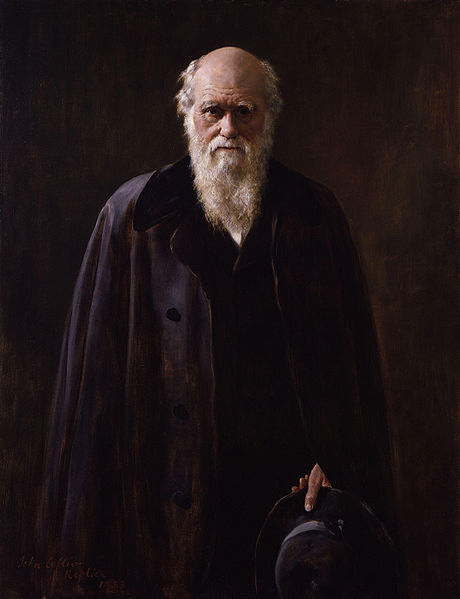
Charles Darwin in 1881, by John Collier

Charles Darwin in 1881, portrait by John Collier; after a Collier painting hanging in the Royal Society

Immortality?  Regardless Darwin’s religious beliefs (I’ll argue he remained Christian, thank you, if you wish to argue), he achieved immortality solely on the strength of his brilliant work in science. Of course he’s best known for being the first to figure out that natural and sexual selection worked as tools to sculpt species over time, a theory whose announcement he shared with Alfred Russel Wallace, who independently arrived at almost exactly the same theory but without the deep evidentiary backup Darwin had amassed.

But had evolution turned out to be a bum theory, Darwin’s other works would have qualified him as one of the greatest scientists of all time, including:

Darwin's theory set out a sequence of coral re...

Darwin’s theory set out a sequence of coral reef formation around an extinct volcanic island, becoming an atoll as the island and ocean floor subsided. Courtesy of the U.S. Geological Survey (Photo credit: Wikipedia)

US Geological Survey graphic demonstrating how coral atolls form on the sinking remains of old volcanic sea mounts, as Darwin described. Wikimedia commons image

  • World’s greatest collector of biological samples:  During his five years’ voyage on HMS Beagle, Darwin collected the largest collection of diverse plant and animal life ever by one person (I believe the record still stands); solely on the strength of his providing actual examples to the British Museum of so much life in so many different ecosystems worldwide, before he was 30 Darwin won election to the Royal Society.  (His election was engineered partly by friends who wanted to make sure he stayed in science, and didn’t follow through on his earlier plan to become a preacher.)
  • Geology puzzle solver:  Coral atolls remained a great geological mystery.  Sampling showed coral foundations well below 50 feet deep, a usual limit for coral growth.  In some cased old, dead coral were hundreds of feet deep.  In the South Pacific, Darwin looked at a number of coral atolls, marvelous “islands” that form almost perfectly circular lagoons.  Inspired partly by Lyell’s new encyclopedic review of  world geology, Darwin realized that the atolls he saw were the peaks of volcanic mounts.  Darwin hypothesized that the volcanoes grew from the ocean floor to the surface, and then the islands were colonized by corals.  The round shape of the volcano gave the atoll its shape.  Then the volcanic mounts eroded back, or sank down, and corals continued to grow on the old foundations.  It was a perfectly workable, natural explanation for a long-standing geologic puzzle.  (See Darwin’s monograph, Structure and Distribution of Coral Reefs.)
  • Patient watcher of flowers:  Another great mystery, this time in biology, concerned how vines twined themselves onto other plants, rocks and structures.  Darwin’s genius in designing experiments shone here:  He put a vine in his study, and watched it.  Over several hours, he observed vine tendrils flailing around, until they latched on to something, and then the circular flailing motion wrapped the tendril around a stick or twig. Simple observation, but no one had ever attempted it before.  (See On the Movements and Habits of Climbing Plants.)
  • Champion of earthworms, and leaf mould:  Darwin suspected the high fertilizer value of “leaf mould” might be related to the action of earthworms.  Again, through well-designed experiments and simple observation, Darwin demonstrated that worms moved and aerated soil, and converted organic matter into even richer fertilizer. (See The Formation of Vegetable Moulds Through the Action of Worms.)
  • Creation of methodological science:  In all of this work, Darwin explained his processes for designing experiments, and controls, and made almost as many notes on how to observe things, as the observations themselves.  Probably more than any other single man, Darwin invented and demonstrated the use of a series of processes we now call “the scientific method.”  He invented modern science.

Any of those accomplishments would have been a career-capping work for a scientist.  Darwin’s mountains of work still form foundations of geology and biology, and are touchstones for genetics.

Born within a few hours of Abraham Lincoln on February 12, 1809, Darwin survived 17 years longer — 17 extremely productive years.  Ill through much of his life with mystery ailments, perhaps Chaga’s Disease, or perhaps some other odd parasite or virus he picked up on his world travels, Darwin succumbed to heart disease on April 19, 1882.

More:


DDT use plunged to just 10 nations in 2015; gone by 2020?

April 13, 2016

UN photo showing a mother and child protected from mosquito-borne disease by a bednet, the chief tool used in 2015 to prevent malaria transmission in endemic areas.

UN photo showing a mother and child protected from mosquito-borne disease by a bednet, the chief tool used in 2015 to prevent malaria transmission in endemic areas.

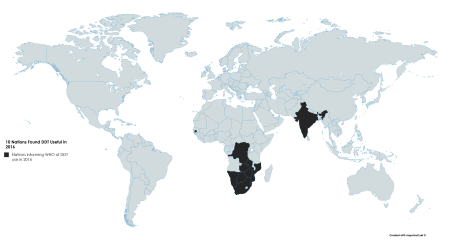
Just ten nations still used DDT in 2015, putting the planet on target to phase out all DDT use by 2020.

World Malaria Report 2015, published by the World Health Organization (WHO) in early December, notes those nations reporting that they use DDT in public health fights against disease. Under the Persistent Organic Pollutants Treaty, any nation may use DDT simply by notifying WHO.  Signatories of the treaty usually agree to stop all use of DDT once current use ends. Since 2003, most nations using it found DDT simply didn’t work well enough to continue use it to fight malaria or any other vector-borne diseases.

In the 2015 Report, Appendix 2A lists methods of vector control used in nations (“vector” being the fancy word for carrier of the disease, or mosquitoes in the case of malaria).  (See pages 234 to 237 of the .pdf.)

Nations in which DDT is used to fight malaria
World Malaria Report 2015 Appendix 2A

  1. Botswana
  2. Democratic Republic of the Congo
  3. Gambia
  4. Mozambique
  5. Namibia
  6. South Africa
  7. Swaziland
  8. Zambia
  9. Zimbabwe
  10. India

Ten nations total, nine in Africa, plus India.

Despite political calls to “bring back” DDT as a means of fighting mosquitoes that carry the Zika virus, no reports show any nation notified WHO it would do so. Most nations afflicted by Zika have been earlier afflicted by other diseases carried by the same species of mosquito, Aedes aegypti.  This species carries dengue fever, yellow fever and chikungunya, and perhaps others. Consequently, most of these nations have already tried DDT against the Zika carriers, and abandoned the projects when hoped-for results did not occur.

Every mosquito on Earth in 2016 carries at least a few of the alleles that make them resistant to, or even immune to DDT. DDT use also pushes mosquito populations to develop paths that make them quickly resistant to other pesticides. WHO guidelines urge public health officials never to use just one pesticide, but instead rotate among a dozen approved for vector use, in order to prevent the bugs from developing resistance. Resistance to pesticides remains one of the chief obstacles to eliminating disease, and a growing obstacle.

India is the world’s only known maker of DDT in 2015, and the heaviest user, using more of the pesticide than all other nations combined. Due to decreasing effectiveness of DDT as mosquito resistance to to it spreads and grows stronger, malaria has proliferated in India despite increased DDT application. In 2015, India announced to WHO it would suspend manufacture and use of DDT by 2020.

More:

In black, the ten nations who used DDT in 2016, nine in Africa, and India. 43 nations used DDT in 2001. India pledges to stop manufacturing DDT by 2020. Map by Ed Darrell, using Mapchart.net

In black, the ten nations who used DDT in 2016, nine in Africa, and India. 43 nations used DDT in 2001. India pledges to stop manufacturing DDT by 2020. Map by Ed Darrell, using Mapchart.net

Save


March 14, 2016: π Day! A π roundup, mostly pie

March 14, 2016

Let’s rerun this one. Again.  I like the photographs. I may go search for a good piece of pie.

Of course you remembered that today is pi Day, right?

Pi Day Pie from Slashfood.com

Happy π Day! Pi Day Pie – Slashfood.com

Oh, or maybe better, π Day.

We’ll start with the brief post from a few months ago, and then build on it with some activities and posts from around the WordPress-o-sphere.

The good people at PiDay.org suggest a few ways you can celebrate:

Make (and Eat) a Pie – These pie recipes for Pi Day from NPR’s McCallister look incredibly tasty. But, there’s no shame in putting a frozen store-bought pie in the oven, or picking up a pie from your local bakery. Any kind of pie is great on Pi Day! If you’re making your own, get inspired by these beautifully designed Pi Day Pies. Tell us on Facebook: What’s your favorite kind of pie for Pi Day?

Hope your π Day is complete as a circle, and well-rounded!

How are others celebrating?  A look around WordPress:

At SocialMediaPhobe, a musical interpretation of pi featuring the music of Michael Blake:

So Long Freedom:

pidaypieToday is March 14th, also known as “Pi Day” for us math geeks out there because March 14th (3/14) is the first 3 digits of π (3.14159…).  To celebrate “Pi Day” I highly recommend doing something mathematical while having some pie at 1:59 pm.  I recommend Yumology‘s S’mores Pie as it has 3 main ingredients (chocolate, marshmallow, and graham cracker) and about 0.14159 other ingredients like sugar, butter, and stuff.  If you are not a math geek, its okay…you can still eat pie and count things like how many stop signs you pass on your way back to work from lunch.  Or you could go to the library and take out a book on something fun like binary code.  As we like to say, “There are only 10 types of people in the world:  Those that understand binary and those that don’t.”  Seriously, binary is as easy as 01000001, 01000010, 01000011.

Miles Free at PMPA Speaking of Precision:

Today 3-14 at 1:59 I will be celebrqting Pi Day. 3.14159 is the value of pi to 5 decimals...

So besides being  the cause of much techie “irrational” exuberance, Pi Day  is a great way to get some engagement with students.

Marymount High School has several activities, last year they had a design competition incorporating pi; the students then made and sold buttons of each design, proceeds going to the Red Cross.

Hmm- math subject matter, design, production, sales, accounting.

Sounds like what we do in manufacturing.
Maybe celebrating Pi Day is not so irrational as first thought.

Free said his pie is peach.

Steve Doyle at CraveDFW:

On March 12, 2009 your lawmakers  passed a non-binding resolution (HRES 224) recognizing March 14, 2009 as National Pi Day. It is one of the more legit holidays we discuss here, and it is actually an homage to geeks everywhere who see the date as a reason to celebrate due to its mathematical implications. We say any reason to celebrate anything is just fine by us.

Since we are predominately about food we will suggest a few places to actually enjoy a pie.

DSC06367

If you followed us at all this week you may have seen the pie at Bowl and Barrel pop up on our pages. This is the uber delicious Butterscotch Pie served as the solo dessert at the bowling alley and restaurant.  Go eat one of these.

He’s got more pi pie, if you click over there.

Gareth Branwyn at MakeZine offers more pie and a mnemonic:

How to Remember Pi to 15 Digits

Pi-Pie--69299

By way of sci-fi author and mathenaut Rudy Rucker’s Facebook wall comes this:

One way to remember the first few digits of pi is to count the letters in the words of this phrase:

“How I need a drink, alcoholic of course, after the heavy lectures involving quantum mechanics.”

[Image via FreakingNews]

Another song, on YouTube, at Awsomesauce:

b.love offers this clock image (is this clock for sale somewhere?):

A clock for pi day

TED Blog offers two videos:

Chirag Singh explains his “passion for pi.”

Daniel Tammet, “Different Ways of Knowing:

Geeks are really out in force today, flaunting pi for all they’ve got.

More:

Hey, students! Did any of your teachers do cool stuff for Pi Day? Tell us what, and who, in comments.

Yes, this is mostly an encore post. Fighting ignorance requires patience.

Yes, this is mostly an encore post. Fighting ignorance requires patience.


Happy birthday, Albert Einstein! 137 years, March 14

March 14, 2016

How many ways can we say happy birthday to a great scientist born on Pi Day?  So, an encore post.
E=mcc - logo from AIP

E=energy; m=mass; c=speed of light

Happy Einstein Day! to us.  Albert’s been dead since 1955 — sadly for us.  Our celebrations now are more for our own satisfaction and curiosity, and to honor the great man — he’s beyond caring.

Almost fitting that he was born on π Day, no? I mean, is there an E=mc² Day?

Albert Einstein was born on March 14, 1879, in Ulm, Germany, to Hermann and Pauline Einstein.

26 years later, three days after his birthday, he sent off the paper on the photo-electric effect; that paper would win him the Nobel Prize in Physics in 1921.

In that same year of 1905, he published three other papers, solving the mystery of Brownian motion, describing what became known as the Special Theory of Relativity and solving the mystery of why measurements of the light did not show any effects of motion as Maxwell had predicted, and a final paper that noted a particle emitting light energy loses mass. This final paper amused Einstein because it seemed so ludicrous in its logical extension that energy and matter are really the same stuff at some fundamental point, as expressed in the equation demonstrating an enormous amount of energy stored in atoms, E=mc².

Albert Einstein as a younger man - Nobel Foundation image

Albert Einstein as a younger man – Nobel Foundation image

Any one of the papers would have been a career-capper for any physicist. Einstein dashed them off in just a few months, forever changing the fields of physics. And, you noticed: Einstein did not win a Nobel for the Special Theory of Relativity, nor for E=mc². He won it for the photo electric effect. Irony in history.

106 years later Einstein’s work affects us every day. Relativity theory at some level I don’t understand makes possible the use Global Positioning Systems (GPS), which revolutionized navigation and mundane things like land surveying and microwave dish placement. Development of nuclear power both gives us hope for an energy-rich future, and gives us fear of nuclear war. Sometimes, even the hope of the energy rich future gives us fear, as we watch and hope nuclear engineers can control the piles in nuclear power plants damaged by earthquakes and tsunami in Japan.

English: Albert Einstein on a 1966 US stamp

Albert Einstein on a 1966 US stamp (Photo credit: Wikipedia)

If Albert Einstein was a genius at physics, he was more dedicated to pacifism. He resigned his German citizenship to avoid military conscription. His pacifism made the German Nazis nervous; Einstein fled Germany in the 1930s, eventually settling in the United States. In the U.S., he was persuaded by Leo Szilard to write to President Franklin Roosevelt to suggest the U.S. start a program to develop an atomic weapon, because Germany most certainly was doing exactly that. But while urging FDR to keep up with the Germans, Einstein refused to participate in the program himself, sticking to his pacifist views. Others could, and would, design and build atomic bombs. (Maybe it’s a virus among nuclear physicists — several of those working on the Manhattan Project were pacifists, and had great difficulty reconciling the idea that the weapon they worked on to beat Germany, was deployed on Japan, which did not have a nuclear weapons program.)

English: USSR stamp dedicated to Albert Einste...

Everybody wanted to claim, and honor Einstein; USSR issued this stamp dedicated to Albert Einstein Русский: Почтовая марка СССР, посвящённая Альберту Эйнштейну (Photo credit: Wikipedia)

Einstein was a not-great father, and probably not a terribly faithful husband at first — though he did think to give his first wife, in the divorce settlement, a share of a Nobel Prize should he win it. Einstein was a good violinist, a competent sailor, an incompetent dresser, and a great character. His sister suffered a paralyzing stroke. For many months Albert spent hours a day reading to her the newspapers and books of the day, convinced that though mute and appearing unconscious, she would benefit from hearing the words. He said he did not hold to orthodox religions, but could there be a greater show of faith in human spirit?

Einstein in 1950, five years before his death

Einstein in 1950, five years before his death

When people hear clever sayings, but forget to whom the bon mots should be attributed, Einstein is one of about five candidates to whom all sorts of things are attributed, though he never said them. (Others include Lincoln, Jefferson, Mark Twain and Will Rogers). Einstein is the only scientist in that group. So, for example, we can be quite sure Einstein never claimed that compound interest was the best idea of the 20th century. This phenomenon is symbolic of the high regard people have for the man, even though so few understand what his work was, or meant.

A most interesting man. A most important body of work. He deserves more study and regard than he gets.

More, Resources:


Pi Day countdown widget

March 4, 2016

You may add this countdown timer to your blog.

Pi Day Countdown

From PiDay.org.

FlippyCat offers a video on dominoes, to celebrate Pi Day.


Darwin and Lincoln and February 12: Cool coincidence or divine intervention?

February 12, 2016

Is it an unprecedented coincidence?  207 years ago today, just minutes (probably hours) apart according to unconfirmed accounts, Abraham Lincoln was born in a rude log cabin on Nolin Creek, in Kentucky, and Charles Darwin was born into a wealthy family at his family’s home  in Shrewsbury, England.

Gutzon Borglums 1908 bust of Abraham Lincoln in the Crypt of the U.S. Capitol - AOC photo

Gutzon Borglum’s 1908 bust of Abraham Lincoln in the Crypt of the U.S. Capitol – Architect of the Capitol photo

Lincoln would become one of our most endeared presidents, though endearment would come after his assassination.  Lincoln’s bust rides the crest of Mt. Rushmore (next to two slaveholders), with George Washington, the Father of His Country, Thomas Jefferson, the author of the Declaration of Independence, and Theodore Roosevelt, the man who made the modern presidency, and the only man ever to have won both a Congressional Medal of Honor and a Nobel Prize, the only president to have won the Medal of Honor. 

In his effort to keep the Union together, Lincoln freed the slaves of the states in rebellion during the civil war, becoming an icon to freedom and human rights for all history.  Upon his death the entire nation mourned; his funeral procession from Washington, D.C., to his tomb in Springfield, Illinois, stopped twelve times along the way for full funeral services.  Lying in state in the Illinois House of Representatives, beneath a two-times lifesize portrait of George Washington, a banner proclaimed, “Washington the Father, Lincoln the Savior.”

Charles Darwin statue, Natural History Museum, London - NHM photo

Charles Darwin statue, Natural History Museum, London – NHM photo

Darwin would become one of the greatest scientists of all time.  He would be credited with discovering the theory of evolution by natural and sexual selection.  His meticulous footnoting and careful observations formed the data for ground-breaking papers in geology (the creation of coral atolls), zoology (barnacles, and the expression of emotions in animals and man), botany (climbing vines and insectivorous plants), ecology (worms and leaf mould), and travel (the voyage of H.M.S. Beagle).  At his death he was honored with a state funeral, attended by the great scientists and statesmen of London in his day.  Hymns were specially written for the occasion.  Darwin is interred in Westminster Abbey near Sir Isaac Newton, England’s other great scientist, who knocked God out of the heavens.

Lincoln would be known as the man who saved the Union of the United States and set the standard for civil and human rights, vindicating the religious beliefs of many and challenging the beliefs of many more.  Darwin’s theory would become one of the greatest ideas of western civilization, changing forever all the sciences, and especially agriculture, animal husbandry, and the rest of biology, while also provoking crises in religious sects.

Lincoln, the politician known for freeing the slaves, also was the first U.S. president to formally consult with scientists, calling on the National Science Foundation (whose creation he oversaw) to advise his administration.  Darwin, the scientist, advocated that his family put the weight of its fortune behind the effort to abolish slavery in the British Empire.  Each held an interest in the other’s disciplines.

Both men were catapulted to fame in 1858. Lincoln’s notoriety came from a series of debates on the nation’s dealing with slavery, in his losing campaign against Stephen A. Douglas to represent Illinois in the U.S. Senate.  On the fame of that campaign, he won the nomination to the presidency of the fledgling Republican Party in 1860.  Darwin was spurred to publicly reveal his ideas about the power of natural and sexual selection as the force behind evolution, in a paper co-authored by Alfred Russel Wallace, presented to the Linnean Society in London on July 1, 1858.   On the strength of that paper, barely noticed at the time, Darwin published his most famous work, On the Origin of Species, in November 1859.

Darwin and Lincoln might have got along well, but they never met.

What unusual coincidences.

Go celebrate human rights, good science, and the stories about these men.

A school kid could do much worse than to study the history of these two great men.  We study them far too little, it seems to me.

Resources:

Charles Darwin:

Abraham Lincoln:

More:

Anybody know what hour of the day either of these men was born?

Yes, you may fly your flag today for Lincoln’s birthday, according to the Flag Code; the official holiday, Washington’s Birthday, is next Monday, February 15th — and yes, it’s usually called “Presidents Day” by merchants and calendar makers. You want to fly your flag for Charles Darwin? Darwin never set foot in North America, remained a loyal subject of Her Majesty, Queen Victoria, to the end of his days. But go ahead. Who would know?

Yes, this is mostly an encore post. Fighting ignorance requires patience.

Yes, this is mostly an encore post. Fighting ignorance requires patience.


Spark ignited a fire that became an environmental alarm, Silent Spring

February 3, 2016

The letter to the editor of the late Boston Herald that sparked Rachel Carson to write Silent Spring.

Oddly, the Tweet from American Scientist doesn’t link to the letter at all. Instead it links to a timeline of events regarding the magazine’s changing treatment of DDT as a subject, since 1944. It’s a useful timeline, but it leaves us wondering about that 1958 letter to the editor.

I’d like to have an original image, but have not found one.  Instead, I found a retyped copy of the text of the letter, looking as though it came from a 1958 typewriter.

Text of letter to the editor by birdwatcher Olga Owens Huckins, published in the Boston Herald on January 30, 1958. The letter sparked naturalist and author Rachel Carson to open a file on pesticides, which she eventually turned into Silent Spring. Image from Weebly

Text of letter to the editor by birdwatcher Olga Owens Huckins, published in the Boston Herald on January 30, 1958. The letter sparked naturalist and author Rachel Carson to open a file on pesticides, which she eventually turned into Silent Spring. Image from Weebly

Do you know where we might find an image of the original letter as published — preferably on the internet?

It also occurs to me that this could be a key piece for a short lesson on the value of citizen involvement, for a class in civics and government, or in a class for Boy Scouts or Girl Scouts on one of the citizenship merit badges.

Mrs. Huckins’s letter is a fine example of the citizen acorns from which grow the oaks of political drives for better communities, and a better world.

More:


Report that malaria and DDT hoaxsters hope you never see

January 21, 2016

 Cover of World Health Organization's "World Malaria Report 2015," which reported dramatic progress controlling malaria.

Cover of World Health Organization’s “World Malaria Report 2015,” which reported dramatic progress controlling malaria.

World Malaria Report 2015 dropped in mid-December, with United Nations-style fanfare.

Which means, you probably heard little to nothing about it in U.S. media, and “conservatives” and anti-science hoaxsters hope you won’t ever see it, so they can claim contrary to the facts that liberals kill kids in Africa.

My cynicism about the fight against malaria dissipates some, but my cynicism about hoaxes substituting for political dialogue grows.

World Health Organization (WHO) releases an annual report near the end of every year, detailing the fight against malaria and progress or lack of it.

Good news this year: WHO estimates deaths to malaria fell below 500,000 per year in 2015. That’s at least a 50% reduction since renewed vigor in the malaria fight in 2000, and it’s a 90% reduction from peak DDT use years, 1958-1963, when WHO estimated 5 million people died each year from malaria.

About 80% of malaria deaths take children under the age of 5.

Bigger picture: Malaria is on the run. Humans are winning the fight against malaria. Much remains to be done, however. Plus, malaria fighters warn that malaria can come roaring back, if governments neglect to follow through on promises of funding, and with well-run programs to cure humans of malaria and prevent new cases.

World Malaria Report 2015 should influence policy discussions in U.S. elections. But generally, this report was ignored.

Millard Fillmore’s Bathtub will feature in-depth discussions of parts of the report, and simple repetition for the record of the report, as part our long-term battle against hoaxsters who claim the U.S. ban on use of DDT on U.S. farms somehow increased malaria in Africa, and killed millions, when malaria actually decreased and millions were saved from death.

Malaria loses only with hard work on the ground by medical people treating and curing humans of the disease, and by public health people working hard to prevent new infections. Most of that work is not glorious, occurs relatively anonymously and away from television cameras and photographers with access to social media.  Which is to say, the hard work of defeating malaria goes unsung around the world. We should work to change that.

What did others say about World Malaria Report?

A collection of Tweets, and other links, for your study.

http://twitter.com/bbbrieger/status/674591008139681793

http://twitter.com/wardhealth/status/674610775646978048

http://twitter.com/News__World/status/674612996484808704

http://twitter.com/DTNIndia/status/684830093085032448


December 31, 2015: Bright Idea Day, anniversary of the Day the Lights Went On

December 31, 2015

Between Christmas and New Year’s Day, here at Millard Fillmore’s Bathtub we celebrate a variety of historically holy days.  December 31, by tradition, is Bright Idea Day, the anniversary of the day Thomas Edison demonstrated for the public a working light bulb, in 1879.

100,000 people gather in Times Square, New York City (surely not the 1 million predicted by NBC!) tonight, and millions more around the world, in festivities for the new year made possible by the work of Thomas Alva Edison.

Here it is, the invention that stole sleep from our grasp, made clubbing possible, and launched 50,000 cartoons about ideas:

The light bulb Thomas Edison demonstrated on December 31, 1879, at Menlo Park, New Jersey - Wikimedia image

The light bulb Thomas Edison demonstrated on December 31, 1879, at Menlo Park, New Jersey – Wikimedia image (GFDL)

The light bulb. It’s an incandescent bulb.

It wasn’t the first bulb. Edison a few months earlier devised a bulb that worked with a platinum filament. Platinum was too expensive for mass production, though — and Edison wanted mass production. So, with the cadre of great assistants at his Menlo Park laboratories, he struggled to find a good, inexpensive filament that would provide adequate life for the bulb. By late December 1879 they had settled on carbon filament.

Edison invited investors and the public to see the bulb demonstrated, on December 31, 1879.

Thomas Edison in 1878, the year before he demonstrated a workable electric light bulb. Library of Congress image

Thomas Edison in 1878, the year before he demonstrated a workable electric light bulb. CREDIT: Thomas Edison, head-and-shoulders portrait, facing left, 1880. Prints and Photographs Division, Library of Congress. Reproduction number LC-USZ62-98067

Edison’s successful bulb indicated changes in science, technology, invention, intellectual property and finance well beyond its use of electricity. For example:

  • Edison’s Menlo Park, New Jersey, offices and laboratory were financed with earlier successful inventions. It was a hive of inventive activity aimed to make practical inventions from advances in science. Edison was all about selling inventions and rights to manufacture devices. He always had an eye on the profit potential. His improvements on the telegraph would found his laboratory he thought, and he expected to sell the device to Western Union for $5,000 to $7,000. Instead of offering it to them at a price, however, he asked Western Union to bid on it. They bid $10,000, which Edison gratefully accepted, along with the lesson that he might do better letting the marketplace establish the price for his inventions. Other inventive labs followed Edison’s example, such as the famous Bell Labs, but few equalled his success, or had as much fun doing it.  (Economics teachers:  Need an example of the marketplace in action?)
  • While Edison had some financial weight to invest in the quest for a workable electric light, he also got financial support, $30,000 worth, from some of the finance giants of the day, including J. P. Morgan and the Vanderbilts who established the Edison Light Company.
  • Edison didn’t invent the light bulb — but his improvements on it made it commercial. “In addressing the question ‘Who invented the incandescent lamp?’ historians Robert Friedel and Paul Israel list 22 inventors of incandescent lamps prior to Joseph Wilson Swan and Thomas Edison. They conclude that Edison’s version was able to outstrip the others because of a combination of three factors: an effective incandescent material, a higher vacuum than others were able to achieve (by use of the Sprengel pump) and a high resistance lamp that made power distribution from a centralized source economically viable.”
  • Edison’s financial and business leadership acumen is partly attested to by the continuance of his organizations, today — General Electric, one of the world’s most successful companies over the past 40 years, traces its origins to Edison.

Look around yourself this evening, and you can find a score of ways that Edison’s invention and its descendants affect your life. One of the more musing effects is in cartooning, however. Today a glowing lightbulb is universally accepted as a nonverbal symbol for ideas and inventions. (See Mark Parisi’s series of lightbulb cartoons, “Off the Mark.”)

Even with modern, electricity-saving bulbs, the cartoon shorthand hangs on, as in this Mitra Farmand cartoon.

Fusilli has an idea, Mitra Farmand, Fuffernutter

Brilliant cartoon from Mitra Farmand, Fuffernutter (regrettably, we note this site is no longer there; but with some hope, we find a new site here)

Or see this wonderful animation, a video advertisement for United Airlines, by Joanna Quinn for Fallon — almost every frame has the symbolic lightbulb in it.

Electrification of America, and the consequent spread of electric lighting and electrical machines to make domestic and industrial life more productive, and the spread of great public works to enable these and other inventions to spread, were made possible by a people roughly united in advancing progress, what historians now call “the progressive agenda” and the great advances of the Progressive Era.

Could we get such agreement among workers, corporate bosses and many levels of government today? When we celebrate anniversaries, like the demonstration of the light bulb, we celebrate the united polity that made such things possible, too.

Other resources:

Patent drawing for Thomas Edison's successful electric lamp. Library of Congress

Thomas Edison’s electric lamp patent drawing and claim for the incandescent light bulb CREDIT: “New Jersey–The Wizard of Electricity–Thomas A. Edison’s System of Electric Illumination,” 1880. Prints and Photographs Division, Library of Congress. Reproduction Number LC-USZ62-97960.

Yeah, this is mostly an encore post. ‘Tis the season for tradition, especially good, wise tradition.

Even More, in 2012 and 2013: