Sputnik’s 50th

October 4, 2007

America woke up on October 4, 1957.

Sputnik, model hanging in Smithsonian Air & Space Museum

The Union of Soviet Socialist Republics (USSR) launched the world’s first artificial satellite into orbit. After successfully putting the shiny ball into orbit, the Soviets trumpeted the news that Sputnik traced the skies over the entire planet, to the shock of most people in the U.S. (Photo of the model in the Smithsonian’s Air & Space Museum in Washington, D.C.)

New Scientist magazine’s website provides significant details about how awake America became, including very good coverage of the Moon landings that were nearly a direct result of Sputnik’s launch — without Sputnik, the U.S. probably wouldn’t have jump started its own space program so, with the creation of NASA and the drive for manned space flight, and without the space race President John F. Kennedy probably wouldn’t have made his dramatic 1961 proposal to put humans on the Moon inside a decade.

Sputnik really did change the world.

Much of the progress to the 1969 Moon landing could not have occurred without the reform of education and science prompted by the Soviets’ triumph. With apathetic parents and the No Child Left Behind Act vexing U.S. education and educators from both sides, more than nostalgia makes one misty-eyed for the National Defense Education Act (NDEA), a direct product of Sputnik-inspired national ambition. Coupled with the GI Bill for veterans of World War II and Korea, NDEA drove U.S. education to be the envy of the world, best in overall achievement (and also drove creationists to try to block such improvements).

(Today NDEA gets little more than a footnote in real historyWikipedia’s entry is short and frustrating, the U.S. Department of Education gives little more. Educators, you have got to tell your history.)

Texas Essential Knowledge and Skills (TEKS) lists 1957 as among the dozen dates students need to know in U.S. history, for Sputnik. It is the only date Texas officials list for U.S. history that is really an accomplishment by another nation. (The first time I encountered this requirement was in a meeting of social studies teachers gearing up for classes starting the following week. The standards mention the years, but not the events; I asked what the event was in 1957 that we were supposed to teach, noting that if it was the Little Rock school integration attempt, there were probably other more memorable events in civil rights. No one mentioned Sputnik. It was more than two weeks before I got confirmation through our district that Sputnik was the historic event intended. Ouch, ouch, ouch!)

Sputnik was big enough news to drive Elvis Presley off the radio, at least briefly, in southern Idaho. My older brothers headed out after dinner to catch a glimpse of the satellite crossing the sky. In those darker times — literally — rural skies offered a couple of meteoroids before anyone spotted Sputnik. But there it was, slowly painting a path across our skies, over the potato fields, over the Snake River, over America.

Sputnik’s launch changed our lives, mostly for the better.

Resources:

Phil Plait at Bad Astronomy provides a series of links teachers can rely on for good information, especially if you’re composing a lesson plan quickly.

New Scientist’s broad range of coverage of the space race, up to the current drive to go to Mars, is well worth bookmarking.

google_sputnik.gif

Google’s anniversary logo, in use today only, gets you to a good compilation of sources.

Fifty nano-satellites launched in honor of the 50th anniversary of Sputnik.

NASA’s history of the event. You can listen to a .wav recording of the telemetry signal from the satellite there, too.

How will you mark the anniversary?

[More links below the fold.]

Read the rest of this entry »


Carnival of DDT

October 3, 2007

Information on DDT is scattered clouds of information, lately.  Some of these really should get more comment — but time is quite short for me right now.

Here’s the news:

One more study on DDT and breast cancer.  Stop the presses on this one.  It’s a good study, and it shows a link.  Effect Measure at the Seed Stables has a good post on it.   One of the key differences here is that this study looked for childhood exposure.  Exposure of children to DDT seems to be more damaging than exposure to adults.  This should be especially worrying considering DDT’s daughter products and their ability to mimic estrogen in the wild.

Bill Moyers’ program on PBS looked at the recent campaign against Rachel Carson, and found the campaign ethically challenged.  Moyers takes a more in-depth and gentle view of Carson, from a perspective from the arts.  Solid information, interesting view.

All Africa.com had a news report on the current anti-malaria campaign in Malawi:  “Rescuing children from malaria.”  Real news — it doesn’t call for broadcast spraying of DDT.  (Surprised?)  In fact, it attacks the colleagues of the Rachel Carson critics, the tobacco companies.

A blogger named Aaron Swartz takes on the Rachel Carson critics rather directly:  “Rachel Carson:  Mass Murderer?” 

A recent think piece out of the always-informative Christian Science Monitor:  “Bring back DDT?  Think again.”

Perhaps a minor blip:  Plaintiffs ask damages against chemical companies and others because the DDT dumped next door has decreased the value of their properties.  An Alabama appeals court ruled that plaintiffs may call in experts to testify that DDT dumping decreases property value.  (Maybe Roger Bate would like to buy the property at market value?  All that DDT would mean no mosquitoes forever, right?)

And from the lost-but-now-found archives, a story that demonstrates subtly the bias that Rachel Carson critics have — Roger Bate defending tobacco companies in a 1996 Wall Street Journal opinion piece.  Perhaps one should not be surprised that people who defend tobacco against health regulators and health care education could turn around and argue for DDT and against Rachel Carson.


Nuclear bombs, game theory, the Cold War to the brink

September 27, 2007

John von Neumann died prematurely at 54, in 1957. He was very much a polymath, acknowledged first for his mathematical abilities, eventually contributing to physics, computer science and economics. His contributions in nuclear physics and game theory especially deserve better recognition than they’ve gotten among the public at large.

John von Neumann, NAS photo

Princeton University commemorates von Neumann’s life on the 50th anniversary of his death, with an afternoon and a night of lectures and discussion by scientists, economists and historians, October 5 and 6, 2007.

It should be good fun, and if you’re in the neighborhood of Princeton, New Jersey on October 5 and 6, you should go.

Here’s the biographical overview of von Neumann from the National Academy of Sciences, showing him to be the sort of guy we would have been happy to keep around another 40 years or so:

John von Neumann (1903-1957). When he was elected a member of the Academy in 1937, von Neumann was known for his contributions to the fields of mathematical logic and the foundations of quantum mechanics. But his interests were wide-ranging, and he went on to do distinguished work in other fields, including economics and strategic thinking. He is perhaps best known for his work in the early development of computers. As director of the Electronic Computer Project at Princeton’s Institute for Advanced Study (1945-1955), he developed MANIAC (mathematical analyzer, numerical integrator and computer), which at the time was the fastest computer of its kind. Built at a time long before the invention of the silicon chip, MANIAC was run on thousands of vacuum tubes. Von Neumann was born in Budapest, Hungary, in 1903, and studied in Berlin, Zurich, and Hamburg. In 1930 he joined the Princeton Institute for Advanced Study. He became a US citizen in 1937, and during the Second World War distinguished himself with his work in weapons development. In 1955 he was named a Commissioner of the Atomic Energy Commission, a position he held up to his death from cancer in 1957.

Free Lecture No. 1:

Budapest: The Golden Years

Early Twentieth Century Mathematics Education in Budapest and Lessons for Today

Free and Open to the Public
Panel Discussion
October 5, 2007
3–6 p.m.
219 Aaron Burr Hall
Princeton University

The starting point for the discussion is The Social Construction of Hungarian Genius, 1867–1930, a paper by Professor Tibor Frank, an historian of Hungarian exiles. The paper will be available for distribution at the event.

Free Lecture No. 2:

“Living in von Neumann’s World: Scientific Creativity, Technological
Advancement, and Civilization’s Accelerating Dilemma of Power”

Lecture and Panel Discussion
8 pm, Saturday October 6, 2007
McCosh 50 Lecture Hall
Princeton University

Introduction by Charles Harper

Lecturers:
Thomas Schelling, University of Maryland College Park,
Nobel Laureate, Economics
George Dyson,
von Neumann biographer

Panel Moderator:
Eric Gregory, Princeton University

Panelists:
Freeman Dyson, Institute for Advanced Study
Martin Nowak, Harvard University
Robert Wright, Princeton University

Banner for von Neumann Lectures, 2007


Texas earthquake!

September 23, 2007

Epicenter of Texas earthquake

Really. A Texas earthquake. September 15, 2007.

Missed it? Well, it was at the dinner hour, 06:16:42 PM (CDT). You may have thought it was Bubba’s great sauce for the barbecue, or the raspberry in the iced tea.

US Geological Survey provides a state-by-state listing of latest earthquakes. Texas is not a particularly active zone — but there are quakes, even here.

This last one, just over a week ago, was a 2.7 on the Richter scale, too weak to merit much news coverage even in the flatlands. It shook Milam County and surprised people there, but it didn’t do much damage:

In terms of destruction, the earthquake was hardly significant.

Emergency responders said they knew of only one report of damage: A teapot fell off of a woman’s stove.

In California, people probably wouldn’t have even noticed the tremor. But this earthquake happened in the Lone Star State and left Brazos Valley residents baffled.

“You just don’t expect your house to shake,” said Burleson County resident Karen Bolt. She was in her trailer home cleaning dishes when the temblor began.

USGS provides more details than you can use:

Magnitude 2.7
Date-Time
  • Saturday, September 15, 2007 at 23:16:42 (UTC) – Coordinated Universal Time
  • Saturday, September 15, 2007 at 06:16:42 PM local time at epicenter
  • Time of Earthquake in other Time Zones

    Location 30.74N 96.74W
    Depth 5.0 kilometers
    Region CENTRAL TEXAS
    Distances 35 km (20 miles) W of Bryan, Texas
    65 km (40 miles) ENE of Taylor, Texas
    110 km (70 miles) ENE of AUSTIN, Texas
    170 km (105 miles) NW of Houston, Texas
    Location Uncertainty Error estimate: horizontal +/- 16.2 km; depth fixed by location program
    Parameters Nst=4, Nph=4, Dmin=123.3 km, Rmss=1.25 sec, Erho=16.2 km, Erzz=0 km, Gp=130.4 degrees
    Source USGS NEIC (WDCS-D)
    Remarks Felt in the Caldwell-Rockdale area.
    Event ID ushhc

    Still, Texans should be relieved it was a small one. The largest recorded Texas earthquake was in 1931, with an epicenter near Valentine. At 5.7 magnitude and VII intensity, it nearly destroyed the little town of Valentine.

    In terms of magnitude and damage, this is the largest earthquake known to have occurred in Texas. The most severe damage was reported at Valentine, where all buildings except wood-frame houses were damaged severely and all brick chimneys toppled or were damaged. The schoolhouse, which consisted of one section of concrete blocks and another section of bricks, was damaged so badly that it had to be rebuilt. Small cracks formed in the schoolhouse yard. Some walls collapsed in adobe buildings, and ceilings and partitions were damaged in wood-frame structures. Some concrete and brick walls were cracked severely. One low wall, reinforced with concrete, was broken and thrown down. Tombstones in a local cemetery were rotated. Damage to property was reported from widely scattered points in Brewster, Jeff Davis, Culberson, and Presidio Counties. Landslides occurred in the Van Horn Mountaiins, southwest of Lobo; in the Chisos Mountains, in the area of Big Bend; and farther northwest, near Pilares and Porvenir. Landslides also occurred in the Guadalupe Mountains, near Carlsbad, New Mexico, and slides of rock and dirt were reported near Picacho, New Mexico. Well water and springs were muddied throughout the area. Also felt in parts of Oklahoma, New Mexico, and in Chihauhua and Coahuila, Mexico.

    Texas history courses could make some use of these data, for map reading exercises, and for general geography about the state. Click on the map below, the isoseismal map of the 1931 Valentine, Texas quake, and geography teachers will begin to dream of warm-up exercises right away.

    Isoseismal map of 1931 earthquake near Valentine, Texas

    USGS offers a wealth of information on Texas’ geology and geography — stream flow information, drought information — collected in one spot for each state in a “Science in your backyard” feature.

    Pick your state, pick your topic, and go.


    Quote of the moment: Washing hands of the matter

    September 23, 2007

    Ignaz Semmelweiss

    This is one of the classic stories of public health, an issue that most U.S. history and world history texts tend to ignore, to the detriment of the students and the classroom outcomes.

    This is the story as retold by Christopher Cerf and Victor Navasky in The Experts Speak:

    In the 1850s a Hungarian doctor and professor of obstetrics named Ignaz Semmelweis (pictured at left) ordered his interns at the Viennese Lying-in Hospital to wash their hands after performing autopsies and before examining new mothers. The death rate plummeted from 22 out of 200 to 2 out of 200, prompting the following reception from one of Europe’s most respected medical practitioners:

    “It may be that it [Semmelweis’ procedure] does contain a few good principles, but its scrupulous application has presented such difficulties that it would be necessary, in Paris for instance, to place in quarantine the personnel of a hospital during the great part of a year, and that, moreover, to obtain results that remain entirely problematical.”

    Dr. Charles Dubois (Parisian obstetrician), memo to the French Academy
    September 23, 1858

    Semmelweiss’ superiors shared Dubois’ opinion; when the Hungarian physician insisted on defending his theories, they forced him to resign his post on the faculty.

    Update, September 26, 2007: Stephen J. Dubner at the Freakonomics blog pointed to a video, to an essay by Semmelweis, and to a column he and Steven D. Levitt had done earlier on handwashing. Maybe things aren’t as good as we had hoped.


    Skirmishes before the war? Creationist assault on Texas

    September 21, 2007

    Intelligent design advocates’ chief claim holds that where a pattern may be discerned, there is someone with intelligence scheming away.

    That explains a recent spattering of activities in Texas that otherwise are just blots of minor, irritating news. It points to animus against science in top religious and political circles in Texas — if, of course, there is anything at all to intelligent design’s chief premise.

    Scientists and citizens for good government, and parents concerned about good education, should note these recent actions:

    First, ID advocates tried to establish a stealth toehold at Baylor University. The Waco Tribune explained the otherwise odd events surrounding Bill Dembski’s latest foray into Baylor — he got himself designated as a “post-doc” student for an engineer’s project, and a website featuring a new sciency term, “informatics,” quickly appeared. School administrators were not satisfied with the transparency and legitimacy of funding for the project, and pulled the plug on it, producing wails of “oppression” from the ID harpy chorus.

    Dembski is a professor at the Southwestern Theological Seminary in Fort Worth. Had he been collaborating with Robert Marks at Baylor, one would think that collaboration from his professorial position would carry more clout, attract more funding, and generally make a lot more sense than having the multiple-degreed Dembski do post-doc work in engineering, a field he’s not yet got a degree in. Apart from the sheer humor of Dembski pursuing one more degree that is not biology in order to try to get the credentials to assault biology, the sheer stupidity of the affair has put scientists off-guard, satisfied that Baylor’s integrity watchdogs have protected science adquately. I’m not so sure.

    Second, without much fanfare outside extreme fundamentalist circles, the Institute for Creation Research moved most of its operation from California to Dallas. The stated reasons include proximity to DFW Airport, which makes sense for a corporation like J. C. Penney or Exxon-Mobil, but doesn’t really make a lot of sense for a “school” that has fought to get the right to grant graduate degrees in California.

    Third, Texas Gov. Rick Perry’s appointment of a stiff-necked creationist to be the chairman of the Texas State Board of Education produced concern among educators and scientists, especially remembering Chairman Don McLeroy’s positions on creationism and evolution in the last biology textbook approval round, in 2003 (not to mention his anti-disease prevention stance on health books in 2004). Concern was defused by a Dallas Morning News article in which McLeroy and other creationists on the board said they would not work to put intelligent design into the curriculum.

    But reports from meetings of the SBOE in the past week make it clear that the creationist agenda is still very much alive, with McLeroy working with other creationists to break standard procedures for curriculum review, and to stack panels reviewing science standards with people who will work against evolution, cosmology, environmental protection and wildlife management, and disease prevention. Politics of Christian dominionists appear to dominate the discussions at the education board, rather than the rigor of the curriculum or how best to teach students so they can ace federally-mandated state tests. Pedagogy takes a back seat to religious politics.

    Individually, each of these events is just another in a long string of nuttiness.  The moving of ICR to Texas, however, means that ICR representatives would have the Texas citizen’s right to testify at textbook hearings.  These may be unconnected events of wingnuttery, or they may be initial moves to be in the right place to gut science textbooks in the next round of Texas textbook approvals.

    It is best not to assume intelligent design where mere incompetence also provides an sufficient answer.

    But watch what happens next.


    West Nile 2007: DDT not needed

    September 21, 2007

    Kern County, California, is ground zero for West Nile virus trouble in 2007. It’s a still-partly rural area, with many farms, around Bakersfield. California so far this year has more than 200 cases of human infection from West Nile reported, and 115 of those cases are in Kern County. Eight people died from the infections, all of them elderly.

    So, were DDT the answer to West Nile virus problems, Kern County would be the first place from which we would expect to hear a plea for DDT.

    Not so.

    Kern County officials hope they’ve turned a corner. There were only eight new cases reported last week, and officials think that their spraying program may have contributed a lot.

    Yes, you read that correctly: The spraying program in Kern County is credited with reducing West Nile virus infections in humans.

    Occasional readers of this outlet might well ask: What are they spraying with, if not DDT?

    Despite the Snake-oil Salesmen™ claim that the U.S. needs to poison itself with DDT in order to fight West Nile, officials in public health use other substances to fight mosquitoes directly, when there is an outbreak of West Nile virus-related disease in humans, or sometimes just in birds.

    [Notice: Original reporting ahead]

    The Kern County Department of Public Health Services actively fights West Nile, with public education, help to medical care professionals, and information to decision makers on what steps need to be taken. People at the agency were anxious to talk about their work against West Nile.

    What do they use to spray for mosquitoes? Not DDT.

    I checked with two other mosquito abatement groups, including Dallas County’s.  They were anxious to talk about their work, though not for attribution without approval of their PR managers, who have so far not returned calls (public relations is impossible when you don’t relate to the public, guys).

    Those who do the spraying emphasize that spraying is rather a last resort, and done only after significant research shows it is necessary. Spraying kills more than the mosquitoes, including a lot of creatures that would normally eat the mosquitoes and keep them in check.  So spraying is done only when the mosquitoes seem to have an unnatural tipping of the balance in their favor.

    Public health departments set traps for mosquitoes.  These traps are checked regularly, and the mosquitoes are sorted by species.  This is vitally important, because West Nile virus is carried only by certain species of mosquito, and different species require different abatement plans, and different insecticides.

    Once sorted by species, the mosquitoes are sampled to see which are carrying pathogens, if any.  In addition, most public health agencies also monitor birds, by reports of bird carcasses (almost always a sign of disease or poisoning), and by captive populations of chickens, whose blood is sampled to see whether viruses are present.

    After the species are identified, the viruses are identified, and it is determined that there is virus activity, a decision is made on whether to spray.

    For West Nile, the chief vector is a species of Culex.  Culex mosquitoes are generally controlled by larvacides, not spraying for adults.  If spraying for adults is determined necessary, most health departments are using synthetic pyrethroids, synthetic versions of insecticides plants manufacture.  While they are not as environmentally friendly as natural pyrethrins, they are much less dangerous than DDT.

    The sprayers I spoke with also made this point:  The old model of DDT spraying of entire neighborhoods is outdated.  “It is not a good use of the product,” as one gently put it.

    For West Nile virus control, here’s what you need to tell Henry I. Miller, up in the ivory towers at the Hoover Institute promoting voodoo science:

    1.  No one thinks West Nile virus is out of control (but it’s a problem).

    2.  Health official thinks current, non-DDT methods of mosquito control are adequate to control for West Nile virus.

    3.  Even when spraying is required, DDT is the wrong stuff to use Culex is generally controlled with a larvacide, and DDT spraying would be much less effective, and much more destructive.

    I asked the abatement people if they were concerned about killing birds with spraying, or killing other things that eat mosquitoes.  Basically, they said it’s not their job, but the chemicals they use are much gentler on birds and other mosquito predators than DDT is.  One fellow said about collateral bird deaths:  “I have bigger finch to fry.”


    DDT damages plants, too?

    September 20, 2007

    A columnist for The Christian Science Monitor argues that DDT damages plants, too — more reasons not to release it into the wild.

    DDT stunts food crops? Plants?  Is that accurate?

    Go see:

    For the past several years, Jennifer E. Fox at the University of Oregon in Eugene has used test tube experiments to study the subtle way pesticides impede this nitrogen-fixing process. Last June she joined several colleagues to report research with real plants. Their paper, published in the Proceedings of the National Academy of Sciences, shows that the pesticides block the bacteria recruitment “signal” that legumes emit. “In essence,” Dr. Fox says, “the agrichemicals are cutting the lines of communication between the host plants and symbiotic bacteria.”

    This has serious implications for farmers. Heavy use of commercial nitrogen fertilizers is showing diminishing returns in terms of crop yields, while fertilizer runoff contaminates streams, lakes, and even coastal ocean areas. If legumes can’t do their natural fertilizing job, even more artificial fertilizer will be required.


    Hijacking science in Texas

    September 20, 2007

    It looks a lot like inside baseball. It’s conducted away from classrooms, while teachers struggle to deliver science to students in crowded classrooms without adequate textbooks, without adequate science labs and without adequate time. The perpetrators hew to Otto von Bismark’s claim that the public shouldn’t see their laws or sausages being made.

    Since Bismark, in the U.S. we have food safety laws to protect our sausage. In Texas, the political scheming in the State Board of Education (SBOE) continues to spoil science education.

    Science standards for Texas Essential Knowledge and Skills (TEKS) — the Texas state science education standards — are being rewritten by the Texas Education Agency, under direction of the SBOE. While procedures have been consistent over the past 15 years or so, and the state legislature reined in SBOE from political shenanigans in textbook selection, SBOE members are fighting back to get the right to skew science standards. For weeks the selection of committees to review specific standards have been held up so members of the SBOE can stack the committees to put their political views in.

    Board members are insisting on stacking the review committees now, weeks after the deadline for members to nominate qualified teachers and experts to review the standards.  This is the gateway to the path of bad standards through which we earlier watched other school boards frolic — Cobb County, Georgia, Dover, Pennsylvania, and the State of Ohio.  Taxpayers in Cobb County and Dover paid the price when courts correctly noted that the changes proposed violated  the religious freedom clauses of the state constitutions and the First Amendment.  Ohio’s board backed down when a new governor cleaned house, and when it became clear that their position would lose in court.

    Simply gutting the standards, however, may not rise to the standard of illegal religious influence.  Keeping kids in the dark may not violate federal or state law.  It’s immoral, but would the Texas State Board stick to that side of morality?  Many observers doubt it, given the track record of recent years striking important health information from texts that might save a few lives, and the legislature’s pro-cancer legislation this year.

    Some observers have provided detailed reports that to many of us look like simple foot dragging. In the past week it has become more clear that the foot dragging is really political positioning.

    If anyone was lulled to sleep by the Dallas Morning News article a few weeks ago which touted board members’ claims they would not advocate putting intelligent design into the biology curriculum, the greater fears now seem to be coming true:  Board members did NOT say they would stand for good science, or that they would not try to cut evolution, Big Bang, astronomy, geology, accurate medicine and health, and paleontology out of curricula.  The Corpus Christi Caller-Times warned:

    Board chairman Don McLeroy, though indicating that he won’t support the teaching of intelligent design, says he would like to see more inclusion in textbooks of what he called weaknesses in the evolutionary theory, a sentiment expressed by many of the predominantly Republican 15-member board.

    This only sounds like another version of a common tactic by religious pressure groups that seek to create a controversy about evolution that only exists in their opposition. That nicely covers their ultimate goal of converting classrooms into pulpits for religious teachings.

    Texas schoolchildren will be the losers if the teaching of science, or health, or history — all subjects that have been the target of pressure groups — is based on something other than the best known and most widely accepted bodies of knowledge. In a pluralistic nation with many creeds and religions, letting personal faith become the guiding force for the public school curriculum invites creation of a battleground.

    Texans should watch the State Board of Education in the months to come.

    Just over a month ago one of the chief theorists behind Big Bang theory died in Austin, Ralph Alpher. His death went largely unnoticed. In 2003, with the Nobel Prize winning-physicist Ilya Prigogine of the University of Texas not yet cool in the grave, charlatans felt free to misrepresent his work on thermodynamics, saying he had “proved” that evolution could not occur.  In fact, his prize-winning work showed that on a planet like Earth, evolution is a virtual certainty.  Prigogine, Alpher: A greater tragedy is brewing: Will Big Bang survive the hatchets of anti-science forces on the SBOE? Many hard theories of science are unpopular with religious fanatics in Texas. Those fanatics are over-represented on the SBOE.

    Don’t just watch.  Write to your board member, to the TEA director, to the governor, to the legislature.  One way to keep “no child left behind” is by holding all children back.   Texas and America cannot afford such Taliban-like enforcement of ignorance.


    Science history slips away: Ralph Alpher and Big Bang

    September 20, 2007

    Looking for something else in an old newspaper, I came across a small obituary for Ralph Alpher. Alpher died August 12, 2007, in Austin, Texas, at the home of his son, Dr. Victor S. Alpher.

    Ralph Alpher, physicist who co-hypothesized the Big Bang

    Ralph Alpher, physicist who co-hypothesized the Big Bang

    Ralph Alpher gave us the Big Bang. We let him slip away, almost unnoticed. Odds are you don’t recall ever hearing of Alpher. Here’s your mnemonic: The alphabet paper.

    In 1948, as a graduate student under George Gamow at the George Washington University, Alpher and Robert Herman of Johns Hopkins laid the groundwork for what would become Big Bang theory, calculating how matter could arise in the Universe. Gamow, exhibiting the sense of humor for which physicists are famous, listed the authors of the paper as Alpher, Bethe, Gamow and Herman — a play on the Greek alphabet’s first three letters (alpha, beta, gamma), and a joke invoking the name of the great physicist Hans Bethe. Bethe liked the joke, consulted on the paper, and the theory of Big Bang was published.

    Ralph Alpher, in Florida, 2006; Alpher home page

    The name “Big Bang” was applied a few years later; Sir Frederick Hoyle and his colleagues favored a “steady state” universe, and at the time both hypotheses could accurately predict most of what was observed, and neither could be disproven. Hoyle, hoping to poke ridicule at the competing hypothesis, belittled it as “a big bang.” The name stuck. The name misleads the unwary; the theory posits a rapid expansion at the beginning of the universe and time, but not an explosion, per se.

    Alpher wrote the mathematical model; the model predicted Big Bang, and specifically, it predicted the cosmic background radiation that would have been left over; it was this background radiation, the “echo” of Big Bang, that Arno Penzias and Robert Wilson stumbled across in 1965. Robert H. Dicke had invested several years in trying to discover this signature, and had to explain to Penzias and Wilson what they had found. Penzias and Wilson won the Nobel Prize for their discovery; Dicke, Alpher, Herman and Gamow, did not get Nobel Prizes. This is generally regarded as one of the great miscarriages of justice in Nobel Prize awards, not that Penzias and Wilson did not deserve an award, but that the chief theorists and the man who unveiled the discovery were overlooked.

    This is another story of rejection leading to great discovery; it is also a rather sad story of a momentous achievement, mostly overlooked through the years.

    Alpher was the son of Jewish émigrés from the Russian pogroms. His high school achievements merited a scholarship to the Massachusetts Institute of Technology, in 1937. MIT had a rule at the time that scholarship recipients could not work outside the school. Alpher assisted his father in building houses in the Washington, D.C. area; the family had little money, and Alpher would be unable to pay room and board without working. Discussions with MIT broke down — the offer of a scholarship was withdrawn, according to most accounts when MIT discovered he was a Jew. As so many great people of the post World War II era, he enrolled at the George Washington University.

    At GWU, Alpher found Gamow as a mentor, and much of the rest is history.

    The New York Times:

    The paper reported Dr. Alpher’s calculations on how, as the initial universe cooled, the remaining particles combined to form all the chemical elements in the world. This elemental radiation and matter he dubbed ylem, for the Greek term defining the chaos out of which the world was born.

    The research also offered an explanation for the varying abundances of the known elements. It yielded the estimate that there should be 10 atoms of hydrogen for every one atom of helium in the universe, as astronomers have observed.

    Months later, Dr. Alpher collaborated with Robert Herman of the Applied Physics Laboratory at Johns Hopkins University on a paper predicting that the explosive moment of creation would have released radiation that should still be echoing through space as radio waves. Astronomers, perhaps thinking it impossible to detect any residual radiation or still doubting the Big Bang theory, did not bother to search.

    The Alpher-Bethe-Gamow paper, or αβγ paper, as explained by the American Institute of Physics:

    When Alpher and Gamow prepared a paper on the subject, Gamow mischievously added the name of the noted nuclear physicist Hans Bethe to the list of authors so it would be called the “Alpher-Bethe-Gamow paper,” mimicking the “alpha-beta-gamma” of the first letters of the Greek alphabet. Unknown to Gamow, Bethe was a reviewer for the journal to which Gamow submitted the article. Bethe took it in good humor, later explaining, “I felt at the time that it was rather a nice joke, and that the paper had a chance of being correct, so that I did not mind my name being added to it.” Gamow also urged Herman to change his name to Delter to match delta, the next letter in the Greek alphabet. Despite Herman’s refusal, in a paper in a major scientific journal Gamow referred to “the neutron-capture theory…developed by Alpher, Bethe, Gamow and Delter.” Not least among his notable characteristics was his sense of humor.

    Alpher continued in this work for a time, but joined General Electric’s labs in the 1950s. When he retired from GE, in 1986 he joined the faculty at Union College in Schenectady, New York, and taught there until 2004.

    Alpher was largely overlooked for awards even while his theory was big news in astronomy and physics for the last 40 years of the 20th century. I regret that I was wholly unaware he was in Austin; how many other great contributors to science and history live among us, unrecognized, uncelebrated, and their stories unrecorded?

    Alpher, Herman and Gamow - and the famous Cointreau bottle

    Photo caption from AIP: A 1949 composite picture with Robert Herman on the left, Ralph Alpher on the right, and George Gamow in the center, as the genie coming out of the bottle of “Ylem,” the initial cosmic mixture of protons, neutrons, and electrons from which the elements supposedly were formed. [The Cointreau bottle from which the three drank a toast upon the acceptance of the paper, is now in the collection of the Smithsonian Institution.]

    Alpher was an Eagle Scout. I wonder whether anyone has a history of his time in Scouting?

    While the Nobel Prize eluded Alpher, he collected a host of other prestigious awards and honors. Earlier this year, President Bush announced that Alpher had been awarded the National Medal of Science, which is administered by the National Science Foundation and is the highest honor for science.

    . . . [T]he citation reads in part:

    “For his unprecedented work in the areas of nucleosynthesis, for the prediction that universe expansion leaves behind background radiation, and for providing the model for the Big Bang theory.”

    Note from George Gamow, on confirmation of Big Bang Gamow’s humor again on display — an undated note from Gamow upon the confirmation of the Big Bang, with a punny reference to Steady State backer Sir Frederick Hoyle. Image from the American Institute for Physics.

    Online sources for Ralph Alpher:

    More:

    Help others hear the echo:

    Add to FacebookAdd to NewsvineAdd to DiggAdd to Del.icio.usAdd to StumbleuponAdd to RedditAdd to BlinklistAdd to TwitterAdd to TechnoratiAdd to Furl


    Geography alert! This APOD is for you

    September 18, 2007

    Astronomy Picture of the Day for September 18, 2007:

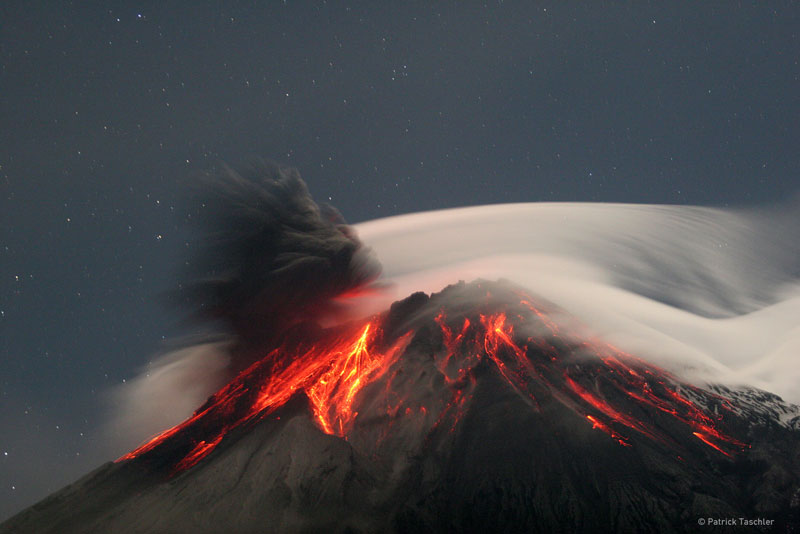
    Tungurahua Volcano, in 2006 eruption

    [Text from APOD website, edited]

    Tungurahua Erupts
    Credit & Copyright: Patrick Taschler
    Explanation:
    Volcano Tungurahua erupted spectacularly last year. Pictured above, molten rock so hot it glows visibly pours down the sides of the 5,000-meter high Tungurahua, while a cloud of dark ash is seen being ejected toward the left. Wispy white clouds flow around the lava-lit peak, while a star-lit sky shines in the distance. The above image was captured last year as ash fell around the adventurous photographer. Located in Ecuador, Tungurahua has become active roughly every 90 years since for the last 1,300 years. Volcano Tungurahua has started erupting again this year and continues erupting at a lower level even today.

    Tungurahua, Ecuador, c Patrick Taschler

    Click thumbnail for larger image

    More information:

    Tungurahua, Ecuador
    Location: 1.467 S, 78.44 W
    Elevation: 16,475 ft. (5023 m)

    Tungurahua is an active stratovolcano also known as the “The Black Giant.” It has a 600 ft. (183 m) wide crater. Most of the volcano is covered by snow. It causes many tremors in the nearby city of Banos. Tungurahua’s lava is mostly composed of basalts. Tungurahua has had at least seventeen eruptions in historical times, its most recent occurring in 1944 when it erupted explosively from its central crater. Located about 25 miles (~40 km) west of Tungurahua is the largest volcano in Equador, Chimborazo and to the north about 50 miles(~80 km ) is Cotopaxi volcano.

    APOD banner graphic


    Using snake oil to lubricate jaws

    September 15, 2007

    Oooh, I missed this one; Instapundit said:

    August 20, 2007

    SOME KIND WORDS FOR DDT — in the New York Times, no less. “Today, indoor DDT spraying to control malaria in Africa is supported by the World Health Organization; the Global Fund to Fight AIDS, Tuberculosis and Malaria; and the United States Agency for International Development. . . . Even those mosquitoes already resistant to poisoning by DDT are repelled by it.”

    The debate over DDT is over. There’s scientific consensus. Anyone who disagrees is a DDT denialist and a mouthpiece for Big Mosquito.

    The debate should be over.  There is scientific consensus that DDT is dangerous and the ban on broadcast use was wise, fair, and still necessary.  Reynolds is one of the denialist brigade who keeps trying to paint environmentalists wrong for working for the ban.

    Reynolds claim is deceptive in at least three ways:

    1. Omission, failing to note history:  Reynolds fails to note that without the ban on broadcast use of DDT (like crop spraying, or spraying of swamps and rivers), DDT would by now be completely ineffective against mosquitoes.  The ban on crop spraying (broadcast use) has been instrumental in preserving the effectiveness of DDT against malaria.  The debate is over, Reynolds lost, and its time he quit denying it (speaking of denialism).  The ban on DDT spraying in the U.S., following similar bans in Europe, and with similar following bans in other nations, has been a key factor in our current victories against malaria — a key factor for the anti-malaria forces.
    2. Omission, not understanding the science:  Reynolds may not know that DDT was cast against other  pesticides that are known to have very low repellent characteristics.  There are other, much more effective and less toxic, and less expensive, ways to repel mosquitoes.
    3. Failure to state the whole case:  Reynolds, the DDT-advocate in the New York Times,  and the study cited, fail to note that DDT is inadequate to more than a very short-term, partial campaign against malaria-carrying mosquitoes.  Other studies recently published note powerful, long-term reduction in malaria infections by use of mosquito netting; these declines do not require multiple, expensive and logistically difficult sprayings of poison in homes every year.  Perhaps more critically, research now shows that mosquito nets produce malaria reductions in the absence of DDT spraying, and the reductions stick; DDT spraying alone cannot produce either a long-term reduction in malaria (say, longer than a year), nor will the reductions stick, nor will the reductions be as great.  Nets work without DDT; DDT does not work without nets.

    Other than that, Reynolds is right:  The debate is over.  Reynolds’ “spray DDT on everything — it works better than snake-oil” argument lost.  It’s time Reynolds stops denying the facts.


    DDT as snake oil

    September 15, 2007

    “It’ll cure what ails ya!”

    emergency-dvd-cover-51cea8wqbkl_aa240_.jpg

    My first year in college, we spent Saturday nights watching “Emergency!” I don’t recall now whether it was on NBC or ABC, but after we saw it once, we were all hooked, Al, Ben and me.

    No, it wasn’t great drama. An hour-long drama about paramedics in Los Angeles probably has a lot of potential — this wasn’t that drama. Jack Webb, of “Dragnet” fame, directed. It had a cast amazing for its “how-did-HE- get-there” quality: Bobby Troup, the jazz pianist and composer of “Route 66″ (” . . . get your kicks on . . .”) played a doctor; his wife, jazz vocalist Julie London, played a nurse. Loved Julie London. Beautiful, but she had all the acting chops of David Janssen (“the man of a thousand faces” of “The Fugitive” fame). Martin Milner was there, too — he actually starred earlier in NBC’s “Route 66” which featured Corvettes, but not Bobby Troupe’s hit song (go figure) — and so was Kevin Tighe and Randolph Mantooth. And Robert Fuller, and Kent McCord. Whew!

    For undergraduate college students, the show was a riot. We noticed early on that the script writers were defibrillator happy. Every time the paramedic truck showed up, the first thing off was the defibrillator. Heart attacks seemed to be a big problem in LA at the time — maybe Jack Webb’s own mortality subconsciously sneaking into the scripts — so the defib unit got a lot of use.

    But it also came out at all the wrong times. Drowning victim? Defibrillator first, THEN artificial respiration. Poison victim? Defib. Auto accident? Defibrillate the victim, THEN worry about the spurting, arterial bleeding (if it’s spurting, is the defib necessary?). Classic kitten in the tree? Defib the tree, THAT will get that kitten down. Read the rest of this entry »


    Bring back the OTA!

    September 14, 2007

    Imagine the United States government had an agency that was staffed with experts who were respected by scientists and policy makers of all political stripes.

    Imagine this agency did studies on serious issues that would affect the nation in the future, and recommend policies that would allow our nation to take advantage of technology to promote human welfare and our economy, and that would allow our nation to resolve issues that threaten our health, domestic welfare and national security.

    Imagine that, because the agency had such strong support and credibility, policy makers would enact recommendations the agency made.

    Imagine!?! No, all you need to do is remember the Office of Technology Assessment (OTA), an arm of Congress that provided powerful information, insight and recommendations on technology policies for about two decades, from about 1974 to 1995.

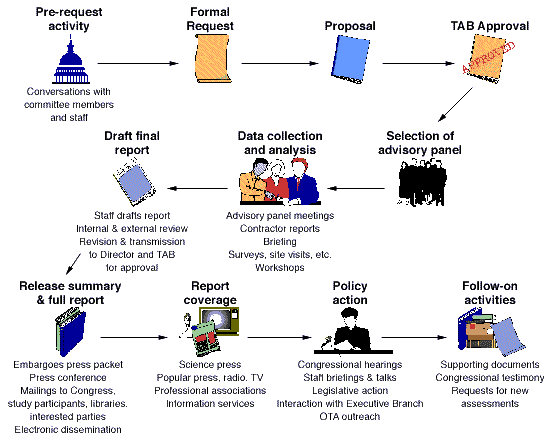
    OTA assessment steps Click on thumbnail for chart of the assessment process used by the Office of Technology Assessment to advise Congress on important technology issues.

    Now, think about how useful it would be to have such an agency back, to advise our nation on climate change, emergency preparedness, weapons of mass destruction in the post-Soviet era, malaria eradication policies, internet safety and security, and other key issues.

    It’s time to bring back the OTA.

    Mark Hoofnagle at the Denialism Blog started sounding the conch:

    The fact of the matter is that our government is currently operating without any real scientific analysis of policy. Any member can introduce whatever set of facts they want, by employing some crank think tank to cherry-pick the scientific literature to suit any ideological agenda. This is truly should be a non-partisan issue. Everybody should want the government to be operating from one set of facts, ideally facts investigated by an independent body within the congress that is fiercely non-partisan, to set the bounds of legitimate debate. Everybody should want policy and policy debates to be based upon sound scientific ground. Everybody should want evidence-based government.

    Go read what he said. Check in with P. Z. Myers’ view. See what John Wilkins says. Hoofnagle lists actions you can take, today, to get the ball rolling.

    In the meantime, wander over to the Princeton University site where the OTA’s reports are now archived (I understand the government was going to take it offline, sort of a latter-day burning of the library at Alexandria). Noodle around and look at the report titles. Notice that, though the agency was killed dead by 1995, the agency had reports on climate change. Notice that the agency was a decade or two ahead in urging policies to encourage the internet. Look at the other issues the agency dealt with, look at the legislation that resulted — and you’ll lament with me that we don’t have the agency around today, when the issues are tougher, the technology more difficult to understand, and politics more driven by rumor than fact.

    Killing the OTA was the Pearl Harbor of the present war on science. It’s time we started to fight back, to take back the scientific Pacific — our nation’s future is no less in peril now from the war on science, than it was then from hostile nations.

    Resources:


    Evolution avoidance syndrome

    September 9, 2007

    Scott Lanyon is director of the University of Minnesota’s Bell Museum of Natural History in Minneapolis. He writes regularly in the museum’s newsletter, Imprint. His latest column addresses the reluctance of scientists and teachers to use the word “evolution” even when their topic hits directly on it.

    Evolution Avoidance Syndrome
    By Scott Lanyon
    Summer 2007

    We have yet another invasive species in the Upper Midwest to worry about these days with the discovery of viral hemorrhagic septicemia virus (VHSv) in inland waters of Wisconsin. VHSv follows in the proud tradition of the zebra mussel, sea lamprey, a variety of carp species, Eurasian watermilfoil, purple loosestrife, curl-leaf pondweed, buckthorn, amur maple, a variety of thistle species, earthworms, gypsy moths, West Nile virus, soybean rust, and other pests that have been introduced to our region and that are causing great harm to our natural areas and our economy.

    Read the rest of this entry »