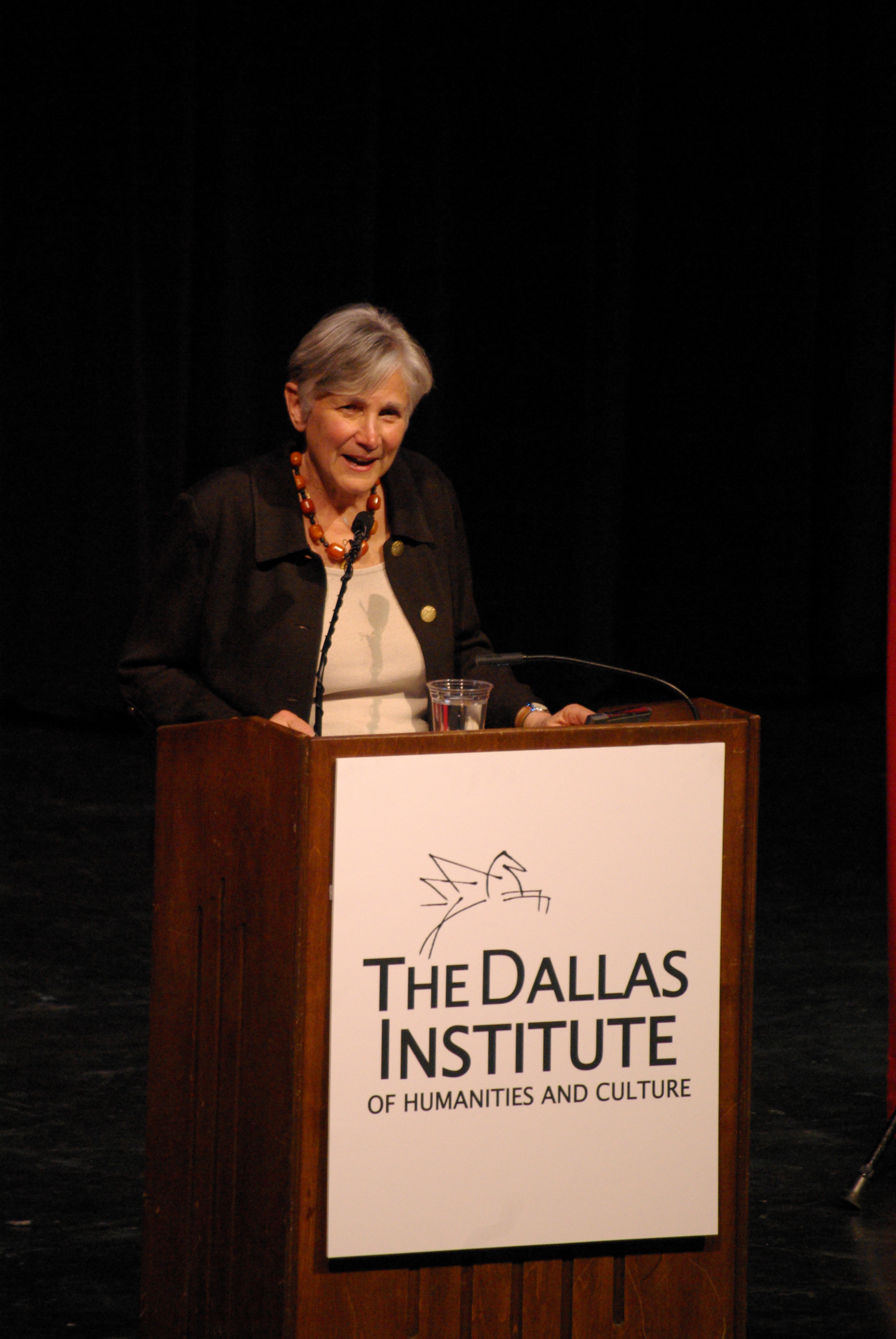
I first met Ravitch a couple of decades ago when I worked for Checker Finn at the Office of Educational Research and Improvement. Ted Bell’s idea of a commission to look at education quality, and it’s 1983 report, saved the Reagan administration and assured Reagan’s reelection in 1984. She was one of the most prodigious and serious thinkers behind education reform efforts, then a close friend of Finn (who was Assistant Secretary of Education for Research) — a position that Ravitch herself held in the administration of George H. W. Bush.
Ravitch now criticizes the end result of all that turmoil and hard work, the No Child Left Behind Act, and the way it has distorted education to keep us in the crisis we were warned of in 1983. Then, the “rising tide of mediocrity” came in part because we didn’t have a good way to compare student achievement, state to state. Today, the mediocrity is driven by the tests that resulted from legislative efforts to solve the problem.
Conditions in education in America have changed. We still have a crisis after 27 years of education reform (how long do we have a crisis before it becomes the norm), but for the first time, Ravitch said, “There is a real question about whether public education will survive.” The past consensus on the value of public education and need for public schools, as I would put it, now is challenged by people who want to kill it.
“The new issue today: Will we have a public education system bound by law to accept all children.”
Ironic, no? The No Child Left Behind Act has instead created a system where many children could be forced to the rear.
I took an evening in the middle of a week of TAKS testing — the Texas Assessment of Knowledge and Skills. With ninth through twelfth grades, we had four days of testing which essentially requires the shutdown of the education for the week (we had Monday to review for the test). It was a week to reflect on just how far we have strayed from the good intentions of public education advocates who pushed the Excellence in Education Commission’s report in 1983.
Ravitch spoke for over an hour. I’ll have more to report as I get caught up, after a month of meetings, test prep, testing, and little sleep.
If you’re teaching world history, or art, or government, or environmental science, or geography, this might be a great blog to track.
Senegal is a very interesting place. Note on the map how it completely surrounds its neighbor nation of The Gambia.
Senegal, map courtesy of the U.S. Federal Aviation Administration (FAA)
France held the nation as a colony once upon a time, from 1850 to independence of the Mali Federation in 1960 — one of the national languages is French, but regional languages are numerous, Wolof, Soninke, Seereer-Siin, Fula, Maninka, and Diola. The Mali Federation was short-lived, and Senegal broke off in August of 1960.
If you listen to NPR, you’ve probably heard their reporter signing off in that distinct way she does, “Tthis is Ofeibea Quist-Arcton, for NPR, in Dah-KAHHH!” (Not to be confused with Dacca, Pakistan).
The French colonies of Senegal and the French Sudan were merged in 1959 and granted their independence as the Mali Federation in 1960. The union broke up after only a few months. Senegal joined with The Gambia to form the nominal confederation of Senegambia in 1982, but the envisaged integration of the two countries was never carried out, and the union was dissolved in 1989. The Movement of Democratic Forces in the Casamance (MFDC) has led a low-level separatist insurgency in southern Senegal since the 1980s, and several peace deals have failed to resolve the conflict. Nevertheless, Senegal remains one of the most stable democracies in Africa. Senegal was ruled by a Socialist Party for 40 years until current President Abdoulaye WADE was elected in 2000. He was reelected in February 2007, but has amended Senegal’s constitution over a dozen times to increase executive power and weaken the opposition, part of the President’s increasingly autocratic governing style. Senegal has a long history of participating in international peacekeeping and regional mediation.
The country is tropical, hot and humid. Geographically, it is low, rolling plains.
Dakar is about as far west as one can go on the African continent. (See the map inset — Senegal is in dark green).
Senegal has iron ores, and phosphorus (ancient bird droppings?). It’s not a rich nation, but it’s better off than many developing countries.
Adkins is in for a great adventure, no?
Africa, showing Senegal - CIA Factbook
Spread the word; friends don't allow friends to repeat history.
I am forever grateful for that nameless White female, who, in her clunky shoes and calf-length tweed skirts, passed out poems on mimeograph paper to her first-grade students. When talking to students myself, I often tell the story of the very prim and ebony Mrs. Covington who challenged her junior high school English class to memorize “Invictus” before telling us who had authored the poem.
Words to teach by. “Invictus?” You know it, even if you don’t think you do.
Out of the night that covers me,
Black as the pit from pole to pole,
I thank whatever gods may be
For my unconquerable soul.
In the fell clutch of circumstance
I have not winced nor cried aloud.
Under the bludgeonings of chance
My head is bloody, but unbowed.
Beyond this place of wrath and tears
Looms but the Horror of the shade,
And yet the menace of the years
Finds and shall find me unafraid.
It matters not how strait the gate,
How charged with punishments the scroll,
I am the master of my fate:
I am the captain of my soul.
At the age of 12, Henley became a victim of tuberculosis of the bone. A few years later, the disease progressed to his foot, and physicians announced that the only way to save his life was to amputate directly below the knee. It was amputated at the age of 25. In 1867, he successfully passed the Oxford local examination as a senior student. In 1875, he wrote the “Invictus” poem from a hospital bed. Despite his disability, he survived with one foot intact and led an active life until his death at the age of 53.
Tomorrow, April 14, Mission Specialists Dottie Metcalf-Lindenburger is scheduled to talk with students at Eastern Guilford High School in North Carolina, and all of the 71,000 students in Eastern Guilford School District.
Caption from NASA: STS-131 Mission Specialist Dorothy Metcalf-Lindenburger, attired in a training version of her shuttle launch and entry suit, poses for a photo prior to the start of an ingress/egress training session in the Space Vehicle Mock-up Facility at NASA's Johnson Space Center. Photo Credit: NASA
Metcalf-Lindenburger is one of three teachers selected in 2004 as astronauts. NASA is committed to help education out. After the Challenger disaster, and the death of “teacher in space” Christa McAuliffe, NASA finally determined to make teachers into astronauts rather than fly “civilians.”
Haley Miller
Guilford Public Schools, Guilford, N.C.
336-370-3200 millerh3@gcsnc.com
April 12, 2010
MEDIA ADVISORY : M10-048
Orbiting Space Shuttle Astronauts — Including Former Teacher — Call North Carolina Students
WASHINGTON — Astronauts orbiting 220 miles above Earth will speak with students in Gibsonville, N.C., on Wednesday, April 14. The call with the students and space shuttle Commander Alan Poindexter and Mission Specialists Dottie Metcalf-Lindenburger, Stephanie Wilson and Clay Anderson will take place at 1:06 p.m. EDT at Eastern Guilford High School in Gibsonville.
Eastern Guilford High School is hosting students from Eastern Guilford Middle School, Gibsonville Elementary, McLeansville Elementary, Rankin Elementary and Sedalia Elementary for the downlink. The school also will broadcast the event to the entire Guilford County Schools district, which serves more than 71,000 students.
The astronauts launched Monday, April 5, aboard space shuttle Discovery from NASA’s Kennedy Space Center in Florida. During the 13-day mission to the International Space Station, the crew will deliver science experiments and supplies; take three spacewalks to switch out a gyroscope on the station’s truss, or backbone; install a spare ammonia storage tank and return a used one; and retrieve a Japanese experiment from the station’s exterior.
Metcalf-Lindenburger is one of three teachers selected to fly as shuttle mission specialists in the 2004 Educator Astronaut Class. She operates the shuttle’s robotic arm. Without robotics, major accomplishments like building the station, repairing satellites in space and exploring other worlds would not be possible.
Students have been preparing for the downlink by conducting NASA engineering design challenges and implementing agency robotics resources and activities into K-12 classrooms. A science, technology, engineering and math, or STEM, club was organized to increase participation and interest, particularly by female students.
The school’s guidance department also is collaborating with local universities to help students investigate and explore STEM opportunities beyond graduation. During follow up in-district workshops in April and May, a NASA Aerospace Education Services Program specialist will demonstrate how to access and use NASA resources in K-12 curricula.
Eastern Guilford High School employee Michael Woods, a former Aerospace Education Services Project specialist at NASA’s Goddard Space Flight Center in Greenbelt, Md., and the agency’s Langley Research Center in Hampton, Va., is leading the downlink effort. In December 2009, NASA awarded Guilford County Schools a two-year grant of nearly $1 million to help middle and high school teachers develop science lessons using the space agency’s content.
The event is part of a series with educational organizations in the U.S. and abroad to improve teaching and learning in science, technology, engineering and mathematics. The in-orbit call is part of Teaching From Space, a NASA project that uses the unique environment of human spaceflight to promote learning opportunities and build partnerships with the kindergarten through 12th grade education community.
NASA Television will air video of the astronauts during the downlink. For NASA TV downlink, schedule and streaming video information, visit:
Here’s another opportunity to put real, cutting edge technology in your classroom. In fact, your kids could probably invent all sorts of new uses for it.
Have you even heard of this stuff? Can you use it, live, with the equipment you’ve got?
Blaise Aguera y Arcas of MicroSoft demonstrated augmented-reality maps using the power of Bing maps, Flickr, Worldwide Telescope, Video overlays and Photosynth, to an appreciative and wowed audience at TEDS:
My prediction: One more advance in computer technology that classrooms will not see in a timely or useful manner.
But have you figured out how to use this stuff in your geography, history, economics or government classes? Please tell us about it in comments. Give examples and links, please.
Were I to advise Diane Ravitch right now, I’d tell her to change all her computer passwords and redouble the security on her servers. Why? After what happened to the scientists who study global warming, I expect many of the same wackoes are working right now to get her e-mails, knowing that the mere act of stealing them will be enough to indict her change of heart on education in America.
It’s much the same mob crowd in both cases. [I’m hopeful it’s not a mob.]
Dr. Ravitch thinks big thoughts about education. She stands in the vanguard of those people who are both academically astute in education, and who can make a case that appeals to policy makers. Working under Checker Finn at the old Office of Educational Research and Improvement, we quickly got familiar with Ravitch’s works and views. Finn and Ravitch, good friends and like-minded in education issues, were the running backs and sticky-handed receivers for any conservative education quarterback, back in the Day.
Finn was Assistant Secretary of Education for Research under Bill Bennett. Ravitch succeeded Finn, under Lamar Alexander. While Bennett and Alexander took troubling turns to the right, and Finn stayed much where he was, Ravitch has been looking hard at what’s working in schools today.
Once outspoken about the power of standardized testing, charter schools and free markets to improve schools, Dr. Ravitch is now caustically critical. She underwent an intellectual crisis, she says, discovering that these strategies, which she now calls faddish trends, were undermining public education. She resigned last year from the boards of two conservative research groups.
“School reform today is like a freight train, and I’m out on the tracks saying, ‘You’re going the wrong way!’ ” Dr. Ravitch said in an interview.
This is big stuff, and good news to teachers who, since I was at Education in 1987, have been telling policy makers the same things Ravitch is saying now.
David Gardner and Milton Goldberg wrote in the report of the Excellence in Education Commission in 1983 that America faces a “rising tide of mediocrity” because of bad decisions. That’s true of much education reform today, too.
Gardner and Goldberg also said that, had a foreign nation done that damage to us, we’d regard it as an act of war.
Maybe Ravitch’s turn can help mediate an end to the Right’s War on Education and pogroms against teachers.
Here in Texas the conservatives on the Texas State Board of Education didn’t like Ravitch’s views when she was in the conservative camp, so Texas has started, finally, to vote out commissioners who don’t get it, who prefer a state of war on Texas’s children to promoting public education
But on this chilly morning, as bus No. 92 rolls down a mountain highway just before dawn, high school students are quiet, typing on laptops.
Morning routines have been like this since the fall, when school officials mounted a mobile Internet router to bus No. 92’s sheet-metal frame, enabling students to surf the Web. The students call it the Internet Bus, and what began as a high-tech experiment has had an old-fashioned — and unexpected — result. Wi-Fi access has transformed what was often a boisterous bus ride into a rolling study hall, and behavioral problems have virtually disappeared.
What would your bus drivers say?
(File under “If you teach them, they will learn — and behavior problems will fade away.”)
Don’t miss the end of the article:
A ride through mountains on a drizzly afternoon can be unpredictable, even on the Internet Bus. Through the windows on the left, inky clouds suddenly parted above a ridge, revealing an arc of incandescent color.
“Dude, there’s a rainbow!” shouted Morghan Sonderer, a ninth grader.
A dozen students looked up from their laptops and cellphones, abandoning technology to stare in wonder at the eastern sky.
“It’s following us!” Morghan exclaimed.
“We’re being stalked by a rainbow!” Jerod said.
More:
These students attend Empire High School in Vail, Arizona, near Tucson. It’s a digital high school, in a district that appears to me to be well above average in family income and technology smarts among parents who vote for school board members — maybe in school board members, too. The article says, “The Vail District, with 18 schools and 10,000 students, is sprawled across 425 square miles of subdivision, mesquite and mountain ridges southeast of Tucson. Many parents work at local Raytheon and I.B.M. plants. Others are ranchers.”
Empire high has a self-directed learner model — looks good online, and judging from the news article, it looks good in practice. These aren’t my students, maybe not your students, either.
Angst over the state of education never goes away:
Much more important is the way we seem to have turned away from the very idea of education that sustains a healthy, vibrant liberal democracy. As I write this I am conscious of how unfashionable it sounds. However, there has been a steady erosion of the notion that education can and should fuel our individual ability to think critically about the world as we find it – which requires knowledge and understanding of how the world has come to be. We are swamped with a language of targets, skills and 21st century ‘learning to learn’, but have forgotten what it is that distinguishes learning (a word that now seems to carry huge weight and always deemed a good thing in itself, when clearly it is not) from education. All worthwhile education is, in the end self-education, based on the student’s curiosity, their need to know and readiness to rise to the challenge of finding out. Indeed, offering challenge to young people is one way to motivate them – so different from today’s orthodoxy which says we should make learning accessible, bite-sized and achievable by all.
They aim to “change the perception of recess from free time away from learning to a valuable learning experience that will teach them and will help them cope in all social settings and environments. When children view recess as “free time” they have a tendency to act in a less responsible manner and push the limits of irresponsible behavior. In order to change the perception of recess, children must see that its content is respected and valued.”
The absolute best memories I have of my childhood consisted of me and my sister on the loose in our backyard making mud pies and playing “lost kids”. When I was in college studying early childhood education, I spent countless hours in classrooms learning about how kids learn. Kids learn through play. They just need the resources. The tools. And time.
Well, yeah, that’s what recess is all about, isn’t it?
Kids need recess to stay healthy, the studies show. Recess keeps them healthy. In my corporate consulting, we counseled managers to provide recess. Creativity and corporate problem solving experts, like Dr. Perry W. Buffington, recommend business people take a recess and get away from work for a while when things get tense, or when problem solvers get dense. In one session I watched with Buffington, one manager didn’t get it and kept coming up with all sorts of things to do to avoid taking a recess. Buffington finally spelled it out for him: Get away from the office; make sure that the activity is AWAY from the building . . .
Heck, do they have an “organizational health” survey at that school? The teachers need recess for the kids, too.
PEDIATRICS Vol. 123 No. 2 February 2009, pp. 431-436 (doi:10.1542/peds.2007-2825) (subscription required for full text), “School Recess and Group Classroom Behavior,” Romina M. Barros, MD, Ellen J. Silver, PhD and Ruth E. K. Stein, MD, Department of Pediatrics, Albert Einstein College of Medicine, Children’s Hospital at Montefiore and Rose F. Kennedy Center, Bronx, New York
OBJECTIVES. This study examines the amount of recess that children8 to 9 years of age receive in the United States and comparesthe group classroom behavior of children receiving daily recesswith that of children not receiving daily recess.
It’s a pretty good rundown of the fight between Keynes and Hayek, conducted mostly after Keynes’ death in economics classrooms and central banks world wide.
And that got me thinking: What if Edith Wharton had Facebooked? Had she lived in our time and communicated digitally, I wonder what her literature would be like. Looking at five days of cursive writing and personal letters made me realize that her compulsion to jot down her thoughts was no different than ours today when we tweet about what we had for lunch or share some fab link we just discovered. The difference between a letter written longhand and a Facebook post is that one takes a little bit longer (and leaves a more lasting trace), but the purpose is the same. Whether we live on a grand, Whartonian scale or a quieter, more ordinary one, we feel more significant when we share intimacies about ourselves with others.
There’s a good warm-up and/or journaling exercise in there for literature teachers.
Spread the word; friends don't allow friends to repeat history.
Neil Shubin’s Your Inner Fish reads well, and it reveals evolution as easy to understand from a morphological view of life as revealed by fossils and modern animals.
Shubin released the illustrations from the book for teachers to use — a rather rare and great contribution to evolution.
Or, until that account is unsuspended by the forces supporting Donald Trump: Follow @FillmoreWhite, the account of the Millard Fillmore White House Library
We've been soaking in the Bathtub for several months, long enough that some of the links we've used have gone to the Great Internet in the Sky.
If you find a dead link, please leave a comment to that post, and tell us what link has expired.
Thanks!
Retired teacher of law, economics, history, AP government, psychology and science. Former speechwriter, press guy and legislative aide in U.S. Senate. Former Department of Education. Former airline real estate, telecom towers, Big 6 (that old!) consultant. Lab and field research in air pollution control.
My blog, Millard Fillmore's Bathtub, is a continuing experiment to test how to use blogs to improve and speed up learning processes for students, perhaps by making some of the courses actually interesting. It is a blog for teachers, to see if we can use blogs. It is for people interested in social studies and social studies education, to see if we can learn to get it right. It's a blog for science fans, to promote good science and good science policy. It's a blog for people interested in good government and how to achieve it.
BS in Mass Communication, University of Utah
Graduate study in Rhetoric and Speech Communication, University of Arizona
JD from the National Law Center, George Washington University


 Posted by Ed Darrell





 Millard Fillmore's Bathtub