Technology that doesn’t work – yet, or well

September 20, 2008

Episode One:  Finding a Toyota Dealer with misdirection from Verizon Wireless

We dropped the rental car off at O’Hare, and immediately I noticed the blower in our Toyota Camry wasn’t performing (2002, 128,000 miles, thank you).  We tried to live with it, but as the coolness of Wisconsin gave way to 80 degrees in Chicago, we thought we’d better get it fixed.

I’ve been faithful to Verizon Wireless, hoping to boost their stock and hoping that will benefit me as a former employee (but nothing yet).  I called their 411 service to find a Toyota dealer in Bloomington, Illinois, so we could get a quick check up on the blower motor, or whatever.  I should have been alert when the area code they gave me was 708, but I didn’t catch it.  The dealer was on Joliet Road.  I called them for directions, and they seemed perplexed, but gave me directions.  We steamed to Bloomington.  Literally.

Our atlas maps didn’t show Joliet Road in Bloomington.  We called for further directions, exit number, and landmarks.  When we entered the Bloomington area, we just couldn’t find it.

Did you know you can drive from Texas to Milwaukee and eat at Panera Bread outlets almost the entire distance on I-35?  We got lunch at Panera, gassed up the car, and then I had a fascinating conversation with a woman at the BP station, trying to get directions to Joliet Road.  She said she’d never heard of it.  We checked the maps.  No luck.  No listing in the index.  Then I had the good sense to ask what the area code of Bloomington is – it’s not 708.

Armed with the new information, we found Dennison Toyota in Bloomington (great place – see forthcoming post).  Joliet Road is near Chicago.  The dealer Verizon Wireless linked us to was miles behind us.

Technology 0, Humans 1.

Episode 2:  Walgreen’s automated prescription service

Kathryn came down with a doozy of the cold while fighting the remnants of Tropical Depression Ike, and when I spoke with her on Tuesday, she sounded nearly dead.  I feared sinus infection, but she refused to treat it like that.  So I flew up to help her drive back on time.

Wednesday afternoon, I started to get symptoms of a cold.  Since my sinus misfortunes while flying with American Airlines in a past life, most of the the time when I get a cold, I get a roaring sinus infection.  I call the physician with symptoms, he prescribes antibiotics.  Only once in the past ten years have we disagreed.

By Friday morning it was clear my work to keep the cold from becoming an infection had failed (I’ll spare you the specific clinical description).  From Wisconsin, I checked with my local Walgreen’s in Texas about picking up a prescription on the road.  Then I called the physician.  It was 1:00 p.m. before we got all the ducks lined up, and Springfield, Illinois, was the next major city.  I had to rely on Verizon Wireless again, but they at least got me to a Walgreen’s.

Walgreen’s’* people were most helpful.  I took the first available listing.  That store referred me to one just off the freeway.  Alas, my prescription had not yet shown up on the computer.  We had almost two hours to Springfield . . .

I confirmed the physician had phoned in the prescrip.  Then I checked with my local drugstore.  It didn’t show on their system.  We passed Springfield, Illinois, and focused on St. Louis.  Again, Walgreen’s’ people came through.  But the prescrip still didn’t show on the national computerized system.

One more check with the local, Texas pharmacy, and the technician let slip the problem:  While prescriptions are phoned in all day, the pharmacist doesn’t take them off the answering machine until the shift ends at 5:00 p.m.  Nothing would happen, technologically, until the humans intervened.

Walgreen’s found an outlet on the south and west side of St. Louis that would allow time for the prescription to show up in the system, and it was right off the freeway.  We got the prescription.  I’m on the mend.

Technology 1, Humans 2 more.

Final Score:  Technology 1, Humans 3.

*  What the heck is the possessive form of “Walgreen’s?”


Just when you thought it was safe to go back into technology

September 18, 2008

Hewlett-Packard announced plans to cut thousands of jobs from tech consulting giant EDS, in Plano, Texas.

About 25,000 people will lose jobs in the next 36 months under plans from HP.


From the technology labs of John McCain

September 17, 2008

Al Gore bravely fought to save ARPANET, the precursor to the internet, and for his efforts got a campaign to turn his good work into a joke by Karl Rove and Bush campaign, in 2000.

John McCain’s tech guy claims McCain had role in inventing the Blackberry.

Obama laughed it off.

There’s a difference between Democrats and Republicans.  Have you noticed?


Why science matters in the campaign

September 7, 2008

Dr. Art Hunt at The RNA Underworld explains why Obama’s plan to double NIH research funding is a good idea.

Big bang for the buck:  Hunt’s analysis suggests doubling the research budgets might drive as much as a trillion dollar increase in our economy. Sure it’s optimistic — but read what he says.  And then consider:  Which platform offers the greatest hope of cures or treatments for cancers?  Which platform offers the best hope for a cure or treatments for Alzheimer’s disease?

The two industries I mention here – pharma and biotech – are intimately interwoven with the basic biomedical research enterprise, and a significant amount of the innovation that drives these industries originates (or originated) in the NIH-funded biomedical research laboratory. In this respect, the NIH budget is an investment, and a wildly-successful one. Even if we don’t take the face-value numbers I have pulled from Wiki here (that show an annual return of some 1000%, and more than 750,000 high-paying jobs the tax receipts from which would probably pay much of the NIH tab by themselves), and instead factor in that some of these receipts and jobs are not American, it is still easy to see that basic biomedical research returns considerably more than the investment made by the government. (And this doesn’t begin to weigh the intangibles, the ways that the research enterprise gives back to society as a whole.)

Science bloggers have been not so noisy as this issue might need:  The closest John McCain came to supporting science, the driver of our economy, was when he offered to assault education, and that’s the opposite of supporting science. Obama’s mentions are encouraging, but not frequent enough nor strident enough.

Think of just three of the issues that are affected by basic science research, that will be yelled about during the campaign:

The silence on science should make us very, very concerned.

Have you read Obama’s response to the 14 big questions on science policy?  McCain has not answered.

Other reading:


Rapping physics in the Bathtub

September 3, 2008

Now it’s gone big time, with NPR’s Morning Edition and Pharyngula on the bandwagon, remember you saw the Large Hadron Collider Rap second here at Millard Fillmore’s Bathtub.

You saw it first at Tommaso Dorigo’s A Quantum Diaries Survivor.

Geography teachers, have you figured out how to use this in your classrooms yet?

Related NPR stories:


“Big LASERS are cool”

September 3, 2008

Scientists at the University of Texas at Austin showed off their petawatt LASER last week (alas, couldn’t make the open house myself).

LASER project manager Todd Ditmire summed it up:  “Big LASERs are cool.”

The $15 million laser creates a beam that is brighter than the surface of the sun. The pulses of light can reach 1 quadrillion watts (a petawatt) but last just one-tenth of a trillionth of a second.

Scientists such as Todd Ditmire, a UT physics researcher, will use the laser to heat substances to incredibly high temperatures for incredibly short periods of time, approximating the conditions at the center of a star. It’s also expected to help the U.S. Department of Energy in its ambitious research effort to create a laser-based controlled fusion energy source, which might one day be the ultimate clean energy source for the country.

With such pride showing, it might be a good time to note that this project is the result of pure science research funding with federal assistance.  If we could have a science debate among presidential candidates, the Texas Petawatt LASER should be front and center evidence for the value and fun of expanding federal support for science.  Texas’s U.S. Sen. Kay Bailey Hutchison participated in the dedication ceremony.  Maybe she noticed.

Congratulations, UT.  Don’t point that thing this way!

Read about it here:


Honor working Americans, fly your flag today

September 1, 2008

Labor Day, 2008 — in addition to honoring America’s working people, especially unionized working people, Labor Day is the traditional start of the presidential campaign in presidential election years.

What if we applied the false start rules the Olympics uses to presidential campaigns?

Fly your U.S. flag today. This is one of the dates designated in law as a permanent date for flag flying.

Miners and their children celebrate Labor Day, Littleton, Colorado, 1940 - Library of Congress

Miners and their children celebrate Labor Day, Littleton, Colorado, 1940 - Library of Congress

Here are some past posts on labor, and Labor Day:

History-minded people may want to look at the history of the holiday, such as the history told at the Department of Labor’s website.

The First Labor Day

The first Labor Day holiday was celebrated on Tuesday, September 5, 1882, in New York City, in accordance with the plans of the Central Labor Union. The Central Labor Union held its second Labor Day holiday just a year later, on September 5, 1883.

In 1884 the first Monday in September was selected as the holiday, as originally proposed, and the Central Labor Union urged similar organizations in other cities to follow the example of New York and celebrate a “workingmen’s holiday” on that date. The idea spread with the growth of labor organizations, and in 1885 Labor Day was celebrated in many industrial centers of the country.

Or this history at the more academic Library of Congress site:

On September 5, 1882, some 10,000 workers assembled in New York City to participate in America’s first Labor Day parade. After marching from City Hall to Union Square, the workers and their families gathered in Reservoir Park for a picnic, concert, and speeches. This first Labor Day celebration was initiated by Peter J. McGuire, a carpenter and labor union leader who a year earlier cofounded the Federation of Organized Trades and Labor Unions, a precursor of the American Federation of Labor.

McGuire had proposed his idea for a holiday honoring American workers at a labor meeting in early 1882. New York’s Central Labor Union quickly approved his proposal and began planning events for the second Tuesday in September. McGuire had suggested a September date in order to provide a break during the long stretch between Independence Day and Thanksgiving. While the first Labor Day was held on a Tuesday, the holiday was soon moved to the first Monday in September, the date we continue to honor.

American Memories at the Library of Congress has several photos of Labor Day celebrations in Colorado, in the mining country.

What do the unions say?  Among other parts of history, the AFL-CIO site has a biography of Walter Reuther, the legendary organizer of automobile factory workersSeptember 1 is the anniversary of Reuther’s birthday (he died in an airplane crash on the way to a union training site, May 10, 1970).

We’re off to a barbecue-style picnic at the in-laws.  Kenny is down from the University of Texas at Dallas, James still hasn’t begun classes at Lawrence University (which is too far to come from for dinner, anyway).  Family usually gets precedence in this house, so we miss the IBEW, UAW, and other union picnics we get invited to here.

We’re glad to have the day off.  Working people made this nation, and this world, what it is today.  We should honor them every day — take a few minutes today, give honor to workers.  Tomorrow, it’s back to work.

Resources:


Obama hoaxers crawl out of the woodwork, onto the internet

August 31, 2008


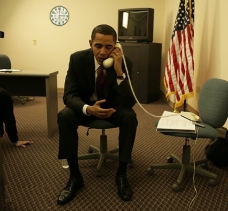
Dennis at Thinking in a Marrow Bone — not an Obama supporter, mind you — posted a conversation he had with a guy who posted a hoaxed photo of Barack Obama, purporting to show him holding a landline telephone upside down.

This is the hoax photo

Dennis called him on the hoax.  After a few rounds of weak defense, and then moral waffling of significant proportion, the hoaxer deleted the comments from his blog.  Dennis preserved the conversation at TMB.

Moral of the story:  Don’t believe much of what you hear or see, without corroboration.  If a claim casts aspersions on someone, and comes on the internet, check it out before granting credence. Thanks to Dennis, an honest guy, for exposing the hoax and preserving the record of it.

Hoaxers are malicious and will do almost anything to damage Obama, even if it requires bringing down the U.S. and burning the flag.  No wonder George Washington wanted out of this sort of politics.

Question:  What’s the deal with the clock in the doctored photo?  [Oh – it says “3:00 o’clock”]

Honor roll:  Bloggers and others who exposed the hoax:

Dishonor roll, the Little List, bloggers who tried to perpetrate and perpetuate the hoax, or who got suckered themselves:

Special Consideration:


Trivia and waste of bandwidth – until it saves your kid’s life

August 31, 2008

Trivial information and internet communication make for bandwidth-wasting and brain-numbing exchanges — friendly, maybe, but your spouse will consider filing papers.

Until it saves your kid’s life with a dramatic diagnosis of a deadly disease across an ocean.

Look at the BBC report on the toddler in Florida whose life was saved by a transatlantic, e-mail suggested diagnosis.  Print story from BBC, here.

A toddler in Florida has been diagnosed with cancer after a Manchester woman saw early warning signs in a picture.

Madeleine Robb, from Stretford, who has never met her pen pal, spotted a shadow behind one of Rowan Santos’s eyes on pictures from her first birthday.

She then e-mailed her mother Megan advising her to get medical help.

The toddler was diagnosed with an aggressive form of cancer – Retinoblastoma – and underwent an operation and is having chemotherapy.

The two mothers became friends on an internet messageboard after their children were born on the same day.

But when Mrs Robb saw the pictures she said she knew something was not right.

Tip of the old scrub brush to Moments in Time.

[FireFox 3 doesn’t support the old video capture of VodPod; my apologies for sending you to the video, though sending someone to a BBC site is probably a great act of education.]


Typewriter of the moment: Will Rogers

August 25, 2008

Will Rogers and his typewriter, WillRogers.com

Will Rogers and his Remington typewriter, Will Rogers Memorial Museums, Claremore-Oolagah, Oklahoma

Caption from the Will Rogers Museums:

Daily writing
It didn’t matter where Will Rogers was when it was time to type his daily telegram. He just pulled out his trusty typewriter — in the car, on the movie set or in his home office overlooking the mountains of his Santa Monica ranch.

Rogers’ newspaper columns were carried by newspapers across America — 500 of them. His influence as an observer of the American condition was wide and deep.

See also this previous post about Will Rogers, for more resources.


And now, the Nigerian scam investigation scam

August 22, 2008

A few months ago I posted about a guy who issued a spectacular reply to someone trying the old Nigerian scam on him.

Yesterday that post got this comment:

Levy Says:
August 22, 2008 at 1:56 am edit

I have found good service for check nigerian. It’s
http://www.nigerianscamcheck.com

Go check that site out. If it’s not a scam itself, it should be.  Just what you were looking for, a “good service for check nigerian.”

Especially note the certificate from the “Global School of Detectives,” the membership in “World Association of Detectives” (yes: W.A.D.), and the certificate from the California Board of Collections and Investigatives Services (P.I.s in California now are licensed by the much newer Bureau of Security and Investigative Services). (See the images of the certificates below.)

If you ever post again, Levy, I swear I’ll send your name and address to both the Latter-day Saints and Jehovah’s Witnesses.


Beloit College Mindset list: No caller ID? No GPS?

August 19, 2008

Beloit College’s Mindset list is an annual event, now. The college puts together a list of things entering college freshman have never done without, trying to help faculty understand what freshman are thinking, and not thinking.

This year’s list, for the entering class of 2012, holds a few jolts for anyone over the age of 30. One last minute change was required, however, when Bret Favre left the Green Bay Packers for the New York Jets.

Here’s the list, and it continues below the fold:

Students entering college for the first time this fall were generally born in 1990.

  1. For these students, Sammy Davis Jr., Jim Henson, Ryan White, Stevie Ray Vaughan and Freddy Krueger have always been dead.
  2. Harry Potter could be a classmate, playing on their Quidditch team.
  3. Since they were in diapers, karaoke machines have been annoying people at parties.
  4. They have always been looking for Carmen Sandiego.
  5. GPS satellite navigation systems have always been available.
  6. Coke and Pepsi have always used recycled plastic bottles.
  7. Shampoo and conditioner have always been available in the same bottle.
  8. Gas stations have never fixed flats, but most serve cappuccino.
  9. Their parents may have dropped them in shock when they heard George Bush announce “tax revenue increases.”
  10. Electronic filing of tax returns has always been an option.
  11. Girls in head scarves have always been part of the school fashion scene.
  12. All have had a relative — or known about a friend’s relative — who died comfortably at home with Hospice.
  13. As a precursor to “whatever,” they have recognized that some people “just don’t get it.”
  14. Universal Studios has always offered an alternative to Mickey in Orlando.
  15. Grandma has always had wheels on her walker.
  16. Martha Stewart Living has always been setting the style.
  17. Haagen-Dazs ice cream has always come in quarts.
  18. Club Med resorts have always been places to take the whole family.
  19. WWW has never stood for World Wide Wrestling.
  20. Films have never been X rated, only NC-17.
  21. The Warsaw Pact is as hazy for them as the League of Nations was for their parents. Read the rest of this entry »

Highest powered LASER in the world – in Texas, naturally

August 15, 2008

Longhorns must be proud. This is really cool science.

The University of Texas is hosting an open house for the Petawatt Laser. The Petawatt Laser is the most powerful laser in the world, creating “power output of more than 2,000 times the output of all power plants in the United States. (A petawatt is one quadrillion watts.)” The open house is August 28. (No, I didn’t get an invitation; Meg Gardiner’s husband got one.)

The laser is brighter than sunlight on the surface of the sun, but it only lasts for an instant, a 10th of a trillionth of a second (0.0000000000001 second).

Not me teach - I didnt shine that laser on your whiteboard.  (Seriously - Dr. Todd Whitmire, University of Texas, operator of the Petawatt Laser)

'Not me teach - I didn't shine that laser on your whiteboard.' (Seriously - Dr. Todd Ditmire, University of Texas, operator of the Petawatt Laser)

The laser reached greater than one petawatt of output in a test run March 31, 2008, at the University of Texas’s Texas Center for High Intensity Laser Science. The instrument will be used to create and study in extreme conditions, “including gases at temperatures greater than those in the sun and solids at pressures of many billions of atmospheres.”

This will allow them to explore many astronomical phenomena in miniature. They will create mini-supernovas, tabletop stars and very high-density plasmas that mimic exotic stellar objects known as brown dwarfs.

“We can learn about these large astronomical objects from tiny reactions in the lab because of the similarity of the mathematical equations that describe the events,” said Ditmire, director of the center.

Such a powerful laser will also allow them to study advanced ideas for creating energy by controlled fusion.

The Texas Petawatt was built with funding provided by the National Nuclear Security Administration, an agency within the U. S. Department of Energy.

Millard Fillmore’s Bathtub could use a petawatt laser, to keep the water in the tub warm, don’t you think?

Tip of the old scrub brush to Lying for a Living.

Resources (just for the sake of listing “ultrafast science”):

Bonus: Flag etiquette violation, below the fold.

Read the rest of this entry »


Will Rogers and Wiley Post crash in Alaska, 1935

August 15, 2008

Will Rogers, images from Will Rogers Museums, Oklahoma

Will Rogers, images from Will Rogers Museums, Oklahoma

After Mark Twain died, America found another great humorist, raconteur, story-teller, who tickled the nation’s funny-bone and pricked the collective social conscience at the same time. Will Rogers is most famous today for his sentiment that he never met a man he didn’t like. In 1935, he was at the height of his popularity, still performing as a lariat-twirling, Vaudeville comedian who communed with presidents, and kept his common sense. He wrote a daily newspaper column that was carried in 500 newspapers across America.  Rogers was so popular that Texas and Oklahoma have dueled over who gets the bragging rights in claiming him as a native son.

Will Rogers ready to perform.  Photo taken prior to 1900 - Wikimedia

Will Rogers ready to perform. Photo taken prior to 1900 - Wikimedia

Wiley Post was known as one of the best pilots in America. He gained fame by being the first pilot to fly solo around the world. Post was famous for his work developing new ways to fly at high altitudes. Post was born in Texas and moved to Oklahoma. He lost an eye in an oil-field accident in 1924, then used the settlement money to buy his first airplane. He befriended Will Rogers when flying Rogers to an appearance at a Rodeo, and the two kept up their friendship literally to death.

Post asked Rogers to come along on a tour of the great unknown land of Alaska, where Post was trying to map routes for mail planes to Russia. Ever adventurous, Rogers agreed — he could file his newspaper columns from Alaska by radio and telephone. On August 15, 1935, their airplane crashed near Point Barrow, Alaska, killing them both.

Wiley Post, first to fly solo around the world, in an early pressure suit for high-altitude flying - Wikimedia photo

Wiley Post, first to fly solo around the world, in an early pressure suit for high-altitude flying - Wikimedia photo

On August 15, 2008, a ceremony in Claremore, Oklahoma, will honor the two men on the 73rd anniversary of their deaths. About 50 pilots from Oklahoma, Missouri, Kansas and Arkansas will fly in to the Claremore Airport for the Will Rogers-Wiley Post Fly-In Weekend. Oklahoma Lt. Gov. Jari Askins will offer a tribute.

Rogers was 56, leaving behind his wife, Betty, and four children. Post, 36, left a widow.

Rogers’ life is really quite legendary. Historian Joseph H. Carter summed it up:

Will Rogers was first an Indian, a cowboy then a national figure. He now is a legend.
Born in 1879 on a large ranch in the Cherokee Nation near what later would become Oologah, Oklahoma, Will Rogers was taught by a freed slave how to use a lasso as a tool to work Texas Longhorn cattle on the family ranch.
As he grew older, Will Rogers’ roping skills developed so special that he was listed in the Guinness Book of Records for throwing three lassos at once: One rope caught the running horse’s neck, the other would hoop around the rider and the third swooped up under the horse to loop all four legs.
Will Rogers’ unsurpassed lariat feats were recorded in the classic movie, “The Ropin’ Fool.”
His hard-earned skills won him jobs trick roping in wild west shows and on the vaudeville stages where, soon, he started telling small jokes.
Quickly, his wise cracks and folksy observations became more prized by audiences than his expert roping. He became recognized as being a very informed and smart philosopher–telling the truth in very simple words so that everyone could understand.
After the 10th grade, Will Rogers dropped out of school to become a cowboy in a cattle drive. He always regretted that he didn’t finish school, but he made sure that he never stopped learning–reading, thinking and talking to smart people. His hard work paid off.
Will Rogers was the star of Broadway and 71 movies of the 1920s and 1930s; a popular broadcaster; besides writing more than 4,000 syndicated newspaper columns and befriending Presidents, Senators and Kings.
During his lifetime, he traveled around the globe three times– meeting people, covering wars, talking about peace and learning everything possible.
He wrote six books. In fact he published more than two million words. He was the first big time radio commentator, was a guest at the White House and his opinions were sought by the leaders of the world.
Inside himself, Will Rogers remained a simple Oklahoma cowboy. “I never met a man I didn’t like,” was his credo of genuine love and respect for humanity and all people everywhere. He gave his own money to disaster victims and raised thousands for the Red Cross and Salvation Army.

Post’s legacy is significant, too. His employer, Oklahoma oil man F. C. Hall, encouraged Post to push for aviation records using Hall’s Lockheed Vega, and Post was happy to comply. Before his history-making trip around the world, he had won races and navigation contests. NASA traces the development of the space-walking suits worn by astronauts to Post’s early attempts for flight records:

For Wiley Post to achieve the altitude records he sought, he needed protection. (Pressurized aircraft cabins had not yet been developed.) Post’s solution was a suit that could be pressurized by his airplane engine’s supercharger.

First attempts at building a pressure suit failed since the suit became rigid and immobile when pressurized. Post discovered he couldn’t move inside the inflated suit, much less work airplane controls. A later version succeeded with the suit constructed already in a sitting position. This allowed Post to place his hands on the airplane controls and his feet on the rudder bars. Moving his arms and legs was difficult, but not impossible. To provide visibility, a viewing port was part of the rigid helmet placed over Post’s head. The port was small, but a larger one was unnecessary because Post had only one good eye!

Last photo of Will Rogers (in the hat) and Wiley Post, in Alaska in 1935 (from Century of Flight)

Last photo of Will Rogers (in the hat) and Wiley Post, in Alaska in 1935 (from Century of Flight)

Tip of the old scrub brush to Alaska bush advocate Pamela Bumsted.

Resources:


In the Utah desert, a GPS is no substitute for common sense

August 10, 2008

A cardinal rule of driving the western U.S. is this: Don’t head off through the mountains or desert without knowing how you’re going to get back, or get to the next smattering of civilization.

Why? Old friend Peter B. Pope once trekked a chunk of Wyoming with another friend, and they had a bit of an altitude sickness scare. After three days above 9,000 feet, they realized they needed to get down, and that was a problem — miles of hiking. Help?

They picked that area of Wyoming to hike because the USGS topographical map showed no roads at all in that section. Real adventure territory. The only way to get help was to get out, and what they needed, really, was just to get out.

Or, consider the sign that used to greet travelers leaving Green River, Utah, going west on U.S. Highway 50: “No services for next 140 miles.” I once stopped to help a guy who had run out of gas 42 miles into that stretch. He confessed he’d seen the sign, but thought a bit less than a quarter-tank of gas in his old gas guzzler would do it. It hadn’t occurred to him it also meant no food or water, or towns, or telephones (I wonder if that road has cell coverage now). He was thinking of walking back for gas. 42 miles. It was well over 100°. I’m sure the highway patrol could have found him before he died.

Maps help. A compass is good. Having the skills of a First Class Boy Scout to use the map and compass together also benefits travelers.

If you have a compass, you still need a map; if you have a GPS, you still need to know whether the roads are passable. In short, you need to know where you’re going, how to get there, and whether you have the equipment to make the trip.

Comes this story from the Associated Press, in USA Today, about a “convoy” of people who thought they’d use a GPS to navigate the back country from Bryce Canyon National Park to the Grand Canyon. The only appropriate response is the one Will Smith’s character gave the woman whose husband had been killed so his skin could be used as a disguise by a giant interstellar cockroach in “Men In Black.” He said: “I mean . . . damn!”

Old friend, John Hollenhorst’s story of the incident on KSL-TV (Channel 5) carries pictures and maps that show just how foolish is the assumption that “a GPS and a cell phone are all they need to get by.”

Vodpod videos no longer available.

more about “ksl.com – Deputies rescue tourists lo…“, posted with vodpod

(KSL ought to let Hollenhorst play the expert on this story — he’s an Eagle Scout and once was an accomplished outdoorsman himself, perhaps still is.)

The group took off heading south from Grosvenor Arch, a natural arch south of the National Geographic-named Kodachrome Basin State Park. To get to Kodachrome Basin, you travel ten miles on unpaved roads. Going south out of Kodachrome Basin to Grosvenor Arch, you find the roads get less well-maintained. The maps show nothing but dirt roads, though some maps show a rather major dirt road that connects with Highway U.S. 89 east of Kanab, Utah, on the way to Page, Arizona. Most highway maps probably don’t convey the reality of the situation. This is the landscape you find:

White Cliffs in the Grand Staircase/Escalante National Monument (BLM photo)

White Cliffs in the Grand Staircase/Escalante National Monument (BLM photo)

It’s not exactly friendly to non-four-wheel-drive vehicles. It’s not friendly to any vehicle.

You don’t see a lot of roads in the 50 or 70 miles you can see, either. Roads that go through that area are unpaved, often unauthorized, and shouldn’t be on any map. Hollenhorst painted the scene:

The Californians ventured into one of the roughest and most remote landscapes in the United States. They believed their GPS unit would lead them back to a paved highway. They wound up desperately calling relatives in California in the middle of the night.

Yes, Virginia — and New York, and California — there really are places like that in America.

One relative, Esther Lahiji, said, “They ran out of gas and they lost their way. It was dark at night. And thank God they could charge their cell phones in their cars.”

The convoy of four vehicles, containing 13 adults and 10 children, had visited Bryce Canyon and Kodachrome Basin. But it left pavement to visit Grosvenor Arch. Using a GPS unit, they tried to reconnect to a paved road far to the south. But they got lost in a network of dirt roads, which Kane County Sheriff Lamont Smith says often lead nowhere.

“Those little spurs, those little dirt sandy spurs go out to the cliffs and dead-end,” he said.

With one vehicle stuck in sand and others running out of gas, they couldn’t go back. And heat was an issue, especially for the children.

The group stumbled into an area with cell phone coverage skipping from a distant tower — an area of accidental coverage (weather can change such coverage patterns — they are hit and miss, at best). They were able to phone for help.

After they called for help by cell phone, rescuers delivered food, water and gasoline and escorted them out.

Sheriff Smith says tourists just shouldn’t rely on a GPS unit in such rugged country.

“If you go off the pavement, you either need to ask the locals where the road goes or which roads to take, or else just stay on the paved roads, because a lot of these roads just don’t go anywhere,” he said.

Need we say it? Out there, one may not find locals to talk to. Last time Kathryn and I visited Kodachrome Basin, there were no other parties camping there — in August, at the height of the tourist season. South of the park? Are you serious? (We didn’t visit Kodachrome this summer.)

From Grosvenor Arch, to get to the Grand Canyon, go north back to Utah State Road 12; it’s about 20 miles. Then go east, through Tropic, Utah, and past the entrance to Bryce Canyon National Park to U.S. Highway 89 (about 30 miles). Highway 89 south to Kanab is another of the most spectacular drives in America, through miles and miles of millions of years of petrified sand dunes — white, red, ochre, maroon, purple and chocolate cliffs, juniper-pinyon desert, pink sands, green cottonwoods, and nice paved roads.

You can stop for coffee in Kanab, in the afternoon at a book/outdoors outfitter/coffee shop, Willow Canyon Outdoor (we stopped three different days — it’s a great cup of good coffee in an area more than 200 miles from the nearest Starbucks; which Starbucks may have the New York Times, Willow Canyon will have the latest High Country News to read; we picked up a couple of CDs of Beethoven for the drive, and had I had more sense, I could have gotten some good trekking poles there).

From Willow Canyon Outdoor, it’s about 40 miles to where that dirt road from Bryce Canyon enters U.S 89, if you survive the drive. It’ll take you two to three hours to make the drive and get coffeed up on paved road if you take the long way — this group from California spent several times that amount of time, and risked their lives.

Paved roads, great scenery, good coffee, nice drive, or you can eat dust and threaten your life. You choose.

Resources: