BBC animation: The Western Front, World War I

July 30, 2007

Western Front of World War I, from BBC animation

Here’s another map animation from the BBC that helps people visualize the stalemate nature of the Western Front of World War I.

If this animation is available in any form for purchase from the BBC for classroom use, I haven’t found it. I do wish the BBC would do a DVD or CD compilation of these animations and make it available at very low cost to teachers (high costs mean schools buy only one copy, which teachers can’t get a chance to see, and consequently won’t integrate into their lesson plans; paradoxically, a low-priced disk would probably earn BBC more money, and certainly would contribute to much more classroom learning).

This would be a good link for individual study at home on the internet. A great lecture could be built around it, if one has internet access live in the classroom and a way to project it.


Humanity’s hope for the future: A giant leap for mankind

July 21, 2007


Southwest Elementary in Burley, Idaho, existed in a world far, far away from the U.S. space program. We watched rocket launches on black and white television — the orbital launches were important enough my father let me stay home from school to watch, but when he dropped me off, I was in a tiny band of students who actually made it to school. Potato farmers and the merchants who supported them thought the space program was big, big stuff.

By John Glenn’s flight, a three-orbit extravaganza on February 20, 1962, a television would appear in the main vestibule of the school, or in the auditorium, and we’d all watch. There were very few spitballs. Later that year my family moved to Pleasant Grove, Utah.

Toward the end of the Gemini series, television news networks stopped providing constant coverage. The launch, the splashdown, a space walk or other mission highlight, but the nation didn’t hold its breath so much for every minute of every mission. Barry McGuire would sing about leaving the planet for four days in space (” . . . but when you return, it’s the same old place.”), then six days, but it was just newspaper headlines.

The Apollo 1 fire grabbed the nation’s attention again. Gus Grissom, one of the three who died, was one of the original space titans; death was always a possibility, but the U.S. program had been so lucky. Apollo’s start with tragedy put it back in the headlines.

The space program and its many successes made Americans hopeful, even in that dark decade when the Vietnam War showed the bloody possibilities of the Cold War. That darkest year of 1968 — see the box below — closed nicely with Apollo 8 orbiting the Moon, and the famous Christmas Eve telecast from the three astronauts, Frank Borman, Jim Lovell, and William A. Anders. The space program kept us hopeful.

By early 1969 many of us looked forward to the flight of Apollo 11 schedule for July — the space flight that promised to put people on the Moon for the first time in history, the realization of centuries-old dreams.

But, then I got my assignment for Scouting for the summer — out of nearly 50 nights under the stars, one of the days would include the day of the space walk. Not only was it difficult to get televisions into Maple Dell Scout Camp, a good signal would be virtually impossible. I went to bed knowing the next day I’d miss the chance of a lifetime, to watch the first moon landing and walk.

Just after midnight my sister Annette woke me up. NASA had decided to do the first walk on the Moon shortly after touchdown, at an ungodly hour. I’d be unrested to check Scouts in, but I’d have seen history.

And so it was that on July 20, 1969, Neil Armstrong became the first human to set foot on the Moon: “A small step for a man, a giant leap for mankind,” was what he meant to say in a transmission that was famously garbled (at least he didn’t say anything about jelly doughnuts).

P. Z. Myers says he remembers a lawnmower going somewhere. It must have been very bright in Seattle. (Thanks for the reminder, P.Z., and a tip of the old scrub brush to you.)

2009 will mark the 40th anniversary.

Texas Essential Knowledge and Skills (TEKS) lists 11 dates for U.S. history as the touchstones kids need to have: 1609, the founding of Jamestown; 1776, the Declaration of Independence; 1787, the Constitutional Convention; 1803, the Louisiana Purchase; 1861-1865, the American Civil War; 1877, the end of Reconstruction; 1898, the Spanish American War; 1914-1918, World War I; 1929, the Stock Market Crash and beginning of the Great Depression; 1941-1945, World War II; 1957, the launching of Sputnik by the Soviets. Most teachers add the end of the Cold War, 1981; I usually include Apollo 11 — I think that when space exploration is viewed from a century in the future, manned exploration will be counted greater milestone than orbiting a satellite; my only hesitance on making such a judgment is the utter rejection of such manned exploration after Apollo, which will be posed as a great mystery to future high school students, I think.)

* 1968, in roughly chronological order, produced a series of disasters that would depress the most hopeful of people, including: the Pueblo incident, the B-52 crash in Greenland, the Tet Offensive in Vietnam, the nerve gas leak at the Army’s facility at Dugway, Utah, that killed thousands of sheep, Lyndon Johnson’s pullout from the presidential race with gathering gloom about Vietnam, the Memphis garbage strike, the assassination of Martin Luther King, Jr., riots, the Black Panther shoot out in Oakland, the Columbia University student takeover, the French student strikes, the tornadoes in Iowa and Arkansas on May 15, the Catonsville 9 vandalism of the Selective Service office, the sinking of the submarine U.S.S. Scorpion with all hands, the shooting of Andy Warhol, the assassination of Robert F. Kennedy, the Buenos Aires soccer riot that killed 74 people, the Glenville shoot out in Cleveland, the cynicism of the Republicans and the nomination of Richard Nixon and Spiro Agnew, the Warsaw Pact invasion of Czechoslovakia crushing the “Prague Spring” democratic reforms, the Chicago Democratic Convention and the police riot, the brutal election campaign, the Tlatololco massacre of students in Mexico City, Black Power demonstrations by winning U.S. athletes at the Mexico City Olympics, coup d’etat in Panama. Whew!


Cool classroom tools – Malaria

July 19, 2007

Here’s a cool CD ROM on malaria — surely there is some use geography and world history teachers can put to it, yes?

Cover for Wellcome Trust CD on malaria

Biology teachers may find it useful, too. Alas, it’s pricey, unless you’re teaching in a developing country.

The disc has 13 interactive tutorials on various aspects of malaria, including control strategies (most relevant to social studies, I think). Perhaps of most use, it’s got 900 images suitable for PowerPoint or other illustration.

Image for animated show of malaria parasite, Wellcome Trust

At left, click the image to go to a Wellcome Trust animation of the life cycle of the malaria parasite.

Why is it the good stuff is so often expensive, and so often difficult to get for the classroom? It reminds me of Mark Twain’s line about how we value the truth so much — you can tell, because we economize on it so.


Encore post: Ernie Pyle’s typewriter

July 16, 2007


PBS’s series, “History Detectives,” featured a mystery involving a typewriter alleged to have belonged to World War II reporter-hero Ernie Pyle. This is an encore post from May 1, 2007, originally entitled “Typewriter of the moment: Ernie Pyle.” Extra links are posted at the end.

This typewriter, a Corona (before the merger made Smith-Corona), belonged to Ernie Pyle, the columnist famous for traveling with the the foot soldiers of all services in World War II. Pyle won a Pulitzer Prize in 1944 for his columns in 1943, published collectively in the books Here is Your War and Brave Men. Pyle was killed covering the end of World War II in the Pacific, on an island named Ie Shima, on April 18, 1945.

The typewriter rests in the Albuquerque Museum. It comes with a story.

Ernie Pyle's typewriter, rescued from a foxhole in Italy in 1944; Albuquerque Museum From the Albuquerque Museum’s exhibit, “America’s Most Loved Reporter”:

[Quote] Ernie Pyle interviewed Sergeant Don Bell, a rodeo rider, in June or July 1944 outside of St. Lo, France. Bell recalled that the foxhole they shared caved in during German shelling. Pyle said, “I have my notes, but my little portable typewriter is buried in that hole.” They hurriedly abandoned the foxhole, leaving the typewriter behind.

Sgt. Bell later salvaged it, kept it through the war, and donated it to the Museum in 1990. A photograph of Pyle in Normandy, typing on an Underwood, may have been taken after this event.

Bell recalled the interview as comforting. He wrote, “…Ernie had taken my ma’s wisdom and turned it into a soldier’s lesson: to find strength in battle you take hold of strength you’ve known at home…and of the faith that underlies it.” [End quote]


Additional on-line sources about Ernie Pyle and his typewriters, July 16, 2007:


Four Stone Hearth 18

July 12, 2007

More catching up: 4 Stone Hearth 18 is up over at Clioaudio — a carnival of blog entries on “Archaeology, Biological Anthropology, Linguistics and Social Anthropology.” Some excellent entries, and even a reference back to the Caddoland map I noted a week or so ago.

4 Stone Hearth on iPod, by Beej Jorgensen

The entries on use of computers during class are useful. This one seems to have a lot of material for world geography and world history, but it’s stuff any social studies teacher should have available as a resource.

Don’t go blind, as Tom Boswell’s father told him when he turned Tom loose in the Library of Congress’ room on baseball.

Campfire Crowd image copyright by Beej Jorgensen.


Buy a piece of a National Forest, help fund schools

July 8, 2007

I’m trying to figure out how to use this amazing spectrum of maps in class.

But, one set can do something good for schools:  You can buy a piece of a national forest, and thereby contribute to a fund to help schools.  It’s a bit of a crackpot idea, really — selling off the national forests to provide a minuscule amount of money for schools.  But there may be some gems of land out there that could be used for  .  .  . decreasing global warming by creating a preserve for trees.

Davey Crockett National Forest, parcels for sale:  This map shows land in Texas for sale.

Your local National Forest may be represented, too.  Get there before the developers?  Not likely — but you can dream, can’t you?

Please be warned, though, I find the site a real memory hog.  If you’re running several programs, and you’re memory deficient as I appear to be for this set of maps, be careful.

Seriously, the site offers a variety of maps of public lands under the jurisdiction of the Bureau of Land Management and National Forest Service.  Mineral leasing, oil and gas, coal, and other resources are mapped.  This affects the western public lands states mostly, but it could be a great source for a geography project on energy or mineral or timber resources for the nation.

What do you think?


Electronic imaging: Photography

July 6, 2007

If you care about such things and have been paying attention here, you may have noted that I do not often post material from my electronic camera. The reason is simple: I’m stuck in the film age.

We have four single-lens reflex cameras, and a couple of other 35mm film-using cameras that served us well for the past 30 years or so. We have some wonderful images, and lots of snapshots. An early experience with electronic images suggested the color might not be as good in purely electronic images, and of course, the detail . . .

Well, I borrowed son Kenny’s Canon PowerShot S70 for the current trip to New Mexico, and I think the results are spectacular. In only one category have I found a flaw: Extreme telephotography.

My thought is that teachers should get a good digital camera for use in creating images for classroom and internet use. No, not the clunky things most schools had that I’ve seen in the past four years — a good Canon or Nikon, or Sony or Fuji or Panasonic, or Kodak. Budget to update every two years or so for the school (the camera I’m shooting with is more than two years old, though).

There’s just no substitute for good images in teaching.

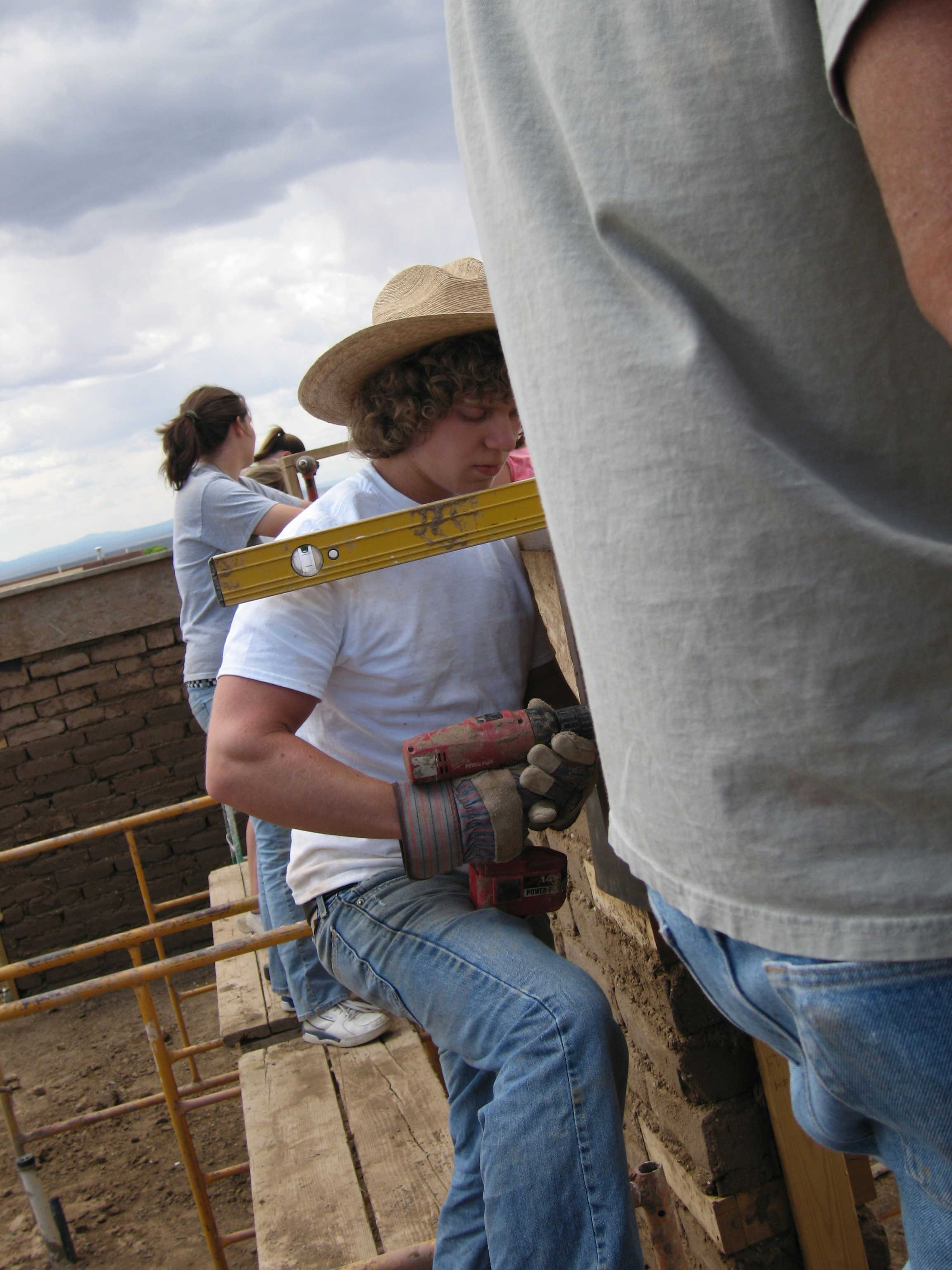
Student applies lessons in building with adobe, in Taos, New Mexico fieldtrip

Photo taken 12 hours ago, on July 5, 2007, of student James Darrell applying lessons in building with adobe, in an adobe house under construction in Taos, New Mexico.  Photo taken while photographer was balanced precariously atop a ladder and holding concrete forms.  Copyright 2007, Ed Darrell


Put Ezra Pound in your classroom

July 5, 2007

This is very, very encouraging.

Ezra Pound in 1971, in Italy

Here’s what eSchool News says about the archive:

July 1, 2007—Thanks to an online audio archive developed by professors at the University of Pennsylvania, recordings of Ezra Pound or William Carlos Williams can take their places on students’ iPods alongside tunes from Better than Ezra or Carlos Santana. Recordings of these two poets’ works are now available free of charge through PennSound, which features about 200 writers and more than 10,000 recordings contributed by poets, fans, and scholars worldwide. The two-year-old site recently acquired rare readings by Pound, some previously unknown. Hearing any poet “makes the poems easier to move into, in some cases,” said Tree Swenson, director of the Academy of American Poets in New York. “Our ears are less logical than our eyes, somehow.” Pound in particular, she said, “is a perfect example of a poet whose tone and phrasing is so distinctive.” While many web sites stream poetry readings, they require an active internet connection. With PennSound, files are downloadable in MP3 format and can be played offline and on portable devices such as iPods, said Charles Bernstein, an English professor and the site’s co-director.

http://writing.upenn.edu/pennsound

Wow. Ezra Pound may not have a lot of usage in high school classes, but the PennSound site features a lot of commentary by highly-qualified students of literature, and poets. There are good readings of classics by good readers, where the authors were long-dead before audio recording was invented — such as John Richetti reading Pope and Swift.

I think the material is not perfectly catalogued. Go look around the site to see what you can find.

This is wonderfully promising.

And, if you’re looking for poetry read aloud, check out The Poetry Foundation, too:  PoetryFoundation.org.  That site features the complete text to one of my favorite poems from contemporary poets, “The Shirt,” by the late Jane Kenyon.  Her husband, the poet Donald Hall, provided a reading of it for NPR once upon a time (here’s another reading by Hall of the same poem) (Here’s more on Hall as the nation’s Poet Laureate).

Poets reading poetry is often wonderful — take twice daily, repeat for the rest of your life.


Sweep of Civilizations: BBC interactive map

June 28, 2007

The British Broadcasting Company (BBC) puts genius into their website — very often, it seems to me.

Go see this interactive map. It shows where civilizations or religions held sway, at a point in history you decide — and then projects forward to show how the group’s influence waxed and waned. Or plot two different groups, side-by-side.

Snapshot of Civilisations is a multi-dimensional picture of human history, where you’re in charge of the timeline.

It uses web technology to reveal the sweep of historical forces and the rise and fall of great empires and ideas over 5000 years in a way that no book could ever do.

And it does it your way. You can customise Civilisations to show you the things that interest you. The best way to understand Civilisations is to have a go.

Great bauble for world geography and world history courses — what sort of a warm-up exercise could you make with this, projecting it from your computer? What sort of homework could be made from this, for the kids to access on their own?

Gee, while you’re there, teachers: Take a look at the interactive quizzes on world religions — this could be a unit all to itself.  Hook up your computer, take the quizzes as a class, on that rainy day when you were supposed to go out to look at the school’s garden and you need a ten-minute, cultural filler that sticks to the state standards.  And look at this multifaith calendar.  You can use it for your daily “this day in history” feature; it’s useful for students doing projects on various religions.  Use some imagination.


History is the Dickens — or could be

June 26, 2007

Faithful readers here may note some long, substantive comments from another “Ed,” who is connected with the Open History Project, it turns out. I’ve linked to the OHP before, but not often enough. It really is a treasure trove.

For example, there is a page of links to computer/internet media works. Included there is a fascinating animation from the British site accompanying what was a PBS Masterpiece Theatre program in the U.S. from Charles Dickens’ novel, Bleak House. The animation, by a creative crew called Rufflebrothers (Mark and Tim Ruffle), covers the life of Charles Dickens. As a simple cartoon, it’s droll — notice Dickens’ siblings dropping dead in an early scene. As a piece of history pedagoguery, it’s brilliant. [It’s Flash animation, and I can’t copy it to paste a sample.]

(I can’t find this animation on the PBS website for Bleak House — but there is another, simpler timeline, covering Dickens and more authors.)

Watch the British animation of Dickens’ life, then go back and take it scene by scene. A pocket watch allows you to see what else was happening in history at that moment. Careful linking allows you to get much more detail — in the scene where his siblings are shown dying (as they did, in fact), the feature gives the details of each of Charles’ brothers and sisters, opening a door of new understanding for the inspiration of the characters in Dickens’ work (It was originally Tiny Fred? Really? After Dickens’ younger brother Frederick?).

Imagine such an animation for the life of George Washington, or for the life of Abraham Lincoln, or Henry Ford, Queen Victoria, Sam Houston, Mark Twain, Theodore Roosevelt, or Albert Einstein.

What in the world can we do to encourage BBC to do more like this? Who else can get in on the act?

What other treasures await you at the Open History Project?


Typewriter of the moment: William Faulkner

June 24, 2007

Faulkner at typewriter, Aug 12, 1954 - AP Photo, ShelfLife

William Faulkner at his typewriter, August 12, 1954, at his home in Oxford, Mississippi. Associated Press photo, via Eons website.

The photo was probably posed; the two books to the left of the typewriter are Faulkner books. Faulkner may have written in a pressed shirt and tie.

Faulkner won the Nobel Prize for Literature in 1950, and delivered a memorable speech about “the human condition” and the importance of art, especially poetry and prose, at his acceptance. His 1954 book, A Fable, won both the National Book Award and the Pulitzer Prize for Fiction, in 1955.

The typewriter is a Royal KHM.

Faulkner was born September 25, 1897 — 2007 marks the 110th anniversary of his birth.

“The past is never dead. It’s not even past.”

—Gavin Stevens

Act I, Scene III, Requiem for a Nun


In a world of electronics, why we still learn the map and compass

June 22, 2007

Why do we bother to teach map reading still, since “everyone” has a GPS?

Wholly apart from plotting the Sweet Tea Line, there is this: Batteries die. Wonderful post at the secret life of a teacher.

While you’re there, gander at his proposals for Alaska’s death-defying fishercrabmen, and a response, and a redirect. When I read it, I thought it had to be the result of a classroom exercise. What could your kids design, if you gave them a dangerous situation somewhere in the world affecting some culture, and asked them to come up with a solution?


Draw this! See the future

June 21, 2007

Can’t draw?  Especially, you can’t draw faces?

Want to see how on-line and computer-based education might work best?

Go here, learn to draw faces well, in under ten minutes (Have some fun — at the entrance page, scroll over each person and read the thought bubbles.)

This piece has been out there for two years.  One might wonder what else this team has done, and where one might find it.

From the Academy of Art University in San FranciscoTip of the old scrub brush to Evangelical Outpost


PowerPoint templates for students

June 18, 2007

I really don’t like assignments to “do a PowerPoint presentation” for kids who are not expert at all on their subjects — there is too much room for too much unintentional mischief when people who know little about a topic are to use a tool designed for people who know too much about a topic.

Among other things, kids who have never had to do a five-page report, nor an outline of a report, do not have the experience to stick to five bullets of less than five words per slide. And don’t get me going on “fireworks” animation of letters to explain things like the death of Medgar Evers, or the evils of child labor.

But if you want some ideas, the Paducah, Kentucky, school system offers some templates for student reports, and a few presentations teachers could use as foundations, here at “Connecting Teachers and Students.” There is advice, too. *

Use these as starting points, please. If you can’t improve on them, you’re not trying (no offense, Paducah — I hope).

A good exercise for you would be to spend an hour reading suggestions from Presentation Zen, and then edit a couple of those presentations from Paducah to make them more, um, zen reflective.

Remember, “template” is just a part of “contemplate.”

(I hope I don’t regret having pointed out that Paducah site to you.)

Update, November 24, 2007: Take a look at the video included in this post to see an effective use of a presentation tool like PowerPoint — though this one was done with Apple’s Keynote. Check the links in the post, too.
Update March 8, 2008:  Paducah’s school district archived the PowerPoint stuff.  I have changed the links above to link to the archive sites.  I replaced “www” with “old” in the URL.

Gold from rust: Tulsa shines, Plymouth doesn’t

June 16, 2007

The story could fuel jokes for years. Or it could cause tears, as indeed it did from the woman who organized the festivities around the unearthing of the 50-year-old Plymouth buried at Tulsa’s courthouse.

The headline in The Tulsa World shows pluck, determination and a good sense of humor: Tulsa celebrates anyway, but the Plymouth is a bucket of rust.

Tarnished gold,” is the headline.

Now we know what 50 years in a hole does to a Plymouth Belvedere.

The tires go flat. The paint fades. Hinges and latches stiffen, upholstery disintegrates, the engine becomes a very large paperweight.

But what the heck. None of us is what we used to be.

1957? Eisenhower sent U.S. Marshalls, and then the U.S. Army, into Little Rock, Arkansas, so 9 African-Americans could register to go to Central High School. That was so long ago that the Little Rock 9 graduated, became doctors, lawyers and businessmen, and even an undersecretary of Labor, and got very gray; Central High is now a National Historic Monument (though still a high school). Greg Morrell wipes grime from Plymouth bumper, Tulsa Convention Center, Tulsa World Photo by Michael Wyke