Imagequilts, with Edward Tufte and Adam Schwartz

September 5, 2013

These are pretty cool.

Can you use them in a classroom?  Some of these Imagequilts pack a lot of information into a small space — such as the one for Cézanne.

Here, “Subatomic Particles“:

Subatomic particles, by Tufte and Schultz; click image for a larger version

Subatomic particles, by Tufte and Schwartz; click image for a larger version

Paul Cézanne“:

Paul Cezanne, Imagequilt by Tufte and Schwartz

Paul Cezanne, Imagequilt by Tufte and Schwartz. Useful in art history? European history?

Super Advanced Placement (AP) history teacher John Irish created outstanding PowerPoints showing off art of European eras, or American eras, for use in introducing a unit of history (see a smattering of examples here).  Could these Imagequilts substitute, or do it as well, and — especially — faster?

Here’s another, “Pablo Picasso“:

Imagequilt, Pablo Picasso, by Tufte and Schwartz

Imagequilt, Pablo Picasso, by Tufte and Schwartz

This one could be particularly useful in a physics course, or a unit on the history of science.  Richard Feynman may be most famous, pedagogically at least, for his invention and use of Feynman Diagrams.  Most discussions simply mention the things, though a few attempt short explanations.  Rare is to find a good example of a Feynman Diagram, to see just what they are and how they work.  Tufte and Schwartz offer a bunch:

Feynman Diagrams, an Imagequilt from Tufte and Schwartz

Feynman Diagrams, an Imagequilt from Tufte and Schwartz

Imagequilts is a Chrome App, available for download so you can make your own.  Of course, you’ll need to use Google Chrome to get full effect.

Got any Imagequilts you’d like to share?

More:


Wisdom, a checklist about students’ use of technology

August 18, 2013

Cheat Sheet:  What do you want kids to do with technology?  By Bill Ferriter

Cheat Sheet: What do you want kids to do with technology? By Bill Ferriter The Tempered Radical blog.williamferriter.com @plugusin

“Technology is a tool, not a learning outcome,” Bill Ferriter says.  He’s right, of course.

Tip of the old scrub brush to April Niemela@AprilJNiemela.

More, generally:


Typewriter of the moment: Aaron Copland in California

August 15, 2013

Composer Aaron Copland at his typewriter in California; Aaron Copland Collection, Library of Congress, circa 1939 or 1940

Composer Aaron Copland at his typewriter in California; Aaron Copland Collection, Library of Congress, circa 1939 or 1940. The photos is placed as either San Diego or Palm Springs; I’m leaning towards Palm Springs with those mountains. Anyone know?

Oddly, the Library of Congress photo site is down for the weekend; here's an image that shows what the photo should look like.  Links should work again come Monday.

Oddly, the Library of Congress photo site is down for the weekend; here’s an image that shows what the photo should look like. Links should work again come Monday.

Details for scholars and history buffs:

ITEM TITLE

Aaron Copland at typewriter, Palm Springs or San Diego, 1939-1940.

SOURCE

Collection: Aaron Copland Collection; Music Division, Library of Congress
Box/Folder: 472/1
Original format: 1 print: b&w; 2.5 x 2.5 in.

DIGITAL ID

copland phot0077

I don’t think this photo is under any copyright, but the collection contains this general language:

Photographs – used by permission of The Aaron Copland Fund for Music, Inc., 254 West 31st Street, 15th floor, New York, NY 10001, phone 461-6956, fax (212) 810-4567. The Fund’s permission is limited to the right to reproduce the image of Aaron Copland. All rights to use individual photographs are controlled by the respective owners of the copyrights in those photographs. For those listed as unidentified, we invite users to contact us with any information they may have with regard to those items.

Is it odd to find a composer working at a typewriter, and not a piano?  Especially before 1990, music writers had much occasion to use the machines — for lyrics, for descriptions of their music and how the published version should look, and for correspondence — and, baby, do composers have correspondence!  The brand on this machine I have not been able to determine; it’s a portable, I imagine, looking at the case to Copland’s left — the typewriter case.

Was Copland a hunt-and-peck typer?  Looks like to me from this photo.

Did you notice the U.S. flag on the pole on the other side of the house?

I wonder what he was working on, in California, at that time.

More:

English: Aaron Copland

Aaron Copland at a machine where we’d expect to find him — years after the photo at the top. Wikipedia image


Outlaw flying in the American west

August 15, 2013

Old Jules tells a great story here about cranking up the old Cessna and climbing high enough to watch the vast powers of the U.S. military run training operations in the New Mexico Desert.

Pilots, bless ’em, tend toward the ornery end of the scale.  That’s what you want if something breaks on your airplane.  You want a guy at the stick who says, “Dagnab it, let’s see how to get out of this one safely.”  (Shades of Flight.  A great movie, really — did you see it?)

This is the place to insert the heroics of pilots in various times of stress, Wally Stewart and his crew bringing their B-24 bomber back over the Mediterrannean and dropping it perfectly on the runway, where it fell apart from the bullet holes [See KUED resources here].  That brave American Airlines crew in the DC-10 over Detroit, Flight 96, who lost hydraulic control when the rear cargo door blew out, and after a string of blue talking, brought the plane down safely (one flight attendant died in the explosion). Those United Airlines pilots who brought the DC-10 Flight 232 down in Sioux City, Iowa, after the rear engine flew apart and destroyed all control of the tail and rudder.  That brave U.S. Airways crew that executed a perfect landing in the Hudson River with Flight 1549.

I think if you talk with pilots much, you get the idea that they like things a little on the edge.  They don’t develop those cool, steely nerves that save lives by having nothing go wrong, ever, or by not pushing their aircraft where the wonks at the Federal Aviation Administration in Washington, D.C., say aircraft should not be pushed.  We hope they do all this pushing in flight simulators; but we also know better.

Cessnas, and just violating some of the rules, don’t deserve those accolades, really.  These stories tell how pilots might develop the skills the brave guys use later.  But they are stories, nevertheless, and they deserve to be told.  They may not save your life flying, but they’ll enrich your life, and help you get through the stuff here on the ground.

So go read Old Jules’s tale.

Then come back here; here are a couple of stories, true as I remember them (a couple of which really should be tracked down; the American west of the latter-half the of 20th century is full of these stories, and they need to be told).

I told Old Jules:

What’s outlaw in flying?

Two observations.

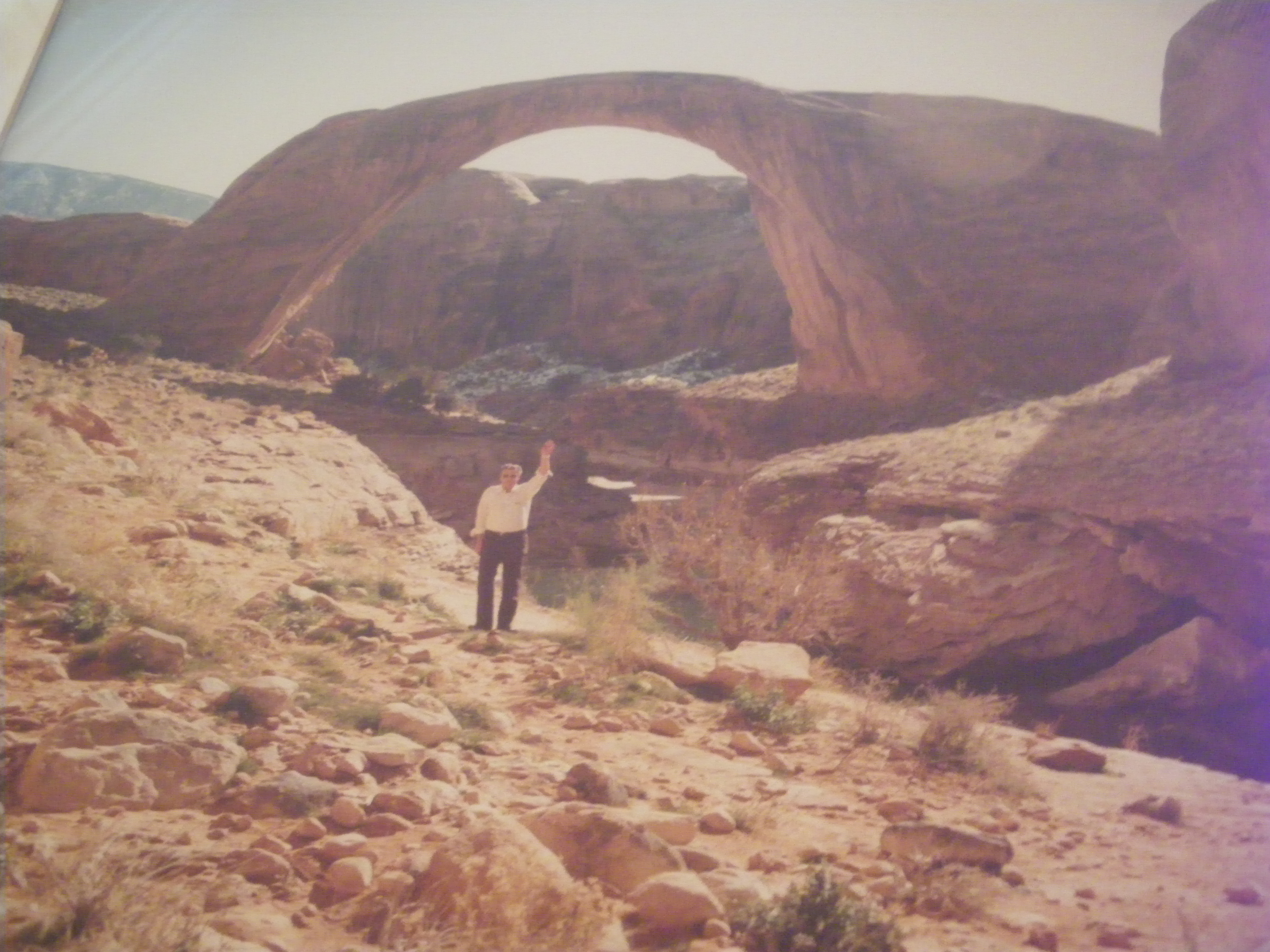
Years ago, while I was staffing the Senate, my brother, Jerry Jones, who spent a good deal of time in his last 20 years in Page, Arizona, called to ask me to check in on a Senate hearing on some FAA issue or other.  Turns out someone — National Park Service, perhaps? — was asking FAA to significantly tighten rules on flying around NPS stuff, including around Rainbow Bridge National Monument.  Apart from the usual issues of air traffic congestion and safety around conflicts between “fixed wing and rotary wing aircraft” (airplanes and helicopters) in and around the Grand Canyon, there were complaints about small plane pilots flying under Rainbow bridge.  The thing really is massive, and you could put the dome of the U.S. Capitol under it, so it’s about 500 feet high . . . what barnstorming pilot could resist?

A somewhat skeptical group of senators quizzed the FAA and Park Service guys on what the problem was, other than noise and hubbub to hikers (who had hiked a mile from the marina on Lake Powell).  About that time Sen. Barry Goldwater, R-Arizona, shuffled into the hearing.  Goldwater was very protective of grand things to see in Arizona, like Rainbow Bridge, and he was also a pilot.

Barry Goldwater, U.S. Senator (AZ-R)

Barry Goldwater, U.S. Senator, R-Arizona. Wikipedia image.

At some point, one of the officials making a case to yank licenses from pilots who pulled the illegal stunt made a comment that questioned the sanity of any pilot who would do such a thing.  Goldwater sat upright.  You mean any pilot who would do such a thing is crazy? Goldwater asked.  Well, yes — and we don’t want crazy people flying airplanes, the official said.  How about such crazy people representing the people of Arizona and passing judgment on your proposals? Goldwater asked.  Then he said he didn’t want an answer to that, that he had some grave reservations about the proposal, and he left the hearing.

I later caught a conversation with the senator in a hallway, in which someone asked him directly if he’d ever flown under Rainbow Bridge, and he said something like, not enough times that the FAA needs to worry about it.

Brother Jerry started a public service effort in his Page days, Page Attacks Trash, a project to clean up litter in and around Page, on the Navajo Reservation, and in the Lake Powell National Recreation Area (NRA) and Rainbow Bridge NM.  It was a great clean-up effort, got the support of the Salt River Project (who operate the Navajo Generating Station in Page); it was big time.  Iron Eyes Cody, who did the famous anti-littering ad featuring the tear in the eye of an American Indian, sometimes dropped in to help out.

Jerry arranged for some television Public Service Announcements (PSAs) filmed in and around Lake Powell, to fight littering.  One of the spots was shot at Rainbow Bridge.  Jerry’s health had been failing for years, but he’d get his cane and make the hike, just to watch the proceedings and keep it all going well.  They finished the spot, broke sticks (as they used to say in the filming biz), and were walking back to the boats at the marina, Jerry and his cane far in the rear.  Just before the film crew rounded the bend, they heard a small airplane buzzing around and the tell-tale cut of the engine, to lose altitude, before roaring the engine to pass under the stone formation.  One of the cameramen had some footage left, and had the presence of mind to turn on the camera and film the thing.

Well, the Park Service and FAA were outraged to hear of the event.  They subpoenaed the film footage, and blew up every frame to see if they could get the tail number on the airplane.  To be honest, I don’t know how that turned out.  I do know that on my wall I have a large photograph of my late brother, two by two-and-a-half feet, waving to the cameraman, with Rainbow Bridge in the background.  That frame didn’t have any useful information, and the law gave him the photo.

The Rainbow Brigde National Monument

Rainbow Bridge National Monument; no, I wouldn’t try to fly a plane under it, either. You could, if you had to, but the authorities would probably track you down like a woodpecker and yank your license. Wikipedia image

Two:

The West Utah Desert remains desolate. On the border between Nevada and Utah, there ain’t much of nothin’. A few roads connect a few ranches, but there’s a good reason U.S. 50 and 6 out there is known as “the loneliest highway in the world.” Bandits might be regarded as welcome company out there sometimes.

Anyway, it was expensive to run copper wires out there, say, 50 miles, to an isolated ranch house, or a lone gas station, or some other building said to be a business. So mostly, AT&T didn’t do it. People who lived and worked out there just had to get along without phone service. Enter a guy named Art Silver Brothers (I think; my memory fades, too), who figured out that radiophone service worked okay. Give people a radiophone — a device which existed then, but which required several pounds of gear and a lot of juice, relatively — and they could dial up the “local” grocery store to check to be sure the milk was good this week, before driving 50 miles to get some dairy whitener for the coffee.

A photo from Beehive Telephone in 2012, showing their service area.

A photo from Beehive Telephone in 2012, showing a part of their service area in Utah, or Nevada, or both. The company still exists!  On their website, they say:  “

Art strung wires where he could, using REA-installed power poles, or fence poles, or whatever he could, and thin, light copper wiring. His Beehive Phone Company was one of the last truly independent phone operations in the U.S., serving a grossly underserved area with patchy service. He didn’t get rich doing it.  He was the company’s only employee most of the time.

Stringing copper over 50 miles for one phone, a company can have difficulty maintaining such lines. Art had a pilot’s license, and he learned he could spot downed lines and other trouble from the air . . . and it was just one step to landing his small airplane on the local road, fixing the problem, and taking off again.

Well, that got the ire of the FAA. They said he shouldn’t do that. They argued that he was impeding traffic an imposing dangers. He said he was keeping lifelines open for people in far-flung places, and it was not a problem for traffic on roads where there might be two vehicles a week passing by. FAA paid for traffic studies on a bunch of those roads; and they enlisted the FCC to try to shut down Silver’s operations.

Remember, part of the system was wired, and part was radio. Turns out that in those pre-cellular days, the radio frequencies Silver used were in the “emergency” spectrum — radio frequencies used by cops and firefighters in places where cops and firefighters existed. FCC took to taping the “phone conversations” of Art’s customers, and in yet another hearing in the Senate, charged that Art was abusing emergency frequencies. The star audio was a tape recording of a woman ordering a significant amount of liquor from a liquor store that served probably six counties in eastern Nevada. FCC argued that obviously was not an emergency, and it amounted to an abuse of spectrum, and it was enough of an abuse to shut down the phone company.

Art finally got his chance to explain. Someone quizzed him about that liquor order, and whether that was appropriate use of emergency radio spectrum.

Well, Art started, the woman making the liquor order was the owning madam of [a] western Nevada brothel, set way in the hell in the middle of nowhere. “And I gotta tell you, if you run a whore house, and you run out of whiskey, that’s an emergency.”

Those were good days to attend hearings in Washington. The Tea Party has ruined all that.

That’s my story; the true facts are probably better.

More:

Jerry Jones and Rainbow Bridge

A bad snapshot of the picture on my wall, Jerry Jones waving from the path in Rainbow Bridge National Monument, moments after a small aircraft flew under the Bridge.


Will Rogers and Wiley Post crashed in Alaska, August 15, 1935

August 15, 2013

Will Rogers, images from Will Rogers Museums, Oklahoma

Will Rogers, images from Will Rogers Museums, Oklahoma

August 15, the Ides of August, hosted several significant events through the years.  In 1935, it was a tragic day in Alaska, as an airplane crash took lives of Will Rogers and Wiley Post.  To refresh your memory, an encore post, with a few edits and additions.

After Mark Twain died, America found another great humorist, raconteur, story-teller, who tickled the nation’s funny-bone and pricked the collective social conscience at the same time. Will Rogers is most famous today for his sentiment that he never met a man he didn’t like. In 1935, he was at the height of his popularity, still performing as a lariat-twirling, Vaudeville comedian who communed with presidents, and kept his common sense. He wrote a daily newspaper column that was carried in 500 newspapers across America.  Rogers was so popular that Texas and Oklahoma have dueled over who gets the bragging rights in claiming him as a native son.

Will Rogers ready to perform.  Photo taken prior to 1900 - Wikimedia

Will Rogers ready to perform. Photo taken prior to 1900 – Wikimedia

Wiley Post was known as one of the best pilots in America. He gained fame by being the first pilot to fly solo around the world. Post was famous for his work developing new ways to fly at high altitudes. Post was born in Texas and moved to Oklahoma. He lost an eye in an oil-field accident in 1924, then used the settlement money to buy his first airplane. He befriended Will Rogers when flying Rogers to an appearance at a Rodeo, and the two kept up their friendship literally to death.

Post asked Rogers to come along on a tour of the great unknown land of Alaska, where Post was trying to map routes for mail planes to Russia. Ever adventurous, Rogers agreed — he could file his newspaper columns from Alaska by radio and telephone. On August 15, 1935, their airplane crashed near Point Barrow, Alaska, killing them both.

Wiley Post, first to fly solo around the world, in an early pressure suit for high-altitude flying - Wikimedia photo

Wiley Post, first to fly solo around the world, in an early pressure suit for high-altitude flying – Wikimedia photo

On August 15, 2008, a ceremony in Claremore, Oklahoma, honored the two men on the 73rd anniversary of their deaths. About 50 pilots from Oklahoma, Missouri, Kansas and Arkansas will fly in to the Claremore Airport for the Will Rogers-Wiley Post Fly-In Weekend. Oklahoma Lt. Gov. Jari Askins will offer a tribute.

Rogers was 56, leaving behind his wife, Betty, and four children. Post, 36, left a widow.

Rogers’ life is really quite legendary. Historian Joseph H. Carter summed it up:

Will Rogers was first an Indian, a cowboy then a national figure. He now is a legend.

Born in 1879 on a large ranch in the Cherokee Nation near what later would become Oologah, Oklahoma, Will Rogers was taught by a freed slave how to use a lasso as a tool to work Texas Longhorn cattle on the family ranch.
As he grew older, Will Rogers’ roping skills developed so special that he was listed in the Guinness Book of Records for throwing three lassos at once: One rope caught the running horse’s neck, the other would hoop around the rider and the third swooped up under the horse to loop all four legs.

Will Rogers’ unsurpassed lariat feats were recorded in the classic movie, “The Ropin’ Fool.”

His hard-earned skills won him jobs trick roping in wild west shows and on the vaudeville stages where, soon, he started telling small jokes.

Quickly, his wise cracks and folksy observations became more prized by audiences than his expert roping. He became recognized as being a very informed and smart philosopher–telling the truth in very simple words so that everyone could understand.

After the 10th grade, Will Rogers dropped out of school to become a cowboy in a cattle drive. He always regretted that he didn’t finish school, but he made sure that he never stopped learning–reading, thinking and talking to smart people. His hard work paid off.

Will Rogers was the star of Broadway and 71 movies of the 1920s and 1930s; a popular broadcaster; besides writing more than 4,000 syndicated newspaper columns and befriending Presidents, Senators and Kings.

During his lifetime, he traveled around the globe three times– meeting people, covering wars, talking about peace and learning everything possible.

He wrote six books. In fact he published more than two million words. He was the first big time radio commentator, was a guest at the White House and his opinions were sought by the leaders of the world.

Inside himself, Will Rogers remained a simple Oklahoma cowboy. “I never met a man I didn’t like,” was his credo of genuine love and respect for humanity and all people everywhere. He gave his own money to disaster victims and raised thousands for the Red Cross and Salvation Army.

Post’s legacy is significant, too. His employer, Oklahoma oil man F. C. Hall, encouraged Post to push for aviation records using Hall’s Lockheed Vega, and Post was happy to comply. Before his history-making trip around the world, he had won races and navigation contests. NASA traces the development of the space-walking suits worn by astronauts to Post’s early attempts for flight records:

For Wiley Post to achieve the altitude records he sought, he needed protection. (Pressurized aircraft cabins had not yet been developed.) Post’s solution was a suit that could be pressurized by his airplane engine’s supercharger.

First attempts at building a pressure suit failed since the suit became rigid and immobile when pressurized. Post discovered he couldn’t move inside the inflated suit, much less work airplane controls. A later version succeeded with the suit constructed already in a sitting position. This allowed Post to place his hands on the airplane controls and his feet on the rudder bars. Moving his arms and legs was difficult, but not impossible. To provide visibility, a viewing port was part of the rigid helmet placed over Post’s head. The port was small, but a larger one was unnecessary because Post had only one good eye!

Last photo of Will Rogers (in the hat) and Wiley Post, in Alaska in 1935 (from Century of Flight)

Last photo of Will Rogers (in the hat) and Wiley Post, in Alaska in 1935 (from Century of Flight)

Tip of the old scrub brush to Alaska bush advocate Pamela Bumsted.

Resources:


Typewriter of the moment: Superman’s (1950s television)

July 20, 2013

Stumbled across this photo of Superman typing away:

Superman typing.

Superman typing. Is that a Remington? (George Reeves played Superman in the television series that ran from 1952 to 1958, “The Adventures of Superman.”)

I’m pretty sure it’s a Remington, a manual  (if you can tell differently, please let me know).  Superman’s “alter ego” was Clark Kent, whose job in the comics and this television series was as a reporter for the Daily Planet, the newspaper for Metropolis.

Do you think the typewriters on Krypton used a QWERTY keyboard?  How did Superman deal with typographical errors, in the time before Correcting Selectrics?


Humanity’s hope for the future: A giant leap for mankind on July 20, 1969

July 20, 2013

It’s a day to remember history.  Do you remember that day, the first time humans set foot on the Moon?

(This is based on an earlier post.)

Southwest Elementary in Burley, Idaho, existed in a world far, far away from the U.S. space program. We watched rocket launches on black and white televisions — the orbital launches were important enough my father let me stay home from school to watch, but when he dropped me off at school, I was in a tiny band of students who actually made it to school. Potato farmers and the merchants who supported them thought the space program was big, big stuff.

By John Glenn’s flight, a three-orbit extravaganza on February 20, 1962, a television would appear in the main vestibule of the school, or in the auditorium, and we’d all watch. There were very few spitballs. Later that year my family moved to Pleasant Grove, Utah.

Toward the end of the Gemini series, television news networks stopped providing constant coverage. The launch, the splashdown, a space walk or other mission highlight, but the nation didn’t hold its breath so much for every minute of every mission. Barry McGuire would sing about leaving the planet for four days in space (” . . . but when you return, it’s the same old place.”), then six days, but it was just newspaper headlines.

The Apollo 1 fire grabbed the nation’s attention again. Gus Grissom, one of the three who died, was one of the original space titans; death was always a possibility, but the U.S. program had been so lucky. Apollo’s start with tragedy put it back in the headlines.

The space program and its many successes made Americans hopeful, even in that dark decade when the Vietnam War showed the bloody possibilities of the Cold War. That darkest year of 1968 — see the box below — closed nicely with Apollo 8 orbiting the Moon, and the famous Christmas Eve telecast from the three astronauts, Frank Borman, Jim Lovell, and William A. Anders. The space program kept us hopeful.

By early 1969 many of us looked forward to the flight of Apollo 11 schedule for July — the space flight that promised to put people on the Moon for the first time in history, the realization of centuries-old dreams.

But, then I got my assignment for Scouting for the summer — out of nearly 50 nights under the stars, one of the days would include the day of the space walk. Not only was it difficult to get televisions into Maple Dell Scout Camp, a good signal would be virtually impossible. I went to bed knowing the next day I’d miss the chance of a lifetime, to watch the first moon landing and walk.

Just after midnight my sister Annette woke me up. NASA had decided to do the first walk on the Moon shortly after touchdown, at an ungodly hour. I’d be unrested to check Scouts in, but I’d have seen history.

And so it was that on July 20, 1969, Neil Armstrong became the first human to set foot on the Moon: “A small step for a man, a giant leap for mankind,” was what he meant to say in a transmission that was famously garbled (at least he didn’t say anything about jelly doughnuts).

P. Z. Myers says he remembers a lawnmower going somewhere. It must have been very bright in Seattle. (Thanks for the reminder, P.Z., and a tip of the old scrub brush to you.)

2013 will mark the 44th anniversary.

Texas Essential Knowledge and Skills (TEKS) lists 11 dates for U.S. history as the touchstones kids need to have: 1609, the founding of Jamestown; 1776, the Declaration of Independence; 1787, the Constitutional Convention; 1803, the Louisiana Purchase; 1861-1865, the American Civil War; 1877, the end of Reconstruction; 1898, the Spanish American War; 1914-1918, World War I; 1929, the Stock Market Crash and beginning of the Great Depression; 1941-1945, World War II; 1957, the launching of Sputnik by the Soviets. Most teachers add the end of the Cold War, 1981; I usually include Apollo 11 — I think that when space exploration is viewed from a century in the future, manned exploration will be counted greater milestone than orbiting a satellite; my only hesitance on making such a judgment is the utter rejection of such manned exploration after Apollo, which will be posed as a great mystery to future high school students, I think.)

* 1968, in roughly chronological order, produced a series of disasters that would depress the most hopeful of people, including: the Pueblo incident, the B-52 crash in Greenland, the Tet Offensive in Vietnam, the nerve gas leak at the Army’s facility at Dugway, Utah, that killed thousands of sheep, Lyndon Johnson’s pullout from the presidential race with gathering gloom about Vietnam, the Memphis garbage strike, the assassination of Martin Luther King, Jr., riots, the Black Panther shoot out in Oakland, the Columbia University student takeover, the French student strikes, the tornadoes in Iowa and Arkansas on May 15, the Catonsville 9 vandalism of the Selective Service office, the sinking of the submarine U.S.S. Scorpion with all hands, the shooting of Andy Warhol, the assassination of Robert F. Kennedy, the Buenos Aires soccer riot that killed 74 people, the Glenville shoot out in Cleveland, the cynicism of the Republicans and the nomination of Richard Nixon and Spiro Agnew, the Warsaw Pact invasion of Czechoslovakia crushing the “Prague Spring” democratic reforms, the Chicago Democratic Convention and the police riot, the brutal election campaign, the Tlatololco massacre of students in Mexico City, Black Power demonstrations by winning U.S. athletes at the Mexico City Olympics, coup d’etat in Panama. Whew!

More, from Millard Fillmore’s Bathtub:

And even more:


Typewriter of the moment: Alice Denham, circa 1956

June 8, 2013

One needs a typewriter to type out a story; but one needs a story to tell, first.

Alice Denham and her typewriter, 1956

Alice Denham, Playboy magazine’s Playmate of the Month in July 1956; photo undated, but probably about the same time; from 20th Century Man

I haven’t been able to identify the typewriter.  A short story she wrote appeared in the same issue of Playboy as her playmate layout.

Denham led an adventurous life in the New York literary scene, as an aspiring writer, and as a woman who liked sex.  Was she working on her book in this photo?  It was eventually published in 1967, My Darling from the Lions.

In 2006 she got attention for another book, a tell-much memoir of her life and romances and flings along the way, Sleeping With Bad Boys – A Juicy Tell-All of Literary New York in the Fifties and Sixties, good enough, or historically interesting enough, to get a review in the New York Times.

If typewriters could talk, you know?

More:


Typewriter of the moment: Stanley Kubrick’s

June 6, 2013

Stanley Kubrick's typewriter on Instagram, from sophireaptress.

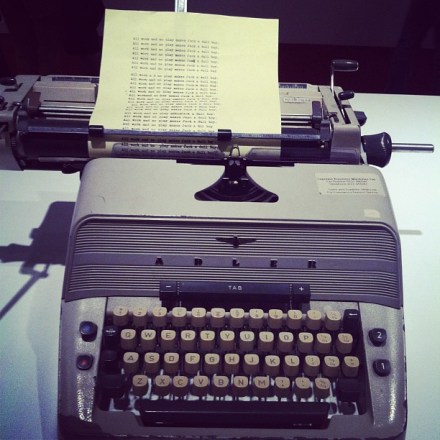
Stanley Kubrick’s typewriter used in “The Shining” on Instagram, from sophireaptress.

It’s an Adler, but Instagram isn’t built for details, you know?

The typewriter is probably on display at the Los Angeles County Museum of Art’s Kubrick Exhibit, which closes June 30, 2013 (hurry!).

More:

Save

Save


No more than 3 points in your presentation!

February 28, 2013

Interesting video from Ethos3, a company that works on presentations and helping others make better presentations.

Um, no, I don’t think they aim at teachers and educators — it’s a for-profit group, not a charity.

That’s also one of my concerns.  Here’s one of a series of short videos Ethos3 prepared, to help you with your next presentation or, you hope, the woman or man who will be making that presentation you have to watch next Wednesday morning at Rotary Club, or at Scout leader training next Saturday, or kicking off the budget planning exercise next Monday (at 7:00 — coffee provided so don’t be late!):

98 views

Generally, I’d agree.

But what about teachers, who have to slog through 150 specific items for the state test?

Observations:

365 Project - Day 29 - I *hate* Powerpoint

Borrowed caption: “365 Project – Day 29 – I *hate* Powerpoint (Photo credit: mike_zellers)”

  1. Teachers could benefit greatly from learning presentation secrets, and making their in-class presentations much more effective.
  2. No school district in America, public, charter, parochial, or homeschool, will give you time to put together such an effective presentation.
  3. Most teachers get no coaching on presentation effectiveness, and their students lose out.
  4. Just because the administrators won’t cut you slack to do it, doesn’t mean a teacher shouldn’t learn about effective presentation techniques, and use them.

In a world of bad bosses, it’s almost impossible to get a really great principal at a school.  Teachers gotta slog on anyway.

You won’t have the time to do the presentation your students deserve, but you should try, anyway.

Dreaming for a minute:  I wish I could get a team like this to help out with designing a curriculum, figuring out where presentation work, how to give them real punch, and where not to use them at all.

What do you think?  Can you tell your story in just three points?  Can you reduce a lecture to three key points that would be memorable, and that spurs students to learn what they need to learn?

More:


Abraham Lincoln, inventor – only president with a patent?

February 10, 2013

Lincoln’s (and Darwin’s) birthday rolls around again next week. What do we know about our 16th president who was the subject of a great and a silly movie in the last year?

Some wag sent out this Tweet today.

Any visitor to Thomas Jefferson’s home at Monticello knows of Jefferson’s wide-ranging interests, and work in science and invention.  I was rather surprised to discover the depth of George Washington’s inventive work, in a seminar sponsorred by the Bill of Rights Institute at Mount Vernon a few years ago.

Abraham Lincoln, too?

Sangamon_River_near_Lincoln's_First_Home_in_Il...

Sangamon River near Lincoln’s first home in Illinois – Photo from Wikipedia

Lincoln lived along the Sangamon River, and he saw development of the river for commercial navigation to be a boon for his district’s economic growth.  Unfortunately, the Sangamon is not deep; boats had difficult times navigating over the many logs and snags, and shallows.

So, Mr. Lincoln offered a technical solution, for which he was granted a patent in 1849.  Details below, from Google Patents:

lincoln-patent-for-buoying_vessels_over_shoals

lincoln-patent-for-boat-buoying-in-jpg

Drawing for Abraham Lincoln’s patent of a boat bouying apparatus.

Was Lincoln the only president to get a patent?  Thomas Jefferson and George Washington worked hard at inventions.  Jefferson shared Ben Franklin’s view that new inventions should be for the benefit of all; does that mean he didn’t seek patents?  Washington’s inventions — including the 16-sided barn for threshing wheat — tended to be improvements on processes; I don’t know of any evidence he even thought of patenting any idea.

It’s possible that Lincoln was the only president so far to have held a patent.

Lincoln’s invention was never built, and that patent never used.

This is an encore post with additions.

More, and miscellany:


Time machine! For Digital Learning Day

February 6, 2013

Screen shot from HHMI's iPad app, Earth Viewer -- the time machine function.

Screen shot from HHMI’s iPad app, Earth Viewer — the time machine function.

Stealing the entire post from P. Z. Myers at Pharyngula:

I’ve been playing with it for a while. It turns out that when you go back to Cretaceous Morris, you need to be able to swim really well, but Cambrian Morris is high and dry on a fairly small landmass (whoa, but oxygen is way down and carbon dioxide way up). You can have your own time machine, too — it’s the EarthViewer app for iPad, and it’s free from HHMI Here’s what it has:

• Data and continental reconstructions dating back billions of years

• Climate and carbon dioxide data for the last 100 years

• The ability to manipulate the globe and zoom to any location

• Track the location of modern cities back over 500 million years

• In depth features on major geological and biological events in Earth history

• Clickable details on geologic eons, eras, and periods

• Automated play modes

• An extensive reference list

• Suggestions for classroom use

• Tutorial videos

Did I mention that it’s free? This HHMI thing is pretty danged sweet.

There is no creationist/Noah’s Flood version.

No Windows version, yet, either.

Did we mention the Howard Hughes Medical Institute made this and related apps free?


Darrell’s corollaries of education + technology: No good work goes unpunished, most opportunities missed

January 27, 2013

Aristotle, and his pupil Alexander
Does this 19th century engraving show the perfect learning situation? Alexander had no iPhone, no laptop; Aristotle used no PowerPoint, no grading machines, not even a chalkboard. Have we come a long way, or is this a measure of how far we’ve fallen? “Aristotle and his pupil, Alexander (c. 340 BCE)” (original source?)

David Warlick‘s blog serves up a lot of stuff to make teachers think (cynically, I wonder whether education administrators can be shoved into thinking at all . . . but I digress).

David Warlick
David Warlick, formerly pictured in a taxi in Shanghai, probably off at some education conference or other, until that photo went away from the internet.

Recently he pondered his own son’s use of several different kinds of media at once.  In a longer discussion that would be worth your while, someone asked, “Has the nature of information influenced the emerging ‘appropriate technologies’ like the digital learning object called an iBook?”  David responded:

My knee-jerk response is, “Not nearly enough.” This current push toward digital textbooks, urged on by our Secretary of Education, concerns me. I worry that we’re engaged in a race to modernize schooling, rather than a sober and thoughtful imagining and designing of learning materials and practices that are more relevant to today’s learners (ourselves include), today’s information landscape and a future that has lost the comforts of certainty, but become rich with wondrous opportunities.

What I enjoyed, though, about my experience in publishing an iBook was learning to hack some features into the book that were not part of Apples general instructions for using their publishing tool. This is the ultimate opportunity of digital learning objects and environments, that they can be hacked into new and better learning experiences by information artisans who see what’s there and what it can become.

In a cynical mood, I commented on an earlier statement Warlick made, about how technology has changed the education landscape:

“… we live in a time of no unanswered questions.”

BUT:

1.  The internet and especially portable devices have exponentially increased the probability that difficult questions will be answered incorrectly.

2.  For teachers, no longer is it possible to ask a simple, factual question as a teaser to get students to search for the answer, and thereby learn something deeper along the way.  Portable computer devices present one more non-print medium in which education appears to be abdicating its duties, and the war.  (We missed radio, film, television, recorded television, and desk-top computing; now we’re missing portable devices.)

English: Cropped picture of Jaime Escalante
Legendary AP calculus teacher Jaime Escalante; pencil, paper, chalkboard and chalk, maybe a slide rule, made up his technology kit. Photo: Wikipedia

3.  No question goes unanswered, but what is really rare is a question that is worth answering; even more rare, that good question that can be answered well from free internet sources.

Darrell’s Education Technology Corollary:  When administrators and policy makers tell educators (especially teachers) they wish to utilize “new technology,” they mean they want new ways to figure out ways to fire teachers, because they don’t have a clue how technology can be used in education, nor have they thought broadly enough about what education is.

Darrell’s Education Technology Corollary Corollary: When a teacher effectively uses technology in a classroom, it will be at the teacher’s instigation, the teacher’s expense, and administrators will get revenge on the teacher for having done so.

I’ve wondered whether I wasn’t too cynical; David offered a solid response.

A couple of weeks later, my cynicism is growing.  I’m warning you, teachers, you adopt new technologies at your risk, often — especially in some school districts like Dallas ISD.

It’s a caution only.  Teachers, being teachers, will continue to push the envelopes, as Fionna Larcom related at Warlick’s blog.  Good on ’em.  One out of 500,000 will get accolades outside the education system, like Jaime Escalante did.  Many others will face reprimand.

But if education is to improve, this experimentation by teachers must continue.  So teachers slog on, under-appreciated and often opposed in their attempts to fix things.

Someday a school system will figure out how to unlock teachers’ creativity, knowledge and skills.  Not soon enough.

Teacher in primary school in northern Laos
Teacher in primary school in northern Laos.  Photo: Wikipedia

(Can someone explain to me how Warlick’s blog, with much better stuff than I do here, gets fewer hits?  Teachers, not enough of you are reading broadly enough.)

More, not necessarily the opinion of this blog:


Typewriter of the moment: Abigail van Buren’s IBM

January 17, 2013

“Dear Abby,” Abigail van Buren, sorts through letters asking advice. Newseum photograph, from publicity photo.

“Dear Abby,” Abigail van Buren, sorts through letters asking advice. Newseum photograph, from publicity photo.

News flash, on Facebook, from the Newseum:

Abigail Van Buren, author of the “Dear Abby” advice column, died Jan. 16, 2013. She was 94.

NPR’s e-mail added a couple of details:

NPR BREAKING NEWS:

‘Dear Abby’ Dies; Pauline Phillips Was Adviser To Millions

Writing under the pen name Abigail Van Buren, she wrote the world’s most widely syndicated column. The daily readership grew to more than 100 million. The column is now written by her daughter, Jeanne.

More at NPR.org:

http://n.npr.org/NPRI/jN375186981_1570913_1570912_Z.htm

What an incredible melange of history in that photo!  You can read about Mrs. Phillips at the NPR site, but consider just this photograph:

  1. “Dear Abby” which used to be regular reading in most households in the morning — literally millions of American households.  She and her chief competition, “Ann Landers,” could each by herself move the nation, to change habits, to question manners, to change behaviors with vaccinations or new medical procedures, and in a few cases, move legislation through Congress.  No one in newspapering or broadcast today has the clout this woman had, but rarely used.  Not even Rupert Murdoch with his empire, had so much clout as Dear Abby.  (Many of us were surprised to learn later that the women who wrote Dear Abby and Ask Ann Landers were twin sisters — another one of those twists in real history that no one would believe in fiction.)
  2. Isn’t that an early IBM electric typewriter? Our local Fry’s doesn’t stock even electric typewriters anymore, nor could I find one in my last run through Staples and Office Depot (catalog sales, perhaps). IBM probably hasn’t made one 20 years, and not one like that one in at least 40 years — that is not a Selectric.
  3. Dial telephone.  Not just a land-line, but an actual, analog, dial telephone.  Without seeing any identifying characteristics, we can assume that her telephone provider was the AT&T regional company — unlikely that it was Continental, the only other major provider in the U.S. at the time.
  4. The Yellow Pages telephone book under the phone.  I think even Yellow Pages stopped printing those things; we haven’t had a good update on our white pages in years.
  5. Newspaper syndication meant EVERYONE had access to her columns — no internet.  A dime for the local paper, and you had Dear Abby.
  6. The fountain pen in her hand, perhaps for more than just signing letters (what do you say, Office Supply Geek?).
  7. No computer, which in addition to replacing the typewriter, would probably also replace the four-drawer file cabinet in back of her (a locking cabinet, perhaps a HON?)
  8. Is that flowered pattern the wallpaper in the place? They don’t make orchid wallpaper like that any more.
  9. Look at that stack of mail.  Each came in an envelope, stamped, for less than 8¢ (1st class rates topped a dime for the first time in 1974).  No e-mail; no electronic version to cut and paste from.  Each letter to appear in the column had to be retyped on that IBM typewriter.  Most high school students today have probably never sent a letter through the mail, and many have never received one, either.

The Newseum didn’t credit the photo, nor say when or where it was taken; I’ve not found more details yet. At the Newseum site, the photo is credited to Phillips-Van Buren, Inc., the company that runs the column.  I’m guessing 1970 at the latest, and this may be in the 1960s or even 1950s.

Some of us old timers get future shock just looking at that photo.  Can your students date that photo with the clues in it, history teachers?  Journalism teachers?  (Photos at OzTypewriters suggest this photo could have been made in the 1960s.)

More:

Heck, it may be a 1950s typewriter (do you read German?):

Deutsch: Elektrische IBM-Schreibmaschine aus d...

Deutsch: Elektrische IBM-Schreibmaschine aus den 1950er Jahren Lizenz (Photo credit: Wikipedia)  (Translated roughly, “IBM electric typewriter from the 1950 license.”)


December 31, 2012: Bright Idea Day, anniversary of Edison’s light bulb

December 31, 2012

Between Christmas and New Year’s Day, here at Millard Fillmore’s Bathtub we celebrate a variety of historically holy days.  December 31, by tradition, is Bright Idea Day, the anniversary of the day Thomas Edison demonstrated for the public a working light bulb in 1879.

100,000 people gather in Times Square, New York City, tonight, and millions more around the world, in festivities for the new year made possible by the work of Thomas Alva Edison.

Here it is, the invention that stole sleep from our grasp, made clubbing possible, and launched 50,000 cartoons about ideas:

The light bulb Thomas Edison demonstrated on December 31, 1879, at Menlo Park, New Jersey - Wikimedia image

The light bulb Thomas Edison demonstrated on December 31, 1879, at Menlo Park, New Jersey – Wikimedia image (GFDL)

The light bulb. It’s an incandescent bulb.

It wasn’t the first bulb. Edison a few months earlier devised a bulb that worked with a platinum filament. Platinum was too expensive for mass production, though — and Edison wanted mass production. So, with the cadre of great assistants at his Menlo Park laboratories, he struggled to find a good, inexpensive filament that would provide adequate life for the bulb. By late December 1879 they had settled on carbon filament.

Edison invited investors and the public to see the bulb demonstrated, on December 31, 1879.

Thomas Edison in 1878, the year before he demonstrated a workable electric light bulb.  Library of Congress image

Thomas Edison in 1878, the year before he demonstrated a workable electric light bulb. CREDIT: Thomas Edison, head-and-shoulders portrait, facing left, 1880. Prints and Photographs Division, Library of Congress. Reproduction number LC-USZ62-98067

Edison’s successful bulb indicated changes in science, technology, invention, intellectual property and finance well beyond its use of electricity. For example:

  • Edison’s Menlo Park, New Jersey, offices and laboratory were financed with earlier successful inventions. It was a hive of inventive activity aimed to make practical inventions from advances in science. Edison was all about selling inventions and rights to manufacture devices. He always had an eye on the profit potential. His improvements on the telegraph would found his laboratory he thought, and he expected to sell the device to Western Union for $5,000 to $7,000. Instead of offering it to them at a price, however, he asked Western Union to bid on it. They bid $10,000, which Edison gratefully accepted, along with the lesson that he might do better letting the marketplace establish the price for his inventions. Other inventive labs followed Edison’s example, such as the famous Bell Labs, but few equalled his success, or had as much fun doing it.  (Economics teachers:  Need an example of the marketplace in action?)
  • While Edison had some financial weight to invest in the quest for a workable electric light, he also got financial support, $30,000 worth, from some of the finance giants of the day, including J. P. Morgan and the Vanderbilts who established the Edison Light Company.
  • Edison didn’t invent the light bulb — but his improvements on it made it commercial. “In addressing the question ‘Who invented the incandescent lamp?’ historians Robert Friedel and Paul Israel list 22 inventors of incandescent lamps prior to Joseph Wilson Swan and Thomas Edison. They conclude that Edison’s version was able to outstrip the others because of a combination of three factors: an effective incandescent material, a higher vacuum than others were able to achieve (by use of the Sprengel pump) and a high resistance lamp that made power distribution from a centralized source economically viable.”
  • Edison’s financial and business leadership acumen is partly attested to by the continuance of his organizations, today — General Electric, one of the world’s most successful companies over the past 40 years, traces its origins to Edison.

Look around yourself this evening, and you can find a score of ways that Edison’s invention and its descendants affect your life. One of the more musing effects is in cartooning, however. Today a glowing lightbulb is universally accepted as a nonverbal symbol for ideas and inventions. (See Mark Parisi’s series of lightbulb cartoons, “Off the Mark.”)

Even with modern, electricity-saving bulbs, the cartoon shorthand hangs on, as in this Mitra Farmand cartoon.

Fusilli has an idea, Mitra Farmand, Fuffernutter

Brilliant cartoon from Mitra Farmand, Fuffernutter

Or see this wonderful animation, a video advertisement for United Airlines, by Joanna Quinn for Fallon — almost every frame has the symbolic lightbulb in it.

Other resources:

Patent drawing for Thomas Edison's successful electric lamp.  Library of Congress

Thomas Edison’s electric lamp patent drawing and claim for the incandescent light bulb CREDIT: “New Jersey–The Wizard of Electricity–Thomas A. Edison’s System of Electric Illumination,” 1880. Prints and Photographs Division, Library of Congress. Reproduction Number LC-USZ62-97960.

Yeah, this is mostly an encore post.

Even More, in 2012: