I don’t vouch for the book — yet, at least. I’ve not read it. I find the study of science, and especially of evolution, offers no barrier to my faith, nor does my faith offer any barrier to my study of science. My faith, which requires an ethical life, offers barriers to creationism — a subject of other posts. But thank God for Charles Darwin? Sure.
“Thank God for Charles Darwin.” T-shirt design from Redbubble
We also need to thank the federal courts, where the First Amendment is enforced, keeping unreasonable fables from diluting science education in public schools.
Coming out of the display on Lucy at the Houston Museum of Natural Science, coming back down the staircase, this is the painting on the wall. In my imagination, this is what Lucy saw will see as they carried carry her, crated up, out of the building. In reality they probably took will carry her down a freight elevator.
This one’s for you, P.Z. — drop into the Houston museum next time you’re down there:
Spread the word; friends don't allow friends to repeat history.
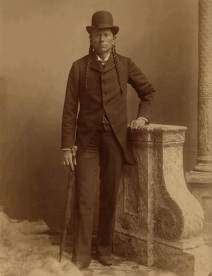
Photographs of Native Americans reside among the publicly and internet available materials of the National Archives. Images can be ordered in sets of slides, or as individual prints, though many are available in quality high enough for PowerPoint works and use on classroom materials. Many of the photos are 19th century.
Quanah Parker stands as one of the larger Native Americans in Texas history. This photo puts a face to a reputation in Texas history textbooks. Texas teachers may want to be certain to get a copy of the photo. His life story includes so many episodes that seem to come out of a Native American version of Idylls of the King that a fiction writer could not include them all, were they not real.
Quanah’s mother was part of the famous Parker family that helped settle West Texas in the 1830s. Cynthia Ann Parker was captured in 1836 when Comanches attacked Fort Parker, near present-day Groesbeck, Texas, in Limestone County. (See Fort Parker State Park.) Given a new name, Nadua (found one), she assimilated completely with the Nocona band of Comanches, and eventually married the Comanche warrior Noconie (also known as Peta Nocona). Quanah was their first child, born in 1852.
Nadua was captured by a Texas party led by Lawrence Sullivan “Sul” Ross in 1860, in the Battle of Pease River. Noconie, Quanah, and most of the Nocona men were off hunting at the time, and the fact of Nadua’s capture was not realized for some time. Nadua asked to return to the Comanches and her husband, but she was not allowed to do so. When her youngest daughter, who had been captured with her, died of an infection, Nadua stopped eating, and died a few weeks later.
Sul Ross was a character in his own right. At the time he participated in the raid that recaptured Cynthia Parker, he was a student at Baylor University (“What do I do on summer breaks? I fight Indians.”) At the outbreak of the Civil War, Ross enlisted in the Confederate Army as a private. Over 135 battles and skirmishes he rose to the rank of Brigadier General, the ninth youngest in the Confederate Army. A successful rancher and businessman back in Texas after the war, he won election as governor in 1887, served two very successful terms (he resolved the Jaybird-Woodpecker War in Fort Bend County, and had to call a special session of the legislature to deal with a budget surplus), refused to run for a third term, and was named president of Texas Agricultural and Mechanical College (Texas A&M) within a few days of stepping down as governor. Ross’s leadership of the college is legendary — students put pennies near a statue of Ross in a traditional plea to pass final exams, among many other traditions. After his death, Texas created Sul Ross State University, in Alpine, Texas, in his honor.
Quanah Parker’s father, Noconie, died a short time after his mother’s capture. He left the Nocona band, joined the Destanyuka band under Chief Wild Horse, but eventually founded his own band with warriors from other groups, the Quahadi (“antelope eaters”) (also known as Kwahadi). The Quahadi band grew to be one of the largest and most notorious, always with Quanah leading them. The Quahadis refused to sign the 1867 Medicine Lodge Treaties, and so avoided immediate internment to a reservation. However, dwindling food supplies and increasing opposition forced Quanah to retire to a reservation in 1875, in what is now southwestern Oklahoma. This was the last Comanche band to come to the reservation.
Quanah was appointed Chief of all the Comanches.
Through investments, Quanah became rich — probably the richest Native American of his time.
Quanah hunted with President Theodore Roosevelt.
Quanah Parker in later life, as a successful businessman. Wikipedia image, public domain
Rejecting monogamy and Christianity, Quanah founded the Native American Church movement, which regards the use of peyote as a sacrament. Quanah had been given peyote by a Ute medicine man while recovering from wounds he’d suffered in battle with U.S. troops. Among his famous teachings: The White Man goes into his church and talks about Jesus. The Indian goes into his Tipi and talks with Jesus.
Bill Neeley wrote of Quanah Parker: “Not only did Quanah pass within the span of a single lifetime from a Stone Age warrior to a statesman in the age of the Industrial Revolution, but he never lost a battle to the white man and he also accepted the challenge and responsibility of leading the whole Comanche tribe on the difficult road toward their new existence.”
Quanah Parker died on February 23, 1911. He is buried at Fort Sill Cemetery, Oklahoma, next to his mother and sister.
Quanah Parker’s epitaph reads:
Resting Here Until Day Breaks
And Shadows Fall and Darkness Disappears is
Quanah Parker Last Chief of the Comanches
Born 1852
Died Feb. 23, 1911
State Board of Education chairman David Bradley of Beaumont told GOP delegates [at the Texas State Republican Convention] that the board was about to take up the science curriculum for public schools. He forecasted a fight over evolution vs. creationism.
Bradley said there are some on the board (he’s among them) that believe God created Man.
“There are others who think their ancestors were apes. That’s okay. But I’m going to vote the right way,” Bradley said.
Is there anything there that suggests Bradley wants good science in Texas textbooks and Texas classrooms?
“Our nation is at risk. The educational foundations of our society are presently being eroded by a rising tide of mediocrity. If an unfriendly foreign power had attempted to impose on America the mediocre educational performance that exists today, we might well have viewed it as an act of war. We have, in effect, been committing an act of unthinking, unilateral educational disarmament. History is not kind to idlers.”
25 years later, Commissar Don McLeroy is leading the tide of mediocrity, doing crippling things to our education system that the likes of Nikita Khruschev and Mao Ze Dong could only dream about.
Spread the word; friends don't allow friends to repeat history.
Federal Reserve Branch banks take seriously the Fed’s pledge to education Americans, and to support educators in understanding economics and the work of the Federal Reserve Banking System.
The educator support team at the Dallas Fed recently secured approval to provide continuing education credits for a two-day session on globalization planned for San Antonio, on June 30 and July 1. These sessions are easy, generally loaded with details, and tailored for educations. Plus they are usually well catered.
$35.00 gets all materials, two lunches, one continental breakfast, and 12 hours of credit.
Not only is ICR appealing their case on granting creationism degrees for science teachers (see preceding post), the State Board of Education is gearing up for another battle in Commissar Don McLeroy’s War on Education and War on Science (two wars for the price of one! He’ll campaign as a budget cutter next time . . .).
Texas’s Institute for Creation Research (ICR) is appealing the decision of the Texas Higher Education Coordinating Board that denied ICR the power to grant graduate science degrees. According to the story in the Houston Chronicle, ICR plans to take the issue to court if THECB does not reverse itself.
Institute spokesman Lawrence Ford said the voluminous appeal — it is 755 pages long, including supporting documents — is based upon a claim of “viewpoint discrimination.”
The appeal described the board’s decision as “academic (and religious) bigotry masquerading as Texas Education Code ‘enforcement.’ ”
Board members and staff are accused of denying the request in April because the institute and its leaders believe the biblical version of the Earth’s creation is literally true.
Institute CEO Henry Morris III said last spring his school’s program includes information about evolution, although he and others affiliated with the school don’t accept the proof of evolution offered by mainstream scientists.
Board members and Higher Education Commissioner Raymund Paredes said they were concerned the degree would not equip graduates to teach science in Texas’ public schools.
The real issue, Stafford said Monday, is whether the institute’s course work — offered online and still available, although not accredited — fits the label of the proposed degree.
The disputed degree is a Master of Science in science education. “Either the curriculum or the label has to change,” Stafford said.
“That label has a particular meaning of preparing somebody as a science teacher.”
Paredes reiterated that in a May 21 letter to Morris. “It was determined that the designation of the degree and the content of the degree were not adequately aligned,” he wrote. “Approval would require either a change in the designation of the degree or a change in the content covered.”
The institute is not inclined to do either, Ford said.
Institute for Creation Research (I can’t find their set of documents as promised by the Houston Chronicle, other than this old press release — maybe you’ll have better luck; by the way, I think none of the pictures showing researchers or science in progress have any connection to ICR — just sayin’)
The Houston Chronicle’s coverage of the Texas State Board of Education meetings this week is not well indexed on the web. Following a couple of odd links I found Gary Sharrar’s article (he’s the Chronicle’s education reporter), though the Associated Press Story shows up for the paper’s main article on most indices I found.
Sharrar adds a few details of Kommissar McLeroy’s war on English education, but the significant thing about the story is in the comments, I think. One poster appears to have details that are unavailable even from TEA. Partisans in the fight have details that Texas law requires to be made public in advance of the meetings, while the state officials who need to advise on the regulations and carry them out, do not.
TEA has an expensive website with full capabilities of publishing these documents within moments of their passage. As of Sunday morning, TEA’s website still shows the documents from last March. Surely Texas is not getting its value from TEA on this stuff.
“It is obvious that too many Texas public school students aren’t learning the basics with our current curriculum,” said Foundation education policy analyst Brooke Terry. “We are glad the new curriculum will emphasize grammar and writing skills.”
Texas public schools fail to adequately prepare many students for college or the workplace, she said, citing a 2006 survey by the Conference Board found that 81 percent of employers viewed recent high school graduates as “deficient in written communications” needed for letters, memos, formal reports and technical reports.
But the Texas Freedom Network, which promotes public education, religious freedom and individual liberties, called the board divisive and dysfunctional.
“College ready” generally means reading well, and reading broadly in literature. From a pedagogical standpoint, emphasizing “grammar and writing skills” over the reading that is proven to improve grammar and writing skills will be a losing battle. I hope the details of the plan will show something different when TEA ever makes them available to the taxpaying/education consuming public and English teachers. NCLB asks that such changes be backed by solid research — it will be fascinating to see whether there is any research to support the Texas plan (not that it matters; this section of NCLB has been ignored by the right wing from the moment NCLB was signed).
Prior to this week’s series of meetings, Commissar McLeroy expressed what sounds like disdain for reading in the English curriculum to the El Paso Times:
But chairman McLeroy said he would fight against some of the measures the educators want, especially the comprehension and fluency portion.
Their suggestions, he said, would have students waste time on repetitive comprehension strategies instead of actually practicing reading by taking in a rich variety of literature.
“I think that time is going to be lost because they’ll be reading some story, and they’ll just overanalyze,” he said.
By the way, calling the Texas Public Policy Foundation a “free market think tank” is misleading. The group is quite hostile to public education, and features on its board several people who have led fights to gut funding for public schools and impose bleed-the-schools voucher programs. The Foundation appears to endorse preaching in public schools and gutting science standards, among other problems.
If it’s good work, why is it done in secret? Remember that I spent years in right wing spin work in Washington. Here’s what I see: Either McLeroy’s administration at the state board is incredibly incompetent and can’t even get the good news right, and out on time, or there is another, darker and probably illegal agenda at work.
Below the fold, the full text of the comment from “WG1” at the Chronicle’s website.
It’s probably not so bad a pig in a poke as it might be — of course, no one had the chance to review it, so no one knows, really — but the processes used, worthy of Napoleon or Kruschev on a bad day, should give cause for concern.
Gotta think about this one for a while.
Spread the word; friends don't allow friends to repeat history.
Not perfect — there is a brown spot on it; but beautiful, surpassingly rare, a creature of the serendipity of nature, it is a natural dogwood blossom in Dallas County, Texas:
What we came to see – the magical dogwood blossoms.
On April 5 Kathryn and I joined David Hurt and a jovial band of hikers for a trip into Dogwood Canyon in Cedar Hill, Texas. The physical formation of Cedar Hill upon which the city of the same name and several others stand, is one of the highest spots between the Mississippi River and the Rocky Mountains. It is an outcropping of chalk, a formation known as the Austin Chalk, that runs from Austin, north nearly to the Oklahoma border.
This rock formation creates a clear physical marker of the boundary between East and West. Dallas is east of the line, Fort Worth, Gateway to the Old West, is 30 miles farther west. On this outcropping is married the plains of the west with the oaks and forests of the east. Within a few miles of the line, the botanical landscape changes, cowboy prairie lands one way, forest lands the other.
On the chalk itself, the soil is thin and alkaline. The alkalinity is a function of the chemical composition of the chalk underneath it.
Dogwoods love the forests of East Texas with their acidic soils. Early spring produces fireworks-like bursts of white dogwood blossoms in the understory of East Texas forests. Dogwoods die out well east of Dallas as the soil changes acidity; driving from Dallas one can count on 30 to 60 miles before finding a dogwood.
Except in Dogwood Canyon. There, where entrepreneur David Hurt originally planned to build a family hideout and getaway, he found a stand of dogwoods defying botanists and the Department of Agriculture’s plant zone maps, blooming furiously in thin alkaline soil atop the Austin Chalk.
Good news: A subcommittee of the Texas Higher Education Coordinating Committee yesterday voted against letting the Institute for Creation Research award graduate degrees in science education because of their rejection of evolution. The full committee will vote today.
Citing the group’s teaching of creationism rather than evolution in its science curriculum, Dr. Paredes said it was clear the school would not adequately prepare its graduates to teach the scientific principles now required in Texas public schools.
“Evolution is such a fundamental principle of contemporary science it is hard to imagine how you could cover the various fields of science without giving it [evolution] the proper attention it deserves as a foundation of science,” he said.
“Religious belief is not science. Science and religious belief are surely reconcilable, but they are not the same thing.”
Henry Morris III, chief executive officer of the institute, contended that the school would prepare students to “understand both sides of the scientific perspective, although we do favor the creationist view.”
After the adverse vote from several coordinating board members meeting as a committee, Mr. Morris said the institute may revise its application or take its case to court.
“We will pursue due process,” he told the board. “We will no doubt see you in the future.”
There’s a guy who doesn’t like my comments on his blog, so he’s banned me. Every once in a while I find a headline or link to something, and it takes me over there — and I remember why he doesn’t like my comments.
Rationality and accuracy are barriers to be overcome for some bloggers, and this guy often falls into that category. Today he’s bummed that gay students and their friends and relatives protest bullying of gays with a Day of Silence. Neil Simpson wrote:
The Day of Silence (where schools encourage kids to be completely silent for a day to protest alleged discrimination against gays) is back, and students’ rights are being violated left and right. It is bad enough that they disrupt the learning process for a whole day, but now some schools aren’t permitting students to miss school that day or instituting other requirements.
Okay, that’s enough. I gotta stop the quoting and make corrections. “Where schools encourage kids to be completely silent for a day?” There is no such place. This is a fabrication of someone. Who?
The link in the quoted paragraph goes to Kevin Bussey’s blog; from there we get a link to a story in WorldNet Daily, perhaps the single greatest source of information pollution on the internet.
But read the story — even WND doesn’t claim that schools are supporting the event. WND only decries the fact that schools won’t bully kids into not supporting the anti-bullying campaign (irony drips from every serif of this story . . .).
Gay clubs and the “Day of Silence” have no purpose in schools. The GLBTX propoganda machine just uses the Trojan Horse of being anti-bullying to get them in. It is all part of the drive not just for tolerance, not just for affirmation, but to silence all critics.
But why have sex clubs and school-sponsored protest days just for that? All you need is a simple and thoroughly enforced anti-bullying policy:
If you physically or verbally harass other students on or off school grounds you will have swift and serious consequences. It doesn’t matter if you are bullying because they are gay / straight / fat / thin / smart / dumb / pretty / ugly / etc., or if it is just because you are a mean jerk. Zero tolerance. Training over. Now go to class and learn something.
Bullying is wrong. I would always protect gays if they were being bullied, but that isn’t what this issue is really about. If it was, then the kids who are picked on for all those other reasons should get a special day as well, and schools wouldn’t persecute students who wanted to opt out of this special day.
Or, until that account is unsuspended by the forces supporting Donald Trump: Follow @FillmoreWhite, the account of the Millard Fillmore White House Library
We've been soaking in the Bathtub for several months, long enough that some of the links we've used have gone to the Great Internet in the Sky.
If you find a dead link, please leave a comment to that post, and tell us what link has expired.
Thanks!
Retired teacher of law, economics, history, AP government, psychology and science. Former speechwriter, press guy and legislative aide in U.S. Senate. Former Department of Education. Former airline real estate, telecom towers, Big 6 (that old!) consultant. Lab and field research in air pollution control.
My blog, Millard Fillmore's Bathtub, is a continuing experiment to test how to use blogs to improve and speed up learning processes for students, perhaps by making some of the courses actually interesting. It is a blog for teachers, to see if we can use blogs. It is for people interested in social studies and social studies education, to see if we can learn to get it right. It's a blog for science fans, to promote good science and good science policy. It's a blog for people interested in good government and how to achieve it.
BS in Mass Communication, University of Utah
Graduate study in Rhetoric and Speech Communication, University of Arizona
JD from the National Law Center, George Washington University


 Posted by Ed Darrell