Recognize this? It’s famous

August 22, 2007

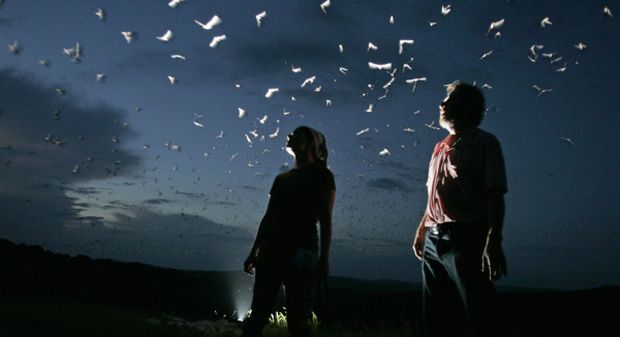
Inside the ------------ - NSF photoWhat in the world is that? Put your guesses in comments.

(Update:  Answer here.)


Arco, Idaho: Stop and see the first peaceful use of atomic power

August 20, 2007

Nils Ribi is a city councilman in Sun Valley, Idaho, who blogs (public officials who blog, really, is probably a good trend).

Ribi urges that if one should find one’s self driving the highways of Idaho, one might want to stop at the nuclear reactor where electricity was first generated — the first peaceful use of atomic power in the world.

If you are driving the highway between Arco and Idaho Falls, take the time to stop and visit the EBR-1 site that is open to the general public. In 1951 it became the first power plant to produce electricity using atomic energy. It has been nicely restored as a historical site and is well worth the stop, although it is not quite like looking into an operating reactor. The kids will enjoy it too.

His blog features photos of recent forest fires in the area, some of which are starkly beautiful.

Castle Rock fire, near Sun Valley, ID - photo by Nils RibiPhoto of helicopter fighting the Castle Rock Fire near Sun Valley, Idaho, by Nils Ribi.


Typewriter of the moment: Faulkner, again

August 15, 2007

The previous photo showed Faulkner himself using the machine.

It was a desktop machine. This color shot shows Faulkner’s portable typewriter, a different machine from the one in the publicity still from 1954.

William Faulkner's typewriter, displayed at his home in Oxford, Mississippi; photo by Gary Bridgman

Photographer Gary Bridgman provided a thorough history and explanation, at the Wikipedia Media site, which I quote completely and directly — bless him for the story:

The “Faulkner portable”: American novelist William Faulkner’s (1897-1962) Underwood Universal Portable typewriter, resting on a tiny desk his stepson helped him build. This space at Rowan Oak, the author’s home, was part of the back porch until Faulkner spent part of a Random House advance to enclose it in 1952, long after he had written his seminal Compson and Sartoris family novels. He insisted that this room not be called his “study.” According to biographer Joseph Blotner, “he did not study in it, so there was no sense in calling it that. It was the ‘office,’ the traditional name for the room in the plantation houses where the business was transacted.” As to the typewriter itself, Underwood introduced its Universal Portable in the mid-1930s among a full line of portables such as Champion, Noiseless Portable and Junior. Faulkner had a habit of buying used portables locally, wearing them out, then trading them in on more used portables. This Underwood was one of at least three typewriters in Faulkner’s possession at the time of his death (the University of Virginia has one, too). So, this is no more “the” typewriter any more than those square carpenter’s pencils next to it are “the” pencils. Had Faulkner lived a few more years, this machine would have met the same fate as the rest. Still, the room has a resonance. BOOK magazine was publishing an article of mine on “Yoknapatourism,” and thinking (mistakenly) that the editors hadn’t already selected a photographer, I returned to Oxford on a rainy October afternoon to make my own pictures for submission. The travel piece was eventually illustrated with sunny-day brochure shots, but I was happy to keep this one for myself. There was no direct lighting within the office, so I let the film take its time, soaking up faint incandescent glow from the library and main hallway, which neatly balanced the cloudy daylight. I used the camera’s timer so my hand wouldn’t jostle the tripod, and I even backed out of the room–in part to let the scarce light do its work and, I think, because I wanted Faulkner’s office truly vacant.

Trivia: the book next to the typewriter is the 1939 edition of Writer’s Market. Thanks to Bill Griffith, curator of Rowan Oak, for letting me past the Lucite wall and to Milly Moorhead West for lending me the tripod. – Gary Bridgman

Photo by Gary Bridgman, southsideartgallery.com.


Power of a community with common purpose

August 12, 2007

There is a lesson in here about common purpose, maybe even one about democratic action as opposed to a rigid patriarchy (though I confess, I don’t know that water cape buffalo don’t also have a rigid patriarchy).

In any case, the large, gentle creatures beat out two competing, sharp-toothed predators, to save a calf. Parents uniting can do great things.

Amazing video, really:

Tip of the old scrub brush to Telic Thoughts — the most thoughtful post they’ve had there in some time.


Bubba, we’re not in Texas anymore . . .

August 11, 2007

Among other reasons people shouldn’t inject religion into biology is that knowledge of biology can protect one from harm. From Dorigo, at A Quantum Diaries Survivor, in this case, a little mycological knowledge is not only useful to prevent illness, it allows appreciation of beauty:

This morning while following the trail to Malga Nemes, above Passo di Montecroce Comelico, we found a spot of the woods very densely populated with specimens of Amanita Muscaria, a venomous mushroom which has a very esthetic appearance. The intense red color of the cap, covered with white warts, is very distinctive.
Here is a trio which was particularly good looking:

Definitely NOT Texas.

Dorigo is a physicist, and usually very interesting. Don’t take my word for it — go check out his blog.


A Scout is . . . Friendly, Courteous, Kind . . . Reverent: 100 years of Scouting

August 4, 2007

Scouts at the World Jamboree renew their oaths, Wednesday, August 1, 2007

  • Scouts from many nations renew their oaths, August 1, at Brownsea Island, off the south coast of England — the 30th World Jamboree of Scouting, marking the founding of Scouting 100 years ago. Photo by Ron Neal, AFP/Getty Images.

The rowdies who like to claim all shows of manners are just ‘wussy PC boojum’ got their knickers all atwist because Scouts at the 30th World Jamboree eat vegetarian.

Why not? It’s a World Jamboree. If the menu that best fits Scouts from 80 nations is vegetarian, why not? In the U.S., the fourth, fifth and sixth points of the Scout Law are “Friendly, Courteous, Kind.” If the menu offends a quarter of the Scouts, can they live up to those three points of the law? What about the twelfth point, which says a Scout is Reverent, especially to the religious views of others?

Here’s the post that set me off, at Innocent Bystanders.  (And here’s the same sort of bluster at a very Scout-unfriendly site — warning, site contains cheesecake NSFW.)

Here’s the news story from ThisIsLondon.com that probably inspired that post: “Scouts banned from eating burgers and bangers — because of religious belief.”

Here’s the AP story in the Bryan-College Station Eagle, in Texas, that notes the fire ban at the Jamboree:

LONDON – Scouts around the world celebrated the 100th anniversary of their movement Wednesday, but those at its birthplace couldn’t show off one of their fundamental skills – firebuilding.

While observances took place from the Kingdom of Bhutan to Ecuador, the symbolic focus was on Brownsea Island, off the coast of southern England. That’s the site where Robert Baden-Powell organized a camp for 20 boys that developed into the worldwide Scouting movement.

Baden-Powell, a lieutenant-general in the British army, organized that camp to teach boys outdoor skills and physical fitness. He detailed the experiences in a book called Scouting For Boys, and the movement gained footing when boys organized themselves into groups, persuaded adults to become their leaders and used Baden-Powell’s ideas as the basis for camps, treks and other activities.

Older girls were allowed to join during the 1970s. Membership was extended to all girls, ages 6 to 25, in 1991.

“When [Baden-Powell] first ran the camp, he brought together different social classes from public schools and less fortunate backgrounds,” said scout Jon Grimes, 19. “It was about crossing the social divide and making friends. Our camp this year will be about making friends between people from different cultures.”

But unlike Baden-Powell’s boys, today’s Scouts are banned from lighting campfires on Brownsea Island. The National Trust acquired the island in 1962 and forbids fires in order to protect the wildlife.

The campfire ban did not dampen the spirit of the 300 Scouts on Brownsea Island who celebrated the centennial canoeing, hiking, making pottery, learning archery and participating in workshops.

Our troop, Troop 355, didn’t send anyone to the World Jamboree, but five boys have already attained their Eagle rank this year — we had an Eagle Court of Honor this afternoon. Scouts devised several interesting ways to celebrate the 100th anniversary of Scouting, regardless of where they are:

Some centennial celebrations began as early as Saturday, when Prince William opened the 21st World Scout Jamboree, in eastern England, with 40,000 youngsters from more than 160 countries.

Scouts from around the world are taking part in events. About 1,000 Scouts are cooking a huge campfire breakfast in Namibia, and groups from all over Malawi will be camping at the top of Mulanje mountain, one of the highest peaks in Africa.

Scouting in the U.S. marks its centennial in 2010.

Other coverage:


Collateral damage from magic bullets

July 22, 2007

In an earlier post I noted Norman Borlaug’s receiving the Congressional Gold Medal. In comments, Bernarda noted those who disagree with the claim that Borlaug’s Green Revolution was much of a benefit, or perhaps more accurately, those who note the problems that result from such advances — and there are many. Bernarda pointed to a BBC lecture from Vendana Shiva, detailing the problems that Punjab experienced as a result of governmental and society structures unable to deal with the changes required by high-yield crops: “Poverty and Globalisation.” It’s worth a read or a listen.
Similarly, in another BBC lecture in that series, Gro Harlem Bruntland details problems from “progress” that includes cutting the forests, in “Health and Population.” Relevant to other discussions here, she notes a rise in malaria due to deforestation, raising an issue that the junk science purveyors opposed to Rachel Carson’s honoring would like to ignore. Here is a small excerpt of her talk — note that deforestation is not a problem that more DDT can solve:

Gro Harlem Bruntland:  Recently, in Mozambique, I saw children with their eyes glazed with fever from a malaria that could have been prevented if their parents could afford bed nets. Deforestation had changed malaria from a nuisance to a curse in a matter of twenty years. 

Gro Harlem Brundtland, former Director General of the World Health Organization (WHO). Wikiquote image.

Gro Harlem Brundtland, former Director General of the World Health Organization (WHO). Wikiquote image.

More people are suffering from this killing and debilitating disease now than ever before, and deforestation, climate change and breakdowns in health services have caused the disease to spread to new areas and areas that have been malaria-free for decades, like in Europe.

In the Philippines, I have watched how beggars sit exhausted on the pavements convulsed with coughing. Tuberculosis, which we long believed had been brought under control by effective treatment, is on the rise again. Increasingly, we see forms of tuberculosis which are resistant to all but a very expensive cocktail of drugs.

I think that HIV/AIDS may be the most serious threat to face sub-Saharan Africa and other developing regions. space. Already, the AIDS epidemic is the leading cause of death in several African countries. AIDS has reversed the increases in life expectancy we have seen over the past thirty years. The social and economic devastation in countries that could lose a fifth of their productive populations is heart-rending.

I believe we are facing this alarming situation largely because of an outdated approach to development. Our theories have to catch up with what our ears and eyes are telling us – and fast.

There was a period in development thinking – not so long ago – when spending on public services, such as health and education, would have to wait. Good health was a luxury, only to be achieved when countries had developed a particular level of physical infrastructure and established a certain economic strength. The implicit assumption was that health was to do with consumption. Experience and research over the past few years have shown that such thinking was at best simplistic, and at worst plainly wrong.

I maintain that if people’s health improves, they make a real contribution to their nation’s prosperity. In my judgement, good health is not only an important concern for individuals, it plays a central role in achieving sustainable economic growth and an effective use of resources.

As in Europe at the end of the 19th and beginning of the 20th century, we have seen that developing countries which invest relatively more, and well, on health are likely to achieve higher economic growth.

In other words, malaria prevention grows on trees, or malaria grows with the cutting of trees.


News from Texas: Tech Meat Team wins national championship

July 19, 2007

Traveling Texas produces its own joys. In the past couple of weeks I’ve been through Wichita Falls, Amarillo, Dalhart, Eastland, Weatherford, Abilene and Lubbock, and a couple score of towns in between.

I loved this headline last week in Texas Tech’s newspaper, The Daily Toreador: “Meat Team wins national championship.”

Who knew there is intercollegiate competition in meat judging? Why isn’t this on ABC or ESPN?

Humor aside, in beef states such skills are critical. Since I love a good steak more than the average person — and I love a good roast beef at least as well — this is the sort of competition I would probably take some interest in, were it covered in daily media outside the affected universities. The team from Tech deserves wider recognition, it seems to me, and I wish Texas newspapers like the Dallas Morning News and Houston Chronicle would give regular coverage to such achievements — not to mention the Lubbock Avalanche-Journal (is that a great name for daily newspaper, or what?)

The competition was held at the 60th annual Reciprocal Meats Conference, at South Dakota State University. Tech’s winning team had to beat another Tech team to get to the championship round, and there they faced another Texas team from Angelo State University in San Angelo (I haven’t made it there yet, this year).

Tech’s two three-person teams began the competition strong, neither losing a round until they faced each other. The team of Megan Mitchell, Travis Chapin and Austin Voyles came out on top, with O’Quinn, Landi Woolley and Matt Sellers falling into the consolation bracket. Because it was a double-elimination competition, each team had to lose twice to be out of the contest.

The Mitchell, Chapin and Voyles team lost one of their rounds later, leaving both teams in the consolation bracket. Winning their way through the consolation bracket, the two teams eventually faced each other once again, and this time O’Quinn, Woolley and Sellers won. They ended up competing against Angelo State University in the finals and emerged victorious.

“It wasn’t really like two teams,” O’Quinn said. “It wasn’t like one Tech team won and the other Tech team lost. It’s just a matter of formality. If all six of us could have been on one team, we would have. We consider ourselves all one team. The Tech team won.”

Rogers noted that combined the teams only lost three rounds.

“Two of our losses were to our own team,” she said. “It really was a group win.”

It was the third national championship for Tech in the competition in the past six years.

Don’t laugh.  Does your university even have a meat judging team?

And while in Lubbock, I had a great chicken-fried steak at River Smith’s. Eat the local fruits, I always say.


Lewis & Clark: Enrichment sources for teachers and students

July 17, 2007

David Horsey of Seattle P-I, on the Lewis and Clark expedition

David Horsey is an editorial writer and cartoonist for the Seattle Post-Intelligencer — he won the Pulitzer Prize for editorial cartoons.  In 2005, the 200th anniversary of the Lewis and Clark Expedition, he retraced the path of the explorers from the Continental Divide to the Pacific.  Horsey photographed his journey, wrote about it, and made drawings.

This is a rich resource for anyone studying the opening of the West, and especially the Lewis and Clark Expedition, exploring the territory included in 1803’s Louisiana Purchase. Let’s hope the Seattle Post-Intelligencer keeps the site available for teachers and students.

Illustration by David Horsey, Seattle Post-Intelligencer.


Another reason why DDT use damages mosquito control: Bats

July 9, 2007

Erich Schlegel photo, bats leaving a cave near Frio, Texas, U of Tenn researchers look on

UTenn grad student Noa Davidai (L) and Prof Gary McCracken watch bats come out of Frio Cave

  • Photos by ERICH SCHLEGEL/DMN

University of Tennessee graduate student Noa Davidai (left) and professor Gary McCracken watch freetail bats emerge from the Frio Cave near Uvalde, Texas. They study the range and value of bats, such as insect control for farmers. And ‘fecal rain’? That enriches soil, Dr. McCracken says. (Dallas Morning News, July 9, 2007, p. 1)

It’s easy to understand. Look at the on-line Dictionary.com definition of the Mexican free-tailed bat, for example:

Mexican free-tailed bat

–noun

any of several small, insect-eating bats of the genus Tadarida, of Mexico and the southwestern U.S., inhabiting limestone caves: residual DDT has reduced most populations.

Dictionary.com Unabridged (v 1.1)
Based on the Random House Unabridged Dictionary, © Random House, Inc. 2006.

Was that difficult? It’s right there in the definition of the animal: DDT kills bats.

Bats eat mosquitoes, those things that carry malaria and other diseases. A Mexican free-tailed bat eats about 70% of its body weight in mosquitoes, every night.

This morning’s Dallas Morning News has a front page story, with great photo, on the value of bats in Texas, “Taking bats to the bank.”

Researchers have long known that bats in Texas caves dine on insect pests. But just how many bats there are and the value of their feeding had proved elusive until a five-year, $2.4 million National Science Foundation study by scientists from Boston University, the University of Tennessee, the U.S. Department of Agriculture and Texas Parks and Wildlife.

From sundown to sunup, the freetail bats consume a staggering 400 metric tons of insects a year in the Winter Garden, or 2 million pounds each night. They range over a radius of 75 miles and feed from ground level to 10,000 feet.

The bats help save $1.7 million annually by preventing crop damage and additional pesticide use in the eight-county Winter Garden, which produces $6 million in cotton each year, according to the report by the Boston University team.

“Most people think of bats as ugly or vile, but there is a real value they provide humankind,” said principal investigator Tom Kunz of Boston University. “The bats are a literal shield for this crop region. But until this project, no one developed a means to measure the specific economic value of bats to agriculture.”

From my experience with agriculture, that $1.7 million figure looks low, way low. Scientific studies like this tend to be very conservative, though, so we can say with great confidence that this is a floor figure.

DDT kills bats, and those bats who don’t die from eating DDT-laced insects often provide meals for predator birds, who then get a greater dose of the next-generation-killing chemical.

Studies have shown that the pesticide DDT often used by farmers in the 1950s and 1960s may also have led to the depletion of large numbers of Mexican free-tailed bats (Clark).The Carlsbad Caverns colony decreased steadily in size from nearly 20 million down to only a couple hundred thousand during the 1960s due to DDT use (Wilson 110).A study in 1974 documented levels of the toxin in fat stores the bats would accumulate before migration, and found that when those fat stores were metabolized during the long flight, DDT levels were high enough to kill many of the bats (Wilson 110).In addition, DDT ingested by mother bats was passed along to their young causing most of them to die before reaching maturity (Wilson 110).Clark’s follow up study in 2001 also showed levels of DDT in bat specimens from the 1950s and 1960s to be considerably higher than in specimens from later decades (Clark).These kinds of toxin levels would account for the dramatic decrease in the Carlsbad bat population.

All of this adds up to a conclusion that critics of Rachel Carson who make the wild claims that DDT is harmless, and that but for DDT mosquito control would have been achieved, and therefore malaria would be wiped out do not have a clue what they are talking about, and probably have some skullduggery in mind when they go after Rachel Carson. Ironically, overuse of DDT actually benefits mosquitoes in the U.S., killing the predators of mosquitoes and other crop and human pests, allowing the mosquitoes to breed and feed uninhibited.

In her book Silent Spring, Rachel Carson had noted a pesticide spill in Austin, Texas, which occurred in 1961 and virtually cleaned out all the fish in the Colorado River downstream — fish, of course, prey on mosquito larvae. DDT use in Texas, therefore, hammers mosquito abatement possibilities at both ends. Read the rest of this entry »


Buy a piece of a National Forest, help fund schools

July 8, 2007

I’m trying to figure out how to use this amazing spectrum of maps in class.

But, one set can do something good for schools:  You can buy a piece of a national forest, and thereby contribute to a fund to help schools.  It’s a bit of a crackpot idea, really — selling off the national forests to provide a minuscule amount of money for schools.  But there may be some gems of land out there that could be used for  .  .  . decreasing global warming by creating a preserve for trees.

Davey Crockett National Forest, parcels for sale:  This map shows land in Texas for sale.

Your local National Forest may be represented, too.  Get there before the developers?  Not likely — but you can dream, can’t you?

Please be warned, though, I find the site a real memory hog.  If you’re running several programs, and you’re memory deficient as I appear to be for this set of maps, be careful.

Seriously, the site offers a variety of maps of public lands under the jurisdiction of the Bureau of Land Management and National Forest Service.  Mineral leasing, oil and gas, coal, and other resources are mapped.  This affects the western public lands states mostly, but it could be a great source for a geography project on energy or mineral or timber resources for the nation.

What do you think?


Image of the moment: San Francisco de Asis without Adams or O’Keefe

July 6, 2007

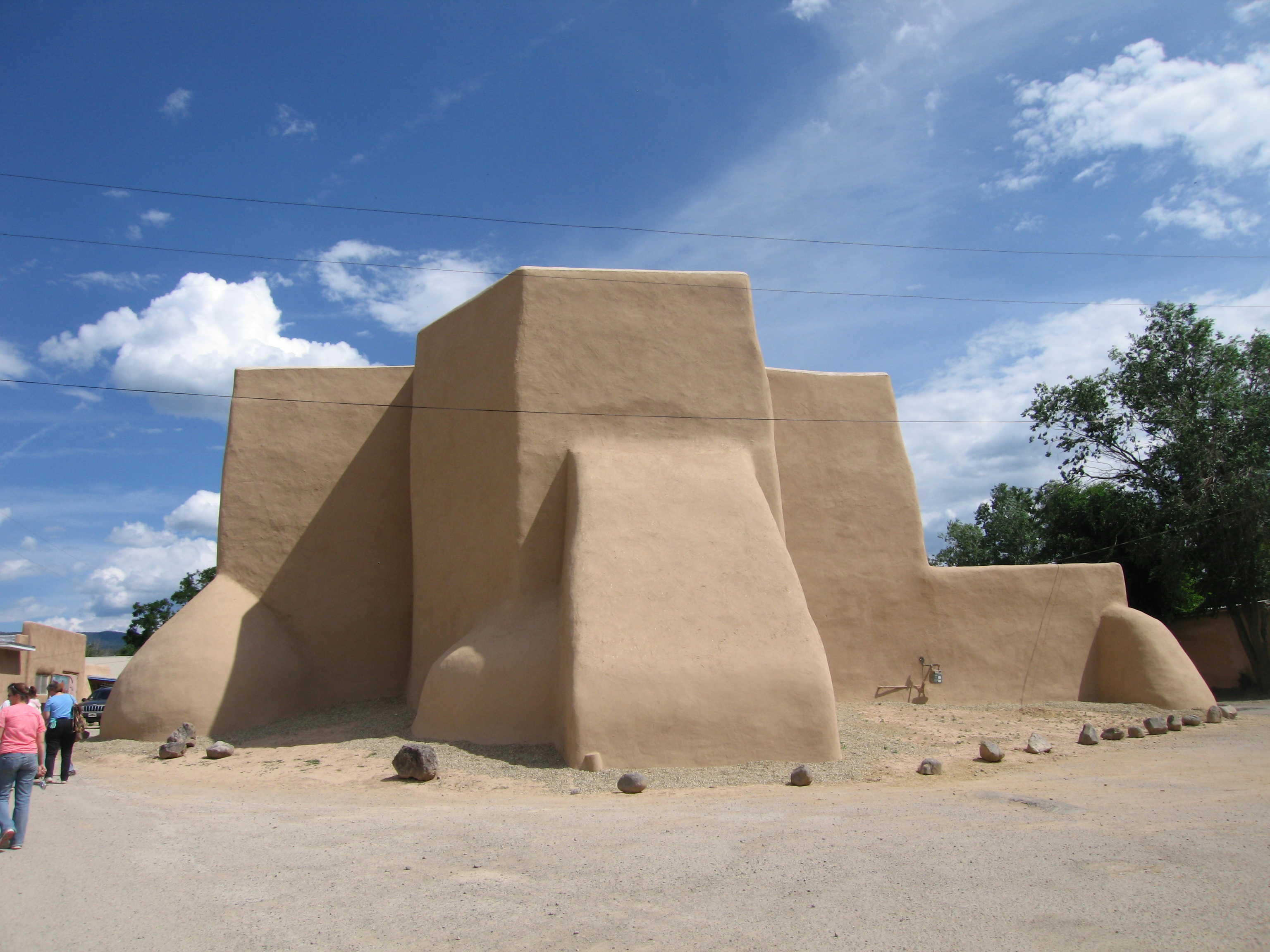
Neither Ansel Adams nor Georgia O’Keefe noted the power lines, or the gas meter.

They must be recent additions.

The essential beauty of the church remains.

1549-san-francisco-de-asis-church-in-taos-july-5-2007.jpg

The original adobe construction of the church was completed in 1772 — four years prior to the Declaration of Independence. It is built in the shape of a cross, but structural weaknesses required the addition of buttresses, shown in the photograph — also of adobe.

A bad photograph of the church is almost impossible.

The interior is cool on a hot afternoon. Adobe construction offers significant advantages, even in the 21st century. The church hosts an active congregation, without air conditioning.

Photo: Copyright 2007, Ed Darrell; you may reproduce for educational or non-profit use, so long as attribution is attached. Attribution must be attached.

Welcome, visitors!  Please leave a comment, at least tell why you visited, and where you’re from.  Thank you.


Electronic imaging: Photography

July 6, 2007

If you care about such things and have been paying attention here, you may have noted that I do not often post material from my electronic camera. The reason is simple: I’m stuck in the film age.

We have four single-lens reflex cameras, and a couple of other 35mm film-using cameras that served us well for the past 30 years or so. We have some wonderful images, and lots of snapshots. An early experience with electronic images suggested the color might not be as good in purely electronic images, and of course, the detail . . .

Well, I borrowed son Kenny’s Canon PowerShot S70 for the current trip to New Mexico, and I think the results are spectacular. In only one category have I found a flaw: Extreme telephotography.

My thought is that teachers should get a good digital camera for use in creating images for classroom and internet use. No, not the clunky things most schools had that I’ve seen in the past four years — a good Canon or Nikon, or Sony or Fuji or Panasonic, or Kodak. Budget to update every two years or so for the school (the camera I’m shooting with is more than two years old, though).

There’s just no substitute for good images in teaching.

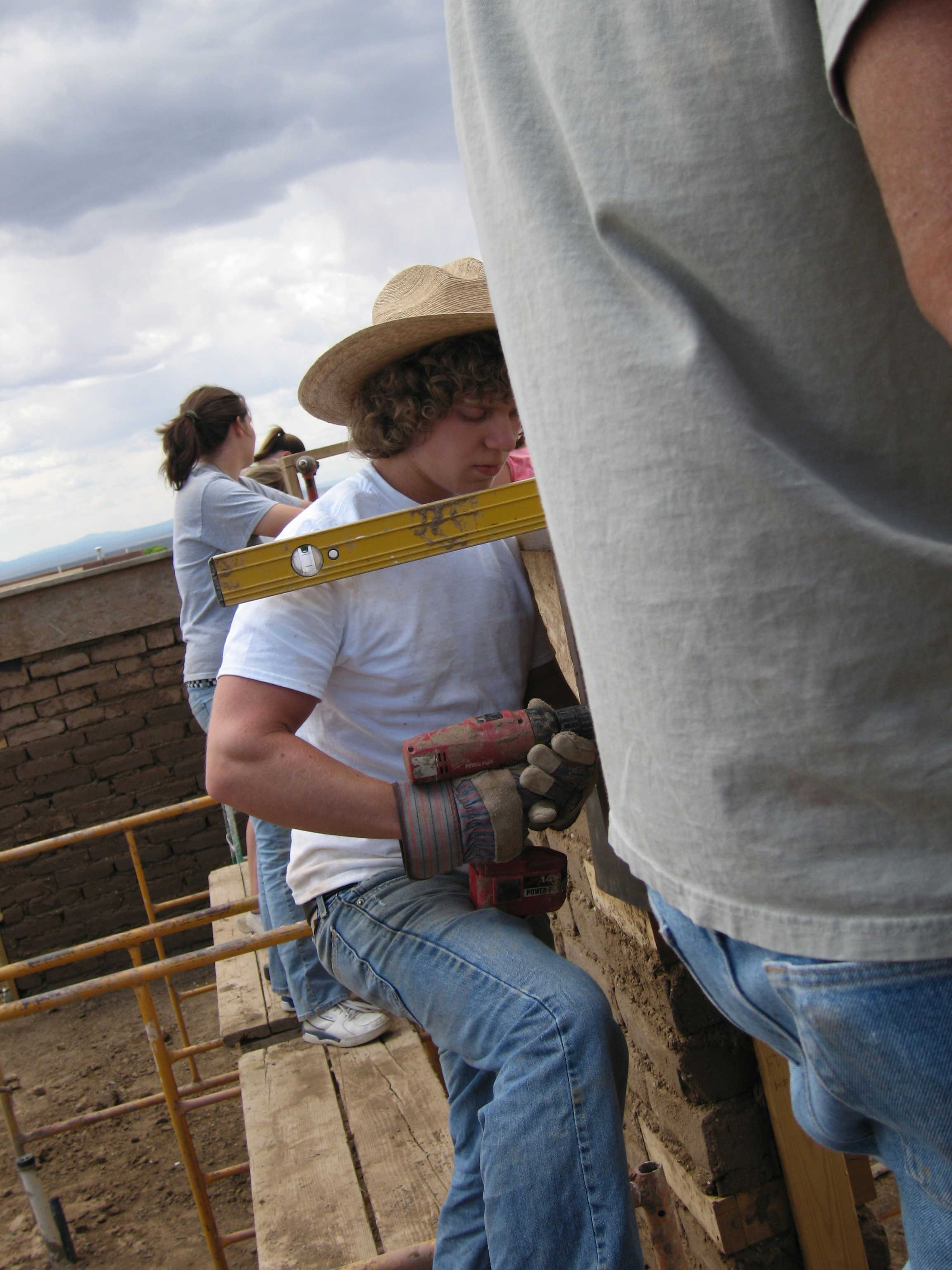
Student applies lessons in building with adobe, in Taos, New Mexico fieldtrip

Photo taken 12 hours ago, on July 5, 2007, of student James Darrell applying lessons in building with adobe, in an adobe house under construction in Taos, New Mexico.  Photo taken while photographer was balanced precariously atop a ladder and holding concrete forms.  Copyright 2007, Ed Darrell


Taos is beautiful this time of year

July 3, 2007

Posting is light — I’m on the road and relatively incommunicado. We’re in New Mexico, building houses with Habitat for Humanity. It’s great stuff.

Taos adobe wall

Adobe construction is amazing. It’s hitting 90 degrees Fahrenheit here by noon — adobe houses, without air conditioning or forced air of any kind stay cool well into the afternoon. Amazing.

My apologies for light posting; comment away on the stuff that is here. I’m running a few posts from the past that deserve wider audience (and more comment). And I’ll try to post from the road. So much to see and say.

  • Photo of adobe wall in house under construction in Taos, New Mexico.  Copyright 2007 by Ed Darrell.  Feel free to use it, with attribution.

Photos of a hoax: The Cardiff Giant

July 2, 2007

David Carlson's pinhole camera photo of a sign promoting the Cardiff Giant

The Cardiff Giant was a great hoax of the 19th century. George Hull, a cigar maker in upstate New York, hired a Chicago sculptor to make a large statute of a man. He then buried the statue on a friend’s farm, and year later hired workmen to dig a well where the statue was buried, and of course the well-diggers “discovered” the statue. Hull’s intent was to hoax Bible literalists who talked about giants in the ground, based on Genesis 6:4.When the statue was discovered, it was claimed to be a petrified giant, evidence of giants living in America. The stone piece was put on traveling display.

The hoax was discovered. That only increased the desire to see the statue, and the price to see it was raised. P. T. Barnum tried to buy the thing, and when his offer was refused, initially he created a hoax of the hoax for his own display.

The Cardiff Giant is on display today at the Farmers Museum in Cooperstown, New York (also home of the Baseball Hall of Fame). Barnum’s fake fake is on display at Marvin’s Marvelous Mechanical Museum, Farmington Hills, Michigan.

Cardiff Giant on display at Cooperstown, New York

The photo at top was created with a grant from the Vermont Council on the Arts by David Carlson, whose website is here (his work is for sale — some of the photos would be good conversation starters in history classrooms) It’s a photo made with a pinhole camera, a camera without a lens. The second photo is from Roadside America, showing the Cardiff Giant as displayed today.