From our public lands, from the Twitter feed of the U.S. Department of Interior:
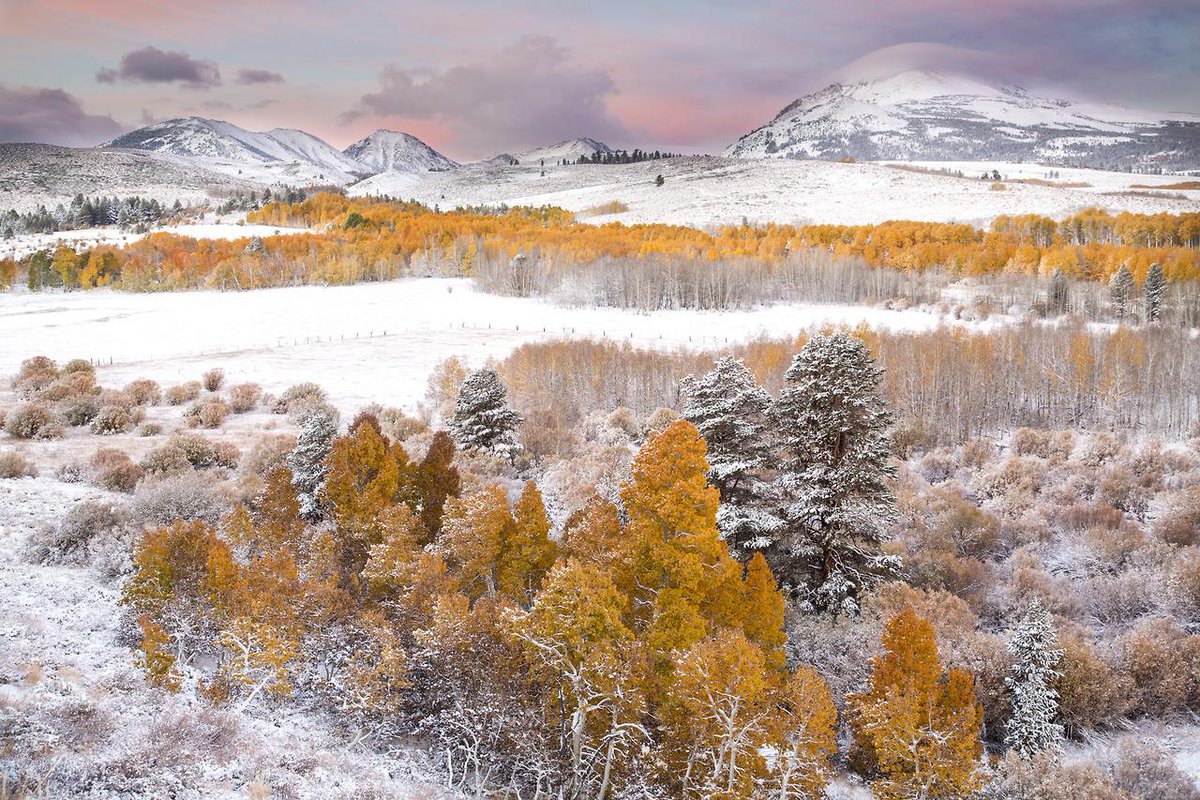
@Interior caption: Fall foliage and snow-capped peaks make for a stunning shot of Conway Summit #California @BLMca #nature
In my winter drives through the desert mountains of the Great Basin I often marveled at how a dusting of snow could turn a landscape generally painted in tones of brown with a little green into almost black and white. Then there are those black and white landscapes slashed by stunning gashes of color, or tinted subtley.
Conway Summit shows the stunning gashes of color this week. Grays, whites, blacks — and gold and pink. It’s in the western part of California, near Nevada and Mono Lake:
Conway Summit is named after John Andrew Conway, a settler in the area in 1880.[3][4] Geographically, it was formed from an upland plateau by the sinking of the land in the Mono basin area.[5] The Sawtooth Ridge of the eastern Sierra Nevada, topped by 12,279-foot (3,743 m) Matterhorn Peak, rise to the west of the pass; Green Creek and Virginia Lakes, in the Sierra Nevada to the west of the pass, are two local destinations for fishing, camping and aspen trees. The Bodie Hills and the infamous Bodie ghost town lie to the east.
This scene comes from our public lands, the undifferentiated lands held in trust by the Bureau of Land Management (BLM) and managed for multiple uses. You and I may look at this photo and marvel at the beauty of America, and say a little prayer of thanks for our public lands. Sens. Mike Lee and Ted Cruz see potential for high-dollar vacation residences throughout this scene, if only the land could be sold off.
Spread the word; friends don't allow friends to repeat history.
Philmont caption: A view of the Philmont sky this weekend! The Tooth of Time is visible in the lower right corner. We have a Canon 5D Mark II with a 16-35 2.8 lens. The exposure was 30 seconds. Bryan Hayek took the photo.
Milky Way viewed from the National Scout Ranch at Philmont, New Mexico.
I took more than 10,000 photos during the making of this of which 6-7000 made the final cut. Itwas filmed mainly in and around Edinburgh but also includes some scenes from the Glencoe area.Music licensed by: “Moonlight Reprise” by Kai Engel (http://kaiengelmusic.wix.co…)
Tip of the old scrub brush to CBS News Twitter feed. Thanks to Mr. Jackaman for putting it up on YouTube, also. It deserves more than 3,196 views.
Spread the word; friends don't allow friends to repeat history.
Yosemite National Park, Facebook site: About forty members of U.S. 6th Cavalry, Troop F, shown mounted on, or standing beside their horses, and lined up atop and beside the Fallen Monarch tree in the Mariposa Grove of Giant Sequoias, Yosemite, 1899.
Giant sequoia trees can be found only in the United States, and only in or near the Sierra Mountains in California.
How massive are they? The tree above, with the 6th Cavalry’s F Troop posing on and around it with their horses, is 26 feet in diameter at its base, where it fell, and 285 feet long, Redwood doesn’t rot like other woods. The tree is still there, today, looking much like it did 115 years ago (Comments on Yosemite NP photo).
The Fallen Monarch, in Mariposa Grove, in 1907:
Fallen Monarch, Mariposa Grove of Yosemite NP, in 1907, with a stage coach and team of six horses posing on top.
When did the tree fall? Hundreds of years ago, perhaps?
Making those nice photographs of the Milky Way and stars isn’t so easy as it looks.
I made my most successful efforts on our recent swing through Colorado, New Mexico and West Texas. Here’s a shot I got that almost shows the Milky Way, probably has Polaris in it, and because it was a timed exposure, also captured star movement and an airplane flying overhead. Photo was taken from the Army Corps of Engineers campground at Abiquiu Reservoir, a few miles from Georgia O’Keefe’s home.
Abiquiu Stars – Time photograph of stars against a pinon pine, pointing north; Milky Way almost visible in the East.
Spread the word; friends don't allow friends to repeat history.
History item: On July 8,1853 four black ships led by USS Powhatan and commanded by Commodore Matthew Perry, anchored at Edo (Tokyo) Bay. Never before had the Japanese seen ships steaming with smoke. They thought the ships were “giant dragons puffing smoke.” They did not know that steamboats existed and were shocked by the number and size of the guns on board the ships.
President Millard Fillmore, defying H. L. Mencken’s later, crabby, hoax claim of do-little-government, sent Matthew C. Perry to Japan to open Japan as a refuge for shipwrecked sailors, and as a coaling stop for steamships. For the previous 200 years, Japan had been closed to all but a few Dutch and Chinese traders. On July 8, 1853, Perry’s small fleet sailed boldly into restricted waters of Japan and anchored.
Delivering the American presents to the Emperor of Japan, at Yokohama. A. O. P. Nicholson image, 1856 publication, “Narrative of the Expedition of an American Squadron to the China Seas and Japan” – artist not identified (Washington, A. O. P. Nicholson, 1856); Nimitz Museum, Annapolis. A list of the presents can be seen at a link near the end of this post; some of the gifts, such as the model of the steam engine, can be identified in this picture.
After some contretemps, which included Japan’s telling Perry to go to Nagasaki instead (where a military party was probably waiting) and Perry’s shelling a few buildings on shore, the Emperor accepted the letter from President Fillmore. Perry told the Emperor he would return the following year for an answer. Perry returned on March 8, 1854, and within a month concluded the Convention of Kanagawa, opening Japan to trade from the west. Generally unheralded, this may have been one of the more important pieces of U.S. diplomacy in history, especially considering the dramatic rise of Japan as an economic and military power, on the basis of the trade Commodore Perry demanded Japan engage in.
We should make special note of the chain of events over the following 85 or so years, culminating in World War II in the Pacific. Had Fillmore not sent Perry, had the U.S. not insisted Japan open itself to the world, would there have been an attack on Pearl Harbor, and war in the Pacific? Alternative histories we’ll never see. But see the discussion at Salon, in 2014, about this topic (conveniently leaving out Millard Fillmore’s role), “What sparked Japan’s aggression during World War II?”
Steam frigate U.S.S. Susquehanna, Matthew Perry’s flagship; the black hull won this small fleet a nickname, “the Black Ships.” Japanese Woodcut, from the University of Indiana
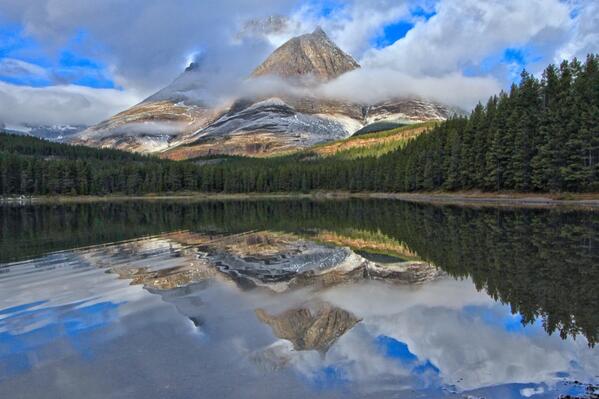
Department of Interior, May 18, 2014 — Here’s our most popular photo on social media last week celebrating @GlacierNPS 104th birthday. pic.twitter.com/JNaYYNnfcH
From @HistoricalPics: This is what a school in Afghanistan looks like. Be thankful for what you have. pic.twitter.com/Dsfva1yNb4
A school in Afghanistan — probably the entire school.
Learning can occur almost anywhere. Some children go to great lengths to get an education, to improve their lives where they are, or to improve their chances of finding a better place to live.
I’ll wager this school has no wi-fi, no in-school suspension, few homework problems, and no difficulty with Common Core State Standards.
Afghanistan’s schools all seem to offer amazing hurdles to education, by U.S. standards. Look at these photos.
A line of girls on their way to school. In Afghanistan most of the cities have limited number of schools which are mostly far away from students home. From Everything Afghanistan
BBC featured a story on the Afghanistan schools project. Caption here: Many Afghan schools are outdoors or in makeshift shelters on barren, dusty earth. (These photos from 2009; photos by Ramon Mohamed, a teacher from Broomhill, Sheffield, England.)
Another outdoor Afghanistan classroom. Photo from BBC
2010 post from Reality of Life in Afghanistan: “Eight years since the repressive Taliban regime was overthrown, 42 per cent children still do not attend or have access to schools. (Photo: RFE/RL)”
Those of us who advocate for outdoor classrooms generally have something else in mind than these photographs from Afghanistan show.
As best I’ve determined, the photographer is Prasit Chansareekorn, of Thailand. Obviously an amazing photographer. We might also presume the star over the summit is Polaris.
Or, until that account is unsuspended by the forces supporting Donald Trump: Follow @FillmoreWhite, the account of the Millard Fillmore White House Library
We've been soaking in the Bathtub for several months, long enough that some of the links we've used have gone to the Great Internet in the Sky.
If you find a dead link, please leave a comment to that post, and tell us what link has expired.
Thanks!
Retired teacher of law, economics, history, AP government, psychology and science. Former speechwriter, press guy and legislative aide in U.S. Senate. Former Department of Education. Former airline real estate, telecom towers, Big 6 (that old!) consultant. Lab and field research in air pollution control.
My blog, Millard Fillmore's Bathtub, is a continuing experiment to test how to use blogs to improve and speed up learning processes for students, perhaps by making some of the courses actually interesting. It is a blog for teachers, to see if we can use blogs. It is for people interested in social studies and social studies education, to see if we can learn to get it right. It's a blog for science fans, to promote good science and good science policy. It's a blog for people interested in good government and how to achieve it.
BS in Mass Communication, University of Utah
Graduate study in Rhetoric and Speech Communication, University of Arizona
JD from the National Law Center, George Washington University


 Posted by Ed Darrell









 Millard Fillmore's Bathtub