Hoaxing Congress: Claiming DDT as pixie dust

March 9, 2011

Tuesday morning, March 8,  the Republican-controlled House of Representatives Committee on Energy and Commerce opened hearings on global warming, staging an assault on science with a series of witnesses, some of whom recently have made a career out of mau-mauing scientists.

Dr. Donald Roberts' testimony to the House Committee on Energy and Power, on March 8, 2011, presented a grand collection of Bogus History, coupled with Bogus Science.

Dr. Donald Roberts’ testimony to the House Committee on Energy and Power, on March 8, 2011, presented a grand collection of Bogus History, coupled with Bogus Science. Roberts has an unfortunate history of presenting doctored data and false claims to Congress.

One witness took after the EPA directly and Rachel Carson by implication, with a specious claim that DDT is harmless.  Donald Roberts is a former member of the uniformed public health service.  Since retiring, and perhaps for a while before, he started running with a bad crowd.  Of late he’s been working with the Merry Hoaxsters of the unrooted Astroturf organization Africa Fighting Malaria (AFM), a group dedicated to publishing editorials tearing down the reputation of Rachel Carson, the World Health Organization (WHO) and the Environmental Protection Agency (EPA).

(That would all be purple prose, were it not accurate in its description of people, organizations and their actions.)

Here’s a link to Roberts’ written testimony at the committee website.

(Here’s a link to all the other written stuff from the March 8 hearing.) [April 27, 2015: These two cites now link to the Democratic Minority record; GOP site was moved or taken down.]

Why was Roberts testifying at a hearing on global warming?  He’s carrying water for the anti-science, “please-do-nothing” corporate crowd.  It’s a tactic from the old tobacco lobbyist book:  Roberts claims that scientists got everything wrong about DDT, and that the ban on DDT done in error has wreaked havoc in the third world.  Therefore, he says, we should never trust scientists.  If scientists say “duck!” don’t bother, in other words.

Roberts is in error.  Scientists, especially Rachel Carson, were dead right about DDT.  Because corporate interests refused to listen to them, the overuse and abuse of DDT rendered it ineffective in the fight against malaria, and DDT use as part of a very ambitious campaign to eradicate malaria had to be abandoned in 1965.  The entire campaign had to be abandoned as a result, and more than 30 million kids have died since.

So don’t grant credence to Roberts now.  He’s covering up one of the greatest industrial screw-ups in history, a screw up that, by Roberts’ own count, has killed 30 million kids.  What in the world would motivate Roberts to get the story so wrong, to the detriment of so many kids?

Roberts said:

Putting issues of EPA budget aside, I want to introduce my technical comments with a quote from a recent Associated Press article with a lead statement “none of EPA’s actions is as controversial as its rules on global warming.”  In my opinion, this is wrong.
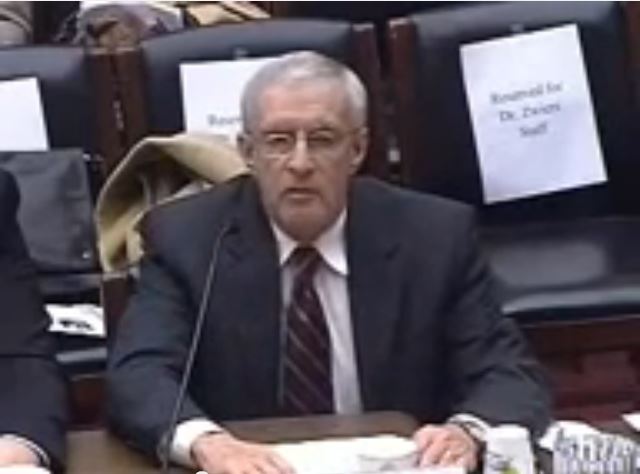
Dr. Donald Roberts testifying to the House Energy Committee, March 8, 2011. Screen capture from Committee video.

Dr. Donald Roberts testifying to the House Energy Committee, March 8, 2011. Screen capture from Committee video.

Roberts is correct here in his opinion.  It is simply wrong that EPA’s rules on global warming and controls of the pollutants that cause it should be controversial.  Among air pollution scientists the rules are not controversial.  Among climate scientists the rules are not controversial.  Roberts and his colleagues at the so-called Competitive Enterprise Institute, Africa Fighting Malaria (AFM), and American Enterprise Institute (AEI) work hard to manufacture controversy where the science does not support their case.

It is wrong.  Roberts should be ashamed.

Roberts said:

Almost forty years ago EPA banned DDT in the United States. Its action against DDT was extraordinarily controversial, and still is. As activists advanced fearful claims against DDT, the EPA was warned, over and over again, a ban would destroy critically important disease control programs and millions upon millions of poor people in developing countries would die as consequence. Leaders of the World Health and Pan American Health Organizations, and even the U.S. Surgeon General warned against the ban. The EPA banned DDT anyway, and the doomsday predictions of those public health leaders proved prescient.

Hmmm.  Roberts signed a “truth in testimony” statement — but that’s not the truth, even if no one paid him to fib.

EPA’s ban on DDT in the U.S. was limited to the United States.  Roberts doesn’t say it flat out, but he implies that the U.S. ban on spraying DDT on cotton fields in Texas and Arkansas — and cotton was about the only crop where DDT was still used — somehow caused a ban on DDT in Africa, or Asia, or South America, or other places where malaria still occurs.

Not so.

In fact, EPA Director William Ruckelshaus defied two federal courts who had ordered a complete ban on DDT use and manufacturing — and left U.S. manufacturing to continue for export markets.  This met all objections to the U.S. ban from all health officials.  DDT use could be allowed in the U.S. for health reasons, or for other emergencies (DDT was used in the Pacific Northwest against the tussock moth in 1974, after the “ban”).  Because U.S. DDT manufacturing was dedicated to export, the ban on domestic use of DDT effectively multiplied the stocks of DDT available to fight malaria, or river blindness, or any other insect vector disease.

I’m also not sure that health officials “pleaded” to stop the U.S. ban on any grounds, but certainly they did not plead with Ruckelshaus to keep spraying DDT on cotton.  Roberts is making stuff up in effect, if not in intent.

Probably more to the point, health officials had stopped significant use of DDT in Africa in 1965, seven years before EPA acted in the U.S., because overuse of DDT on crops in Africa had bred mosquitoes that were resistant and immune to the stuff. Since 1955, in close cooperation with the malaria-fighting experts from the Rockefeller Foundation including the great Fred Soper, WHO carried on a methodical, militant campaign to wipe out malaria.  The program required that public health care be beefed up to provide accurate malaria diagnoses, and complete treatment of human victims of the parasitic disease.  Then an army of house sprayers would move in, dosing the walls of houses and huts with insecticide.  Most malaria-carrying mosquitoes at the time would land on the walls of a home or hut after biting a human and getting a blood meal, pausing to squeeze out heavy, excess water to make flight easier.  If the wall were coated with an insecticide, the mosquito would die before being able to bite many more people, maybe before becoming capable of spreading malaria.

DDT was Soper’s insecticide of choice because it was long-lasting — six months or more — and astonishingly deadly to all small creatures it contacted.

But, as Malcolm Gladwell related in his 2001 paean to Soper in The New Yorker, Soper and his colleagues well understood they were racing against the day that mosquitoes became resistant enough to DDT that their program would not work.  They had hoped the day would not arrive until the late 1970s or so — but DDT is such an effective killer that it greatly speeds evolutionary processes.  In the mid-1960s, before an anti-malaria campaign could even be mounted in most of Subsaharan Africa, resistant and immune mosquitoes began to stultify the campaign.  By 1965, Soper’s crews worked hard to find a substitute, but had to switch from DDT.  By 1972 when the U.S. banned DDT use on cotton in the U.S., it was too late to stop the resistance genes from killing WHO’s anti-malaria program.  In 1969 WHO formally abandoned the goal of malaria eradication.  The fight against malaria switched to control.

Roberts claims, implicitly, that people like those who worked with Soper told EPA in 1971 that DDT was absolutely essential to their malaria-fighting efforts.  That could not be accurate.  In 1969 the committee that oversaw the work of the UN voted formally to end the malaria eradication project.  In effect, then, Roberts claims UN and other health officials lied to EPA in 1971.  It is notable that Soper is credited with eradicating malaria from Brazil by 1942, completely without DDT, since DDT was not then available.  Soper’s methods depended on discipline in medical care and pest control, and careful thought as to how to beat the disease — DDT was a help, but not necessary.

Interestingly, the only citation Roberts offers is to his own, nearly-self-published book, in which he indicts almost all serious malaria fighters as liars about DDT.

Can Roberts’ testimony be trusted on this point?  I don’t think we should trust him.

In fact, DDT and the eradication campaign had many good effects.  In 1959 and 1960, when DDT use was at its peak in the world, malaria deaths numbered about 4 million annually.  The eradication campaign ultimately was ended, but it and other malaria-fighting efforts, and general improvements in housing and sanitation, helped cut the annual death toll to 2 million a year by 1972.

After the U.S. stopped spraying DDT on cotton, mosquitoes did not migrate from Texas and Arkansas to Africa.  As noted earlier, the EPA order stopping agricultural use, left manufacturing untouched, to increase U.S. exports.  So the ban on DDT in the U.S. increased the amount of DDT available to fight malaria.

Malaria fighting, under Soper’s standards, required great discipline among the malaria fighters — the sort of discipline that governments in Subsaharan Africa could not provide.  Had WHO not slowed its use of DDT because of mosquito resistance to the stuff, WHO still would not have been able to mount eradication campaigns in nations where 80% of residences could not be sprayed regularly.

Advances in medical care, and better understanding of malaria and the vectors that spread it, helped continue the downward trend of malaria deaths.  There was a modest uptick in the 1980s when the parasites themselves developed resistance to the drugs commonly used to treat the disease.  With the advent of pharmaceuticals based on Chinese wormwood, or artemisinin-based drugs, therapy for humans has become more effective.  Today, the annual death toll to malaria has been cut to under a million, to about 900,000 per year — a 75% drop from DDT’s peak use, a 50% drop from the U.S. ban on farm use of DDT.

With the assistance of WHO, most nations who still suffer from malaria have adopted a strategy known as Integrated Vector Management, or IVM (known as integrated pest management or IPM in the U.S.).  Pesticides are used sparingly, and insect pests are monitored regularly and carefully to be sure they are not developing genetic-based resistance or immunity to the pesticides.  This is the method that Rachel Carson urged in 1962, in her book, Silent Spring.  Unfortunately, much of the malaria-suffering world didn’t come to these methods until after the turn of the century.

Progress against malaria has been good since 2001, using Rachel Carson’s methods.

Don Roberts’ blaming of science, EPA, WHO, and all other malaria fighters is not only misplaced, wrong in its history and wrong in its science, but it is also just nasty.  Is there any way Roberts could not know and understand the facts?

These are the facts Roberts works to hide from Congress:

  1. “Science” and scientists were right about DDT.  DDT is a dangerous substance, uncontrollable in the wild according to federal court findings and 40 years of subsequent research.  If we were to judge the accuracy of scientists about DDT, we would have to conclude that they were deadly accurate in their judgment that use of DDT should be stopped.
  2. If the ban on DDT was controversial in 1972, it should not be now.  All research indicates that the judgment of EPA and its director, William Ruckelshaus, was right.
  3. EPA was not warned that a ban on agricultural use of DDT would harm public health programs, in the U.S., nor anywhere else in the world.  In any case, EPA’s jurisdiction ends at U.S. borders — why would WHO say anything at all?
  4. DDT use to fight malaria had been curtailed in 1965, years before the U.S. ban on farm use, because overuse of DDT on crops had bred DDT-resistant and DDT-immune mosquitoes.  Consequently, there was not a huge nor vociferous lobby who warned that health would be put at risk if DDT were banned.  Claims that these warnings were made are either false or grossly misleading.
  5. Malaria death rates declined to less than 50% of what they were when DDT was banned from farm use in the U.S. — there was no “doomsday” because the U.S. stopped spraying DDT on cotton, and there never has been a serious shortage of DDT for use against malaria, anywhere in the world.

How much of the rest of the testimony against doing something about global warming, was complete hoax?

More:

[Editor’s note:  My apologies.  I put this together on three different machines while conducting other activities.  On proofing, I find several paragraphs simply disappeared, and edits to make up for the time of composing and fix tenses, got lost.  It should be mostly okay, now, and I’ll add in the links that disappeared shortly . . . oh, the sorry work of the part-time blogger.]

Update, 2015: Video of the hearing, from YouTube:


Roger Bate’s simple lie about DDT

January 22, 2011

In the last two weeks we’ve seen a virtual-world assault by Richard Tren, Roger Bate and Don Roberts, alternately telling fantastic tales about how Rachel Carson from beyond the grave organized a mass murder that rivals Joseph Stalin, or saying that environmentalists conspire to keep life-saving chemicals from getting to Africa and Asia.

This morning’s e-mail brought a release from the often-fact-challenged American Enterprise Institute, under the by-line of Roger Bate — “The UN’s Scientific Fraud Against DDT.”

Fraud?  That’s all on Bate.  Here are things Bate will not tell you:

  • No malaria fighting organization claims it needs more DDT.
  • DDT has never been banned in Africa, nor Asia.
  • If any nation wishes to use DDT to fight malaria, that nation need only write a letter to the World Health Organization informing WHO of that fact.
  • If anyone violates the Persistent Organic Pollutants Treaty (POPs) and uses DDT without telling WHO first, there is no penalty.
  • Malaria death rates are, now, at the lowest level in human history.  While there is a threat of a resurgence of malaria, the threat comes because the malaria parasites themselves develop resistant to the pharmaceuticals used to treat the disease in humans — no connection to DDT.
  • DDT use cannot stop malaria.  Consider:  India is one of two or three nations today who still manufacture DDT, and India uses more DDT than all the rest of the world’s nations put together.  Malaria is still a problem for India.
  • Beating malaria requires more than poisoning the hell out of Africa.

Roger Bate:  Walking science, history, law and policy fraud.  His claims are hoaxes.

Update: Tim Lambert at Deltoid looked at the claims of Bate and Roberts, and found that they appear to have made many errors in simple math and statistics.  Read about it here.


DDT: Zombie ideas of the right-winged and ill-informed

November 7, 2010

John Quiggin’s done with his book, Zombie Economics:  How Dead Ideas Still Walk Among Us.

Cover of John Quiggin's Zombie Economics

Cover of John Quiggin's Zombie Economics

Go buy a copy.  You will be happy you did.

Today, at Crooked Timber he’s looking at zombie ideas he was sure would eventually go away — like the bizarre, false idea that a lot more DDT should be used to fight malaria.

Is Quiggin ever wrong?


Quote of the moment: Lewis Carroll on Republican politics, climate skeptics, DDT advocates and creationism

October 26, 2010

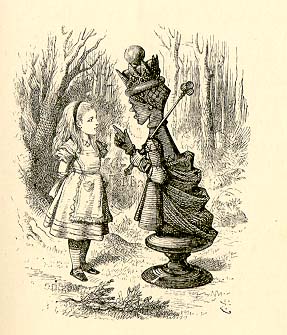
Alice and the Red Queen

Alice and the Red Queen – illustration by Sir John Tenniel

Alice laughed: “There’s no use trying,” she said; “one can’t believe impossible things.”

“I daresay you haven’t had much practice,” said the Queen. “When I was younger, I always did it for half an hour a day. Why, sometimes I’ve believed as many as six impossible things before breakfast.”

Charles Lutwidge Dodgson, writing under the name Lewis Carroll,
Alice in Wonderland, 1866

[Yes, the illustration is from Through the Looking Glass, 1871]


Called this one right: DDT advocates think poison is always the answer

October 25, 2010

This is a story about the persistence of bad information, and about the flow of news and other new information.

At about the same time I was writing about the Lancet study on potential undercounting of malaria deaths in India, Debora McKenzie at New Scientist pored over the same article (maybe the same Bloomberg News piece), and reported it in greater detail than I did here.  McKenzie’s piece is worthy of a read.

Glenn Reynolds, Instapundit

Glenn Reynolds, Instapundit

Glenn Reynolds at Instapundit picked up on McKenzie’s piece — but reflecting his pro-poison and anti-humanitarianism bias, he tacked on a gratuitous slap at health workers, scientists and governments who tried to eradicate malaria in the 20th century:

MALARIA KILLING MORE PEOPLE THAN WE THOUGHT?

Malaria has always been one of humanity’s biggest killers, but it may be far bigger than we realised. An unprecedented survey of the disease suggests that it kills between 125,000 and 277,000 people per year in India alone. In contrast, the World Health Organization puts India’s toll at just 16,000.

Other countries using similar accounting methods, such as Indonesia, may also be underestimating deaths from malaria. That means it could be killing many more than the WHO’s official estimate of nearly 1 million people a year worldwide, suggesting more money should be spent to fight it.

It’s too bad the malaria eradication efforts were allowed to fail.

“Allowed” to fail?  Reynolds assumes someone wanted the program to fail?  Reynolds assumes someone could have stopped the failure, other than the pro-DDT forces who overused the stuff and drove mosquitoes to evolve resistance, or other than the governments of Subsaharan Africa who could not mount massive health care campaigns due to the instability of their governments?  It’s too bad the program failed — it was mighty ambitious.  “Allowed to fail” is an undeserved slap at malaria fighters like Fred Soper.

This slip to finger-pointing is what I warned about in my post:  Though India is the world’s greatest manufacturer of DDT, and though more DDT is used in India today than the rest of the world combined, someone will look at the undercount story, blame the imaginary ban on DDT, blame Rachel Carson (who never advocated a ban on DDT), and make some smug political snark.

Reynolds was pulled away from the snark, fortunately.  Reader Kevin O’Brien wrote to Reynolds about  the difficulties of beating any disease, using smallpox as his launching point.  Beating smallpox was a massive effort, made easier by the fact that the pox resided only in humans, as opposed to the malaria parasite’s two-species life cycle.  O’Brien’s missive to Reynolds, a few errors included, is the best commentary Reynolds has had on DDT and disease in some time.

One frequently-obnoxious blogger pulled back from the brink is not enough, though.

Andrew Bolt

Andrew Bolt

Andrew Bolt jumped the shark at his blog for the Melbourne (Australia) Daily Sun.  The headline for his post is inflammatory and wrong, and warns us that most of what Bolt writes will be wrong:

How many children did Carson’s green lies kill?

Foolish hope that DDT could be a magic bullet against malaria, like Bolt’s,  helps frustrate workable plans to fight the disease.  Policy makers being convinced that some political conspiracy keeps DDT from working to beat malaria, in effect kills children.  Fighting malaria requires long, hard work, to bolster health care systems in entire nations, to accurately and quickly diagnose malaria, and to provide complete treatment to cure human victims.  That work is hampered by policy makers and popular opinion who hold that DDT would be cheaper and quicker, and effective.  Bolt takes any source, no matter how scurrilous, in his unholy condemnation of conservationists and scientists, especially Rachel Carson.  His sole source to condemn Carson is a publication from the far, far-fringe.

How many children will Bolt’s brown lies kill? one could ask.

I warned earlier:

Watch.  Advocates of poisoning Africa and Asia will claim scientists and environmental activists are somehow to blame for any underreporting, and they will call for more DDT use, claiming a ban has made India a refuge for malaria.  Those reports will fail to mention India’s heavy DDT use already, nor will they suggest an ineffectiveness of the nearly-sacred powder.

Andrew Bolt, you’ve made me a prophet — a saddened and disappointed prophet.  It’s good to see Glenn Reynolds step back from the brink of hysteria.  It’s too bad Bolt took the plunge.  Others will probably follow Bolt.

How far will the bad claims spread?


“3 billion and counting” — the errors one makes when using Howard Stern as a science advisor

October 7, 2010

“3 Billion and Counting” premiered at a tiny New York venue a couple of weeks ago, the latest skirmish in the War on Science. Physician-to-the-stars Dr. Rutledge Taylor claims that malaria could be eradicated if only DDT had not been banned from Africa.

What?  No, no, you’re right: DDT has never been banned from Africa, not even under the 2001 Persistent Organic Pollutants Treaty.  The film comes out of Hollywood, starring a Hollywood physician.  Perhaps that should clue us in that it is not a serious documentary, and not to be taken at face value.

Nor at any value.

Taylor engaged a publicist and conducted a national campaign to launch the movie.  In that campaign he someone appeared on Howard Stern’s radio show.  [There’s a guy in comments who claims it wasn’t Taylor, though Taylor wrote it in the first person.  Odd as hell.]

How silly are the claims in the movie?

A post at the movie’s blog revealed that Ronnie, Stern’s limousine driver, had a fight with bedbugs, and that Stern thinks DDT should be brought back.  That’s how bad this movie is:  Howard Stern is the science advisor.

Yes, yes, you’re right:  DDT stopped working against bedbugs in the 1950s (see Bug Girl’s recent post).  That doesn’t stop the publicists from defending the movie at the movie’s blog.  “Royce” [who claims not to be a publicist for the movie] said:

The problem with DDT is that it worked too well in stomping out malaria. The science proves that it minimally impacted the environment. But this information was suppressed. Wonder why and by whom? This movies addresses and uncovers the answers to these questions..Questions that many of us had about this issue.

I tried, without success I’m sure, to set him straight:

Royce,

First, DDT was not the weapon that eradicated malaria in the U.S.  We worked for 30 years to improve medical care, beef up the Public Health Service and county public health officers, educate people on how to drain mosquito breeding areas near their homes, be certain people with malari were fully treated to a cure, and to raise incomes to improve housing so that people could live in a home where mosquitoes could not enter at night (the times malaria-carrying mosquitoes bite).  By 1939, malaria was essentially eliminated from the U.S.  DDT was not available for use for another seven years.

Earlier we had defeated malaria and yellow fever in Panama, during the construction of the Panama Canal — long before any insecticide existed.  Beating malaria is possible with discipline, accurate information, and sustained effort.  No pesticide is necessary.

Second, DDT has never been out of use in Africa since 1946, nor in Asia.  DDT is in use right now by the World Health Organization (WHO) and at least five nations in Africa who have malaria problems.  If someone told you DDT is not being used, they erred.

Unfortunately, overuse of DDT by agricultural interests, in the early 1960s, bred mosquitoes that are resitant and immune to DDT.  DDT simply is not the effective pesticide it once was, and for the WHO project to eradicate malaria, this problem was the death knell.  WHO had to fall back to a malaria control position, because pro-DDT groups sprayed far too much of the stuff, in far to many places, mostly outside.

Third, all serious studies indicate that DDT greatly affects environment, with doses of the stuff multiplying from application through the top of the trophic levels in the ecosystem.  A minimal dose of DDT to kill mosquito larva in an estuary, for example, multiples many times as zooplankton and the mosquito larva soak it up.  The next level of consumers get about a ten-times dose from what was sprayed, and that multiplies exponentially as other creatures consume the lower-level consumers.  By the time an insect or crustacean-eating bird gets the critter, the dose is millions of times stronger, often to fatal levels for the bird.

If the dose is sub-lethal, it screws up the reproduction of the bird.  DDT in the egg kills the chick before it can fledge from the nest, often before it can hatch.  If by some miracle the chick does not die from acute DDT poisoning, the eggshells produced by a DDT-tainted female bird are often too thin to survive the growth of the embryo — either way the chicks die.  (There are a couple of studies done on plant-eating birds which showed that the chicks did not die before hatching — they died shortly after hatching.)

DDT is astoundingly effective at screwing up the reproduction of birds.

Fourth, studies show that humans exposed to DDT rarely get an acutely toxic dose, but that their children get screwed up reproductive systems, and there is a definite link from DDT exposure to the children of the mother — the cancer goes to the next generation.  DDT is not harmless to people at all — it is just not acutely toxic, generally.

Fifth, as I note above, DDT is no longer highly effective in controlling mosquitoes.  Where once it killed them dead, they have developed immunity, and now digest the stuff as if it were food.  There are studies that show DDT is also weakly repellent, but there are better, less-toxic repellents, and there is no reason to use something so deadly to all other creatures in the ecosystem to get a weak repellent effect.

Because of the biomagnification, DDT kills the predators of mosquitoes much more effectively, and for a much longer period, than it kills mosquitoes.  This sets the stage for mosquitoes to come roaring back, with all the natural checks on mosquito population out of commission.

Why use a poison that is not very effective, but very deadly, when there are better alternatives available?

Malaria death rates are the lowest they have been in human history.  There is no good case to be made that more DDT could provide any benefit.

DDT is still manufactured in astonishing quantity in North Korea, for one.  DDT is used in Africa and Asia, but no one with any sense uses it to eradicate malaria — DDT screwed up that chance 50 years ago.

Rutledge’s movie appears to be sinking from release (it’s played two theaters that I can find, for less than a week at each).  It may be far underwater already.  It would be to DDT whatExpelled” was to creationism, but it lacks the cloying, gullible religious fanatics to push it.

Thank God.

Malaria-fighting pesticide sprayers in Africa - publicity still from "3 Billion and Counting"

Mystery photo: If spraying pesticides to fight malaria isn't allowed in Africa as Rutledge Taylor argues, why are these pesticide sprayers pictured in this photo? Publicity still from "3 Billion and Counting" via Rotten Tomatoes website

Also see, at Millard Fillmore’s Bathtub:


Truth in a fair fight: Eli Rabett explains Gates Foundation’s good work against malaria

September 21, 2010

Good works are oft’ interred with the bones of the good workers, according to that Brutus Mark Antony guy — and at Watts Up With That, many work to bury any good workers, too.

So, a specially-scrubbed carrot is due Eli Rabett, who details the good works of the Gates Foundation against malaria, just to counteract the clamor of the howling at WUWT.

. . . since this started with an attack on Bill Gates, it is important to understand at least some of the interesting things that the Gates Foundation is doing to help fight malaria.

Among these, Affordable Medicines for Malaria (AMFM), is one of the cleverest, and may even work. The idea is that AMFM will buy ACT (artemisinin combination therapy – something else the Wattoids didn’t know about) drugs directly from the manufacturers in huge amounts at deep discount, and pass the drugs on to the distributors, public health agencies, private wholesale pharmacies, and NGOs at so far below cost that even counterfeit drugs cost more. The private wholesalers can take their profit.

One may hope someone will find the magic bullet to fight malaria.  There’s the Ghost of Santayana pacing the chalkboard again, however:  Our experience shows that magic is not real, no magic bullet has ever existed against malaria, and DDT is not now the magic bullet it never was in the first place.  “Those who cannot remember the past are condemned to repeat it,” Ghost of Santayana mutters.

A special place in hell is reserved for those who remember the past, but tell false tales about it instead.


Still evil and wrong: McIlhinney still leads a cover up of malaria facts

September 20, 2010

U.S. President’s Malaria Initiative (PMI) Africa Indoor Residual Spraying (AIRS) Project found this warehouse with 119 tons of leftover, surplus and expired DDT in Ethiopia. In total, PMI AIRS Progect found 930 tons of unused DDT in Ethiopia, in 1,600 tons of expired pesticides total. Other nations have other surplus DDT stocks. Africa never suffered a shortage of DDT.

U.S. President’s Malaria Initiative (PMI) Africa Indoor Residual Spraying (AIRS) Project found this warehouse with 119 tons of leftover, surplus and expired DDT in Ethiopia. In total, PMI AIRS Progect found 930 tons of unused DDT in Ethiopia, in 1,600 tons of expired pesticides total. Other nations have other surplus DDT stocks. Africa never suffered a shortage of DDT.

Watch the video, and you can see God trying to stop her from talking, putting that frog in her throat.

Ann McIlhinney was wrong when she made the movie “Not Evil, Just Wrong,” and she’s still spreading false tales.  I found her diatribe, interestingly enough at a site called 2012 Doomsday Predictions.

I only respond to the first six minutes or so — you get the idea.  McIlhinney leaves no falsehood untold, no crazy charge not leveled at Rachel Carson and “environmentalists.”

Here’s the film clip of McIlhinney misleading the masses:

Here is my quick and dirty response:

1. Environmentalists are not calling for a ban on coal, oil or gas. Fear talk. Why would anyone tell such a whopping lie? How do we know the film lies? Who is this “environmentalist” they fear to name?

2. Rachel Carson was right — DDT kills ecosystems. Carson said we needed to restrict the use of DDT in order to keep it viable as a pesticide. But few listened (not McIlhinney, that’s for sure). Consequently, DDT became ineffective against mosquitoes that carry malaria, scuttling the World Health Organization’s ambitious campaign to eradicate malaria. Had that not happened, and had we eradicated malaria by 1975 as planned, millions of lives could have been saved. McIlhinney is the one with blood on her hands.

3. DDT has never been banned worldwide, was never banned in Africa, and is still used in those places it still works, under a special treaty signed in 2001. McIlhinney hopes you won’t know about that treaty, and fails to mention it herself. What’s she trying to hide?

4. Carson did not say DDT was the sole culprit for the decline of birds — but by 1962, it was the sole culprit preventing their recovery. Bald eagles and brown pelicans have come off the endangered species list, populations recovering in almost lock-step with the decline of DDT in the birds’ flesh — proof that Carson was right.

5. Under U.S. law, no agency could ban a useful pesticide without mountains of evidence that the pesticide was dangerous. Four separate court proceedings looked at DDT, two before the EPA acted, and two appeals after EPA banned DDT use on crops. All four courts found DDT to be dangerous and uncontrollable in the wild. The two appeals of EPA’s labeling change were both decided on summary judgment — the science was so powerfully on Carson’s side. In May 1963 the President’s Science Advisory Council reported on their fact checking of Carson’s book — they said Carson was dead right in everything but one: Carson was too easy on DDT. That panel, with its significant population of Nobel winners, called for quick action against DDT. Why doesn’t McIlhinney give the facts here?

6. The claim that EPA’s ban influenced WHO is pure bullfeathers. WHO had to end its malaria eradication campaign, using DDT, in 1965 — the mosquitoes were immune to the stuff. EPA didn’t act until seven years later, and EPA’s jurisdiction extends only to the borders of the U.S. In fact, EPA’s “ban” left DDT to be manufactured in the U.S. for export to Africa. Can’t McIlhinney read a calendar? The “ban” in 1972 did not travel back through time to stop WHO from using DDT. (For that matter, WHO never completely stopped DDT — wherever it could work, they used it, and still do.)

7. DDT has always been available for any government in Africa to use. What that guy in the film is really saying is racist: He’s claiming Africans were too stupid to use DDT, though it was cheap and available, and though it would save their lives. Don’t listen to him. Africans are not stupid: They’d use DDT were it effective and safe. Shame on McIlhinney for entertaining such a claim.

8. Malaria did not skyrocket after DDT was banned in the U.S. Mosquitoes don’t migrate that far. There was an uptick in malaria 20 years later, when the pharmaceuticals that cure malaria in humans, ceased to be effective.

But today, malaria rates are the lowest they’ve been in recorded history, and malaria death rates are the lowest they’ve been in human history. When the U.S. banned DDT spraying on cotton in 1972, about 2 million people a year died from malaria. Today, the death toll is under 900,000. Don’t be frightened or stampeded by erroneous, large figures.

In the end, we can’t poison Africa to health, and if we could, it would be immoral to do that instead of building health care to fight diseases.

Children die because hard-hearted politicos like Ann McIlhinney frustrate the work of malaria fighters, and mislead policy makers away from solutions that would save children’s lives.

Shame on her.


Yet another blow against warming “skeptics”: Virginia judge quashed Cuccinelli’s witch hunt

September 2, 2010

Vivian Paige pulled together early reports and the actual court documents:  A judge in Virginia quashed the subpeona issued by Virginia’s Attorney General Ken Cuccinelli to the University of Virginia, in a rather blatant attempt to silence a famous scientist working on global warming, Michael Mann.

Rosalind Helderman explained in the Virginia Politics blog of the Washington Post:

Judge Paul M. Peatross Jr. ruled that Cuccinelli can investigate whether fraud has occurred in university grants, as the attorney general had contended, but ruled that Cuccinelli’s subpoena failed to state a “reason to believe” that Mann had committed fraud.

The ruling is a major blow for Cuccinelli, a global warming skeptic who had maintained that he was investigating whether Mann committed fraud in seeking government money for research that showed that the earth has experienced a rapid, recent warming. Mann, now at Penn State University, worked at U-Va. until 2005.

According to Peatross, the Virginia Fraud Against Taxpayers Act, under which the civil investigative demand was issued, requires that the attorney general include an “objective basis” to believe that fraud has been committed. Peatross indicates that the attorney general must state the reason so that it can be reviewed by a court, which Cuccinelli failed to do.

Peatross set the subpoena aside without prejudice, meaning Cuccinelli could give the subpoena another try by rewriting the civil demand to better explain the conduct he wishes to investigate. But the judge seemed skeptical of Cuccinelli’s underlying claim about Mann, noting that Cuccinelli’s deputy maintained in a court hearing that the nature of Mann’s fraud was described in subsequent court papers in the case.

“The Court has read with care those pages and understands the controversy regarding Dr. Mann’s work on the issue of global warming. However, it is not clear what he did was misleading, false or fraudulent in obtaining funds from the Commonwealth of Virginia,” Peatross wrote.

Also, as suggested earlier here, the judge noted that Cuccinelli’s authority did not extend to four of the five grants questioned, because they were federal grants, not state grants.  (See here, too.)

Comments at Helderman’s article show the fault lines of division on global warming — purely political faultlines.

Since opponents of action against warming so frantically publicized stolen e-mails from researchers late last year, in official proceedings scientists have smacked down skeptics on almost every issue.

Which only means that scientists now sit in the position of Cassandra after Apollo’s curse.


The rear of the horse that measles rode in on

May 23, 2010

Why would people fail to inoculate their kids against measles, and thereby contribute to deadly epidemics?

There was this guy in Britain, Andrew Wakefield, who published a study suggesting a link between measles vaccines and autism.  But it turned out his research didn’t support that claim.  Then it turned out he was under contract to produce a paper that made that claim regardless the science, for a lawsuit.

Darryl Cunningham's graphic account of measles vaccine hysteria, one page

A page from Darryl Cunningham's graphic account of measles vaccine hysteria, "The Facts in the Case of Dr. Andrew Wakefield." TallGuyWrites (Darryl Cunningham)

Darryl Cunningham created a concise, 15-page graphic accounting of the story of how the misdeeds of one physician led to a world-wide, child-killing panic.  If you do not know the story, go read it.  You should be troubled by the story it tells.  Be sure to read it through.  Cunningham is thorough in his debunking of the hysteria the anti-vaxxers promote, and you should know it all.

Darryl Cunningham's graphic story, "The Facts in the Case of Dr. Andrew Wakefield"

Another page from Darryl Cunningham's graphic story, "The Facts in the Case of Dr. Andrew Wakefield" about the motivations behind the hysteria.

Then send a copy to Jenny McCarthy, or anyone else who carries the torch of ignorance-based hysteria against vaccines and in favor of disease.

Dr. Wakefield’s original paper was retracted by the publisher — it’s no longer considered valid science.  It’s a hoax.  No subsequent research confirmed any links to autism.  Serious, large-scale follow-up studies revealed no connection whatsoever between measles vaccine and autism.

Measles is a nasty disease, tough to eradicate, and working hard to come back and get your children and grandchildren.  Don’t be suckered.

Andrew Wakefield created a hoax.  Those who rely on his study rely on bogus science, voodoo science.  History tells us that, if we stop the fight against measles, people will die.

Would you contribute to publishing this comic for distribution in pediatrician’s waiting rooms?

More:

Tip of the old scrub brush to JD 2718.


Historians: ‘Stop the Texas SBOE evisceration of history and social studies’

May 15, 2010

Keith Tucker, WhatNowToons.com, via Tennessee Guerrilla Women

Keith Tucker, WhatNowToons.com, via Tennessee Guerrilla Women

In a series of articles at George Mason University’s History News Network, historians from Texas and across the nation make a powerful case against the changes in social studies standards proposed by the politicians at the Texas State Board of Education.

Together, this is a powerful indictment of the actions of the SBOE, and strong repudiation of the raw political purposes and tactics employed in the War on Education by the “conservative” faction, including especially lame duck, anti-education crusader/jihadist Don McLeroy.

Texas scholars

Scholars outside of Texas

Historians can sign a petition set up for the purpose at a site that offers links to the essays, too, An Open Letter from Historians to the Texas State Board of Education.

SBOE will take up the issue again in meetings in Austin this coming week.


Wall Street Journal’s DDT-fueled war on science

May 12, 2010

I don’t subscribe to the Wall Street Journal — their discounts to educators are lousy.

So I missed this editorial when it ran on April 24, 2010 (page A12), “DDT and population control – malaria still kills one million every year.”

Nominally, that should be good news.  At the peak of DDT use in the early 1960s, malaria killed about 3 million people annually.  By the time we banned DDT use on cotton crops in the U.S., the death toll was still about 2 million people annually.  From the heyday of DDT, we’ve decreased malaria’s death toll, to less than half what it was.

Editorial writers at the Journal don’t let facts get in their way when they go off on a misdirected political jihad or crusade.  Gross error Number 1:  They mislead readers about the facts.

They are claiming that a million is too many (it is), but they claim that the total would be significantly less if only Americans would attack Africa with poison.  We have trouble enough with wars in Afghanistan and Iraq, it seems to me.  There is no indication that we could reduce malaria rates with a lot of extra poison.  Malaria is a parasite in human blood.  To defeat the disease we have to defeat the infections in humans.  Mosquitoes just spread the disease from one human to another.  DDT does not cure malaria in humans; it is one preventive device of limited effectiveness.

What are they on about?

The Journal’s editorial writers said:

Environmental activists this week marked the 40th anniversary of Earth Day, which happened to fall three days before World Malaria Day. Insofar as Earth Day politics have contributed to today’s malaria epidemic, the two events are related.

You could see this one coming.  The reactionaries at the editorial seek out opportunities to criticize environmentalists, whose cause they see as anti-business.   The Journal’s editorial page usually carries an op-ed piece by Hoover Institute maven Henry I. Miller about once a year (see here, for example), claiming we need DDT to fight West Nile virus.  We don’t, of course.  West Nile virus-carrying mosquitoes are best fought with other pesticides, when pesticides are used.  They need to be hit before adulthood, while they are still larva, in the water.  DDT is exactly wrong for such applications.  But Miller’s piece comes around almost every year, as soon as the first West Nile virus infections in humans are noted.

So, since they so soundly disregard science on that diatribe, why not here, too?  DDT offers a great target for Tea Baggers, Know-Nothings, and truth bashers.  Most of the history of DDT was written before the internet, so it’s easier to spread falsehoods without contradiction.

Disinformation.  Propaganda.  Shame on the Wall Street Journal.

Earth Day and World Malaria Day are related in this way:  Environmentalists warned us that doing the wrong stuff in the environment would make it harder to fight malaria, and they were right.  People who resist clean air and clean water legislation also resist legislation to stop poisoning our planet.  Those people rarely do anything to fight malaria, either.  Human comfort, human health, human survival, is not what they are concerned about.

Earth Day founder Gaylord Nelson, a U.S. Senator from Wisconsin, was a leading opponent of the insecticide DDT, which remains the cheapest and most effective way to combat malarial mosquitoes.

Gaylord Nelson, the father of Earth Day, was governor of Wisconsin when the University of Wisconsin did the first studies showing that songbirds and raptors in Wisconsin were being wiped out by DDT. We should expect him to be an opponent of indiscriminate use of the stuff.  His state was on the road to ruin, and long before the federal government acted against DDT, Wisconsin had laws and regulations to limit its use.  Wisconsin’s wild populations recovered a bit more quickly because Wisconsin had acted.

Gaylord Nelson at the Apostle Islands, Photograph by Frank Wallick, 1967.

Gaylord Nelson at the Apostle Islands, Photograph by Frank Wallick, 1967.

Nelson also knew that, in the U.S., malaria was conquered by 1939 (according to the Centers for Disease Control).  DDT came along in 1946, seven years later.  While DDT was used to control mosquitoes in the U.S., it was for no disease control reasons — that was why so many people opposed the rather pointless use of the stuff.  And I suspect Nelson was savvy enough to know that DDT has not been the cheapest means of controlling mosquitoes for several years.  One application of DDT in Africa costs about $12.00, for the professional who must apply it, and the testing to determine whether DDT will even work.  One application lasts about six months.  So, for a year’s protection, DDT costs about $24.00 per house, per year.

Bednets cost about $10.00, and last about five years.  That works out to $2.00 year.  For $24.00, you could provide a dozen different nets in a home, though most homes would use them only to protect children.

Moreover, recent test runs in Africa show DDT about 25% to 50% effective in reducing malaria incidence, while bednets are about 50% to 85% effective.  Nets are cheaper and more effective.

Doesn’t the Wall Street Journal have fact checkers?  Or do they just not care about the facts?

Rachel Carson’s 1962 book, “Silent Spring,” misleadingly linked pesticides to cancer and is generally credited with popularizing environmental awareness.

Wrong on three fronts.  Carson noted that the family of chemicals from which DDT comes might have links to cancer, but she did not make the claim that DDT is carcinogenic.  DDT was banned because it’s a long-term, deadly poison that destroys ecosystems.  Cancer in humans was not a part of the equation.

However, DDT is now known to be a weak human carcinogen.  Every cancer-fighting agency on Earth lists it as a “probable human carcinogen” (it is confirmed to cause cancer in other mammals).  Can’t the Wall Street Journal find the phone number of the American Cancer Society?

DDT earned its ban because of 20 years of research data by 1972, showing that DDT kills virtually everything it comes in contact with that is smaller than a large man, and it destroys ecosystems.  Talking about DDT’s carcinogenicity is a red herring.  Carson didn’t claim DDT was a significant cause of cancer, nor was DDT banned from agricultural use because anyone thought it was a significant cause of cancer.  Yes, DDT is a weak human carcinogen, contrary to the Journal’s implication; but no, that’s not why it was banned.

Carson’s book certainly ignited concerns about human activities affecting environment other than land development.  But “environmental awareness” is as old as our nation, at least.  A hundred years prior to Rachel Carson’s book, the U.S. set aside the world’s first National Park, Yellowstone.  60 years earlier, Teddy Roosevelt and Gifford Pinchot led the drive to conserve the nation’s forests.  The Soil Conservation Service, a New Deal program, worked to save soil on farms and unimproved areas, a good 30 years before Carson’s book.  Environmental awareness is an almost-congenital trait in Americans.  Rachel Carson sounded alarms about new reactive chemical combinations.  Americans were already alert to the need to save soil, water, air and wild spaces.

We banned DDT to save our crops and to save our wildlife.  Those are good reasons to keep the ban today.

But other leading greens of the period, including Nelson, biologist Paul Ehrlich and ecologist Garrett Hardin, were also animated by a belief that growth in human populations was harming the environment.

Nelson thought the U.S. needed to slow immigration (see more below).  Ehrlich feared a massive round of starvation, which was staved off only with the Green Revolution and billions of dollars of foreign aid money, the good luck of our having Norman Borlaug and the Rockefeller Foundation, and major economic change in nation’s like India and China.  Hardin pointed out that even the best intentioned people needed a structure to encourage them to conserve, else conservation would not take place.

They all recognized that while any human could minimize her impact on the natural world, no one person could ameliorate all the effects of billions of people.

“The same powerful forces which create the crisis of air pollution also are threatening our freshwater resources, our woods, our wildlife,” said Nelson. “These forces are the rapid increase in population, industrialization, urbanization and scientific technology.”

Notice, please, that Sen. Nelson did not suggest humans should do anything to cause or encourage massive human death (nor did the Journal do the courtesy of noting where they quoted him from).  He merely notes that air pollution and water pollution, and a lack of freshwater, are created by human populations, industry, urban sprawl and technology.  All of these things threaten human health.  Nelson is concerned that we not add to human illness and misery.  That’s not what the Journal’s editorial wants you to think, however.  It will suggest instead that Nelson urged more human suffering and death.

How craven must an editorial board be to accuse good people, falsely, of such sins?

In his book “The Population Bomb,” Mr. Ehrlich criticized DDT for being too effective in reducing death rates and thus contributing to “overpopulation.”

I doubt it.  I can’t find anything quite to that description in my copy of the book.  It’s a common internet legend (one level dumber than urban legend) — but shouldn’t the Wall Street Journal have higher standards than to use for documentation, “my cousin Clem heard a story about a person his aunt once knew?”

Hardin opposed spraying pesticides in the Third World because “every life saved this year in a poor country diminishes the quality of life for subsequent generations.”

Now the Journal is making things up.  In the essay from which the Journal quotes him, Hardin wrote about the dangers of uncontrolled immigration and population growth — almost sounding like an angry Arizona Tea Partier at times — but never did he get close to suggesting that we should not suppress malaria, for any reason.  (Wise readers may wish to see what Hardin actually said, where he really went awry if he did, and how his words resonate today, at his essay, “Living on a Lifeboat.”  Writers at the Journal should be ashamed of savaging the reputation of a guy who is so much in tune with what they usually write.  Notice Hardin does not mention DDT, use of pesticides in foreign nations, malaria, nor any other disease.  He rails at starvation, however.)  When the Wall Street Journal engages in fiction, shouldn’t they let us know?

For these activists, malaria was nature’s way of controlling population growth, and DDT got in the way.

Gee, in context, that’s all fiction. Never did Sen. Gaylord Nelson claim malaria was a good population control tactic, nor that we should stop using DDT to allow more people to die. Those are whole cloth lies. Never did Garrett Hardin say either of those things. Never did Paul Ehrlich say those things.

Cover of 2003 Science Magazine special on Garrett Hardin's essay

Cover of 2003 Science Magazine special on Garrett Hardin’s essay, “Tragedy of the Commons”

For anti-science activists, like the writers at the Wall Street Journal’s editorial page, falsehoods have become coin of the realm, and DDT is just one more sciency thing to try to use as whip against political opponents. The serious question is, why is the Wall Street Journal opposed to clean air and clean water?  Why are they trying to politicize things at all?

The writers at the Journal continue:

Today, malaria still claims about one million lives every year—mostly women and children in sub-Saharan Africa. There’s no evidence that spraying the chemical inside homes in the amounts needed to combat the disease harms humans, animals or the environment. Yet DDT remains severely underutilized in the fight against malaria because the intellectual descendants of Senator Nelson continue to hold sway at the World Health Organization and other United Nations agencies.

Full disclosure would be good here.  Malaria death rates are at the lowest point in history, at least since 1900.  Yes, too many die — but it’s not the fault of “not enough DDT.”  No nation that uses DDT has ever succeeded in eradicating malaria with pesticides alone.  Only those nations that assaulted malaria from the  human side, treating malaria in human victims, have been successful in eradicating the disease.  DDT use was essentially suspended in Africa by the World Health Organization in about 1965, because overuse of DDT in agriculture had bred mosquitoes that are resistant and immune to the stuff.  No amount of DDT spraying, anywhere, can reverse that.  Spraying DDT where mosquitoes are unaffected by it, is stupid.

Plus, studies indicate a correlation between DDT use, even in those small amounts, and premature deaths to children in the households sprayed.  DDT is not harmless.  DDT is not benign.

DDT has never been banned in Africa, and even under the 2001 Persistent Organic Pesticides Treaty (POPs) DDT has a special carve out to keep it available to fight malaria, despite its being a destroyer of worlds.  So implicit in the Journal’s screed here is that Africans are too stupid or lazy to use a substance that would save their children and themselves from malaria, though it’s available relatively cheaply.

Is DDT “underutilized?”  Again we should ask, why would anyone use DDT where it is not effective? Then we should ask, who would use DDT in fighting disease in Africa, and do they use it?  It turns out that DDT is not completely superfluous to all mosquito populations.  But testing is required to be sure DDT will work — were an organization to use ineffective pesticides, thousands could die, and the testing is therefore a preservation of human life.  And, because of past incidents in Africa, for example when DDT killed off the fish local populations depend on for their food, DDT use is extremely limited, to indoor applications only, and only by trained professionals who limit its spread.

WHO has been using DDT in Africa for indoor residual spraying (IRS) since the 1950s.  Use was slowed when DDT’s effectiveness was compromised.  In recent years WHO held a press conference on DDT to encourage locals who fear DDT poisoning to go along, and since 2005 DDT’s effectiveness appears to be dropping.  But DDT is available for use wherever it is needed to fight malaria in Africa.

Is the Wall Street Journal calling for mass poisoning of Africa?  What else could they be talking about?  Why would they call for such a thing?

The Journal claims WHO and other UN agencies are “under the sway” of Sen. Nelson, and that’s bad?  Let’s be clear:  Nelson didn’t oppose use of DDT in Africa to fight malaria.  UN’s WHO is the leading continent-wide advocate of proper use of DDT to fight malaria.  If the Journal claims that current, appropriate use of DDT is too little, what is the Journal advocating?

The good news is that the Obama Administration has continued the Bush policy of supporting DDT spraying in Zambia, Mozambique and other countries where the locals want it used. “Groups like the Pesticide Action Network have lobbied the U.S. Agency for International Development to stop spraying DDT, and Obama is ignoring them so far,” says Richard Tren of Africa Fighting Malaria, an advocacy group. “They’re prioritizing what makes sense from a science and public health point of view.”

Let’s be clear:  The Bush administration refused to allow U.S. money to be used to purchase DDT, or to use DDT, until about 2005.  Environmental Defense, the organization that first sued to stop DDT use in the U.S., argued for years that DDT should be allowed in the limited use WHO proposed, but Bush’s people stood firmly opposed, though never explaining why.  In any African nation where local people want DDT, it’s freely available with other money, of course.  So U.S. opposition, bizarre as it was, was not and is not a barrier to DDT use.

Most environmental groups favor beating malaria, and if a bit of DDT carefully controlled will help do the trick, so much the better.  While business lobbyists have falsely impugned environmentalists for years on this point, actual opposition to DDT use has come, in Uganda for example, from business groups.  Tobacco growers claim they fear some DDT will somehow get on tobacco leaves, and that will make the stuff unsaleable in the European Union.  Cotton growers fear any faint traces of DDT will ruin sales of organic cotton to the EU.  These business groups sued to stop DDT use against malaria in Uganda.

But environmental organizations, like ED, the Sierra Club, and others, have been fighting malaria for 40 years.

Which is more than we can say for Richard Tren.  Tren is one of two or three of the leading false propagandists for poisoning Africa in the world.  He tells false tales about Rachel Carson, false tales about DDT’s harms and effectiveness, and as best I can tell he has never lifted one finger or written one check to fight malaria himself, while taking tens of thousands of dollars to spread his false tales.

There are dozens of noble malaria fighters out there whose opinions we should seek — Socrates Litsios, the late Fred Soper, to mention two.  Why does the formerly august Wall Street Journal use Richard Tren as a source, when there are authoritative people handy to talk?

DDT helped to eradicate malaria in the U.S. and Europe after World War II, and the U.S. is right to take the lead in reforming public health insecticide policy and putting the lives of the world’s poor above green ideology.

Printed in The Wall Street Journal, page A12

According to the history of malaria at the CDC, malaria was essentially wiped out in the U.S. by 1939.  DDT was not available for use for another seven years.  Malaria was gone from northern Europe by World War II.  DDT was a tool in the final eradication of the disease in Italy and Greece.  But the main campaign against malaria was in curing the disease in humans, before the mosquito populations could rise up.

Among the nasty facts of science the Journal either does not know, or refuses to say, DDT can’t eradicate mosquitoes.  In anti-malaria campaigns, DDT is used to knock down the mosquito populations temporarily, so that the disease can be cured in humans.  Mosquito populations will quickly rise again, and in even greater numbers — but if there is no human reservoir of malaria parasites for mosquitoes to draw from, they cannot spread the disease.  Malaria parasites must spend part of their life cycle in humans, and part in mosquitoes.

Curing malaria in humans is the tough part.  It requires money to improve medical care, for accurate and speedy diagnoses, and for prompt and complete treatment of the disease in each patient.  Preventing malaria is aided greatly by better-built homes with screens on windows, the sort of stuff that requires people to have more than subsistence incomes.  So beating malaria generally requires economic development, too.

How much easier is it to bash environmentalists than to confront the real causes of malaria.  Bashing environmentalists won’t do anything to relieve human suffering nor eliminate the disease, so we can bash environmentalists again next World Malaria Day, and next Earth Day — all at no cost to us, safe in our Wall Street Journal offices in Manhattan, New York, U.S.A.  The Journal has fallen victim to bold purveyors of junk and voodoo science, and bogus and voodoo history.  Shame on the Journal.

Curing the disease in humans means the mosquitoes are mere nuisances, and no longer vectors of disease.  Killing the mosquitoes with poison means the disease will be back with a vengeance in a few weeks or months.  Curing humans is more difficult, and more costly — but it saves lives and can save Africa.  We cannot poison Africa to health.

It’s curious, though:  How did they get so poisoned by DDT, up in that office building?

More:

Help stop the poisoning of discussion:  Share this post:

Add to FacebookAdd to NewsvineAdd to DiggAdd to Del.icio.usAdd to StumbleuponAdd to RedditAdd to BlinklistAdd to TwitterAdd to TechnoratiAdd to Furl

Save


Climate denialism as Mrs. Gump might see it

May 7, 2010

Stupid is as stupid does.

Climate denialists trumpeted a hearing scheduled for Thursday before a select committee of the U.S. House of Representatives at which the madcap, veracity-challenged Christopher Monckton will carry the banner for denialism:

Also testifying to the panel will be another Briton, Lord Christopher Monckton, a hereditary peer in the House of Lords and prominent critic of the scientific consensus supporting anthropogenic climate change.

Of course, Monckton is not a hereditary peer of the House of Lords.  He has a peerage, but in Britain, they won’t let him near the levers of government.  No one has a hereditary peerage any more, and Monckton has never sat in Lords or Commons.

If Monckton can lie about stuff like that, what won’t he lie about?  If the denialists can be suckered so easily, what makes anyone think they are skeptics, and not gullibles? Bogus history, voodoo history, and voodoo science from the Republican end of the Select Committee.  Astonishing.

At the hearing a letter from 250 scientists, members of the National Academy of Sciences, called on Congress to act wisely and soon to fight human-caused global warming.

Incredibly, Monckton was the sole witness from the Republican side.  Remember the title of Chris Mooney’s book, The Republican War on Science? It’s still a valid title, it appears.

Witnesses at May 6, 2010 hearing before House Select Committee on Global Warming

Monckton squirms among the scientists: From left, Dr. James Hurrell, Dr. James McCarthy, Lord Christopher Monckton, Dr. Chris Field, Dr. Lisa Graumlich; photo from the Select Committee

The hearing was before the Select Committee on Energy Independence and Global Warming, chaired by Rep. Edward J. Markey, D-Mass.

Written statements from the May 6 hearing:

Statements are in .pdf format.

  • OPENING STATEMENT: Chairman Edward J. Markey
  • Dr. Lisa Graumlich, Director, School of Natural Resources and the Environment, University of Arizona, and member of the “Oxburgh Inquiry” panel
  • Dr. Chris Field, Director, Department of Global Ecology, Carnegie Institution of Washington, and co-chair of “Impacts, Adaptation and Vulnerability” portion of new IPCC report due in 2014
  • Dr. James McCarthy, Professor of Biological Oceanography, Harvard University, past President and Chair of the American Association for the Advancement of Science, co-chair of “Impacts, Adaptation and Vulnerability” portion of IPCC report published in 2001
  • Dr. James Hurrell, Senior Scientist, National Center for Atmospheric Research, contributor to IPCC reports
  • Lord Christopher Monckton, Chief Policy Adviser, Science and Public Policy Institute

The hearing got precious little press, but it’s interesting to see the blogs that lead the denialism charge try to ignore most of the hearing.


NAACP letter campaign against gutting Texas social studies standards

May 6, 2010

I get e-mail from the NAACP; the rest of the nation is paying attention to the follies run by the conservative bureaucrats at the SBOE:

Ed,

Don't Erase Our History I wouldn’t want to be a Texas State Board member this week.

Last week, we asked you to write to your representative, telling him or her that rewriting Texas history textbooks is ignorant and unpatriotic.

Over 1,500 people have already written in, filling the inboxes of our school leaders.

This week, we’d like to offer you one more chance to get involved. The NAACP is planning rallies, hearings and press conferences in Texas to stop the state board from rewriting history. But we can’t do it without you.

An issue as controversial as rewriting history elicits strong emotions, and we want to give you the chance to speak out. Do you have something you would like to say at the hearing?

http://action.naacp.org/TextbookHearing

The NAACP works to ensure equal rights and to eliminate discrimination against all racial and ethnic groups. The proposed changes to our textbooks threaten our mission. This is not about Republicans or Democrats — it’s about our shared history as Texans. That’s why we want to use the words of our Texas supporters to turn the tide.

The Texas textbook vote is just two weeks away, so we need to push ourselves harder now than ever before.

The future of our children’s education is in the hands of just a few State Board members. Your voice could be the one to tip the scale.

Take a moment to tell us what you think about the Texas State Board rewriting history. The best submissions will be read at the hearing on May 19th.

http://action.naacp.org/TextbookHearing

Thank you for helping to protect our history.

Gary Bledsoe
President, Texas NAACP


SBOE dare not say his name: “Obama”

May 3, 2010

What?  The Texas State Board of Education is doing such a shoddy job of writing social studies standards that they don’t even name the current president of the U.S.?

It’s a cautionary tale of overprescribing, and of looking at everything as if it has some ulterior motive.  But is there any rational reason why the SBOE refuses to utter the name “Obama?”

President Barack Obama

Who is this man? Texas social studies standards let his identity remain a mystery, despite the historical significance of his election.

SBOE should stop gutting social studies standards and vote to simply accept the updates provided by teachers, historians, economists and geographers.  The process is out of control, embarrassing to Texas, and damaging to education.

Grading Texas has the story (from TSTA), here in its entirety (but go check out that blog):

April 28, 2010

The president has a name: it’s Barack Obama

TSTA President Rita Haecker created a stir among legislators today when she testified, at a hearing hosted by the Mexican American Legislative Caucus, that the State Board of Education, in its recent rewrite of social studies curriculum standards, had refused to name President Barack Obama.

That bit of news seemed to catch several lawmakers by surprise. They already knew that the right-wing bloc on the board had attempted to rewrite history. But to go so far as to omit the name of the historic, first African American president of the United States seemed preposterous, even by conservative leader Don (the Earth is 5,000 years old) McLeroy’s standards.

Haecker was correct. Barack Obama’s name, so far, has not been included in the history curriculum standards on which the SBOE is scheduled to take a final vote next month. The standards do note the “election of first black president” as a significant event of 2008, but they don’t say who that black president is.

Haecker urged legislators to make changes, if necessary, to the curriculum setting process to protect educator input and ensure that “scholarly, academic research and findings aren’t dismissed or diminished at the whim of a board member’s own political or religious view of the world.”

State Education Commissioner Robert Scott accepted the caucus’ invitation to voluntarily testify on the curriculum adoption process. He said his and the Texas Education Agency’s role was mostly in technical support of the SBOE.

Board Chairwoman Gail Lowe of Lampasas, who also had been invited, declined to attend, even though the caucus had offered to pay her travel expenses.

Predictably, Lowe was skewered for her failure to show up by the mostly Democratic legislators who attended the caucus hearing. Lowe must have figured it was better to be skewered in absentia than in person.

You can read Rita Haecker’s prepared testimony here:

http://www.tsta.org/news/current/

Oh, go on — you can say it — tell your friends:

Add to FacebookAdd to NewsvineAdd to DiggAdd to Del.icio.usAdd to StumbleuponAdd to RedditAdd to BlinklistAdd to TwitterAdd to TechnoratiAdd to Furl