November 10, 2008
Update: Teachers may sign up to get CEU credits for this event. Check in at the sign-in desk before the event — certificates will be mailed from SMU later.
It will be one more meeting of scientists that Texas State Board of Education Chairman Dr. Don McLeroy will miss, though he should be there, were he diligent about his public duties.
Dr. Barbara Forrest, one of the world’s foremost experts on “intelligent design” and other creationist attempts to undermine the teaching of evolution, will speak in the Faith and Freedom Speaker Series at Southern Methodist University (SMU) in Dallas. Her evening presentation will serve as a warning to Texas: “Why Texans Shouldn’t Let Creationists Mess with Science Education.”
Dr. Forrest’s presentation is at 6:00 p.m., in the Hughes-Trigg Student Center in the Hughes-Trigg Theatre, at SMU’s Campus. The Faith and Freedom Speaker Series is sponsored by the Texas Freedom Network’s (TFN) education fund. Joining TFN are SMU’s Annette Caldwell Simmons School of Education and Human Development, Center for Teaching Excellence, Department of Anthropology, Department of Biological Sciences, and Department of Philosophy.
Hughes-Trigg is at 3140 Dyer Street, on SMU’s campus (maps and directions available here).
Seating is limited for the lecture; TFN urges reservations be made here.

Dr. Forrest being interviewed by PBS's NOVA crew, in 2007. Southeastern Louisiana University photo.
From TFN:
Dr. Barbara Forrest
is Professor of Philosophy at Southeastern Louisiana University. She is the co-author with Paul R. Gross of Creationism’s Trojan Horse: The Wedge of Intelligent Design (2004; 2007), which details the political and religious aims of the intelligent design creationist movement. She served as an expert witness in the first legal case involving intelligent design, Kitzmiller et al. v. Dover Area School District. She is a member of the Board of Directors for the National Center for Science Education and Americans United for Separation of Church and State. Widely recognized as a leading expert on intelligent design, she has appeared on Larry King Live, ABC’s Nightline, and numerous other television and radio programs.
Also see:
Spread the word; friends don't allow friends to repeat history.
 Leave a Comment » |
  Accuracy, Biology, Creationism, Education, Education quality, Ethics, Evolution, Famous trials, Freedom - Political, geology, Heroes, History, Hoaxes, Intelligent Design, Junk science, Jurisprudence, Justice, Law, Natural history, Paleontology, Politics, Public education, Rampant stupidity, Science, Separation of church and state, State school boards, Teaching, Texas, Texas Citizens for Science, Texas Freedom Network, Textbook Selection, Voodoo science, War on Education, War on Science | Tagged: Barbara Forrest, Creationism, Education quality, Evolution, History, Junk science, Politics, Science, Science Curriculum, Texas, Texas Freedom Network, Voodoo science |
  Permalink
 Posted by Ed Darrell
November 5, 2008
So, last week or so I commented on the woes of Kentucky, where, the polls showed, 28% of voters were yoked with the millstone belief that our president-elect is Muslim. Someone commented, and sent me the link that showed 23% of Texans carry a similar burden in their own swim.
Can it get much more weird, more divorced from reality?
How about we marry bizarre, untrue beliefs about religion with bizarre, untrue beliefs about science? And then — God save us, please — how about let’s put that person on the state school board during a rewrite of science standards?
Meet Cynthia Dunbar, member of the Texas State Board of Education.

At the tinfoil hat website “Christian Worldview” (as if Christians are unable to see normally), Dunbar posted this bizarre statement:
So we can imagine the blatant disregard for our Constitution, but what other threats does an Obama administration pose? We have been clearly warned by his running mate, Joe Biden, that America will suffer some form of attack within the first 6 months of Obama’s administration. However, unlike Joe, I do not believe this “attack” will be a test of Obama’s mettle. Rather, I perceive it will be a planned effort by those with whom Obama truly sympathizes to take down the America that is threat to tyranny.
Challenged by the Texas Freedom Network to do the American, patriotic thing and take the comments down, Dunbar refuses.
Dunbar was not worried about martial law when President George W. Bush actually took the steps she claims to worry about now, assigning troops to domestic crowd control in the U.S. It’s the marriage of presidential power with the bizarre phantasms of “the Christian worldview” that makes Ms. Dunbar’s views so nutty. It’s her position on the Texas State Board of Education that makes her views troubling, if not downright dangerous.
Her statement is as crazy as if she had accused John McCain of being a communist sympathizer, and Manchurian candidate, for ‘having spent so much time schmoozing with North Vietnamese officials.’ It’s also every bit as offensive as such a claim would be.
One mystery remains: Do wacko views produce creationism, or does creationism produce these wacko views? We await the creationist who can make an argument in favor of creationism without making a detour off the deep end.
It’s going to take more than tinfoil to protect Texas’s children, and Barack Obama, from these nuts.
If you want to pray, pray that God grants us reason, to save us and our children from such nuts, and this one especially.
Tip of the old scrub brush to Chris Comer.
_________________
Spread the word; friends don't allow friends to repeat history.
10 Comments | Barack Obama, Bogus history, Creationism, Education, History, Rampant stupidity, Science, State school boards, Terrorism, Texas Freedom Network, Textbook Selection, Voodoo history, Voodoo science | Tagged: Bogus history, Creationism, Cynthia Dunbar, Education, Insanity, Obama, Rampant stupidity, Science, Terrorism, Voodoo history, Voodoo science | Permalink
Posted by Ed Darrell
November 3, 2008
I told you so.
Recent research and assessments of anti-malaria campaigns in Africa show dramatic results from the use of bed nets and other non-DDT spraying methods.
Rachel Carson was right.
I was compelled to jump into this issue when Utah’s U.S. Rep. Rob Bishop made a silly and incorrect statement against Rachel Carson, after his failed attempt to derail a bill to rename a post office in her honor on the 100th anniversary of her birth. The slam-Rachel-Carson effort turned out to include Oklahama U.S. Sen. Tom Coburn (who has since recanted), and an array of anti-science types who rail against “environmentalists” and made astoundingly false claims against Carson’s work and Carson herself.
In those cases, Carson’s critics called for a return of massive spraying of DDT. Eventually most of them backed off of calling for outdoor spraying. Eventually Sen. Coburn lifted his hold on the post office renaming legislation (and it passed).
The calumny continued on the internet, however, with an active hoax campaign for DDT and against environmental protection and Rachel Carson. Steven Milloy joined Lyndon Larouche in promoting the anti-Carson screeds of the late Dr. Gordon Edwards, a UC Davis entomologist who argued against science that DDT was harmless to humans and animals.
Enough about history. Look at the real results on the ground, today:
First, note the study published in Lancet that documents a dramatic decrease in malaria in Gambia, using “low-cost” strategies that include bed nets. Agence France Presse carried a summary of the study. [Another link to the same AFP article.]
Incidence of malaria in Gambia has plunged thanks to an array of low-cost strategies, offering the tempting vision of eliminating this disease in parts of Africa, a study published Friday by The Lancet said.
At four key monitoring sites in the small West African state, the number of malarial cases fell by between 50 percent and 82 percent between 2003 and 2007, its authors found.
The tally of deaths from malaria, recorded at two hospitals where there had been a total of 29 fatalities out of 232 admissions in 2003, fell by nine-tenths and 100 percent in 2007. A fall of 100 percent means that no deaths attributed to malaria occurred that year.
“A large proportion of the malaria burden has been alleviated in Africa,” the study concludes.
Also see:
Second, note that malaria rates also fell in Kenya, with a shift in infections away from young children, a very good sign. TropIKA.net carried a summary of that study.
Toronto’s Globe and Mail carried a longer story on Kenya’s experience, “Malaria a rare public-health success story in Africa.”
“We had to stay home and tend the sick – you can never leave them to go and work in the fields – and then there was no income and we were hungry. So truly, that 100 shillings was a great investment.”
The family heard about the importance of using a bed net to fend off malaria in a sermon at church, and then on the radio. Now, a year later, they would be able to get them for free, as Kenya ramps up its efforts to get every single citizen sleeping under a net.
Already, two-thirds of Kenyan children are sleeping beneath them and, as a result, child malaria deaths have fallen by 40 per cent in the past two years.
This remarkable success story has been repeated across much of Africa: Deaths of children under 5 declined 66 per cent in Rwanda from 2005 to 2007 and by 51 per cent in Ethiopia.
“This really is the one global public-health story that is simply and straightforwardly positive,” said Jon Lidén, spokesman for the Global Fund to Fight AIDS, Tuberculosis and Malaria, which has been behind much of the push.
“It’s not a gradual change. It’s a fundamental change in the fight against malaria.”
Yet the decidedly unglamorous innovations responsible for the change – spraying houses, treating standing water to kill larvae, mass distribution of cheap polyester nets and better drugs, and simple public education on the need to treat suspected malaria quickly – receive almost no attention.
“We never make the headlines with this stuff,” said Shanaaz Sharif, head of disease control for Kenya’s Ministry of Health, which has thus far given out 11 million nets at a cost to the government of $6 each.

From the Toronto Globe and Mail: “Sulay Momoh Jongo, 7, is seen inside a mosquito net in a mud hut is seen inside a mosquito net in a mud hut in Mallay village, southern Sierra Leone, on April 8, 2008. Although free treatment is sometimes available in Sierra Leone to fight the mosquito-borne disease — whose deadliest strain is common in the country’s mangrove swamps and tropical forests — many cannot get to health clinics in time. Worldwide, more than 500 million people become severely ill with malaria every year. One child dies of the disease every 30 seconds. Picture taken April 8, 2008. (Katrina Manson/Reuters)”
Despite pledges from the U.S. to signficantly increase funding to fight malaria, money has not flowed from the U.S., especially for bed nets. Ironically, Canada is the chief donor of the nets.
Canada has had a key role in this success: The Canadian International Development Agency is the single largest donor of bed nets to Africa – nearly 6.4 million by the end of last year. In addition to government support, Canadian individuals and charities – notably the Red Cross – have embraced the issue by making donations and fundraising.
“Canadians … haven’t got the credit they deserve,” said Prudence Smith, head of advocacy for Roll Back Malaria, a partnership between key global-health agencies and donors such as the Bill and Melinda Gates Foundation.
Not all news is good. In Zimbabwe, dictator Robert Mugabe misused $7.3 million in malaria-fighting money from the Global Fund to Fight AIDS, Tuberculosis and Malaria. So far, he has not repaid the Global Fund. Politics continues to kill Africans, not an absence of DDT.
In India, where DDT use is untallied, manufacture massive, and use virtually uncontrolled, malaria is resurgent. According to The Telegraph in Calcutta, malaria is epidemic among people living in poorer sections of the city, often with fatal results. ExpressIndia.com’s headline tells the story: “Malaria puts city on the edge: toll rises to 8.”
Public health officials in India will step up information and education campaigns, and urge residents “not to panic.”
See also:
In the Philippines, the government’s press agency promotes malaria prevention steps.
Science Daily reports progress in the long march for a malaria vaccine.
Public health officials warn the U.S. is completely unprepared for a malaria outbreak, according to The Orlando Sentinel, via the Houston Chronicle.
More:
Spread the word; friends don't allow friends to repeat history.
6 Comments | Africa, Conservation, Cost of Green, DDT, Health care, History, Hoaxes, Junk science, Malaria, Politics, Public health, Science, Voodoo science | Tagged: Africa, DDT, Foreign Aid, Health care, Hoaxes, India, Junk science, Malaria, Public health, Rachel Carson, Science, Voodoo science | Permalink
Posted by Ed Darrell
October 28, 2008
The Constructive Curmudgeon headlined his post on the matter “Atheist for Intelligent Design in Boulder. This is not a Joke.”
But of course, it is a joke. The punchline is bad, which suggests it’s a bad joke, but the science is worse, which makes it a joke.
It only means there are atheists with bad ideas, too. Atheism is a big tent, apparently.
It’s our old buddy Bradley Monton, the darling of Telic Thoughts.
You’ll note Monton’s science background is not front and center: He’s a philosopher.
No matter how often the philosophers tell us that somebody should be watching out for all the damage flying pigs could do to aircraft and parked cars, we are obligated to point out that pigs don’t fly.
Monton will argue for federal regulation of flying pigs intelligent design at Old Main Chapel in Boulder, Tuesday, October 28, at 7:30 p.m. Douglas Groothuis, the Constructive Curmudgeon and philosopher at a Denver seminary, may be there to lead the standing ovation, and to distribute newspapers to protect the audience from flying pigs as they go back to their cars.
(The lecture series is hosted by Alistair Norcross, a philosophy prof at Colorado University who usually argues for scalar utilitarianism. I guess he’s not bothered to check out the usefulness of intelligent design — or, more accurately, its uselessness.)
Spread the word; friends don't allow friends to repeat history.
17 Comments | Creationism, Evolution, Intelligent Design, Junk science, Politics, Rampant stupidity, Science, Voodoo science | Tagged: Evolution, Intelligent Design, Junk science, Rampant stupidity, Science, Voodoo science | Permalink
Posted by Ed Darrell
October 8, 2008
It’s been about a year since the first, completely impromptu Carnival of DDT. Last fall, in October and November, there was enough going on about DDT to merit something like a blog carnival, with a second in November.
My news searches today turned up a number of items of interest in DDT and fighting malaria — enough to merit another summary post, IMHO. Here goes.
First, Tim Lambert at Deltoid sets straight the history of the policy of the World Health Organization (WHO) with regard to DDT use, and whether WHO caved in to pressures from environmentalists to completely ban DDT, as Roger Bate had earlier, erroneously said. Tim has a number of well-researched, well-reasoned posts on DDT and health; people researching the issue should be sure to visit the archives of his blog. But for today, make sure you read “Roger Bates’ false history.”

Ornithologist Tom Cade holds a gyrfalcon, which is larger than the peregrine falcons he helped to preserve. Now working to aid the revival of the California condors, he will speak Friday (October 10) at Hawk Mountain Sanctuary. Allentown (Pennsylvania) Morning-Call
(Photo above has gone missing; see photo below)

Ornithologist Tom Cade, with a falcon; photo by Kate Davis, from Cade’s biography at Global Raptors
This Friday the Hawk Mountain Sanctuary presents an award to Tom Cade, the Boise, Idaho guy credited with doing much to save the endangered peregrine falcon. You can read about it in the Allentown, Pennsylvania, Morning Call.
Cade played a major role in reviving the nearly extinct peregrine falcon in the 1970s. As a graduate student, he studied how a pesticide contributed to their sharp population decline. He eventually founded a conservation group, The Peregrine Fund, which reintroduced captivity-bred birds to the wild.
. . . The falcon’s revival is widely considered one of the most successful recoveries of an endangered species. The species teetered on the brink of extinction in 1970, when as few as 39 known pairs of nesting falcons existed. A 2003 survey puts the number of nesting pairs at more than 3,100.
On Thursday Cade will receive the Sarkis Acopian Award for Distinguished Achievement in Raptor Conservation. According to The Morning Call, “The award is given infrequently by Hawk Mountain officials and is named after the Kempton-area bird sanctuary’s primary benefactor, a late philanthropist who studied engineering at Lafayette College.”
Also, see this story about the recovery of peregrines in Canada, from the Sudbury Star.
Bug Girl tells the story of a new documentary on the Michigan State University professor who documented the deaths of songbirds made famous in Rachel Carson’s book, Silent Spring. Dr. George J. Wallace’s work became the subject of an article in Environmental Journalism in 2005. Students and faculty at MSU’s Knight Center for Environmental Journalism produced the movie, “Dying to Be Heard.” Be sure to check out the comments at Bug Girl, for more information.
International health care expert César Chelala argues that the “War Against Malaria Can Be Won, Without DDT” at the on-line Epoch Times. Chelala reports on a project in Mexico — where DDT use has never stopped since 1946 — a project now extended to other places in Central America, demonstrating that the tried and true methods of preventing mosquitoes from breeding and avoiding contact work well to fight malaria. Plus, he says, it’s cheaper than using DDT. Doubt that it could work? Chelala points out that the Panama Canal could not be dug without controlling mosquito-borne illnesses, and the Canal was opened in 1914, 25 years before DDT was demonstrated to be deadly to insects, more than 30 years before widespread deployment of DDT.
Early detection and treatment is critical to eliminate the parasite carriers. An important aspect of this project has been the collaboration of voluntary community health workers who are taught to make an early diagnosis in situ and to administer complete courses of treatment not only to those affected but also to the patients’ immediate contacts.
The project was carried out in specific pilot areas called “demonstration areas” which had been selected due to their high levels of malaria transmission. In those areas, the number of malaria cases fell 63% from 2004 to 2007. In several demonstration areas I visited in Honduras and Mexico as a consultant for the Pan American Health Organization malaria had practically been eliminated. Plans are underway to expand the project to other regions where malaria remains a serious threat.
One of the advantages of not using DDT (besides avoiding its toxic effects) is the enormous savings realized from discontinuing its routine use. These savings can now be put to good use with other diseases.
You might also want to view Chelala’s description of solutions for public health crises in Africa, at The Globalist.
Chelala’s cool, clear and accurate reporting sadly contrasts with the hysteric and wrong reporting at Newsbusters and other polemical outlets on the web, seemingly bent on perpetration of the hoax that DDT is harmless and Rachel Carson was wrong.
Liz Rothchild’s one-woman play about Rachel Carson, “Another Kind of Silence,” got good reviews upon opening at the Warehouse Theatre, in Croydon, England.
Meanwhile, from Uganda comes news that DDT spraying failed to reduce malaria in spraying done in that nation. Proponents expected a sharp and steep decline in malaria, but numbers are not greatly reduced. Even after taking account for the legal difficulties of spraying, after conservative businessmen sought an injunction to stop DDT use, the results do not speak well for DDT’s effectiveness.
Contrary to expectations, data collected by health departments in Apac and Oyam districts, which record the highest malaria incidence in the world, do not reflect significant improvements since DDT spraying ended prematurely. From May to July 2008, which is the period immediately following the spraying, between 400 and 600 clinical malaria cases per 100,000 of the population were reported per week in Oyam; and 600 to 800 such cases in Apac for the same period. These are almost exactly the same as the number of cases reported between January and April 2008.
Getting news out of Africa is not always easy. Reading reports from Ugandan papers, it becomes clear that reporting standards differ greatly from the U.S. to Uganda. Still, the saga from Uganda demonstrates that DDT is no panacea. Uganda is a nation that had not used DDT extensively prior to the mid-1960s. Resistance to use now comes from tobacco and cotton interests who speciously claim that potential DDT contamination of crops would result in the European Union banning vital Ugandan exports. The legal issues all alone assume Shakespearean tragedy dimensions. Or, perhaps more accurately, we could call the story Kafkaesque.
See also:
Happily, we have evidence that younger people show concern about DDT pollution, in a story about the stuff in Teen Ink magazine.
A study in the UK finds DDT present in colostrum, the vital pre-milk substance newly-lactating mothers create for their babies, as well as in later breast milk.
Bed bugs continue their own surge on Americans, and knee-jerk writers editorialize for the return of DDT, completely unaware that bed bugs are among those critters most resistant to DDT, and unaware that there are other, more effective solutions.
James McWilliams writes in The Texas Observer that most of us are ecological illiterates, which makes control of pollution more difficult, in a review of a new book, The Gulf Stream. Canny readers will recognize McWilliams as the author of the recently-published book, American Pests: Our Losing War on Insects from Colonial Times to DDT.
Sandra Steingraber will lecture on November 11 in Philadelphia on “The Many Faces of DDT,” part of a series of lectures sponsored by the Chemical Heritage Foundation, “Molecules That Matter.” Steingraber is the author of Living Downstream: An ecologist looks at cancer and the environment.
Canada’s Leader-Post reports that Chinese food processors have been caught using DDT in food to reduce insect infestations. The cycle starts all over again.
Time for this carnival’s midway to shut down for the night. Don’t let the bed bugs bite.
Spread the word; friends don't allow friends to repeat history.
3 Comments | Accuracy, Africa, Books, DDT, Environmental protection, Health care, Hoaxes, Malaria, Politics, Rachel Carson, Science, Voodoo science, War on Science | Tagged: Africa, Books, DDT, Environmental protection, health, Hoaxes, Malaria, Politics, pollution, Rachel Carson, Science | Permalink
Posted by Ed Darrell
October 3, 2008
October 2008 — Uganda is nearing the end of the season when the national health service sprays DDT inside homes to discourage mosquitoes from biting, and spreading malaria. Results from DDT use this year show no improvement over the previous year, and in some cases malaria rates are higher.

BBC map of Uganda, showing Apac Province. Apac is victim to terrorism by the “Lord’s Resistance Army” and other armed bandits, as well as being the most malaria-ridden area of the world.
The story from The Observer in Kampala, via All-Africa.com news, provides some of the details, but little analysis to be debated. Is the failure of the program due to partial implementation, since implementation was resisted by businesses and cotton farmers? Or is DDT simply ineffective? It’s nearly impossible to tell from data available so far.
Below the fold, the story in its entirety.
Read the rest of this entry »
Spread the word; friends don't allow friends to repeat history.
2 Comments | Africa, DDT, Health care, Malaria, Politics, Science, Voodoo science | Tagged: Africa, DDT, health, Malaria, Politics, Science, Uganda, Voodoo science | Permalink
Posted by Ed Darrell
September 28, 2008
The Millard Fillmore soap-on-a-rope* started spinning in the shower this morning. I knew some mischief was afoot.
Sure enough, as soon as we turned the gas on to the computer and the screen warmed up, what should pop up but a group claiming to be opposed to junk science and arrogant ignorance, but arrogantly spreading the ignorance of junk science: Climate Change Fraud, “The Crichtonian Green.”
I caught the site with a news reader that looks for idiocy about DDT. This is the line the automoton caught:
“DDT is not a carcinogen…the DDT ban has caused the deaths of tens of millions of poor people…”
We’ve washed out the dirt from Crichton’s claims before in the Bathtub, in “Michael Crichton hysterical for DDT.” Go read his errors there (there’s a YouTube video of his assaulting innocent school children with his hysteric errors, too, in case you think I’m joking).
Among the anti-science crowds, this stuff is holy writ. Dogma insists that scientists are craven political creatures driven to silly programs that waste money and hurt poor people. Never mind the facts. They believe it religiously — and they treat efforts to educate them as assaults on their faith.
DDT is a well-established carcinogen in animals, including mammals, and every cancer-fighting agency on Earth lists DDT as a probable human carcinogen. The various “bans” on DDT all allow DDT to be used to protect poor people against disease, but DDT’s overuse by its advocates led to rapid evolution of resistance and immunity in insects targeted by DDT — DDT use was stopped when it stopped being effective. Inaction on the part of DDT advocates, and their unwillingness to use other methods to fight malaria, have been culprits in the too-slow program to reduce malaria among poor people. Spraying DDT advocates with DDT will do absolutely nothing to get them off their butts to act.
(Go to the search feature on this blog, search for “DDT.” The truth is out there.)
Oy. This is how the week starts?
__________
* No, I never did get a Millard Fillmore soap-on-a-rope; but it makes a good gambit to open a post, don’t you think?
Spread the word; friends don't allow friends to repeat history.
8 Comments | Accuracy, Bogus history, Climate change, DDT, Global warming, History, Hoaxes, Junk science, Politics, Rampant stupidity, Science, Voodoo science, War on Science | Tagged: Climate change, DDT, History, Hoaxes, Junk science, Politics, Rampant stupidity, Science, Voodoo science | Permalink
Posted by Ed Darrell
September 17, 2008
John Stossel’s new book makes a detour to rail against the regulation of DDT and against Rachel Carson and her book, Silent Spring.
I’ve not read the book, but from what I’ve read about it, he’s got it dead wrong. If the example offered by Grokmedia is their own, and not Stossel’s, shame on them. (Stossel’s complained about DDT before, though, and gotten the facts as wrong as Grokmedia has them.) The claims are unbelievable:
Consider the chemical DDT. I’m sure, if you’ve heard anything at all about DDT, it’s that it’s a horrible, deadly chemical, that must be banned to preserve the public’s safety. The truth is, the only thing DDT affects are mosquitos. Not humans. In fact, I’m old enough to remember trucks pulling through our neighborhood and spraying the stuff into the air, like gigantic clouds, bringing death – to the mosquito population. These clouds of DDT harmed no one. There were no great increases in any kind of cancer or other fatal diseases – and certainly none that could be associated with DDT. Enter the book, Silent Spring.
A woman by the name of Rachel Carson wrote a book that vilified DDT, and blamed our love of chemical solutions for her own cancer. (She died of breast cancer two years after the publication of her book.) Silent Spring is almost single-handedly credited with triggering a worldwide ban on DDT. The result of this ban has been, paradoxically enough, millions of deaths in countries like Ethiopia, where malaria kills due to mosquito infestations. U.S. aid policy bans sending money to any country that chooses to spray with DDT.
How did Silent Spring cause this wave of destruction? Marketing. The book was marketed by it’s publishers. The marketing efforts attracted the attention of a mainstream media hungry for stories that scare the populace to death. The unwashed masses Demanded That Something Be Done. Politicians, eager to grandstand (and free of conciences that might give them pause to think about the Law of Unintended Consequences) passed laws, and that was that.
Here’s what I wrote in comments to the post at Grokmedia, which appears to have gone into their own hell for any post that disagrees with their views:
Stossel said that about DDT? Once again, he’s gone off the rails.
Do you seriously think that a book publisher with its meager PR budget could derail a multi-billion-dollar pesticide manufacturing industry that was led by several of America’s top 100 corporations? Do you think corporations are really that incompetent at the public relations game?
The truth is that DDT was banned because of its harm to the environment, not due to its dangers to human health (though, to be perfectly accurate we should note that every cancer-fighting agency on Earth says DDT is a probably human carcinogen, and recent research has strengthened the links between cancer in people exposed to DDT in their mother’s breast milk and in utero, and that DDT is now known to be a rather nasty endocrine disruptor in all animals). More than a thousand studies confirmed the dangers of DDT to birds and other predators higher up in food chains, especially in estuarine waters.
No one passed a law banning DDT. If the action was popular, that was beside the point. In 1962, in response to the half-million-dollar slander campaign against Carson by the pesticide manufacturers (don’t take my word for it — look it up), President Kennedy asked his Science Advisory Council to scrutinize the book. In May 1963 they reported back that Carson was correct on all counts but one — they said Carson went too easy on the dangers of DDT, and that action needed to be taken right away to stop its use. Kennedy dallied, however, and did little before he died.
The “ban” on DDT came nearly a decade later, in 1972. It was not due to any “junk science” law (an interesting claim since it is based on junk science itself). Two federal courts had ordered EPA to speed up its analysis of the registration of the pesticide, in lieu of simply ordering the stuff off the market after two entirely different lawsuits. Pesticide manufacturers had been defendants in both lawsuits, and they put up a more than vigorous fight — but they lost on the science.
EPA dragged its feet, but finally acted against DDT in 1972, effectively banning the broadcast spraying of DDT on crops, but leaving it available for things like malaria control. Of course the ruling was challenged in court, since under U.S. law, had the ruling been only popular, and not based on considerable evidence, the courts would have been obligated to nullify the ruling. In two separate challenges, the courts ruled that EPA’s action was solidly based on the scientific evidence, and therefore would stand.
That’s quite a bit different from the picture Stossel paints, I gather. Is this, perhaps, his first foray into fiction?
And, did you catch the contradictions? The author claims mosquito abatement in Ethiopia is hampered by a lack of U.S. aid, as a result of Rachel Carson’s book in 1962. Do they know that George Bush is president? Do they really think Bush and Cheney are tools of Rachel Carson? Do they know that bed nets have cut malaria rates by half where they were used in Ethiopia?
Looks like another example of DDT poisoning to me.
Spread the word; friends don't allow friends to repeat history.
4 Comments | Africa, DDT, Junk science, Malaria, Politics, Rachel Carson, Science, Voodoo history, Voodoo science | Tagged: Africa, DDT, Ethiopia, Junk science, Malaria, Rachel Carson, Voodoo history, Voodoo science | Permalink
Posted by Ed Darrell
August 24, 2008
Page A1 of the New York Times on Sunday, August 24, 2008: “A Teacher on the Front Line as Faith and Science Clash.”
Read it, and consider these questions:
- Would your local paper have the guts to report on this issue, for your local schools? (The Times went to Florida; heaven knows few Florida papers could cover the issue in Florida so well.)
- What is your local school board doing to support science education, especially for evolution, in your town? Or is your local school board making it harder for teachers to do their jobs?
- What is your state education authority doing to support science education, especially in evolution, in your state? Or is your state school board working to make it harder for teachers to do their jobs, and working to dumb down America’s kids?
- Do your school authorities know that they bet against your students when they short evolution, because knowledge about evolution is required for 25% of the AP biology test, and is useful for boosting scores on the SAT and ACT?
- Does your state science test test evolution?
- Do your school authorities understand they are throwing away taxpayer dollars when they encourage the teaching of voodoo science, like intelligent design?
It takes a good paper like the Times to lay it on the line:
The Dover decision in December of that year [2005] dealt a blow to “intelligent design,” which posits that life is too complex to be explained by evolution alone, and has been widely promoted by religious advocates since the Supreme Court’s 1987 ban on creationism in public schools. The federal judge in the case called the doctrine “creationism re-labeled,” and found the Dover school board had violated the constitutional separation of church and state by requiring teachers to mention it. The school district paid $1 million in legal costs.
That hasn’t slowed the Texas State Board of Education’s rush to get the state entangled in litigation over putting religious dogma in place of science. The Texas Education Agency (TEA) is already embroiled in one suit, brought by the science-promoting science curriculum expert they fired for noting in an e-mail that science historian Barbara Forrest was speaking in a public event in Austin. TEA may well lose this case, and their side is not helped when State Board Chairman Don McLeroy cavorts with creationists in a session teaching illegal classroom tactics to teachers. Clearly Texas education officials are not reading the newspapers, the court decisions, or the science books.
Here’s one of the charts accompanied the article. While you read it, consider these items: The top 10% of science students in China outnumber all the science students in the U.S.; the U.S. last year graduated more engineers from foreign countries than from the U.S.; the largest portion were from China. China graduated several times the number of engineers the U.S. did, and almost all of them were from China.
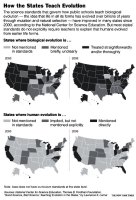
Copyright 2008 by the New York Times
Can we afford to dumb down any part of our science curriculum, for any reason? Is it unfair to consider creationism advocates, including intelligent design advocates, as “surrender monkeys in the trade and education wars with China?”
Update: 10:00 p.m. Central, this story is the most e-mailed from the New York Times site today; list below the fold.
Read the rest of this entry »
Spread the word; friends don't allow friends to repeat history.
5 Comments | Biology, Charles Darwin, Creationism, Darwin, Education, Education quality, Evolution, Intelligent Design, Politics, Public education, Religion, Science, Separation of church and state, State school boards, Teaching, Texas, Texas Citizens for Science, Texas Education Agency (TEA), Texas Freedom Network, Voodoo science, War on Education, War on Science | Tagged: Creationism, Don McLeroy, Education, Evolution, Politics, Religion, Science, Texas, Voodoo science | Permalink
Posted by Ed Darrell
August 21, 2008
Here’s the post from über creationist Ken Ham’s site, in its entirety:
Last week, AiG speaker Mike Riddle did a series of talks in Brenham, Texas. On the first day, Mike did four different sessions for 1st–6th graders. He usually speaks to young people on topics like “The Riddle of the Dinosaurs,” AiG’s well-known “7C’s of History,” and fossils.

On the next day, Mike did four special sessions for teachers. Each presentation was geared to help instructors be better prepared to teach origins in the public schools. In addition to speaking on what creationists believe, he spoke on understanding presuppositions and assumptions in the origins debate–and using critical thinking skills. Mike also had the opportunity to meet with the Chairman of the Texas State School Board, Don McLeroy (a biblical creationist), and gave presentations to an open audience at the Brenham High School auditorium.

Mike and Don McLeroy (Chairman, Texas State School Board)
“Special sessions for teachers?” Oy vey.
1. I’ll wager, if those were real, public school teachers, they were given continuing education credits for attending. That would be illegal, especially if Riddle did not preface his presentations with a legal disclaimer that what he urges is contrary to Texas science standards and contrary to the Constitution. Want to wager whether he did?
2. What’s McLeroy doing there? Doesn’t he know he’s supposed to maintain antiseptic separation from such controversial stuff? They fire people from the TEA for attending sessions that are legal and support the Texas standards. What sort of Quisling action is this on McLeroy’s part?
3. Is Rick Perry watching? The state’s legal fees will rise dramatically as a result of this kind of bad judgment at the SBOE. Can Texas taxpayers afford this?
4. Why does Don McLeroy hate Texas’s smarter, college-bound children so?
It takes a particular form of chutzpah to stand idly by while qualified science teachers are fired from the state’s education agency for promoting science, and then go cavort with creationists. It may not be cowardice exactly, but courage is its antonym.
Spread the word; friends don't allow friends to repeat history.
4 Comments | Education, Ethics, History, Politics, Religion, Science, State school boards, Teaching, Texas, Texas Citizens for Science, Texas Education Agency (TEA), Voodoo science | Tagged: Bad Judgment, Creationism, education standards, Evolution, Ken Ham, Politics, Religion, Science, Texas, Voodoo science | Permalink
Posted by Ed Darrell
August 18, 2008
Louisiana’s state legislature — the legislature that the Supreme Court slapped down in 1987 for trying to introduce religion into science classes in Edwards v. Aguillard — rushed through a bill drafted by the deaf-to-the-law Discovery Institute which purports on its face to make it legal for Louisiana science teachers to teach creationism, intelligent design, tarot card reading, UFO-ism, or any other crank science that the teacher feels compelled to offer.

A Louisiana alligator used by c design proponetsist Denyse O'Leary to illustrate a blog post about Louisiana's litigation bait law on creationism in schools. Without any appreciation of th irony, or as a subtle warning, we can't say. (photo from The Advocate?)
Louisiana’s Gov. Bobby Jindal, R-Mars, rushed to sign the brain-sucker into law, in his ambitious quest to get John McCain to name him as the nominee for vice president. It appears on the surface that Jindal’s national political aspirations will have to wait, but the law he signed requires Louisiana’s school districts to be ready when the students come back in the next few weeks, to do whatever it is they are going to do about creationism and other crank science.
Discovery Institute minions have been hawking creationism wares, and other creationists have offered to put Genesis into the science curriculum — but the law does not authorize those actions or wares itself. Instead, it passes the judgment to local school boards, sort of.
“Sort of.” Words that make a litigator’s heart flutter when talking about to-be-implemented laws! You’d think that, with all the money the Discovery Institute spends to entice legislators and school board members to poke their noses into matters they do not know, DI could spend a few thousands of dollars to get a competent legislative law drafter to draft a workable law. The cheapskates always pay more, Click and Clack say, and here’s another case to prove the point. It would have been difficult to intentionally write a law better intended to get local school boards sued.
A few of us noted the law does not indemnify local school districts against lawsuits if they goof and put religion into science classes. This is important, because the law requires local school districts to step up to the line and have a policy in place by the start of this school year. Which means, if the district doesn’t have the policy written out now, they’re late.
Tony Whitson at Curricublog spent time this summer pondering exactly how the law works, what it requires, and who it requires to act. His analysis — that the law is litigation bait just waiting to snare a local school board, a real “Dover Trap” — is cool, hard, and chilling. Go read it at his blog.
Whitson recommends that the Louisiana Board of Elementary and Secondary Education get an opinion from the state’s attorney general. This will not comply with the impossible and punishing deadline the legislature established, but it’s a much wiser stewardship of local monies, to try to avoid litigation. Tony wrote:
Taking stock of the situation: To summarize where things now stand, in light of everything above:
The law is by no means so benign as its promoters pretend. It will unleash all manner of chaotic mischief. On the other hand, there is a method to this madness, making it predictable that the perpetrators’ strategy will be to insinuate Exploring Evolution into the state’s (and then other states’) public schools.
BESE and the school districts cannot comply with the statute, which commands that
The State Board of Elementary and Secondary Education and each city, parish, or other local public school board shall adopt and promulgate the rules and regulations necessary to implement the provisions of this Section prior to the beginning of the 2008-2009 school year.
There are legal requirements (public notice, etc.) for adopting administrative rules for implementing legislation that make it impossible for that to be done by every state and district school board before the new school year begins.
So what can BESE do?
My suggestion is that BESE, at it’s meeting Tuesday, should move to request an opinion from the State Attorney General. They should ask him for an opion advising them, the district Boards of Education, and individual school principals, as to who will be responsible for the costs of defending against litigation for unconstitutional state promotion of religion in the use of supplemental materials. Presumably, if there’s a suit brought directly against BESE itself because of the substance of a text they have approved, then they would be defended by the AG’s office, on behalf of the state (like when the AG hired Wendell Bird as as special assistant for defending the state’s “Balanced Treatment” law). But will the AG commit his office to defending every district, every school, and every teacher whose use of “supplemental materials” is challenged for violation of the First Amendment?
Louisiana’s legislature set a trap for Louisiana science teachers and local school boards — whether intentionally or not is immaterial. Rather than authorize specific material for the curriculum, the new creationism law requires school boards to analyze materials to supplement the science curriculum. The law passes the buck to the local school boards.
So, Louisiana school board members now must become expert on science, and Constitutional law.
Rule of thumb: It costs a school board about $1 million every time they goof and put religion into science classrooms, in litigation costs alone. Louisiana’s legislature didn’t appropriate any money to compensate the school boards.
This law promises to entangle science educators and curriculum, and ensnare local school boards – all of which helps dumb down science achievement and prevent U.S. kids from getting the education they need to compete in a global economy. Alas.
Spread the word; friends don't allow friends to repeat history.
3 Comments | Creationism, Education, Education success, Evolution, First day, History, Intelligent Design, Politics, Rampant stupidity, Science, Teaching, Voodoo science | Tagged: Creationism, Education, Evolution, History, Intelligent Design, Louisiana, Politics, Science, Voodoo science | Permalink
Posted by Ed Darrell
August 17, 2008
It’s gotta be a virus, and pray to God it isn’t contagious.
Jennifer Marohasy made jaws drop with a stunningly under-informed claim about energy equilibrium and light bulbs, confusing watts as a measure of heat, getting thermodynamics wrong, and generally acting as if her wits temporarily headed to the beach.
And then she came right back with this one [moved to here]:
I have become curious about something. The core of the Earth is alleged to be molten. It’s also a fact that the deeper you dig into the Earth, the warmer it gets. Where is that heat coming from… surely not from the Sun. What’s the possibility that the Earth generates some of it’s own heat from geothermal processes?
The possibility is 100%. Ernest Rutherford had the goods on the issue just after the turn of the 19th to the 20th centuries. He won the Nobel Prize for Chemistry in 1908 for his work on radioactivity, which included calculations on how the planet Earth is heated from within. Some sources say Rutherford identified planetary heating as early as 1896.

Ernest Rutherford, Nobel Foundation photo
Marohasy lives in Australia — is Google disabled for that continent or something?
These are the people who lead the charge for climate change skeptics? Anthony Watts, where are you?
This is a preview of the sort of ignorance that will elbow its way into Texas science if the State Board of Education succeeds in dumbing down Texas science classes, pulling down the intelligence quotient with creationism.
“Alleged to be molten.”
And water is alleged to be wet.
Spread the word; friends don't allow friends to repeat history.
7 Comments | Climate change, geology, Global warming, Rampant stupidity, Science, Voodoo science | Tagged: Climate change, geology, Physics, Science, Voodoo science | Permalink
Posted by Ed Darrell
August 17, 2008
Every once in a while we get a glimpse of what the future would be like if the creationists ruled education and could teach some of the fantastic things they believe to be true as fact.
For example, creationists have for years complained that the basic chemistry of life somehow violates what chemists and physicists know as the “laws” of thermodynamics. Patient explanations of what we know about how photosynthesis works, and how animals use energy, and what the laws of thermodynamics actually are, all fall on deafened ears.
Comes Jennifer Marohasy, an Australian blogger at The Politics and Environment Blog, with this fantastic explanation about how the well-established notion of radiative equilibrium, simply doesn’t work.
“For the Earth to neither warm or cool, the incoming radiation must balance the outgoing.”
Not really.
No, really. Go read the post. And see these critiques, at Tugboat Potemkin, where problems with the rules of the principle of Conservation of Energy are noted, and Deltoid, where LOLCats makes a debut in explaining physics to the warming denialists.
Then go back and read the comments at Marohasy’s blog.
It’s not just the confusion of terms, like treating watts as units of heat. There’s an astonishing lack of regard for cause and effect in history, too:
Conservation of energy: it’s not just a phrase. The theory of radiative equilibrium arose early in the 19th century, before the laws of thermodynamics were understood.
Probably didn’t mention it here before, but Marohasy is also one of those bloggers who suffers from DDT poisoning. Among other things, she and Aynsley Kellow (whose book she recommends) use an astounding confabulation of history to claim DDT wasn’t harming birds at all, completely ignoring more than 1,000 research studies to the contrary (and not one in support of their claim).
Suggestion for research: Is the denialism virus that affects creationists, DDT advocates, and climate denialists, the same one, or are there slight variations? A virus seems the most charitable explanation, unless one wishes to blame prions.
Creationist physics, denialism in meteorology, physics, chemistry, and history. It makes a trifecta winner look like he’s not trying.
See also:
Spread the word; friends don't allow friends to repeat history.
1 Comment | Accuracy, Climate change, Creationism, denialism, Education, Global warming, History, Physics, Science, Voodoo history, Voodoo science | Tagged: chemistry, Climate change, Creationism, DDT, denialism, History, Physics, Thermodynamics, Voodoo history, Voodoo science | Permalink
Posted by Ed Darrell
August 12, 2008
This will be a short post, and so will confuse the long-winded but short-thought intelligent design advocates, especially those who claim to be philosophers, and especially those who claim to be philosophers of science who can see a role for intelligent design.
A short visit to Telic Thoughts last week produced a revelation that they have a new philosopher who wants to argue that intelligent design “philosophically” could be science, if. I answered that argument at some length, in lay terms, here: “Intelligent Design, a pig that does not fly.”
Dr. Francis Beckwith, at Baylor, appears to have dropped his campaign to teach philosophy in science classes since he rediscovered that God visits the Pope, and since he moved on to more serious philosophical pursuits and away from his practice of confusing people about the law of separation of church and state in America (especially confusing the Texas State Board of Education). We hope Beckwith sticks with philosophy and stays out of Texas textbooks.
So there was a vacancy in the phalanx of defenders of intelligent design, in the slot reserved for company store philosohers. Dr. Brad Monton volunteered for the job. Monton has a blog, here. Monton philosophizes at the University of Colorado.
What should be the role of theism in science? Exactly this: Theism should encourage scientists to be diligent, to be honest, to ask tough questions, and be kind. Theism should encourage scientists to be wise stewards of their lab resources and time, and to share the fruits of their work with humanity, for the benefit of all creation (no, not “creationism”).
That’s it. Honest and thorough, not mean. Work quickly and true.
If scientists stick to the noble purposes of their work, using these noble methods, we will see a quick death to creationism and intelligent design, which clamor and riot to be included in the science texts though they have not a lick of evidence to support them that is honest, true and nobly gained.
Philosophical debates do not belong in high school science classes, nor middle school or elementary school science classes. The fun of science, the honest ethics of science, the value of science, and the stuff of science are appropriate topics for those science classes. Especially school kids should not be encouraged to offer unevidenced, petulent denials of the facts as we know them. That will only encourage them to become larcenists, disturbed individuals, and Republican state legislators. Heaven knows we don’t need those.
Wes Elsberry agrees at his blog, The Austringer, but with more felicity:
The issue is not whether science could make progress in spite of re-adoption of 17th century theistic science, but whether theistic science could provide any benefit to the methods of science today. Monton, Plantinga, and the neo-Luddites have not convincingly made that case. Mostly, they haven’t even badly made that case. They seem to assume that science would be better off reverting to 17th century theistic science and become perplexed when scientists disagree with them. We had that debate, we call it “the 19th century”. Nobody has shown that the mostly-theistic body of scientists who decided to eschew supernatural conjectures as part of science were wrong to do so. Mostly, I think, because they were right to do so, and their reasoning still applies today.
Monton seeks a publisher. I wish he’d seek a course in botany, another in zoology, another in genetics, and one in evolution. He might find something worth publishing, then.
Philosophically, anything fits in science, if there is evidence to support it, and especially if there is theory that supports it and offers solid explanations that can be relied upon. But we don’t teach philosophy to kids. We teach the kids the evidence. Philosophically, any voodoo science could be considered science, if there were evidence to support it. Philosophically, the FAA should regulate flying pigs that pose a threat to commercial and general aviation. Pragmatically, however, pigs don’t fly. In regulation of our air space, and in our science classes, we rely on theory backed by hard evidence. I wish theists would all agree on that point, and shut up about intelligent design until some institute of discovery actually provides research results that provide evidence that ID is science, rather than philosophy.
See? I said it would be short.
Spread the word; friends don't allow friends to repeat history.
10 Comments | Accuracy, Creationism, Education, Evolution, Intelligent Design, Politics, Religion, Science, State school boards, Teaching, Voodoo science | Tagged: Creationism, Education, Evidence, Evolution, Intelligent Design, Philosophy, Religion, Science, State Boards of Education, Voodoo science | Permalink
Posted by Ed Darrell
August 10, 2008
Y’all with a smattering of understanding about evolution: Go to this blog and help straighten out the creationists, will you?
“Creationist medical dilemma” at Unreasonable Faith
This is one of the hottest posts in the WordPress blogging continent at the moment. Unreasonable Faith posted the old Doonesbury cartoon about the guy whose doctor diagnoses tuberculosis, and then asks the guy whether he’s a creationist before prescribing treatment (if you don’t know the cartoon, go see!). I don’t think it was intended to attract so much traffic.
In the past three days creationists have moved into the comments section with all manner of creationist misinformation. Few of the creationists are the hard-shelled, obnoxious type, but they could use some good information on genetics, mutations and evolution rates from someone familiar with the topics.
Spread the word; friends don't allow friends to repeat history.
Leave a Comment » | Creationism, Evolution, Health care, Religion, Science, Voodoo science | Tagged: Creationism, Evolution, Health care, Medical Care, Religion, Science, Voodoo science | Permalink
Posted by Ed Darrell





 Millard Fillmore's Bathtub