Watts falls victim to Monckton’s voodoo

October 19, 2009

Among those who call themselves “skeptical” of claims about climate change, Anthony Watts has distinguished himself from time to time for often using solid science and raising good questions.  His campaign to look at the placement of weather reporting stations indicates an understanding of the way science should work (though we haven’t seen results).

So, what’s Watts doing repeating Monckton’s hysterical, inaccurate rantWe already know Monckton’s testimony is impeached.

Is Watts so politically naive as to think any nation would cede sovereignty on an issue of climate change? One more indication that people should stick to their knitting, and not venture into areas where they have no expertise.


The war against Rachel Carson still rages

October 11, 2009

Tim Lambert and Deltoid takes apart the hapless and pointless attack on Rachel Carson by J. F. Beck, in some publication named Quadrant.

Beaten so badly in the realm of law making, regulatory hearings, in the courts, and in the science journals, critics of a clean environment are reduced to attacking a woman who has been dead for 45 years.

That’s the best they got?

Also see:


Monckton will lie about anything

October 10, 2009

Lordy! Monckton said to the Winnipeg Sun (in Manitoba, but you knew that) :

He continues: “Remember DDT, the pesticide used to kill mosquitoes that carried malaria. Jackie Kennedy read a book saying it was harmful, got her husband the president to bring pressure to have it banned and in 40 years 40 million people, mainly children, died. Now we’ve come to our senses and re-introduced it but only after the fashionable left did their damage.

Not so fast.  Here are a few of the errors.

1.  Key phrase:  “the pesticide that used to kill mosquitoes that carried malaria.”  It’s not very good anymore.  Mosquitoes acquired alleles that allow them to digest DDT, rather as food, instead of getting poisoned by it.  This evolutionary response was speeded when DDT was overused (abused, that is) by big farmers.  The World Health Organization had a campaign to use DDT to knock down a mosquito population for about six months, quickly treat all the humans who had the disease, and so when the mosquitoes came roaring back after six months, there would be no malaria for them to get from one person to spread.  WHO stopped the program when the quickly-evolving resistance to DDT made it impossible.  This was in the years 1964 through about 1966.  DDT was not banned, and production and use of the stuff continued around the world.

2.  President Kennedy was asked about DDT at a press conference.  He said he’d read the book.  It wasn’t “meddling” by Jackie Kennedy — though she would have been right had she done it.   Jackie Kennedy proved her mettle later as an editor of books, a real force to be reckoned with and a woman of great judgment.

(Yeah, I had sound trouble with it, except for the press conference with Kennedy.)

3.  Kennedy didn’t act against DDT.

President John F. Kennedy at a press conference on August 29, 1962; he announced the retirement of Supreme Court Associate Justice Felix Frankfurter and the appointment of Arthur Goldberg to replace him; in questions, he was asked about DDT and Rachel Carson's book, Silent Spring.

President John F. Kennedy at a press conference on August 29, 1962; he announced the retirement of Supreme Court Associate Justice Felix Frankfurter and the appointment of Arthur Goldberg to replace him; in questions, he was asked about DDT and Rachel Carson’s book, Silent Spring.

4.  Kennedy did ask the experts to check out Carson’s book.  The President’s Science Advisory Commitee (PSAC) (including Nobel winners) spent several months studying the book and its footnotes, and checking with other experts.  In May 1963 they issued a verdict:  Carson’s book, Silent Spring, was accurate and true, but suffered one flaw:  Carson’s alarm wasn’t loud enough nor demanding action quickly enough.  PSAC urged Kennedy to act immediately to slow or stop the use of DDT.  Alas, he was assassinated six months later. (Full text of the PSAC report is available on this blog, here.)

5.  Though the federal government stopped massive use of DDT on its side, large agricultural interests used it extensively.  After a decade of devastation across the country, in two separate trials federal judges ruled DDT a dangerous substance — they withheld injunctions when the newly-formed EPA promised to expedite hearings on tighter regulations for the stuff which had been floundering for a few years.  So it was that in 1971, more than seven years after John F. Kennedy’s death, a full administrative hearing on DDT began at EPA.  DDT had been fully available world wide for 9 years after Carson’s book.

6.  In 1972, still under court order, the EPA administrative law judge Edmund Sweeney ruled that a new label for DDT would be adequate control.  Under the new label, use would be severely restricted, and broadcast spraying on crops would be prohibited, but DDT would be freely available.  If someone wanted to, they could buy DDT and broadcast it themselves.  Under the labeling rules, nothing could be done to such violators.  Judge Sweeney carefully documented in his hearings all the benefits and drawbacks of DDT.  A more restrictive proposal, such as a ban, would not do much more than the new label (if the label was followed), and Sweeney said that he did not find that EPA had the power to do any more.  EPA administrator William Ruckleshaus got a more detailed review of the law from his legal team, and concluded that EPA could indeed ban broadcast use, and so he did.  At least two of the DDT manufacturers sued, claiming there was no scientific basis for a ban.  Under U.S. law, if the scientific data do not back up such a rule, the courts are obligated to overturn the rule.  Both courts granted summary judgment for EPA, meaning that even if all the evidence were interpreted to favor the pesticide manufacturers, they would still lose on the law.  There were no further appeals.

7.  The EPA ban allowed DDT to be used in emergencies, especially if there were an emergency involving malaria or other insect-borne disease; specifically, EPA’s order allowed DDT use against any insect “vector” to fight disease at any time, for indoor residual spraying (IRS) the preferred method of fighting malaria.   The EPA ban did not cover manufacturing, and U.S. DDT manufacturers ran a lively export business through 1984. On the day before the Superfund law took effect in 1984, requiring manufacturers to clean up toxic wastes they had dumped in violation of law, several of the DDT manufacturers declared bankruptcy, leaving the Superfund to clean up DDT sites in Texas and California, and other places.  Clean up continues today, 25 years later, costing tens of millions of dollars a year.

Manufacture of DDT today is chiefly in India and China.  Pollution problems abound near those sites.

8.  DDT use was never banned in Africa, especially for use to fight malaria.  Considering mosquito resistance and immunity, however, Africans generally chose not to use DDT.  DDT’s reputation was further tarnished when it was revealed that broadcast outdoor spraying had killed food fishes in several places, leading to near starvation for local populations.  South Africa used DDT right up through 1996, then stopped.  When mosquitoes with malaria flowed over the border from neighboring nations without adequate disease control programs, malaria rates shot up, and DDT was again used as a last-ditch defense.

9.  Generally, malaria infections and malaria deaths continued to decline in Africa and Asia after Silent Spring, and after the U.S. banned DDT use on crops. Malaria in Africa rose after 1985 when malaria parasites developed immunity to the pharmaceuticals used to treat the disease in humans.  Without an effective drug regimen, death rates rose, too.  DDT could not offer any help in this fight.

10.  One of the greatest barriers to fighting malaria in Africa has been unstable governments.  For example, it is difficult to believe that Idi Amin, the horrible dictator who ruled Uganda from 1971 to 1979,  and claimed to have eaten some of his executed enemies, refused to spray DDT because he wanted to be environmentally friendly.  If Monckton wants to make such a claim explicitly, he’s nuts (he may be nuts anyway, but this unspoken claim of his is particularly insane).   Other nations had less spectacular misrule, but the effect was the same:  When governments could not, or did not mount fights against mosquitoes and malaria, malaria spread.  This had nothing to do with DDT, nor with a lack of DDT.

11.  When WHO suspended their campaign against malaria using large-scale DDT spraying out of doors, malaria killed about two million people annually, down from a peak of nearly four million 15 to 20 years earlier.  Today, malaria kills about 900,000 people annually.  Monckton says the lack of DDT has been responsible for 40 million deaths in the last 40 years.  That’s a good trick, really — it’s a lower rate than others have claimed, but it assumes that every malaria death could have been prevented with DDT, something we know is not the case.  More, it assumes that the U.S. ban on spraying DDT on cotton in Texas in 1972 somehow caused Africans to stop using DDT in 1965, a neat feat of time travel, and an astounding feat of regular travel, Texas being about 10,000 miles from most of Africa, too far for mosquitoes to migrate.

In three sentences, Monckton crammed in 11 grotesque falsehoods.  And that paragraph was not even the topic of the article.  And what is it about these propaganda attacks dead women?  Unholy attacks on Rachel Carson are bad enough — now Monckton goes after Jackie Kennedy, too?  Do these guys carefully choose targets who cannot respond, and who, because dead, cannot sue for libel?

Is it true that a Lie can get halfway around the world before Truth gets its boots on?  Isn’t there some Truth Police who could stop Monckton from spreading that crap?

Oh, and while I’m thinking about it:

Spread the word, stop the madness:

Add to FacebookAdd to NewsvineAdd to DiggAdd to Del.icio.usAdd to StumbleuponAdd to RedditAdd to BlinklistAdd to TwitterAdd to TechnoratiAdd to Furl


P.Z. Myers, “Darwin’s cephalopod,” threatens to sleep forever

September 9, 2009

Well, how would you read this?  P.Z. said:

Wake me up when a creationist says something intelligent.

Add to FacebookAdd to NewsvineAdd to DiggAdd to Del.icio.usAdd to StumbleuponAdd to RedditAdd to BlinklistAdd to TwitterAdd to TechnoratiAdd to Furl


Intelligent design in science classes: Two views

August 19, 2009

Texas’s ACLU chapter’s convention on August 1 featured a lively and informative session on intelligent design.  It might seem like it was set up as a debate, but as the video shows, the two views complemented each other surprisingly.

Presenters were Liberty Legal Institute’s Hiram Sasser and Barbara Forrest, a professor of philosophy at Southeastern Louisiana University, the premier chronicler of the creationism wars in the U.S.

Help others to see:

Add to FacebookAdd to NewsvineAdd to DiggAdd to Del.icio.usAdd to StumbleuponAdd to RedditAdd to BlinklistAdd to TwitterAdd to TechnoratiAdd to Furl


How about another cup of coffee? (Global Warming Conspiracy)

August 18, 2009

Encore post from September 17, 2007 — maybe more appropriate today than ever before.

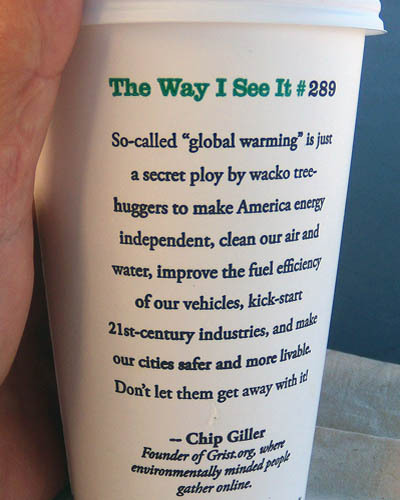
Found this on my coffee cup today:

The Way I See It #289

So-called “global warming” is just

a secret ploy by wacko tree-

huggers to make America energy

independent, clean our air and

water, improve the fuel efficiency

of our vehicles, kick-start

21st-century industries, and make

our cities safer and more livable.

Don’t let them get away with it!

Chip Giller
Founder of Grist.org, where
environmentally-minded people
gather online.

Starbucks Coffee Cup, The Way I See It #289 (global warming)

Look! Someone found the same cup I found!

Add to FacebookAdd to NewsvineAdd to DiggAdd to Del.icio.usAdd to StumbleuponAdd to RedditAdd to BlinklistAdd to TwitterAdd to TechnoratiAdd to Furl

Save


Climate skeptic shell game: ‘Please don’t read how CO2 amplifies warming’

August 8, 2009

In heated political discussions, I’ve discovered that when people stretch the facts, sometimes they do it to protect their interests; but if they exaggerate and stretch things when the facts are on their side, it’s pathological and you can’t trust them on anything.

As the old joke goes, ‘I once knew a guy who cheated at golf so bad that when he got a hole-in-one, he wrote down “zero” on the score card.’

Scientists at Oregon State University released a study that shows the tilt and wobble of the Earth can trigger ice ages and the ends of ice ages. As you can imagine, climate change skeptics and denialist will jump on this study to say we don’t need to worry about carbon dioxide — ‘warming can’t be blamed on carbon dioxide.’

In fact, Anthony Watts has already done that.

Read the entire press release, and don’t skip over the parts that are important to policy on air pollution and climate change.  The paper indeed says that planetary wobble causes ice ages, and warming between ice ages.  That’s part of the climate change debate, probably a sizable win for climate skeptics.

But they can’t leave well enough alone; the study explicitly warns of the warming effects of human-released CO2.  Watts left out this paragraph:

“Solar radiation was the trigger that started the ice melting, that’s now pretty certain,” said Peter Clark, a professor of geosciences at OSU. “There were also changes in atmospheric carbon dioxide levels and ocean circulation, but those happened later and amplified a process that had already begun.”

Watts left this out, too, and this qualifies the Oregon State study as “alarmist” under usual skeptic rubrics:

Sometime around now, scientists say, the Earth should be changing from a long interglacial period that has lasted the past 10,000 years and shifting back towards conditions that will ultimately lead to another ice age – unless some other forces stop or slow it. But these are processes that literally move with glacial slowness, and due to greenhouse gas emissions the Earth has already warmed as much in about the past 200 years as it ordinarily might in several thousand years, Clark said.

“One of the biggest concerns right now is how the Greenland and Antarctic ice sheets will respond to global warming and contribute to sea level rise,” Clark said. “This study will help us better understand that process, and improve the validity of our models.”

Peter Clark of Oregon State and his associates published an important study in Science on Friday.  The study points to variations in the usual 23-degree tilt of the Earth’s access as triggers for glaciation and retreat of glaciers, over time.  The study poses important questions, such as:  Has human contribution to greenhouse gases prevented cooling in the past two centuries?  The study offers potential insights into research into climate change and human contributions to climate change.

The study in no way exonerates carbon dioxide from implication as a major, human-contributed component to the mix of factors driving climate change in the 21st century.  The study is really pretty cool; it should be fodder for geography and environmental science classes this fall, and it should be one factor in the discussion over warming and what we need to do about it.

Watch:  Some will try to make it the latest political shuttlecock instead.

Here’s the full press release:

8-6-09

Media Release

Long debate ended over cause, demise of ice ages – may also help predict future

CORVALLIS, Ore. – A team of researchers says it has largely put to rest a long debate on the underlying mechanism that has caused periodic ice ages on Earth for the past 2.5 million years – they are ultimately linked to slight shifts in solar radiation caused by predictable changes in Earth’s rotation and axis.

In a publication to be released Friday in the journal Science, researchers from Oregon State University and other institutions conclude that the known wobbles in Earth’s rotation caused global ice levels to reach their peak about 26,000 years ago, stabilize for 7,000 years and then begin melting 19,000 years ago, eventually bringing to an end the last ice age.

The melting was first caused by more solar radiation, not changes in carbon dioxide levels or ocean temperatures, as some scientists have suggested in recent years.

“Solar radiation was the trigger that started the ice melting, that’s now pretty certain,” said Peter Clark, a professor of geosciences at OSU. “There were also changes in atmospheric carbon dioxide levels and ocean circulation, but those happened later and amplified a process that had already begun.”

The findings are important, the scientists said, because they will give researchers a more precise understanding of how ice sheets melt in response to radiative forcing mechanisms. And even though the changes that occurred 19,000 years ago were due to increased solar radiation, that amount of heating can be translated into what is expected from current increases in greenhouse gas levels, and help scientists more accurately project how Earth’s existing ice sheets will react in the future.

“We now know with much more certainty how ancient ice sheets responded to solar radiation, and that will be very useful in better understanding what the future holds,” Clark said. “It’s good to get this pinned down.”

The researchers used an analysis of 6,000 dates and locations of ice sheets to define, with a high level of accuracy, when they started to melt. In doing this, they confirmed a theory that was first developed more than 50 years ago that pointed to small but definable changes in Earth’s rotation as the trigger for ice ages.

“We can calculate changes in the Earth’s axis and rotation that go back 50 million years,” Clark said. “These are caused primarily by the gravitational influences of the larger planets, such as Jupiter and Saturn, which pull and tug on the Earth in slightly different ways over periods of thousands of years.”

That, in turn, can change the Earth’s axis – the way it tilts towards the sun – about two degrees over long periods of time, which changes the way sunlight strikes the planet. And those small shifts in solar radiation were all it took to cause multiple ice ages during about the past 2.5 million years on Earth, which reach their extremes every 100,000 years or so.

Sometime around now, scientists say, the Earth should be changing from a long interglacial period that has lasted the past 10,000 years and shifting back towards conditions that will ultimately lead to another ice age – unless some other forces stop or slow it. But these are processes that literally move with glacial slowness, and due to greenhouse gas emissions the Earth has already warmed as much in about the past 200 years as it ordinarily might in several thousand years, Clark said.

“One of the biggest concerns right now is how the Greenland and Antarctic ice sheets will respond to global warming and contribute to sea level rise,” Clark said. “This study will help us better understand that process, and improve the validity of our models.”

The research was done in collaboration with scientists from the Geological Survey of Canada, University of Wisconsin, Stockholm University, Harvard University, the U.S. Geological Survey and University of Ulster. It was supported by the National Science Foundation and other agencies.

About the OSU College of Science: As one of the largest academic units at OSU, the College of Science has 14 departments and programs, 13 pre-professional programs, and provides the basic science courses essential to the education of every OSU student. Its faculty are international leaders in scientific research.

Watts did note the abstract of the paper, at Science (to get the full text, you must be a subscriber or pay a high fee for the one article):

Science 7 August 2009:
Vol. 325. no. 5941, pp. 710 – 714
DOI: 10.1126/science.1172873

Research Articles

The Last Glacial Maximum

Peter U. Clark,1,* Arthur S. Dyke,2 Jeremy D. Shakun,1 Anders E. Carlson,3 Jorie Clark,1 Barbara Wohlfarth,4 Jerry X. Mitrovica,5 Steven W. Hostetler,6 A. Marshall McCabe7

We used 5704 14C, 10Be, and 3He ages that span the interval from 10,000 to 50,000 years ago (10 to 50 ka) to constrain the timing of the Last Glacial Maximum (LGM) in terms of global ice-sheet and mountain-glacier extent. Growth of the ice sheets to their maximum positions occurred between 33.0 and 26.5 ka in response to climate forcing from decreases in northern summer insolation, tropical Pacific sea surface temperatures, and atmospheric CO2. Nearly all ice sheets were at their LGM positions from 26.5 ka to 19 to 20 ka, corresponding to minima in these forcings. The onset of Northern Hemisphere deglaciation 19 to 20 ka was induced by an increase in northern summer insolation, providing the source for an abrupt rise in sea level. The onset of deglaciation of the West Antarctic Ice Sheet occurred between 14 and 15 ka, consistent with evidence that this was the primary source for an abrupt rise in sea level ~14.5 ka.
1 Department of Geosciences, Oregon State University, Corvallis, OR 97331, USA.
2 Geological Survey of Canada, 601 Booth Street, Ottawa, Ontario K1A 0E8, Canada.
3 Department of Geology and Geophysics, University of Wisconsin, Madison, WI 53706, USA.
4 Department of Geology and Geochemistry, Stockholm University, SE-10691, Stockholm, Sweden.
5 Department of Earth and Planetary Sciences, Harvard University, Cambridge, MA 02138, USA.
6 U.S. Geological Survey, Department of Geosciences, Oregon State University, Corvallis, OR 97331, USA.
7 School of Environmental Science, University of Ulster, Coleraine, County Londonderry, BT52 1SA, UK.

Supporting online material, including a solid discussion of methods and several charts that are not contained in the full publication, is available, free, in .pdf form.  Warning to creationists:  This is heavy on science using radioactive isotopes for dating.  For that matter, it’s loaded with a lot of other science that climate change skeptics generally dismiss as “computer simulation” instead of hard data.  How will they treat this study?  Skeptically?  Don’t bet on it.

Resources:

Share this story and the science:

Add to FacebookAdd to NewsvineAdd to DiggAdd to Del.icio.usAdd to StumbleuponAdd to RedditAdd to BlinklistAdd to TwitterAdd to TechnoratiAdd to Furl


Astroturf as tool for (political) climate change – caught red handed

August 8, 2009

Bob Park’s weekly newsletter gives the story sharply and succinctly (August 6 edition):

WHAT’S NEW   Robert L. Park   Friday, 6 Aug 09   Washington, DC

CLIMATE: LETTERS TO CONGRESS ARE EXPOSED AS “ASTROTURF”.
They look like a grass-roots campaign, but they’re fakes.  The letters  purported to be from registered nonprofit groups.  Rep. Edward Markey (D-MA), a sponsor of the climate bill, has begun an inquiry into whether the fake letters amount to fraud.  The American Coalition for Clean Coal Electricity disavowed the scurrilous tactic and said it was considering legal action against the Hawthorne Group, a firm it paid to make the climate bill disappear.  Hawthorne, however, is only a contractor.  It hired Bonner and Associates to make the hit.  The founder of the firm, Jack Bonner, laid the blame squarely on a wayward employee who has since been fired. Thus was the purity of the legislative process restored. But why had this employee taken it upon himself to do such a thing?  A lowly temp, he was paid according to the number of fraudulent letters he sent to congressional offices.  And nobody supervised his work?

Dr. Park offered facts only, no links.

Let me help you out.  But a word of warning:  This campaign against Al Gore and serious science is really, really sleazy.

Who can you trust?  It’s clear that we can’t trust claims from climate change sceptics and denialists, especially when they claim “thousands” of scientists and “thousands” of citizens oppose laws to mitigate the damage from climate change.

Please help spread accurate science reporting; tell friends about this post:

Add to FacebookAdd to NewsvineAdd to DiggAdd to Del.icio.usAdd to StumbleuponAdd to RedditAdd to BlinklistAdd to TwitterAdd to TechnoratiAdd to Furl


India accepts climate junk science; U.S. suffers

July 25, 2009

It would be good news were it not so bad:  India, usually considered a threat to U.S. dominance in science, has turned its back on climate science and instead, citing junk science claims, rejected overtures to reduce pollution that affects climate.  India appears to have fallen victim to the hoaxters who claim climate change is no big deal.

From the Financial Times:

A split between rich and poor nations in the run-up to climate-change talks widened on Thursday.

India rejected key scientific findings on global warming, while the European Union called for more action by developing states on greenhouse gas emissions.

Jairam Ramesh, the Indian environment minister, accused the developed world of needlessly raising alarm over melting Himalayan glaciers.

He dismissed scientists’ predictions that Himalayan glaciers might disappear within 40 years as a result of global warming.

“We have to get out of the preconceived notion, which is based on western media, and invest our scientific research and other capacities to study Himalayan atmosphere,” he said.

As if the atmosphere of the Himalayan range is unaffected by emissions from Europe or Asia.  As if the glaciers in the Himalayas, and the snowfall,  and the water to India’s great rivers, come independent from the rest of the world.

Deadly air pollution obscures the India Gate, New Delhi, India, November 2008 - NowPublic.com

Deadly air pollution obscures the India Gate, New Delhi, India, November 2008 - NowPublic.com

It’s interesting to see these issues play out politically.   India and China both understand that the U.S. and Europe have much more to lose from climate change than either of those nations.  Climate damage to the U.S. wheat belt, for example, would chiefly close off U.S. production of wheat for export, opening markets for others — like India and China.  Critically, such damage also hurts U.S. ability to offset balance of payments issues, providing economic and finance advantages to China’s banks.  U.S. ports are much more vulnerable to climate change damage, from increase storms and changing ocean levels, than are ports in India and China — and there are more ports that are vulnerable in the U.S. and Europe.

India’s inaction and recalcitrance should not be used as justification for the U.S. to do nothing, thereby slitting its own patriotic throat.

But watch:  Climate denialist blogs, “hate-America-first” outlets like World Net Daily, and Osama bin Laden will hail India’s inaction.

Let’s hope cooler heads prevail, lest we run out of cooler heads.

Shake of the old scrub brush to Brown Hell and Watt’s Up With That.

If this is important to you, please share it; click on the button you choose below.

Add to FacebookAdd to NewsvineAdd to DiggAdd to Del.icio.usAdd to StumbleuponAdd to RedditAdd to BlinklistAdd to TwitterAdd to TechnoratiAdd to Furl


Bated breath, bated brains, bated sense and DDT

July 11, 2009

At the root of all the false tales about Rachel Carson and DDT there are a handful of sources, all of them with an axe to grind.  In any discussion where someone tries to make a claim that DDT is good but misunderstood, or that Rachel Carson was evil tantamount to Pol Pot, Mao ze Dong and Lex Luther combined, the sources will turn out to be Gordon Edwards, Steven Milloy parroting Gordon Edwards, Elizabeth Whelan, Roger Bate, or Richard Tren.

Oh, there’s that Driessen guy, but he just quotes these other guys, appearing not to bother to check the accuracy of their statements.

Roger Bate in his high-salaried position as a propagandist for AEI.

Roger Bate in his well-paid position as a propagandist for AEI.

Not one of these sources is an expert on DDT or its class of chemicals.  None of them is an entomologist, other than Gordon Edwards, whose productive work in entomology ended well before he fell in with Lyndon LaRouche and other America-hating groups.

It’s a tight-knit bunch, largely out of the sight of reporters and fact-checkers — and definitely out of the sight of scientists who work in either malaria reduction, wildlife management, or toxics control

If you care about science, about the War on Science (you out there, Mooney?), if you care about health care in Africa, Africa, Asia or generally about fighting malaria and saving kids’ lives; if you have any dog in the wise management of natural resources and especially wildlife; if you care about environmental protection, and wise government policies that will protect your children’s and grandchildren’s health and heritage, you need to read this article on Roger Bate. [Article archived here, now; or here.]

Now operating out of the conservative American Enterprise Institute (AEI), Bate’s signature coup to date has been to spread the myth that environmentalists, by preventing the use of the pesticide DDT (Dichloro-Diphenyl-Trichloroethane) to kill mosquitoes in developing countries, have heartlessly caused millions of malaria deaths worldwide. It needs to be said at the outset that this argument is untrue. While some groups have pressed hard to find alternatives, there is little evidence that a concerted effort to abolish anti-malaria DDT spraying ever occurred. Of the few environmental organizations that even pay attention to pesticide use overseas, the ones with any clout all support a clause in the Stockholm Convention that allows DDT use for public health reasons.

The fact that this knowledge has not stopped Roger Bate is not surprising. The wider the untrue story spreads, the worse environmentalists look, and that’s always been his bottom line. For all his personal likeability, he is a man on a mission, and because he doesn’t let anything slow down the pace and scope of his argument, he is very good at what he does.

The story is titled “Bate and Switch: How a free-market magician manipulated two decades of environmental science.”

Adam Sarvana wrote the story for the Public Education Center (PEC), a non-profit center with an investigative journalism experiment based in Washington, D.C.  (Note to newspapers:  You can probably get rights to print this story.)

Quick!  Warn the others:

Add to FacebookAdd to NewsvineAdd to DiggAdd to Del.icio.usAdd to StumbleuponAdd to RedditAdd to BlinklistAdd to TwitterAdd to TechnoratiAdd to Furl

Read the rest of this entry »


Jesus would have wept, but He was dehydrated from the heat

June 30, 2009

This rather captures it well, don’t you think?

But if you watched the debate [on climate change fighting legislation in the U.S. House of Representatives] on Friday, you didn’t see people who’ve thought hard about a crucial issue, and are trying to do the right thing. What you saw, instead, were people who show no sign of being interested in the truth. They don’t like the political and policy implications of climate change, so they’ve decided not to believe in it — and they’ll grab any argument, no matter how disreputable, that feeds their denial.

Indeed, if there was a defining moment in Friday’s debate, it was the declaration by Representative Paul Broun of Georgia that climate change is nothing but a “hoax” that has been “perpetrated out of the scientific community.” I’d call this a crazy conspiracy theory, but doing so would actually be unfair to crazy conspiracy theorists. After all, to believe that global warming is a hoax you have to believe in a vast cabal consisting of thousands of scientists — a cabal so powerful that it has managed to create false records on everything from global temperatures to Arctic sea ice.

Yet Mr. Broun’s declaration was met with applause.

Those are the words of Nobel Prize-winning economist Paul Krugman.  If Krugman gets a second Nobel for following the IPCC’s Nobel-winning advocacy, Rep. Broun will cite that as evidence of conspiracy, probably claim it as a conspiracy of “smart, intelligent people.”

See all of Krugman’s column in the New York Times.


Encore post: Rebutting junk science, “100 things to know about DDT” point #6 (the “500 million saved” or “500 million died” errors)

June 22, 2009

Encore post — originally posted in August 2007.  Another in a continuing series, showing the errors in JunkScience.com’s list of “100 things you should know about DDT.” (No, these are not in order.)  In the summer of 2009, the denialists have trotted this error out again.

Steven Milloy and the ghost of entomologist J. Gordon Edwards listed this as point six in their list of “100 things you should know about DDT “[did Edwards really have anything to do with the list before he died?]:

6. “To only a few chemicals does man owe as great a debt as to DDT… In little more than two decades, DDT has prevented 500 million human deaths, due to malaria, that otherwise would have been inevitable.”

[National Academy of Sciences, Committee on Research in the Life Sciences of the Committee on Science and Public Policy. 1970. The Life Sciences; Recent Progress and Application to Human Affairs; The World of Biological Research; Requirements for the Future.]

In contrast to their citation for the Sweeney hearing record, which leads one away from the actual hearing record, for this citation, the publication actually exists, though it is no longer available in print. It’s available on-line, in an easily searchable format. [I urge you to check these sources out for yourself; I won’t jive you, but you should see for yourself how the critics of Rachel Carson and WHO distort the data — I think you’ll be concerned, if not outraged.] The quote, though troubled by the tell-tale ellipses of the science liar, is accurately stated so far as it goes.

The problems? It’s only part of the story as told in that publication.  The National Academy of Science calls for DDT to be replaced in that book; NAS is NOT calling for a rollback of any ban, nor is NAS defending DDT against the claims of harm. The book documents and agrees with the harms Rachel Carson wrote about eight years earlier.

Sign at the National Academy of Sciences building, Washington, D.C.

Sign at the National Academy of Sciences building, Washington, D.C.

Milloy (and Edwards, he claims), are trying to make a case that the National Academy of Sciences, one of the more reputable and authoritative groups of distinguished scientists in the world, thinks that DDT is just dandy, in contrast to the views of Rachel Carson and environmentalists (who are always cast as stupid and venal in Milloy’s accounts) who asked that DDT use be reduced to save eagles, robins and other songbirds, fish, and other wildlife, and to keep DDT useful against malaria.

First, there is no way that a ban on DDT could have been responsible for 500 million deaths due to malaria.  Calculate it yourself, the mathematics are simply impossible: At about 1 million deaths per year, if we assume DDT could have prevented all of the deaths (which is not so), and had we assumed usage started in 1939 instead of 1946 (a spot of 7 years and 7 million deaths), we would have 69 million deaths prevented by 2008. As best I can determine, the 500 million death figure is a misreading from an early WHO report that noted about 500 million people are annually exposed to malaria, I’m guessing a bit at that conclusion — that’s the nicest way to attribute it to simple error and not malicious lie. It was 500 million exposures to malaria, not 500 million deaths. It’s unfortunate that this erroneous figure found its way into a publication of the NAS — I suppose it’s the proof that anyone can err.

This error, “500 million deaths,” crops up in several publications after it was originally made near the end of the 1960s; honest researchers would get a good copy editor who would do the math and realize that 500 million people would not have died from malaria had there been no control at all, since 1939, when DDT was discovered to have insecticidal properties. Were Milloy and Edwards making a good faith case, I’d excuse it; but Edwards was a scientist and should have known better, Milloy has been spreading this falsehood long enough he could not fail to know better.

But the actual publication from the National Academy of Sciences suggests other issues that JunkScience.com would rather you not know about.

Importantly and specifically, the National Academy of Sciences is calling for broad research 1.) to avoid the problems that DDT presented (problems which Junk Science denies exist), and 2.) to combat the continuing evolution of the insect pests (evolution which Junk Science also denies), and 3.) to provide insecticides that hit specific targets to avoid the collateral damage of harming helpful insects, other animals and especially predators of the harmful insects (more problems that Junk Science pretends do not exist).

Three pages carry references to DDT in the book, The Life Sciences: Recent Progress and Application to Human Affairs — The World of Biological Research Requirements for the Future (National Academy of Sciences, 1970). This was a study of the state of science in several areas, with a survey of places particularly ripe for research considering human needs in the world. It was a sort of road map of where governments and other funders of research should spend their research monies in order to have the greatest beneficial effects.

The book suggests the need for extensive funding for research in biology over the following decade or two, or four. Were Milloy and Edwards correct that DDT was the panacea lifesaver, one might wonder why DDT was included in the book at all except to note a great success that precludes need for further research. That’s not what the book says at all.

Among the chief recommendations, NAS said research had to focus on rapidly biodegradable, closely targeted chemical pesticides to replace the DDT-style, long-lived, broad spectrum pesticides. NAS recognized the environmental dangers of DDT first and foremost in the introduction and statement of key recommendations:

It is imperative that new, degradable insecticides and pesticides with highly specific actions be devised and that their ecological consequences be understood, as it is imperative that the full ecological impact of the existing armamentarium of such agents be evaluated. Classical dose responses, evaluated only in terms of mortality or morbidity statistics, will not suffice; such data also must include an assessment in terms of modern knowledge of cell physiology, metabolism, and cytogenetics. [see page 11 of the book.]

These are exactly the things Milloy and Edwards ignore. This is a warning that simple toxicity tests on humans are not enough — pesticides need to be tested for downstream effects. That is what Rachel Carson called for in Silent Spring, research to understand the full effects of chemicals we use in the wild. This recommendation from NAS fully recognizes that chemicals like DDT, while they may offer significant benefits, can at the same time be significantly dangerous and damaging.

From the general introduction, the NAS authors point to three specific DDT-related issues. In general, the NAS view of DDT can be summarized like this: ‘DDT produced some great benefits fighting harmful insects, but its benefits need to be balanced against its great dangers and great potential for long-term damage. DDT is the poster child for beneficial chemicals that are also hazardous. We need to understand all the dangers as well as some of the benefits, in order to make wise decisions on chemical use. In the interim, where we have gaps in our knowledge, we should be careful.’

By carefully selecting only part of a statement by the NAS in one of the three areas of research, and leaving out all the qualifying statements, Milloy and the late Edwards misrepresent what NAS said. NAS was not calling for greater use of DDT. NAS was not calling for continued use of DDT. NAS was not criticizing any of the bans on DDT usage. NAS was saying we don’t know how great is the danger from DDT, and more study is needed; and use of DDT must be restricted in the interim.

Excerpt 1: Crop research

Increase research in rotating crops, herbicides and pesticides: In a section mentioning the need for alternative treatments, and commending organic methods of farming, on page 182 NAS notes the efficacy of crop rotation, and then talks about the need to have several different tools available to get rid of weeds and insect pests.

Similarly, recognition of the insecticidal properties of DDT in 1939, initially used against insects directly injurious to man, indicated the intelligent application of understanding of insect physiology, entomology, pharmacology, and the arts of the organic chemist could prevent crop destruction by insects. To date, the use of 2,4-D has increased yearly even though it has been replaced in part, and DDT is being withdrawn because of concern for its potentially adverse effects on man, transfer to the general environment, prolonged persistence, destruction of beneficial insects and possibly other wildlife, and stimulation of resistance in the target insects. These are now matters of broad general concern, and it is regrettable that public decisions must be made on the basis of our limited knowledge. But these compounds paved the way for modern agriculture. Without their equivalent, modern intensive agriculture is not possible, and, just as the continual breeding of new crop strains is imperative, so too is a continuing search for effective herbicides and pesticides, optimally with specific effects on offending organisms, degradable in the soil and nontoxic to man and animals. Attainment of these goals will require continuously increasing understanding of plant and insect physiology and life cycles.

Control of undesirable species by biological means is, in many ways, the most attractive possibility for future exploration. The notion is by no means new; attempts at such control began late in the nineteenth century. Indeed, some 650 species of beneficial insects have been deliberately introduced into the United States from overseas, of which perhaps 100 are established. These are now major factors in the control of aphids and a variety of scale insects and mealybugs. More recently, microbes and viruses have been considered for these purposes, a few of which are being used; for example, spores of the bacterium B. thuringiensis are used to control the cabbage looper and the alfalfa caterpillar. Some insects have been utilized for control of weeds — e.g., prickly pear in Australia and the Klamath weed in the western United States — while a combination of the cinnabar moth and the ragwort seed fly is required to keep down the population of the toxic range weed, the tansy ragwort.

There is no ringing endorsement for bringing back DDT, but rather a much more sophisticated understanding demonstrated that a variety of tools, some chemical and some living, need to brought to bear in agriculture and health — coupled with a clear understanding that non-beneficial effects need to be studied and understood, for all attempts to control pests for crops, and threats to humans. This is quite contrary to the general tone of Milloy’s and Edwards’s list, and far beyond the misleading snippet they offer.

Near the end of that first paragraph, the NAS call for pesticides that are pest specific, rapidly degradable once released, and nontoxic to humans and other beneficial creatures, targets and shoots directly at DDT, which is non-specific, long-lived in the soil, and toxic to almost everything.

That’s just the first of the three mentions of DDT.

Excerpt 2: Industrial technologies – Pesticide research

The second mention is in a discussion specific to pesticides. The NAS panel recommends research to find safe, short-lived alternatives that target specific pests. DDT is a long-lived toxin that has broad targets. This is a very long entry, but unlike the JunkScience.com guys, I think accuracy is more than one quote ripped out of context; in context, you see that NAS is not defending DDT as a safe, panacea against malaria.

I quote from the NAS publication at length, below; I want you to see that NAS is not contradicting Rachel Carson in any way; in fact, NAS is paying homage to Carson, adopting her calls to action in research and development, while updating the science which showed, in 1969, that Carson was right more than anyone could have known. Because it’s a long quote, I’ll put it in a different color, not boxing it where the formatting gets out of hand:

___________________________

From: The Life Sciences: Recent Progress and Application to Human Affairs — The World of Biological Research Requirements for the Future (National Academy of Sciences, 1970)

[Beginning on page 213]

Pesticides

As noted earlier, the properties of DDT and 2,4-D inaugurated a new era in management of our living resources and gave rise to a new industry. Each touched off a wave of research that continues to the present, seeking newer compounds that are species-specific, safe, and degradable. For the moment, the use of such compounds is indispensable; until superior means and materials are found, these compounds are essential to the success of our agriculture, while assisting in maintenance of our woodlands and protection of our health. It is the scale of this use, rather than their intrinsic toxicity, that has properly generated public concern over the effects of these chemicals on the public health. In 1966, total production of all pesticides in the U.S. was 1,012,598,000 pounds.

The rapid increase in use occurred because new pesticides have been developed that control hitherto uncontrolled pests, and broader use of pesticides in large-scale agriculture has increased crop yields significantly. Current trends in crop production involving large acreages, greater use of fertilizers, and intensive mechanized cultivation and harvesting offer particularly favorable opportunities for insect pests and would result in large crop losses to these pests unless control measures were applied.

The increased number of new pesticides in part reflects a second generation of pesticides with more appropriate persistence for economic control of specific pests, more complete control of the pest, less hazard for the applicator, or less hazardous residues on the crop. An additional impetus to the development of the pesticides comes from the fact that many insect pests have developed resistance to the older pesticides. The development of pest resistance does not necessarily entail the development of more dangerous pesticides; the new agent need only be chemically different to overcome resistance. The continuing search for new, more nearly ideal pesticides requires the joint effort of research teams composed of organic chemists, biochemists, pharmacologists, physiologists, entomologists, and botanists. The effort is managed much like the development of new drugs, each chemical entity being tested in a “screen” of a variety of insects.

About 73 percent of the total insecticide usage is in agriculture, and about 25 percent is used in urban areas by homeowners, industry, the military, and municipal authorities. The remaining 2 percent is applied to forest lands, grassland pasture, and on salt and fresh water for mosquito control. Over 50 percent of the insecticide used in agriculture is applied to cotton acreage alone.

When insect-control measures are not used in agriculture, insect pests take 10 to 50 percent of the crop, depending on local conditions. Losses of this magnitude are not readily tolerated in the United States in the face of a rapidly increasing population and a concomitant decrease in agricultural acreage. In this sense, the use of pesticides might be deemed essential at this time for the production and protection of an adequate food supply and an adequate supply of staple fiber. While alternative methods of pest control are under investigation and development, they are not yet ready to displace completely the chemical pesticides, and it appears that a pesticide industry will be required for some years to come.

Pesticides have been tremendously effective, but individual pesticides, like sulfa drugs and antibiotics, tend to lose their effectiveness as species resistance to them develops. Hence, there will be a continuing search for new pesticides as long as pesticides are considered to be required for the economy or the public health. This search will require the continuing participation of able biologists. As with drugs, new pesticides, optimally, should be selectively toxic for specific pests, rather than broadly toxic against a wide variety of pests with serious side-effects on nonpest species. Broad-spectrum pesticides affect an essential enzyme or system common to a wide variety of pests. A selective pesticide, on the other hand, either should affect an essential enzyme or system peculiar to a particular pest or should be applied in such a way that only the particular pest gains access to it.

An interesting example of a selective pesticide is the rodenticide norbormide, which is highly toxic for rats, particularly for the Norway rat. By contrast, the acute oral toxicity of norbormide for other species is much lower, the lethal dose for a great variety of birds and mammals, per kilogram of body weight, being more than 100 times greater. The mechanism of the selective toxic action of the norbormide for rats is not yet elucidated.

Achievement of target specificity requires a sophisticated knowledge of the anatomical, physiological, or biochemical peculiarities of the target pest as compared with other pests or vulnerable nonpests; a pesticide may then be developed that takes advantage of these peculiarities. This is obviously not easy to accomplish, and norbormide may prove to be unique for many years. An alternative is the introduction of a systemic pesticide into the host or preferred food of the target pest. Other pests or nonpests would not contact the pesticide unless they shared the same host or food supply. As an example, a suitable pesticide may be applied to the soil and imbibed by the root system of a plant on which the pest feeds. The pest feeding on the plant then receives a toxic dose. The application of attractants or repellents (for nontarget species) would increase the selectivity of the systemic pesticide. The use of systemic pesticides on plants used for food by humans or domestic animals poses an obvious residue problem.

There has been a strong public reaction against the continued use of pesticides on the grounds that such use poses a potential threat to the public health as well as being a hazard to wildlife. Careful investigations have so far failed to establish the magnitude of the threat to the public health; i.e., there are as yet few if any clear-cut instances of humans who have suffered injury clearly related to exposure to pesticides that have been used in the prescribed manner. Report No. 1379 of the 89th Congress (July 21, 1966)* concluded:

The testimony balanced the great benefits of disease control and food production against the risks of acute poisoning to applicators, occasional accidental food contamination and disruption of fish and wildlife. . . . The fact that no significant hazard has been detected to date does not constitute adequate proof that hazards will not be encountered in the future. No final answer is possible now, but we must proceed to get the answer. (Italics ours [NAS]).

Failure to establish such hazard does not mean that it does not exist. There are no living animals, including those in the Antarctic, that do not bear a body burden of DDT. Large fish kills and severe effects on bird populations have been demonstrated. The large-scale use of these agents has been practiced for less than two decades, and use has increased annually until this year (1969). Whereas the anticholinesterase compounds, which have high acute toxicity (and hence are highly hazardous to the applicator), are readily and rapidly degraded in nature, the halogenated hydrocarbons are not. With time, their concentration in the soil and in drainage basins, lakes, ponds and even the oceans must continue to increase, thereby assuring their buildup in plant and animal tissues. Over a sufficient time period, this is potentially disastrous. And should such a period pass without relief, the situation could not be reversed in less than a century. Because of the large economic benefit to the farmer, it is pointless to adjure him to be sparing; unless restrained by law, he will make his judgment in purely personal economics terms. But mankind badly needs the incremental food made possible by use of effective pesticides, and the enormous benefit to public health of greatly reducing the population of insects that are disease vectors is a self-evident boon to humanity. Thus it is imperative that alternative approaches to pest control be developed with all possible dispatch, while we learn to use available pesticides only where they are clearly necessary and desirable and to apply them in the minimal amounts adequate to the purpose.

A recent development in insect-pest control has been the possible use of juvenile hormone. This hormone, normally produced by insects and essential for their progress through the larval stages, must be absent from the insect eggs if the eggs are to undergo normal maturation. If juvenile hormone is applied to the eggs, it can either prevent hatching or result in the birth of immature and sterile offspring. There is evidence to suggest that juvenile hormone is much the same in different species of insects, and analogs have been prepared that are effective in killing many species of insects, both beneficial and destructive. There would, therefore, be great danger of upsetting the ecological balance if juvenile hormone were applied on a large scale.

What is needed, then, is development of chemical modifications of juvenile hormone that would act like juvenile hormone for specific pests but not for other insects. For example, a preparation from balsam fir, which appears to be such an analog, has been identified and is effective against a family of bugs that attack the cotton plant, but not against other species. If it proves possible to synthesize similar analogs specific for other pests, a new type of pesticide may emerge. If this happens, it will be extremely important to explore possible side-effects on other insect species and on warm-blooded animals before introduction of yet a new hazard into the biosphere.

We cannot rest with existing pesticides, both because of evolving resistance to specific compounds and because of the serious long-term threat posed by the halogenated hydrocarbons. While the search for new, reasonably safe pesticides continues, it is imperative that other avenues be explored. It is apparent that this exploration will be effective only if there is, simultaneously, ever-increasing understanding of the metabolism, physiology, and behavior of the unwanted organisms and of their roles in the precious ecosystems in which they and we dwell.

__________________

* U.S. Congress. Senate. Committee on Government Operations. Interagency Environmental Hazards Coordination, Pesticides and Public Policy (Senate Report 1379). Report of the Subcommittee on Reorganization and International Organizations (pursuant to S. R. 27, 88th Cong., as amended and extended by S. R. 288), 89th Cong., 2d sess., Washington, D.C., U.S. Government Printing Office, 1966.

________________________________

Anyone should be able to see from various parts of that excerpt that NAS was not defending DDT as harmless; that instead, NAS was saying that despite its great utility, DDT use needed to be extremely limited, and that substitutes for it needed to be found as quickly as possible — and then, the substitutes need to be researched to make sure they don’t have unintended bad effects, on other species, at other places, at other times.

Excerpt 3: The Great Hazards – Man and his environment

The third excerpt has the money quote — it contains an obvious error of fact, but an error that has been seized upon and trumpeted from one end of the world to the other: The 500 million dead miscalculation. Critics of environmental stewards like to trot this out, sometimes going so far as to accuse Carson and environmentalists of genocide, for the deaths of 500 million people that would have been prevented but for our concerns ‘for a few silly birds.’

I reiterate, the mathematics do not work. If we assumed 5 million deaths to malaria every year for the 20th century, we’d get 500 million deaths. Records indicate total deaths as high as 3 million in some years; since World War II, deaths have averaged about 1 million per year. So, even were it true that DDT bans unnecessarily caused all those deaths (and it’s not true), the total, between 1946 and 2006 would be about 50 million deaths. The “500 million deaths” figure is incorrect by a multiple of 10, at least, in addition to being absolutely in error historically. DDT never offered the realistic hope of eradicating malaria; by 1965, it was already failing where it was applied, and human institutional failures (not environmentalists) prevented its application in places where it might have helped.

The National Academy of Sciences (NAS) discusses hazards from chemistry and biochemistry, in one of its final chapters studying life sciences and their applications to human affairs. NAS authors write about the need to study causes of deaths and how to prevent them (including lung cancer and smoking), and there is discussion on the difficulty of getting clear answers to every question. In a section titled “Man and his environment,” NAS discusses environmental damage: Deforestation, pollution, and animal and plant extinctions. On page 430, there is an example given of supposedly beneficial chemicals turning toxic once released; DDT is the example:

Then NAS discusses DDT:

Large-scale use of pesticides can start a chain in which these substances concentrate in plant an animal tissues and, when ingested, accumulate in the adipose [fat] tissue of the human body. As an illustration of this process, consider the record of Clear Lake, California, where DDD (a breakdown product of DDT) entered the lake at 0.02 part per million (ppm). A year later, its concentration was 10 ppm in the plankton, 900 ppm in fish that eat the plankton, and 2,700 ppm in fish that eat fish that eat plankton. No data are available concerning people who ate such fish.

* * * * *

The effects of these changes in the environment on man himself are not known.

NAS notes that absence of proof of damage should not imply safety, and the article notes that small doses of pollutants, repeated over time, can cause serious health problems.

And then, on page 432, NAS discusses the harmful, latent effects of substances considered to be beneficial — using DDT as the example:

Until reliable evidence thus obtained becomes available, public health measures designed to minimize exposure to such pollutants are patently advisable. But surely a rule of reason should prevail. To only a few chemicals does man owe as great a debt as to DDT. It has contributed to the great increase in agricultural productivity, while sparing countless humanity from a host of diseases, most notably, perhaps, scrub typhus and malaria. Indeed, it is estimated that, in a little more than two decades, DDT has prevented 500 million deaths due to malaria that would otherwise have been inevitable. Abandonment of this valuable insecticide should be undertaken only at such time and in such places as it is evident that the prospective gain to humanity exceeds the consequent losses. At this writing, all available substitutes for DDT are both more expensive per crop-year and decidedly more hazardous to those who manufacture and utilize them in crop treatment or for other, more general purposes.

The health problems engendered by undesirable contaminants of the environment may also be raised by substances that are intentionally ingested. Only large-scale, long-term epidemiological research will reveal whether the contraceptive pills, pain killers, sleeping pills, sweetener, and tranquilizers, now consumed on so great a scale, have any untoward long-range effects on their consumers.* Man has always been exposed to the hazards of his environment and it may well be that he has never been more safe than he is today in the developed nations. Food contamination is probably minimal as compared with that in any previous era, communal water supplies are cleaner, and, despite the smog problem, air is probably less polluted than in the era of soft coal or before central heating systems were the norm. Witness the fact that jungle dwelling natives of South America exhibit a considerably higher incidence of chromosomal aberrations in their somatic cells than does the American population. But modern man also increasingly exposes himself to the chemical products of his own technologies and has both the biological understanding to ascertain the extent of such hazards and the prospect of technological innovation to minimize them where they are demonstrated. To do less would be improvident and derelict.

__________________________

* This sentence was written in June 1969. Revelations of the untoward effects of both steroid contraceptives and cyclamates were made public months later.

__________________________

As presented by the “100 facts about DDT” list, all the qualifiers, warnings, and listed harms of DDT are left off. The numbers cited in the quoted section are in error, and considering that the NAS was calling for research into the harms of DDT, research to replace DDT with chemicals that were short-lived, more carefully targeted by species, and fully researched to avoid the collateral harms DDT caused, it seems dishonest to present that edited quote as an endorsement of DDT. It is no endorsement at all.

And so, it is dishonest to present the quote at all so grossly out of context.

Steven Milloy should strike #6 from his list of “100 things you should know about DDT.”

Save

Save


Little anti-green devils

April 2, 2009

Just when you thought things were looking up for getting the facts out — I mean, even Sen. Tom Coburn lifted his hold on the bill to name the post office after Rachel Carson — along comes Green Hell Blog.

Green Hell Blog?  It looks like a vanity site for Steve Milloy, the polluting company shill who has maintained the unholy dudgeon against Rachel Carson, against health professionals, against malaria fighters, and for reintroducing DDT to poison Africa.  Milloy has a new book published by Regnery (couldn’t you have guessed the publisher?).   Title of Milloy’s book:  Green Hell.

Holy mother of pearl!  Here’s Milloy’s flatterer (Milloy himself?) railing away at educating kids at nature centers.

Can you believe it?  He’s complaining about people like Boy Scouts as threats to the environment.  One might have differences with Boy Scout officials, but criticizing Boy Scouts themselves is just beyond the pale.

One might ask, tongue in cheek, why does Mr. Milloy hate America, America’s natural resources, and America’s history so?  What does Milloy have against kids?  Then there is the creeping, nagging thought:  What if it’s not parody?


Up-to-the-minute reports from the science ramparts — today’s evolution hearings

March 25, 2009

If you’re not thinking of Edward R. Murrow’s reports from the roof of the building in London as the bombs fell, you’re not aware of how grave things are in Texas.

The Texas Freedom Network is live-blogging the hearings in Austin, before the Texas State Board of Education (SBOE).  Testimony of a sort is being offered on whether to force Texas kids to study false claims of scientific error about evolution.

Steve Schafersman of Texas Citizens for Science is live-blogging, too, here at EvoSphere.

Schafersman listed several ways you can keep up with the hearings:

I will be live blogging the Texas State Board of Education meeting of 2009 March 25-27 in this column. This includes the hearing devoted to public testimony beginning at 12:00 noon on Wednesday, March 25. I will stay through the final vote on Friday, March 27.

Go to the following webpages for further information:

State Board of Education
http://www.tea.state.tx.us/index3.aspx?id=1156

March 25-26 SBOE Meeting Agenda
http://www.tea.state.tx.us/index4.aspx?id=3994

March 25 Public Hearing with Testimony, 12:00 noon
http://www.tea.state.tx.us/index4.aspx?id=4034

State Board rules for Public Testimony
http://www.tea.state.tx.us/index4.aspx?id=3958#Public%20Testimony

Current Science TEKS as revised in 2009 January
http://ritter.tea.state.tx.us/rules/home/sboeprop.html

For the live audio feed, go to http://www.tea.state.tx.us/ for the link.


Cargo cults in global warming, and Arthur Robinson

March 14, 2009

Cargo cult science has deep roots among those who deny global warming or who allow that warming is occurring, but claim we can do nothing about it.  So, it’s no surprise that, at the voodoo science 2nd International Conference on Climate Change, somebody would trot out the old falsehoods about DDT.

According to Traditional Catholic Reflections (you can tell its traditional Catholic because it brooks no comments — you can’t correct an error there):

Speaking at the conference hosted by the Heartland Institute in New York City,[Dr. Arthur Robinson, Director of the Oregon Institute of Science and Medicine] said, “There is a current example of genocide by the removal of technology, and that is the ban on DDT, and that has resulted in the deaths of 30 to 40 million people and has left half a billion infected with malaria.”

It’s malaria that kills people, not a lack of DDT.  The removal of DDT from spraying cotton crops  in Texas and California did absolutely nothing to promote malaria in Africa.  Dr. Robinson needs a basic geography course.  Mosquitoes do not migrate from the U.S. to Africa or Asia.

Stopping the spraying of DDT in the U.S. in 1972 wasn’t a factor in the cessation of usage of DDT in Africa seven years earlier, either.  Dr. Robinson could use some basic math sequencing and calendar reading remediation, too.

Dr. Robinson could use some history and public policy instruction, too.  DDT was never banned in Africa, nor was it banned in India or China which together now produce almost all the DDT used in the world, which is a lot.  There’s no ban on DDT in Uganda, where Dr. Robinson’s friends in the business world are suing to stop the spraying of DDT in huts in affected regions — because they are afraid it will harm their tobacco business.

It’s a heckuva lot easier to throw darts at health care workers and disease fighters than it is to talk about real solutions with these guys.

If Robinson is dead wrong on a one-liner about DDT, how wrong do you think he is in the rest of his presentation on climate change?

Is there any crackpot “scientist” who was not at the Heartland Institute’s wing-ding?