Need your help: Call Bush, tell him to let veterans vote

August 14, 2008

The thing with the flag? That was sorta funny. It was meant as humor.

This isn’t funny: The Bush administration is actively working to stop injured and ill veterans in Veterans Administration facilities from registering to vote.

These actions are most likely violations of the Voting Rights Act (under Section 2, or Section 11 – not my area of expertise, alas), but don’t expect Bush’s Justice Department to prosecute. These actions violate the VA’s own rules on helping veterans to vote. More pragmatically, there isn’t time for a big fight before the election. Veterans will be stopped from voting unless there is action now.

There is an easier, simpler solution — though we’re late. Bush should just rescind the order, encourage all veterans to vote, and help voter registration drives and attempts to get absentee ballots injured and ill veterans in VA facilities.

Susan Byseiwicz is Connecticut’s Secretary of State, the person charged with making sure the state’s voting system works. Among other things, she tries to get people to register to vote:

WHAT is the secretary of Veterans Affairs thinking? On May 5, the department led by James B. Peake issued a directive that bans nonpartisan voter registration drives at federally financed nursing homes, rehabilitation centers and shelters for homeless veterans. As a result, too many of our most patriotic American citizens — our injured and ill military veterans — may not be able to vote this November.

I have witnessed the enforcement of this policy. On June 30, I visited the Veterans Affairs Hospital in West Haven, Conn., to distribute information on the state’s new voting machines and to register veterans to vote. I was not allowed inside the hospital.

Outside on the sidewalk, I met Martin O’Nieal, a 92-year-old man who lost a leg while fighting the Nazis in the mountains of Northern Italy during the harsh winter of 1944. Mr. O’Nieal has been a resident of the hospital since 2007. He wanted to vote last year, but he told me that there was no information about how to register to vote at the hospital and the nurses could not answer his questions about how or where to cast a ballot.

Just a minor glitch, an information vacuum waiting to be filled? Go back and reread the last sentence in her second paragraph: “I was not allowed inside the hospital,” to register veterans to vote, she said.

Connecticut’s attorney general, Richard Blumenthal, and I wrote to [Veterans Affairs] Secretary [James B.] Peake in July to request that elections officials be let inside the department’s facilities to conduct voter education and registration. Our request was denied.

The department offers two reasons to justify its decision. First, it claims that voter registration drives are disruptive to the care of its patients. This is nonsense. Veterans can fill out a voter registration card in about 90 seconds.

Second, the department claims that its employees cannot help patients register to vote because the Hatch Act forbids federal workers from engaging in partisan political activities. But this interpretation of the Hatch Act is erroneous. Registering people to vote is not partisan activity.

If the department does not want to burden its staff, there are several national organizations with a long history of nonpartisan advocacy for veterans and their right to vote that are eager to help, as are elected officials like me.

The department has placed an illegitimate obstacle in the way of election officials across the country and, more important, in the way of veterans who want to vote.

Read the rest of her plea, which was carried in the New York Times last Monday, August 11.

And then take action. Bills have already been filed in Congress to force the Department of Veterans Affairs to allow veterans in its hospitals to register and vote. Frankly, time is running out. Many of these veterans will have to vote absentee — they need to be registered and have about a month to get the ballots and mail them back. There are 82 days to the election. Time is short.

So: Call George Bush and tell him to let veterans in hospitals register, and vote. George’s phone number for comments is 202-456-1111; if for any reason that does not work for you, try the general switchboard at 202-456-1414. Tell Bush I said to say “Howdy.”

The White House won’t put you through to George, but they will tally your opinion. If they give you a hard time, ask them: Why is George Bush afraid of the votes of wounded and ill veterans?

Ready to do more to support our veterans? Call the Secretary of Veterans Affairs: [::grumble:: Just try to find a general phone number for VA. Still looking. It appears the Secretary of Veterans Affairs doesn’t give a damn about veterans — they can’t call him, you can’t call him either. Still looking.]

Or you may write Sec. Peake at his office:

The Honorable James B. Peake
Secretary
U.S. Department of Veterans Affairs
810 Vermont Avenue NW
Washington, DC 20420

I do not recommend on-line messages, since they clog a bureaucracy that should be helping veterans, but VA does not make it easy to contact them. If you wish to write an electronic message to the VA, try here.

“The federal government should be doing everything it can to support our nation’s veterans who have served us so courageously. There can be no justification for any barrier that impedes the ability of veterans to participate in democracy’s most fundamental act, the vote,” Sec. of State Byseiwicz said.

Absolutely.

This is no small group. Veterans in hospitals are numerous enough to swing elections in many districts, and nationally. They fought for our nation, and they deserve to have their voices heard, and their votes registered.

In her request, [California Secretary of State Debra] Bowen cited a 1994 executive order by President Bill Clinton requiring federal agencies to undertake the responsibility of registration when asked to do so by state election officials. A spokeswoman for Ms. Bowen said she was considering litigation.

More than 100,000 people reside for a month or longer at the V.A. campuses nationally, a number that has grown in recent years as more soldiers return wounded from the war.

In California, the federal Department of Veterans Affairs runs eight major medical centers and 11 nursing homes that provide care for more than 200,000 veterans.

What would George Washington do?

More resources:

Tip of the old scrub brush to Ed Brayton at Dispatches From the Culture Wars.


63rd anniversary: Hiroshima, August 6; Nagasaki, August 9

August 9, 2008

63 years ago, U.S. military action brought a quick close to hostilities without an invasion of Japan, with the detonation of two atomic bombs, one over Hiroshima on August 6, 1945, and one over Nagasaki on August 9.

Daily Yomiuri Online carried a description of memorial events in Hiroshima today, from Yomiuri Shimbun:

NAGASAKI–The Nagasaki municipal government held a ceremony Saturday marking the 63rd anniversary of the atomic bombing of the city, at which participants called for the abolition of all nuclear weapons.

A total of 5,650 A-bomb survivors, representatives of victims’ families from around the nation and Nagasaki citizens participated in the ceremony. Prime Minister Yasuo Fukuda also attended the ceremony, which was held in Nagasaki Peace Park near ground zero.

Nagasaki Mayor Tomihisa Taue read out the Nagasaki Peace Declaration, which urges the worldwide abolition of nuclear weapons.

“Human beings have no future unless nuclear weapons are eliminated. We shall clearly say no to nuclear weapons,” Taue said.

The ceremony started at 10:40 a.m. Three books listing the names of 3,058 people confirmed to have died as a result of the bombing in the past year were placed inside a memorial box in front of the Peace Statue.

The total number of books listing the names of the deceased is 147, and the number of names is 145,984.

Representatives of surviving victims, bereaved families, the prime minister and Hiroshima Mayor Tadatoshi Akiba placed flowers at the site.

At 11:02 a.m., the time the atomic bomb struck, ceremony participants offered a silent prayer. At the same time, local high school students rang the Bells of Nagasaki.

In the peace declaration, Taue read from an academic paper written by four people, including a former U.S. secretary of state, which promoted a new policy for developing nuclear weapons. The proposal encouraged countries to ratify the Comprehensive Test Ban Treaty. The mayor said world nuclear powers “should sincerely fulfill their responsibility of nuclear disarmament,” and urged the government to pass the three nonnuclear principles into law.

This year also marks the 100th anniversary of the birth of Takashi Nagai, a medical doctor who helped rescue of victims after the bombing.

The mayor referenced one of the doctor’s remarks, saying: “There are no winners or losers in a war. There is only destruction.”

Shigeko Mori, 72, representing survivors of the bombing, read out an oath for peace that said Japan should promote its Constitution and the three nonnuclear principles to the rest of the world to prevent nuclear proliferation.

Fukuda gave a speech, saying, “Japan should play a responsible role in the international community as a nation cooperating for peace.”

(Aug. 10, 2008)

Other information:

Other related posts at Millard Fillmore’s Bathtub:


No one believes it. Is it so?

August 9, 2008

One of the great mysteries of history is how an entire nation of people can follow a leader into tragedy — a stupid war, economic morass, cultural suicide, genocide, or other tragedy — without appearing to notice they were going against their national values, against reason, against morality.

I wonder if part of the answer can be found by studying the way our brains perceive things, in particular, the way our brains force us to see things that are not so.

Some things are just so unbelievable, our brains tell us we’re seeing something different, something more believable. Here are two examples, the Charlie Chaplin mask illusion, and the Einstein mask illusion.

Chaplin — you know it’s concave, but the nose sticks out every time:

Einstein — is Big Brother really watching you? What do your eyes say?

Here’s a nasty little kicker: Even when most people know that it’s an illusion, they can’t perceive the illusion-in-action; as Paul Simon wrote, “Still a man sees what he wants to see and he disregards the rest.” See Stephen Fry’s discussion about the illusion from BBC2:

Historical applications

  • CIA chief William Colby was involved in Operation Phoenix during the Vietnam War. When investigations revealed that the operation involved torture, many people refused to believe the U.S. would be involved in torture (good!). And even after he admitted to Congressional committees that he had personally authorized the torture, people had difficulty believing it. David Wise wrote an article about Operation Phoenix for the New York Times Magazine, July 1, 1973: “Not one of Colby’s friends or neighbors, or even his critics on the Hill, would, in their wildest imagination, conceive of Bill Colby attaching electric wires to a man’s genitals and personally turning the crank. “Not Bill Colby… He’s a Princeton man.'”
  • “[T]he Russians are finished. They have nothing left to throw against us,” a confident Adolf Hitler told Gen. Franz Halder in July 1941. Russia mired down the German army, making the phrase “the Eastern Front” a dreaded death sentence in German commands. In the end, it was the Soviet Army that first got to Berlin, and captured Hitler’s command bunker where der Führer had committed suicide a short time before. Adding to the historic irony, twice over: First, Stalin refused to believe his intelligence service reports that the Nazis were massing on the border of Russia, just two years after the Molotov-Ribbentrop Pact, which pledged neither nation would invade the other. Second, Hitler’s generals had studied Napoleon’s invasion of Russia in 1812, working to avoid all the mistakes Napoleon made. So sure were the Nazis of their superiority to Napoleon in every way, they invaded Russia on the anniversary of Napoleon’s invasion, June 22, 1941. Great shades of Santayana’s Ghost!
  • Bush administration historians will wonder why Bush was able to do what he did, in the Iraq war and other situations foreign and domestic, with even members of his own party who saw him close up believing he’d do something different. See this story by Ron Susskind, “Faith, Certainty and the Presidency of George Bush,” New York Times Magazine, October 17, 2004.
  • The Gulf of Tonkin Resolution, based on an incident in the Gulf of Tonkin near Vietnam.  (See also documents from the National Security Agency archives.)
  • Weapons of Mass Destruction in Iraq.

Richard Feynman discussed at length how scientists know their experimental results are accurate, and how to keep science honest. He pointed out that most of the time, errors creep in at the start, and some people just refuse to believe they exist. It is easiest to fool ourselves, Feynman said — and so a good scientist understands that, and protects against self-deception. If only other disciplines could adopt that philosophy, strategy and tactics!

Faith can get us through troubled times, but often gets us into troubled times in the first place.

Do you have other examples of self-delusion by illusionary means?

Tip of the old scrub brush to Vous Pensez.


Atomic bomb madness: A real blast

July 23, 2008

Truly the lazy days of summer — I missed the anniversary of the Trinity Project, the first atomic bomb ever exploded, at White Sands, New Mexico, early on the morning of July 16, 1945. That was 63 years ago.

The Trinity atomic bomb test, culmination of the Manhattan Project, July 16, 1945

The Trinity atomic bomb test, culmination of the Manhattan Project, July 16, 1945

The New Mexico blast demonstrated that atomic bombs work. President Harry S Truman got the word of the successful test while attending the Potsdam Conference with Winston Churchill of England and Joseph Stalin of the Soviet Union.

The Potsdam Conference, July 1945 - Churchill, Stalin, and Truman at the table - Photo from the Truman

The Potsdam Conference, July 1945 – Churchill, Stalin, and Truman at the table – Photo from the Truman

Truman hoped to avoid a land invasion of Japan, which experts said would leave at least a million dead U.S. soldiers and five million dead Japanese. Truman was a soldier in World War I, who saw the trenches close up. He hoped to avoid anything similar for soldiers, and civilians. From Potsdam, Truman, Churchill and Stalin issued the Potsdam Declaration, ending with an ultimatum to Japan to surrender unconditionally or face terrible consequences.

Japan did not surrender. On August 6, 1945, the U.S. detonated the first atomic bomb used in warfare over Hiroshima, Japan, a city with large military support facilities. Within a few minutes, nearly 100,000 people were dead. When Japan failed to offer unconditional surrender even then, a second atomic device was detonated over Nagasaki, Japan, on August 9. (Had Japan not surrendered then a scramble would have been on — the U.S. had materials for about four more bombs, but they were not ready to go.)

1945 launched the world into the Atomic Age, by many accounts. The existence of atomic weaponry added to tensions on the planet played out during the Cold War. The creation of thermonuclear weapons, many times as powerful as a simple atomic bomb, only added to the tension. Perhaps we should call it the Atomic Angst Age.

Does that explain the fascination with photos of atomic blasts in recent days?

Wired’s online version noted the anniversary and included a slide show of atomic milestones, featuring a few blasts.

Then this post, from a blog named Picdit — “8 Insane Nuclear Explosions” rode the top of the popularity index of WordPress for the past couple of days. I’m not sure why these photos or the events they portray deserve to be called “insane.” I’m perplexed about why they are so popular.

These events around the creation, testing and use of nuclear arsenals resonate deeply with those of us who lived through any of these times. High school students have tested poorly on these issues during the past five years, however. Many of my history students do not know the significance of the classic mushroom cloud that marks an atomic blast.

I hope the curiosity is genuine curiosity for the historic events, that this curiosity leads to understanding of the destructive power of nuclear weapons, and that those tens of thousands who clicked on those images achieved an iota of understanding. I hope.

The First Bomb at Bikini, Charles Bittinger, 1946 - Captured at the peak of formation, this painting illustrates the classic mushroom cloud shape. The pink color of the cloud is due to the oxidation of nitrogen caused by high heat and radiation from the explosion. The rapidly cooling fireball is the cause of the red glow seen deep within the cloud. The blast wave created the massive waves and steam that engulfed the target fleet at the bottom.

The First Bomb at Bikini, Charles Bittinger, 1946 – “Captured at the peak of formation, this painting illustrates the classic mushroom cloud shape. The pink color of the cloud is due to the oxidation of nitrogen caused by high heat and radiation from the explosion. The rapidly cooling fireball is the cause of the red glow seen deep within the cloud. The blast wave created the massive waves and steam that engulfed the target fleet at the bottom.” From the Naval Historical Center Art Collection.

Check out:


Typewriter of the moment: W. H. Auden at Swarthmore

June 25, 2008

Poet W. H. Auden taught students at Swarthmore for three years, 1942-1945. Swarthmore’s library started rather early to collect Auden’s manuscripts and other materials, including the typewriter he used there — an Underwood, as you can see, below.

Auden's typewriter during his Swarthmore years (1942-1945).

Auden’s typewriter during his Swarthmore years (1942-1945).

The library has a detailed, on-line exhibit of Auden’s work and associations with the college, material useful for student research and in-class presentations related to his work.

Auden’s poetry was contemporary, and it reflected the fears and passions of lovers, and lovers of liberty, in the face of the fascist threat of World War II.  Auden died, aged by tobacco, alcohol and barbituates, in 1973, aged 67.

Resources:

Add to FacebookAdd to NewsvineAdd to DiggAdd to Del.icio.usAdd to StumbleuponAdd to RedditAdd to BlinklistAdd to TwitterAdd to TechnoratiAdd to Furl

Save

Save

Save

Save


Query to historians: Material on German-American Internment in WWII?

June 14, 2008

Historians, help me out: What do you know about the internment of German Americans and Italian Americans during World War II?

The website of the German-American Internee Coalition lists several sources, and it has a lengthy set of lesson plans (too much for use in Texas, I fear). Is this information accurate? Has anyone used it in a classroom, and can you tell us your experience? Is there a mention of this in your world history or U.S. history text?

Please respond in comments.

Gate and guard tower at Fort Lincoln, ND, intern site for German-Americans and othersPhoto: At sunset, the gate and guard tower at Fort Lincoln, North Dakota, where German-Americans and Japanese-Americans were interned during World War II. From the John Christgau Collection of photos; courtesy the site at the German-American Internee Coalition (GAIC).

D-Day, 1944

June 6, 2008

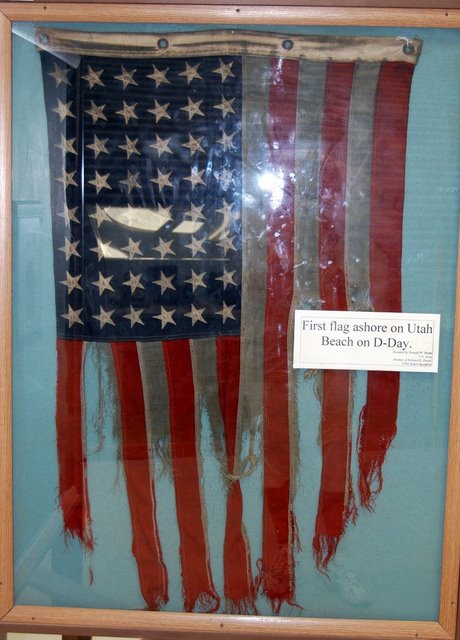
First Flag on Utah Beach, June 6, 1944Got an e-mail with a question.


Today is the 64th anniversary of the Invasion of Normandy in World War II, a date generally called D-DayNo, you don’t have to fly your flag.  This is not one of the days designated by Congress for flag-flying.

But you may, and probably, you should.


The Wrong Stuff, on purpose: Weikart misquotes Darwin

May 10, 2008

Richard Weikart is an arm of the Discovery Institute’s disinformation brigade. A couple of years ago he published a book attempting to link Darwin to the Holocaust in a blame-sharing arrangement. This book and some of its arguments appear to be the foundation of the text used to write the script for the mockumentary movie “Expelled!” featuring Nixon speechwriter Ben Stein.

Which is to say, the basis for the movie is dubious. Weikart’s scholarship creating links between Darwin, science and Hitler is quite creative. It is also based on arguments created from Darwin’s writings that mislead the innocent about evolution, science and history, or which get Darwin and evolution exactly wrong.

Michael Ruse published an op-ed in a Florida paper in February — a piece which is no longer available there (anybody got a copy? Nebraska Citizens for Science preserved a copy) — and Weikart responded, restating his creative claims. Alas for the truth, Weikart’s canards are still available at the Discovery Institute website, putting an interesting twist on Twain’s old line: The truth will go to bed at night while a falsehood will travel twice around the world as the truth kicks off its slippers.

Looking for Ruse’s piece, I found Weikart’s response here and here. I composed a quick response pointing out the problems, which I would like to posit here for the record — partly because I doubt Darwiniana gets much traffic, partly because the censor-happy folks at Discovery Institute don’t allow free discussion at their site, and partly so I can control it to make sure it’s not butchered as Weikart butchers Darwin’s text.

At Darwiniana I said:

Weikart’s strip quoting of Darwin is most disappointing. [Weikart wrote:]

Darwin claimed in chapter two of The Descent of Man that there were great differences in moral disposition and intellect between the “highest races” and the “lowest savages.” Later in Descent he declared, “At some future period, not very distant as measured by centuries, the civilised races of man will almost certainly exterminate and replace throughout the world the savage races.” Racial inegalitarianism was built into Darwin’s analysis from the start.

Darwin argued the differences in intellect and manners between the “highest” of men and the “lowest” of men did NOT change the fact that we are are all related — legally, Darwin’s argument would evidence a claim absolutely the opposite of what Weikart claims. Here are Darwin’s words from Chapter II of Descent of Man, as Darwin wrote them, without Weikart’s creative editing:

Nor is the difference slight in moral disposition between a barbarian, such as the man described by the old navigator Byron, who dashed his child on the rocks for dropping a basket of sea-urchins, and a Howard or Clarkson; and in intellect, between a savage who uses hardly any abstract terms, and a Newton or Shakespeare. Differences of this kind between the highest men of the highest races and the lowest savages, are connected by the finest gradations. Therefore it is possible that they might pass and be developed into each other. [emphasis added]

That’s not inegalitarianism at all — Darwin’s saying they are the same species, related closer than the poets allow. If we stick to the evidence, and [do] not wander off into poetic philosophy, we must acknowledge that Darwin’s own egalitarian spirit shows here in the science, too. It would be an odd kettle of fish indeed that a crabby guy like Hitler, who shared the antiscience bias of Weikart’s organization, would suddenly accept the science of a hated Englishman that ran contrary to his other philosophies. Who makes the error here, Hitler or Weikart? If they both think Darwin endorsed racism, they both do — but there is not an iota of evidence that Hitler based his patent racism on science, let alone the science of an Englishman.

As to the second quote, Weikart leaves the context out, and the context is everything. Darwin is not arguing that “savages” (the 19th century word for “aboriginals”) were less human, nor that they are a different species. He was arguing that in some future time there would appear creationists like Dr. Weikart’s colleagues at the Discovery Institute who will deny evolution because, once Europeans and others with guns conduct an unholy genocide (which Darwin writes against in the next chapter), and once humans wipe out chimpanzees, orangs and gorillas, the other great apes, the creationists can [then] dishonestly look around, blink their eyes and say, “Where are the links? There cannot be evolution between (Animal X) and humans!”

Darwin wrote:

At some future period, not very distant as measured by centuries, the civilised races of man will almost certainly exterminate, and replace, the savage races throughout the world. At the same time the anthropomorphous apes, as Professor Schaaffhausen has remarked (18. ‘Anthropological Review,’ April 1867, p. 236.), will no doubt be exterminated. The break between man and his nearest allies will then be wider, for it will intervene between man in a more civilised state, as we may hope, even than the Caucasian, [emphasis added] and some ape as low as a baboon, instead of as now between the negro or Australian and the gorilla.

In the end, Darwin wrote against genocide, against racism, and in favor of the higher thinking abilities of all dark-skinned people. He wrote in favor of Christian morality. Darwin himself remained a faithful, tithing Christian to the end of his life.

Such a man, and such amazing science, deserve accurate history, not the fantastic, cowardly and scurrilous inventions Dr. Weikart has given them. We should rise to be “man in a more civilized state” as Darwin had hoped.

Update, July 24, 2008, nota bene:  To anyone venturing here from the Blogcatalog discussion on intelligent design: Get over to the site of Donald Johanson’s Institute for Human Origins, and especially look at the presentation “On Becoming Human.”  Also check out the Evolution Gateway site at Berkeley, especially this page which explains what evolution is, and this page which offers some introduction for what the evidence for evolution really is.  One quick answer to a question someone asked there:  Between H. erectus and modern humans, H. sapiens, in the time sequence we have fossils of H. heidelbergensis and H. neanderthalensis.  It’s pretty clear that Neandertal is not ancestral to modern humans, but instead lived alongside modern humans for 50,000 years or so from the Middle East through Southern Europe.  To the question of actual transitional fossils, you’d need to hit the paleontology journals — there are a lot.  You may also benefit from taking a look at the articles at this special Nature site.


Call for help: Real story behind the Holocaust?

May 4, 2008

Historians, help me out here. I’ve recently become aware that many creationists have swallowed as accurate Richard Weikart’s book making Darwin complicit in the Nazi Holocaust of World War II.

I have always dismissed Weikart. His claims fly in the face of history recorded by too many reputable and trustworthy hands. Others aren’t concerned with what history really shows, or are simply ignorant of history (candidates for Jay Leno’s “Jaywalking” segment). I am working to assemble what I hope will be a short piece showing the error of Weikart’s claims.

It seems to me there are many holes in the history case Weikart tries to make. And the history case needs to be nailed down, accurately.

Scientists already have responded. The American Academy for the Advancement of Science complains that the scientific inaccuracies in the film muddy the waters between science and religion unfairly and unnecessarily (see video here). The Jewish Anti-Defamation League has complained about the unholy Holocaust claims. Movie reviewers have not been kind to the film, with reviews like the New York Times:

One of the sleaziest documentaries to arrive in a very long time, “Expelled: No Intelligence Allowed” is a conspiracy-theory rant masquerading as investigative inquiry.

Still there are creationists, and other people of faith out there, who grant credence to Weikart’s claims. So we need a clear rebuttal to Weikart’s claims, from the history viewpoint.

The National Center for Science Education has a brief that touches on these arguments; what other sources do you recommend on these specific claims listed below?

Weikart makes six claims (I’ve borrowed here from an article he wrote for American Spectator):

1. Darwin argued that humans were not qualitatively different from animals. The leading Darwinist in Germany, Ernst Haeckel, attacked the “anthropocentric” view that humans are unique and special.

That seems directly contrary to the view of Darwin presented in the better biographies. I don’t recall Darwin ever arguing this point at all. Is Weikart imagining this?

2. Darwin denied that humans had an immaterial soul. He and other Darwinists believed that all aspects of the human psyche, including reason, morality, aesthetics, and even religion, originated through completely natural processes.

Darwin never denied the existence of human souls. While Darwin made rather brilliant arguments for how morality could arise through evolution, going so far as to say that morality is necessary for the survival of a social species such as humans, at no point in his arguing for the natural processes does he deny or disavow the supernatural. Descent of Man will offer Darwin’s work on the rise of morals and art — what other sources would you recommend?

3. Darwin and other Darwinists recognized that if morality was the product of mindless evolution, then there is no objective, fixed morality and thus no objective human rights. Darwin stated in his Autobiography that one “can have for his rule of life, as far as I can see, only to follow those impulses and instincts which are the strongest or which seem to him the best ones.”

Notes from Evil Bender, Creationist quotemining of Darwin: moral relativism edition, has already called out the gross error in Weikart’s claim here — this is quite contrary to what Darwin actually argued and said. But again, there should be a few other sources to rebut Weikart’s claim. Which do you recommend?

4. Since evolution requires variation, Darwin and other early Darwinists believed in human inequality. Haeckel emphasized inequality to such as extent that he even classified human races as twelve distinct species and claimed that the lowest humans were closer to primates than to the highest humans.

Actually, Darwin was a potent advocate of legal equality, for example in his advocacy and support for ending slavery. Weikart’s claim here completely steps away from reality. I admit to not being overly familiar with Haeckel’s work, partly because Haeckel doesn’t represent Darwin, partly because I have just never found the guy’s work particularly interesting or useful. What sources and arguments do you recommend here?

5. Darwin and most Darwinists believe that humans are locked in an ineluctable struggle for existence. Darwin claimed in The Descent of Man that because of this struggle, “[a]t some future period, not very distant as measured by centuries, the civilised races of man will almost certainly exterminate and replace throughout the world the savage races.”

That’s a complete distortion of what Darwin wrote, of course — the NCSE site has a short rebuttal. Darwin was writing of the clash between colonists and natives, largely between Europeans and aboriginals, or between Europeans with guns and aboriginals without them. Key case in point: The Tasmanian “Wars,” which led to the almost complete extinction of native Tasmanians, a sad circumstance Darwin saw on his voyage. Got other sources you recommend?

6. Darwinism overturned the Judeo-Christian view of death as an enemy, construing it instead as a beneficial engine of progress. Darwin remarked in The Origin of Species, “Thus, from the war of nature, from famine and death, the most exalted object which we are capable of conceiving, namely, the production of the higher animals, directly follows.”

This claim is so full of hooey I’m not sure where to start. What do you think? Can you imagine how quickly Darwin would have gotten his shotgun out for some fool who suggests, like Weikart does here, that Darwin was not grieved by the death of Annie? Are you outraged at the butchering of the last paragraph from Origin of Species?

There are a lot of Christians who should know better who have been misled by this claptrap. Will you help me make a brief against Weikart’s claims?

Comments are open. Please chime in.


Anniversary of the Ardeatine Massacre

March 24, 2008

Do your texts even mention the Ardeatine Massacre?  On March 24, 1944, just outside of Rome, German troops murdered 335 Italians in a cave, in revenge for an attack on a column of German troops by an Italian resistance group that killed 31 German soldiers.

A Quantum Diaries Survivor wrote last year about the settling of a journalism controversy over the events.  I wrote moreThis year a blog tightly focused on executions — ExecutedToday.com —  marks the actual anniversary.


Last flag-raising vet from Iwo Jima, Raymond Jacobs

February 7, 2008

Raymond Jacobs died February 5 — he is thought to be the last surviving U.S. soldier pictured in the photos of the flag-raisings on Iwo Jima in 1945.

Raymond Jacobs looks up at flag, Iwo Jima 1945 - AP photo In the photo at right, Ray Jacobs is the radioman looking up; Associated Press photo

BBC news carried the story.

Raymond Jacobs died of natural causes at the age of 82 last week, his daughter told the Associated Press

Jacobs said he was present at the first flag raising, captured by a photographer for Leatherneck magazine. A later flag-raising, to put up a larger flag, was photographed by Joe Rosenthal, who won a Pulitzer Prize for the photo.

He is said to have returned to his unit by the time a more famous Associated Press photograph of a second flag-raising was taken later the same day.

Jacobs later fought in the Korean conflict in 1951 before retiring as a sergeant. He went on to work as a reporter, anchor and news director in local television in Oakland.

Eyewitnesses to the two World Wars dwindle in numbers. Historians and friends should be certain to capture their stories before they are gone.

Japan renamed the island Iwo To, its name prior to the war.


Found: Last photo of Ernie Pyle

February 4, 2008

A reporter named Richard Pyle — no relation, he notes — writing for the Associated Press reports that a photograph of Ernie Pyle has surfaced, showing him dead, after he was hit by a Japanese machine gun bullet while reporting on U.S. troops, on the island of Ie Shima, on April 18, 1945.

Photos here, at the Dallas Morning News site. Story here.

Especially in black and white, the photo is not so macabre as to shock. Pyle looks peaceful, asleep, as Richard Pyle wrote. The value is historical. It’s a reminder that reporters, too, put themselves in harm’s way, to inform Americans about the world, providing the information our democratic republic needs to function well.

Remember to vote in your state’s primary elections this year. Deserve their heroism.

Earlier notes on Ernie Pyle:

Read the rest of this entry »


Texas teachers: 9th Legacies Dallas History Conference, January 26

January 20, 2008

You’re not registered yet?

Students learn history best when it affects them directly, or when they can see the stuff close up. The Legacies Dallas History Conferences focus on history in and around Dallas, Texas. This is prime material for Texas and Dallas history, economics and government classes.

The 9th Annual Legacies Dallas History Conference is set for next Saturday, January 26, in the half-day from 8:30 a.m. to 1:10 p.m: “Dallas Goes to War: Life on the Homefront.” $40 for nine presentations — or $100 brings an invitation to schmooze with the presenters on Friday night, before the conference. The conference will be at the Hall of State at Fair Park. The conference was assembled by Dr. Michael V. Hazel.

If you’re teaching at a high school or middle school in the Dallas area, print this off for every social studies and English teacher at your school, and pass it out to them Tuesday (or Monday if you’re open then).

Nancy Harkness Love and Betty Huyler Gillies, first women to fly B-17, during WWII

Many of the conference presentations roll down that alley of a topic most Texas students need more of, the events around World War II. One session dives into Vietnam, one goes back to the Civil War, and World War I is remembered.

Bob Reitz, the public historian who curates the amazing Jack Harbin Museum of Scout History at Dallas’s Camp Wisdom, alerted me to the conference with a plug to his colleague’s presentation. Anita Mills-Barry will present her paper, “Homefront Scouting During World War II: Participation by Boy Scouts and Girl Scouts in the Civilian Effort in Dallas County.”

A copy of the web invitation to the conference below the fold.

Read the rest of this entry »


Pearl Harbor, 66 years ago today

December 7, 2007

This is an encore post, from a year ago. That was the last official reunion of the Pearl Harbor veterans, though I suspect a few will be there today, unofficially. New resources at the end of the post:

______________________________________

Pearl Harbor, 65 years ago today

December 7, 2006

Associated Press 1941 file photo of a small boat assisting in rescue of Pearl Harbor attack victims, near the U.S.S. West Virginia, as the ship burns.

Today is the 65th anniversary of Japan’s attack on the U.S.’s Pacific Fleet at Pearl Harbor, Hawaii.

Our local newspaper, The Dallas Morning News, has a front-page story on survivors of the attack, who have met every five years in reunion at Pearl Harbor. Today will be their last official reunion. The 18-year-olds who suffered the attack, many on their first trips away from home, are in their 80s now. Age makes future reunions impractical.

From the article:

“We’re like the dodo bird. We’re almost extinct,” said Middlesworth, now an 83-year-old retiree from Upland, Calif., but then – on Dec. 7, 1941 – an 18-year-old Marine on the USS San Francisco.

Nearly 500 survivors from across the nation were expected to make the trip to Hawaii, bringing with them 1,300 family members, numerous wheelchairs and too many haunting memories.

Memories of a shocking, two-hour aerial raid that destroyed or heavily damaged 21 ships and 320 aircraft, that killed 2,390 people and wounded 1,178 others, that plunged the United States into World War II and set in motion the events that led to atomic bombings of Hiroshima and Nagasaki.

“I suspect not many people have thought about this, but we’re witnessing history,” said Daniel Martinez, chief historian at the USS Arizona Memorial. “We are seeing the passing of a generation.”

Another article notes the work of retired history professor Ron Marcello from the University of North Texas, in Denton, in creating oral histories from more than 350 of the survivors. This is the sort of project that high school history students could do well, and from which they would learn, and from which the nation would benefit. If you have World War II veterans in your town, encourage the high school history classes to go interview the people. This opportunity will not be available forever.

There is much to be learned, Dr. Marcello said:

Dr. Marcello said that in doing the World War II history project, he learned several common themes among soldiers.

“When they get into battle, they don’t do it because of patriotism, love of country or any of that. It’s about survival, doing your job and not letting down your comrades,” he said. “I heard that over and over.”

Another theme among soldiers is the progression of their fear.

“When they first got into combat, their first thought is ‘It’s not going to happen to me.’ The next thought is ‘It might happen to me,’ and the last thought is ‘I’m living on borrowed time. I hope this is over soon,’ ” Dr. Marcello said.

Dr. Marcello said the collection started in the early 1960s. He took charge of it in 1968. Since Dr. Marcello has retired, Todd Moye has taken over as the director.

Other sources:

While this is not one of the usual dates listed by Congress, you may fly your U.S. flag today.

End of encore post —

Other resources:


Michigan officially remembers Pearl Harbor attack

December 6, 2007


Press release from Michigan Gov. Jennifer M. Granholm:

Flags to Fly Half-Staff Throughout Michigan on Friday in Honor of Pearl Harbor Day

LANSING – Governor Jennifer M. Granholm today encouraged Michigan citizens to observe Pearl Harbor Day on Friday, December 7, by lowering flags across the state to half-staff and remembering those who lost their lives in the attack on Pearl Harbor on December 7, 1941.

“On Pearl Harbor Day, we honor the lives lost in the attack 66 years ago and remember that we enjoy freedom thanks to their supreme sacrifices,” Granholm said. “This year, we also salute the men and women stationed around the world, including those fighting in Iraq and Afghanistan, who are defending and protecting our freedom today.”

In December 2005, Granholm signed Executive Order 2005-27 ordering the flag of the United States of America be flown half-staff on all state buildings and facilities throughout the state of Michigan on Pearl Harbor Day each December 7. Procedures for flag lowering, including on Pearl Harbor Day, were detailed by Governor Granholm in Executive Order 2006-10. The Legislature officially recognized the sacrifice of the servicemen and servicewomen who gave their lives at Pearl Harbor by enacting Public Act 157 of 2000, which declares that December 7 of each year be known as Pearl Harbor Day in the state.

On the morning of December 7, 1941, the Armed Forces of the United State of America stationed at Pearl Harbor, Hawaii, were attacked by the air and naval forces of Imperial Japan. The attack claimed the lives of 2,334 servicemen and servicewomen and wounded another 1,143.

When flown at half-staff or half-mast, the United States flag should be hoisted first to the peak for an instant and then lowered to the half-staff or half-mast position. The flag should again be raised to the peak before it is lowered for the day.

# # #

Michiganders, or anyone else, may subscribe to Flag Honors, the service notifying when flags in Michigan are to be flown half-staff. If you know of similar services for any other state, kindly make a note in comments.