January 30: A beginning, beginning of the end, end of the beginning, end

January 30, 2017

When students claim to find fantastic conjunctions of dates that they claim show worldwide conspiracies, sometimes centuries in existence, I point them to the internet to find what happened on that date (whatever date it is) and note coincidences “a suspicious mind” might find compelling.

Almost every date on the calendar produces astonishing coincidences. But that’s all they are.

Right? It’s not as if there are such conspiracies, or that the gods conspire to send us messages by making momentous things occur on the same day, right?

January 30 is a momentous date, according to the AP list of events that occurred on this day.
A suspicious mind might reel at these coincidences.

Franklin D. Roosevelt, National Portrait Gallery

Franklin D. Roosevelt, National Portrait Gallery

Beginning: Franklin Roosevelt, the only president of the U.S. to break the tradition of getting elected to two terms only, was born on January 30, 1882,  in Hyde Park, New York.  (Both Ulysses Grant and his cousin, Theodore Roosevelt, had tried to break the two-term tradition  before.)  Roosevelt served at the 32nd president, winning election in 1932, 1936, 1940, and 1944.  During his first term the date of presidential inaugurations was moved from March 21 to January 21, partly in appreciation for the period of time the nation drifted seemingly deeper into depression between Roosevelt’s election in November 1932 and his inauguration in March 1933.  Roosevelt contracted polio in 1921, won election as New York’s governor in 1928, and then won the 1932 presidential race.  His death on April 12, 1945, pushed Harry Truman into the presidency for three years before he had to face the electorate.

End of the beginning: On January 30, 1933, Adolf Hitler took office as chancellor of Germany.  A World War I veteran, Hitler had spent time in prison for trying to overthrow the government. Hitler was seven years younger than FDR, but their careers occasionally coincided on key years.  Hitler’s assuming power in January 1933 gave him a two-month jump on FDR; at the time, few people, if anyone noticed the coincidental rise, nor could see the significance of the events of the year.  According to The History Place:

Germany was a nation that in its history had little experience or interest in democracy. In January 1933, Adolf Hitler took the reins of a 14-year-old German democratic republic which in the minds of many had long outlived its usefulness. By this time, the economic pressures of the Great Depression combined with the indecisive, self-serving nature of its elected politicians had brought government in Germany to a complete standstill. The people were without jobs, without food, quite afraid and desperate for relief.

Now, the man who had spent his entire political career denouncing and attempting to destroy the Republic, was its leader. Around noon on January 30th, Hitler was sworn in.

“I will employ my strength for the welfare of the German people, protect the Constitution and laws of the German people, conscientiously discharge the duties imposed on me, and conduct my affairs of office impartially and with justice to everyone,” swore Adolf Hitler.

Democratic-based government in Germany was doomed for the foreseeable future.  Few foresaw that.

Beginning of the end: On January 30, 1968, during the Vietnamese new year celebration known as Tet, Vietcong and North Vietnamese army regulars kicked off the Tet Offensive, striking targets all over Vietnam simultaneously.  Caught nearly completely by surprise, U.S. and South Vietnamese forces lost control of Saigon, the South Vietnamese capital for a time.  While the U.S. and South Vietnamese eventually won these many battles and pushed out the invading forces,  the simple fact that the thought-to-be-decimated forces of Ho Chi Minh could pull of the offensive at all sent the chilling message that victory in this guerrilla did not yet belong to South Vietnam and the U.S., nor had a tide been turned.   After tumultuous elections in the U.S., Richard Nixon’s presidency could not turn the tide, either.  A “peace” was negotiated, mostly between North Vietnam and the U.S., in 1973, but it did not hold.  In 1975 relations between North Vietnam and South Vietnam hit crisis again, and the U.S. pulled out the last forces left in South Vietnam in April.  Vietcong and North Vietnamese forces defeated the rapidly dissipating military of the South, and the country was united under communist, North Vietnam rule.
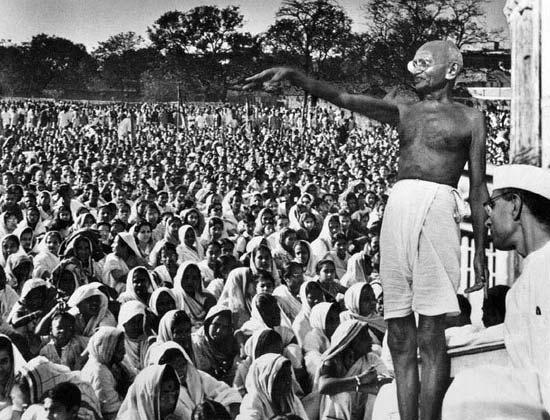
Mahatma Gandhi addresses Indians; image from Bins Corner, probably public domain

Mahatma Gandhi addresses Indians

An end: Hindu extremist Nathuram Godse shot and killed Mohandas K. Gandhi in India, on January 30, 1948.  Gandhi was known as “Mahatma,” which means “Great Soul.”  Gandhi campaigned for India’s independence and end of British colonial rule for most of the 1920s, including a period of time in prison for subversive activities.  Gandhi’s great contribution to political change is the massive use of non-violent, non-cooperation.  Non-violent tactics tend to highlight the moral positions of groups in conflict, and make the non-violent side appear to have the stronger case.  Such tactics expose hypocrisy and despotic government rules.  Though he resigned from his political party in 1934, Gandhi remained a key icon of the drive for India’s independence.  When violence broke out over the Mountbatten plan to grant independence in 1947, creating two nations of Pakistan and India divided along religious, Gandhi again appealed for peace, but became the most famous victim of the religious violence that still roils the region today.  Committed to peace and non-violence, Gandhi himself did not ever win the Nobel Peace Prize, perhaps because his life was cut short.  His work inspired other Nobel Peace laureates, including the Rev. Dr. Martin Luther King, Jr. (1964), the Dalai Lama (1989), Aung San Suu Kyi (1991), Nelson Mandela (with Frederik Willem deKlerk, 1993), and U.S. President Barack Obama (2009).

On January 30, 2011, when I first noted these coincidences here, much of the world held its breath, watching events in North Africa, including especially Tunisia and Egypt.  I wondered, which of these traditions would that day follow, to peace, or toward war?

On January 30, 2017, the installation of Hitler and the Tet Offensive remind us of hubris of world leaders and really bad decisions that can have disastrous results, soon, and for a long time after.

Coincidence? What do you think?


White House proclamation: Pearl Harbor Remembrance Day, 2016

December 7, 2016

President Barack Obama places a wreath at the USS Arizona Memorial, part of the World War II Valor in the Pacific National Monument, in Pearl Harbor, Hawaii, Dec. 29, 2011. (Official White House Photo by Pete Souza)

President Obama proclaimed Pearl Harbor Remembrance Day for 2016:

Presidential Proclamation

National Pearl Harbor Remembrance Day, 2016

NATIONAL PEARL HARBOR REMEMBRANCE DAY, 2016

– – – – – – –

BY THE PRESIDENT OF THE UNITED STATES OF AMERICA

A PROCLAMATION

Seventy-five years ago, Japanese fighter planes attacked the United States Naval Base at Pearl Harbor, destroying much of our Pacific Fleet and killing more than 2,400 Americans. The following day, President Franklin D. Roosevelt called on the Congress to declare war and “make it very certain that this form of treachery shall never again endanger us.” In that spirit, Americans came together to pay tribute to the victims, support the survivors, and shed the comforts of civilian life to serve in our military and fight for our Union. Each year on National Pearl Harbor Remembrance Day, we honor those whose lives were forever changed that December morning and resolve to uphold the legacy of all who stepped forward in our time of need.

From the docks of Pearl Harbor to the beaches of Normandy and far around the world, brave patriots served their country and defended the values that have sustained our Nation since its founding. They went to war for liberty and sacrificed more than most of us will ever know; they chased victory and defeated fascism, turning adversaries into allies and writing a new chapter in our history. Through their service and unparalleled devotion, they inspired a generation with their refusal to give in despite overwhelming odds. And as we reflect on the profound debt of gratitude we owe them for the freedoms we cherish, we are reminded of the everlasting responsibilities we have to one another and to our country.

In memory of all who lost their lives on December 7, 1941 — and those who responded by leaving their homes for the battlefields — we must ensure the sacrifices they made in the name of liberty and democracy were not made in vain. On this solemn anniversary, there can be no higher tribute to these American patriots than forging a united commitment to honor our troops and veterans, give them the support and care they deserve, and carry on their work of keeping our country strong and free.

The Congress, by Public Law 103-308, as amended, has designated December 7 of each year as “National Pearl Harbor Remembrance Day.”

NOW, THEREFORE, I, BARACK OBAMA, President of the United States of America, do hereby proclaim December 7, 2016, as National Pearl Harbor Remembrance Day. I encourage all Americans to observe this solemn day of remembrance and to honor our military, past and present, with appropriate ceremonies and activities. I urge all Federal agencies and interested organizations, groups, and individuals to fly the flag of the United States at half-staff this December 7 in honor of those American patriots who died as a result of their service at Pearl Harbor.

IN WITNESS WHEREOF, I have hereunto set my hand this sixth day of December, in the year of our Lord two thousand sixteen, and of the Independence of the United States of America the two hundred and forty-first.

BARACK OBAMA


2016: Election day art of Norman Rockwell, and unpredictability of elections

November 8, 2016

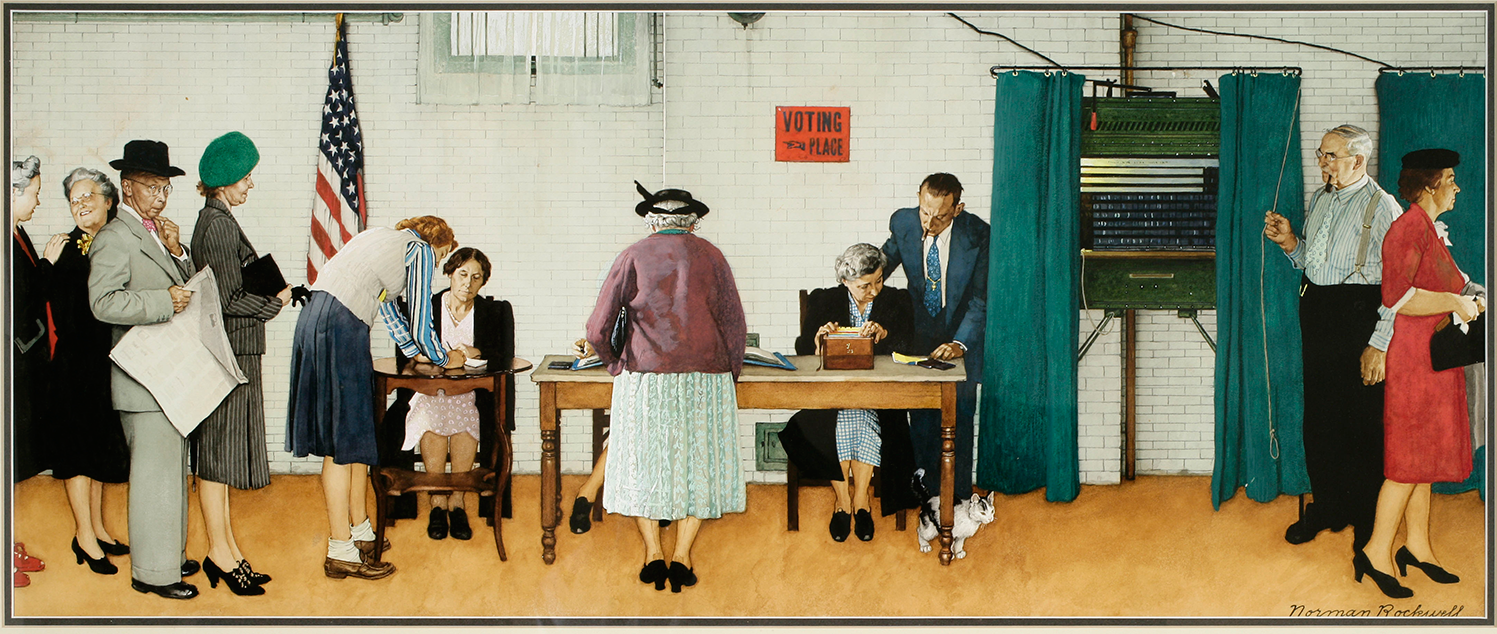
Especially in 2016, I think of this great, undersung painting by Normal Rockwell, “Election Day (1944)”:

Norman Rockwell, Election Day, 1944, watercolor and gouache, 14 x 33 1/2 in., Museum purchase, Save-the-Art fund, 2007.037.1.

Norman Rockwell, Election Day, 1944, watercolor and gouache, 14 x 33 1/2 in., Museum purchase, Save-the-Art fund, 2007.037.1.

Remember when people used to dress up to go to the polls?

In 1944 President Franklin Roosevelt ran for an unprecedented fourth term.  Most Americans did not know it, but he was deathly ill at the time.  He dropped Vice President Henry Wallace from his ticket — some argue it was a mutual disaffection at that time — and selected the relatively unknown young Missouri U.S. Sen. Harry S Truman for the vice president’s slot.

In November 1944, D-Day was known to be a successful invasion, and most Americans hoped for a relatively speedy end to World War II in both Europe and the Pacific.  Within the next ten months, the nation would endure the last, futile, desperate and deadly gasp of the Third Reich in the Battle of the Bulge, the liberation of Berlin in April 1945, and end of the war in the European Theatre on May 8; the Battle of Leyte Gulf, the Philippines Campaign, and the bloody, crippling battles of Iwo Jima and Okinawa in the Pacific Theatre, and then the first use of atomic weapons in war, at Hiroshima and Nagasaki (and we hope, the last use).

Voters in Cedar Rapids could not have known that.  They did not know that, regardless their vote for FDR or his Republican challenger, New York Gov. Thomas Dewey, Harry S Truman would be president within six months, nor that the entire world would change in August 1945.

This painting captures a time of spectacular moment, great naivity, and it pictures the way history got made.

For a 2007 exhibition, the Cedar Rapids Museum of Art offered this history:

Norman Rockwell: Fact & Fiction

September 12, 2009 – January 3, 2010

In 2007, the citizens of Cedar Rapids rallied together to purchase a series of watercolors destined for the auction block in New York. These five watercolors, by acclaimed 20th century American artist Norman Rockwell, depicted scenes associated with an election day and were created specifically for the November 4, 1944 issue of the Saturday Evening Post. To complete the Post commission, Rockwell traveled to a quintessential Midwestern town, Cedar Rapids, to study local citizens as models for his series of images.
In the 65 years since his visit, numerous anecdotes and stories have arisen about the artist’s time in Cedar Rapids and the creation of this work. This exhibition uses these five, newly conserved and restored watercolors and a related oil painting from the Norman Rockwell Museum, along with numerous photographs taken by local photographer Wes Panek for Rockwell, to investigate the many facts and fictions associated with Rockwell’s visit and this set of watercolors.
Norman Rockwell: Fact & Fiction has been made possible in part by Rockwell Collins, Candace Wong, and local “Friends of Norman Rockwell.” General exhibition and educational support has been provided by The Momentum Fund of the Greater Cedar Rapids Community Foundation.

Friends of Norman Rockwell: Wilma E. Shadle, Howard and Mary Ann Kucera, Jean Imoehl, Ben and Katie Blackstock, Marilyn Sippy, Chuck and Mary Ann Peters, Phyllis Barber, Ann Pickford, Anthony and Jo Satariano, Barbara A. Bloomhall, Virginia C. Rystrom, Jeff and Glenda Dixon, Robert F. & Janis L. Kazimour Charitable Lead Annuity Trust, Fred and Mary Horn, Mrs. Edna Lingo, John and Diana Robeson, Jewel M. Plumb, Carolyn Pigott Rosberg, Mr. and Mrs. Robert J. Buchacek, Dan and Anne Pelc, Mary Brunkhorst, and John and Diana Robeson.

I am amused and intrigued that this scene also closely resembles the scene when I voted in Cheverly, Maryland, in 1984 — down to the dog in the picture.  Oh, and most of the women didn’t wear dresses, none wore hats, and I was the only guy in the room with a tie.

Roosevelt won the 1944 election in an electoral college landslide, 432 to 99, but Dewey won Iowa, and we might assume Dewey won Cedar Rapids, too.

And that Truman guy?  Rockwell came back to the topic of elections four years later, when Truman was running for election to the office he’d filled for nearly four years, with another classic, American election portrayal.

“Election Day,” by Norman Rockwell, 1948

More:

This is an encore post.

Yes, this is an encore post. Defeating ignorance takes patience and perseverance.


October 31, we remember the sinking of the Reuben James

October 31, 2016

U.S.S. Reuben James (D-245) on the Hudson River in April 1939, over two years before she was sunk in the Battle of the Atlantic.

U.S.S. Reuben James (DD-245) on the Hudson River in April 1939, over two years before she was sunk in the Battle of the Atlantic. Photo from the Ted Stone Collection, Marines Museum, Newport News, Virginia, via Wikipedia

It was a tragedy in 1941, but before the U.S. could develop a serious policy response to Germany’s action, Japan attacked Pearl Harbor.  Within a week after that, our policy towards Germany was set by Germany’s declaration of war on the U.S.

It’s important history for a couple of reasons.

  • The sinking was part of the massive, years-long Battle of the Atlantic, which the Allies won only by building ships faster than Germany could sink them.  Had the Allies lost this battle, the war would have been lost, too.
  • While the USS Reuben James was a Navy destroyer, the key weapons of the Battle of the Atlantic were Merchant Marine cargo ships, carrying goods and arms to Britain and other Allied nations.  “Civilians” played a huge role in World War II, supplying the soldiers, armies, navies and air forces.
  • Recently, politicians took to making claims that the U.S. declared war on Germany without any hostile action having passed between them, without Germany having perpetrated any hostilities toward the U.S.  Look at the dates, it’s not so.
  • Woody Guthrie wrote a song about the event, giving us a touchstone to remember.

Millard Fillmore’s Bathtub covered the event with longer, detailed articles in past years, including these, which you should see especially if you are a student in a history class or a teacher of one:

Europe has changed. The world has changed.  The U.S. has changed.  War has changed.  We should remember, especially those people who died defending the merchants who defended the idea of the Four Freedoms.

Where did the ship get its name? From a Barbary War hero:

Reuben James was born in Delaware, Ohio about 1776. He joined the U.S. Navy and served on various ships, including the frigate USS CONSTELLATION. It was during the infamous Barbary Wars that the American frigate PHILADELPHIA was captured by the Barbary pirates. Having run aground in the pirate capital of Tripoli on the southern shores of the Mediterranean Sea, the crew had to abandon ship and formulate a plan of attack. Lieutenant Stephen Decatur, along with a group of volunteers which included Boatswain’s Mate Reuben James, entered Tripoli harbor under the cover of darkness in an attempt to set the PHILADELPHIA to the torch so that the pirates could not make use of her.

The American volunteers boarded the PHILADELPHIA on 16 February 1804 and were met by a group of the savage Barbary pirates who were guarding their prize. A furious battle ensued, and during the bloody chaos of hand-to-hand combat, a villanous pirate made ready to end the life of Lieutenant Decatur. Reuben James, with both of his hands already wounded, in an act of selfless dedication and courage did throw his hand before the pirate’s cleaving blade! Willing to give his life in defense of his captain, Reuben James took the blow from the sword!

Having proved to the world over the courage and dedication of United States Sailors, Reuben James also hammered home the fact that US Sailors are undefeatable by not only surviving, but recovering from his wounds and continuing his career in the U.S. Navy! After spending many more years with Decatur, James was forced to retire in January 1836 because of declining health brought on because of past wounds. He died on 3 December 1838 at the U.S. Naval Hospital in Washington, D.C.

More:

Yes, this is mostly an encore post. Fighting ignorance requires patience.

Yes, this is mostly an encore post. Fighting ignorance requires patience.


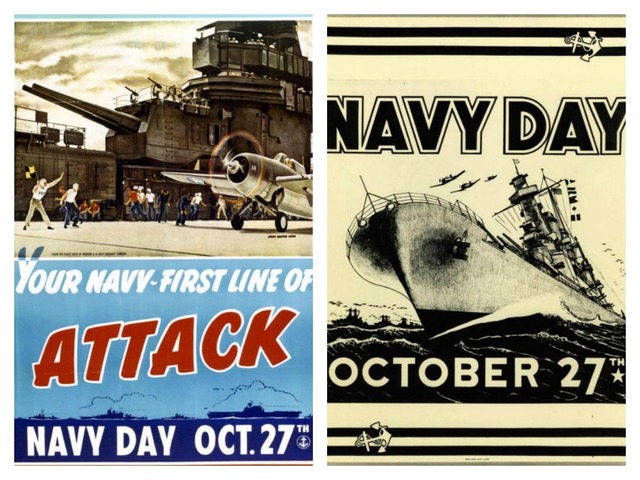
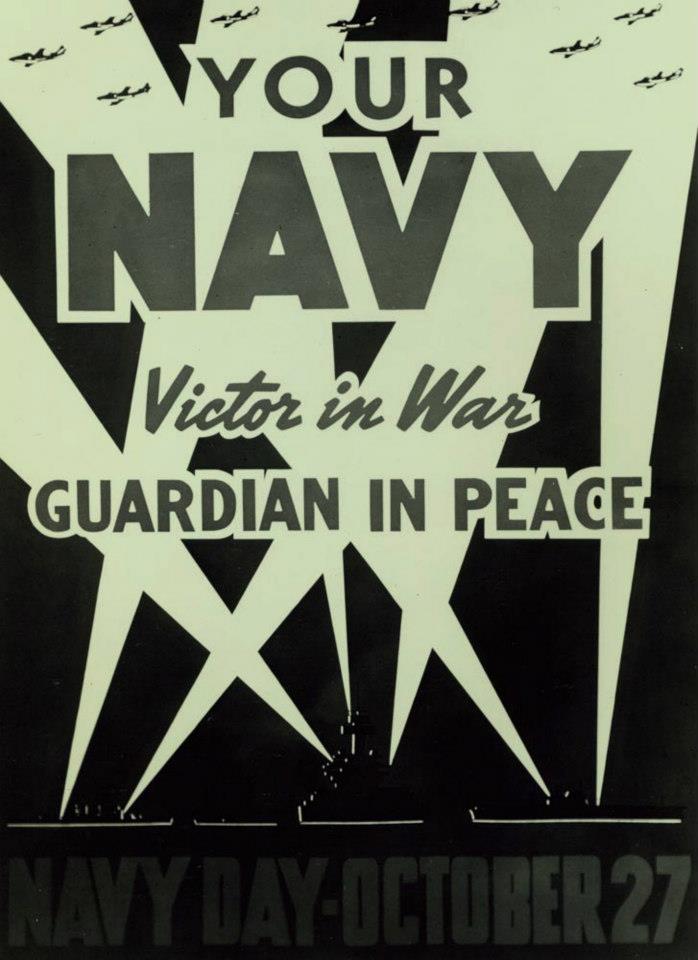
Fly your flag for Navy Day, October 27, 2016

October 26, 2016

A reminder to fly your U.S. flags tomorrow in honor of the U.S. Navy.

We celebrate Navy Day each year on October 27, one of the score of dates designated in the U.S. Flag Code to fly Old Glory.

Navy Day may be eclipsed by Armed Forces Day, Memorial Day and Veterans Day in modern life, but it’s still in the law and the Navy still notes it.

So should we.

You get an idea of the celebrations from some of the old Navy Day posters. (If you can put a year on posters undesignated, please tell us in comments; if you know of a poster not shown here, please give a link in comments.)

Navy Day poster, after World War I

Navy Day poster, after World War I


This may have been used as a Navy Day poster after the death of Theodore Roosevelt, a former, popular Secretary of the Navy. Crasch McDuff blog

This may have been used as a Navy Day poster after the death of Theodore Roosevelt, a former, popular Secretary of the Navy. Crash MacDuff blog


Navy Day poster, post World War I, pre-World War II

Navy Day poster, post World War I, pre-World War II

Navy Day poster, 1931; Crash MacDuff blog

Navy Day poster, 1931; Crash MacDuff blog


Navy Day poster, early 1940s

Navy Day poster, early 1940s, featuring the battleship USS New Jersey.
Illustration by Matt Murphey


Navy Day poster, 1940s

Navy Day poster, 1940s


Two more 1940s Navy Day posters

Two more 1940s Navy Day posters


Navy Day poster, 1944

Navy Day poster, 1944


Billboard showing art similar to the poster, Navy Day 1944

Billboard showing art similar to the poster, Navy Day 1944. History 101 image


Navy Day Poster, 1945

Navy Day Poster, 1945


Navy Day Poster from after World War II (?)

Navy Day Poster from after World War II (?)


Navy Day poster, 1947, Crash MacDuff blog

Navy Day poster, 1947, Crash MacDuff blog. “Issued September 1947. Courtesy of the Naval Historical Foundation. NHHC Photograph Collection, NH 78860.”


Navy Day poster, 1940s, perhaps. From an eBay listing

Navy Day poster, 1940s, perhaps. From an eBay listing


August 21, 2016: Fly your flag for Hawaii Statehood in 1959

August 21, 2016

It’s been 57 years since the youngest state entered the union — the longest stretch in which the U.S. has not added another state.

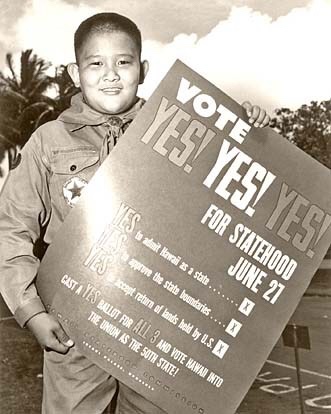
"On June 14, 1959, Boy Scout Milton Motooka helped get the word out for Hawaii’s statehood plebiscite to be held 13 days later. A new documentary will focus on Hawaii’s statehood." Hawaiians voted yes in the plebiscite, and statehood was declared two months later. (Whatever became of Scout Motooka?)

“On June 14, 1959, Boy Scout Milton Motooka helped get the word out for Hawaii’s statehood plebiscite to be held 13 days later. A new documentary will focus on Hawaii’s statehood.” Hawaiians voted yes in the plebiscite, and statehood was declared two months later. (Whatever became of Scout Motooka? See comments on last year’s post.)

“On June 14, 1959, Boy Scout Milton Motooka helped get the word out for Hawaii’s statehood plebiscite to be held 13 days later. A new documentary will focus on Hawaii’s statehood.” Hawaiians voted yes in the plebiscite, and statehood was declared two months later. (Whatever became of Scout Motooka?)

June’s plebiscite smoothed the path for statehood, declared two months later.

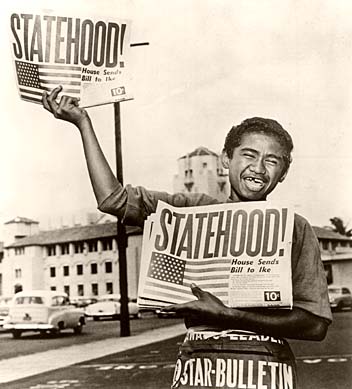
A newsboy happily hawks the Honolulu Star-Bulletin with the headline showing the state had achieved statehood, August 21, 1959. Star-Bulletin photo

13-year-old paperboy Chester Kahapea happily hawks a commemorative edition of the Honolulu Star-Bulletin with the headline showing the state had achieved statehood after the U.S. House of Representatives passed the law authorizing Hawaii as a state. Star-Bulletin photo by Murray Befeler.

Hawaii’s official statehood day is August 21, commemorating the day in 1959 when Hawaii was recognized as a member of the union of the United States of America.  Hawaiians should fly their flags to day in honor of the date (you may, too).

Hawaii formally celebrates the day on the third Friday in August, this year on the 19th.  I hope you joined in the festivities (it’s a holiday in Hawaii) — but under the U.S. Flag Code, you may certainly fly your flags on August 21, regardless which day of the week that is.

Specimen copy of the ballot used by Hawaiians in a June 27, 1959, plebiscite to approve conditions of statehood. Image from Hawaii Magazine, 2009

Specimen copy of the ballot used by Hawaiians in a June 27, 1959, plebiscite to approve conditions of statehood. Image from Hawaii Magazine, 2009

After the U.S. annexed Hawaii in 1898 (in action separate from the Spanish-American War) attempts at getting Hawaii admitted as a state got rolling.  After World War II, with the strategic importance of the islands firmly implanted in Americans’ minds, the project picked up some steam.  Still, it was 14 years after the end of the war that agreements were worked out between the people of Hawaii, the Hawaiian royal family, Congress and the executive branch.  The deal passed into law had to be ratified by a plebiscite among Hawaiian citizens.  The proposition won approval with 94% of votes in favor.

Some native Hawaiian opposition to statehood arose later, and deference to those complaints has muted statehood celebrations in the 21st century.

Other than the tiny handful of loudmouth birthers, most Americans today are happy to have Hawaii as a state, the fifth richest in the U.S. by personal income.  The nation has a lot of good and great beaches, but the idea of catching sun and surf in Hawaii on vacation might be considered an idealized part of the American dream.

“Loudmouth birthers?” Yeah, Barack Obama, our 45th President, was born in Hawaii in 1961. Some whiners think that, but for statehood, Obama would not have been a citizen eligible to be president. Hawaii is not good ground for growing sour grapes, though. Birth in a territory would probably be enough to make him eligible. Water under the bridge: Hawaii was a state in 1961. President Obama remains president.

U.S. and Hawaii flags flying together.

U.S. and Hawaii flags flying together.

More:

U.S. postage stamp issued in 2009 commemorating the 50th anniversary of Hawaii's admission to the union.

U.S. postage stamp issued in 2009 commemorating the 50th anniversary of Hawaii’s admission to the union.

Contrast the first class postage price above with the airmail postage price of this stamp issued in 1959 — August 21, 1959 7¢ Rose Hawaii Statehood C55 26432. Wikipedia image

Contrast the first class postage price above with the airmail postage price of this stamp issued in 1959 — August 21, 1959 7¢ Rose Hawaii Statehood stamp. Wikipedia image

This is an encore post.

This is an encore post.

Save

Save


Trinity test, world’s first atomic bomb – July 16, 1945

July 17, 2016

Another good reason to follow the National Archives on Twitter, Tumblr and other media:  Great updates.

Like this one on the explosive arrival of the Atomic Age:

 Atomic Age Begins

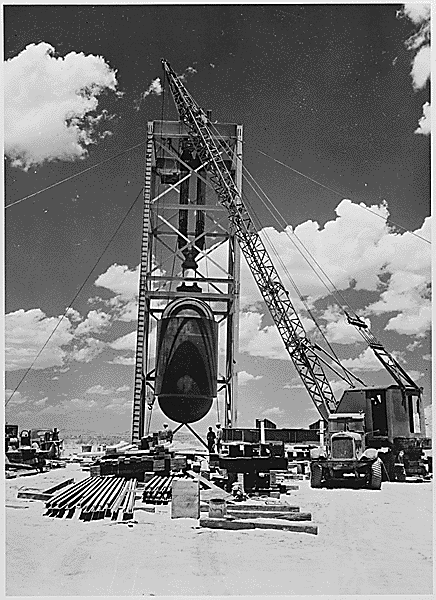
"Trinity" atomic device being positioned at White Sands, New Mexico - National Archives

Trinity atomic device “Jumbo” being positioned at White Sands, New Mexico – National Archives

Atomic Age Begins

On July 16, 1945 the United States tested a nuclear device, code named “Trinity”, for the first time in White Sands Proving Ground, New Mexico.

Above: [“Jumbo” atomic device being positioned for “Trinity” test at Alamogordo, New Mexico.], 1945

Below: [“Trinity” explosion], 07/16/1945

Source: research.archives.gov

It’s astonishing to think anyone could hide the explosion today. Near the end of World War II, after Germany had surrendered to end the war in Europe, no one really knew just what at atomic explosion would look or sound like. The test occurred near dawn in a very desolate part of New Mexico’s southern desert, a then sparsely populated state. A few thousand may have seen the flash; a few hundred may have heard or felt the explosion. No one in government confirmed any report of a weapon.

English: Rare color photograph of the first nu...

Rare color photograph of the first nuclear test at Trinity site, July 16, 1945. Blurriness is in the original photograph (done when color photography was still fairly new). (Photo credit: Wikipedia)

This is based on an earlier post, and is mostly an encore post.

This is based on an earlier post, and is mostly an encore post.


Happy birthday, Albert Einstein! 137 years, March 14

March 14, 2016

How many ways can we say happy birthday to a great scientist born on Pi Day?  So, an encore post.

E=mcc - logo from AIP

E=energy; m=mass; c=speed of light

Happy Einstein Day! to us.  Albert’s been dead since 1955 — sadly for us.  Our celebrations now are more for our own satisfaction and curiosity, and to honor the great man — he’s beyond caring.

Almost fitting that he was born on π Day, no? I mean, is there an E=mc² Day?

Albert Einstein was born on March 14, 1879, in Ulm, Germany, to Hermann and Pauline Einstein.

26 years later, three days after his birthday, he sent off the paper on the photo-electric effect; that paper would win him the Nobel Prize in Physics in 1921.

In that same year of 1905, he published three other papers, solving the mystery of Brownian motion, describing what became known as the Special Theory of Relativity and solving the mystery of why measurements of the light did not show any effects of motion as Maxwell had predicted, and a final paper that noted a particle emitting light energy loses mass. This final paper amused Einstein because it seemed so ludicrous in its logical extension that energy and matter are really the same stuff at some fundamental point, as expressed in the equation demonstrating an enormous amount of energy stored in atoms, E=mc².

Albert Einstein as a younger man - Nobel Foundation image

Albert Einstein as a younger man – Nobel Foundation image

Any one of the papers would have been a career-capper for any physicist. Einstein dashed them off in just a few months, forever changing the fields of physics. And, you noticed: Einstein did not win a Nobel for the Special Theory of Relativity, nor for E=mc². He won it for the photo electric effect. Irony in history.

106 years later Einstein’s work affects us every day. Relativity theory at some level I don’t understand makes possible the use Global Positioning Systems (GPS), which revolutionized navigation and mundane things like land surveying and microwave dish placement. Development of nuclear power both gives us hope for an energy-rich future, and gives us fear of nuclear war. Sometimes, even the hope of the energy rich future gives us fear, as we watch and hope nuclear engineers can control the piles in nuclear power plants damaged by earthquakes and tsunami in Japan.

English: Albert Einstein on a 1966 US stamp

Albert Einstein on a 1966 US stamp (Photo credit: Wikipedia)

If Albert Einstein was a genius at physics, he was more dedicated to pacifism. He resigned his German citizenship to avoid military conscription. His pacifism made the German Nazis nervous; Einstein fled Germany in the 1930s, eventually settling in the United States. In the U.S., he was persuaded by Leo Szilard to write to President Franklin Roosevelt to suggest the U.S. start a program to develop an atomic weapon, because Germany most certainly was doing exactly that. But while urging FDR to keep up with the Germans, Einstein refused to participate in the program himself, sticking to his pacifist views. Others could, and would, design and build atomic bombs. (Maybe it’s a virus among nuclear physicists — several of those working on the Manhattan Project were pacifists, and had great difficulty reconciling the idea that the weapon they worked on to beat Germany, was deployed on Japan, which did not have a nuclear weapons program.)

English: USSR stamp dedicated to Albert Einste...

Everybody wanted to claim, and honor Einstein; USSR issued this stamp dedicated to Albert Einstein Русский: Почтовая марка СССР, посвящённая Альберту Эйнштейну (Photo credit: Wikipedia)

Einstein was a not-great father, and probably not a terribly faithful husband at first — though he did think to give his first wife, in the divorce settlement, a share of a Nobel Prize should he win it. Einstein was a good violinist, a competent sailor, an incompetent dresser, and a great character. His sister suffered a paralyzing stroke. For many months Albert spent hours a day reading to her the newspapers and books of the day, convinced that though mute and appearing unconscious, she would benefit from hearing the words. He said he did not hold to orthodox religions, but could there be a greater show of faith in human spirit?

Einstein in 1950, five years before his death

Einstein in 1950, five years before his death

When people hear clever sayings, but forget to whom the bon mots should be attributed, Einstein is one of about five candidates to whom all sorts of things are attributed, though he never said them. (Others include Lincoln, Jefferson, Mark Twain and Will Rogers). Einstein is the only scientist in that group. So, for example, we can be quite sure Einstein never claimed that compound interest was the best idea of the 20th century. This phenomenon is symbolic of the high regard people have for the man, even though so few understand what his work was, or meant.

A most interesting man. A most important body of work. He deserves more study and regard than he gets.

More, Resources:


He really said it, October 29, 1941: Churchill, ‘never give in’ (Quote of the Moment)

October 29, 2015

The statue of Churchill (1973) by Ivor Roberts-Jones in Parliament Square, London. Wikipedia image. Photo by Eluveitie.

The statue of Churchill (1973) by Ivor Roberts-Jones in Parliament Square, London. Wikipedia image. Photo by Eluveitie.

In late 1941, at the height of Britain’s troubles as the sole surviving, able-to-fight exponent of democratic government in Europe, Winston Churchill paid a visit to his old school, to hear the students sing and join them in song. He was asked to speak.

It was a short speech, wholly extemporaneous, but one phrase went on to become one of the most-quoted parts of any speech ever given, anywhere.

Never give in, never give in, never, never, never, never — in nothing, great or small, large or petty — never give in except to convictions of honour and good sense!

Winston S. Churchill, address to the boys of Harrow School, October 29, 1941.

More:

Yes, this is mostly an encore post. Fighting ignorance requires patience.

Yes, this is mostly an encore post. Fighting ignorance requires patience.


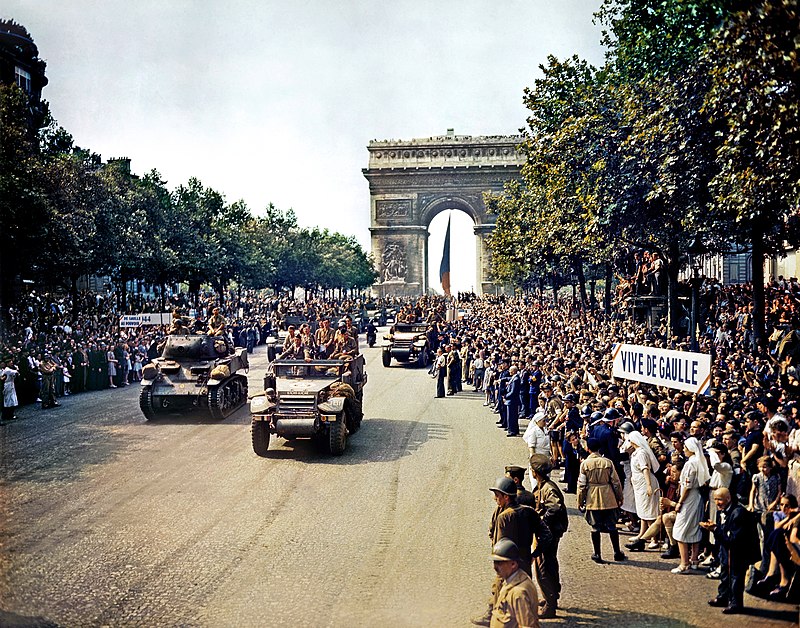
August 25, 1944: Liberation of Paris

August 24, 2015

Front page of the New York Times on August 26, 1944, noting the liberation of Paris after Allied troops reached there, following D-Day.

Front page of the New York Times on August 26, 1944, noting the liberation of Paris after Allied troops reached there, following D-Day.

On August 26, 1944, on a front page filled with other news from the war in Europe and the Pacific, the New York Times carried the story from the Associated Press:

Allied Forces Help French to Rid Capital of Nazis


By THE ASSOCIATED PRESS

SUPREME HEADQUARTERS, Allied Expeditionary Force, Aug. 25 — The Paris radio announced late tonight that the French capital had been liberated and that the German commander had signed a document ordering his troops to cease fire immediately.

The announcement followed entry of American and French troops into the capital during the day. There was no immediate confirmation here.

The latest word at headquarters was that American and French troops had joined Fighting French patriots on the Ile de la Cite in the heart of the capital after bitter fighting with Germans and French collaborationist militiamen.

Gen. Charles de Gaulle, President of the French Committee of National Liberation, said in a speech broadcast from Paris:

“France will take her place among the great nations which will organize the peace. We well not rest until we march, as we must, into enemy territory as conquerors.”

Allies invaded Europe at Normandy the previous June.

August, 1944: American soldiers watch as the Tricolor flies from the Eiffel Tower again. (Image: National Archives), via Brain Pickings

August, 1944: American soldiers watch as the Tricolor flies from the Eiffel Tower again. (Image: National Archives), via Brain Pickings

Wikipedia gives the unadorned, but detail-rich version of the story; note the vast array of national forces who joined to oust the Germans, including Spanish Republicans-in-exile:

The Liberation of Paris (also known as the Battle for Paris) was a military combat that took place during World War II from 19 August 1944 until the German garrison surrendered the French capital on 25 August 1944. Paris had been ruled by Nazi Germany since the signing of the Second Compiègne Armistice on 22 June 1940, after which the Wehrmachtoccupied northern and western France.

The liberation began when the French Forces of the Interior—the military structure of the French Resistance—staged an uprising against the German garrison upon the approach of the US Third Army, led by General George Patton. On the night of 24 August, elements of General Philippe Leclerc‘s 2nd French Armoured Division (the Régiment de marche du Tchad, a mechanised infantry unit led by Captain Raymond Dronne and composed primarily of exiled Spanish republicans), made its way into Paris and arrived at the Hôtel de Ville shortly before midnight. The next morning, 25 August, the bulk of the 2nd Armored Division and US 4th Infantry Division entered the city. Dietrich von Choltitz, commander of the German garrison and the military governor of Paris, surrendered to the French at the Hôtel Meurice, the newly established French headquarters, while General Charles de Gaulle arrived to assume control of the city as head of the Provisional Government of the French Republic.

Victory parades followed on August 26 and August 29. Paris was spared destruction ordered by German Chancellor Adolf Hitler when his commander simply failed to carry out the destruction, perhaps because his forces had been overrun more quickly than he’d imagined, perhaps because French underground and other resistance fighters simply prevented it.

From Wikipedia, a rare color photograph:

From Wikipedia, a rare color photograph: “Crowds of French patriots line the Champs Elysees to view Free French tanks and half tracks of General Leclerc’s 2nd Armored Division passes through the Arc du Triomphe, after Paris was liberated on August 26, 1944. Among the crowd can be seen banners in support of Charles de Gaulle.” Jack Downey, U.S. Office of War Information – This image is available from the United States Library of Congress’s Prints and Photographs division under the digital ID fsac.1a55001.

More:


Fly your flag August 21, for Hawaii Statehood in 1959

August 21, 2015

"On June 14, 1959, Boy Scout Milton Motooka helped get the word out for Hawaii’s statehood plebiscite to be held 13 days later. A new documentary will focus on Hawaii’s statehood." Hawaiians voted yes in the plebiscite, and statehood was declared two months later. (Whatever became of Scout Motooka?)

It’s been 56 years since the youngest state entered the union — the longest stretch in which the U.S. has not added another state.

"On June 14, 1959, Boy Scout Milton Motooka helped get the word out for Hawaii’s statehood plebiscite to be held 13 days later. A new documentary will focus on Hawaii’s statehood." Hawaiians voted yes in the plebiscite, and statehood was declared two months later. (Whatever became of Scout Motooka?)

“On June 14, 1959, Boy Scout Milton Motooka helped get the word out for Hawaii’s statehood plebiscite to be held 13 days later. A new documentary will focus on Hawaii’s statehood.” Hawaiians voted yes in the plebiscite, and statehood was declared two months later. (Whatever became of Scout Motooka?)

“On June 14, 1959, Boy Scout Milton Motooka helped get the word out for Hawaii’s statehood plebiscite to be held 13 days later. A new documentary will focus on Hawaii’s statehood.” Hawaiians voted yes in the plebiscite, and statehood was declared two months later. (Whatever became of Scout Motooka?)

June’s plebiscite smoothed the path for statehood, declared two months later.

A newsboy happily hawks the Honolulu Star-Bulletin with the headline showing the state had achieved statehood, August 21, 1959. Star-Bulletin photo

13-year-old paperboy Chester Kahapea happily hawks a commemorative edition of the Honolulu Star-Bulletin with the headline showing the state had achieved statehood after the U.S. House of Representatives passed the law authorizing Hawaii as a state. Star-Bulletin photo by Murray Befeler.

Hawaii’s official statehood day is August 21, commemorating the day in 1959 when Hawaii was recognized as a member of the union of the United States of America.  Hawaiians should fly their flags to day in honor of the date (you may, too).

Hawaii formally celebrates the day on the third Friday in August, this year coincidentally on the 21st.  I hope you joined in the festivities (it’s a holiday in Hawaii) — but under the U.S. Flag Code, you may certainly fly your flags on August 21, regardless which day of the week that is.

Specimen copy of the ballot used by Hawaiians in a June 27, 1959, plebiscite to approve conditions of statehood. Image from Hawaii Magazine, 2009

Specimen copy of the ballot used by Hawaiians in a June 27, 1959, plebiscite to approve conditions of statehood. Image from Hawaii Magazine, 2009

After the U.S. annexed Hawaii in 1898 (in action separate from the Spanish-American War) attempts at getting Hawaii admitted as a state got rolling.  After World War II, with the strategic importance of the islands firmly implanted in Americans’ minds, the project picked up some steam.  Still, it was 14 years after the end of the war that agreements were worked out between the people of Hawaii, the Hawaiian royal family, Congress and the executive branch.  The deal passed into law had to be ratified by a plebiscite among Hawaiian citizens.  The proposition won approval with 94% of votes in favor.

Some native Hawaiian opposition to statehood arose later, and deference to those complaints has muted statehood celebrations in the 21st century.

Other than the tiny handful of loudmouth birthers, most Americans today are happy to have Hawaii as a state, the fifth richest in the U.S. by personal income.  The nation has a lot of good and great beaches, but the idea of catching sun and surf in Hawaii on vacation might be considered an idealized part of the American dream.

U.S. and Hawaii flags flying together.

U.S. and Hawaii flags flying together.

More:

From Prologue, the blog of the National Archives: This petition, rolled onto a wooden spool, was signed by 116,000 supporters of Hawaii statehood and presented to the U.S. Senate on February 26, 1954. (RG 46, Records of the U.S. Senate)

From Prologue, the blog of the National Archives: This petition, rolled onto a wooden spool, was signed by 116,000 supporters of Hawaii statehood and presented to the U.S. Senate on February 26, 1954. (RG 46, Records of the U.S. Senate)


U.S. postage stamp issued in 2009 commemorating the 50th anniversary of Hawaii's admission to the union.

U.S. postage stamp issued in 2009 commemorating the 50th anniversary of Hawaii’s admission to the union.


Contrast the first class postage price above with the airmail postage price of this stamp issued in 1959 — August 21, 1959 7¢ Rose Hawaii Statehood C55 26432. Wikipedia image

Contrast the first class postage price above with the airmail postage price of this stamp issued in 1959 — August 21, 1959 7¢ Rose Hawaii Statehood stamp. Wikipedia image


This is an encore post.

This is an encore post.


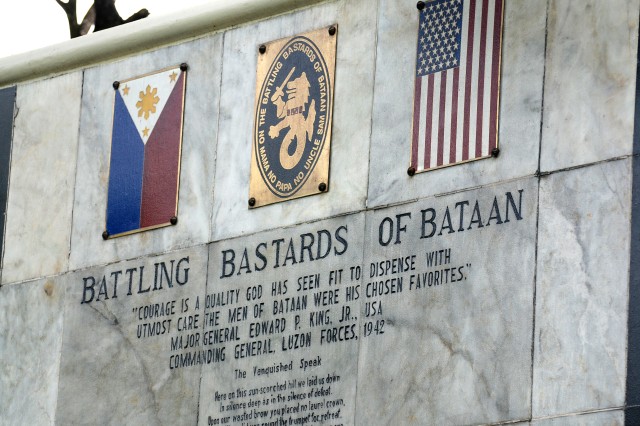
Frank Hewlett, journalist/poet: The Battling Bastards of Bataan

July 7, 2015

Photos of Frank and Virginia Hewlett, and Frank's reporting colleague William MacDougall, in post-war life. Images found at The Downhold Project.

Photos of Frank and Virginia Hewlett, and Frank’s reporting colleague William McDougall, in post-war life. Images found at The Downhold Project.

Frank Hewlett told me all about Washington, D.C.  In my youth, in the potato fields of southern Idaho, and on the slopes of the towering Wasatch Front in Utah, Frank Hewlett came on the pages of the Salt Lake Tribune nearly every day, telling what happened in Washington and how that might affect us in the west.

Two doors north of our home on Conant Avenue in Burley was the home of Henry C. Dworshak. Though we rarely saw him at home, Dworshak’s work in Washington as U.S. Senator was detailed by Hewlett. (Irony never far away, when my older brother Wes won a competitive appointment to the U.S. Air Force Academy from Dworshak, the first they met was to pose for a picture for the local newspaper.)

Frank Hewlett told me, and a half-million other people, about the ins and outs of getting authorization and funding to build massive dams on the Colorado River, at Flaming Gorge, Utah, and at Glen Canyon.

In 1979 I moved to Washington, D.C., doing press work for a Utah senator.  First full day on the job, who strides into the office but Frank Hewlett.

I got there late in Frank’s career. He was nearing retirement, and he was battling cancer.  His wife, Virginia, still suffered from the effects of imprisonment in the Philippines by Japanese forces in the World War II.  Editors at the Tribune seemed to want to push him out of the job. That didn’t seem to phase him much.  He’d seen much worse.

Hewlett reported for UPI during World War II — UPI’s glory days, the same agency from which Edward R. Murrow hired some of his best reporters in London (including Walter Cronkite).  Frank had been a personal friend of Gen. Douglas MacArthur, close enough that when the U.S. got back to Manila and pushed the Japanese out, MacArthur loaned Frank his personal jeep, so Frank could drive around to the Japanese prison camps to try to find his wife, who’d been captured because she stayed behind to burn the U.S. flag from the embassy, when the Japanese invaded.  Hewlett found Virginia, weighing way under 100 pounds and needing years of loving care to get back to a semblance of the beautiful young bride the war stole from Frank.

As with every other veteran of World War II I ever knew, Frank Hewlett didn’t talk about the war much. Once over lunch, he told me I could go look up his reports, but he wasn’t going to rehash them.

You might wonder why I fondly recall a guy who could be so curt and acerbic, who wouldn’t tell me the stories I wanted to  hear from him about the war. There were other tales he was happy to talk about — from where comes the old political saw, “You can’t go back to Pocatello,” how Republicans and Democrats combined to make National Parks and great Bureau of Reclamation dams, how Dwight Eisenhower was so concerned about snow and cold messing up John Kennedy’s inauguration that he ordered troops with flamethrowers out in the early morning to melt the ice and dry the streets of Washington.  Great history, great stories.

Didn’t hurt when he learned I had lived in Burley, Idaho.  Two refugees from the spud fields, together in D.C.

When I made a goof in a press release, when our legislation ran into problems, Frank wouldn’t barge into the office and head to the coffee pot.  He’d poke his head through door, say, “Can I buy you a coffee?” Then in one of the Senate eateries he’d quietly tell me how he’d fix whatever problem I was having.  Most often he had good advice, but always he had great concern that the youngest press guy in the Senate get through the trouble.

Once I mentioned how “fighting the bastards” reminded me of war, and he corrected me: Organizational conflict is nothing like war, and the bastards, well, often they are the good guys.  He said he’d written a poem about that.  He was sure he had a copy, and he’d get it to me.  He couldn’t remember all the lines, he said — but he gave me a recitation of what he said he could remember: “The Battling Bastards of Bataan . . . No one gives a damn.”  He explained that soldiers at Bataan despaired that no one knew their faite

Virginia grew ill. Cancer eventually took her. Kathryn and I visited Frank at his Virginia home, intending to take him out to dinner. His own cancer and other ills bothered him, he didn’t want to go out — we ended up eating hot dogs he had in the refrigerator.  Frank reminded me he’d get me a copy of his poem.

Didn’t happen. At his funeral at that little Catholic Church in Alexandria, the eulogist told about Frank’s love for Virginia and how it survived the war, and said he’d been a correspondent in a lot of tight places.

Today, I found a website with poems about World War II, and in a quick scroll found Frank’s name.

Battling Bastards of Bataan

We’re the battling bastards of Bataan;
No mama, no papa, no Uncle Sam.
No aunts, no uncles, no cousins, no nieces,
No pills, no planes, no artillery pieces
And nobody gives a damn
Nobody gives a damn.

by Frank Hewlett  1942

Now I have a copy of Frank’s poem.

Bataan Memorial at Capas Concentration Camp, Philippines, photo by Rachael Tolliver

From Army.mil, the U.S. Army’s home page: Photo Credit: Rachael Tolliver/ The names and units of those U.S. military personal who died at, or in route to the Capas Concentration Camp during the Bataan Death March, are etched on marble and titled “Battling Bastards of Bataan.” The memorial is located at the Capas National Shrine, in Capas, Tarlac, Philippines. “Battling Bastards of Bataan” was a limerick poem penned by Frank Hewlett, Manila bureau chief for UP and the last reporter to leave Corregidor before it fell to the Japanese. “We’re the battling bastards of Bataan/No mama, no papa, no Uncle Sam/No aunts, no uncles, no cousins, no nieces/No pills, no planes, no artillery pieces/And nobody gives a damn.”

More:


Leader to the bone: Eisenhower’s astonishing D-Day leadership example, “Blame . . . is mine alone”

June 6, 2015

It is a model of leadership, an example more leaders should follow — though few do. It’s one more example of the high caliber leadership Dwight Eisenhower demonstrated throughout his life. In it’s imperfections, handwritten, it should take your breath away.  Eisenhower was a leader down to the bone.

So again, today, on the 71st anniversary of the D-Day invasion, we remember.

Eisenhower's unused statement on the failure of D-Day

Eisenhower’s contingency statement, in case D-Day failed – image from the National Archives

This quote actually isn’t a quote. It was never said by the man who wrote it down to say it. It carries a powerful lesson because of what it is.

In preparing for the D-Day invasion, Supreme Allied Commander Dwight Eisenhower carefully contemplated what would happen if the invasion failed.  What if the Germans repulsed the Allies, and no foothold was established to re-take the main body of Europe from the Germans?

Ike’s answer is a model of leadership:  He would take the blame.  Regardless what happened, Ike took full responsibility for the failure, giving credit to the soldiers who would have sacrificed in vain, perhaps their lives.

The Bathtub recently posted Gen. Dwight Eisenhower’s “order of the day” to the troops about to conduct the Allied invasion of Normandy — D-Day — to establish the toehold in Europe the Allies needed to march to Berlin, and to end World War II in Europe. As a charge to the troops, it was okay — Eisenhower-style words, not Churchill-style, but effective enough. One measure of its effectiveness was the success of the invasion, which established the toe-hold from which the assaults on the Third Reich were made.

eisenhower-with-paratrooper-eve-of-d-day.jpg

Photo shows Eisenhower meeting with troops of the 101st Airborne Division, 502nd Parachute Infantry Regiment, on the eve of the invasion. It was these men whose courage he lauded.

When Eisenhower wrote his words of encouragement to the troops, and especially after he visited with some of the troops, he worried about the success of the operation. It was a great gamble. Many of the things the Allies needed to go right — like weather — had gone wrong. Victory was not assured. Defeat strode the beaches of Normandy waiting to drive the Allies back into the water, to die.

Eisenhower wrote a second statement, a shorter one. This one was directed to the world. It assumed the assault had failed. In a few short sentences, Eisenhower commended the courage and commitment of the troops who, he wrote, had done all they could. The invasion was a chance, a good chance based on the best intelligence the Allies had, Eisenhower wrote. But it had failed.

The failure, Eisenhower wrote, was not the fault of the troops, but was entirely Eisenhower’s.

He didn’t blame the weather, though he could have. He didn’t blame fatigue of the troops, though they were tired, some simply from drilling, many from war. He didn’t blame the superior field position of the Germans, though the Germans clearly had the upper hand. He didn’t blame the almost-bizarre attempts to use technology that look almost clownish in retrospect — the gliders that carried troops behind the lines, sometimes too far, sometimes killing the pilots when the gliders’ cargo shifted on landing;  the flotation devices that were supposed to float tanks to the beaches to provide cover for the troops (but which failed, drowning the tank crews and leaving the foot soldiers on their own); the bombing of the forts and pillboxes on the beaches, which failed because the bombers could not see their targets through the clouds.

There may have been a plan B, but in the event of failure, Eisenhower was prepared to establish who was accountable, whose head should roll if anyone’s should.

Eisenhower took full responsibility.

Our landings in the Cherbourg-Havre area have failed to gain a satisfactory foothold and I have withdrawn the troops. My decision to attack at this time and place was based upon the best information available. The troop, the air [force] and the navy did all that bravery and devotion to duty could do. If any blame or fault attaches to the attempt, it is mine alone.

Who in the U.S. command would write such a thing today?  Who else in history would have written such a thing?  Is there any indication that Julius Caesar, Alexander the Great, Attila the Hun, Genghis Khan, or any other commander of a great army in  a world-turning invasion, considered how to save and perhaps salve the reputation of his troops, though they had failed?

Leadership is more than just positive thinking.

  • The message may also be viewed here. Yes, it’s incorrectly dated July 5 — should have been June 5.  In history, little is perfect.  We can excuse his slip of the pen, considering what else he had on his mind.


More:

General Eisenhower speaks with members of the ...

Another  angle of the meeting with the troops:  General Eisenhower speaks with members of the 101st Airborne Division on the evening of 5 June 1944.  Wikipedia image

This is mostly an encore post.


“Eyes of the world are upon you” – Ike’s orders to the troops for D-Day, June 5, 1944

June 6, 2015

Wikimedia caption and data: General Dwight D. Eisenhower addresses American paratroopers prior to D-Day.

Wikimedia caption and data: General Dwight D. Eisenhower addresses American paratroopers prior to D-Day. “Gen. Dwight D. Eisenhower gives the order of the Day. ‘Full victory-nothing less’ to paratroopers in England, just before they board their airplanes to participate in the first assault in the invasion of the continent of Europe.” Eisenhower is meeting with US Co. E, 502nd Parachute Infantry Regiment (Strike) of the 101st Airborne Division, photo taken at Greenham Common Airfield in England about 8:30 p.m. on June 5, 1944. The General was talking about fly fishing with his men as he always did before a stressful operation. Memoir by Lt Wallace C. Strobel about this photo (seen wearing the number 23 around his neck): http://www.historyaddict.com/Ike502nd.html U.S. Army photo via the Library of Congress; U.S. Army photographer unknown.

Soldiers, Sailors, and Airmen of the Allied Expeditionary Force: You are about to embark upon the Great Crusade, toward which we have striven these many months. The eyes of the world are upon you.

– Order of the Day, 6 June, 1944 (some sources list this as issued 2 June)

(This is mostly an encore post.)


Fly your flag for Victory Europe Day, May 8, 2015 – 70th anniversary

May 8, 2015

Yes, you should be flying your flag today for Victory Europe Day (VE Day)!

Caption from Pinterest, World War Items: A huge American flag unfurled in New York’s Herald Square on VE Day on May 8, 1945. This 80x160 foot flag was hung from the eighth floor balcony of Macy’s New York department store, covering the façade from 34th and 35th Streets along Broadway. Beneath it were placed a set of British, Chinese, French and Russian flags, held by two giant mailer fists. (AP Photo)

Caption from Pinterest, World War Items: A huge American flag unfurled in New York’s Herald Square on VE Day on May 8, 1945. This 80×160 foot flag was hung from the eighth floor balcony of Macy’s New York department store, covering the façade from 34th and 35th Streets along Broadway. Beneath it were placed a set of British, Chinese, French and Russian flags, held by two giant mailer fists. (AP Photo)

VE Day is not one listed in the Flag Code for flying the colors, but in most years there is a proclamation from the President urging that we do fly the flag.

This year President Obama noted the 70th anniversary of VE Day with his weekly message: