Morgan Freeberg had a great idea, but mislabled it. I’ve started a corrected list here, below. More corrections will need to be made, and a few additions will be in order. I already added a tiny handful. To start out all the links go to Morgan’s site, so I can’t vouch for any of his definitions. Feel free to suggest explanatory links for any work or phrase, in comments.
First draft,”Words Most Abused by the Right”:
Tolerance
Tolerance t-shirt design from Northern Sun; t-shirt will certainly tick off members of the Right Wing.
I wrote to you last week about the Special Session that Governor Perry has called to address redistricting. As you know, state leaders have dropped their challenges to the Senate district map, meaning that the current makeup of Senate District 10 should remain unchanged for the remainder of the decade. This is wonderful news for our community. We’ve faced this redistricting battle for the past two years and have finally earned an important victory that continues to hold us together.
Unfortunately, Governor Perry is also insisting that the Legislature adopt the interim congressional and State House maps, which include features that a federal court ruled are in violation of the U.S. Voting Rights Act. The people of our district certainly know how important it is to have fairly drawn maps that allow voters to elect the leaders of their choice. All Texans deserve that.
You have a chance to speak out against the unfair congressional and State House maps.
I hope you will join us tomorrow for a public hearing with the House Select Committee on Redistricting. It’s vital that we make our voices heard. Let’s tell our state leaders to keep Senate District 10 intact and then to draw fair congressional and State House districts.
PUBLIC HEARING – House Select Committee on Redistricting Thursday, June 6 – 2:00 PM – 1401 Pacific Avenue, Dallas
The Committee will hear testimony from any member of the public until 7:00 PM. Once again, I understand that this is extremely short notice. I wish that there were more opportunities for the people of North Texas to have their say on this critical issue, but this may be the only chance that we get. If you are able, please come stand with us in the fight for fair maps.
Your friend, and proudly, your state senator,
Wendy Davis
Will you be there?
Seal of State Senate of Texas. Wikipedia image. (Are those dots the Illuminati dots Gov. Perry insisted on?)
It’s a lousy place for inexpensive parking, so you may want to take the train — it runs within a couple of blocks of the hearing site. But it’s a vital topic.
One wearies of the Texas GOP ramming their views down the gullet of citizens as if voters were just geese to be fattened for foie gras.
Teachers who watch this may cry as they watch America’s future slip away into the Tide of Mediocrity™ we were warned about, which NCLB mistook for high water. Turn it up so you can hear the full sound effects. That’s the level of mediocrity rising as the “official” fiddles.
W. Edwards Deming researched and wrote a lot about organization managers who don’t really have a clue what is going on in their organizations, and who lack tools to measure employee work, because they lack an understanding of just what products are, what the resources are that are required to make the desirable product, and how to processes that make those products work, or could work better.
That’s education, today.
Should teachers be “held accountable?” Depends. Effective organizations understand that accountability is the flip-side of the coin of authority. Anyone accountable must have the authority to change the things that affect product, for which that person is “held accountable.” Texas schools lose up to 45 days a year to testing — that may drop as the TAKS test is phased out, but it won’t drop enough. 45 days is, effectively 25% of the school year. If time-on-task is important to education as Checker Finn used to badger us at the Department of Education, then testing is sucking valuable resources from education, way above and beyond any benefits testing may offer.
Today, Texas Governor Rick Perry has proposed laws sitting on his desk that would greatly pare back unnecessary testing. A coalition of businessmen (no women I can discern) with a deceptively-named organization urges Perry to veto the bills, because, they claim, rigor in education can only be demonstrated by a tsunami of tests.
What’s that, you ask? Where is the person concerned about the student? She’s the woman with the leaky classroom, who is being shown the door.
Why is it those with authority to change things for the better in Texas schools, and many other school systems throughout the U.S., are not being held accountable? If they won’t use their authority to make things better, why not give that authority to the teachers?
Check out McLeod’s blog — good comments on his video there.
Interesting to me that a guy who didn’t go to college, made a fortune, left money to establish a college (and other schools), and has a great university named after him, today.
Bust of George Washington by Avard Fairbanks, at George Washington University, among the cherry blossoms. GWU photo
Full disclosure: My law degree comes from George Washington University, which was for many years Utah’s second law school, after the University of Utah.
Brad Goldpaint (Goldpaint Photography) planned to shoot pictures of the Milky Way, something I’ve tried to do without much success, at Crater Lake National Park, one of the more spectacular backdrops for such a photograph.
Those plans were interrupted — without warning. Thank goodness.
I drove to Crater Lake National Park on the night of May 31, 2013 to photograph the Milky Way rising above the rim. I’ve waited months for the roads to open and spring storms to pass, so I could spend a solitude night with the stars. Near 11pm, I was staring upward towards a clear night sky when suddenly, without warning, an unmistakable faint glow of the aurora borealis began erupting in front of me. I quickly packed up my gear, hiked down to my truck, and sped to a north facing location. With adrenaline pumping, I raced to the edge of the caldera, set up a time-lapse sequence, and watched the northern lights dance until sunrise. The moon rose around 2am and blanketed the surrounding landscape with a faint glow, adding depth and texture to the shot. The last image in the sequence above shows the route of the International Space Station (ISS) which flew over at 2:35am.
No motion control systems were used during the production of this time-lapse. We are actively seeking various marketing partnerships to strategically promote and develop, specialized photography equipment used in the field. If you are interested in soliciting your product with Goldpaint Photography, please contact us at info@goldpaintphotography.com.
Poetic understatement: ” . . . without warning, an unmistakable faint glow of the aurora borealis began erupting in front of me.”
June 1 is National Trails Day, celebrated the first Saturday of June each year. It’s a day designated by hikers and users of trails, the people who use trails for health, fun and adventure.
This should be a particularly American, and broadly celebrated event. We are a nation of trails throughout our history — including in no particular order the Natchez Trace, the Chisholm Trail, various Trails of Tears, the Cumberland Trail, the Oregon Trail, the Overland Trail, the Goodnight Trail, the Santa Fe Trail, the Mission Trails, and countless others. We fly across the continent in five hours today; when European explorers came, they explored the place on foot, first. When humans migrated across the Bering Land Bridge, they came on foot, and populated the Americas from the Arctic Circle to Tierra del Fuego.
This year National Trails Day® will occur on June 1, 2013. National Trails Day is always the first Saturday in June.
What is National Trails Day®?
American Hiking Society‘s National Trails Day® (NTD) is a celebration of America’s magnificent Trail System, occuring annually on the first Saturday in June. NTD features a series of outdoor activities, designed to promote and celebrate the importance of trails in the United States. Individuals, clubs and organizations from around the country host National Trails Day® events to share their love of trails with friends, family, and their communities. NTD introduces thousands of Americans to a wide array of trail activities: hiking, biking, paddling, horseback riding, trail running, and bird watching and more. For public and private land managers alike, National Trails Day® is a great time to showcase beautiful landscapes and special or threatened locales as thousands of people will be outside looking to participate in NTD events.
National Trails Day® evolved during the late ‘80s and ‘90s from a popular ethos among trail advocates, outdoor industry leaders and political bodies who wanted to unlock the vast potential in America’s National Trails System, transforming it from a collection of local paths into a true network of interconnected trails and vested trail organizations. This collective mindset hatched the idea of a singular day where the greater trail community could band together behind the NTD moniker to show their pride and dedication to the National Trails System.
America’s 200,000 miles of trails allow us access to the natural world for recreation, education, exploration, solitude, inspiration, and much more. Trails give us a means to support good physical and mental health; they provide us with a chance to breathe fresh air, get our hearts pumping, and escape from our stresses. All it takes is a willingness to use them!
National Trails Day® also aims to highlight the important work thousands of volunteers do each year to take care of America’s trails. Trails do not just magically appear for our enjoyment; their construction and maintenance takes hours of dedicated planning and labor. So give thanks to your local volunteers and consider taking a day to give back to your favorite trail.
Who Can Host a National Trails Day® event?
Anyone can host a National Trails Day® event. If you need help with programming ideas or would like more information, take some time to read through the materials on the host information page. There you will find all the information you need to host a successful event. Once you’ve planned the event, remember to register it!
Who Can Attend a National Trails Day® event?
Anyone is allowed to attend public NTD events, unless otherwise noted. All public events are listed under the event search page. Events registered as “private” will not appear on the event search page.
What Kinds of Events are Included?
National Trails Day® events involve a broad array of activities, including hiking, bike riding, trail maintenance, birding, wildlife photography, geocaching, paddle trips, trail running, trail dedications, health-focused programs, and children’s activities. Whatever you like to do outdoors, there is bound to be an event to fit your interests. If you don’t find the type of event you want, then plan it yourself — and be sure to register it.
How do Trails Make You Healthy?
Trails give you the opportunity to get your heart pumping, lungs expanding, and muscles working at various levels of difficulty, thereby improving your physical as well as mental well-being. With obesity rates skyrocketing, exercise is increasingly important, and trails provide a wide variety of opportunities for being physically active.
Does National Trails Day® have to be the first Saturday in June?
If your organization has a conflict with the first Saturday in June, plan your National Trails Day® event for a day or weekend that works best for you. No matter what day you choose, be sure to register your event with American Hiking Society; the national attention will draw more participants and media, and American Hiking Society will help you throughout the entire planning process.
Got a picture of your favorite trail? Send it in, or link to it in comments.
Menunkatuck Blue-Blazed (CFPA) Trail. Participants in the National Trails Day 2010 inaugural Menunkatuck Trail hike sponsored by the Connecticut Forest and Park Association (CFPA), Guilford Conservation Land Trust (GCLT) and the New Haven Hiking Club (NHHC). Wikipedia photo
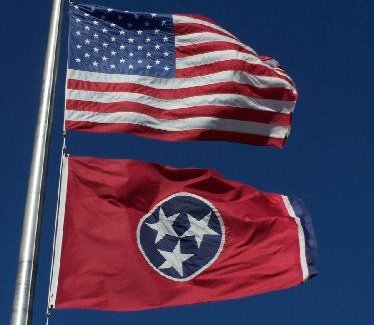
Kentucky joined the union on June 1, 1792, the 15th state. Tennessee joined four years later, on June 1, 1796, becoming the 16th state.
U.S. and Tennessee flags flying together on one staff. Photo by J. Stephen Conn
Kentucky’s state flag features a Native American and European colonist standing together, and the state motto, “United We Stand, Divided We Fall.” Photo by Gage Skidmore
Kentucky’s admission to the union pushed the U.S. flag to 15 stars and 15 stripes. President George Washington signed the law that authorized the U.S. flag be expanded to 15 stripes in early 1794. I’ve not pinned down the history of what happened next. So far as I know there was no law expanding the flag to 16 stripes, and in 1818, Congress said the flag would be 13 stripes, and stars equal to the number of states.
What happened in between? I suspect there are a lot of 15-stripe flags, but it wouldn’t surprise me to find a 16-stripe flag somewhere. A variety of stars-and-stripes flags cropped up, which the 1818 law was intended to squelch.
Residents of the Bluegrass State and the Volunteer State should fly their flags today, in honor of their state’s having joined the union on June 1.
Spread the word; friends don't allow friends to repeat history.
We trained hard, but it seemed that every time we were beginning to form up into teams we would be reorganized. Presumably the plans for our employment were being changed. I was to learn later in life that, perhaps because we are so good at organizing, we tend as a nation to meet any new situation by reorganizing; and a wonderful method it can be for creating the illusion of progress while producing confusion, inefficiency, and demoralization.
Ogburn’s magazine article became the basis for his book, The Marauders. In turn, that was the basis for a movie, Merrill’s Marauders. In the book, the quote is different:
As a result, I suppose, of high-level changes of mind about how we were to be used, we went though several reorganizations. Perhaps because Americans as a nation have a gift for organizing, we tend to meet any new situation by reorganization, and a wonderful method it is for creating the illusion of progress at the mere cost of confusion, inefficiency and demoralization.
The Marauders (1959), chapter 2, page 60 (attributed)
My old friend Frank Hewlett had been a correspondent in the South Pacific and Southeast Asia, including Burma, during World War II. Frank told me that he had been the first to call the American group “Merrill’s Marauders” in a war news dispatch on the progress the group made. He did not get any credit for the book or movie title, but he said it was great that any group of soldiers that worked that well got popular attention for their work. I’ve never found Hewlett’s dispatches from that period, but I’ve never found anything else he told me to be inaccurate.
In serious corporate reorganizations, or in corporate culture change operations, this quote is usually trotted out in opposition to whatever the proposed change may be. Generally reorganizers will dismiss the thing as fictional, in at least one case claiming that renegade corporate leader Bob Townsend made it up.
In our work at Committing to Leadership at American Airlines, CEO Bob Crandall actually read the full quote (misattributed at the time), and observed that it was probably true — but not a good reason to stop a needed reorganization. Crandall pointed to the last sentence, and said that a good manager’s job is to make sure that reorganization creates real success, not just an illusion of action, and that any good manager will recognize that reorganizations offer the danger of demoralization and confusion. Those are problems to be managed, Crandall said, not fates that cannot be avoided.
Do you find Ogburn’s snippet of wisdom to be true? So what?
“The Mary Ellen Carter” is a bit of an odd song, probably best performed where a bunch of people can join in, obviously fueled by a few pints to the guitar players, and seemingly not correct if not done with at least one twelve-string in the band. More, it’s a song with a story that you may not get the first time through, but you should get. Stan Rogers’s poetry is not simple. He tells complex stories.
Home in Halifax, one of three albums by Stan Rogers on which “The Mary Ellen Carter” appears. The song is also on Between the Breaks . . . Live! and The Very Best of Stan Rogers.
It’s a song about a group of men who were aboard the Mary Ellen Carter when that ship scuttled. The song describes their work to patch her up, to raise her from the depths and make her “rise again.” But we never learn whether the ship was refloated. That’s not the point of the song. It’s a song about getting back up when you’ve been scuttled, when you’ve got holes punched in your side, and you’re under water.
The song has become a classic of the genre and many artists covered it even before Rogers’ death, including Jim Post who began performing it in the 1980s, as did Makem and Clancy, and the English a cappella trio, Artisan, who went on to popularise their harmony version of it in UK folk circles throughout the 1980s and 1990s, and Portland, Maine-based folk group Schooner Fare. Ian Robb recorded it with the other members of Finest Kind on his album From Different Angels. It was also recorded by the seven piece Newfoundland band The Irish Descendants as part of the tribute album Remembering Stan Rogers: An East Coast Tribute performed by a large number of acts at Rogers’ favorite venue in Halifax, Dalhousie University; the album is out of print though occasionally available from online sellers; the track does not appear on any of the band’s own albums.
It was also recorded by Williamsburg, Virginia-based Celtic rock band Coyote Run as part of their self-titled Coyote Run album. According to liner notes with their 10 Years and Running retrospective album, Coyote Run‘s recording of the song was done with the same 12-string guitar that Stan Rogers himself had used when recording the song.
As a tribute to Stan Rogers, “The Mary Ellen Carter” has been sung to close the annual Winnipeg Folk Festival every year since his death.
Surely you’ve heard it, no?
Winnipeg Folk Festival 2006. “The Mary Ellen Carter” is sung to close this festival, each year since 1983. Wikipedia image
According to the lore, the song actually saved a sailor’s life once, in 1983, with the sinking of the Marine Electric. The pedestrian version of the story:
So inspiring is the song that it is credited with saving at least one life. On February 12, 1983 the ship Marine Electric was carrying a load of coal from Norfolk, Virginia to a power station in Somerset, Massachusetts. The worst storm in forty years blew up that night and the ship sank at about four o’clock in the morning on the 13th. The ship’s Chief Mate, fifty-nine-year-old Robert M. (“Bob”) Cusick, was trapped under the deckhouse as the ship went down. His snorkeling experience helped him avoid panic and swim to the surface, but he had to spend the night alone, up to his neck in water, clinging to a partially deflated lifeboat, and in water barely above freezing and air much colder. Huge waves washed over him, and each time he was not sure that he would ever reach the surface again to breathe. Battling hypothermia, he became tempted to allow himself to fall unconscious and let go of the lifeboat. Just then he remembered the words to the song “The Mary Ellen Carter”.
And you, to whom adversity has dealt the final blow With smiling bastards lying to you everywhere you go Turn to, and put out all your strength of arm and heart and brain And like the Mary Ellen Carter, rise again.
Rise again, rise again—though your heart it be broken Or life about to end. No matter what you’ve lost, be it a home, a love, a friend, Like the Mary Ellen Carter, rise again.
He started to sing it and soon was alternately shouting out “Rise again, rise again” and holding his breath as the waves washed over him. At seven o’clock that morning a Coast Guard helicopter spotted him and pulled him to safety.[1] Only two men of the other thirty-three that had been aboard survived the wreck. After his ordeal, Cusick wrote a letter to Stan Rogers telling him what had happened and how the song helped save his life. In response, Cusick was invited to attend what turned out the be the second-to-last concert Rogers ever performed. Cusick told his story in the documentary about Stan Rogers, One Warm Line.[2][3]
Truth is stranger and better than fiction once again. You couldn’t convince me that story was plausible, if it were fiction.
Cusick’s story has a coda, though, and it’s an important one. From the survivors come not only tales of the trials, but information that, if listened to, can prevent future tragedies.
Bob Cusick is “still kicking.” That’s no small feat for any man about to turn 85. It’s especially notable when you are one of only three sailors to survive what was among the nation’s worst maritime disasters.
Tuesday will mark the 25th anniversary of the sinking of the coal ship Marine Electric in a blizzard off Chincoteague. Thirty-one sailors died.
Cusick was the ship’s chief mate. He still has nightmares about how the rusted relic of World War II rolled before the crew could launch its lifeboats. He can still feel the water swallowing him and hear the men screaming for help in the darkness.
But the nightmares aren’t as frequent now.
“It’s really been a long time,” he said from his home in New Hampshire. “And evidently, a lot of good came from that ship’s sinking.”
Most of it because of Cusick and the other two survivors’ testimonies.
Before we hear the good, let’s get the facts:
The Marine Electric was what mariners call a rust bucket. Its huge cargo hatches were warped, wasted away and patched cosmetically with putty and duct tape. The deck was cracked, and the hull even had a hole punched through by a bulldozer.
Still, inspectors cleared it to sail, and it routinely hauled pulverized coal from Norfolk to a power plant near Boston.
Its last trip was into the teeth of a violent nor’easter. The aging ship was no match for the weather. For more than 24 hours, the Marine Electric was battered by swells that stretched 40 feet from trough to crest.
For part of the trip, the ship had been diverted to escort a trawler into Chincoteague.
Not long after resuming its course, the Marine Electric started taking on water.
Seas crashing over those corroded decks rushed inside the hatches, mixing with the powdered coal to create an unstable slurry.
The water couldn’t be pumped out, because the ship’s owners had welded covers over the drain holes.
Cusick was lucky. He had just come off watch and was wearing an insulated coat his wife had insisted he buy and a raw wool cap she had knitted for him. They would eventually make the difference between life and death.
Cusick swam for an hour in the tempest before finding a swamped lifeboat. He climbed inside and wedged himself beneath the seats, slipping under the 37-degree water, to escape the howling winds. He gasped for breaths between waves.
Cusick found strength in a song about the shipwreck of the Mary Ellen Carter, and folksinger Stan Rogers’ refrain to “rise again, rise again.”
Cusick would spend 2 hours and 45 minutes in the frigid water, nearly double what Navy survival charts claimed was possible.
It was after dawn when a Coast Guard helicopter from Elizabeth City, N.C., running on fumes, dropped a basket into his lifeboat and Cusick was hoisted to safety.
Rogers’s song, and Cusick’s story, were put to great use.
As a result of this accident, and the detailed records of neglect Cusick kept, the Coast Guard launched its renowned rescue swimmers program. Ships sailing in cold waters are required to provide survival suits to their crews; safety inspections are more rigorous; lifeboats must have better launching systems; and rafts must have boarding platforms to allow freezing sailors to climb inside.
We lived on the Potomac when the Marine Electric went down. We had the daily, sometimes hourly updates, and the growing sense of tragedy. I well recall my amazement that anyone survived in the cold water. In the 30 years since, I had never heard the full story.
This is why we study history. This is why we write history. This is why we revel in history, even faux history, being turned into art by the poets and troubadors.
Knowing history, and knowing the art, we can stand up to demand that money to inspect ships for safety be restored to the federal budget, that money to build safe air transport be revived, that politicians stop blocking the doors to the hospitals and clinics (Rick Perry, Greg Abbott), and that justice be done on a thousand other scores where cynics and highway robbers tell us it cannot be done or it’s too expensive.
And then we all may, as the Mary Ellen Carter, rise again.
Marine Electric sank on February 12, 1983; Stan Rogers died less than four months later, on June 2, 1983, returning home from performing at the Kerrville Folk Festival in Texas. Listen to Mr. Cusick’s story, and listen to Mr. Rogers’s telling of his:
Catching a fish is fun for kids, but many families have questions about how to get started. That’s why some state parks are offering free fishing classes. They’ll teach you the basics through fun, hands-on activities. Texas Parks and Wildlife has this report on a program called “Go Fish” as the June Outdoor Activity of the Month.
To find places to fish and events near you, visit texasstateparks.org/fishing
Doesn’t seem that long ago, but he’s grown, graduated from college and moved 2,000 miles away; heck, both of the boys graduated and moved away. We started our romancing of Texas State Parks at Ink’s Lake State Park, in one of the hottest Augusts I ever would wish to see. We got a new tent, big enough for a family and bigger than the pup tent Kathryn and I used on the Atlantic Beaches (never did get that hurricane smell out of it . . .). I worried about older son Kenny. Little patience for anything not electronic.
The rules were they could play handheld games until we got there, in the car, but not once we got down to camping. When we got to Ink’s Lake it was 105º F. Kenny decided he’d rather stay in the car with his games. Eventually the batteries died.
It was a fun, but not necessarily easy first day. We had Disney TrueLife Adventure watching a wasp and spider fighting. We had deer wandering through the site, including one with a deformed mouth (we named her Celeste, but don’t ask me why). Deer would do almost anything for a bite of cantaloupe. Swimming, rocks to jump off of . . . Kenny was bordering on crabby.
I never took to fishing. That’s Kathryn’s bailiwick. She got poles for the kids. The whole point of the trip was to get back to fishing for Kathryn. Kenny complained about the hot son on the end of the pier, about the worms, about the lack of video games. He complained about everything until he got that pole in his hand and dropped the hook in the water. I wish we had it on video. Instantly, he became a man of patience.
Caught his first little fish that day, too. Bluegill, or crappie — I don’t remember. The next few days brought quite a bit of adventure — small boat tour of Ink’s Lake, big tourist boat trip on nearby Lake Buchanan (” . . . this is Texas, Honey. It’s pronounced buck-CANnon. Don’t forget.”). We froze in LonghornCavern. We found magic, and five-foot catfish, at Hamilton Pool. The catfish were larger than James, but he took great delight in watching them in the bottom of the supernaturally-clear pool.
Hamilton Pool, near the Pedernales River – photo by Reid Sullivan during drought conditions 1/2/2006, via Wikipedia
Both boys got great at camping, both had long periods with Boy Scouts after YMCA Guides (Kenny got Life; James got Eagle). I think both of them got the fishing merit badge with help from the Mighty Fisher, Eddie Cline. We have thousands of photos, lots of great memories, and for our family, it started with that trip to Ink’s Lake.
Caption from Pete Souza‘s slide show: A message from President Barack Obama is seen on a Plaza Towers Elementary School sign, at Moore Fire Department Station #1 in Moore, Okla., May 26, 2013. (Official White House Photo by Pete Souza)
Pete Souza‘s work as White House photographer will ultimately make historians’ work much richer. He’s got a great eye for a shot that needs to be snapped, and a great sense of art on the fly. If you’re not a regular watcher of Souza’s work, you probably should be, especially if you’re teaching history.
This is what it looks like at Officers Row, at Mammoth Hot Springs in Yellowstone National Park:
Yellowstone National Park “On this Memorial Day, American Flags are proudly displayed on Officers’ Row in Mammoth Hot Spring as we remember those who gave their lives in military service to our country. (dr2)”
President John F. Kennedy speaking to a special joint session of Congress, on May 25, 1961; in this speech, Kennedy made his famous statement asking the nation to pledge to put a man on the Moon and bring him back safely, in the next ten years.
It was an era when Congress would respond when the President challenged America to be great, and Congress would respond positively.
On May 25, 1961, President Kennedy delivered a special message to Congress, on the challenges facing the U.S. around the world, in continuing to build free market economies, and continuing to advance in science, as means of promoting America’s future. He closed with the words that have become so famous. From the Apollo 11 Channel, excerpts from the speech, via Fox Movietone news:
History from the Apollo 11 Channel:
In an address to a Joint session of the United States Congress, Kennedy announces full presidential support for the goal to “commit…before this decade is out, to landing a man on the Moon and returning him safely to the Earth” and urges Congress to appropriate the necessary funds, eventually consuming the largest financial expenditure of any nation in peacetime.
Though Kennedy had initially been convinced that NASA should attempt a manned mission to Mars, NASA Associate Administrator Robert Seamans spent three days and nights working, ultimately successfully, to convince him otherwise.
“Washington Goes to the Moon”: A two-part radio program produced by WAMU-FM in Washington, D.C. that deals with the political story behind Project Apollo.
Spread the word; friends don't allow friends to repeat history.
Michigan Gov. Rick Snyder continued the program started by his predecessor, Jennifer Granholm, to send out notices electronically of occasions to fly the U.S. flag, and when to fly flags at half staff. Michigan honors every soldier who dies with a day of mourning, with half-staff flags.
Notices also go out for things like Memorial Day. Here is the e-mail the system sent out today, a notice to fly the flag on Memorial Day, and how to fly it: Half-staff until noon, full staff from noon until sunset.
So now you know.
FLAGS ORDERED LOWERED ON MONDAY, MAY 27
LANSING, MI – The flag of the United States has been ordered lowered to half-staff in Michigan on Monday, May 27, 2013 in honor of Memorial Day. This recognition is asked to be observed until noon of the same day at which point it should be raised to the peak.
“It is a great honor to join with fellow Americans in paying special tribute to the selfless individuals who serve and protect our country,” said Gov. Rick Snyder. “On this day, and every day, we say ‘thank you’ to the courageous and vigilant men and women who sacrifice much to ensure our safety, and we remember those who made the ultimate sacrifice in carrying out their sworn duties.”
Michigan residents, businesses, schools, local governments and other organizations are encouraged to display the flag at half-staff.
When flown at half-staff or half-mast, the U.S. flag should be hoisted first to the peak for an instant and then lowered to the half-staff or half-mast position.
###
You may fly your flag all weekend if you wish, of course.
Different activities honoring fallen soldiers are scheduled through the weekend. What’s going on in your town?
“A garden of 33,000 flags was planted by city officials and members of the Massachusetts Military Heroes Fund this week, and will cover part of the Boston Common near the Soldiers and Sailors Monument through Memorial Day, in honor of fallen soldiers from the state. Each flag put in the ground near the monument will represent a service member from Massachusetts who gave his or her life defending the country since the Civil War to the present day.” Photo via Lorie Jenkins on Twitter, in Boston Magazine.
Or, until that account is unsuspended by the forces supporting Donald Trump: Follow @FillmoreWhite, the account of the Millard Fillmore White House Library
We've been soaking in the Bathtub for several months, long enough that some of the links we've used have gone to the Great Internet in the Sky.
If you find a dead link, please leave a comment to that post, and tell us what link has expired.
Thanks!
Retired teacher of law, economics, history, AP government, psychology and science. Former speechwriter, press guy and legislative aide in U.S. Senate. Former Department of Education. Former airline real estate, telecom towers, Big 6 (that old!) consultant. Lab and field research in air pollution control.
My blog, Millard Fillmore's Bathtub, is a continuing experiment to test how to use blogs to improve and speed up learning processes for students, perhaps by making some of the courses actually interesting. It is a blog for teachers, to see if we can use blogs. It is for people interested in social studies and social studies education, to see if we can learn to get it right. It's a blog for science fans, to promote good science and good science policy. It's a blog for people interested in good government and how to achieve it.
BS in Mass Communication, University of Utah
Graduate study in Rhetoric and Speech Communication, University of Arizona
JD from the National Law Center, George Washington University


 Posted by Ed Darrell







 Millard Fillmore's Bathtub