New York in time-lapse — a teaser

March 14, 2013

Another time-lapse film by Samuel Orr, this one on a city, “New York Day.”

I said it is a teaser.  Orr wants to do a longer film, but needs some financial backing to get it done.

Details here:

Please go to the Kickstarter project page and help support a longer version of this short film

kickstarter.com/projects/motionkicker/new-york-year

I shot this film over 4 trips to NYC 2011-2012. The time-lapse sequences you see here were made (mostly) from hundreds of thousands of still images. A Canon 7D and T3i were the main cameras, with backup from a couple of older Nikon Coolpix 5000 point and shooters. A few clips are sped-up video.

Many thanks to the generosity of the musician/composer who allowed his great celtic track “Sawjig” to be used;
Ben Rusch aka Jasmine Brunch
benrusch.com
jasminebrunch.com

For more info on this and other projects;
motionkicker.com
twitter.com/motionkicker

i


March 14: π Day! A π roundup, mostly pie

March 14, 2013

Of course you remembered that today is pi Day, right?

Pi Day Pie from Slashfood.com

Happy π Day! Pi Day Pie – Slashfood.com

Oh, or maybe better, π Day.

We’ll start with the brief post from a few months ago, and then build on it with some activities and posts from around the WordPress-o-sphere.

The good people at PiDay.org suggest a few ways you can celebrate:

Make (and Eat) a Pie – These pie recipes for Pi Day from NPR’s McCallister look incredibly tasty. But, there’s no shame in putting a frozen store-bought pie in the oven, or picking up a pie from your local bakery. Any kind of pie is great on Pi Day! If you’re making your own, get inspired by these beautifully designed Pi Day Pies. Tell us on Facebook: What’s your favorite kind of pie for Pi Day?

Hope your π Day is complete as a circle, and well-rounded!

How are others celebrating?  A look around WordPress:

At SocialMediaPhobe, a musical interpretation of pifeaturing the music of Michael Blake:

So Long Freedom:

pidaypieToday is March 14th, also known as “Pi Day” for us math geeks out there because March 14th (3/14) is the first 3 digits of π (3.14159…).  To celebrate “Pi Day” I highly recommend doing something mathematical while having some pie at 1:59 pm.  I recommend Yumology‘s S’mores Pie as it has 3 main ingredients (chocolate, marshmallow, and graham cracker) and about 0.14159 other ingredients like sugar, butter, and stuff.  If you are not a math geek, its okay…you can still eat pie and count things like how many stop signs you pass on your way back to work from lunch.  Or you could go to the library and take out a book on something fun like binary code.  As we like to say, “There are only 10 types of people in the world:  Those that understand binary and those that don’t.”  Seriously, binary is as easy as 01000001, 01000010, 01000011.

Miles Free at PMPA Speaking of Precision:

Today 3-14 at 1:59  I will be celebrqting Pi Day. 3.14159 is the value of pi to 5 decimals...

So besides being  the cause of much techie “irrational” exuberance, Pi Day  is a great way to get some engagement with students.

Marymount High School has several activities, last year they had a design competition incorporating pi; the students then made and sold buttons of each design, proceeds going to the Red Cross.

Hmm- math subject matter, design, production, sales, accounting.

Sounds like what we do in manufacturing.
Maybe celebrating Pi Day is not so irrational as first thought.

Free said his pie is peach.

Steve Doyle at CraveDFW:

On March 12, 2009 your lawmakers  passed a non-binding resolution (HRES 224) recognizing March 14, 2009 as National Pi Day. It is one of the more legit holidays we discuss here, and it is actually an homage to geeks everywhere who see the date as a reason to celebrate due to its mathematical implications. We say any reason to celebrate anything is just fine by us.

Since we are predominately about food we will suggest a few places to actually enjoy a pie.

DSC06367

If you followed us at all this week you may have seen the pie at Bowl and Barrel pop up on our pages. This is the uber delicious Butterscotch Pie served as the solo dessert at the bowling alley and restaurant.  Go eat one of these.

He’s got more pi pie, if you click over there.

Gareth Branwyn at MakeZine offers more pie and a mnemonic:

How to Remember Pi to 15 Digits

Pi-Pie--69299

By way of sci-fi author and mathenaut Rudy Rucker’s Facebook wall comes this:

One way to remember the first few digits of pi is to count the letters in the words of this phrase:

“How I need a drink, alcoholic of course, after the heavy lectures involving quantum mechanics.”

[Image via FreakingNews]

Another song, on YouTube, at Awsomesauce:

b.love offers this clock image (is this clock for sale somewhere?):

A clock for pi day

TED Blog offers two videos:

Chirag Singh explains his “passion for pi.”

Daniel Tammet, “Different Ways of Knowing:

Geeks are really out in force today, flaunting pi for all they’ve got.

More:


Happy birthday, Albert Einstein!

March 14, 2013

How many ways can we say happy birthday to a great scientist born on Pi Day?  So, an encore post.

E=mcc - logo from AIP

E=energy; m=mass; c=speed of light

Happy Einstein Day! to us.  Albert’s been dead since 1955 — sadly for us.  Our celebrations now are more for our own satisfaction and curiosity, and to honor the great man — he’s beyond caring.

Almost fitting that he was born on π Day, no? I mean, is there an E=mc² Day?

Albert Einstein was born on March 14, 1879, in Ulm, Germany, to Hermann and Pauline Einstein. 26 years later, three days after his birthday, he sent off the paper on the photo-electric effect; that paper would win him the Nobel Prize in Physics in another five years, in 1921. In that same year of 1905, he published three other papers, solving the mystery of Brownian motion, describing what became known as the Special Theory of Relativity and solving the mystery of why measurements of the light did not show any effects of motion as Maxwell had predicted, and a final paper that noted a particle emitting light energy loses mass. This final paper amused Einstein because it seemed so ludicrous in its logical extension that energy and matter are really the same stuff at some fundamental point, as expressed in the equation demonstrating an enormous amount of energy stored in atoms, E=mc².

Albert Einstein as a younger man - Nobel Foundation image

Albert Einstein as a younger man – Nobel Foundation image

Any one of the papers would have been a career-capper for any physicist. Einstein dashed them off in just a few months, forever changing the fields of physics. And, you noticed: Einstein did not win a Nobel for the Special Theory of Relativity, nor for E=mc². He won it for the photo electric effect. Irony in history.

106 years later Einstein’s work affects us every day. Relativity theory at some level I don’t understand makes possible the use Global Positioning Systems (GPS), which revolutionized navigation and mundane things like land surveying and microwave dish placement. Development of nuclear power both gives us hope for an energy-rich future, and gives us fear of nuclear war. Sometimes, even the hope of the energy rich future gives us fear, as we watch and hope nuclear engineers can control the piles in nuclear power plants damaged by earthquakes and tsunami in Japan.

English: Albert Einstein on a 1966 US stamp

Albert Einstein on a 1966 US stamp (Photo credit: Wikipedia)

If Albert Einstein was a genius at physics, he was more dedicated to pacifism. He resigned his German citizenship to avoid military conscription. His pacifism made the German Nazis nervous; Einstein fled Germany in the 1930s, eventually settling in the United States. In the U.S., he was persuaded by Leo Szilard to write to President Franklin Roosevelt to suggest the U.S. start a program to develop an atomic weapon, because Germany most certainly was doing exactly that. But while urging FDR to keep up with the Germans, Einstein refused to participate in the program himself, sticking to his pacifist views. Others could, and would, design and build atomic bombs. (Maybe it’s a virus among nuclear physicists — several of those working on the Manhattan Project were pacifists, and had great difficulty reconciling the idea that the weapon they worked on to beat Germany, was deployed on Japan, which did not have a nuclear weapons program.)

English: USSR stamp dedicated to Albert Einste...

Everybody wanted to claim, and honor Einstein; USSR issued this stamp dedicated to Albert Einstein Русский: Почтовая марка СССР, посвящённая Альберту Эйнштейну (Photo credit: Wikipedia)

Einstein was a not-great father, and probably not a terribly faithful husband at first — though he did think to give his first wife, in the divorce settlement, a share of a Nobel Prize should he win it. Einstein was a good violinist, a competent sailor, an incompetent dresser, and a great character. His sister suffered a paralyzing stroke. For many months Albert spent hours a day reading to her the newspapers and books of the day, convinced that though mute and appearing unconscious, she would benefit from hearing the words. He said he did not hold to orthodox religions, but could there be a greater show of faith in human spirit?

Einstein in 1950, five years before his death

Einstein in 1950, five years before his death

When people hear clever sayings, but forget to whom the bon mots should be attributed, Einstein is one of about five candidates to whom all sorts of things are attributed, though he never said them. (Others include Lincoln, Jefferson, Mark Twain and Will Rogers). Einstein is the only scientist in that group. So, for example, we can be quite sure Einstein never claimed that compound interest was the best idea of the 20th century. This phenomenon is symbolic of the high regard people have for the man, even though so few understand what his work was, or meant.

A most interesting man. A most important body of work. He deserves more study and regard than he gets.

More, Resources:


Waiting for Comet Godot

March 14, 2013

Comet Pan-STARRS?

I just can’t see it.

The past two evenings, when it was supposed to be visible, we couldn’t find it.  Maddeningly, others have great photos of the thing.

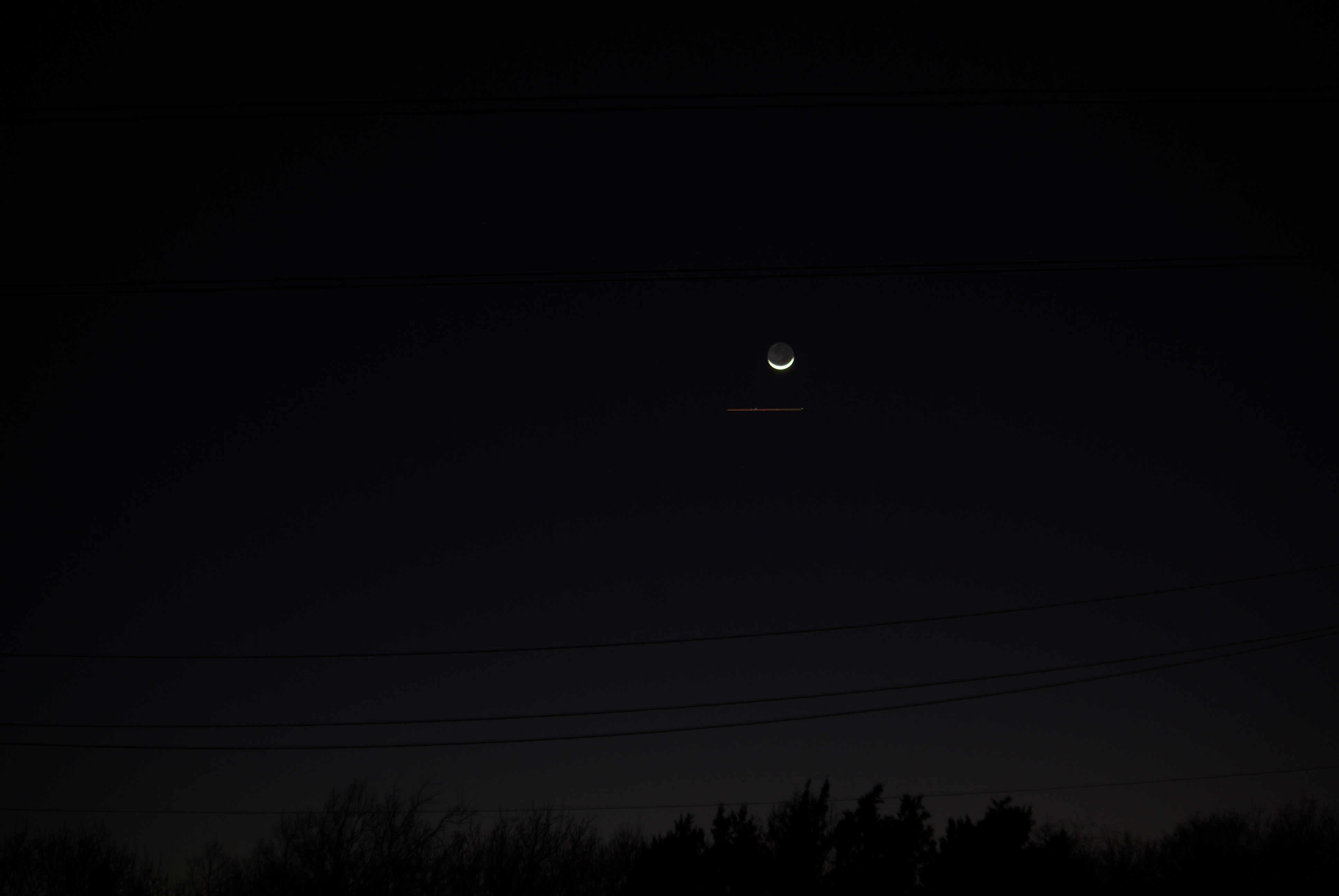
Here’s a photo of where it was supposed to be the evening of March 12.  Nice sliver of a Moon.

A view to the west over south Grand Prairie, Texas, showing the sliver of the new Moon, but a no-show Comet Pan-STARRS, March 12, 2013.  Photo by Ed, Kathryn and Peanut.

A view to the west over south Grand Prairie, Texas, showing the sliver of the new Moon, but a no-show Comet Pan-STARRS, March 12, 2013. Photo by Ed, Kathryn and Peanut.

We watched for over an hour, from just after the Sun’s winking out in a blaze of orange (Texas dust and DFW smog).  We were shooting without a tripod, and so it was difficult to capture just how thin was the line of the Moon for a long time.  It was not a clear crescent, with mountains of the Moon providing jagged lines that glistened like a crystal glass necklace.  Longer exposures revealed the comet to other observers in other places, but not to us.  Perched as we were right on the edge of the Austin Chalk Escarpment, we were joined by a dozen or so others who hoped to see the comet, or who were just putting their BMX bikes away.

A more detailed, and grainy, shot of the Moon (with no comet):

New Moon over Grand Prairie Texas, looking for Comet Pan-STARRS, photo by Ed Darrell

Eventually the Moon stated its presence, but still no Comet Pan-STARRS, on March 12, 2013. Looking west over Grand Prairie, Texas.  (Yeah, probably would have been a much better photo if not handheld.)

Here’s a photo of where it was supposed to be last night, the evening of March 13.

Moon over Grand Prairie, no comet, 3-13-2013

On March 13, Comet Pan -STARRS rode directly underneath the Moon; it’s invisible in this longer exposure, though you can see the streaking lights of a jetliner flying out of DFW International Airport under the Moon.

It’s like waiting for Godot.  Waiting for Comet Godot.

Quoting from SamuellBeckett.net:
ESTRAGON: 
People are bloody ignorant apes.  He rises painfully, goes limping to extreme left, halts, gazes into distance off with his hand screening his eyes, turns, goes to extreme right, gazes into distance. Vladimir watches him, then goes and picks up the boot, peers into it, drops it hastily.
VLADIMIR:  Pah!He spits. Estragon moves to center, halts with his back to auditorium.
ESTRAGON:  Charming spot. (He turns, advances to front, halts facing auditorium.)
Inspiring prospects. (He turns to Vladimir.)
Let’s go.
VLADIMIR:  We can’t.
ESTRAGON:  Why not?
VLADIMIR:  We’re waiting for Godot.
ESTRAGON:  (despairingly). Ah! (Pause.) You’re sure it was here?
VLADIMIR:  What?
ESTRAGON:  That we were to wait.
VLADIMIR:  He said by the tree. (They look at the tree.) Do you see any others?
ESTRAGON:  What is it?
VLADIMIR:  I don’t know. A willow.
ESTRAGON:  Where are the leaves?
VLADIMIR:

It must be dead.


More:

Brian Klimowski's photo of Comet Pan-STARRS, March 12, 2013

Other photographers found Comet Pan-STARRS. This photo comes via SpaceWeather.com. ” Brian Klimowski sends this picture from the countryside near Flagstaff, Arizona . . . ‘Beautiful show this evening!’ says Klimowski. ‘I took the photo from an altitude of about 9500 feet in the San Francisco Peaks near Flagstaff. A 1-second exposure with my Canon digital camera easily revealed the comet.'” Photo details: Canon 7D, 125 mm, 1s @ F/5.6. ISO 1250


Brilliant film: A Forest Year, from Motionkicker

March 14, 2013

Cousin Amanda Holland called my attention to this on Facebook.  Time lapse photography and a forest — heavenly to me.

More details from Motionkicker,  Samuel Orr:

help support my new time-lapse project at kickstarter!
kickstarter.com/projects/motionkicker/new-york-year

A Forest Year was made from 40,000 still images taken from my front window over 15 months, and were blended into the film.

Find out more about how it was made at motionkicker.com

Special thanks to Johnny_RIpper for letting me use his music.
soundcloud.com/johnny_ripper

Tip of the old scrub brush to Amanda Holland and the National Forest Foundation.

More:


Great obits, tribute: The Scoop on obit author Amanda Lewis

March 13, 2013

The Scoop, a blog of the Dallas Morning News, followed up on that great obit of Harry Stamps.  Reporter Eric Aasen tracked down Amanda Lewis, Stamps’s daughter, and the author of his obituary, which the Biloxi Sun-Herald judge “best ever.”

Harry Stamps and his daughter, Amanda Lewis

Harry Stamps with his daughter, Amanda Lewis, at her wedding in Dallas. Lewis wrote the great obituary for her father published last week in the Biloxi Sun-Herald. Photo from Amanda Lewis, via The Scoop

“He had a life-long love affair with deviled eggs, Lane cakes, boiled peanuts, Vienna [Vi-e-na] sausages on saltines, his homemade canned fig preserves, pork chops, turnip greens, and buttermilk served in martini glasses garnished with cornbread.”

Lewis tells The News she started writing the obituary Thursday morning, when she began the long drive from Dallas to Mississippi. She says her mother had given her some highlights, some bullet points in order to write the standard small-print farewell. But that’s not the kind of obituary she wanted to write.

“I don’t understand why people do a résumé for an obituary,” says Lewis. “It never captures the spirit of the person. My dad had such a big spirit. He had such a big personality. And I didn’t think listing where he went to college and his résumé would do him justice. I liked the idea of setting it up as kind of a contrast where at first you think it’ll be a pretentious obituary — everyone’s great when they die in an obituary — and then I tried to use what would have been his sense of humor to describe my dad. And clearly it worked. I was pleased with it.”

So was everyone else.

Aasen had a couple of great photos to add  (and it ran in this morning’s edition of the newspaper, too).

My father told the story of attending the funeral for a woman who had a bit of a checkered past, as he would euphemistically tell us, and who did not get along with everyone.  He said the pastor, delivering a eulogy, talked of fine Italian tapestries, famous for brilliant colors and even silver and gold used as thread.  “In every fine Italian tapestry, there are black threads woven in, to contrast with the silver and gold,” the pastor said.  “And so it was with the life of this woman.”

Some tributes to the departed capture their spirit — think of Teddy Kennedy quoting  a paraphrase of Bernard  Shaw at the funeral of his brother Robert.  Tributes provide deep, lasting memories, or change events on their own, sometimes.

Harry Stamps’s obit was a great oneI’ve posted two others that I think produced more smiles than tears, and I know there are other obituaries out there that are worthy of reading, spreading the news about, and perhaps, emulation.   Know of any?

More:


Backyard birds: Goldfinch at the feeder

March 12, 2013

No, he’s not particularly gold — but this is winter, and if he’s going to get his breeding plumage, it will come in a couple of weeks.

We’ve had Niger thistle seed feeders out for years; this year one goldfinch (Spinus tristis) finally started to visit.  We’ve had as many as four at a time — but they’re probably headed north soon.

Here’s a shot of our first guest, from a couple of weeks ago.

Goldfinch at the feeder

A goldfinch male, checking out the feeder before bringing in his buddies — we hope.

If you’re north of Dallas, and you see this guy at your feeder this summer, tell him “hello” from us.

The non-breeding plumage isn’t so flashy as the bright yellow of the breeding males.  Some of the finches settle in to a beautiful, smooth olive-drab livery for much of the winter.  Close up, they look like good pen-ink-drawings by a master artist.

More:


Great obits: Val Patterson, Salt Lake City

March 12, 2013

A nice guy by all reports – but not a Ph.D.

Not that he cheated to get it.

It’s a great story, and it unfolded only in the obituary he wrote for himself.  The obituary ran in The Salt Lake Tribune, from July 15 to July 22, 2012.

Val Patterson

Obituary

1953 – 2012

Val Patterson

Val Patterson, 1953-2012

I was Born in Salt Lake City, March 27th 1953. I died of Throat Cancer on July 10th 2012. I went to six different grade schools, then to Churchill, Skyline and the U of U. I loved school, Salt Lake City, the mountains, Utah. I was a true Scientist. Electronics, chemistry, physics, auto mechanic, wood worker, artist, inventor, business man, ribald comedian, husband, brother, son, cat lover, cynic. I had a lot of fun. It was an honor for me to be friends with some truly great people. I thank you. I’ve had great joy living and playing with my dog, my cats and my parrot. But, the one special thing that made my spirit whole, is my long love and friendship with my remarkable wife, my beloved Mary Jane. I loved her more than I have words to express. Every moment spent with my Mary Jane was time spent wisely. Over time, I became one with her, inseparable, happy, fulfilled. I enjoyed one good life. Traveled to every place on earth that I ever wanted to go. Had every job that I wanted to have. Learned all that I wanted to learn. Fixed everything I wanted to fix. Eaten everything I wanted to eat. My life motto was: “Anything for a Laugh”. Other mottos were “If you can break it, I can fix it”, “Don’t apply for a job, create one”. I had three requirements for seeking a great job; 1 – All glory, 2 – Top pay, 3 – No work.

Val Patterson

Val Patterson, 1953-2012

Now that I have gone to my reward, I have confessions and things I should now say. As it turns out, I AM the guy who stole the safe from the Motor View Drive Inn back in June, 1971. I could have left that unsaid, but I wanted to get it off my chest.  Also, I really am NOT a PhD. What happened was that the day I went to pay off my college student loan at the U of U, the girl working there put my receipt into the wrong stack, and two weeks later, a PhD diploma came in the mail. I didn’t even graduate, I only had about 3 years of college credit. In fact, I never did even learn what the letters “PhD” even stood for. For all of the Electronic Engineers I have worked with, I’m sorry, but you have to admit my designs always worked very well, and were well engineered, and I always made you laugh at work. Now to that really mean Park Ranger; after all, it was me that rolled those rocks into your geyser and ruined it. I did notice a few years later that you did get Old Faithful working again. To Disneyland – you can now throw away that “Banned for Life” file you have on me, I’m not a problem anymore – and SeaWorld San Diego, too, if you read this.

To the gang: We grew up in the very best time to grow up in the history of America. The best music, muscle cars, cheap gas, fun kegs, buying a car for “a buck a year” – before Salt Lake got ruined by over population and Lake Powell was brand new. TV was boring back then, so we went outside and actually had lives. We always tried to have as much fun as possible without doing harm to anybody – we did a good job at that.

If you are trying to decide if you knew me, this might help… My father was RD “Dale” Patterson, older brother “Stan” Patterson, and sister “Bunny” who died in a terrible car wreck when she was a Junior at Skyline. My mom “Ona” and brother “Don” are still alive and well. In college I worked at Vaughns Conoco on 45th South and 29th East. Mary and I are the ones who worked in Saudi Arabia for 8 years when we were young. Mary Jane is now a Fitness Instructor at Golds on Van Winkle – you might be one of her students – see what a lucky guy I am? Yeah, no kidding.

My regret is that I felt invincible when young and smoked cigarettes when I knew they were bad for me. Now, to make it worse, I have robbed my beloved Mary Jane of a decade or more of the two of us growing old together and laughing at all the thousands of simple things that we have come to enjoy and fill our lives with such happy words and moments. My pain is enormous, but it pales in comparison to watching my wife feel my pain as she lovingly cares for and comforts me. I feel such the “thief” now – for stealing so much from her – there is no pill I can take to erase that pain.

If you knew me or not, dear reader, I am happy you got this far into my letter. I speak as a person who had a great life to look back on. My family is following my wishes that I not have a funeral or burial. If you knew me, remember me in your own way. If you want to live forever, then don’t stop breathing, like I did.

A celebration of life will be held on Sunday, July 22nd from 4:00 to 6:00 pm at Starks Funeral Parlor, 3651 South 900 East, Salt Lake City, casual dress is encouraged.

Online condolences may be offered and memorial video may be viewed at www.starksfuneral.com.

These little snippets of history delight historians, though many of them are so fantastic they make newspaper obit writers frazzled trying to track down the facts.


Great Obits: Amos Schuchman, New York City

March 12, 2013

Amos Schuchman

Amos Schuchman, photo from the New York Daily News, via BizPac Review

Another great obituary.

It was a paid notice (most obituaries are paid notices, by the way), published February 2, 2013 — and it offered Amos Schuchman one last dig at The New York Times:

Amos Schuchman's obit, loved everything about NYC except the NY Times

“[Amos Schuchman] Loved his family, his birth and adopted countries, finance, skiing, opera, ballet and biking in Central Park. Loved everything about NYC, except the New York Times.”

“Loved everything about NYC, except the New York Times.”

Amos Schuchman’s children wrote, “His fearless heart still beats within all of us.  Shalom, Saba.”

Sometimes obituaries really capture the deceased person’s spirit.  Schuchman’s smiling now.

(No, I don’t share his view of the newspaper.)

More:


Great obits: Harry Weathersby Stamps, Long Beach

March 12, 2013

Alerted by a Tweet from Matt Soniak:

Several blogs and other sites, and the Biloxi Sun-Herald, say this is the best obit ever.  It’s a very good one, in any case.

Harry Stamps and wife Ann, in Long Beach, Mississippi

Photo from the SunHerald: PHOTO COURTESY AMANDA LEWIS Harry Stamps stands with wife Ann at their Katrina-damaged home in Long Beach. Stamps wears his famous grass-stained Mississippi State University baseball cap Read more here: http://www.sunherald.com/2013/03/11/4521106/best-obit-ever-harry-stamps-obituary.html#storylink=cpy

At the Biloxi SunHerald.com:

Harry Weathersby Stamps

December 19, 1932 — March 9, 2013

Long Beach

Harry Weathersby Stamps, ladies’ man, foodie, natty dresser, and accomplished traveler, died on Saturday, March 9, 2013.

Harry was locally sourcing his food years before chefs in California starting using cilantro and arugula (both of which he hated). For his signature bacon and tomato sandwich, he procured 100% all white Bunny Bread from Georgia, Blue Plate mayonnaise from New Orleans, Sauer’s black pepper from Virginia, home grown tomatoes from outside Oxford, and Tennessee’s Benton bacon from his bacon-of-the-month subscription. As a point of pride, he purported to remember every meal he had eaten in his 80 years of life.

The women in his life were numerous. He particularly fancied smart women. He loved his mom Wilma Hartzog (deceased), who with the help of her sisters and cousins in New Hebron reared Harry after his father Walter’s death when Harry was 12. He worshipped his older sister Lynn Stamps Garner (deceased), a character in her own right, and her daughter Lynda Lightsey of Hattiesburg. He married his main squeeze Ann Moore, a home economics teacher, almost 50 years ago, with whom they had two girls Amanda Lewis of Dallas, and Alison of Starkville. He taught them to fish, to select a quality hammer, to love nature, and to just be thankful. He took great pride in stocking their tool boxes. One of his regrets was not seeing his girl, Hillary Clinton, elected President.

He had a life-long love affair with deviled eggs, Lane cakes, boiled peanuts, Vienna [Vi-e-na] sausages on saltines, his homemade canned fig preserves, pork chops, turnip greens, and buttermilk served in martini glasses garnished with cornbread.

He excelled at growing camellias, rebuilding houses after hurricanes, rocking, eradicating mole crickets from his front yard, composting pine needles, living within his means, outsmarting squirrels, never losing a game of competitive sickness, and reading any history book he could get his hands on. He loved to use his oversized “old man” remote control, which thankfully survived Hurricane Katrina, to flip between watching The Barefoot Contessa and anything on The History Channel. He took extreme pride in his two grandchildren Harper Lewis (8) and William Stamps Lewis (6) of Dallas for whom he would crow like a rooster on their phone calls. As a former government and sociology professor for Gulf Coast Community College, Harry was thoroughly interested in politics and religion and enjoyed watching politicians act like preachers and preachers act like politicians. He was fond of saying a phrase he coined “I am not running for political office or trying to get married” when he was “speaking the truth.” He also took pride in his service during the Korean conflict, serving the rank of corporal–just like Napolean, as he would say.

Harry took fashion cues from no one. His signature every day look was all his: a plain pocketed T-shirt designed by the fashion house Fruit of the Loom, his black-label elastic waist shorts worn above the navel and sold exclusively at the Sam’s on Highway 49, and a pair of old school Wallabees (who can even remember where he got those?) that were always paired with a grass-stained MSU baseball cap.

Harry traveled extensively. He only stayed in the finest quality AAA-rated campgrounds, his favorite being Indian Creek outside Cherokee, North Carolina. He always spent the extra money to upgrade to a creek view for his tent. Many years later he purchased a used pop-up camper for his family to travel in style, which spoiled his daughters for life.

He despised phonies, his 1969 Volvo (which he also loved), know-it-all Yankees, Southerners who used the words “veranda” and “porte cochere” to put on airs, eating grape leaves, Law and Order (all franchises), cats, and Martha Stewart. In reverse order. He particularly hated Day Light Saving Time, which he referred to as The Devil’s Time. It is not lost on his family that he died the very day that he would have had to spring his clock forward. This can only be viewed as his final protest.

Because of his irrational fear that his family would throw him a golf-themed funeral despite his hatred for the sport, his family will hold a private, family only service free of any type of “theme.” Visitation will be held at Bradford-O’Keefe Funeral Home, 15th Street, Gulfport on Monday, March 11, 2013 from 6-8 p.m.

In lieu of flowers, the family asks that you make a donation to Mississippi Gulf Coast Community College (Jeff Davis Campus) for their library. Harry retired as Dean there and was very proud of his friends and the faculty. He taught thousands and thousands of Mississippians during his life. The family would also like to thank the Gulfport Railroad Center dialysis staff who took great care of him and his caretaker Jameka Stribling.

Finally, the family asks that in honor of Harry that you write your Congressman and ask for the repeal of Day Light Saving Time. Harry wanted everyone to get back on the Lord’s Time.

View & sign register book @ www.bradfordokeefe.com
Read more here: http://www.legacy.com/obituaries/sunherald/obituary.aspx?n=harry-stamps&pid=163538353&fhid=4025#fbLoggedOut#storylink=cpy

Yeah, but wouldn’t it have been funny to have held the funeral at the local links?  Just give the address, say nothing about golf, and don’t let anyone mention the venue.  They’d have talked about it for years.


How to tell Scouts are coming for dinner

March 11, 2013

Scout Dutch ovens at Camp Wisdom

Scouts coming for dinner – Dutch ovens ready for duty at Wisdom Trail District Outdoor Leader training, Camp Wisdom, Circle 10 Council BSA, March 9, 2013.

Dutch ovens lined up for duty is a tell that Scouts and Scouters are expected for dinner, aren’t they?

More:


Annals of global warming: NASA finds amplified greenhouse effects shift northern growing seasons

March 11, 2013

Global warming affects plants in northern hemisphere, NASA chart

From NASA: Of the 10 million square miles (26 million square kilometers) of northern vegetated lands, 34 to 41 percent showed increases in plant growth (green and blue), 3 to 5 percent showed decreases in plant growth (orange and red), and 51 to 62 percent showed no changes (yellow) over the past 30 years. Satellite data in this visualization are from the AVHRR and MODIS instruments, which contribute to a vegetation index that allows researchers to track changes in plant growth over large areas. Credit: NASA’s Goddard Space Flight Center Scientific Visualization Studio; click image for original view; click here for greater detail

Press release from NASA, March 10, 2013 (links in text added here):

RELEASE : 13-069


Amplified Greenhouse Effect Shifts North’s Growing Seasons

WASHINGTON — Vegetation growth at Earth’s northern latitudes increasingly resembles lusher latitudes to the south, according to a NASA-funded study based on a 30-year record of land surface and newly improved satellite data sets.

An international team of university and NASA scientists examined the relationship between changes in surface temperature and vegetation growth from 45 degrees north latitude to the Arctic Ocean. Results show temperature and vegetation growth at northern latitudes now resemble those found 4 degrees to 6 degrees of latitude farther south as recently as 1982.

“Higher northern latitudes are getting warmer, Arctic sea ice and the duration of snow cover are diminishing, the growing season is getting longer and plants are growing more,” said Ranga Myneni of Boston University’s Department of Earth and Environment. “In the north’s Arctic and boreal areas, the characteristics of the seasons are changing, leading to great disruptions for plants and related ecosystems.”

The study was published Sunday in the journal Nature Climate Change.

Myneni and colleagues used satellite data to quantify vegetation changes at different latitudes from 1982 to 2011. Data used in this study came from NOAA’s Advanced Very High Resolution Radiometers (AVHRR) onboard a series of polar-orbiting satellites and NASA’s Moderate Resolution Imaging Spectroradiometer (MODIS) instruments on the Terra and Aqua satellites.

As a result of enhanced warming and a longer growing season, large patches of vigorously productive vegetation now span a third of the northern landscape, or more than 3.5 million square miles (9 million square kilometers). That is an area about equal to the contiguous United States. This landscape resembles what was found 250 to 430 miles (400 to 700 kilometers) to the south in 1982.

“It’s like Winnipeg, Manitoba, moving to Minneapolis-Saint Paul in only 30 years,” said co-author Compton Tucker of NASA’s Goddard Space Flight Center in Greenbelt, Md.

The Arctic’s greenness is visible on the ground as an increasing abundance of tall shrubs and trees in locations all over the circumpolar Arctic. Greening in the adjacent boreal areas is more pronounced in Eurasia than in North America.

An amplified greenhouse effect is driving the changes, according to Myneni. Increased concentrations of heat-trapping gasses, such as water vapor, carbon dioxide and methane, cause Earth’s surface, ocean and lower atmosphere to warm. Warming reduces the extent of polar sea ice and snow cover, and, in turn, the darker ocean and land surfaces absorb more solar energy, thus further heating the air above them.

“This sets in motion a cycle of positive reinforcement between warming and loss of sea ice and snow cover, which we call the amplified greenhouse effect,” Myneni said. “The greenhouse effect could be further amplified in the future as soils in the north thaw, releasing potentially significant amounts of carbon dioxide and methane.”

To find out what is in store for future decades, the team analyzed 17 climate models. These models show that increased temperatures in Arctic and boreal regions would be the equivalent of a 20-degree latitude shift by the end of this century relative to a period of comparison from 1951-1980.

However, researchers say plant growth in the north may not continue on its current trajectory. The ramifications of an amplified greenhouse effect, such as frequent forest fires, outbreak of pest infestations and summertime droughts, may slow plant growth.

Also, warmer temperatures alone in the boreal zone do not guarantee more plant growth, which also depends on the availability of water and sunlight.

“Satellite data identify areas in the boreal zone that are warmer and dryer and ¬¬other areas that are warmer and wetter,” said co-author Ramakrishna Nemani of NASA’s Ames Research Center in Moffett Field, Calif. “Only the warmer and wetter areas support more growth.”

Researchers did find found more plant growth in the boreal zone from 1982 to 1992 than from 1992 to 2011, because water limitations were encountered in the latter two decades.

Data, results and computer codes from this study will be made available on NASA Earth Exchange (NEX), a collaborative supercomputing facility at Ames. NEX is designed to bring scientists together with data, models and computing resources to accelerate research and innovation and provide transparency.

For more information and images associated with this release, visit:

http://go.nasa.gov/12Amv2s

– end –


text-only version of this release

More:


The Presidential Library that isn’t a Presidential Library

March 9, 2013

Campaign poster showing William McKinley holdi...

Campaign poster showing William McKinley holding U.S. flag and standing on gold coin “sound money”, held up by group of men, in front of ships “commerce” and factories “civilization”. (Photo credit: Wikipedia)

Things you learn looking for documents:  The U.S. National Archives now manages the presidential libraries and museums — except for one:  The William McKinley Memorial Library and Museum.

President William McKinley Memorial Library and Museum, in Niles, Ohio.

President William McKinley Memorial Library and Museum, in Niles, Ohio. McKinley was born in Niles. Photo from the LIbrary’s website.

To be more accurate and fair, National Archives manages the documents for the presidential libraries starting with Herbert Hoover, though there are usually special arrangements with each of the libraries.

Separately, the Ladies of Mount Vernon Association manages the research facilities at Mount Vernon, Virginia,  (and the rest of the grounds) associated with George Washington, and the Abraham Lincoln Presidential Library and Museum in Springfield, Illinois, is operated by a separate foundation, too.  The Teddy Roosevelt Center at Dickinson State University in North Dakota stands apart from the National Archives system, too (much TR material can be found at Harvard, too).

The idea of a specific library to hold papers from a president’s term is a mid-20th century idea.  Franklin Roosevelt and Herbert Hoover were the first, with the idea coming about the same time.  Private foundations built and operated them until after the Nixon library, and since then Congress authorized the National Archives to get into the act and coordinate the work, and then made the links official, for libraries from here on out.

For presidents prior to Hoover, papers generally became the property of the outgoing president.  Collection was spotty.  The idea of library dedicated to one president is such a good one, though, that private groups have gone back to set them up for Washington and Lincoln.

And McKinley.

Modern texts don’t show well the high regard McKinley had from Americans before he was assassinated.  Within a few years after his death, the people of Ohio and his birthplace, in Niles, got Congress to approve a memorial.  Eventually the local library moved into the memorial building.

The National McKinley Birthplace Memorial Association was incorporated by a special Act of Congress on March 4, 1911.  The purpose of the Association was to erect a suitable structure marking the birthplace of President William McKinley, the 25th President of the United States. The result was the National McKinley Birthplace Memorial.

McKinley was born in the city of Niles, Ohio on January 29, 1843. The city donated the site for the Memorial which consisted of an entire city square. The architects were McKim, Mead & White of New York and the erection of the Memorial was done by John H. Parker Company, also of New York. Groundbreaking began in 1915 with the corner stone being laid on November 20, 1915.

The building was dedicated on October 5, 1917.

The cost was more than half a million dollars, all of which was donated by the American public.

The 232 foot by 136 foot by 38 foot monument is constructed of Georgian marble with two lateral wings–
one wing houses the public library called the McKinley Memorial Library, and the other wing houses the
McKinley Museum and an auditorium. The Museum contains artifacts of the life and presidency of McKinley.

In the center of the Memorial is a Court of   Honor supported by 28 imposing columns. It features a heroic statue of McKinley sculptured by John Massey-Rhind. Surrounding the statue are busts and tablets dedicated to the members of    McKinley’s cabinet and other prominent men who were closely associated with him.  These bronze busts, mounted on marble pedestals, weigh between 800 and 1100 pounds each.

As a presidential library, the McKinley Memorial Library in Niles is unique.  While it does not offer the vast research resources of the National Archives, it does offer a memorial from the people of Ohio and the U.S., a more down-home look at  reverence for presidents and the keeping of the history of our heroes.

Memorial to President William McKinley in Niles, Ohio

The memorial to President McKinley in Niles. Photo from the McKinley Memorial Library and Museum.

The “official” list of other presidential libraries and museums in the National Archives’ network, listed at the American Presidency Project at the University of California – Santa Barbara:

Herbert Hoover Presidential Library and Museum
Herbert Hoover Presidential Library Association
Franklin D. Roosevelt Library and Digital Archives
Harry S. Truman Library and Museum
The Dwight D. Eisenhower Library
John F. Kennedy Library and Museum
Lyndon Baines Johnson Library and Museum
Richard Nixon Library and Museum
Richard Nixon Library Foundation
Gerald R. Ford Library and Museum
Jimmy Carter Library
Ronald Reagan Presidential Foundation and Library
George Bush Presidential Library and Museum
William J. Clinton Presidential Library and Museum
Clinton Presidential Center
George W. Bush Presidential Library
George W. Bush Presidential Center

More:


Millard Fillmore: Still dead, still misquoted, 139 years later

March 8, 2013

Millard Fillmore wax head

A wax likeness of Millard Fillmore’s head, appearing to be for sale for $950.00 back in 2007. Did anyone ever buy it? Yes, it does bear an unusual resemblance to Tom Peters.

March 8, 2013, is the 139th anniversary of Millard Fillmore’s death.  Famous lore claims Fillmore’s last words were, “The nourishment is palatable.”

What a crock!

Manus reprints the text from the New York Times obituary that appeared on March 9:

Buffalo, N.Y., March 8 — 12 o’clock, midnight. — Ex-President Millard Fillmore died at his residence in this city at 11:10 to-night. He was conscious up to the time. At 8 o’clock, in reply to a question by his physician, he said the nourishment was palatable; these were his last words. His death was painless.

First, I wonder how the devil the writer could possibly know whether Fillmore’s death was painless?

And second, accuracy obsessed as I am, I wonder whether this is the source of the often-attributed to Fillmore quote, “The nourishment is palatable.” Several sources that one might hope would be more careful attribute the quote to Fillmore as accurate — none with any citation that I can find. Thinkexist charges ahead full speed; Brainyquote removed the quote after I complained in 2007. Wikipedia lists it. Snopes.com says the quote is “alleged,” in a discussion thread.

I’ll wager no one can offer a citation for the quote. I’ll wager Fillmore didn’t say it.

Let’s be more stolid:  The quote alleged to be Fillmore’s last words, isn’t.  No one says “palatable” when they’re dying, not even the man about whom it is claimed that Queen Victoria pronounced him the hansomest man she ever met (just try tracking that one down), and whose strongest legacy is a hoax about a bathtub, started 43 years after he died.  No one calls soup “sustenance.”

The alleged quote, the misquote, the distortion of history, was stolen from the obituary in the New York Times.  Millard Fillmore did not say, “The sustenance is palatable.”

What were Millard Fillmore’s last words?  They may be buried in the notebook of one of his doctors.  They may be recorded in some odd notebook held in the Buffalo and Erie County Historical Society, or in the Library of SUNY Buffalo, or in the New York State Library‘s dusty archives.

But the dying President Fillmore did not say, “The sustenance is palatable.”

Millard Fillmore: We’d protect his legacy, if only anyone could figure out what it is.

This is partly an encore post, based on a post from 2007.

More:


Millard Fillmore’s links to March 8: Hurrah! and R.I.P.

March 8, 2013

I awoke from a particularly hard sleep after a night celebrating ten Cub Scouts’ earning their Arrow of Light awards and advancing into Boy Scout troops, to a missive from Carl Cannon (RealClear Politics) wondering why I’m asleep at the switch.

Millard Fillmore died on March 8, 1874, and he expected to see some note of that here at the Bathtub.  This blog is not the chronicler of all things Millard Fillmore, but can’t we at least get the major dates right?

Carl is right.  Alas, Millard Fillmore’s Bathtub is avocation, and at times like these an avocation that should be far down the list of avocations.

To mark the date, here is a post out of the past that notes two key events on March 8 that Fillmore had a hand in, the second being his death.  Work continues on several fronts, and more may splash out of the tub today, even about Fillmore.  Stay tuned.

Fillmore died on March 8, 1874; exactly 20 years earlier, Commodore Matthew C. Perry landed in Japan, in the process of what may be the greatest and most overlooked legacy of Millard Fillmore’s presidency, the opening of Japan to the world.  Here’s that post:

Commodore Matthew C. Perrys squadron in Japan, 1854 - CSSVirginia.org image

The Black Ships — Commodore Matthew C. Perry’s squadron in Japan, 1854 – CSSVirginia.org image from Gleason’s Pictorial Drawing Room Companion, Boston, May 15, 1852 (also, see BaxleyStamps.com); obviously the drawing was published prior to the expedition’s sailing.

On March 8, 1854, Commodore Matthew C. Perry landed for the second time in Japan, having been sent on a mission a year earlier by President Millard Fillmore.  On this trip, within 30 days he concluded a treaty with Japan which opened Japan to trade with the U.S. (the Convention of Kanagawa), and which began a cascade of events that opened Japan to trade with the world.

Commodore Matthew C. Perry in 1852 photograph, Library of Congress via WikiMedia

Commodore Matthew C. Perry in 1852 photograph, Library of Congress via WikiMedia

Within 50 years Japan would come to dominate the seas of the the Western Pacific, and would become a major world power.

1854 japanese woodblock print of U.S. Navy Commodore Matthew C. Perry. Peabody Museum: The characters located across the top read from right to left, A North American Figure and Portrait of Perry. According to the Peabody Essex Museum, this print may be one of the first depictions of westerners in Japanese art, and exaggerates Perrys western features (oblong face, down-turned eyes, bushy brown eyebrows, and large nose).  But compare with photo above, right.  Peabody Museum holding, image from Library of Congress via WikiMedia

1854 japanese woodblock print of U.S. Navy Commodore Matthew C. Perry. Peabody Museum: “The characters located across the top read from right to left, ‘A North American Figure’ and ‘Portrait of Perry.’ According to the Peabody Essex Museum, ‘this print may be one of the first depictions of westerners in Japanese art, and exaggerates Perry’s western features (oblong face, down-turned eyes, bushy brown eyebrows, and large nose).'” But compare with photo above, right. Peabody Museum holding, image from Library of Congress via WikiMedia

Then, 20 years later, on March 8, 1874, Millard Fillmore died in Buffalo, New York.

The Perry expedition to Japan was the most famous, and perhaps the greatest recognized achievement of Fillmore’s presidency.  Fillmore had started the U.S. on a course of imperialistic exploitation and exploration of the world, with other expeditions of much less success to Africa and South America, according to the story of his death in The New York Times.

The general policy of his Administration was wise and liberal, and he left the country at peace with all the world and enjoying a high degree of prosperity. His Administration was distinguished by the Lopez fillibustering expeditions to Cuba, which were discountenanced by the Government, and by several important expeditions to distant lands. The expedition to Japan under Commodore Perry resulted in a favorable treaty with that country, but that dispatched under Lieut. Lynch, in search of gold in the interior of Africa, failed of its object. Exploring expeditions were also sent to the Chinese seas, and to the Valley of the Amazon.

More: