Annals of global warming: Records from Mauna Loa show continuing rise in atmospheric CO2

March 26, 2011

NOAA's Mauna Loa Observatory, NOAA photo, 1982, Cmdr. John Bortniak

NOAA's Mauna Loa Observatory, from NOAA At the Ends of the Earth Collection, 1982 NOAA photo by Commander John Bortniak

John Adams observed, and Ronald Reagan was fond of quoting, “Facts are stubborn things . . .”

Here are the facts on atmospheric carbon dioxide (CO2):


Monthly CO2 levels since 1960, Mauna Loa Observatory (Scripps Inst of Oceanography)

Mauna Loa Observatory, Scripps Institution of Oceanography, UCSD (University of Calfornia-San Diego); CO2 concentrations in parts per million (ppm)

As described at the Scripps Institution of Oceanography site:

Description:
Monthly average atmospheric carbon dioxide concentration versus time at Mauna Loa Observatory, Hawaii (20°N, 156°W) where CO2 concentration is in parts per million in the mole fraction (p.p.m.). The curve is a fit to the data based on a stiff spline plus a 4 harmonic fit to the seasonal cycle with a linear gain factor.

Data from Scripps CO2 Program.

For perspective, here’s a chart from Scripps that shows why there is concern over current levels of CO2:

CO2 over the past 420,000 years - Scripps Institution of Oceanography

CO2 over the past 420,000 years - Scripps Institution of Oceanography

Resources, More:


No, Henry Wallace would not have been president long, had FDR died a few months early

March 25, 2011

Oh, it’s a technical quibble, I know.

Henry Wallace campaign button from 1948

Henry Wallace campaign button, probably from 1948. R. Emmett Tyrell worries unnecessarily that Henry Wallace might have been president, had FDR died a few months earlier.

I’ve read R. Emmett Tyrell for years.  Back in the day, when American Spectator was scratching to get anyone to read, they sent me free copies — I presume because they got my name off of a list for National Review.  At some point they decided they could actually get someone to pay for the magazine, and I fell off their list.

It was a fun read back then.  American Spectator showed up on newsprint, not slick paper.  There was a college newspaper feel to it.  They had a great section called “Brayings from the barnyard,” in which they’d quote stupid things that people said.  That was the first place I encountered the old saw, “Those whom the gods destroy, they first make mad.”

And I’m sure that, had he thought about it for three minutes, he wouldn’t have written it.  But Tyrell didn’t think.

In the on-line blog for the Spectator, in the traditionally-named “The Current Crisis,” Tyrell wrote:

Progressives have long been in favor of One World vouchsafed by the United Nations. Henry Wallace, Franklin Delano Roosevelt’s second vice president and the 1948 presidential candidate for the Progressive Party, spoke of it often. On the campaign trail in 1948 he spoke of “jobs, peace, and freedom” that “can be attained together and make possible One World, prosperous and free, within our lifetime.” He too promised to coordinate policy through the United Nations. Had President Roosevelt died but six months earlier, America would have had this fantastico in the White House. As it was, in one last act of cunning for his country, Roosevelt maneuvered Wallace out of the vice presidency and Harry Truman in. Harry was green but he was not naïve. We came that close to Henry Wallace and his “Gideon’s Army” in the White House.

Does Tyrell really believe that?

Henry Wallace could not have succeeded to the presidency at any time after noon, January 21, 1945, and had he succeeded to the presidency any time before January 21, he’d have served only until January 21.  Had Roosevelt died any time after November 7, 1944, Harry S Truman would have been inaugurated on January 21, 1945.  Had Roosevelt died between the Democratic Convention and the election, one could make an argument that Truman would not have won the nomination nor the presidency — we’ve never had a candidate die before election day, nor between election and inauguration (though William Henry Harrison sure pushed it).

Berryman cartoon, 1948, Truman v. Tom Dewey

Berryman cartoon, probably from the Washington Star, 1948 — New York Gov. Thomas Dewey was expected to handily defeat President Harry S Truman; the election was held anyway. Elections have consequences.

Roosevelt died on April 12, 1945.  Six months earlier quickly calculated would have been October 12.  [I goofed when I submitted a comment at the Spectator site, and calculated December — too quick a calculation!]  Wallace, then the vice president to FDR, almost certainly would not have won the Democrats’ nomination for president.  It may have been possible for the party to name a new ticket, and if so, it would not have had Wallace on top.  One can make a case that Truman wouldn’t have been on top of a new ticket, either — but even October 12 may have been too late to change the ballot, for pragmatic purposes, prior to the election.  Most discussions I’ve seen suggest that the vice presidential candidate would be moved up in such a case.

So, had Roosevelt died months prior to April 12, 1945, we would have had Henry Wallace as president for only a few weeks, until inauguration day the next January.  Then we would have had Harry S Truman, or Thomas E. Dewey.  Dewey ran against Truman in 1948, and lost.  There’s a good case to be made that Truman would have defeated Dewey in 1944, had they run against each other then.  Truman would have had the sympathy vote, and he would have been thought to have been the heir to the Roosevelt legacy and policies near the end of World War II.  With Hitler and Tojo on the run, it would have been a bad time to switch parties and policies.

We’ll never know, but Tyrell need not worry.

Harry Truman and Chicago Tribune from November 4, 1948

Harry Truman and Chicago Tribune from November 4, 1948


EDUSolidarity Day After, Part 3: Why would a teacher like me hang with a union?

March 23, 2011

I mean, really.  I have two degrees after attending three colleges.  I’ve taught at three different universities.  My parents were (nominally) Republicans.  I worked the Republican side of the U.S. Senate, for Orrin Anti-Labor-Law-Reform Hatch, for heaven’s sake.  I sat  through the hearings on the graft in the Operating Engineers local, the graft in the welders union in Pennsylvania that provided workers to the nuclear reactors, and the graft in the Central States Teamsters Pension Fund.  Two of my staff colleagues went on to chair the National Labor Relations Board, one is a well-known anti-labor lobbyist, and I’ve sat through the “no union here, ever” courses at three different corporations as a member of management.

What gives?

Why do I and other teachers stick with the union?

Diagram of a Liberty Ship

Diagram of a Liberty Ship

My father did carry a union card, though he was a Republican.  He had lots of stories about the difficulty of working with unions from his days with the United Cigar Stores in Los Angeles, and he probably had plenty of reason  to dislike them — but he got a job as a pipefitter building Liberty Ships.  He had to join the pipefitters union, and so he did.

Deep at heart, my father wanted to be a successful businessman.  After the war, he went back to sales.  He wound up in Burley, Idaho, managing a Western Auto store, when he struck out on his own.  Well, he and a partner.  Sedam and Darrell Furniture.  They had a disagreement, and it ended up as Sedam’s on one side of town, and Paul Darrell Hotpoint on the other.

Liberty Ships under construction during World War II

Liberty Ships under construction during World War II

It was about that time that he got a lung x-ray for something, and they found the spot.  He’d given up smoking in the 1930s, but as a pipefitter, he put a lot of asbestos on pipes to shield merchant marines from heat, to insulate the pipes, to prevent shipboard fires.  That was before the dangers of asbestos were well understood.  On the x-ray, it looked like cancer.

But it didn’t grow.  The spot just stayed there, for years.

The store in Burley fell victim to a bad economy when the union at J. R. Simplot Potatoes struck one year, in November.  The strikers weren’t buying Christmas gifts.  There were about 16 furniture and appliance stores in a county with about 16,000 people total.  Several of them didn’t survive the strike and my father’s was one of them.  A lot of people in town cursed the union for causing the strike.  On one of our trips moving to Utah, I rode with Dad and asked him about it, and why the union went on strike.  As a victim of the strike, he could have unloaded.  But he didn’t.

He explained how workers organized to get power to negotiate with big businesses.  Jack Simplot was a man we knew, a good man and a customer from all we knew — but the workers were good people, too, my father explained.  Sometimes workers and employers can’t agree.  My father explained that a strike was one of the few tools workers could use to get an employer to change his position against his will.  I told him I thought it was unfair that workers could strike and force other businesses out.  My father explained that it was tougher on the workers who didn’t buy from us — they needed the stuff they didn’t buy.

Over the next few years I watched as my father got screwed over by good people running good companies, people who were anti-union, but more, anti-employee.  He lost guaranteed bonuses.  He lost promised promotions.  He didn’t get promised raises.  My father never again owned his own business.  Instead he was an employee, unprotected by unions in a string of positions where union protection would have been a good deal for him.  He could not strike, as the workers at J. R. Simplot had.

One of the investigators for the Senate Labor Committee was a character of great proportion — no central casting bureau could have thought up a character like Frank Silbey.  Silbey headed Orrin Hatch’s investigations into unions, and he was a marvel to watch.  Soon after Hatch took over as chair of Labor, Silbey and I had a long lunch to work out just how we would work together.  I expressed to him my concern that any investigation of a union might hurt unions, and hurt workers.

Silbey thought for a minute, and took in a deep breath.  He started to put his finger in my face, but he stopped, and used it to doodle on the table cloth at the old Monocle, near his office in an odd building the Senate owned.

“Listen,” he said.  “You need to know that I am not anti-union.  I can’t be.”  And he told me about his own father.

I don’t remember the business.  I remember that Frank talked about how his family was not rich by any stretch, and his father worked hard at a union job.  The old man had not a lot of time for friends off the job, not after spending the time he wanted to with his wife and kids.  And so it was that, when he died unexpectedly, too young, Frank’s mother knew that it would be a sad funeral, with very few people attending.

When they got to the synagogue for the funeral, though, there was a huge crowd.  The place was literally overflowing with people.  The union had closed the business in honor of Mr. Silbey, and the union turned out for the funeral.  Each of the workers spent time meeting the widow, and telling her what a great man and good friend her husband had been.

“And that’s why I can’t ever be anti-union,” Frank said.  “When all is said and done, the union will stick by you when nobody else does.”

Over the next five years we found a few unions where that was not exactly true, but in most of those cases, those people who made that not true, went to jail.

The health care side of the Senate Labor Committee had a hearing into lung diseases, including black lung, brown lung, and the mesothelioma, the disease pipefitters got from asbestos.  One of the witnesses came from a pipefitters union.  Among other things, he testified to the astonishing rates of illness and untimely deaths among the pipefitters on the World War II Liberty Ships.

On the way out of the hearing I mentioned to the guy that my father had worked on the Liberty Ships, as a pipefitter.  He looked stricken, and paled.  He pulled me off to the side of the hallway, and said, “I am so sorry for you.  Your father did heroic work and the nation owes him a deep debt.”  No one had ever spoken about my father like that to me before, and I teared up.

“How long has he been gone,” the guy asked.

“Well, he’s got a spot on his lung, but it hasn’t changed.  He’s still alive,” I said (my father would die within the decade).

The pipefitters representative smiled, then laughed.  “He’s one of a very small band of survivors.  He’s still a hero, though.”

Throughout his life, my father was a very good man.  Think of the character Jimmy Stewart played in “It’s a Wonderful Life.”  That was my father.  He organized across party lines for local elections.  He organized blood drives.  During the Korean War he headed the local program to take care of soldiers passing through town who ran out of money, or got sick, or got thrown in jail.  My father served on more Troop Committees for the various Boy Scout units my brothers and I joined than anyone had a right to expect.

For all his good work, he didn’t get anything but his own satisfaction out of it.

It was a staffer who never met him, for a union he hadn’t worked in for 40 years who called him the hero he was.

“When all is said and done, the union will stick by you when no one else does,” Frank Silbey said.

It’s still true.  In America, we still need that kind of loyalty to working people, especially to teachers.  We need it now more than ever.


EDUSolidarity Day, Part 2: Stanley Fish, formerly opposed to teacher unions, changed his mind — “We’re all badgers now”

March 22, 2011

WordPress was down for a few hours this afternoon, and I had a longish meeting this evening.  I’m running behind.

While I’m gearing up to get my promised comments up, take a look at Stanley Fish’s post at his New York Times blog:

In over 35 years of friendship and conversation, Walter Michaels and I have disagreed on only two things, and one of them was faculty and graduate student unionization. He has always been for and I had always been against. I say “had” because I recently flipped and what flipped me, pure and simple, was Wisconsin.

When I think about the reasons (too honorific a word) for my previous posture I become embarrassed. They are by and large the reasons rehearsed and apparently approved by Naomi Schaefer Riley in her recent op-ed piece “Why unions hurt higher education” (USA Today). The big reason was the feeling — hardly thought through sufficiently to be called a conviction — that someone with an advanced degree and scholarly publications should not be in the same category as factory workers with lunch boxes and hard hats. As Riley points out, even the American Association of University Professors (AAUP) used to be opposed to unionization because of “the commonly held belief that universities were not corporations and faculty were not employees.”

Good discussion from smart guys.  Go see.


EDUSolidarity Day

March 22, 2011


From the EDUSolidarity site:

Throughout the day of March 22, teachers will be sharing posts entitled “Why Teachers Like Us Support Unions”.  For those of you here to share, thank you for doing so.  To submit your posts, click here.

For those of you not sharing, we hope you will take the time to read from an extremely varied and wide variety of teachers across the country and world.  We ask that you read with open minds.  You will read many different reasons for support, some of them contradictory.  What all stories will share though is a desire to serve students.  We all feel that teachers unions give us the best shot to give our students the best possible education.

The full list of posts can be found here.

If you’re a blogger and you want to join us, please do.  Send the link to your post to the EDUSolidarity site — and let us know about it here, in comments.

Teachers in New York City are wearing red in support of union teachers (so are some in Dallas).

Of course, this is a part-time activity for those of us who teach.  I don’t have my post up yet, and may not until the school day is over.

We’re professional teachers, not professional lobbyists.  We don’t have billionaires paying for our political speech, only our hearts and minds.

Other bloggers’ contributions

  1. Rachel Levy at All Things Education
  2. Sarah Puglisi at A Day in the Life
  3. Leo Casey at EdWize
  4. Sherman Dorn
  5. f(t)
  6. Gregg Lundahl at Edwize
  7. Doug Noon – Borderland – Fairbanks, AK.
  8. Jamie JosephsonDontworryteach – Washington, DC.
  9. Kate Nowakf(t) – Syracuse, NY.
  10. Sabrina Stevens Shupe – Failing Schools – Denver, CO.
  11. Jonathan – jd2718 – Bronx, NY.
  12. Anthony Cody – Living in Dialogue – Oakland, CA.
  13. Stephen Lazar – Outside the Cave – Gotham Schools – Bronx, NY.
  14. Nancy Flanagan – Teacher in a Strange Land – Cedar, MI.
  15. Ken Bernstein aka “teacherken”teacherken at Daily Kos – Arlington, VA. teacherken
  16. Jose Vilson – The Jose Vilson – New York, NY. thejlv
  17. Sophie Germain – A Brand New Line – Santa Clara, CA. sophgermain
  18. Sarah PuglisiA Day In the Life – Oxnard, CA.
  19. Jeff Silva-BrownA Passion for Teaching and Opinions – Ukiah, CA. ukiahcoachbrown
  20. Dan Anderson – A Recursive Process – Saratoga Springs, NY. dandersod
  21. Mr. A. TalkAccountable Talk – New York, NY.
  22. Frank Noschese – Action-Reaction – Cross River, NY. fnoschese
  23. Lisa Butler – Adventures with Technology – Harrisburg, PA. SrtaLisa
  24. Rachel Levy – All Things Education – Ashland, VA. RachelAnneLevy
  25. Jason BuellAlways Formative – San Jose, CA. jybuell
  26. The Reflective EducatorAn Urban Teacher’s Education – New York, NY. urbanteachersed
  27. Apple A Day – Apple A Day Project – Boston, MA. appleadayproj
  28. Amy Valens – August to June: Bringing Life to School – New York, NY. augusttojune
  29. Chana – Blogging at the Edge of Democracy – Durham, NC. democracysedge
  30. Bud Hunt – Bud the Teacher – Fort Collins, CO. budtheteacher
  31. ChazChaz’s School Daze – Queens, NY.
  32. Marc Bousquet – Chronicle of Higher Education – Los Gatos, CA.
  33. David Coffey – Delta Scape – Spring Lake, MI. delta_dc
  34. Leo CaseyDissent Magazine – New York, NY.
  35. Brent NyczDon’t Settle – New York, NY. BNiche
  36. Peter – Ed in the Apple – New York, NY.
  37. Norm ScottEducation Notes – Rockaway Beach, NY.
  38. Deven Black – Education on the Plate – New York City, NY. devenkblack
  39. David Andrade – Educational Technology Guy – Bridgeport, CT. daveandcori
  40. educator4WI – educator4WI – Madison, WI.
  41. Francis S. Midy – EduSolidarity Essays – Bronx, NY.
  42. Suzanne Donahue – EduSolidarity Essays – Rockland County, NY.
  43. Eric BrunsellEdutopia – STEM Blog – Appleton, WI. Brunsell
  44. Esther BerksonEdwize – Bronx, NY.
  45. Jason LeibowitzEdwize – New York, NY.
  46. Jessica JacobsEdwize – Staten Island, NY.
  47. Lissette VelazquezEdwize – New York, NY.
  48. Marc KorashanEdwize – New York, NY.
  49. Roseanne McCoshEdwize – Bronx, NY.
  50. JennyElementary, My Dear, or Far From It – Springfield, VA. jenorr
  51. Marie Levey-Pabst – English Teachin’ Vegan – Boston, MA.
  52. Christal WattsFive Feet of Feisty – Fairfield, CA. christal_watts
  53. Jay Bullockfolkbum’s rambles and rants – Milwaukee, WI. folkbum
  54. Fred Klonsky – Fred Klonsky’s Blog – Chicago, IL. fklonsky
  55. Zeno – Halfway There – Northern CA.
  56. Mimi YangI Hope This Old Train Breaks Down… – El Salvador (formerly NYC). untilnextstop
  57. Cathy B – I.M.O. In My Opinion – Detroit, MI. Cathy_Brackett
  58. David B. Cohen – InterACT – Palo Alto, CA. CohenD
  59. Ruben BrosbeIs Our Children Learning? – New York, NY. blogsbe
  60. Lynne Winderbaumjd2718 (friend’s blog) – Rockland County, NY.
  61. Larry Ferlazzo – Larry Ferlazzo’s Websites of The Day – Sacramento, CA. larryferlazzo
  62. Julia TsyganLearning (by) Teaching – Stockholm, Sweden.
  63. Kathryn Coffey – Literacy Gurl – Spring Lake, MI. literacygurl
  64. Gregg LundahlLundahl – New York, NY.
  65. Brian CohenMaking the Grade – Philadelphia, PA. bncohen
  66. Mark Anderson – MAnderson’s Bubble – New York, NY. mandercorn
  67. Nick Yates – Maryland Math Madness – Baltimore, MD. nyates314
  68. CurmudgeonMath Curmudgeon – VT.
  69. Chris Hill – Math is a Shovel – Seattle, WA. hillby258
  70. Sue VanHattum – Math Mama Writes – Richmond, CA.
  71. Owen Thomas – MathEdZineBlog – Columbus, OH. vlorbik
  72. John Goldenmathhombre – Grand Haven, MI. mathhombre
  73. Miss Adventure – Miss Adventure’s Adventures – GA.
  74. Michael Dunn – Modern School – San Francisco, CA. ModSchool
  75. Bill IveyMy Blog at ISENET.ning.com – Shelburne Falls, MA.
  76. Tricia DiPasqualeMy Life – Somerville, MA. PDiPasquale
  77. Kristen FoussMy Web 2.0 journey – Cincinnati, OH. fouss
  78. Courtney FerrellNo Teacher Left Behind – New York, NY.
  79. Miss EyreNYC Educator – New York, NY.
  80. Christopher SearsOmega Unlimited – Maysville, KY.
  81. Stephen LazarOutside the Cave – Bronx, NY. SLazarOtC
  82. John Mcrann – Outside the Cave (guest post) – Bronx, NY.
  83. Penelope MillarOutside the Cave (Guest post) – VA. PetiteViking
  84. Alexa – Pas Pour Tout Les Yeux (personal blog, mostly private) – Chicago, IL.
  85. Chris Spiliotispassing notes – Enterprise, FL. _thelink
  86. Pat BallewPat’s Blog – USA.
  87. Peggy RobertsonPeg with Peg – Centennial, CO. PegwithPen
  88. Brendan Murphy – Philosophy Without A Home – Waukegan IL. dendari
  89. pissedoffteacherPissedoffteacher – Queens, NY.
  90. Chris LehmannPractical Theory – Philadelphia, PA. chrislehmann
  91. Gamal Sherif – ProgressEd – Philadelphia, PA.
  92. Alice Mercer – Reflections on Teaching – Sacramento, CA. alicemercer
  93. Chuck Olynyk – Remember Fremont – Pomona, CA.
  94. Nancy Cavillones – Se Hace Camino al Andar – Bronx, NY.
  95. Shakespeare’s SisterShakespeare’s Sister – CO. shakes_sister
  96. Sherman Dorn – Sherman Dorn – Tampa, FL. shermandorn
  97. Chris Janotta – SOS Million Teacher Blog Site – Tinley Park IL. SOSMTM
  98. Ira David Socol – SpeEdChange – Holland, MI. irasocol
  99. Maria AngalaTeacher Sol – Washington, DC. TeacherSol
  100. Mary Rice-BootheThe Education Traveler – New York, NY. Edu_Traveler
  101. Jose VilsonThe Jose Vilson – New York, NY. thejlv
  102. Timothy Boyle – The Notebook – Philadelphia, PA.
  103. Samuel ReedThe Philadelphia Public School Notebook – Philadelphia, PA. sriii2000
  104. Kelly Mueller – The Power of Accomplished Teaching – St. Louis, MO. lkelly46
  105. Rich Trash – The Trashman’s Disposable Reader – Queens, NY. RichTrash
  106. David ReberTopeka K-12 Examiner – Lawrence, KS. David_Reber
  107. Tuba BauhoferTuba Bauhofer – Kent. springrose12
  108. Mary Tedrow – Walking to School – Winchester, VA. mtedrow
  109. Katie Svoboda – What’s on Katie’s Mind? – Sturgis, MI.
  110. Paul Wagnerzenbassoon at Daily Kos – Hebron, IN. BssnistPaul

Quote of the moment: Thomas Jefferson on public works

March 21, 2011

Map of "internal improvements" in Virginia - Library of Congress: "What is the transportation improvement between Fairfax Courthouse and Warrenton - the Alexandria-Warrenton turnpike, or the Orange and Alexandria Railroad? Can you spot the Columbia Pike connecting the Little River Turnpike to Washington DC, via Alexandria (now Arlington) County? Note how roads do not connect Dumfries to the Shenandoah Valley... Source: A map of the internal improvements of Virginia; prepared by C. Crozet, late principal engineer of Va. under a resolution of the General Assembly adopted March 15th, 1848, Library of Congress"

Map of “internal improvements” in Virginia – Library of Congress: “What is the transportation improvement between Fairfax Courthouse and Warrenton – the Alexandria-Warrenton turnpike, or the Orange and Alexandria Railroad? Can you spot the Columbia Pike connecting the Little River Turnpike to Washington DC, via Alexandria (now Arlington) County? Note how roads do not connect Dumfries to the Shenandoah Valley… Source: A map of the internal improvements of Virginia; prepared by C. Crozet, late principal engineer of Va. under a resolution of the General Assembly adopted March 15th, 1848, Library of Congress”

Back in the 18th and 19th centuries, they called public works, “internal improvements.”

The fondest wish of my heart ever was that the surplus portion of these taxes, destined for the payment of that debt, should, when that object was accomplished, be continued, by annual or biennial re-enactments, and applied, in time of peace, to the improvements of our country by canals, roads, and useful institutions, literary or others; and, in time of war, to the maintenance of the war.

♦  Thomas Jefferson, in letter to John Wayles Eppes, Poplar Forest, September 11, 1813; found in The Quotable Jefferson, collected and edited by John P. Kaminski, Princeton University Press, 2006


Quote of the moment: Goodbye unions, goodbye democracy

March 20, 2011

Nelson Lichtenstein, University of California - Santa Barbara

Nelson Lichtenstein, University of California - Santa Barbara, Santa Barbara Independent photo

Most jobs in America are not in manufacturing or subject to international competition. So the service sector, retail, construction — there are a huge number of jobs where international competition has nothing to do with it. The obstacles there are domestic. Labor law is totally dysfunctional. Workers really don’t have the right to form unions of their choosing. So you’re right to be pessimistic, just for different reasons.

I also have a mega-historical answer to that question, though. If you look at the last 150 years of history across all nations with a working class of some sort, the maintenance of democracy and the maintenance of a union movement are joined at the hip. We’ve seen this dramatically reconfirmed in Spain and South Korea and Poland over the years. If democracy has a future, then so too must trade unionism. Sadly, that doesn’t offer much hope for my lifetime. But there is such a thing as conflict between capital and labor.

Nelson Lichtenstein is arguably the most influential living historian of American labor; interviewed by Ezra Klein of the Washington Post blogs, March 10, 2011


When reform efforts frustrate themselves

March 20, 2011

Sometimes, state and administrative pressure to change school culture is counterproductive, sometimes destructive enough to derail reform efforts.  How?

When the teachers are made scapegoats.

Dana Goldstein, Lady Wonk, followed up on the reform efforts at Central Falls High School in Rhode Island, from last year:

Despite their clear pleasure in working with the students, Kulla and Cherko said teacher morale throughout the building remains low, in part because of last year’s termination crisis and the resulting high-turnover among staff, and in part because student discipline remains a major problem.

“The kids, when they’re here, need to know this is a place of learning,” Kulla said. “Right now they don’t.” Cherko added that the layoff crisis was interpreted by many students as a sign that their teachers were incompentent. “I’m not sure they realize how nationally-driven what happened last year was,” he said. “They say, ‘The teachers got fired because they’re bad at their jobs.'”

The Central Falls administration certainly seems hard at work attempting to improve discipline and attendence; the fact that the numbers remain problematic show just how difficult it is to revitalize a school’s culture. The termination crisis, unfortunately, probably worsenend the problem by sending students and their parents the message that CFHS teachers are not respected professionals.

Goldstein discusses other issues, and it’s worth a read.


“I Have Sex” — students speak out against ideological attack on Planned Parenthood

March 20, 2011

Here’s something to think about, from students at Wesleyan College:

The film’s producers on Facebook.

Tip of the old scrub brush to Dana Goldstein, Lady Wonk.


Another Brazilian wins Lurie Cartoon Award from UN Correspondents

March 20, 2011

2010’s Lurie Award Winner for cartooning was another Brazilian — as in 2007.  The subject is global warming, with a wistful look at what might happen:

Lurie Award Winner, 2010 - Raimundo Waldez Da C. Duarte in Amazonia, in Brazil

Lurie Award Winner, 2010 - Raimundo Waldez Da C. Duarte in the publication Amazonia, in Brazil

Ice continues to melt at the South Pole, alas.  How to break it to the penguins?

Cartoonist Raimundo Waldez Da C. Duarte, Amazonia, Brazil

Cartoonist Raimundo Waldez Da C. Duarte, Amazonia, Brazil

Raimundo Waldez Da C. Duarte took $10,000  from the award.  He cartoons for Amazonia in Brazil.

You may view the 1st, 2nd and 3rd place cartoons, and ten citations for excellence, at the Lurie Award site.


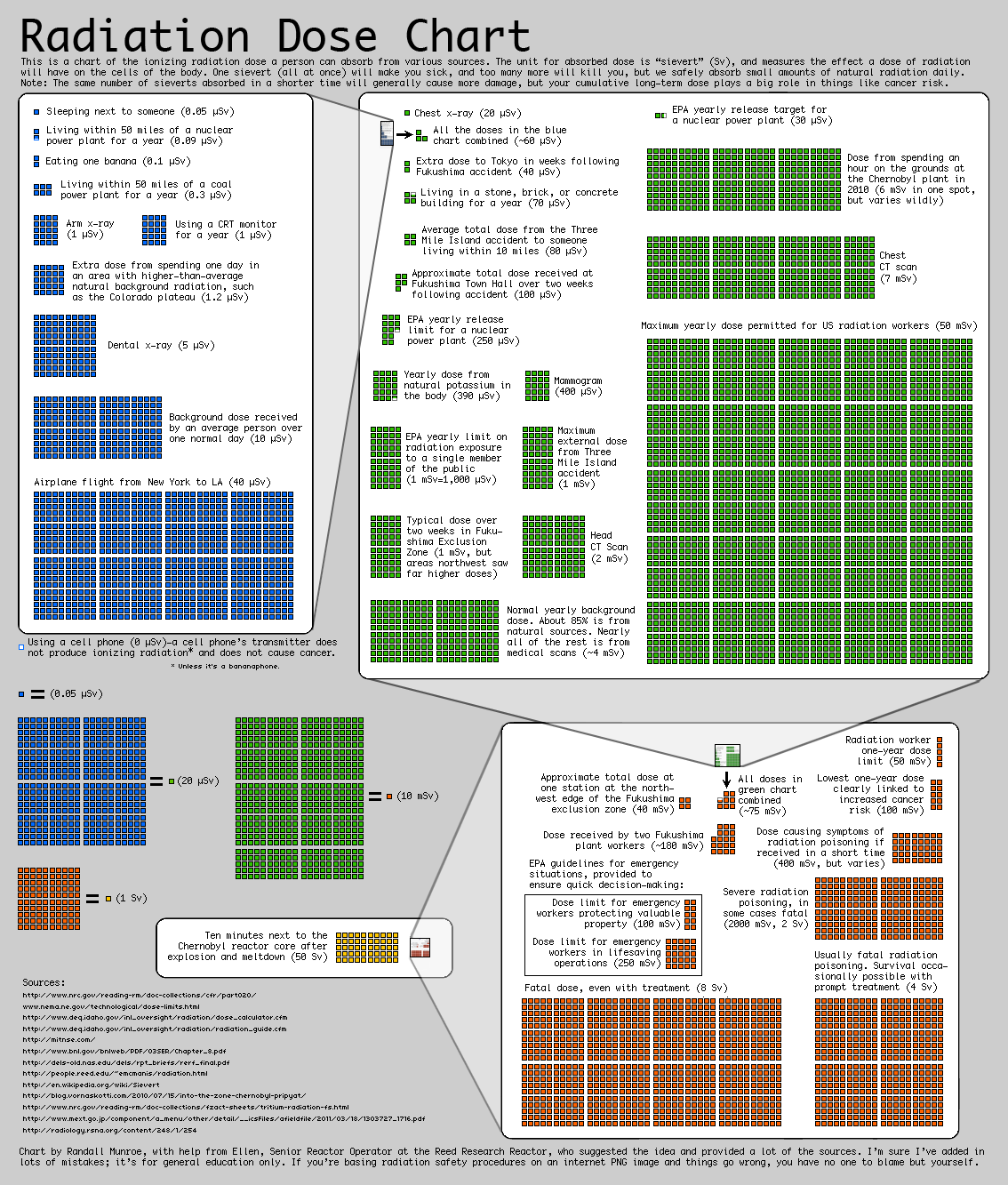
Radiation dose comparison charts from XKCD

March 20, 2011

No, there’s no humor in this thing — just good, solid information.

XKCD put together a chart that shows in geometric terms how various radiation doses work. With a tip of the pen to Bob Parks, the chart notes that cell phones don’t count here because cell phones don’t put out ionizing radiation, the type that causes cancer, but just radio waves.

The chart won’t be easy to read here — click on the image and go to the XKCD site for a bigger, more readable image:

Radiation Dose Chart from XKCD

Radiation Dose Chart from XKCD

It’s a good, clear graphic in its full size.  Go see.


Republicans and fixing the economy

March 20, 2011

Apparently they think that “fix the economy” means something more akin to “fix your dog” than increase jobs.

If you’re unemployed, or facing layoff, you will be happy to know how the Republicans have your back.  Or, happy to know they’re doing something behind your back.  Or they’re trying to put you flat on your back.  Or something.


Evolution of the Neo-Tea Party

March 20, 2011

Evolution of the Neo-Tea Party, by Verbalobe

Evolution of the Neo-Tea Party, by Verbalobe

Oh, For Goodness Sake claims it comes from Verbalobe, but I can’t find it there.  Verbalobe signed it, though . . . .


Yellowstone, Land to Life — a film to free from bondage

March 20, 2011

Yes, it’s a tease.  Drat.  Just a trailer for the film.

But how exquisite is just the trailer!

Yellowstone National Park Orientation Film (excerpt) from Northern Light Productions on Vimeo.

Northern Light Productions made the film for the “Canyon Visitor Education Center in Yellowstone National Park. The film offers a compelling overview of the ‘big picture’ geology that has shaped and continues to influence Yellowstone and its ecosystem.”

Big picture geology?  How about making this film available to schools to talk about geology, geography, and history?

Yellowstone National Park annually gets about three million visitors.  Yellowstone is one of those places that ever American should see — but at that rate, it would be more than 100 years before everybody gets there.

We need good, beautifully shot, well-produced, interesting films on American landmarks in the classroom.

How do we get this one freed for America’s kids, Yellowstone Park?


What’s the radiation level right now?

March 19, 2011

Concerned about radiation from Japan?

It’s highly improbable that dangerous levels of radiation would drift more than a few miles from the damaged nuclear power plants in Japan, but maybe seeing some actual readings might convince people there’s not much to worry about — other than our sympathy for Japan, the Japanese people and especially those workers who have stayed on the site of the power plant to work to secure the reactors so they do not become hazards to the population at large.  Those workers may be exposed to significant, harmful radiation, and they deserve all the thanks you can give them.

Below is a map of the contiguous 48 states of the U.S., showing live readings from about a dozen sampling sites across the nation.  The map should update about every minute (if it doesn’t, and  you want to see updates, click through to the Radiation Network site).

Normal background levels are about 25 to 75; a low-level warning might be given if readings are sustained at 100.  These numbers are Counts Per Minute (CPM), a very crude measure from a Geiger counter showing how many radioactive particles or rays hit the sensor in a minute.  It does not distinguish alpha, beta or gamma, and it may be dependent on the design of the Geiger counter, especially the size of the sensor — differently designed machines give different readings even right next to each other.

So it’s a crude count, but it’s a map of counts.

Radiation Network map of radiation in the U.S.  Read legend, use with caution

Radiation Network map of radiation in the U.S. Read legend, use with caution. Click map to go to Radiation Network site.

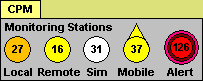
Here is legend information for the map:

Legend for Radiation Network map

Sampling station symbols, Radiation Network

Nuclear site, calculated by the Radiation Network

At left is a symbol used on the map to mark “nuclear sites” by the Radiation Network.  Note that a nuclear “site” is not necessarily a nuclear power station.  For example, there are nuclear sites designated near Moab, Utah; there are a couple of ore refining facilities or tailing ponds there, but no nuclear power station.  The map shows a nuclear site in the Texas Panhandle.  There is no nuclear power station there.

Instructions on how to read the map, from RadNet:

How to Read the Map:

Referring to the Map Legend at the bottom left corner of the map, locate Monitoring Stations around the country that are contributing radiation data to this map as you read this, and watch the numbers on those monitoring stations update as frequently as every minute (your browser will automatically refresh).  The numbers represent radiation Counts per Minute, abbreviated CPM, and under normal conditions, quantify the level of background radiation, i.e. environmental radiation from outer space as well as from the earth’s crust and air.  Depending on your location within the US, your elevation or altitude, and your model of Geiger counter, this background radiation level might average anywhere from 5 to 60 CPM, and while background radiation levels are random, it would be unusual for those levels to exceed 100 CPM.  Thus, the “Alert Level” for the National Radiation Map is 100 CPM, so if you see any Monitoring Stations with CPM value above 100, further indicated by an Alert symbol over those stations, it probably means that some radioactive source above and beyond background radiation is responsible.

Notice the Time and Date Stamp at the bottom center of the Map.  That is Arizona Time, from where we service the Network, and your indication of how recently the Radiation Levels have been updated to the Map.

(Please note: Any White circles on the map represent Monitoring Stations that are running Simulations, instead of using a real Geiger counter, so any Alert levels that may occur over those stations are to be ignored since they represent only momentary testing.)

Remember, “alert level” is sustained count above 100. But again, be alert that this is only counts per minute, and may be difficult to translate to an accurate radiation reading.

The Radiation Network is an all volunteer operation, no government funding or other involvement.  In fact, the network is seeking volunteers to get a Geiger counter and hook it up to the internet to provide even more real-time readings.  See “How to Participate in the Nationwide Radiation Network.”

If you’re a denier of global warming/climate change, you should use your usual denial tool, claiming that because radiation at background levels is “normal,” no level of radiation can be harmful.  In fact, if you’d make that claim and volunteer to go staff the crews trying to cool the reactors, the entire world would salute you.

Should you be concerned? MIT’s Technology Review explains that the levels of radiation at the plant site itself are quite low, though higher than normal (article by Courtney Humphries).  The article also explains that radiation levels rapidly drop the farther from the plant one is; while we may be able to detect increases in radiation attributable to the radiation from Fukushima site, it is highly unlikely that radiation will exceed safety standards:

In terms of potential health dangers from radiation from the Fukushima Daiichi Nuclear Power Station, “the people who are in the most immediate danger from acute and severe radiation doses are those people who are on site at the moment and who are desperately trying to keep the reactors under control,” says Jacqueline Williams, a radiation oncologist at the University of Rochester Medical Center.

Moving away from the immediate vicinity of the plant, radiation levels drop very rapidly. James Thrall, radiologist-in-chief at Massachusetts General Hospital, says that radiation levels are inversely proportional to the square of the distance from the source: The level at two miles from the source are one-quarter what they are at one mile, and “at 10 miles away, it’s almost an infinitesimal fraction,” he says. Individual exposure also varies widely depending on whether a person is outside or indoors, or shielded with protective clothing. Japanese authorities have evacuated the population living within a 20-kilometer radius of the plant, and have warned those living within 30 kilometers to stay indoors. Some experts say that people living beyond this range have no cause for concern at this time. “This has nothing to do with the general population,” McBride says.

The trickier question is whether lower doses of radiation—well below the threshold of acute illness—could lead to long-term health consequences for those in that area. Thrall says that epidemiological studies on survivors of nuclear attacks on Japan have found that those receiving 50 millisieverts or more had a slightly elevated cancer risk—about 5 percent higher than expected—and that risk seemed to rise with higher exposures. But scientists still vigorously debate whether that risk can be extrapolated down to even lower exposures.

After the nuclear disaster at Chernobyl, the population experienced a surge in thyroid cancers in children. However, scientists found that the culprit was not radiation in the air but radioactive contamination of the ground, which eventually found its way into cow’s milk. Thrall points out that in Japan, this is highly unlikely because the authorities are carefully monitoring the water and food supplies and keeping the public informed, which did not happen at Chernobyl.

More, resources: