NASA’s poster for National Aviation Day 2016. A young girl looks up at some of the experimental ideas for future aviation. NASA said: “It’s an exciting time for aviation, with potential NASA X-planes on the horizon and a lot of new technologies that are making airplanes much more Earth friendly. Use National Aviation Day to excite and inspire the young people you know about exploring aeronautics as a future career. Credits: NASA / Maria C. Werries”
August 19 is National Aviation Day. In federal law, the day is designated for flying the flag (36 USC 1 § 118).
August 19 is the anniversary of the birth of Orville Wright, usually credited with being on the team with his brother Wilbur who successfully built and flew the first heavier-than-air flying machine.
Celebrate? The White House issued no proclamation for 2018. but you may fly your flag anyway.
Spread the word; friends don't allow friends to repeat history.
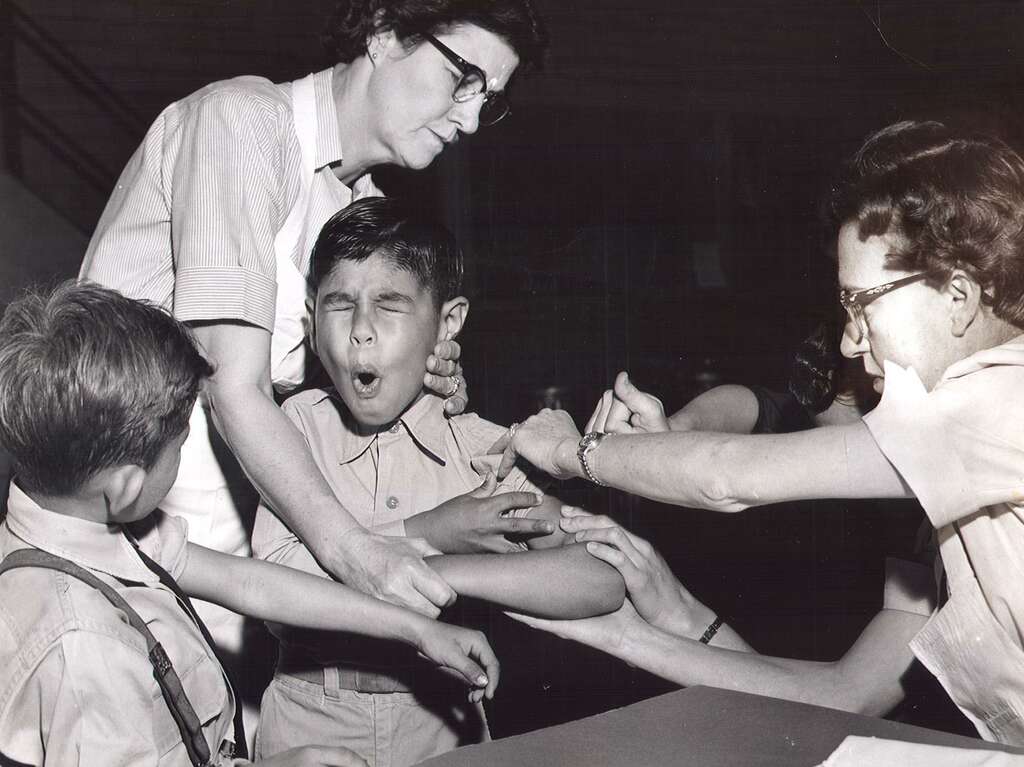
March of Dimes Foundation photo: “Nurses tended to polio patients in iron lung respirators at the Robert B. Green Memorial Hospital polio ward in San Antonio in 1950. It was a common scene throughout the polio crisis that swept Texas.” From the San Antonio Express-News article on the history of polio in the city.
It didn’t work.
In a desperate move to stop polio epidemics, after World War II but before the Salk polio vaccine was available, some American towns authorized aerial spraying of DDT over their cities.
Of course, DDT doesn’t stop viruses, and polio is a virus. Polio virus is not spread by a vector, an insect or other creature which might have been stopped by DDT, as mosquitoes spread malaria parasites and West Nile virus.
Aerial spraying of DDT against polio did not one thing.
A podcast from the Science History Institute discussed these misdirected events recently, and someone there did a sharp, short video to explain the issue.
YouTube explanation:
An animation drawn from episode 207 of Distillations podcast, DDT: The Britney Spears of Chemicals.
Americans have had a long, complicated relationship with the pesticide DDT, or dichloro-diphenyl-trichloroethane, if you want to get fancy. First we loved it, then we hated it, then we realized it might not be as bad as we thought. But we’ll never restore it to its former glory. And couldn’t you say the same about America’s once-favorite pop star?
We had a hunch that the usual narrative about DDT’s rise and fall left a few things out, so we talked to historian and CHF fellow Elena Conis. She has been discovering little-known pieces of this story one dusty letter at a time.
But first our associate producer Rigoberto Hernandez checks out some of CHF’s own DDT cans—that’s right, we have a DDT collection—and talks to the retired exterminator who donated them.
I bring it up here because in recent weeks there’s been a little surge on Twitter, and probably on Facebook and other places, in people claiming DDT causes polio, or causes symptoms so close to polio that physicians could never tell the difference. A lot of anti-vaccine advocates pile on, claiming that this would prove that the polio vaccine doesn’t work.
That’s all quite hooey-licious, off course. Polio’s paralysis of muscles in almost no way resembles acute DDT poisoning, which causes muscle misfiring instead of paralysis. As with almost every other disease, acute DDT poisoning can cause nausea; but DDT poisoning either kills its victim rather quickly, or goes away after a couple of weeks.
Polio doesn’t do that.
In the podcast, you’ll hear the common story of kids running behind DDT fogging trucks, because people thought DDT was harmless. In the concentrations in the DDT fogs, it would be almost impossible to ingest the 4 ounces or so of DDT required to get acute poisoning.
In any case, it’s one more odd facet of a long story of human relations to DDT and diseases. It’s worth a listen for history’s sake. But in this case, it’s entertaining, too. You’ll hear stories of people who opposed government actions to spray DDT, and who thought the government was too lax in its regulation and use of DDT.
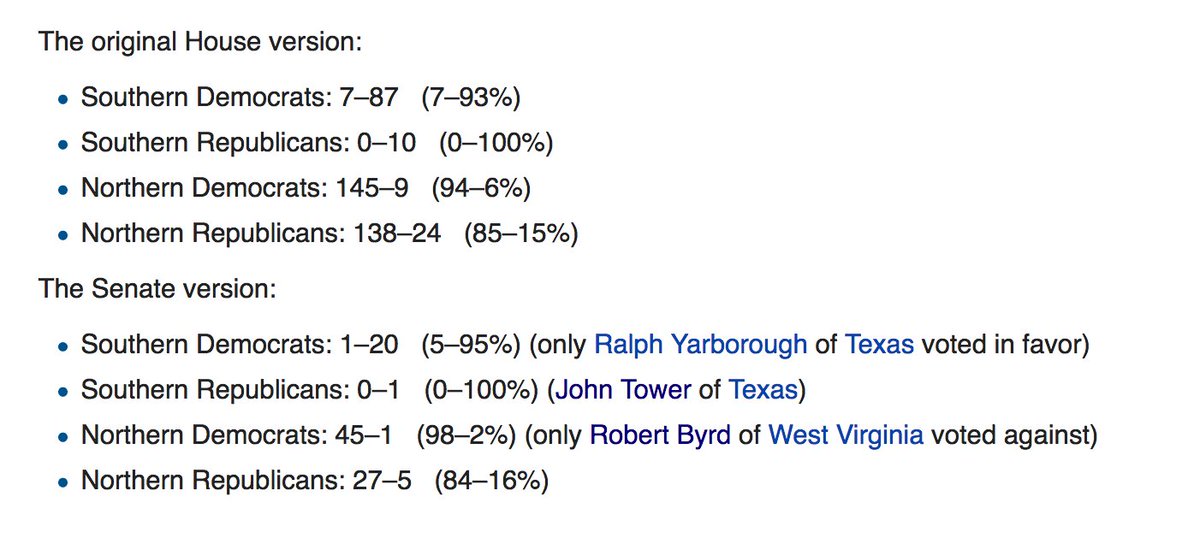
How Congress voted on the Civil Rights Act of 1964, broken down by party and with a few more details; chart by Kevin M. Kruse; from Kruse’s Twitter account.
Not sure if everybody got their Bogus History from Dinesh D’Souza, but a lot of people have the same wrong ideas about what party supported civil rights in the post-World War II era. These crappy distortions of history are showing up on Facebook and all over Twitter. Worse, people believe them.
The crappy claim is that Democrats are the party of racism and support for the Ku Klux Klan. Historically, that was once so; but it has not been so since 1948 as the two main parties in the U.S. switched positions, with Democrats taking on civil rights as a key cause for Democratic constituencies, and the Republican Party retreating from Abraham Lincoln’s work in the Civil War and immediate aftermath, and instead welcoming in racists fleeing the Democratic Party.
Think Strom Thurmond, vs. Mike Mansfield and Lyndon Johnson.
Kevin Kruse corrected D’Souza in a series of Tweets, and you ought to read them and follow the notes. Kruse is good, and better, he is armed with accurate information.
This is solid history, delivered by Kruse in a medium difficult for careful explanations longer than a bumper sticker.
I keep seeing this talking point in my mentions so, sure, let's address it.https://t.co/AxuVqDHwVq
First of all, the central point in the original tweet stands. If you have to go back to the 1860s or even the 1960s to claim the “party of civil rights” mantle — while ignoring legislative votes and executive actions taken in *this* decade — you’re clearly grasping at straws.
Anyone who reads newspapers would know that. Alas, one of the campaigns of conservatives over the past 40 years has been to kill off newspapers. They’ve been way too successful at it.
I’ll include mostly the Tweets for the rest of this post.
First of all, the central point in the original tweet stands.
If you have to go back to the 1860s or even the 1960s to claim the "party of civil rights" mantle — while ignoring legislative votes and executive actions taken in *this* decade — you're clearly grasping at straws.
Second, this fact — that GOP votes were needed to overcome the opposition of Southerners in Congress (Democrats *and* Republicans) — is weirdly trotted out as if it's a hidden secret and not, you know, a central part of historians' narrative of the civil rights era.
This is a constant thing with D'Souza, by the way, claiming "historians won't tell you this" or "they don't lecture about that" when, in fact, we do constantly.
It's a fairly big tell that he hasn't read much in the field and probably never even took a class in US history.
Democrats were the dominant party, but had become increasingly divided over civil rights, with northern white liberals and African-Americans steadily gaining on the southern conservative segregationists who had long controlled the party.
Because Democrats had such overwhelming margins in Congress but were divided internally on civil rights, the fight over the CRA and VRA were at heart fights *within* the Democratic Party.
Liberal Dems fought for these bills; conservative Dems worked to stop them.
Look at the history behind both bills, before the final votes.
Both were introduced by Democratic presidents, ushered through Congress by Democratic committee chairs and leaders, given more votes in the end by Democrats than the GOP, and then signed by Democratic president.
The Civil Rights Act of 1964: proposed by JFK, passed by Democratic-led House (152 Dem votes for, 138 Rep votes for) and Democratic-led Senate (46 Dem votes for, 27 Rep votes for). LBJ signed it with MLK at his side.
The Voting Rights Act of 1965: advanced by LBJ and passed by Democratic-led House (221 Dem votes for, 112 Rep votes for) and Democratic-led Senate (49 Dem votes for, 30 Rep votes for), LBJ signed it.
In comparison, Senator Barry Goldwater — the conservative GOP presidential candidate who ran against LBJ in 1964 — voted against the Civil Rights Act and campaigned on the vote.
Conservatives in both parties *hated* the civil rights bill, denounced as "socialist" in this ad: pic.twitter.com/uRg4rmEVi7
Back up and look at those vote totals for the bills. You can see Democrats and Republicans on both sides.
Yes, Southern Democrats in the Senate filibustered the CRA. But the only Southern Republican senator filibustered too, and the filibuster's leader soon switched to the GOP.
As I showed in great detail in this thread, the new Southern Republicans in the House and Senate in the 1960s were basically indistinguishable from old Southern Democrats on matters of civil rights and segregation: https://t.co/UD83C8BErw
On the flip side, yes, liberal and moderate Republicans did side with the majority of Democrats to pass the bills, after Dem leaders recruited them.
Again, though, the real distinction is region, not party. Southern conservatives in both parties resisted it. Here's the CRA vote: pic.twitter.com/4N9SlbrSVy
D'Souza and those like him point to the yes votes of liberal & moderate Republicans — deliberately ignoring the no votes of conservatives like Goldwater — to claim that today's *conservative* GOP is the party of civil rights.
Moreover, as noted in this thread, National Review — which still has D'Souza on its masthead — led the charge against these liberal and moderate Republicans over the course of the 1960s.https://t.co/TIDUZT2a3F
So, no, the GOP was not "the party of civil rights" in the 1960s.
There were, to be sure, moderates in the GOP like Romney and Rockefeller who stood up for civil rights. But Goldwater Republicans fought them for control of the party and ultimately won: https://t.co/292BtVZi87
In the end, it's insane that conservatives now try to reach back to reclaim votes of moderate and liberal Republicans — whom conservatives *hated* at the time — to provide cover for today's conservative GOP.
Sorry, you didn't want them then. You don't get to claim them now.
You can view the entire thread in one unroll, which I find difficult to translate to this blog platform — but you may find it easier to disseminate:
Hi! please find the unroll here: Thread by @KevinMKruse: "I keep seeing this talking point in my mentions so, sure, let's address it. First of all, the central point in the origi […]" https://t.co/MRYiSGQ6xN Talk to you soon. 🤖
— Thread Reader App (@threadreaderapp) July 27, 2018
Spread the word; friends don't allow friends to repeat history.
From Harper’s Magazine: “Raising the American flag over Fort Santiago, Manila, on the evening of August 13, 1898.” From Harper’s Pictorial History of the War with Spain, Vol. II, published by Harper and Brothers in 1899.
August in the U.S. is a lazy, often hot, summer month. It’s a month for vacation, picnicking, local baseball games, camping, cookouts and beach vacations. It’s not a big month for events to fly the U.S. flag.
Except, perhaps, in Olympics years, when the U.S. flag is often flown a lot, in distant locations. About 50 percent of photographs of the U.S. flag flying in August features an American Olympic athlete. 2018 is not an Olympics year.
Only one event calls for nation-wide flag-flying in August, National Aviation Day on August 19. This event is not specified in the Flag Code, but in a separate provision in the same chapter U.S. Code. Three states celebrate statehood, Colorado, Hawaii and Missouri. Will the president issue a proclamation to fly the flag for National Aviation Day?
Put these dates on your calendar to fly the flag in August:
President Obama singing “Amazing Grace” in Charleston, South Carolina, June 26, 2015. This may be a wire service photo, but credit was stripped off.
Joan Baez says she’s made her last album, maybe will stop touring soon.
But she’s still speaking out for good, for equality, for civil rights, against violence.
Here’s a sharp animated video made for a song Baez released this year, “The President Sang Amazing Grace.” We once had a president who would do that. Atlantic Magazine highlights a few outstanding films, and this is one.
“I was driving when I heard ‘The President Sang Amazing Grace,’” Joan Baez told The Atlantic, “and I had to pull over to make sure I heard whose song it was because I knew I had to sing it.” The 77-year-old folk legend included the song in her final album, Whistle Down The Wind, released in early March. Originally written and performed by Zoe Mulford following the 2015 mass shooting in a historic black church in Charleston, South Carolina, Baez’s rendition of “The President Sang Amazing Grace” has been animated in a powerful new video. Read more: https://www.theatlantic.com/video/ind… “The President Sang Amazing Grace” is performed by Joan Baez, written by Zoe Mulford, and animated in this video by Jeff Scher. It is part of The Atlantic Selects, an online showcase of short documentaries from independent creators, curated by The Atlantic.
Shake of the old scrub brush to Joan Baez on Twitter (@JoanCBaez).
Watch the new video for "The President Sang Amazing Grace" created & animated by Jeff Scher. https://t.co/cBhAyVUY8A
NASA posted this back in 2013 — but a lot of people missed it. It’s an animation of the Moon’s full rotation, showing all sides of the Moon lighted by the Sun. Film images come from the Lunar Reconnaissance Orbiter (LRO).
Watching this video we can think of all sorts of oddities about the Moon that maybe we didn’t get answers to in our high school astronomy class, or Astronomy 101 at State U: Why do we see only one side of the Moon from Earth? Doesn’t that mean the Moon doesn’t rotate? And shouldn’t Pink Floyd have called the album, “Far Side of the Moon?”
Explanation: No one, presently, sees the Moon rotate like this. That’s because the Earth’s moon is tidally locked to the Earth, showing us only one side. Given modern digital technology, however, combined with many detailed images returned by the Lunar Reconnaissance Orbiter (LRO), a high resolution virtual Moon rotation movie has now been composed. The above time-lapse video starts with the standard Earth view of the Moon. Quickly, though, Mare Orientale, a large crater with a dark center that is difficult to see from the Earth, rotates into view just below the equator. From an entire lunar month condensed into 24 seconds, the video clearly shows that the Earth side of the Moon contains an abundance of dark lunar maria, while the lunar far side is dominated by bright lunar highlands. Two new missions are scheduled to begin exploring the Moon within the year, the first of which is NASA’s Lunar Atmosphere and Dust Environment Explorer (LADEE). LADEE, which launched just over a week ago, is scheduled to begin orbiting the Moon in October and will explore the thin and unusual atmosphere of the Moon. In a few months, the ChineseChang’e 3 is scheduled to launch, a mission that includes a soft lander that will dispatch a robotic rover.
Tip of the old scrub brush to World and Science on Twitter (@WorldandScience).
Caption from NASA: The American flag heralded the launch of Apollo 11, the first Lunar landing mission, on July 16, 1969. The massive Saturn V rocket lifted off from NASA’s Kennedy Space Center with astronauts Neil A. Armstrong, Michael Collins, and Edwin “Buzz” Aldrin at 9:32 a.m. EDT. Four days later, on July 20, Armstrong and Aldrin landed on the Moon’s surface while Collins orbited overhead in the Command Module. Armstrong and Aldrin gathered samples of lunar material and deployed scientific experiments that transmitted data about the lunar environment. Image Credit: NASA
July 4. Surely everyone knows to fly the flag on Independence Day, the anniversary of the Declaration of Independence.*
In the month of the grand patriotic celebration, what other dates do we fly the U.S. flag? July 4 is the only date designated in the Flag Code for all Americans to fly the flag. Three states joined the union in July, days on which citizens of those states should show the colors, New York, Idaho and Wyoming.
Plus, there is one date many veterans think we should still fly the flag, Korean War Veterans Armistice Day on July 27. Oddly, the law designating that date urges flying the flag only until 2003, the 50th anniversary of the still-standing truce in that war. But the law still exists. What’s a patriot to do?
Patriots may watch to see whether the president issues a proclamation for the date.
From Pinterest: “Riders in the patriotic horse group Americanas from Rexburg, Idaho, participate in the 163rd annual Days of ‘47 KSL 5 Parade Tuesday July 24, 2012 [in Salt Lake City, Utah]. (Chris Detrick | The Salt Lake Tribune)”
Generally we don’t note state holidays or state-designated flag-flying events, such as Utah’s Pioneer Day, July 24, which marks the day in 1847 that the Mormon pioneers in the party of Brigham Young exited what is now Emigration Canyon into the Salt Lake Valley. But it’s a big day in Utah, where I spent a number of years and still have family. And I still have memories, not all pleasant, of that five-mile march for the Days of ’47 Parade, in that wool, long-sleeved uniform and hat, carrying the Sousaphone. Pardon my partisan exception. Utahns will fly their flags on July 24.
Idaho statehood, July 3 (1890, 43rd state)
Independence Day, July 4
Wyoming statehood, July 10 (1890, 44th state)
New York statehood, July 26 (1788, 11th state)
National Korean War Veterans Armistice Day, July 27 (flags fly at half-staff, if you are continuing the commemoration which was designated in law only until 2003)
* July 4? But didn’t John Adams say it should be July 2? And, yes, the staff at Millard Fillmore’s Bathtub sadly noted that, at most July 4 parades, it appears no one salutes the U.S. flag as it passes, as the Flag Code recommends. MFB’s been fighting flag etiquette ignorance since 2006. It’s taking much, much longer than we wished.
The U.S. flag on Mars – No manned missions to Mars occurred, yet, so there is no flag planted on Mars. But the Mars Rover, Curiosity, has a U.S. flag medallion affixed to a rocker arm. From NASA: This view of the American flag medallion on NASA’s Mars rover Curiosity was taken by the rover’s Mars Hand Lens Imager (MAHLI) during the 44th Martian day, or sol, of Curiosity’s work on Mars (Sept. 19, 2012). The flag is one of four “mobility logos” placed on the rover’s mobility rocker arms.
Yes, this is an encore post. Defeating ignorance takes patience and perseverance.
Save
Spread the word; friends don't allow friends to repeat history.
The popular hero of the Mexican-American War, Zachary Taylor, died on July 9. For the second time, a vice president was sworn in to replace the elected president.
Millard Fillmore was that vice president.
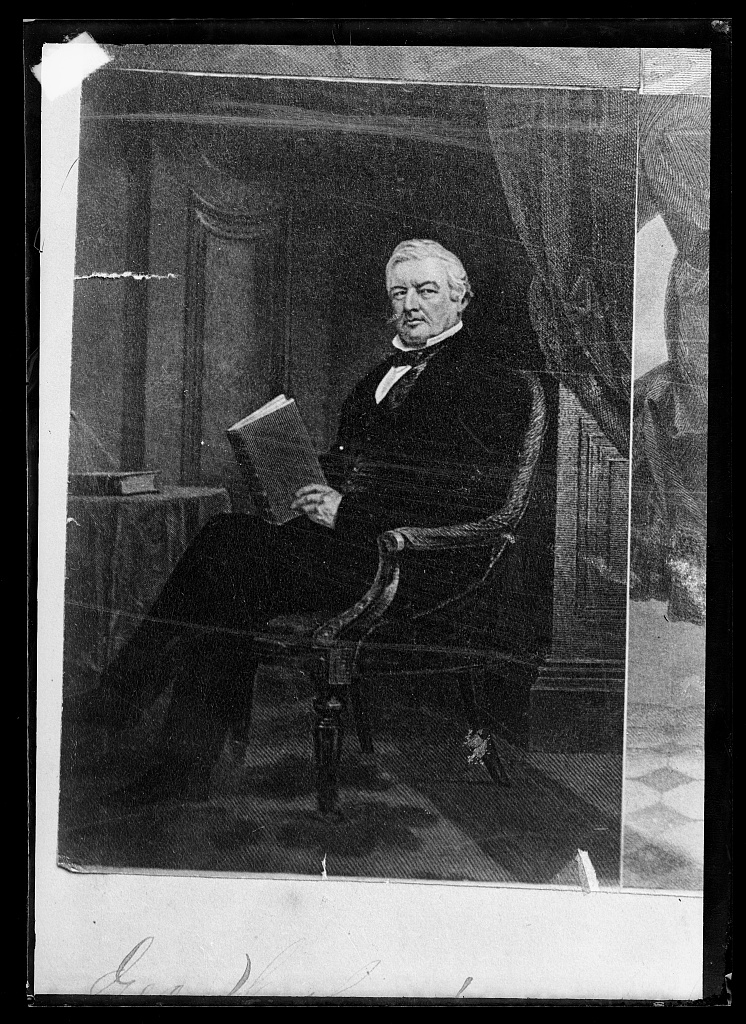
Millard Fillmore, in 1873, 20 years after he left the presidency. Portrait by C. M. Bell. From the Library of Congress.
Fillmore ended the run of presidents by Whig Party members, the last Whig. He served out the term of Taylor, but despite trying, never succeeded in winning election on his own.
Most people including historians know little about Fillmore, except his unsavory role in signing the Fugitive Slave Act, and thereby pushing the nation closer to civil war. The hoax on Fillmore’s allegedly introducing a plumbed bathtub to the White House, by H. L. Mencken in 1917, stained Fillmore’s reputation and chased out most information about good things he had done, such as opening Japan to trade.
There are morals about hoaxes and fake news in Fillmore’s story. Those morals are much lost to history now.
One story says Queen Victoria commented that Millard Fillmore was the handsomest man she’d ever met; true or not, imposing Trump’s face on Fillmore doesn’t improve anything. Illustration from BBC
Millard Fillmore was a self-educated man, an ardent reader, the founder of the White House library.
Millard Fillmore understood the strategic geography of Japan, an opened Japan up to the world.
Has Trump done anything beneficial? Logical? Based on good, accurate information?
We may have a bone to pick with BBC.
BBC’s article, by Jude Sheerin from the Washington bureau, actually is quite well done. The article compares the nativism in Fillmore’s time, to which Fillmore fell victim, with Trump’s nativism — and the comparison is troubling.
In the end, the Whigs refused to nominate Fillmore to run for his own term in 1852 (he had succeeded President Zachary Taylor on Taylor’s death, remember); Fillmore was courted by the American Party, better known to school kids as the Know-Nothings. Fillmore led the Know-Nothings to a crushing defeat in 1852 (they did get Maryland), but the Whigs never recovered either. In 1856, partly in the ashes of the Whigs, rose the Republican Party to run John C. Fremont for President.
And in 1860, the new Republican Party managed to knock a homerun, getting Abraham Lincoln elected to the presidency on the party’s second try.
“What is past is prologue,” the wall of the National Archives tells us, and Santayana warns that those who do not remember history will repeat it. What lessons can we learn from comparing Donald Trump to Millard Fillmore?
Other than the fact that Fillmore was actually quite a bit better looking, that is.
Spread the word; friends don't allow friends to repeat history.
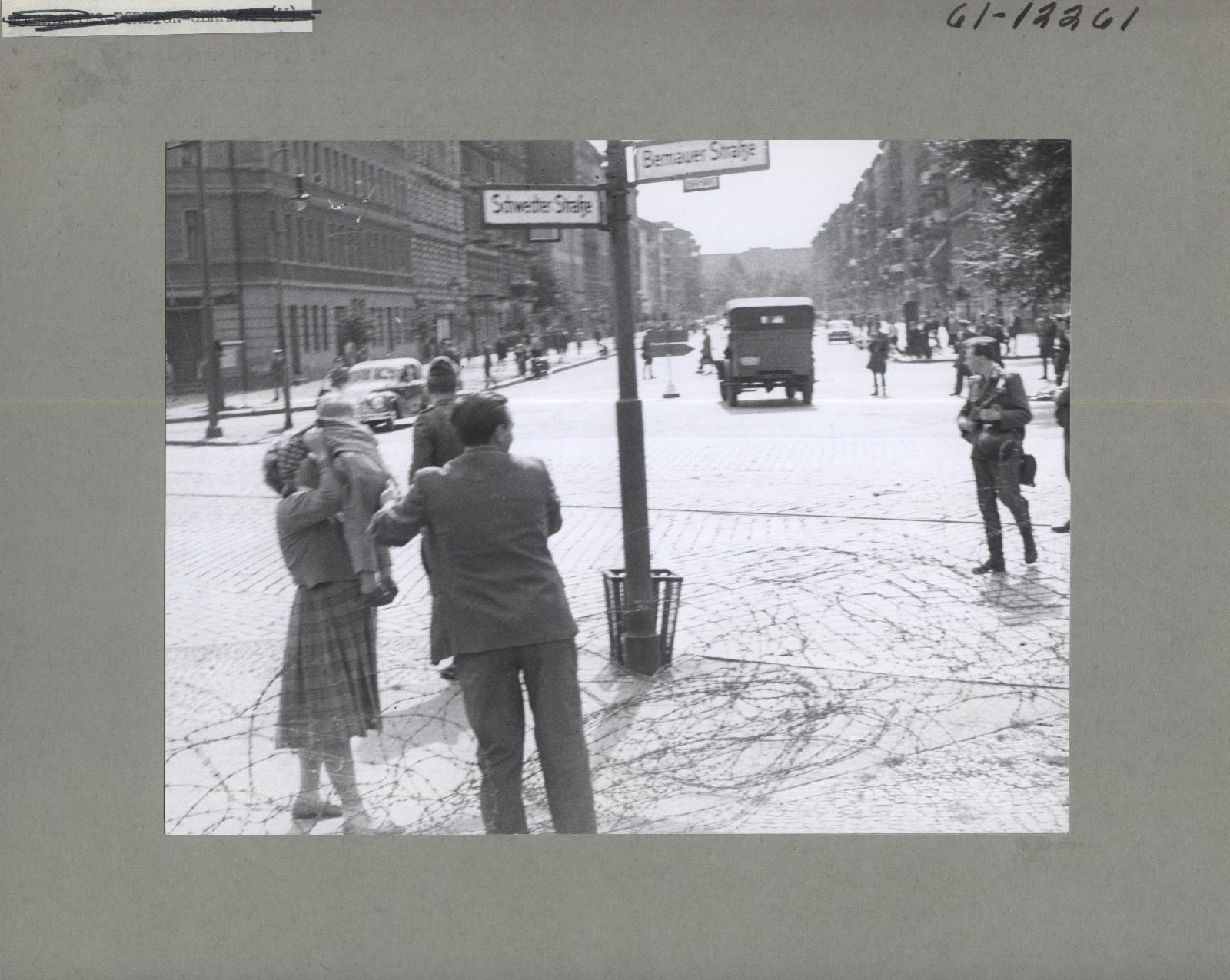
August, 1961. First the barbed wire went up surrounding West Berlin, separating those in the Russian sector, and East Germany, from those in the French, British and U.S. sectors, an island of non-communist rule in a sea of communists.
The famous wall of concrete, steel and barbed wire would be built soon. Germans living in Berlin were sometimes trapped by arbitrary lines on a map, lines that meant the difference between freedom and a communist dictatorship.
Berlin residents pass children over the barbed wire separating the free West Berlin from Soviet-occupied West Berlin. August 1961. U.S. National Archives image, from U.S. Information Agency.
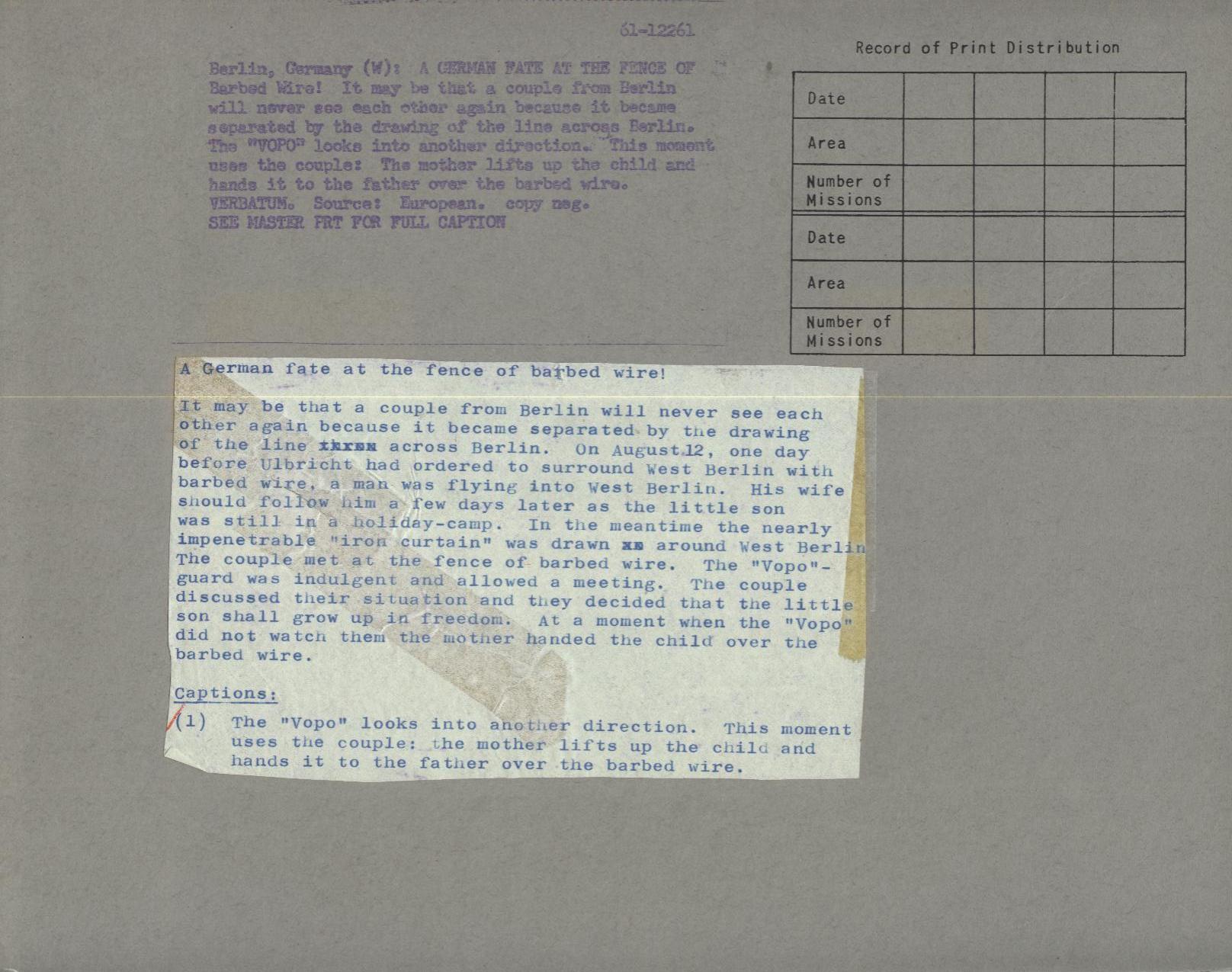
The guard, a “Vopo,” looked the other way. And that made all the difference in that child’s life.
Caption for photo from USIA, on the back of the photo.
Why does this image call out to me now, as if from the voice of that child, pleading for help? Does it call to you, too?
Spread the word; friends don't allow friends to repeat history.
Of course you know to fly your flag on June 14 for Flag Day — but did you know that the week containing Flag Day is Flag Week, and we are encouraged to fly the flag every day?
Clifford Berryman’s 1901 Flag Day cartoon, found at the National Archives: “In this June 14, 1904, cartoon, Uncle Sam gives a lesson to schoolchildren on the meaning of Flag Day. Holding the American flag in one hand, Uncle Sam explains that the flag has great importance, unlike the Vice Presidency, which he ridicules in a kindly manner. (National Archives Identifier 6010464)”
On June 14, 1885, Bernard J. Cigrand placed a 10-inch, 38-star flag in a bottle on his desk at the Stony Hill School in Ozaukee County, Wisconsin. The 19-year-old teacher then asked his students to write essays on the flag and its significance to them. This small observance marked the beginning of a long and devoted campaign by Cigrand to bring about national recognition for Flag Day.
And so we do, today, still.
Yes, this is an encore post. Defeating ignorance takes patience and perseverance.
Spread the word; friends don't allow friends to repeat history.
“Flag Day, Pittsburgh, Pennsylvania.” 1942 photo by John Vachon (1914-1975) for the U.S. Farm Security Administration/Office of War Information. Image from the National Archives and Records Administration (NARA)
Fathers Day, third Sunday in June (June 17 in 2018)
Several states celebrate statehood. New Hampshire, Virginia, Arkansas, Kentucky, Tennessee and West Virginia celebrate statehood; Kentucky and Tennessee share the same date.
Kentucky, June 1 (1792, 15th state)
Tennessee, June 1 (1796, 16th state)
Arkansas, June 15 (1836, 25th state)
West Virginia, June 20 (1863, 35th state)
New Hampshire, June 21 (1788, 9th state), and
Virginia, June 25 (1788, 10th state)
Additionally, Congress passed a resolution designating the week in which June 14th falls as National Flag Week, and urging that citizens fly the flag each day of that week. In 2018 that would be the week of June 10, which falls on Sunday, through June 16.
Flag-flying days for June, listed chronologically:
Kentucky and Tennessee statehood, June 1
Flag Day, June 14; National Flag week, June 10 to 16
Arkansas statehood, June 15 (duplicating a day in National Flag Week)
Fathers Day, June 17
West Virginia statehood, June 20
New Hampshire statehood, June 21
Virginia statehood, June 25
As you know, any resident may fly the flag any day of the year, under the etiquette provided in the Flag Code.
National Archives caption: This illustration entitled, “Flag Day – 1900”, by cartoonist Clifford Berryman, which appeared in the Washington Post on June 14, 1900, depicts the growth of American influence in the world as the European powers watch in the background as new century is ushered in.
Flag Day, 1918, at Fort Sam Houston, Texas. Photo by Miles F. Weaver (1879-1932), from the collection of the National Archives (NARA)
Save
Spread the word; friends don't allow friends to repeat history.
Or, until that account is unsuspended by the forces supporting Donald Trump: Follow @FillmoreWhite, the account of the Millard Fillmore White House Library
We've been soaking in the Bathtub for several months, long enough that some of the links we've used have gone to the Great Internet in the Sky.
If you find a dead link, please leave a comment to that post, and tell us what link has expired.
Thanks!
Retired teacher of law, economics, history, AP government, psychology and science. Former speechwriter, press guy and legislative aide in U.S. Senate. Former Department of Education. Former airline real estate, telecom towers, Big 6 (that old!) consultant. Lab and field research in air pollution control.
My blog, Millard Fillmore's Bathtub, is a continuing experiment to test how to use blogs to improve and speed up learning processes for students, perhaps by making some of the courses actually interesting. It is a blog for teachers, to see if we can use blogs. It is for people interested in social studies and social studies education, to see if we can learn to get it right. It's a blog for science fans, to promote good science and good science policy. It's a blog for people interested in good government and how to achieve it.
BS in Mass Communication, University of Utah
Graduate study in Rhetoric and Speech Communication, University of Arizona
JD from the National Law Center, George Washington University



 Posted by Ed Darrell