Polar bears demand Goldilocks ice; she’s baked to death in the sun

March 9, 2018

Zachary Labe's animation showing decline of long-term ice in the Arctic.

Zachary Labe’s animation showing decline of long-term ice in the Arctic. Long-term variability and loss of February #Arctic sea ice volume (left) and thickness (right) during the satellite era. Data from PIOMAS, graphic by Zachary Labe.

Polar bears need Goldilocks ice. There isn’t much.

Zachary Labe’s .gif shows the decline in ice thick enough from which polar bears can hunt, right up to 2018. Hunting areas for the bears decline, and bears will go hungry and cubs will die.

Polar bear researcher Andrew Derocher told us on Twitter what the graphic means:

Great graphic to refute deniers spouting that there’s more sea ice in the Arctic. For , it’s a Goldilocks scenario: sea ice can’t be too thick, too thin, too much, too little, it has to be just right. Of course, too thick isn’t an issue anymore.

Though the dangers to polar bears “isn’t an issue anymore” among scientists, it is also true that denialists, especially on blogs, Twitter and Facebook, drive opinion contrary to science and against the interest of the survival of polar bears. A paper by a group of scientists including members of the Polar Bear Specialist Group recently detailed that the internet legions of denial convince many people polar bears are not in trouble, making it difficult to work to save the animals.

Abstract

Increasing surface temperatures, Arctic sea-ice loss, and other evidence of anthropogenic global warming (AGW) are acknowledged by every major scientific organization in the world. However, there is a wide gap between this broad scientific consensus and public opinion. Internet blogs have strongly contributed to this consensus gap by fomenting misunderstandings of AGW causes and consequences. Polar bears (Ursus maritimus) have become a “poster species” for AGW, making them a target of those denying AGW evidence. Here, focusing on Arctic sea ice and polar bears, we show that blogs that deny or downplay AGW disregard the overwhelming scientific evidence of Arctic sea-ice loss and polar bear vulnerability. By denying the impacts of AGW on polar bears, bloggers aim to cast doubt on other established ecological consequences of AGW, aggravating the consensus gap. To counter misinformation and reduce this gap, scientists should directly engage the public in the media and blogosphere.

Reduced ice means smaller, less healthy cubs, hungrier less healthy mothers, hungrier, more-likely-to-eat-cubs males.


While denialists rage, the Earth still warms. Eppure, lei si scalda.

Tip of the old scrub brush to Andrew Derocher on Twitter.


Trump’s ignoring and forgetting of his ‘forgotten man’ voters

March 7, 2018

Trump’ s middle America voters hurt still. Tax cuts make them hurt more, and. Trade war can’t help.

Trump has abandoned Americans.


Tip of the old scrub brush to Greg Sargent @ThePlumLineGS.

twitter.com/theplumlinegs/status/971409308666777601


Chess games of the rich and famous: Daumier’s Parisian players

March 7, 2018

Honore Daumier (1808-1879), 1863 painting

Honore Daumier (1808-1879), 1863 painting “The Chess Players” (“Les joueurs d’échecs”) Wikimedia image

You can find these two men playing chess in the Petit Palais, Paris.


Rain and hail on St. Patrick’s Day 2016

March 6, 2018


Still from a rainy St. Patrick's Day film.

Still from a rainy St. Patrick’s Day film.

My iPhone made this video from shots I took on March 17, 2016 — better job of editing than I could have done.

Should I let iPhone make more movies?


Sri Lanka declared malaria-free, without DDT

March 6, 2018

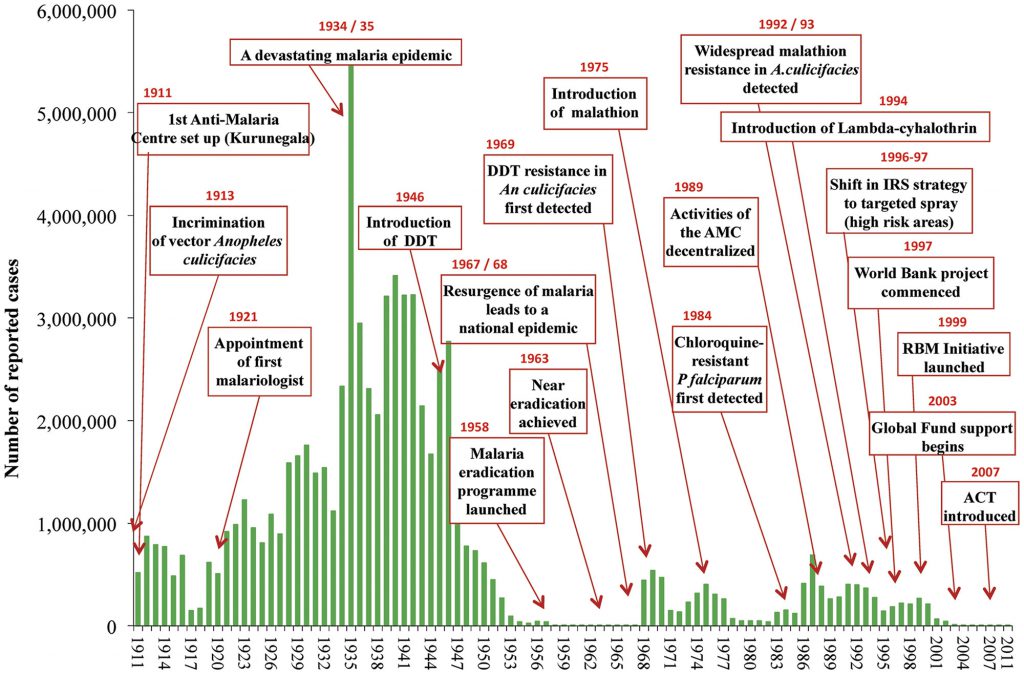
Chart from the India Foundation shows the ups and downs of fighting malaria in Sri Lanka in the 20th and 21st centuries. Sri Lanka is malaria-free since 2016.

Sri Lanka pushed malaria out of the country, and is certified by the World Health Organization (WHO) as malaria-free, as of September 2016.

If you follow the fight against malaria, this may not be news to  you. If you’re a victim of the pro-DDT, anti-WHO and anti-Rachel Carson hoaxes, you may be surprised.

Sri Lanka once got malaria to almost nothing, with heavy use of DDT in Indoor Residual Spraying. Then the budget hawks stopped the anti-malaria program (“Success!”) to save money. Malaria came roaring back as it will when vigilance relaxes — but by then the mosquitoes were mostly resistant to DDT, and a civil war kept the nation from mounting any public health campaigns in much of the country.

With the advent of new medicines, ABC therapy, and new methods to diagnose the disease, and using bednets and targeted pesticides other than DDT, Sri Lanka beat the disease. The news was carried in Britain’s The Guardian.

The World Health Organisation has certified that Sri Lanka is a malaria-free nation, in what it called a truly remarkable achievement.

WHO regional director Poonam Khetrapal Singh said in a statement that Sri Lanka had been among the most malaria-affected countries in the mid-20th century.

But, the WHO said, the country had begun an anti-malaria campaign that successfully targeted the mosquito-borne parasite that causes the disease, not just mosquitoes. Health education and effective surveillance also helped the campaign.

https://www.theguardian.com/society/2016/sep/05/sri-lanka-malaria-free-world-health-organisation

This is a blow to the anti-WHO pro-DDT forces. Sri Lanka has been a key story in their tales of how only DDT could fix malaria, stories told long after DDT stopped working. One more example shot down.

More:

Tip of the old scrub brush to The Guardian.


Spring comes a month earlier than it did for our grandparents. That is an annual disaster.

March 4, 2018

What are you doing about it?

In 2018, Spring is early in the west and east, but later than normal in the southeast. Overall, springs come earlier these days.

A map of plant growth, including the emergence of leaves and blooms, updated daily tracks the arrival of spring compared to normal seasonal timing over a 50-year period. USGS

A map of plant growth, including the emergence of leaves and blooms, updated daily tracks the arrival of spring compared to normal seasonal timing over a 50-year period. USGS

Generally, since 1900, spring has arrived a few minutes earlier every year, on average. But each spring is unique, and in 2018 variation covers almost 40 days, 20 days on either side of a “normal” spring arrival in a location.

Yale Environment 360 explains the observations and consequences.

The early spring arrival coincides with a slew of other odd weather trends happening across the globe, from a heat wave in the Arctic, where temperatures reached 43 degrees Fahrenheit in February, to a cold snap in Europe.

An early spring comes with consequences: Disease-carriers such as ticks and mosquitoes emerge sooner, the USGS warns, and it can trigger a longer, more intense pollen season. In addition, if flowers bloom earlier than normal, it “can disrupt the critically important link between wildflowers and the arrival of birds, bees, and butterflies” that is critical to the pollination of crops and other plants, the USGS wrote.

While generally these trackers show the earlier springs over decades, I am delighted by the dramatic variation in some places. Where we live in Dallas, for example, spring is delayed this year — according to the maps. Sure enough, last year most of our spring-blossoming trees were already abloom, only to lose blossoms for fruit in later winds and cold. See my post from last year on Mexican plums, link below. This year the Mexican plum is budded, but not blossoming yet.

In contrast, the daffodil/narcissus plants are up earlier than usual, some already blossoming. Again, in the past two years they’ve been even earlier.

More:

Tip of the old scrub brush to Yale Environment 360’s Twitter feed.


Fly the U.S. flag in March 2018?

March 2, 2018

Members of the New York City Fire Department carry 343 U.S. flags honoring the 343 NYFD members killed on 9/11, in the St. Patrick's Day Parade. New York Post caption:

Members of the New York City Fire Department carry 343 U.S. flags honoring the 343 NYFD members killed on 9/11, in the St. Patrick’s Day Parade. New York Post caption: “Despite the cold and gray morning, parade-goers turned out for St. Patrick’s Day to celebrate Irish heritage in New York City on March 17, 2014. FDNY members set the pace as they marched down 5th Avenue holding American flags for the annual event. SHANNON STAPLETON/Reuters”

I usually put up a post near the first of the month listing the occasions upon which U.S. laws urge us to fly Old Glory. March sometimes slips by without such a post.

No good reason, other than in most years, March offers no regular national commemorations upon which flag flying is urged. The odd year is when Easter comes early. Easter is one of the holidays the Flag Code says flags should be flown.

But, most years, Easter falls in April, as it does in 2018.

The Flag Code urges residents of states to fly the U.S. flag on the anniversary of their state’s entering the union, on statehood day. Those are the only dates in March, most years. In March, we have four statehood days in the first four days of the month. If I dawdle, we miss most of the dates.

Flag fly dates, for March (some already past, in 2018):

  • March 1, Ohio statehood (1803, 17th state)
  • March 1, Nebraska statehood (1867, 37th state)
  • March 3, Florida (1845, 27th state)
  • March 4, Vermont statehood (1791, 14th state)
  • March 15, Maine statehood (1820, 23rd state)

Many St. Patrick’s Day revelers and parade marchers display the U.S. flag, but it’s not an official U.S. observance.

I keep hoping, but I get little traction for a law urging flying the flag to observe Freedom Day, on the birth anniversary of the Father of the Constitution, James Madison (he was born March 16, 1751).

People gathered on the lawn of James Madison's home in Montpelier, Virginia, to display the U.S. flag in a card display, 2011. AP photo?

People gathered on the lawn of James Madison’s home in Montpelier, Virginia, to display the U.S. flag in a card display, 2011. AP photo?

Much irony, and great history, in the U.S. colors being shown so dramatically on St. Patrick’s Day, a day relatively uncommemorated in Ireland, and commemorated in the U.S. chiefly to help overcome bias against Irish immigrants.

Some irony in the unmarked birthday of the Father of the Constitution.

Sure, you may fly the U.S. flag every day in March. You need not wait for sanction from a Presidential Proclamation or a Congressional Resolution. You may fly the flag every day. (Just follow flag etiquette when you do.)

I’ll try to keep up better, next year. (I said that last year.)

U.S. colors led the St. Patrick's Day parade in Seattle, Washington, in 2014. Photo from IrishClub.org

U.S. colors led the St. Patrick’s Day parade in Seattle, Washington, in 2014. Photo from IrishClub.org


U.S. colors stood out in a field of green at the St. Paul, Minnesota, St. Patrick's Day parade, 2015(?). Photo from VisitStPaul.com.

U.S. colors stood out in a field of green at the St. Paul, Minnesota, St. Patrick’s Day parade, 2015(?). Photo from VisitStPaul.com.

More

This is an encore post.

Yes, this is a bit of an encore post. Defeating ignorance takes patience and perseverance.


Impromptu and confusing art. Or is it construction?

February 28, 2018

Our family, our sons and my wife, will recognize this thread, in spirit at least.

Funny enough.

Then . . .

https://twitter.com/fromira/status/968590701809172480

The whole thread is worth reading.

My family? Well, there was that tour of the Modern Art Museum of Fort Worth a few years back . . .

Modern Art Museum of Fort Worth - Diagonal of May 25, 1963 1963 Dan Flavin American, 1933-1996 Warm white fluorescent light, edition 2/3 96 inches

Diagonal of May 25, 1963 1963 Dan Flavin American, 1933-1996 Warm white fluorescent light, edition 2/3 96 inches Although Dan Flavin is invariably described as one of the patriarchs of Minimalist sculpture—along with his colleagues Donald Judd, Sol LeWitt, Carl Andre, and Robert Morris—he has generally rejected the appellation “Minimalist” and even the term “sculpture” as too confining a designation, often pointing out that his works are ephemeral, temporary, and installed in relation to given architectural conditions. Flavin began making his signature works of industrially prefabricated fluorescent tubes and fixtures in 1963. Emanating different colors of light, Flavin’s installations have an indeterminate volume and appear virtually without mass, and it is true that their ethereal presence remains distinct from the emphatic physicality of most Minimalist sculpture. A more rigorous connection can be seen with Marcel Duchamp’s Readymades, which offer an important precedent for Flavin’s off-the-shelf materials and his reliance on the common, found object. Like Duchamp, Flavin considered his works to be “proposals” rather than sculptures, part of a system of investigations rather than static objects. Diagonal of May 25, 1963, 1963 is one of Flavin’s first and most important investigations into the formal possibilities of using standard fluorescent light fixtures in commercially available colors. The image of the diagonal was a critical early theme executed by the artist, in series and according to simple mathematical configurations. Flavin made a number of diagonal “proposals” in different colors, alternating their angles from right to left. Flavin executed the first diagonal in gold light, subsequently making diagonals in green, yellow, and red. The Museum’s Diagonal of May 25, 1963 may be the most conceptually and formally pure work in the series: pure white, ultraviolet light. In his 1965 essay “‘…in daylight or cool white.’ an autobiographical sketch,” Flavin refers to the Diagonal of May 25, 1963 as a “diagonal of personal ecstasy” describing its “forty-five degrees above horizontal” position as one of “dynamic equilibrium.” The artist envisioned the diagonal as a contemporary symbol that “in the possible extent of its dissemination as a common strip of light or a shimmering slice across anybody’s wall, had the potential for becoming a modern technological fetish.”(1) – Michael Auping (1) Dan Flavin, “‘…in daylight or cool white.’ an autobiographical sketch,” Artforum 4 (December 1965): 20–24.

For the record, we tend to seek out modern art pieces that compare to Flavin’s work now, having found some in later visits to Fort Worth, some in the Dallas Museum of Art, and some in the Whitney Museum in New York, and in other places, that offer wonderful opportunities to ponder modern life, what is art, and to laugh.


Moms Demand Action, organizing the hell out of our schools, now

February 26, 2018

Want to help? Give them a text.

And that post in turn links to this one from Shannon Watts, founder of Moms Demand Action:

You don’t need to be a member of Twitter to see the posts and links, so you could go read the thread on Twitter using the links above. But it may be easier if I just give you Ms. Watts’s thread here.

Shannon Watts, founder of #Everytown and #MomsDemandAction

Shannon Watts, founder of #Everytown and #MomsDemandAction

In the past five years, we’ve defeated hundreds of bad gun lobby bills, like guns in K-12 schools, guns on college campuses, permitless carry, and expanding Stand Your Ground.

And we’ve passed good bills, like strengthening background check laws in eight states; and strengthening domestic violence laws in 25 states to keep guns away from domestic abusers. Passing Red Flag Laws, and laws that enhance the NICS system.

In the recent November elections, eight out of eight of the candidates MomsDemand endorsed won their races. Thirteen of our volunteers ran in electoral races across the country and nine of them won – and hundreds more plan to run in upcoming elections.

We’ve been successful because we’re relentless. Every time guns are discussed in a statehouse or in Congress, we’re in the audience showing lawmakers we’re watching them. And we give our business only to companies with policies that keep our families and communities safe.

MomsDemand is the grassroots arm of Everytown. We have a chapter in every state, 70,000+ active volunteers, and more than 4 million supporters. We are the David to the NRA‘s Goliath, and we will win. Join us.


Most repugnant campaign fund raiser ever?

February 25, 2018

I do not recall a more repugnant abuse of wounded or sick people in a campaign ad, than Donald Trump’s fundraiser featuring a young kid wounded in the mass shooting in Florida.

Trump campaign newsletter first page. Image via @mattmfm

Trump campaign newsletter first page. Image via @mattmfm

Trump's repugnant campaign letter, page 2 -- showing the offensive photo of Trump with a shooting victim. Tradition, and in some places campaign laws, forbid use of such victim photos to raise money or campaign.

Trump’s repugnant campaign letter, page 2 — showing the offensive photo of Trump with a shooting victim. Tradition, and in some places campaign laws, forbid use of such victim photos to raise money or campaign.

Page 3 of Trump's campaign letter, asking for contributions or purchases from the campaign store.

Page 3 of Trump’s campaign letter, asking for contributions or purchases from the campaign store.

Page four of the campaign newsletter, making clear this repugnant money appeal is from the Trump campaign.

Page four of the campaign newsletter, making clear this repugnant money appeal is from the Trump campaign.

twitter.com/mattmfm/status/967474049013121027


Annals of Global Warming: Chukchi ice melt 2018

February 24, 2018

As Bill McKibben notes, something seems amiss with this chart.

Chart from data from the National Snow and Ice Data Center (NSIDC) showing sea ice in the Bering-Chukchi Sea; 2018's ice decline in red. Graphic by Zachary Labe.

Chart from data from the National Snow and Ice Data Center (NSIDC) showing sea ice in the Bering-Chukchi Sea; 2018’s ice decline in red. Graphic by Zachary Labe.

The U.S. National Snow and Ice Data Center in Boulder, Colorado, track ice in the Arctic. The chart shows extent of sea ice in square kilometers, with a comparison of about the past 20 years.

In red, you see what is happening to the ice in 2018 — a dramatic melt, a dramatic plunge in the amount of sea ice.

Arctic Circle area temperatures rose dramatically above normal temperatures for winter in the past few weeks, by 25 to 40 degrees Fahrenheit (see report in the Sydney Morning Herald). Such dramatic increases frequently result when a weakened jet stream fails to keep cold Arctic air in the Arctic — and the polar vortex slips to give some temperate latitude land incredible freezes. The colds that get reported on the news and touted by science dissenters as evidence Global Warming does not occur, are the result of those heat blobs in the Arctic.

Sydney (Australia) Morning Herald reports: Arctic temperatures in February 2018 are averaging well above normal, and peaking up to 25 degrees higher than normal. Photo: globalweatherlogistics.com

Sydney (Australia) Morning Herald reports: Arctic temperatures in February 2018 are averaging well above normal, and peaking up to 25 degrees higher than normal. Photo: globalweatherlogistics.com

Tipping points are not always discernable in real time. This may be an exception.

Time to act, people!


Tip of the old scrub brush to Bill McKibben, of course.


Annals of Global Warming: Arctic Circle is a scary 20 degrees F warmer than it should be right now; our protective ice cap melts

February 23, 2018

What will we tell our grandchildren we did when we realized Earth was heating too much and too fast?

Time to act is now.

twitter.com/sustainable2050/status/967125850318692352


Quote of the Moment: American poet Phillis Wheatley, the drive for freedom

February 19, 2018

Poet Phillis Wheatley at the Boston Women's Memorial; Lucy Stone in the background.

Phillis Wheatley at the Boston Women’s Memorial; Lucy Stone Abigail Adams in the background.

Phillis Wheatley lived as a slave in Boston, Massachusetts, during the American Revolution. Because she wrote so well, she avoided many of the problems of slavery until her master died. She died a few years later, in poverty, never achieving the fame or income she deserved.

She wrote about the Love of Freedom:

. . . in every human Breast, God has implanted a Principle, which we call Love of Freedom; it is impatient of Oppression, and pants for Deliverance … the same Principle lives in us.

Letter to the Reverend Samson Occom, February 11, 1774

Wheatley is featured in a stunning sculpture in Boston’s Women’s Memorial, with Abigail Adams and Lucy Stone.

Boston Women's Memorial at the Commonwealth Avenue Mall, featuring Phillis Wheatley, Lucy Stone and Abigail Adams.

Boston Women’s Memorial at the Commonwealth Avenue Mall, featuring Phillis Wheatley, Lucy Stone and Abigail Adams.

More:


Phillis Wheatley: Poem for General Washington, on Presidents Day

February 19, 2018

What is a good flag flying occasion without some inspiring poetry?

Get your flag up (if it’s not up already), and read some poetry from a remarkable woman, in this encore post.

Wheatley called this a poem to “His Excellency General Washington.” Sadly, she died in 1784, so she never got to see him as president.

From the Poem-a-Day folks at the American Academy of Poets:

His Excellency General Washington
by Phillis Wheatley

George Washington

George Washington, as he appears on the one-dollar bill.

Celestial choir! enthron’d in realms of light,
Columbia’s scenes of glorious toils I write.
While freedom’s cause her anxious breast alarms,
She flashes dreadful in refulgent arms.
See mother earth her offspring’s fate bemoan,
And nations gaze at scenes before unknown!
See the bright beams of heaven’s revolving light
Involved in sorrows and the veil of night!

The Goddess comes, she moves divinely fair,
Olive and laurel binds Her golden hair:
Wherever shines this native of the skies,
Unnumber’d charms and recent graces rise.

Muse! Bow propitious while my pen relates
How pour her armies through a thousand gates,
As when Eolus heaven’s fair face deforms,
Enwrapp’d in tempest and a night of storms;
Astonish’d ocean feels the wild uproar,
The refluent surges beat the sounding shore;
Or think as leaves in Autumn’s golden reign,
Such, and so many, moves the warrior’s train.
In bright array they seek the work of war,
Where high unfurl’d the ensign waves in air.
Shall I to Washington their praise recite?
Enough thou know’st them in the fields of fight.
Thee, first in peace and honors—we demand
The grace and glory of thy martial band.
Fam’d for thy valour, for thy virtues more,
Hear every tongue thy guardian aid implore!

One century scarce perform’d its destined round,
When Gallic powers Columbia’s fury found;
And so may you, whoever dares disgrace
The land of freedom’s heaven-defended race!
Fix’d are the eyes of nations on the scales,
For in their hopes Columbia’s arm prevails.
Anon Britannia droops the pensive head,
While round increase the rising hills of dead.
Ah! Cruel blindness to Columbia’s state!
Lament thy thirst of boundless power too late.

Proceed, great chief, with virtue on thy side,
Thy ev’ry action let the Goddess guide.
A crown, a mansion, and a throne that shine,
With gold unfading, WASHINGTON! Be thine.

American Poet Phyllis Wheatley, detail from the Boston Women's Memorial on Commonwealth Ave.

American Poet Phillis Wheatley, detail from the Boston Women’s Memorial on Commonwealth Ave.

Who was the inspiring woman, Phillis Wheatley? Read her biography at the Academy of American Poets site.

Phillis Wheatley was the first black poet in America to publish a book. She was born around 1753 in West Africa and brought to New England in 1761, where John Wheatley of Boston purchased her as a gift for his wife. Although they brought her into the household as a slave, the Wheatleys took a great interest in Phillis’s education. Many biographers have pointed to her precocity; Wheatley learned to read and write English by the age of nine, and she became familiar with Latin, Greek, the Bible, and selected classics at an early age. She began writing poetry at thirteen, modeling her work on the English poets of the time, particularly John Milton, Thomas Gray, and Alexander Pope. Her poem “On the Death of the Rev. Mr. George Whitefield” was published as a broadside in cities such as Boston, New York, and Philadelphia and garnered Wheatley national acclaim. This poem was also printed in London. Over the next few years, she would print a number of broadsides elegizing prominent English and colonial leaders.

More, at the AAP site.

Remember to fly your flag today, February 19, for Presidents Day. If you wish, you may fly it again on February 22, the birthday of George Washington (on the Gregorian Calendar).

This is an encore post.

Yes, this is an encore post. Defeating ignorance takes patience and perseverance.


Annals of Global Warming: Bering Sea lost a third of its ice in eight days

February 17, 2018

What will we tell our grandchildren we did to save the planet, when we heard this news?

One third of the ice gone, in about one week BEFORE spring.

twitter.com/insideclimate/status/964848153559228416