Saturday jellyfish

April 19, 2008

Jellyfish croceted from newspaper plastic bags, by Barnowl

Pelagia plastica

In the meantime, I’ll post a photo of a jellyfish I crocheted from plastic yarn recently (I’ve felt that I have the brains of a jellyfish when I get home from work lately). It is loosely modeled on Pelagia spp. jellyfish, and I created the yarn from newspaper wrappers that friends at work saved for me. I used the hyperbolic crochet technique for the tentacles, and a simple cap pattern for the bell. All parts were crocheted using a size L hook.

In case you were wondering what to do to keep those plastic bags your newspaper comes in from ending up as junk/food that will kill a turtle in the Gulf of Mexico, I offer this jellyfish, from Guadelupe Storm-Petrel. (I think this may be a Texas blogger.)


Quote of the moment: Utah Phillips, to graduates

April 19, 2008

Those of you lucky — or unlucky — enough to be giving commencement addresses are polishing them right now, if you have any sense about getting these things done before deadline.

Consider the wisdom of the not-well-enough-known folksinger, Utah Phillips, who is said to have once said to a high school class:

“You are about to be told, again, that you are America’s most valuable natural resource. Have you seen what this country does to its valuable natural resources?” -Utah Phillips, addressing a high school class.

Tip of the old scrub brush to Rob Lopresti and his trademarked Unfamiliar Quotations. [Hey, Rob: Got a more detailed citation on that one?]


‘Twas the 18th of April in ’75 . . . (Paul Revere’s Ride)

April 19, 2008

Paul Revere — tonight’s the anniversary of his famous ride.

John Copley's painting of Paul Revere

Paul Revere, 1768, by John Singleton Copley (1738-1815)

John Copley painted all the bigwigs of revolutionary Boston, including this portrait of the famous horse-mounted alarm before he turned older and grayer.

And as April 18 is the anniversary of Revere’s ride, April 19 is the anniversary of the “shot heard ’round the world.”

Both events are celebrated in poetry; April is National Poetry Month. This could be a happy marriage for history and English classrooms.

National Poetry Month 2008 poster


An inconvenient parody

April 18, 2008

I found such a fantastically wonderful parody of the way denialists think science works . . .

If it’s not parody, the author should stay alert for men in white with nets.

Maybe the author should just stay alert; who can tell parody these days? This thing is so good that I’ll bet it suckers in dozens of denialists.

It’s what you’d expect, after all. Lightning will strike the same lunacy twice, or three times.


How DDT could work in aggressive breast cancers

April 18, 2008

A Quebec research team finds that DDT’s breakdown product, DDE, could promote aggressive breast cancer growth; news report on forthcoming journal paper.

Other news on cancer and DDT:


That kid’s at it again

April 17, 2008

The kid in Kearny, New Jersey, who caught his U.S. history teacher peddling religion instead, is at it again.

This time he’s targeting a textbook on government — and it happens to be one written by the most right wing of the semi-mainstream government text writers.

Education Gadfly has the story here, with the Official Fordham Foundation cynicism at anyone who professes to be the the left of Ayn Rand (it’s an endearing cynicism, really — it makes the stuff much more readable, and it indicates that there is gray matter in action behind the comments).   CNBC  has the Associated Press story here.

Matthew LaClair complains about the book’s slant on climate change and church-state relations — two hot-button issues, to be sure.  One wonders why a government text has any view on climate change, and one wonders how anyone could get the church-state thing wrong without criminal intent — but go see for yourself.  LaClair, you recall, recorded his U.S. history teacher going on about the glories of Christianity, and blew the whistle.  For that Matthew got slapped around unjustly in the local media.  He was correct, before, about church state relations, so we might cut him some slack on this complaint. 

Read it all; and remember to trust your textbooks no farther than you can throw them.  The Bathtub tends to agree with the Gadfly that texts should be accurate, and that the selection processes for texts is out of hand (as defined by Diane Ravitch).  But on the other hand, it appears to me that James Q. Wilson and John Dilulio, the authors of the text in question, got some things wrong.  They can fix it, and do so with a smile.

Will they?

See also the other bias on the issue, from the Center for Inquiry — with a detailed critique.

http://www.centerforinquiry.net/


Oregon claims ownership of laws, asserts copyright

April 17, 2008

The comments at Boing-Boing are a lot smarter than the action by Oregon. Oregon mailed cease and desist letters to on-line providers of the texts of Oregon laws.

No, not to the big, hugely for-profit publisher West; only to smaller, on-line providers.

Tip of the old scrub brush to Dr. Bumsted.


700,000

April 16, 2008

Page hits on the blog slipped past 700,000 just before noon today, Central Time. 

Other than the odd post on ancient animation, the Bathtub is plateaued at just over 2,000 viewers per day.   All of them are advance-degreed, well-balanced, erudite individuals, I gather.   At least, most are too polite to post just for the sake of responding.  Some of the best and most interesting stuff comes from readers who comment.

If hits were dollars, we could buy about 42 seconds of the war in Iraq, I estimate.


Cold showers for intelligent design: ID not even fringe science

April 16, 2008

Experimentalchimp raises some serious questions about how fringe science sometimes stumbles into the stuffier meetings of real science — or, at least, into the gossip columns of real science, with his post, “How Empty Science Becomes Wisdom.

The post discusses a silly proposal made by a fellow in Virginia that perhaps, just maybe, cold showers might fight depression.

Let me introduce you to Nikolai Shevchuk. He’s worked at the Department of Radiation Oncology at Virginia Commonwealth University School of Medicine. One day Nikolai gets an idea. What if cold showers could treat depression? After all, cold showers get the adrenaline pumping, doesn’t it? So Nikolai gets a few friends together and asks them to try taking a cold shower and seeing if it improves their moods. Nikolai probably likes to take cold showers himself and he feels just fine!

So Nikolai writes down his ideas. There’s not what you’d call a huge amount of evidence for them. Nikolai tries his hardest to think up a mechanism by which cold showers can make you feel good. The adrenaline thing was good, but what if he can invoke some kind of evolutionary mechanism. Hey! Yeah! That’s it! Back when man was a hunter-gatherer chasing after prey, he’d have to swim after it in cold water. So modern man, lacking these environmental stressors must be getting depressed as a result!

It’s not rocket science, but it’ll do.

Nikolai doesn’t want to keep this breakthrough to himself, so he sends it all off to a medical journal. Medical Hypotheses, to be specific. Medical Hypotheses. It sounds so truthy, doesn’t it?

Truthy, indeed. (Right up the alley of Telic Thoughts, no?)

The story about how Shevchuk’s work got picked up by a journal, Medical Hypotheses, and how it migrated to the London Times and farther, may make you giggle. Or squirm.

But it also made me wonder: If this almost-admitted joker in Virginia can get this dubious quality conjecture published in a journal, why is it intelligent design advocates cannot get even a hypothesis published somewhere in more than 20 years of existence.

I didn’t say “20 years of trying,” because I suspect that the ID people are not trying to do even fringe science. (There’s that other joke, too: “Oh, yeah, they’re trying. Verrrrrry trying!“)

I have often said that intelligent design is to biology what cold fusion is to physics and chemistry, only stripped of the extensive experimental backup published in the journals. This points up one of the key problems of intelligent design: There is no intelligence in it. Intelligent design is the vapor ware of biology, too. No hypotheses, no experiments, no observations from the wild, no laboratories, no grants, no attendees at science conferences, only one or two poster sessions (and not by the grad student tyros, but by the greatest minds in ID) — nothing.

ID can’t crack the fringe science journals, because ID lacks the wisp of ideas required to be called fringe science.

Maybe science fiction next? Calling Orson Scott Card!

This contrast between intelligent design and intelligent conversation is so stark that the new ID mockumentary “Expelled!” has had to work hard to make sure scientists of faith do not appear in any way in the movie. Why? Well, Christopher Heard at Higgaion carefully explains, if the movie showed people like Ken Miller, a faithful Christian who happens to be the lead author on the most-used high school and junior college biology textbooks, it would give the lie to the film’s entire premise, that faithful Christians are not allowed into the halls of science.

But to return to the main point: the real reason that folk like Miller and Collins find no place in Expelled is because they do “confuse”—that is, complicate—the simplistic and false dichotomy that the filmmakers wish to construct. When your whole schtick is to pit religious “design proponents” open to the supernatural against atheistic, philosophically materialist “Darwinists,” all those pesky scientists who simultaneously affirm evolutionary biology and a robust Christian faith become very, very inconvenient.

(Heard also features a transcript of part of an interview Scientific American editor John Rennie had with the film’s associate producer of “Expelled!”, Mark Mathis. It really made me laugh for some reason — is it that I’m too deep into grading? Check it out, let me know.)

How did Miller get into the hallowed halls, anyway? He did real science, published it, got his Ph.D., and continues research, academic advising, and teaching.

Why can’t ID do that?

When the cold showers hypothesis gets more respect than intelligent design, it’s time to pull the drain plug on intelligent design.

Maybe Mathis should install cold showers in the lobbies of the theatres that show his movie. People who buy a ticket to the movie may need them, especially after they realize they’ve seen so much of the stuff before, in better venues (and with attribution).

Maybe Mathis, Ben Stein and the entire “Expelled!” team should try the cold showers out first, to see if maybe a cold shower might shock them back to reality.

Tip of the old scrub brush to Expelled! Exposed, for the tip to Heard’s piece.


First Amendment: Engraved in stone

April 15, 2008

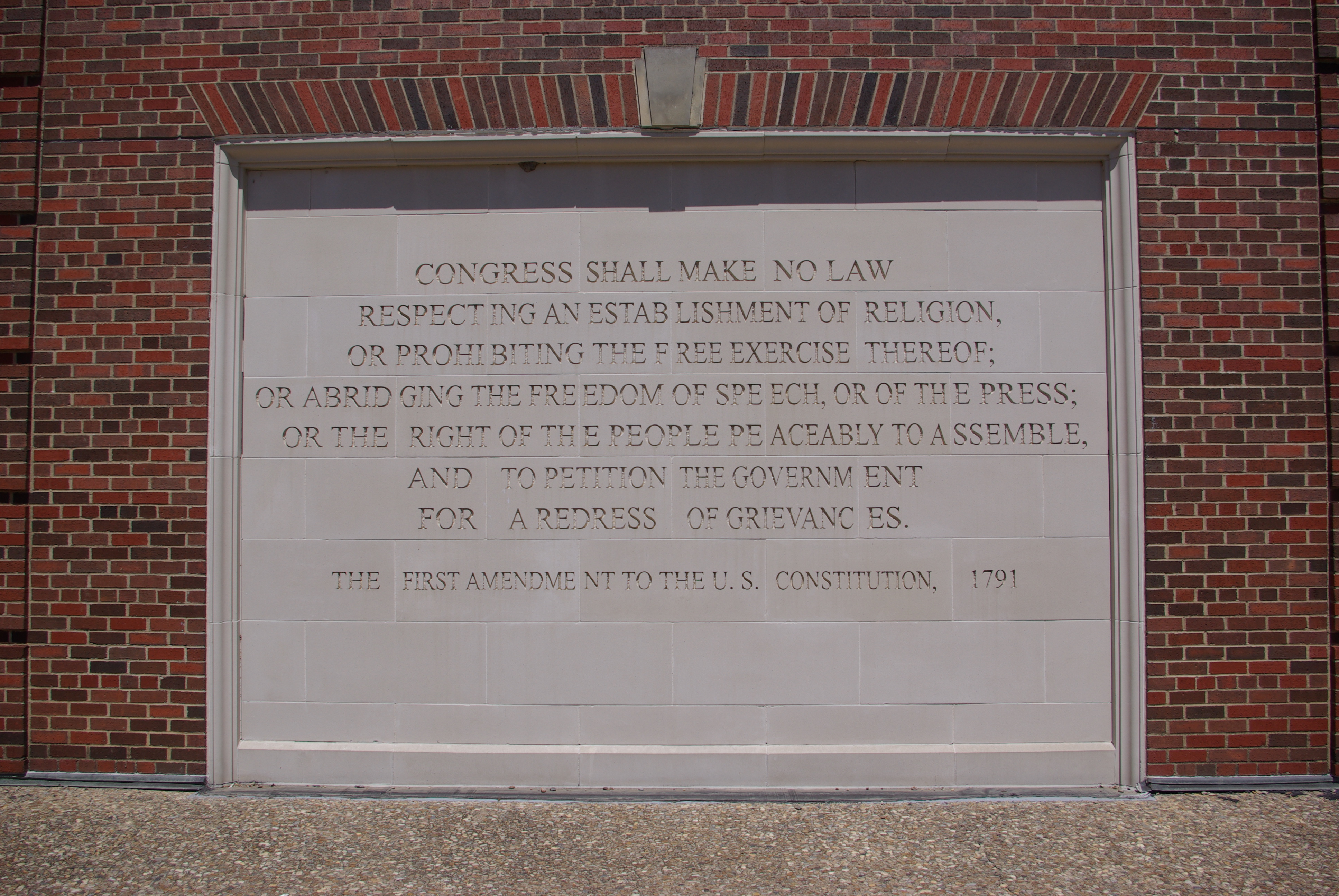
In a discussion about teaching evolution in biology classes a few years ago, I had carefully explained how and why the First Amendment does not require creationism to be taught in biology classes, and in fact is the reason that creationism isn’t taught, in the Establishment Clause. My explanation irritated the tarnation out of a creationist woman who exclaimed, “Well, it’s not like the First Amendment is engraved in stone!”

Heh. Guess what I found at Southern Methodist University Saturday. There, outside the main door of the Umphrey Lee Center, which houses the Department of Economics and the Division of Journalism of the Meadows School for the Arts:

The First Amendment, at SMU


3rd-5th Science and math teachers: Summer academy

April 15, 2008

Nosing around the blogs of the Dallas Morning News can turn up some interesting stuff.

Do you know a good elementary school math or science teacher in Dallas ISD? They ought to apply for this program, as noted by DMN reporter Kent Fischer:

ExxonMobile Logo.gifExxonMobil sponsors a week-long summer training program for math and science teachers. The deadline to apply is many months away, but you can find out the info by clicking the jump.

The program has a good hook: They encourage students to “nominate” their teachers, to encourage good teachers to apply.

The Mickelson ExxonMobil Teachers Academy recently launched www.sendmyteacher.com that allows students to nominate their teacher to be one of the 100 teachers who will be selected to attend next year’s Academy in Jersey City, NJ. Students can send their teachers an electronic note or print out a certificate to encourage them to apply for the program. Teachers are also able to self nominate for consideration.

Students?  Know a good math or science teacher?  For readers outside of Dallas, of course, any 3rd- to 5th-grade teacher in any school is eligible.

The Academy was started by pro golfer Phil Mickelson and his wife, Amy. They worked with ExxonMobil to create a special learning environment for teachers.

They are joined by math and science experts from the National Science Teachers Association and Math Solutions who teach the teachers at the Academy. They come up with fun ways to learn math and science while playing with balloons, rocket cars and marbles. Anything is possible in math and science!

Applications are due in October 2008 for the 2009 program.


Obama: Science in science classrooms, please

April 14, 2008

We haven’t persuaded the candidates to discuss science policy, though it directly affects health care policy, the war in Iraq, climate change, and housing.  That scrappy little newspaper in York, Pennsylvania got Barack Obama to go on the record against teaching intelligent design, though.

Obama gave about five minutes to a reporter from the York Daily Record, the paper that led the nation in reporting on the Kitzmiller case.  They scooped again:

Q: York County was recently in the news for a lawsuit involving the teaching of intelligent design. What’s your attitude regarding the teaching of evolution in public schools?

A: “I’m a Christian, and I believe in parents being able to provide children with religious instruction without interference from the state.

But I also believe our schools are there to teach worldly knowledge and science. I believe in evolution, and I believe there’s a difference between science and faith. That doesn’t make faith any less important than science.

It just means they’re two different things. And I think it’s a mistake to try to cloud the teaching of science with theories that frankly don’t hold up to scientific inquiry.”

Has either Clinton or McCain gone on the record on the issue yet?

Tip of the old scrub brush to the blogs of the Dallas Morning News.


Desert Rock power plant controversy heats up

April 14, 2008

A dozen scholars from a half dozen universities presented papers at SMU Saturday, at a symposium titled “Indians and Energy: Exploitation and Opportunity in the American Southwest.” Papers detailed the history, economics, cultural and social effects of the development of energy resources on Indian lands, concentrating on development of the massive Navajo Reservation that straddles four western states.

The seminar was cosponsored by the William P. Clements Center for Southwest Studies at SMU, and the distinguished School for Advanced Research of the Human Experience, at Santa Fe.

Energy development does not paint a pretty picture. Since 1800, development of Indian resources generally means value is extracted from Indian lands, but the Indians themselves make no profit, and often bear the burdens of development, especially in health damage, pollution, and hammering of social structures.

One presenter, Colleen O’Neill of Utah State, had a photograph that hit me hard. It showed two Navajos aboard an ore car from a uranium mine on the Reservation, in 1952. Neither man had any breathing protection of any kind. I worked for a decade to get compensation for victims of atomic fallout and mine radiation, on the U.S. Senate staff. And I know that the death rate from lung cancer for the uranium miners was nearly 95% when I worked the issue, 30 years ago. Those smiling men had been given a death sentence, and no one told them.

Especially after the final presentation, specifically aimed at a new proposal for another massive coal-fired electrical generating plant in an area that hosts two already, concern about the effects of energy development was clear from the symposium participants and audience.

Stakes got a lot higher Sunday morning. The Arizona Republic published a story on Desert Rock about as glowing as the proponents could hope for, pitting high unemployment rates and a lack of electricity on the Navajo Reservation against environmentalists who oppose the plant.

This post is a marker. I hope I’ll get time to write more about the seminar and the extensive findings (the School for Advanced Research will publish the papers, but that will be several months in the future). But until then, let me urge you to read the newspaper’s story, “For Navajos, Coal means survival.”

When you read the story, remember this: The employment numbers cited in the story are considerably more optimistic than any touted before; past construction on the Reservation has been difficult for Navajos to break into the work force, and imported workers generally do much of the work; it’s taken more than 50 years for Navajos to get the number of jobs they now hold at the Four Corners Plant, a fight that continues; and the sad story of the woman who died during a cold snap will tug at your heart and conscience, but you need to remember that there is no way her cold hogan will get electricity from Desert Rock; her children will still be cold if the plant is built.

More, later, I hope.

Sherry Smith and Brian Frehner did a whale of a job organizing the thing, by the way. You shoulda been there.

Resources:


Typewriter of the moment: Heart Mountain Japanese internment camp

April 14, 2008

A remarkable device, in sad, remarkable circumstances.

The photos below show a typewriter that produces Japanese characters, an invention of no small achievement.

The photos also show American citizens, arrested for being Japanese, in the Heart Mountain internment camp in Wyoming, during World War II. They’re getting the machine in operation to produce a camp newspaper.

Newspaper volunteers reassemble a Japanese typewriter, for the Heart Mountain Sentinel

The official caption:

Members of the staff and volunteer helpers reassemble a privately owned Japanese typewriter to be used for the Japanese language edition of the Heart Mountain Sentinel, Center newspaper. The paper is wrapped around the rubber cylinder, the typist pushes the roller riding platen over the bed of type. After picking the next character, a lever is operated which picks up the type, presses it against the paper and replaces it in its niche. Complicated in appearance and operation, due to the shorthand characteristics of Japanese writing, the advance of thought is nearly equal in speed to a standard English typewriter. — Photographer: Parker, Tom — Heart Mountain, Wyoming. 1/13/43

Heart Mountain Relocation Center, workers assemble Japanese character typewriter for the newspaper, 1943

Official caption:

This complicated looking gadget is a standard Japanese typewriter, the private property of a resident of Japanese ancestry at the Heart Mountain Relocation Center. The machine, loaned to the center newspaper for its Japanese section which is printed for for the purpose of informing those residents unable to read English, is here being assembled by Sentinel staff members. The paper is wound on the round drum, which operates on rollers over the type bed, spotted over the required character, an arm picks the metal slug from the bed, presses it against the paper and returns it to its niche. Due to the shorthand character of Japanese printing, the typewriter is nearly equal in speed in conveying thoughts as a standard English typewriter. — Photographer: Parker, Tom — Heart Mountain, Wyoming. 1/13/43

These photos are available from several sites. The best quality is probably from UC Berkeley’s Bancroft Library’s contribution to the California Digital Library. Office Museum.com also carries the photos, with attribution to the Department of Interior, War Relocation Authority, National Archives, Still Picture Branch, NWDNS-210-G-E691 and E728.

From the Office Museum:

The first typewriter with Chinese characters was produced about 1911-14. Nippon Typewriter Co. began producing typewriters with Chinese and Japanese characters in 1917. “The Nippon has a flat bed of 3,000 Japanese characters. This is considered a shorthand version since the Japanese language contains in excess of 30,000 characters.” (Thomas A. Russo, Office Collectibles: 100 Years of Business Technology, Schiffer, 2000, p. 161.) A successor company, Nippon Remington Rand Kaisha, was producing similar machines in the 1970s.

To use the typewriter, paper is wrapped around the cylindrical rubber platen, which moves on rollers over the bed of type. The operator uses a level to control an arm that picks up a piece of metal type from the bed, presses it against the paper, and returns it to its niche. While the machine is complicated, because of the shorthand character of Japanese writing, the Japanese language typewriter is nearly equal to an English language typewriter in speed for recording thoughts.

Other posts on typewriters, here. Other posts on Japanese internment, here.


Jeffrey Sachs: Pricing can’t cure all environmental ills

April 14, 2008

Natural resources people — foresters, river masters, biologists, botanists, agronomists, farmers, rock climbers and miners — understand almost instinctively that wise management of natural resources takes a blend of wisdom in commercial sectors and by government. Still, every once in a while some newly-minted Ph.D. in economics, or some economist who recently learned that governments own 86% of the land in Nevada, put forth a “bold proposal” to let the markets resolve environmental issues. Let pricing do it, they say.

Jeffrey Sachs, director of the Earth Institute at Columbia University, gives a short interview to the Wall Street Journal’s economics bloggers, in which he details why pricing cannot do the entire job, with examples:

Sachs: Pricing plays a role. Certainly with carbon emissions we need a price. But it’s almost never enough when we’re talking about really big technological changes. When you think of the computer industry and its roots in defense, when you think of the Internet with its root in defense and the National Science Foundation, when you think about drug development and the crucial role of the National Institutes of Health – one major industry after another has always relied, and needed to rely, on a mix of public and private actions.

When we’re talking about something as basic as a sustainable technology this is going to be inevitable. Think about how we’re going to climb out of the mess on nuclear power for example. We need a nuclear power industry in this country but it’s tied up in knots. Pricing by itself isn’t going to do it. There has to be public acceptability, there has to be sense of security that a regulatory framework, safe storage and nonproliferation protection is in place. These are just too complicated to be solved by a price.

For many other things, such as watershed management, there isn’t even a price that turns them into a market. The issues of watershed management involve different rights of upstream and downstream users, and different types of users. [like agriculture, households and industry.] The right price is going to be different. Pricing plays a role, but so does basic science, eminent domain, right of passage and liability.

Sachs is widely experienced in international economics, and in alternative economics. As an advocate of free markets generally, he’s pretty deep into development ideas. You won’t always agree with his opinions, but you’d do well to pay attention to what he says and the data upon which he bases his opinions.

Teachers, this is a short answer that covers a wealth of issues in your economics courses.