Bedbugs, DDT

April 13, 2008

Bedbugs came back.

Common bedbug, Cimex lectularius, University of Minnesota image

Common bedbug, Cimex lectularius, University of Minnesota image

Once a scourge, bedbugs seemed to have gone away, largely, during most of the past 30 years, in most of the western world. International travel and other conducive conditions joined in the perfect storm, however, and bedbug infestation reports are rising in places like New York City.

A significant number of news stories on the topic mention DDT, which was briefly the pesticide of choice against bedbugs. Probably a majority of the blog posts on the topic call for a return of DDT for general use.

This blog is a refreshing exception: New York vs. Bed Bugs, “No DDT, thanks, we’re good.”

Update: In comments, Bug Girl suggests we look at the blog of Bedbugger, and especially this interview with an entomologist.  Take a look — the expert, Dr. James W. Austin of Texas A&M, says bedbugs are about 100% resistant to DDT.


The last Morton Meyerson Marathon

April 12, 2008

It is done.

James Darrell and the trombones of the Duncanville Wind Ensemble leave the stage at the Morton H. Meyerson Symphony Hall

The curly-headed guy with the trombone at the center — that’s James.

For the last eight years we have attended what we affectionately call the Meyerson Marathon, an evening of concert performances by Duncanville’s bands, capped with an always-stellar performance by the Wind Ensemble. Duncanville borrows the Morton H. Meyerson Symphony Center for an evening. The bands always sound great, but sometimes the great hall adds a little to their performances. In Duncanville, even the junior high bands are very, very good.

Kenny played euphonium (playing trumpet with his braces was too painful; he’s gone back to trumpet for college jazz performances). James played trombone — and April 1 was James’ last performance at the Meyerson.

One more sign of time’s incessant march. Of course, On April 1, time’s march was accompanied with some fine band music.

Next week the Wind Ensemble decamps for Washington, D.C., for a Friday performance at the Festival of Music.


Geologist finds meteor crater – on Google Earth

April 11, 2008

Geologist Arthur Hickman used Google Earth to look at part of Australia he was studying. In the satellite photos provided by Google Earth, Hickman noticed something no one else had seen: An impact crater.

Hickman Crater, Australia

For his alertness, Hickman had the 270-meter crater named after him.


Renaissance shadow over contemporary art: Penultimate suppers

April 11, 2008

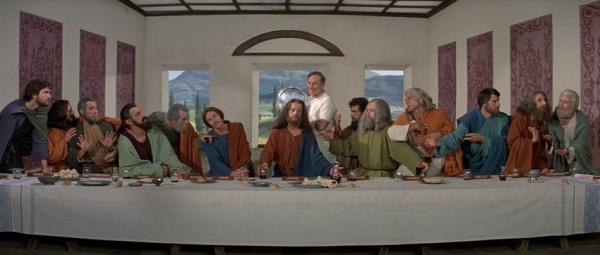
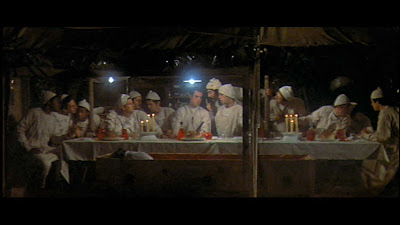
Jeremy Barker at Popped Culture assembled more than 30 versions of contemporary recastings of DaVinci’s painting of “The Last Supper.” There’s the Simpsons version, the cartoon version with Disney and Warner Bros. characters. There’s the Sopranos version, and the Battlestar Galactica version.

For example, the Robert Altman version, from M*A*S*H:

If you need a 20 minute lesson on the influence of Renaissance art on contemporary art, this is one many high school kids may find interesting, if not amazingly historically informative. I suspect there is a great lesson plan hiding in there about 20th century history as reflected in parody art.

It’s a brilliant and subtle demonstration of the power of DaVinci’s art that there are so many copy cat pictures, don’t you think?

I did notice, however, that Barker left out the Mel Brooks version, from “History of the World, Part I.” It may not fit the meme.

Mel Brooks'

Resources:


Science funding: Kicking our future away

April 9, 2008

Drat.

We get Charlie Rose’s program late here — generally after midnight. I’m up to my ears with charitable organization duties (“Just Say No!”), work where I came in midstream, family health issues, and other typical aggravations of trying live a well-examined life.

I caught most of an hour discussion on science in America, featuring Sir Paul Nurse, president of Rockefeller University and Nobel laureate, Bruce Alberts, editor of Science, Shirley Ann Jackson, president of  Rensselaer Polytechnic Institute, Harold Varmus, Nobel winner and president of Memorial Sloan-Kettering Cancer Center, and Lisa Randall, the Harvard nuclear physicist (string theory).

It was a great policy discussion. It had great humor, and great wisdom. And at the end, Rose thanked Nurse and others for helping him put on a 13-part seminar on science policy.

Thirteen parts? And I caught just the last few minutes of #13?

There is the Charlie Rose archives! Here’s the show I caught, “The Imperative of Science.” Great discussion. Scary — Lisa Randall notes that the action in physics has moved to CERN, in Europe, and the search for the Higgs Boson. Varmus and Nurse talk about restrictions in funding that bite at our ability to keep the world lead in education and science. Educators, especially in science, should watch.

Are we kicking away our ability to lead in technology, health care, and other vital economic areas? One cannot help but wonder in listening to these people discuss the difficulty of getting support for critical research during the Bush administration. They each stressed the hope that the next president will be one literate in science.

Pfizer underwrote the series. The entire series is available for viewing at a site Pfizer set up(Signs of change:  Notice that physics is represented by two women; there are signs of hope in American science.)

Go see, from Pfizer’s website on the series:

The Charlie Rose Science Series

  • Episode 1: The Brain — Exploring the human brain from psychoanalysis to cutting edge research.
  • Episode 2: The Human Genome — Exploring the contributions that have been made to science through the discovering and mapping of human DNA.
  • Episode 3: Longevity — An in-depth discussion of longevity and aging from the latest research on calorie restriction, anti-aging drugs, genetic manipulation to the social and economic implications of an increase in human life span. (Longevity News Release)
  • Episode 4: Cancer — A discussion of the latest advances in cancer, from the genetics to cancer prevention, early detection, diagnosis, treatment and management of care. (Cancer News Release)
  • Episode 5: Stem Cells — A roundtable discussion on the latest advances in embryonic and adult stem cell research, their implications, and potential to change the way medicine is practiced.
  • Episode 6: Obesity — An informative dialogue on the growing obesity epidemic, its impact on overall health and the latest research to help understand, treat and prevent obesity. (Obesity News Release)
  • Episode 7: HIV/AIDS — A panel of leading experts addresses current treatment and prevention strategies, and new medical breakthroughs being used in the fight against HIV/AIDS. (HIV/AIDS News Release)
  • Episode 8: Pandemics — An exploration of factors that could create a global pandemic and how the science and public health leaders are addressing the crisis. (Pandemics News Release)
  • Episode 9: Heart Disease — A panel of experts explores the biology and genetics of cardiovascular disease, prevention and treatment, the development of medical, surgical and interventional therapies and steps individuals can take toward a heart-healthy lifestyle. (Heart Disease News Release)
  • Episode 10: Global Health — A roundtable discussion on initiatives aimed at fighting infectious diseases, protecting women and children, and strengthening global public health systems. (Global Health News Release)
  • Episode 11: Human Sexuality — A panel of experts explores major trends in human sexual behavior, sexual desire and satisfaction, and sexual dysfunction issues. (Human Sexuality News Release)

I wish all news programs covered science so well, and made their material so readily available.


Not 1207468165327

April 8, 2008

The hottest post on WordPress is a non-post at Fallout 3 a Post-Nuclear Blog.  Go figure.

It’s only a number:  1207468165327. 

If you click to the post, you get a note apologizing, but telling you you’re looking for something that isn’t there.

Is P. Z. Myers right, that popularity on a blog generates more popularity?  Or is that number significant to someone, somewhere — to many someones?

A magic code to generate traffic, perhaps?  Ah, the Mysteries of the Intertubes, as Sen. Ted Stevens would say.


Why Rats, Lice and History is a great book

April 7, 2008

Gerald Weissman wrote a solid review of Hans Zinsser’s Rats, Lice and History in the journal Emerging Infectious Diseases. The review appeared two years ago, but I just found it.

It’s hard nowadays to reread the work of de Kruif or Sinclair Lewis without a chuckle or two over their quaint locution, but Zinsser’s raffiné account of lice and men remains a delight. Written in 1935 as a latter-day variation on Laurence Sterne’s The Life and Opinions of Tristam Shandy, Zinsser’s book gives a picaresque account of how the history of the world has been shaped by epidemics of louseborne typhus. He sounded a tocsin against microbes in the days before antibiotics, and his challenge remains meaningful today: “Infectious disease is one of the few genuine adventures left in the world. The dragons are all dead and the lance grows rusty in the chimney corner. . . . About the only sporting proposition that remains unimpaired by the relentless domestication of a once free-living human species is the war against those ferocious little fellow creatures, which lurk in dark corners and stalk us in the bodies of rats, mice and all kinds of domestic animals; which fly and crawl with the insects, and waylay us in our food and drink and even in our love”

If you’ve not read Zinsser’s book, this review will give you lots of reasons why you should.  They don’t write history like this for high schools, though they should:

Despite the unwieldy subtitle “Being a study in biography, which, after twelve preliminary chapters indispensable for the preparation of the lay reader, deals with the life history of TYPHUS FEVER,” Rats, Lice and History became an international critical and commercial success. Zinsser’s romp through the ancient and modern worlds describes how epidemics devastated the Byzantines under Justinian, put Charles V atop the Holy Roman Empire, stopped the Turks at the Carpathians, and turned Napoleon’s Grand Armée back from Moscow. He explains how the louse, the ubiquitous vector of typhus, was for most of human history an inevitable part of existence, “like baptism, or smallpox”; its habitat extended from hovel to throne. And after that Murder in the Cathedral, the vectors deserted Thomas à Becket: “The archbishop was murdered in Canterbury Cathedral on the evening of the twenty-ninth of December [1170]. The body lay in the Cathedral all night, and was prepared for burial on the following day…. He had on a large brown mantle; under it, a white surplice; below that, a lamb’s-wool coat; then another woolen coat; and a third woolen coat below this; under this, there was the black, cowled robe of the Benedictine Order; under this, a shirt; and next to the body a curious hair-cloth, covered with linen. As the body grew cold, the vermin that were living in this multiple covering started to crawl out, and, as … the chronicler quoted, ‘The vermin boiled over like water in a simmering cauldron, and the onlookers burst into alternate weeping and laughter …'”

Add to FacebookAdd to NewsvineAdd to DiggAdd to Del.icio.usAdd to StumbleuponAdd to RedditAdd to BlinklistAdd to TwitterAdd to TechnoratiAdd to Furl


Scientists look at origin of life and RNA world issues, the Cambrian, evolution of legs, and human evolution

April 6, 2008

Some scientists are not slowed much by the creationist assault on evolution and other science education.

While we’ve been talking here, people like Andrew Ellington are advancing the science with regard to what we know about origin of life and “RNA world” issues. See “Misperceptions meet state of the art in evolution research,” from Ars Technica. For speed’s sake, and accuracy, I’ll quote extensively from John Timmer’s article at Ars Technica.

Four scientists laid out the state of the art in their respective fields in a session sponsored by the American Association for the Advancement of Science’s Dialog on Science, Ethics, and Religion, in late February 2008, at AAAS’s annual meeting. [Where? I don’t know.] Andrew Ellington spoke about origin of life research, Douglas Erwin explained new findings on fossils from the Cambrian, Ted Daeschler detailed the state of knowledge about how fish turned into tetrapods on land, and John Relethford addressed human evolution.

The discussion of life’s origins was handled by Andy Ellington of the University of Texas – Austin. He started by noting that simply defining life is as much of a philosophical question as a biological one. He settled on the following: “a self replicating system capable of Darwinian evolution,” and focused on getting from naturally forming chemicals to that point.

Ellington noted that chemicals necessary for life can and do form without living things. He said research shows that the first replicating chemicals led to the first reproducing life forms. And finally, he said that RNA activities reveal a lot about how the “RNA World” — before DNA — could function and carry on without DNA, which is in all known life forms today.

RNA ligase ribozyme, from Ars Technica

An RNA ligase ribozyme

[More, below the fold]

Read the rest of this entry »


Top 25 guitar riffs of all time? This school needs a history class

April 6, 2008

Guitar-X students — from London Tech Music School — picked what they consider to be the top 25 guitar riffs of all time.

You can listen to the top 25 in The Sun’s video below linked to below [I can’t get the video to embed correctly, alas]. The entire list is below that.

The Beeb’s report:

Here’s the full 25 on the list, courtesy of Reuters’ wire:

1. Smoke On The Water – Deep Purple (1973)
2. Smells Like Teen Spirit – Nirvana (1991)
3. Walk This Way – Aerosmith (1975)
4. Purple Haze – Jimi Hendrix (1967)
5. Sweet Child O Mine – Guns N Roses (1987)
6. Paradise City – Guns N Roses (1987)
7. Ace Of Spades – Motorhead (1980)
8. Enter Sandman – Metallica (1991)
9. Under The Bridge – Red Hot Chilli Peppers (1992)
10. Welcome To The Jungle – Guns N Roses (1987)
11. Run To The Hills – Iron Maiden (1982)
12. Walk – Pantera (1992)
13. Johnny Be Goode – Chuck Berry (1958)
14. Back In Black – AC/DC (1980)
15. Immigrant Song – Led Zeppelin (1970)
16. Wake Up – Rage Against The Machine (1992)
17. Highway to Hell – AC/DC (1979)
18. My Generation – The Who (1965)
19. 7 Nation Army – The White Stripes (2003)
20. Born To Be Wild – Steppenwolf (1968)
21. Give It Away – Red Hot Chilli Peppers (1991)
22. Paranoid – Black Sabbath (1970)
23. Voodoo Chile (Slight Return) – Jimi Hendrix (1967)
24. Eye Of The Tiger – Survivor (1982)
25. Money For Nothing – Dire Straits (1984)
(Editing by Paul Casciato)

A spokesman for the school seemed quite proud that a lot of the top 25 are 20 years old; no one who ever listened to rock and roll between 1957 and 2008 will think this list to be perfect, though. There is too much good guitar riffing absent. The Idolator, obviously more current than I, complains:

As you’d expect from a list based on the opinions of young guitar students, you’ve got some Hendrix, some Angus, three from Slash in the Top 10. But two Frusciantes? A Dimebag? A Knopfler?

. . . Duuuuuuude, no “Stone Cold Crazy?” And if you’re going to bother with Jack White, you have to go with “Icky Thump.” Maybe it’s just my patriotism talking, I think an American school would have made a much fiercer list. One with some Kerry King! Some John Petrucci! Some John Mayer!

John Mayer? Things that pass for value these days! (No Steely Dan licks made the list.)

How about the Beatles? No “Ticket to Ride?” How about the Stones, for the love of blues roots: No “Satisfaction?” This can’t be the list ’cause it doesn’t list the same guitar riffs as me!

No Santana? Nothing from Clapton, not even Cream? “Sunshine of Your Love” doesn’t rate over something on that list? “Layla” isn’t mentioned!? What sort of time warp list warping is that! Where is one of the three dozen great riffs from Motown? Duane Allman? How about the Beach Boys and “Surfin’ USA?”

The list seems limited by genre, too. Surely Wes Montgomery or George Benson, or both of them, should be in there. Somebody’s version of “Malagena” ought to be in there.

Comments are wide open, Dear Readers: What guitar riff ought to be in the top 25, that is not included on that list?

Resources:


Rape in the Congo: When is “never again?”

April 5, 2008

An epidemic of brutal, and constant, rapes in Congo made me wonder when the world will stand up against such mass, directed violence.

A new movie asks the same question: The Greatest Silence – Rape in the Congo.  The movie premieres on HBO on Tuesday, April 8, 2008.

Poster for movie, The Greatest Silence

War in the Congo is not about liberty, it’s not really about the politics of a nation, at least, not a nation as any book defines it. At this point, the conflict is over who controls deposits of ores, some fo them rare, from which today’s modern technological devices are manufactured. The world needs to worry about blood diamonds, but also blood cell phones, blood iPods and blood computers.

Seriously, when does “never again” begin?


Typewriter of the moment: Linowriter

April 4, 2008

Linowriter, in the collection of International Printing Museum, Carson, CA

This curious machine is in the collection of the International Museum of Printing in Carson, California. I’ve never been to the museum myself.

The museum’s website describes the machine:

Linowriter, Circa 1920

This typewriter with a linotype keyboard arrangement was sold by the Empire Typefoundry, Buffalo. Very few of these machines were made and today their exact purpose is obscure. Possibly this kind of typewriter was intended for the small newspaper office where the editorial staff also operated the linotype.
(9.5 inches high)

The Linotype machine was the device that mechanically set the type to print the newspaper, generally a very large, noisy machine that mechanically assembled lead slugs of letters, and then cast a lead plate that could be used to print the page.

I wonder:  Do you know of any linotype machines still in use?


Monument to brevity: William Henry Harrison

April 4, 2008

William Henry Harrison died on April 4, 1841, 31 days after his inauguration as president of the United States.

Perhaps during the cold and rainy inauguration, perhaps from a well-wisher, Harrison caught a cold. The cold developed into pneumonia. The pneumonia killed him.

William Henry Harrison, White House portrait Harrison, a Whig, was the first president to die in office. His vice president, John Tyler, was a converted Democrat who abandoned the Whig platform as president.

Harrison won fame pushing Indians off of lands coveted by white settlers in the Northwest Territories. Harrison defeated Tecumseh’s Shawnee tribe without Tecumseh at the Battle of Tippecanoe, then beat Tecumseh in a battle with the English in which Tecumseh died in the War of 1812.

Schoolchildren of my era learned Harrison’s election slogan: “Tippecanoe, and Tyler, too!”

Congress voted Harrison’s widow a payment of $25,000 since he had died nearly penniless. This may be the first example of a president or his survivors getting a payment from the government after leaving office.

In the annals of brief presidencies, there is likely to be none shorter than Harrison’s for a long time. As you toast him today, you can honestly say he did not overstay his White House tenure. Others could have learned from his example.


Pomposity squared: Ben Stein and R. C. Sproul

April 4, 2008

Via Heart of Flesh, a half-hour conversation between Ben Stein and the often-pompous R. C. Sproul of Ligonier Ministries. Sproul had Stein in the studio to promote the mockumentary film Stein stars in, “Expelled!”

Stein continues to reveal the religious nature of intelligent design advocacy, all the time complaining science doesn’t pay enough attention.

At what point does irony veer into hypocrisy? I think that point’s long past for these guys.

Vodpod videos no longer available. from heartofflesh.wordpress.com posted with vodpod

Ω Ω Ω Ω Ω

Anyone vaguely familiar with the science of astronomy, or cosmology, or physics, or biology, may want to get a bullet to chew on before clicking “play.” It’s that bad.

But what is this? Sproul disowns the movie? It may be that the movie, devoid of science as it is, is still too sciency for Sproul. Here’s how Sproul’s writers put it in his blog:

As our readers may already know, Dr. Sproul frequently challenges the unbiblical and irrational theories of Darwinian evolution in print and through lectures. While we were waiting for Mr. Stein to arrive for the interview, Dr. Sproul mentioned to the crew that he took some time in between book projects back in the early 90s. He was doing some recreational reading and ended up writing another book, Not A Chance: The Myth of Chance in Modern Science and Cosmology.

It is important to note that during this free exchange of ideas, not all of the opinions expressed by Mr. Stein in the interview are the views of Ligonier Ministries. Christians should recognize that the argument from design does not necessarily prove the Genesis view of creation. We are not part of the Intelligent Design movement, but certainly share similar concerns for freedom of speech and inquiries into cosmology. Our foremost concern is to uphold the inerrancy and inspiration of the Bible and the authority of our Creator.

Don’t you love it? Super Sproul figures out the laws of chance in physics and chemistry in his spare time, probably in his game room between foosball challenges from the grandkids.

Sproul’s blog also reveals there is another part to this interview.

R. C. Sproul should do a public service some day. He ought to interview P. Z. Myers for an hour, and then interview Ken Miller for an hour (he can disclaim science later in his blog, if he chooses). Better yet, Sproul should have Myers and Miller each spend a week at Ligonier Ministries teaching theologians about biology.

I wager Sproul doesn’t have the fortitude to do something like that. Rants can’t stand the facts. Sproul’s genius is making his rants in a quieter voice, so they don’t sound as irrational as they are.

At about 14:40 into the interview, Stein says “There are very few places where more nonsense is spoken than universities.” First, one wonders why Stein and the movie’s producers want so badly to be seen as part of that university community?

Second, this interview demonstrates Stein’s error — there are lots of places more nonsense is spoken, including anywhere Sproul’s interview with Stein is aired.

In the universities, at least they strive for accuracy and honesty.

ID expelled? No.  Flunked.  Yes.
Buy the bumper sticker!

Creationism puts faith at risk?

April 4, 2008

Interesting view:  A homeschooler argues that homeschooling parents can do a disservice to the faith of their children by misteaching creationism instead of evolution.  At The Upside Down World.

Those who are teaching their children using creationist curriculum are in particular danger of setting their children up for this fall. To see why, I’d like to offer a challenge. Take your child’s creationist materials and look at whatever footnotes and references are provided. Now take an evening and look up the names of the authors cited. Odds are excellent that virtually all of the authors are creationist scientists. Now, take the names of any mainstream scientists who are quoted or whose work is referenced and attempt to track down their work. Specifically, see if you can find the particular quotes used in your child’s materials. Google books can be a great way of doing this. Now, read through whatever you can find with an eye towards evaluating the accuracy of the quotes provided (ie are words changed, relevant sections replaced by “. . .”). Also try and honestly evaluate if the author of your child’s materials has accurately conveyed the substance of what the author is saying.

If you drink, you may want to keep some strong drink nearby to sustain yourself during this process, because I promise you, you will not be happy with what you find. Unfortunately, the only way creationist materials are able to create the appearance of validity is by only referring to the work of “creation scientists” (who don’t do research, BTW. Their work is limited to analyzing the work of others to look for potential holes which might be able to be seen as supporting a creationist perspective. This is not science.). When creationist materials do refer to the work of mainstream scientists, conducting actual research, they almost uniformly misquote and misrepresent them. If you do not believe me, then take a weekend or two and do the research yourself. The internet is a wonderful tool.

In a later report, it comes out that the biggest problem a Christian mother has raising science-literate kids is opposition from creationists who claim that knowledge is somehow evil.  They just can’t keep their agendas hidden — and there is some ripe stuff in the comments.


Best April Fool’s

April 1, 2008

Steaming into the final days of law school. Papers due. Finals coming. The job demanded extra hours, too.

I had been up well before dawn for some fool reason — job interview? We were closing down the President’s Commission on Americans Outdoors, and I didn’t have a job lined up. Full day at the office, the race through D.C. traffic at rush hour to get to class, three hours of lecture (probably punctuated with that dark, French roast coffee from Au Bon Pain), the train ride and late night walk home, writing the paper and fighting the printer of the crude computer we rented just for the month. It had been more than 20 hours since I’d seen bed.

It was all I could do to stay awake to get up the stairs and into bed. “1:30 a.m.” the clock radio glowed. Three and a half hours to sleep, maybe. I remembered it was April 1, and I smiled as I wondered what odd stories might pop up on the news wires in the morning.

“Get up. We have to go to the hospital!” Kathryn said. I looked at the clock again. 1:31 a.m.

I was concerned, but I was sleepy, too. I asked why.

“My water broke. We have to go.” I felt her side of the bed, and it was wet. I thought it was pretty sneaky of her to go so far as to keep a pan of water close by to make the joke. Just as I got to bed, she had to get up. Riiight!

I kept waiting for the “April Fool!” She’d planned this one well, but I didn’t think it was very funny. I wanted rest.

I turned over to go back to sleep.

“Do I have to drive myself?” Kathryn yelled from the bathroom. We were in Cheverly, Maryland, and the George Washington University Hospital was across town. I jolted awake, and smiled that there would be no significant traffic on the trip. It wasn’t a joke. I hoped I could stay awake for the drive.

kenny_s_new_guitar.jpg

Just about 13 hours of terrifying (for a first-time dad, not to mention a first-time mom) labor later, Kenny was born. Give him credit: He was born so that we got him cleaned up, got Kathryn comfortable, and unshaven and unshowered I could make it to my next class across the street from the hospital (to turn in work and say why I was missing the class).

21 years ago today, I well remember what I was doing. Happy birthday, Kenny!

Notice, Dear Reader, the great attention and homage to history demonstrated in the snapshot above (from last year, really): The Rock and Roll Hall of Fame t-shirt, the denims, the Gibson Les Paul, the “Abbey Road” cover poster on the wall, the topographic map of a favorite hike (near Woodstock, New York, with the Camp Rising Sun crew), the guitar strap his father used in the late 1960s, and the vintage light fixture with just one bulb burning.

Best April Fool’s ever.