December 17, history written in the wind and engraved in stone

December 17, 2016

Ten feet in altitude, 120 feet traveled, 12 seconds long. That was the first flight in a heavier-than-air machine achieved by Orville and Wilbur Wright of Dayton, Ohio, at Kittyhawk, North Carolina, on December 17, 1903.

Few witnesses observed the flight.  Though the brothers Wright fully understood the potential of the machine they had created, even they waited before revealing to their supporters, and then the world, what they had accomplished.

Critics complain others achieved flight in a heavier-than-air machine before the Wrights. There are stories of flights in Texas, Connecticut, and France. If anyone achieved flight before the Wrights, the Wrights did a much better job of recording their achievement, and promoting it afterward. In the end, the Wrights left a legacy of flight research conducted in classic science, with careful records, a lot of experiments and observations, and publication of results.

We honor the Wrights.

From the Library of Congress:

On the morning of December 17, 1903, Wilbur and Orville Wright took turns piloting and monitoring their flying machine in Kill Devil Hills, North Carolina. Orville piloted the first flight that lasted just twelve seconds. On the fourth and final flight of the day, Wilbur traveled 852 feet, remaining airborne for 57 seconds. That morning the brothers became the first people to demonstrate sustained flight of a heavier-than-air machine under the complete control of the pilot.

No lost luggage, no coffee, no tea, no meal in a basket, either.  No ATC (Air Traffic Control) delays.  Neither brother endured a TSA screening.

Resources on the Wright Brothers’ first flight:

(I almost always forget the big dates until the end of the day.  This is mostly an encore post.)

Yes, this is mostly an encore post. Fighting ignorance requires patience.

Again, this is mostly an encore post. Fighting ignorance requires patience.

Save


Millard Fillmore’s letter to Abraham Lincoln, December 16, 1861: The Trent Affair

December 16, 2016

First page of Millard Fillmore's letter to Abraham Lincoln on the Trent Affair, sent December 16, 1861, 155 years ago today. Library of Congress image.

First page of Millard Fillmore’s letter to Abraham Lincoln on the Trent Affair, sent December 16, 1861, 155 years ago today. Library of Congress image.

Sometimes ex-presidents get the bug to offer advice to the person holding the office at the time.

Most of the time they let the urge pass.

But on December 16, 1861, former President Millard Fillmore shot off a letter to Abraham Lincoln, 7 months into the Civil War, warning Lincoln that a breach of relationships with Britain was to be avoided. Britain complained when U.S. warships stopped a British ship and arrested two Confederate diplomats.

It’s known as the Trent Affair, after the name of the British ship that was stopped.

It’s an example of a foreign nation interfering in domestic affairs of the U.S. Do we ever face such circumstances in the 21st century? Do we expect different results today?

Fillmore’s letter, in transcript:

Abraham Lincoln Papers at the Library of Congress. Transcribed and Annotated by the Lincoln Studies Center, Knox College. Galesburg, Illinois.

Millard Fillmore to Abraham Lincoln, Monday, December 16, 1861 (Trent Affair)

From Millard Fillmore to Abraham Lincoln, December 16, 1861

Buffalo, Dec. 16. 1861.

Sir,

I have never, under any circumstances, presumed to offer any advice, as to men or measures, to those who have succeeded me in the administration of the Government; and I beg of you to consider the few crude suggestions which I am now about to make, as mere hints from one who will feel no mortification, personally, if they should be wholly disregarded.

I can in some measure appreciate the difficulties with which the administration of the Government is now embarrassed by this unholy rebellion; for I heard the muttering thunder, and viewed the gathering storm at a distance in 1850; and while I approve most cordially of the firm stand which you have taken in support of the constitution, as it is, against insane abolitionism on one side and rebellious secessionism on the other, and hope and trust that you will remain firm; yet, it was not to speak of this that I took up my pen, but of a new danger which threatens more immediately our Northern frontier, but in its consequences, most fatally, the whole country. You of course must anticipate that I refer to a threatened rupture with England;1 for if we are so unfortunate as to be involved in a war with her at this time, the last hope of restoring the Union will vanish, and we shall be overwhelmed with the double calamities of civil and foreign war at the same time, which will utterly exhaust our resources, and may practically change the form of our government and compel us in the end to submit to a dishonorable peace.

I perceive that the telegram of this morning announces the fact from semi-official sources that, the law officers of Great Britain have given it as their opinion that the arrest of Messrs. Mason & Slidell and forcibly taking them from the Trent, a British merchant or transport vessel, was not justified by the law of nations; and that the British Cabinet were united in sending a despatch to Lord Lyon,2 protesting against the act, and demanding satisfaction by the restoration of the prisoners and a suitable apology for the insult to the British Flag. I still cherish the hope, however, that this statement may be greatly exagerated– But suppose it be true– What then? It may be said that one of two things must happen– Either, this Government must submit to the demand thus made upon it by Great Britain, or take the hazards of a war at a most inconvenient time to settle a point of international law by resort to arms. This alternative should be avoided it it can be with honor, and I venture to suggest that it may be, by urging in a firm but conciliatory argument in reply to the demand of Great Britain, our views of the Belligerent right to arrest these men, but conclude by saying that although we feel assured that we are right, yet if Great Britain after weighing our argument still adheres to the opinion that we are wrong, then as this is a purely legal question, where no insult was intended to the flag of Great Britain, nor any intention to invade her rights, and as the point in dispute is one of international law in which all maritime nations are interested, we propose to submit it to one of the crowned heads of Europe for arbitrament, agreeing to abide its award. It seems to me that Great Britain can not refuse so fair a proposition. But if she does, and insists on an unconditional compliance with her demand or war, all Christendom will then hold her responsible for the consequences.

I trust you will pardon these suggestions, which are made on the spur of the moment, without consultation with, or the knowledge of, any one; and may remain in confidence between us if you prefer that they should.

I am with sincere respect &

great haste, Truly yours

Millard Fillmore

[Note 1 On November 8, 1861 Captain Charles Wilkes of the U. S. S. San Jacinto intercepted the Trent, a British ship, and arrested James Mason and John Slidell who were on their way to Europe as representatives of the Confederacy. This violation of Britain’s neutrality nearly led to a war with the United States.]

[Note 2 Lord Lyons was the British minister to the United States.]

Could students today translate that letter, written in cursive? Maybe, for the sake of knowing history, we need to teach students how to read cursive, if not write it. Is it possible to teach reading without the writing?

Page 2, Millard Fillmore to Abraham Lincoln, on the Trent Affair. Library of Congress image.

Page 2, Millard Fillmore to Abraham Lincoln, on the Trent Affair. Library of Congress image.


Page 3 of Fillmore letter to Lincoln. Library of Congress image.

Page 3 of Fillmore letter to Lincoln. Library of Congress image.


Page 4 of Fillmore's letter to Lincoln. Library of Congress image.

Page 4 of Fillmore’s letter to Lincoln. Library of Congress image.


Page 6, the last page of Millard Fillmore's letter to Abraham Lincoln about the Trent Affair. Library of Congress image.

Page 5, the last page of Millard Fillmore’s letter to Abraham Lincoln about the Trent Affair. Page 6 shows only the author and topic.  Library of Congress image.

Save

Save


Fact sheet for World Malaria Report 2016

December 16, 2016

A woman shows the mosquito net that protects her and her family from malaria transmission, in India. India remains the world's top DDT user, but is switching to nets in an effort to bring malaria rates down and set up malaria eradication before the end of DDT in 2020. WHO image.

A woman shows the mosquito net that protects her and her family from malaria transmission, in India. India remains the world’s top DDT user, but is switching to nets in an effort to bring malaria rates down and set up malaria eradication before the end of DDT in 2020. WHO image.

World Health Organization publishes an annual World Malaria Report, with the year appended to the title. It summarizes the state of the fight against malaria worldwide, recording progress and setbacks.

In the tally of progress we get a clear indication of what is needed to continue or increase that progress, with the ultimate goal of controlling malaria to the point it poses no great economic risk, or health risk, to any nation, or better that human malaria is eradicated.

World Malaria Report 2016 is 184 pages, shorter than some previous reports but packed with figures and history, some of which requires greater background to understand completely.

For example, the 2016 publication notes that about 412,000 people died from malaria in 2016. This is a shocking figure. Most of the news coverage of the report mentions this death toll in the first paragraph.

It’s too many deaths. But it’s a more than 50% reduction in deaths from 1990s rates, and it’s a more than 90% reduction from the annual death tolls that shocked the world to concerted action after World War II. Most estimates are that about 5 million people a year died from malaria through the 1950s, and into the 1960s.

WHO concentrates on the malaria fight, and plays down the political aspects to encourage international cooperation to help fight the disease. But there are political statements made, if one has the background to understand them. There remains controversy over the use of DDT, with many people yelling far and wide that if ‘bans on DDT were removed’ then malaria would quickly become an eradicated disease. This position ignores the facts, that there were still 5 million people dying each year during peak DDT use; that death tolls plunged after the U.S. banned DDT use on crops; that the U.S. ban covered only crop use, and that DDT use against disease has never been banned anywhere in the world; and that DDT use continued long after the U.S. banned DDT, around the world. DDT use never stopped.

Taken together, we would understand that the 90% reduction in malaria deaths from peak DDT use years, was accomplished mostly without DDT, and that therefore DDT is not a panacea.

World Malaria Report 2016 also tallies the slow demise of DDT. Mosquito resistance to pesticides, especially DDT, is a major problem in the fight against the disease. But more DDT can’t fix that problem now that every mosquito on Earth carries alleles that make them resistant and wholly immune to the stuff. DDT will probably never be a panacea, even were its manufacture not scheduled to stop very soon.

History, and a complete assessment of the science and current conditions in the frontlines of the malaria fight, can help us put these things in perspective.

So far, only the Los Angeles Times in the U.S. provided any in-depth reporting on World Malaria Report 2016. We hope other media will take up the challenge to inform. They will find WHO’s Fact Sheet useful.

With that warning in mind, it’s good to look at the broad outlines of the report, which WHO has packaged into a fact sheet for our convenience.

Fact Sheet: World Malaria Report 2016

13 December 2016

The World Malaria Report, published annually by WHO, tracks progress and trends in malaria control and elimination across the globe. It is developed by WHO in collaboration with ministries of health and a broad range of partners. The 2016 report draws on data from 91 countries and areas with ongoing malaria transmission.

Global progress and disease burden (2010–2015)

According to the report, there were 212 million new cases of malaria worldwide in 2015 (range 148–304 million). The WHO African Region accounted for most global cases of malaria (90%), followed by the South-East Asia Region (7%) and the Eastern Mediterranean Region (2%).

In 2015, there were an estimated 429 000 malaria deaths (range 235 000–639 000) worldwide. Most of these deaths occurred in the African Region (92%), followed by the South-East Asia Region (6%) and the Eastern Mediterranean Region (2%).

Between 2010 and 2015, malaria incidence rates (new malaria cases) fell by 21% globally and in the African Region. During this same period, malaria mortality rates fell by an estimated 29% globally and by 31% in the African Region.

Between 2010 and 2015, malaria incidence rates (new malaria cases) fell by 21% globally and in the African Region. During this same period, malaria mortality rates fell by an estimated 29% globally and by 31% in the African Region.

Other regions have achieved impressive reductions in their malaria burden. Since 2010, the malaria mortality rate declined by 58% in the Western Pacific Region, by 46% in the South-East Asia Region, by 37% in the Region of the Americas and by 6% in the Eastern Mediterranean Region. In 2015, the European Region was malaria-free: all 53 countries in the region reported at least 1 year of zero locally-acquired cases of malaria.

Children under 5 are particularly susceptible to malaria illness, infection and death. In 2015, malaria killed an estimated 303 000 under-fives globally, including 292 000 in the African Region. Between 2010 and 2015, the malaria mortality rate among children under 5 fell by an estimated 35%. Nevertheless, malaria remains a major killer of under-fives, claiming the life of 1 child every 2 minutes.

Trends in the scale-up of malaria interventions

Vector control is the main way to prevent and reduce malaria transmission. Two forms of vector control are effective in a wide range of circumstances: insecticide-treated mosquito nets (ITNs) and indoor residual spraying (IRS).

ITNs are the cornerstone of malaria prevention efforts, particularly in sub-Saharan Africa. Over the last 5 years, the use of treated nets in the region has increased significantly: in 2015, an estimated 53% of the population at risk slept under a treated net compared to 30% in 2010.

Indoor residual spraying of insecticides (IRS) is used by national malaria programmes in targeted areas. In 2015, 106 million people globally were protected by IRS, including 49 million people in Africa. The proportion of the population at risk of malaria protected by IRS declined from a peak of 5.7% globally in 2010 to 3.1% in 2015.

Diagnostics

WHO recommends diagnostic testing for all people with suspected malaria before treatment is administered. Rapid diagnostic testing (RDTs), introduced widely over the past decade, has made it easier to swiftly distinguish between malarial and non-malarial fevers, enabling timely and appropriate treatment.

New data presented in the report show that, in 2015, approximately half (51%) of children with a fever who sought care at a public health facility in 22 African countries received a malaria diagnostic test compared to 29% in 2010. Sales of RDTs reported by manufacturers rose from 88 million globally in 2010 to 320 million in 2013, but fell to 270 million in 2015.

Treatment

Artemisinin-based combination therapies (ACTs) are highly effective against P. falciparum, the most prevalent and lethal malaria parasite affecting humans. Globally, the number of ACT treatment courses procured from manufacturers increased from 187 million in 2010 to a peak of 393 million in 2013, but subsequently fell to 311 million in 2015.

Prevention in pregnancy

Malaria infection in pregnancy carries substantial risks for the mother, her fetus and the newborn child. In Africa, the proportion of women who receive intermittent preventive treatment in pregnancy (IPTp) for malaria has been increasing over time, but coverage levels remain below national targets.

IPTp is given to pregnant women at scheduled antenatal care visits after the first trimester. It can prevent maternal death, anaemia and low birth weight, a major cause of infant mortality. Between 2010 and 2015, there was a five-fold increase in the delivery of 3 or more doses of IPTp in 20 of the 36 countries that have adopted WHO’s IPTp policy – from 6% coverage in 2010 to 31% coverage in 2015.

Insecticide and drug resistance

In many countries, progress in malaria control is threatened by the rapid development and spread of antimalarial drug resistance. To date, parasite resistance to artemisinin – the core compound of the best available antimalarial medicines – has been detected in 5 countries of the Greater Mekong subregion.

Mosquito resistance to insecticides is another growing concern. Since 2010, 60 of the 73 countries that monitor insecticide resistance have reported mosquito resistance to at least 1 insecticide class used in nets and indoor spraying; of these, 50 reported resistance to 2 or more insecticide classes.

Progress towards global targets

To address remaining challenges, WHO has developed the Global Technical Strategy for Malaria 2016-2030 (GTS). The Strategy was adopted by the World Health Assembly in May 2015. It provides a technical framework for all endemic countries as they work towards malaria control and elimination.

This Strategy sets ambitious but attainable goals for 2030, with milestones along the way to track progress. The milestones for 2020 include:

  • Reducing malaria case incidence by at least 40%;
  • Reducing malaria mortality rates by at least 40%;
  • Eliminating malaria in at least 10 countries;
  • Preventing a resurgence of malaria in all countries that are malaria-free.

Progress towards the GTS country elimination milestone is on track: In 2015, 10 countries and areas reported fewer than 150 locally-acquired cases of malaria. A further 9 countries reported between 150 and 1000 cases.

However, progress towards other GTS targets must be accelerated. Less than half (40) of the 91 malaria-endemic countries are on track to meet the GTS milestone of a 40% reduction in malaria case incidence by 2020. Progress has been particularly slow in countries with a high malaria burden.

Forty-nine countries are on track to achieve the milestone of a 40% reduction in malaria mortality; this figure includes 10 countries that reported zero malaria deaths in 2015.

Funding trends

In 2015, malaria funding totalled US$ 2.9 billion, representing only 45% of the GTS funding milestone for 2020. Governments of malaria-endemic countries provided 32% of total funding. The United States of America and the United Kingdom are the largest international funders of malaria control and elimination programmes, contributing 35% and 16% of total funding, respectively. If the 2020 targets of the GTS are to be achieved, total funding must increase substantially.

More:

Save

Save


“The Night Before Christmas,” read by dozens of stars? Or one shining performance?

December 15, 2016

Jim Meskimen, reading in 27 different celebrity voices.

Jim Meskimen, reading in 27 different celebrity voices.

BoingBoing is passing this around. It’s a Vanity Fair production, featuring the voices of 27 celebrities reading “The Night Before Christmas.”

All 27 are performed by Jim Meskimen.

Nice job.

But, was it Clement Clark Moore who wrote that poem? Or someone else?

Shake of the old scrub brush to Xeni Jardin on Twitter.

Save

Save


UN/Lurie cartoon awards 2015 retrospective: 3rd Place to Mike Luckovich, Atlanta Constitution-Journal

December 14, 2016

Cartoonist winners of the 2016 United Nations/Ranan Lurie Political Cartoon Awards will be announced December 15, 2016.

American political cartoons come through a rich and glorious history. Cartoons held politicians’ feet to the fire throughout the 19th century, helped fight corruption and campaigned for wise growth policies. In the 20th century, political cartooons helped establish America’s rich conservation foundations, and again fought corruption, playing a huge role in the Watergate scandal exposure.

The UN/Lurie awards bring to us a world of good cartoons, often carrying powerful messages in images that require no translation. Anticipating the 2016 awards, we’re looking back at 2015 winners.

Here’s third prize winner in the UN/Lurie Awards for 2015, a year dominated by attacks on journalists and especially cartoonists which add an exclamation point to the powerful effects cartoons have in fighting for good. Third prize went to U.S. veteran cartoonist Mike Luckovich who draws for the Atlanta Journal-Constitution:

2015's 3rd prize in the UN/Lurie Political Cartoon Awards went to Mike Luckovich, in the Atlanta Journal-Constitution.

2015’s 3rd prize in the UN/Lurie Political Cartoon Awards went to Mike Luckovich, in the Atlanta Journal-Constitution.

AP World History teachers may want to keep that cartoon for document-based questions, noting the links to the French Revolution and revolutions through the 18th and 19th centuries, as well as events of 2014 and 2015.


December 14, Alabama flies the flag for statehood

December 14, 2016

U.S. and Alabama flags share a pole at the Alabama Capitol Building in Montgomery. USFlagStore.com image.

U.S. and Alabama flags share a pole at the Alabama Capitol Building in Montgomery. USFlagStore.com image.

Alabama joined the union on December 14, 1819, the 22nd state.

Under provisions of the U.S. Flag Code, residents of a state are encouraged to fly the U.S. flag on their respective statehood day.

Does Alabama commemorate its own statehood?

More: 


U.S. and Alabama flags flying together. Liberty Flagpoles image.

U.S. and Alabama flags flying together. Liberty Flagpoles image.

Save

Save


UN/Lurie cartoon awards 2015 retrospective: 2nd Place, Raimundo Rucke, Brazil

December 13, 2016

A reminder, cartoonist winners of the 2016 United Nations/Ranan Lurie Political Cartoon Awards will be announced December 15, 2016.

Truth in cartoons. Boss Tweed complained that his voters couldn’t read the news stories, but they could see the “damned pictures.” On the run, Tweed was captured in Spain when someone recognized him from the images drawn by Thomas Nast.

Fighting corruption across the globe.

Here’s the second place winner in the UN/Lurie Awards for 2015, to Raimundo Rucke, drawing for O Dia, in Brazil.

Second place cartoon in 2015's UN/Ranan Lurie Political Cartoon Awards, to Raimundo Rucke, drawing for O Dia, in Brazil.

Second place cartoon in 2015’s UN/Ranan Lurie Political Cartoon Awards, to Raimundo Rucke, drawing for O Dia, in Brazil.

What issues will dominate the 2016 contest, do you think?


Good news, or great challenge? U.S. could help eliminate malaria

December 13, 2016

World Malaria Report 2016, published December 13, offers great hope in progress made against malaria in the past 16 years.

But it also notes a severe challenge: Funding to beat malaria works well, but funding pledges sometimes are not met, and progress against the disease slowed some in 2016.

In 2000, nearly a million people died from malaria worldwide. In 2015, the death toll had been cut to ~470,000, a 50% reduction in 15 years.

In 2016, ~429,000 people died from malaria. It’s 40,000 fewer people than the year before. Malaria fighters had hoped for more.

Most deaths occur in Africa, most deaths occur to children, and most deaths occur in areas where distribution of insecticide-impregnated bednets has not been complete. Distribution was slowed in 2016 by lack of funds at steps in the process, from manufacturing the nets (now done significantly in Africa) to distributing the nets, to educating people how to use them. Nets are more effective than pesticide spraying, with DDT or the other 11 approved pesticides, and considerably less expensive.

A child shows off the mosquito bednet that keeps him malaria-free. Image from Nothing But Nets.

A child shows off the mosquito bednet that keeps him malaria-free. Image from Nothing But Nets.

WHO’s press release on the Report laid out the problem, with hints at a solution.

Sustained and sufficient funding for malaria control is a serious challenge. Despite a steep increase in global investment for malaria between 2000 and 2010, funding has since flat-lined. In 2015, malaria funding totalled US$ 2.9 billion, representing only 45% of the funding milestone for 2020 (US$ 6.4 billion).

Governments of malaria-endemic countries provided about 31% of total malaria funding in 2015. The United States of America is the largest international malaria funder, accounting for about 35% of total funding in 2015, followed by the United Kingdom of Great Britain and Northern Ireland (16%).

U.S. funding was just over $1 billion. That may sound like a lot, but it’s not even a drop in the U.S. federal budget bucket.

With a doubling of the U.S. contribution to $2 billion, the U.S. could again lead the world in fighting malaria, and set a good example of American democracy in action.

In doing that, another 100,000 lives might be saved each year.

Then, U.S. would have high moral ground to urge other nations to contribute to fighting malaria, either directly through WHO or through non-governmental organizations whose work goes too-often unsung, such as Malaria No More, Nothing But ‘Nets, and the Clinton Foundation.

$10 buys a net and distribution, and a net protects a child from malaria better than spraying dangerous insecticides, for two to five years.

What are the odds the Trump administration could be recruited to beat malaria? Let’s increase those odds.


UN/Lurie cartoon awards 2015 retrospective: 1st Place to Aristides Hernandez Guerrero

December 13, 2016

Cartoonist winners of the 2016 United Nations/Ranan Lurie Political Cartoon Awards will be announced December 15, 2016.

Political cartoons pack a powerful punch, of information and political policy critique. Cartoonists are among the first to be censored when authoritarian governments move in, among the first to be attacked when radical, destructive political militants commit terror acts (as we saw in 2015).

Political cartoons record history, making them fertile materials for classroom use.

Here’s the first place winner in the UN/Lurie Awards for 2015. First place went to Cuban cartoonist, Aristides Hernandez Guerrero, for a cartoon in Courrier International:

First place cartoon in the 2015 UN/Lurie Political Cartoon Awards, by Aristides Hernandez Guerrero, in Courrier Political, Cuba.

First place cartoon in the 2015 UN/Lurie Political Cartoon Awards, by Aristides Hernandez Guerrero, in Courrier Political, Cuba.


WHO’s World Malaria Report 2016 shows great progress, but funding slowdown hurts the fight against malaria

December 13, 2016

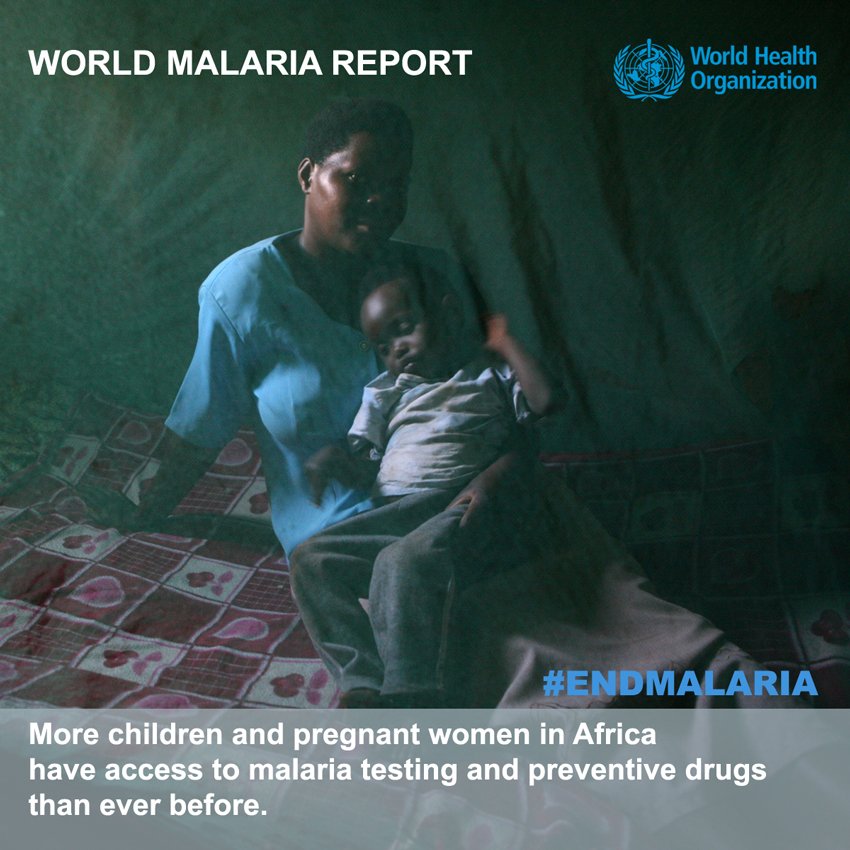
Promotional poster for the World Malaria Report 2016, from WHO

Promotional poster for the World Malaria Report 2016, from WHO; poster shows a woman and her child, protected from mosquitoes behind a bednet.

Incidence of malaria dropped to a new, all-time low in 2016, with reductions in total infections to 212 million, and a drop in malaria deaths to 429,000, worldwide. Malaria fighters had hoped the decreases would be greater.

Cover of World Malaria Report 2016, from the World Health Organization (WHO). The report has been published annually since at least 2008, tracking progress in the fight to control and eradicate malaria, one of the greatest scourge diseases in human history.

Cover of World Malaria Report 2016, from the World Health Organization (WHO). The report has been published annually since at least 2008, tracking progress in the fight to control and eradicate malaria, one of the greatest scourge diseases in human history.

This news comes from the World Health Organization’s (WHO) World Malaria Report 2016, released this morning in Geneva, Switzerland.

Of concern to readers here, the report lists ten nations still using DDT, the same number as 2015. Nine African nations and India still find some utility in DDT, though resistance to the long-used pesticide is found in almost all populations of almost all varieties of mosquito.

India remains the world’s heaviest user of DDT and the only place DDT is manufactured. The nine DDT-using African nations are Botswana, Democratic Republic of Congo, Gambia, Mozambique, Namibia, South Africa, Swaziland, Zambia, and Zimbabwe. Due to mosquito and other vector insect resistance to DDT, India will stop using DDT by 2020, and stop manufacturing at the same time.

Insecticide-impregnated bednets now are the chief tool used to prevent spread of new malaria infections. Nets have proven more effective than Indoor Residual Spraying (IRS), which has always been the chief use of DDT in the malaria fight. The report notes that mosquito resistance grows alarmingly to the preferred net pesticides, pyrethroids. Nets provide a physical barrier to mosquitoes, however, and work even when the insecticides wear off.

This years report is shorter than previous years, but still loaded with statistics and policy issues to be unpacked in the next few days.

WHO’s press release:


Malaria control improves for vulnerable in Africa, but global progress off-track

News release

WHO’s World Malaria Report 2016 reveals that children and pregnant women in sub-Saharan Africa have greater access to effective malaria control. Across the region, a steep increase in diagnostic testing for children and preventive treatment for pregnant women has been reported over the last 5 years. Among all populations at risk of malaria, the use of insecticide-treated nets has expanded rapidly.

But in many countries in the region, substantial gaps in programme coverage remain. Funding shortfalls and fragile health systems are undermining overall progress, jeopardizing the attainment of global targets.

Scale-up in malaria control

Sub-Saharan Africa carries a disproportionately high share of the global malaria burden. In 2015, the region was home to 90% of malaria cases and 92% of malaria deaths. Children under five years of age are particularly vulnerable, accounting for an estimated 70% of all malaria deaths.

Diagnostic testing enables health providers to rapidly detect malaria and prescribe life-saving treatment. New findings presented in the report show that, in 2015, approximately half (51%) of children with a fever seeking care at a public health facility in 22 African countries received a diagnostic test for malaria, compared to 29% in 2010.

To protect women in areas of moderate and high malaria transmission in Africa, WHO recommends “intermittent preventive treatment in pregnancy” (IPTp) with sulfadoxine-pyrimethamine. The treatment, administered at each scheduled antenatal care visit after the first trimester, can prevent maternal and infant mortality, anaemia, and the other adverse effects of malaria in pregnancy.

According to available data, there was a five-fold increase in the percentage of women receiving the recommended 3 or more doses of this preventive treatment in 20 African countries. Coverage reached 31% in 2015, up from 6% in 2010.

Insecticide-treated nets are the cornerstone of malaria prevention efforts in Africa. The report found that more than half (53%) of the population at risk in sub-Saharan Africa slept under a treated net in 2015, compared to 30% in 2010.

Last month, WHO released the findings of a major 5-year evaluation in 5 countries. The study showed that people who slept under long-lasting insecticidal nets (LLINs) had significantly lower rates of malaria infection than those who did not use a net, even though mosquitoes showed resistance to pyrethroids (the only insecticide class used in LLINs) in all of these areas.

An unfinished agenda

Malaria remains an acute public health problem, particularly in sub-Saharan Africa. According to the report, there were 212 million new cases of malaria and 429 000 deaths worldwide in 2015.

There are still substantial gaps in the coverage of core malaria control tools. In 2015, an estimated 43% of the population in sub-Saharan Africa was not protected by treated nets or indoor spraying with insecticides, the primary methods of malaria vector control.

In many countries, health systems are under-resourced and poorly accessible to those most at risk of malaria. In 2015, a large proportion (36%) of children with a fever were not taken to a health facility for care in 23 African countries.

“We are definitely seeing progress,” notes Dr. Pedro Alonso, Director of the WHO Global Malaria Programme. “But the world is still struggling to achieve the high levels of programme coverage that are needed to beat this disease.”

Global targets

At the 2015 World Health Assembly, Member States adopted the Global Technical Strategy for Malaria 2016-2030. The Strategy set ambitious targets for 2030 with milestones every 5 years to track progress.

Eliminating malaria in at least 10 countries is a milestone for 2020. The report shows that prospects for reaching this target are bright: In 2015, 10 countries and territories reported fewer than 150 indigenous cases of malaria, and a further 9 countries reported between 150 and 1000 cases.

Countries that have achieved at least 3 consecutive years of zero indigenous cases of malaria are eligible to apply for the WHO certification of malaria elimination. In recent months, the WHO Director-General certified that Kyrgyzstan and Sri Lanka had eliminated malaria.

But progress towards other key targets must be accelerated. The Strategy calls for a 40% reduction in malaria case incidence by the year 2020, compared to a 2015 baseline. According to the report, less than half (40) of the 91 countries and territories with malaria are on track to achieve this milestone. Progress has been particularly slow in countries with a high malaria burden.

An urgent need for more funding

Sustained and sufficient funding for malaria control is a serious challenge. Despite a steep increase in global investment for malaria between 2000 and 2010, funding has since flat-lined. In 2015, malaria funding totalled US$ 2.9 billion, representing only 45% of the funding milestone for 2020 (US$ 6.4 billion).

Governments of malaria-endemic countries provided about 31% of total malaria funding in 2015. The United States of America is the largest international malaria funder, accounting for about 35% of total funding in 2015, followed by the United Kingdom of Great Britain and Northern Ireland (16%).

If global targets are to be met, funding from both domestic and international sources must increase substantially.

Note to editors

RTS,S/AS01 malaria vaccine

Last month, WHO announced that the world’s first malaria vaccine would be rolled out through pilot projects in 3 countries in sub-Saharan Africa. Vaccinations will begin 2018. The vaccine, known as RTS,S, acts against P. falciparum, the most deadly malaria parasite globally, and the most prevalent in Africa. Advanced clinical trials have shown RTS,S to provide partial protection against malaria in young children.

WHO multi-country evaluation on LLINs

On 16 November 2016, WHO released the findings of a 5-year evaluation conducted in 340 locations across 5 countries: Benin, Cameroon, India, Kenya and Sudan. The findings of this study reaffirm the WHO recommendation of universal LLIN coverage for all populations at risk of malaria.

Will major media cover this news? Will your local newspapers and broadcast outlets even make note?

Save


Milky Way and the Snake River Canyon

December 10, 2016

Near where I first saw the Milky Way, on my Snake River.

#DYK 800 pairs of #hawks, #owls, #eagles & #falcons come each spring to mate & raise young in Snake River canyon. http://bit.ly/2d4Zz6O

BLM Idaho on Twitter: #DYK 800 pairs of #hawks, #owls, #eagles & #falcons come each spring to mate & raise young in Snake River canyon. http://bit.ly/2d4Zz6O

The photo is by Bob Wick, the great public lands photographer whose work highlights BLM and other public lands sights.

On Instagram there is more information:

mypubliclandsHappy Friday from BLM Idaho! On day five of our @mypubliclands Instagram takeover we are soaring over to Morley Nelson Snake River Birds of Prey National Conservation Area.

The deep canyon of the Snake River, with its crags and crevices and thermal updrafts, is home to the greatest concentration of nesting birds of prey in North America – and perhaps, the world. The BLM’s mission here is to preserve this remarkable wildlife habitat, while providing for other compatible uses of the land. Some 800 pairs of hawks, owls, eagles and falcons come each spring to mate and raise their young. The area truly exemplifies “nature in the rough,” with few public facilities. However, the birds and their unique environment offer rich rewards to those willing to experience this special place on its own terms and who have patience to fit into the natural rhythms of life here. Photo: Bob Wick

Get outside this year and visit BLM.gov to #GetAFreshLook of your public lands! Follow BLM Idaho on Facebook and Twitter @BLMIdaho.

Save


White House proclamation: Pearl Harbor Remembrance Day, 2016

December 7, 2016

President Barack Obama places a wreath at the USS Arizona Memorial, part of the World War II Valor in the Pacific National Monument, in Pearl Harbor, Hawaii, Dec. 29, 2011. (Official White House Photo by Pete Souza)

President Obama proclaimed Pearl Harbor Remembrance Day for 2016:

Presidential Proclamation

National Pearl Harbor Remembrance Day, 2016

NATIONAL PEARL HARBOR REMEMBRANCE DAY, 2016

– – – – – – –

BY THE PRESIDENT OF THE UNITED STATES OF AMERICA

A PROCLAMATION

Seventy-five years ago, Japanese fighter planes attacked the United States Naval Base at Pearl Harbor, destroying much of our Pacific Fleet and killing more than 2,400 Americans. The following day, President Franklin D. Roosevelt called on the Congress to declare war and “make it very certain that this form of treachery shall never again endanger us.” In that spirit, Americans came together to pay tribute to the victims, support the survivors, and shed the comforts of civilian life to serve in our military and fight for our Union. Each year on National Pearl Harbor Remembrance Day, we honor those whose lives were forever changed that December morning and resolve to uphold the legacy of all who stepped forward in our time of need.

From the docks of Pearl Harbor to the beaches of Normandy and far around the world, brave patriots served their country and defended the values that have sustained our Nation since its founding. They went to war for liberty and sacrificed more than most of us will ever know; they chased victory and defeated fascism, turning adversaries into allies and writing a new chapter in our history. Through their service and unparalleled devotion, they inspired a generation with their refusal to give in despite overwhelming odds. And as we reflect on the profound debt of gratitude we owe them for the freedoms we cherish, we are reminded of the everlasting responsibilities we have to one another and to our country.

In memory of all who lost their lives on December 7, 1941 — and those who responded by leaving their homes for the battlefields — we must ensure the sacrifices they made in the name of liberty and democracy were not made in vain. On this solemn anniversary, there can be no higher tribute to these American patriots than forging a united commitment to honor our troops and veterans, give them the support and care they deserve, and carry on their work of keeping our country strong and free.

The Congress, by Public Law 103-308, as amended, has designated December 7 of each year as “National Pearl Harbor Remembrance Day.”

NOW, THEREFORE, I, BARACK OBAMA, President of the United States of America, do hereby proclaim December 7, 2016, as National Pearl Harbor Remembrance Day. I encourage all Americans to observe this solemn day of remembrance and to honor our military, past and present, with appropriate ceremonies and activities. I urge all Federal agencies and interested organizations, groups, and individuals to fly the flag of the United States at half-staff this December 7 in honor of those American patriots who died as a result of their service at Pearl Harbor.

IN WITNESS WHEREOF, I have hereunto set my hand this sixth day of December, in the year of our Lord two thousand sixteen, and of the Independence of the United States of America the two hundred and forty-first.

BARACK OBAMA


December 7, 2016: Fly your flags for Pearl Harbor Remembrance, and for Delaware statehood — and at half staff

December 7, 2016

Flag flies at half-staff over the USS Utah, in Pearl Harbor (2004 photo – Pearl Harbor, Hawaii (May 31, 2004) – Sailors assigned to ships based at Pearl Harbor bring the flag to half-mast over the USS Utah Memorial on Ford Island in honor of Memorial Day May 31, 2004. U.S. Navy photo)

Flag flies at half-staff over the USS Utah, in Pearl Harbor (2004 photo – Pearl Harbor, Hawaii (May 31, 2004) – Sailors assigned to ships based at Pearl Harbor bring the flag to half-mast over the USS Utah Memorial on Ford Island in honor of Memorial Day May 31, 2004. U.S. Navy photo)

December 7 is a two-fer flag-flying day.

By public law, December 7 is Pearl Harbor Remembrance Day, and Americans fly the U.S. flag in memory of those who lost their lives at Pearl Harbor on December 7, 1941. U.S. flags should be flown at half-staff.

Under the U.S. Flag Code, residents of the relevant state should fly their U.S. flag on the date the state joined the union.

In 1787 Delaware quickly and promptly elected delegates to the former colony’s convention to ratify the Constitution proposed at the Philadelphia convention just over three months earlier. The ratification of the Constitution won opposition from strong factions in almost every state. Pols anticipated tough fights in New York, Virginia, and other states with large populations. They also expected other states would wait to see what the bigger states did.

Delaware didn’t wait.  On December 7 Delaware became the first of the former British colonies to ratify the Constitution. Perhaps by doing so, it guaranteed other states would act more favorably on ratification.

Because Delaware was first, it is traditionally granted first position in certain ceremonies, such as the parades honoring newly-inaugurated presidents. Delaware’s nickname is “The First State.”

In Delaware and the rest of the nation, fly your flags on December 7, 2016.

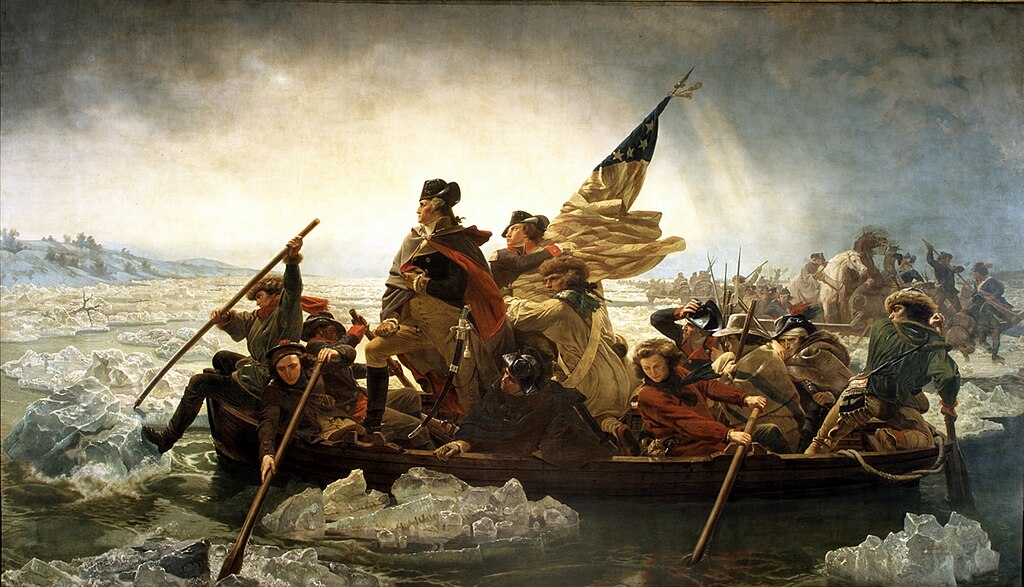
The most famous portrayal of a U.S. flag flying in Delaware is in the painting by Emanuel Leutze (American, 1816–1868).

The most famous portrayal of a U.S. flag flying in Delaware is in the painting by Emanuel Leutze (American, 1816–1868). “Washington Crossing the Delaware,” 1851. The Metropolitan Museum of Art, New York, Gift of John Stewart Kennedy, 1897 (97.34) Among other problems with this portrayal: The flag depicted had not been designated on the date of the crossing, Christmas 1776.

Yes, this is mostly an encore post. Fighting ignorance requires patience.

Yes, this is mostly an encore post. Fighting ignorance requires patience.

Save

Save


December 2016 flag-flying days

December 7, 2016

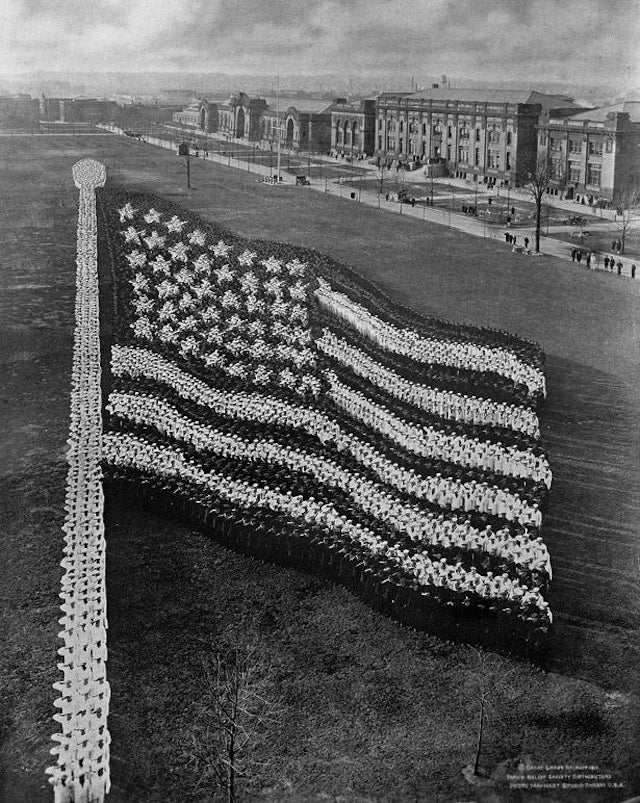
A

A “living flag” composed of 10,000 sailors, or “Blue Jackets at Salute,” by the Mayhart Studios, December 1917; image probably at the Great Lakes training facility of the Navy. Gawker media image

November offers several flag flying days, especially in years when there is an election.

But December may be the month with the most flag-flying dates, when we include statehood days.

December 7 is Pearl Harbor Remembrance Day.  It’s not in the Flag Code, but public law (P.L. 103-308) urges that the president should issue a proclamation asking Americans to fly flags.

December 25 is Christmas Day, a federal holiday, and one of the score of dates designated in the Flag Code. If you watch your neighborhood closely, you’ll note even some of the most ardent flag wavers miss posting the colors on this day, as they do on Thanksgiving and New Years.

Other dates?

Nine states attained statehood in December, so people in those states should fly their flags (and you may join them).  Included in this group is Delaware, traditionally the “First State,” as it was the first colony to ratify the U.S. Constitution:

  • Illinois, December 3 (1818, 21st state)
  • Delaware, December 7 (1787, 1st state)
  • Mississippi, December 10 (1817, 20th state)
  • Indiana, December 11 (1816, 19th state)
  • Pennsylvania, December 12 (1787, 2nd state)
  • Alabama, December 14 (1819, 22nd state)
  • New Jersey, December 18 (1787, 3rd state)
  • Iowa, December 28 (1846, 29th state)
  • Texas, December 29 (1845, 28th state)

December 15 is Bill of Rights Day, marking the day in 1791 when the Bill of Rights was declared ratified; but though this event generally gets a presidential proclamation, there is no law or executive action that requires flags to fly on that date, for that occasion.

Eleven flag-flying dates in December.  Does any other month have as many flag flying opportunities?

Have I missed any December flag-flying dates?  11 events on 10 days (Delaware’s statehood falls on the anniversary of the Pearl Harbor attack).

Here’s a list of the days to fly the flag, under national law, in chronological order:

  1. Illinois, December 3 (1818, 21st state)
  2. Pearl Harbor Remembrance Day, December 7
  3. Delaware, December 7 (1787, 1st state) (shared with Pearl Harbor Remembrance Day)
  4. Mississippi, December 10 (1817, 20th state)
  5. Indiana, December 11 (1816, 19th state)
  6. Pennsylvania, December 12 (1787, 2nd state)
  7. Alabama, December 14 (1819, 22nd state)
  8. New Jersey, December 18 (1787, 3rd state)
  9. Christmas Day, December 25
  10. Iowa, December 28 (1846, 29th state)
  11. Texas, December 29 (1845, 28th state)

Fly your flag with respect to the flag, for the republic it represents, and for all those who sacrificed that it may wave on your residence.

Appropriate to a snowy December.

Appropriate to a snowy December. “The Barn on Grayson-New Hope Road. This barn with its old truck and ever-present American flag, is often the subject of photographs and paintings by the locals.” Photo and copyright by Melinda Anderson

Yes, this is mostly an encore post. Fighting ignorance requires patience.

Yes, this is mostly an encore post. Fighting ignorance requires patience, and it’s taking much longer than I thought.

Encore

Save

Save


Georgia’s vote ratified the 13th Amendment, December 6, 1865

December 6, 2016

13th Amendment to the U.S. Constitution. National Archives image.

13th Amendment to the U.S. Constitution. National Archives image.

On December 6, 1865, Georgia’s legislature voted to ratify the 13th Amendment to the Constitution, pushing the total of states past the three-fourths margin required, 27 of 36 states. Secretary of State William Seward proclaimed the amendment ratified 12 days later, on December 18.

But we celebrate it in February.

February 1 is National Freedom Day in the U.S.

Text courtesy of the Legal Information Institute at Cornell University, 36 U.S. Code § 124 reads:

The President may issue each year a proclamation designating February 1 as National Freedom Day to commemorate the signing by Abraham Lincoln on February 1, 1865, of the joint resolution adopted by the Senate and the House of Representatives that proposed the 13th amendment to the Constitution.

(Pub. L. 105–225, Aug. 12, 1998, 112 Stat. 1259.)

The Library of Congress collects original documents teachers and students can use to study the 13th Amendment; here’s the full page, copied in case they change it:

Primary Documents in American History

13th Amendment to the U.S. Constitution

Thomas Nast's celebration of the emancipation of Southern slaves with the end of the Civil War.
Thomas Nast.
Emancipation.
Philadelphia: S. Bott, 1865.
Wood engraving.
Prints and Photographs Division.
Reproduction Number:
LC-USZ62-2573

The 13th Amendment to the Constitution declared that “Neither slavery nor involuntary servitude, except as a punishment for crime whereof the party shall have been duly convicted, shall exist within the United States, or any place subject to their jurisdiction.” Formally abolishing slavery in the United States, the 13th Amendment was passed by the Congress on January 31, 1865, and ratified by the states on December 6, 1865.

Library of Congress Web Site | External Web Sites | Selected Bibliography

Digital Collections

A Century of Lawmaking for a New Nation

This collection contains congressional publications from 1774 to 1875, including debates, bills, laws, and journals.

References to debate on the 13th Amendment (S.J. Res. 16) can be found in the Congressional Globe on the following dates:

  • March 31, 1864 – Debated in the Senate (S.J. Res. 16).
  • April 4, 1864 – Debated in the Senate.
  • April 5, 1864 – Debated in the Senate.
  • April 6, 1864 – Debated in the Senate.
  • April 7, 1864 – Debated in the Senate.
  • April 8, 1864 – The Senate passed the 13th Amendment (S.J. Res. 16) by a vote of 38 to 6.
  • June 14, 1864 – Debated in the House of Representatives.
  • June 15, 1864 – The House of Representatives initially defeated the 13th Amendment (S.J. Res. 16) by a vote of 93 in favor, 65 opposed, and 23 not voting, which is less than the two-thirds majority needed to pass a Constitutional Amendment.
  • December 6, 1864 – Abraham Lincoln’s Fourth Annual Message to Congress was printed in the Congressional Globe: “At the last session of Congress a proposed amendment of the Constitution, abolishing slavery throughout the United States, passed the Senate, but failed for lack of the requisite two-thirds vote in the House of Representatives. Although the present is the same Congress, and nearly the same members, and without questioning the wisdom or patriotism of those who stood in opposition, I venture to recommend the reconsideration and passage of the measure at the present session.
  • January 6, 1865 – Debated in the House of Representatives (S.J. Res. 16).
  • January 7, 1865 – Debated in the House of Representatives.
  • January 9, 1865 – Debated in the House of Representatives.
  • January 10, 1865 – Debated in the House of Representatives.
  • January 11, 1865 – Debated in the House of Representatives.
  • January 12, 1865 – Debated in the House of Representatives.
  • January 13, 1865 – Debated in the House of Representatives.
  • January 28, 1865 – Debated in the House of Representatives.
  • January 31, 1865 – The House of Representatives passed the 13th Amendment (S.J. Res. 16) by a vote of 119 to 56.
  • February 1, 1865 – President Abraham Lincoln signed a Joint Resolution submitting the proposed 13th Amendment to the states.
  • December 18, 1865 – Secretary of State William Seward issued a statement verifying the ratification of the 13th Amendment.

Abraham Lincoln Papers at the Library of Congress

The complete Abraham Lincoln Papers at the Library of Congress consists of approximately 20,000 documents. The collection is organized into three “General Correspondence” series which include incoming and outgoing correspondence and enclosures, drafts of speeches, and notes and printed material. Most of the 20,000 items are from the 1850s through Lincoln’s presidential years, 1860-65.

A selection of highlights from this collection includes:

Search the Abraham Lincoln Papers using the phrase “13th amendment” to locate additional documents on this topic.

The Alfred Whital Stern Collection of Lincolniana

This collection documents the life of Abraham Lincoln both through writings by and about Lincoln as well as a large body of publications concerning the issues of the times including slavery, the Civil War, Reconstruction, and related topics.

From Slavery to Freedom: The African-American Pamphlet Collection, 1822-1909

This collection presents 396 pamphlets from the Rare Book and Special Collections Division, published from 1822 through 1909, by African-American authors and others who wrote about slavery, African colonization, Emancipation, Reconstruction, and related topics.

Chronicling America: Historic American Newspapers

Chronicling America

This site allows you to search and view millions of historic American newspaper pages from 1836 to 1922. Search this collection to find newspaper articles about the 13th Amendment.

A selection of articles on the 13th Amendment includes:

Congress.gov

Constitution of the United States of America: Analysis and Interpretation

The Constitution of the United States of America: Analysis and Interpretation (popularly known as the Constitution Annotated) contains legal analysis and interpretation of the United States Constitution, based primarily on Supreme Court case law. This regularly updated resource is especially useful when researching the constitutional implications of a specific issue or topic. It includes a chapter on the 13th Amendment. (PDF, 201 KB)

Exhibitions

The African-American Mosaic

This exhibit marks the publication of The African-American Mosaic: A Library of Congress Resource Guide for the Study of Black History and Culture. This exhibit is a sampler of the kinds of materials and themes covered by this publication. Includes a section on the abolition movement and the end of slavery.

African American Odyssey: A Quest for Full Citizenship

This exhibition showcases the African American collections of the Library of Congress. Displays more than 240 items, including books, government documents, manuscripts, maps, musical scores, plays, films, and recordings. Includes a brochure from an exhibit at the Library of Congress to mark the 75th Anniversary of the 13th Amendment.

American Treasures of the Library of Congress: Abolition of Slavery

An online exhibit of the engrossed copy of the 13th Amendment as signed by Abraham Lincoln and members of Congress.

The Civil Rights Act of 1964: A Long Struggle for Freedom

This exhibition, which commemorates the fiftieth anniversary of the landmark Civil Rights Act of 1964, explores the events that shaped the civil rights movement, as well as the far-reaching impact the act had on a changing society.

The Teachers Page

American Memory Timeline: The Freedmen

The Emancipation Proclamation and Thirteenth Amendment freed all slaves in the United States. This page links to related primary source documents.

Link disclaimerExternal Web Sites

The Collected Works of Abraham Lincoln, Abraham Lincoln Association

Documents from Freedom: A Documentary History of Emancipation, 1861-1867, University of Maryland

End of Slavery: The Creation of the 13th Amendment, HarpWeek

“I Will Be Heard!” Abolitionism in America, Cornell University Library, Division of Rare and Manuscript Collections

Landmark Legislation: Thirteenth, Fourteenth, & Fifteenth Amendments, U.S. Senate

Mr. Lincoln and Freedom, The Lincoln Institute

Our Documents, 13th Amendment to the U.S. Constitution, National Archives and Records Administration

Proclamation of the Secretary of State Regarding the Ratification of the Thirteenth Amendment, National Archives and Records Administration

Proposed Thirteenth Amendment Regarding the Abolition of Slavery, National Archives and Records Administration

The Thirteenth Amendment, National Constitution Center

Selected Bibliography

Avins, Alfred, comp. The Reconstruction Amendments’ Debates: The Legislative History and Contemporary Debates in Congress on the 13th, 14th, and 15th Amendments. Richmond: Virginia Commission on Constitutional Government, 1967. [Catalog Record]

Hoemann, George H. What God Hath Wrought: The Embodiment of Freedom in the Thirteenth Amendment. New York: Garland Pub., 1987. [Catalog Record]

Holzer, Harold, and Sara Vaughn Gabbard, eds. Lincoln and Freedom: Slavery, Emancipation, and the Thirteenth Amendment. Carbondale: Southern Illinois University Press, 2007. [Catalog Record]

Maltz, Earl M. Civil Rights, the Constitution, and Congress, 1863-1869. Lawrence, Kan.: University Press of Kansas, 1990. [Catalog Record]

Richards, Leonard L. Who Freed the Slaves?: The Fight Over the Thirteenth Amendment. Chicago: The University of Chicago Press, 2015. [Catalog Record]

Tsesis, Alexander, ed. The Promises of Liberty: The History and Contemporary Relevance of the Thirteenth Amendment. New York: Columbia University Press, 2010. [Catalog Record]

—–. The Thirteenth Amendment and American Freedom: A Legal History. New York: New York University Press, 2004. [Catalog Record]

Vorenberg, Michael. Final Freedom: The Civil War, the Abolition of Slavery, and the Thirteenth Amendment. Cambridge; New York: Cambridge University Press, 2001. [Catalog Record]

Younger Readers

Biscontini, Tracey and Rebecca Sparling, eds. Amendment XIII: Abolishing Slavery. Detroit: Greenhaven Press, 2009. [Catalog Record]

Burgan, Michael. The Reconstruction Amendments. Minneapolis: Compass Point Books, 2006. [Catalog Record]

Schleichert, Elizabeth. The Thirteenth Amendment: Ending Slavery. Springfield, N.J.: Enslow Publishers, 1998. [Catalog Record]

Save

Yes, this is mostly an encore post. Fighting ignorance requires patience.

Yes, this is mostly an encore post. Fighting ignorance requires patience.