On November 14, 1960, Ruby Bridges went to school

November 14, 2016

American Experience reminds us:

On November 14, 1960, 6-year-old Ruby Bridges walked into William J. Frantz Elementary School in New Orleans.

This is an encore post I put up then, happy to have an excuse to repeat historic photos, great art from a great American painter, Norman Rockwell, and remind students of history.

This came on Twitter, back in 2014:

You don’t recognize her there?

How about in Norman Rockwell’s illustration?

The Problem We All Live With,” Norman Rockwell, 1964; oil on canvas, Norman Rockwell Museum, Stockbridge, Massachusetts

Ruby Bridges with President Barack Obama, in 2011:

President Obama and Ruby Bridges viewing Normal Rockwall's painting, "The Problem We All Live With," at the White House in 2011. Photo by Pete Souza, public domain.

President Obama and Ruby Bridges viewing Normal Rockwall’s painting, “The Problem We All Live With,” at the White House in 2011. Photo by Pete Souza, public domain.

Ms. Bridges tells some of her story:

Yes, this is mostly an encore post. Fighting ignorance requires patience.

Yes, this is mostly an encore post. Fighting ignorance requires patience.


Celebrating Veterans Day 2016

November 11, 2016

A teacher asked on Twitter yesterday for sources of information to set up a curriculum for Veterans Day, and I sent a few suggestions (and got thanked!).

Teachers watching through the day probably saw several sources pop up on the internet that they wished they’d had last week, to plan for this week.

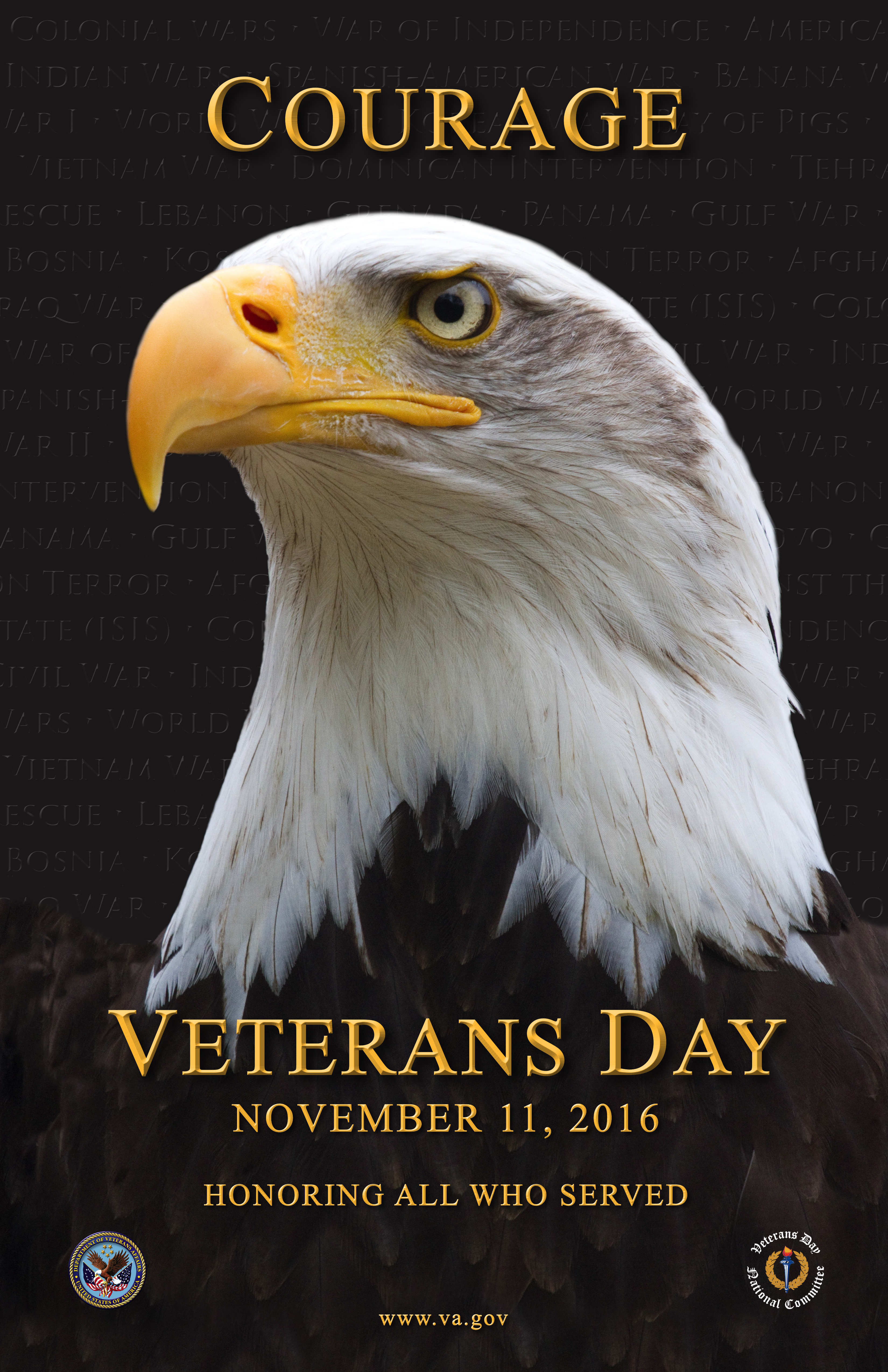
For one, I didn’t post the Veterans Administration’s annual Veterans Day poster, and it’s a very nice one this year:

Veterans Day poster for 2016. Look carefully, you'll see the names of past military engagements in which veterans may have fought, in the background behind the very sharp photo of the head of a bald eagle, our national symbol.

Veterans Day poster for 2016. Look carefully, you’ll see the names of past military engagements in which veterans may have fought, in the background behind the very sharp photo of the head of a bald eagle, our national symbol.

In world history or U.S. history, I usually stop for the day to talk about the origins of Veterans Day in Armistice Day, the day the guns stopped blazing to effectively end fighting in World War I. For several reasons, including mnemonic, the treaty called for an end to hostilities on the “11th hour of the 11th day of the 11th month” of 1918. Your state’s history standards probably has that phrase somewhere, but the history behind it is what students really find interesting.

Original documents and good history can be found at the Library of Congress online collections.

The Allied powers signed a ceasefire agreement with Germany at Rethondes, France, at 11:00 a.m. on November 11, 1918, bringing the war later known as World War I to a close.

President Wilson proclaimed the first Armistice Day the following year on November 11, 1919, with the these words: β€œTo us in America, the reflections of Armistice Day will be filled with solemn pride in the heroism of those who died in the country’s service and with gratitude for the victory, both because of the thing from which it has freed us and because of the opportunity it has given America to show her sympathy with peace and justice in the councils of the nations…” Originally, the celebration included parades and public meetings following a two-minute suspension of business at 11:00 a.m.

Co. E, 102nd U.S.A. Curtiss Studio, photographers, c1917. Panoramic Photographs. Prints & Photographs Division

Between the world wars, November 11 was commemorated as Armistice Day in the United States, Great Britain, and France. After World War II, the holiday was recognized as a day of tribute to veterans of both wars. Beginning in 1954, the United States designated November 11 as Veterans Day to honor veterans of all U.S. wars. British Commonwealth countries now call the holiday Remembrance Day.

Online holdings of the National Archives and Records Administration (NARA) provide rich sources of information on America’s military, and on veteran’s day. NARA leans to original documents a bit more than the Library of Congress. For Veterans Day 2016, NARA featured an historic photo form 1961:

 President John F. Kennedy Lays a Wreath at the Tomb of the Unknown Soldier as part of Veterans Day Remembrances, Arlington National Cemetery, Arlington, Virginia, 11/11/1961 Series: Robert Knudsen White House Photographs, 1/20/1961 - 12/19/1963. Collection: White House Photographs, 12/19/1960 - 3/11/1964 (Holdings of the @jfklibrary)

NARA caption: President John F. Kennedy Lays a Wreath at the Tomb of the Unknown Soldier as part of Veterans Day Remembrances, Arlington National Cemetery, Arlington, Virginia, 11/11/1961 Series: Robert Knudsen White House Photographs, 1/20/1961 – 12/19/1963. Collection: White House Photographs, 12/19/1960 – 3/11/1964 (Holdings of the @jfklibrary)

For teachers, that page also features this:

For Veterans Day, explore the many resources in the National Archives about veterans and military service.

(Well, actually it’s for everyone. But teachers love those kinds of links, especially AP history teachers who need documents for “Document-Based Questions” (DBQs).

On one page, the Veterans Administration makes it easy for teachers to plan activities; of course, you need to start some of these weeks before the actual day:

For Teachers & Students

Hope your Veterans Day 2016 went well (remember to bring in your flag at home!).

Get ready for Veterans Day 2017 — the 11th day of the 11th month.


Save

Save

Save

Save

Save


President Obama’s Veterans Day Proclamation, 2016

November 11, 2016

A message written by First Lady is seen on a U.S. Marine Corps flag at Walter Reed National Military Medical Center in Bethesda, Md., April 4, 2012.

A message written by First Lady is seen on a U.S. Marine Corps flag at Walter Reed National Military Medical Center in Bethesda, Md., April 4, 2012. From a White House blog post, “5 Ways You Can Thank a Veteran.”

Fly your U.S. flags today for Veterans Day.

From the office of the Press Secretary of the White House:

The White House
Office of the Press Secretary
For Immediate Release, November 08, 2016

Presidential Proclamation — Veterans Day, 2016

VETERANS DAY, 2016

BY THE PRESIDENT OF THE UNITED STATES OF AMERICA

A PROCLAMATION

America has long stood as a beacon of hope and opportunity, and few embody that spirit here at home and beyond our borders more than the members of our Armed Forces. Soldiers, Sailors, Airmen, Marines, and Coast Guardsmen are part of an unbroken chain of brave patriots who have served our country with honor and made tremendous sacrifices so that we may live free. On Veterans Day, we salute the women and men who have proudly worn the uniform of the United States of America and the families who have served alongside them, and we affirm our sacred duty as citizens to express our enduring gratitude, both in words and in actions, for their service.

Our country has the best-trained and best-equipped military force in the world, and we need to make sure we have the most supported and respected veterans in the world. We are a Nation that leaves no one behind, and my Administration has made historic investments to provide veterans access to the resources and education they need to share in our Nation’s promise when they return home. Partnering with community leaders across America, First Lady Michelle Obama and Dr. Jill Biden’s Joining Forces initiative works to ensure our country’s heroes can thrive by combatting veteran homelessness, promoting their emotional well-being, and advancing employment training and placement — and we have made great progress. Today, the unemployment rate for veterans is lower than the national average, and veteran homelessness has been nearly cut in half since 2010. We also recognize that some of these courageous men and women have faced and overcome profound challenges, both physically and emotionally, in defense of our freedom. We must continue to provide high quality health care to our veterans and make sure they have the support they have earned and deserve.

The example our Nation’s veterans set throughout their lives is a testament to the drive and perseverance that define the American character. Let us uphold our obligations to these heroic individuals and never forget those who paid the ultimate price for our liberty. On this day and throughout the year, may we sustain their lasting contributions to our Nation’s progress and carry forward their legacy by building a future that is stronger, safer, and freer for all.

With respect for, and in recognition of, the contributions our service members have made to the cause of peace and freedom around the world, the Congress has provided (5 U.S.C. 6103(a)) that November 11 of each year shall be set aside as a legal public holiday to honor our Nation’s veterans.

NOW, THEREFORE, I, BARACK OBAMA, President of the United States of America, do hereby proclaim November 11, 2016, as Veterans Day. I encourage all Americans to recognize the valor and sacrifice of our veterans through appropriate public ceremonies and private prayers, and by observing 2 minutes of silence for our Nation’s veterans. I call upon Federal, State, and local officials to display the flag of the United States and to participate in patriotic activities in their communities. I call on all Americans, including civic and fraternal organizations, places of worship, schools, and communities to support this day with commemorative expressions and programs.

IN WITNESS WHEREOF, I have hereunto set my hand this eighth day of November, in the year of our Lord two thousand sixteen, and of the Independence of the United States of America the two hundred and forty-first.

BARACK OBAMA

First Lady Michelle Obama, in support of the Joining Forces initiative, greets members of the military following remarks at Al Udeid Air Base in Qatar, Nov. 3, 2015. (Official White House Photo by Amanda Lucidon)

First Lady Michelle Obama, in support of the Joining Forces initiative, greets members of the military following remarks at Al Udeid Air Base in Qatar, Nov. 3, 2015. (Official White House Photo by Amanda Lucidon)

Save

Save

Save


What can we learn from election-day art?

November 8, 2016

Interesting contrasts, at least.

I love the “County Election” painting of George Caleb Bingham, showing an election in 1852, the year incumbent President Millard Fillmore could not get even the nomination of his party. I love the tension of Norman Rockwell’s painting of the 1944 election in Cedar Rapids, Iowa, with tensions we see only in retrospect. (That post also shows real tensions in a family, in the election of 1948, in another Rockwell painting).

What else does the world of art show about elections in America? What do you think?

Illustration from Harper's Weekly, showing election persuasion at the polls. Library of Congress collection

Illustration from Harper’s Weekly, November 7, 1857, showing election persuasion at the polls – politicians trying to buy votes. Library of Congress collection

If bribery didn’t work, there was always plain old fisticuffs.

Fighting at the polls. Illustration from Harper's Weekly, November 7, 1857. Library of Congress collections

Fighting at the polls. Illustration from Harper’s Weekly, November 7, 1857. Library of Congress collections

Here’s an unusual ritual, portrayed about the 1892 contest between William Henry Harrison and Grover Cleveland. Did this really happen? Did the loser pull the winner on a cart through the city?

“Lost Bet,” by John Klir, Library of Congress. Pearson’s education materials say this was common in the 19th century.

Louis Dalrymple noted a twist on the tradition four years later.

Puck Magazine, November 11, 1896.

Puck Magazine, November 11, 1896. “Print shows a bloated businessman holding an American flag labeled ‘Victory,’ riding in a wheelbarrow being pushed by another man; in the background, a young boy is telling a stranger that his Dad had a bet with the other man regarding the outcome of the presidential election. The stranger is uncertain who lost the bet.” Drawing by Louis Dalrymple for Puck. Library of Congress collections

Not sure how long that tradition of the loser pushing or pulling the winner hung on, but by 1904 election night was an occasion to walk about, socialize, and watch fireworks, if this print from the William Randolph Hearst organization is accurate. Teddy Roosevelt won the presidency on his own that year.

“Election night illumination at the Flatiron Building [New York City].” New York Sunday American & Journal, a Hearst newspaper. Library of Congress collections

“Politics in the Oyster House,” 1848 by Richard Caton Woodville. Image found at Wikiwand
George Caleb Bingham's

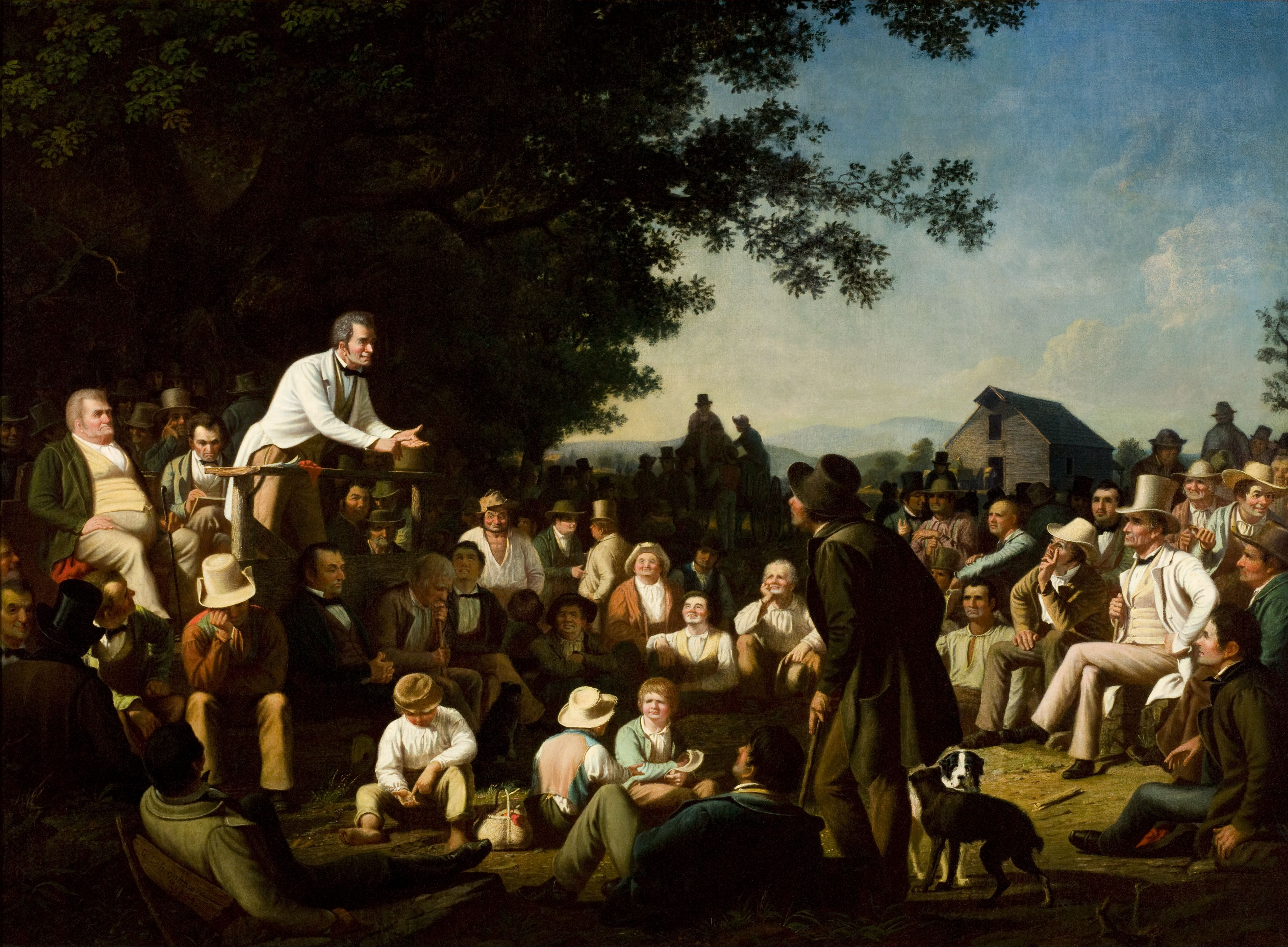
George Caleb Bingham’s “Stump Speaking,” 1853-54. Image from Wikiwand

Not all election work involves a crowd.

George Caleb Bingham,

George Caleb Bingham, “Canvassing the Vote”
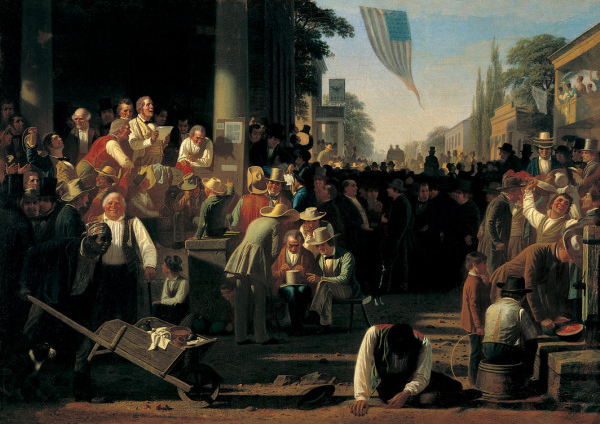
George Caleb Bingham,

George Caleb Bingham, “The Verdict of the People,” 1854-55. Wikiwand image

This looks more like the campaign party of a victorious candidate in the late 20th and early 21st centuries, though I’m not really sure this tradition survived much past the 2000 election.

John Sloan,

John Sloan, “Election Night,” 1907, an image from a New York drinking establishment. Collection of the Memorial Art Gallery of the University of Rochester.

Janie Price’s Evolution of American Painting said:

Here is the scene of Election Night written in Sloan’s Journal:

β€œTook a walk in the afternoon and saw boys in droves, foraging for fuel for their election fires this evening. . . . after dinner . . . out again and saw the noisy trumpet blowers, confetti throwers and the β€œticklers” in useβ€”a small feather duster on a stick which is pushed in the face of each girl by the men, and in the face of men by the girls. A good humorous crowd, so dense in places that it is impossible to control one’s movement.” (John French Sloan)

Women voted for the first time nationwide in 1920, after the ratification of the 19th Amendment. J. F. Kernan’s painting for The Country Gentleman magazine in 1922 shows some of the tensions that remained after the national amendment.

J. F. Kernan in Country Gentleman magazine, November 4, 1922

J. F. Kernan in Country Gentleman magazine, November 4, 1922. Wikimedia image

Rockwall made great use of his time and photographs in Cedar Rapids. In addition to the painting there, he used the setting for his famous “Undecided,” which became the cover of the Saturday Evening Post. 1944 was the last time prior to 2016 that both major candidates came from New York.

“Undecided,” Norman Rockwell, 1944. Copyright Curtis Publications

One might wonder if Rockwell considered himself undecided, when one sees this “son” of the painting, from 1960, featuring Rockwell in the same voting booth.

β€œNorman Rockwell at the Voting Booth” painted in 1960, based on his 1944 studies in Cedar Rapids, it seems to me. Image from The Easel

β€œNorman Rockwell at the Voting Booth” painted in 1960, based on his 1944 studies in Cedar Rapids, it seems to me. Image from The Easel

One last Rockwell to close out, one of my favorites, showing the happy candidate Casey, after having gotten the news that the voters were not so happy with him.
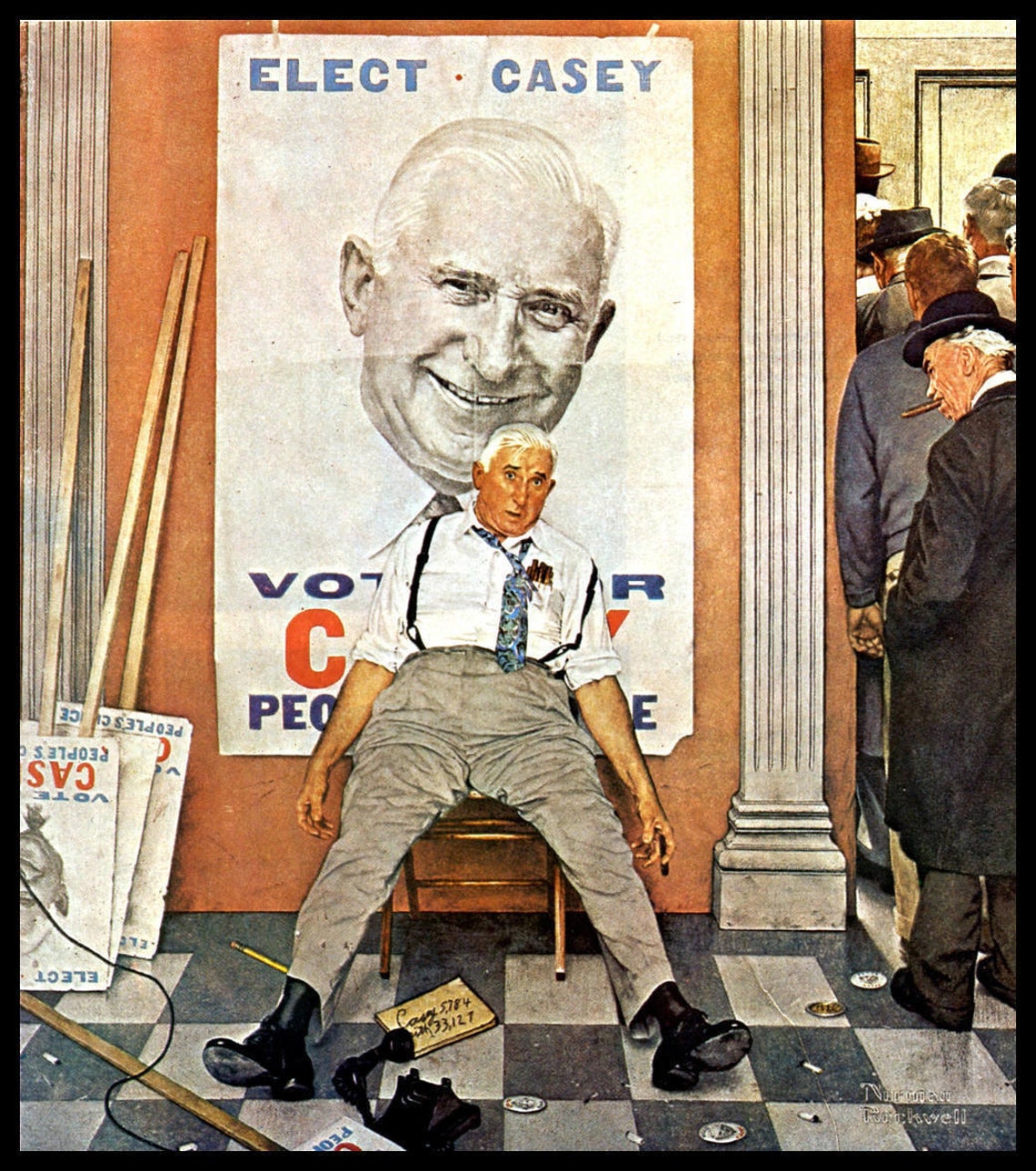
Norman Rockwall,

Norman Rockwall, “Elect Casey,” or “Before and After,” November 1958 for the Saturday Evening Post.

Legendary election jokester Dick Tuck once ran for the state legislature in California, on the slogan, “The job needs Tuck, and Tuck needs the job.” He lost, and he said what I can imagine the fictional Casey saying, “The people have spoken. The bastards!”

What are your favorite election day images? What are your memories of elections past?


2016: Election day art of Norman Rockwell, and unpredictability of elections

November 8, 2016

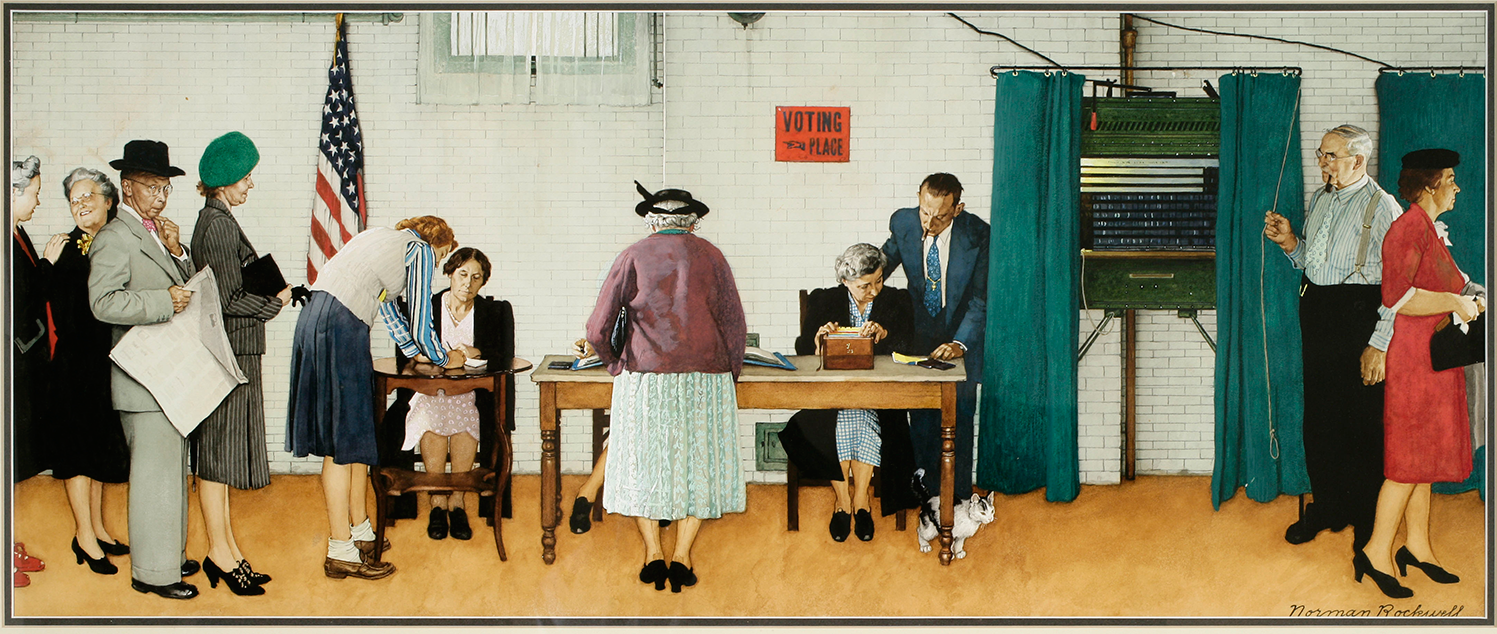
Especially in 2016, I think of this great, undersung painting by Normal Rockwell, “Election Day (1944)”:

Norman Rockwell, Election Day, 1944, watercolor and gouache, 14 x 33 1/2 in., Museum purchase, Save-the-Art fund, 2007.037.1.

Norman Rockwell, Election Day, 1944, watercolor and gouache, 14 x 33 1/2 in., Museum purchase, Save-the-Art fund, 2007.037.1.

Remember when people used to dress up to go to the polls?

In 1944 President Franklin Roosevelt ran for an unprecedented fourth term.Β  Most Americans did not know it, but he was deathly ill at the time.Β  He dropped Vice President Henry Wallace from his ticket — some argue it was a mutual disaffection at that time — and selected the relatively unknown young Missouri U.S. Sen. Harry S Truman for the vice president’s slot.

In November 1944, D-Day was known to be a successful invasion, and most Americans hoped for a relatively speedy end to World War II in both Europe and the Pacific.Β  Within the next ten months, the nation would endure the last, futile, desperate and deadly gasp of the Third Reich in the Battle of the Bulge, the liberation of Berlin in April 1945, and end of the war in the European Theatre on May 8; the Battle of Leyte Gulf, the Philippines Campaign, and the bloody, crippling battles of Iwo Jima and Okinawa in the Pacific Theatre, and then the first use of atomic weapons in war, at Hiroshima and Nagasaki (and we hope, the last use).

Voters in Cedar Rapids could not have known that.Β  They did not know that, regardless their vote for FDR or his Republican challenger, New York Gov. Thomas Dewey, Harry S Truman would be president within six months, nor that the entire world would change in August 1945.

This painting captures a time of spectacular moment, great naivity, and it pictures the way history got made.

For a 2007 exhibition, the Cedar Rapids Museum of Art offered this history:

Norman Rockwell: Fact & Fiction

September 12, 2009 – January 3, 2010

In 2007, the citizens of Cedar Rapids rallied together to purchase a series of watercolors destined for the auction block in New York. These five watercolors, by acclaimed 20th century American artist Norman Rockwell, depicted scenes associated with an election day and were created specifically for the November 4, 1944 issue of the Saturday Evening Post. To complete the Post commission, Rockwell traveled to a quintessential Midwestern town, Cedar Rapids, to study local citizens as models for his series of images.

In the 65 years since his visit, numerous anecdotes and stories have arisen about the artist’s time in Cedar Rapids and the creation of this work. This exhibition uses these five, newly conserved and restored watercolors and a related oil painting from the Norman Rockwell Museum, along with numerous photographs taken by local photographer Wes Panek for Rockwell, to investigate the many facts and fictions associated with Rockwell’s visit and this set of watercolors.

Norman Rockwell: Fact & Fiction has been made possible in part by Rockwell Collins, Candace Wong, and local “Friends of Norman Rockwell.” General exhibition and educational support has been provided by The Momentum Fund of the Greater Cedar Rapids Community Foundation.

Friends of Norman Rockwell: Wilma E. Shadle, Howard and Mary Ann Kucera, Jean Imoehl, Ben and Katie Blackstock, Marilyn Sippy, Chuck and Mary Ann Peters, Phyllis Barber, Ann Pickford, Anthony and Jo Satariano, Barbara A. Bloomhall, Virginia C. Rystrom, Jeff and Glenda Dixon, Robert F. & Janis L. Kazimour Charitable Lead Annuity Trust, Fred and Mary Horn, Mrs. Edna Lingo, John and Diana Robeson, Jewel M. Plumb, Carolyn Pigott Rosberg, Mr. and Mrs. Robert J. Buchacek, Dan and Anne Pelc, Mary Brunkhorst, and John and Diana Robeson.

I am amused and intrigued that this scene also closely resembles the scene when I voted in Cheverly, Maryland, in 1984 — down to the dog in the picture.Β  Oh, and most of the women didn’t wear dresses, none wore hats, and I was the only guy in the room with a tie.

Roosevelt won the 1944 election in an electoral college landslide, 432 to 99, but Dewey won Iowa, and we might assume Dewey won Cedar Rapids, too.

And that Truman guy?Β  Rockwell came back to the topic of elections four years later, when Truman was running for election to the office he’d filled for nearly four years, with another classic, American election portrayal.

“Election Day,” by Norman Rockwell, 1948

More:

This is an encore post.

Yes, this is an encore post. Defeating ignorance takes patience and perseverance.


Election Day 2016: Fly your flag, and VOTE!

November 8, 2016

Saint Louis Art Museum, St. Louis, Missouri George Caleb Bingham (American, 1811–1879). The County Election, 1852. Oil on canvas. 38 x 52 in. (96.5 x 132.1 cm). Gift of Bank of America.

The County Election, 1852. Saint Louis Art Museum, St. Louis, Missouri George Caleb Bingham (American, 1811–1879).Β  Oil on canvas. 38 x 52 in. (96.5 x 132.1 cm). Gift of Bank of America.

Every polling place should be flying the U.S. flag today.Β  You may fly yours, too.Β  In any case, if you have not voted already, go vote today as if our future depends upon it, as if our nation expects every voter to do her or his duty.

Today the nation and world listen to the most humble of citizens.Β  Speak up, at the ballot box.

Did you notice?Β  In George Caleb Bingham’s picture, there are no U.S. flags.Β  You should fly yours anyway.

The whole world is watching.

More:

This is an encore post.

Yes, this is an encore post. Defeating ignorance takes patience and perseverance. And I really like Bingham’s painting.


Milky Way from Easter Island

November 6, 2016

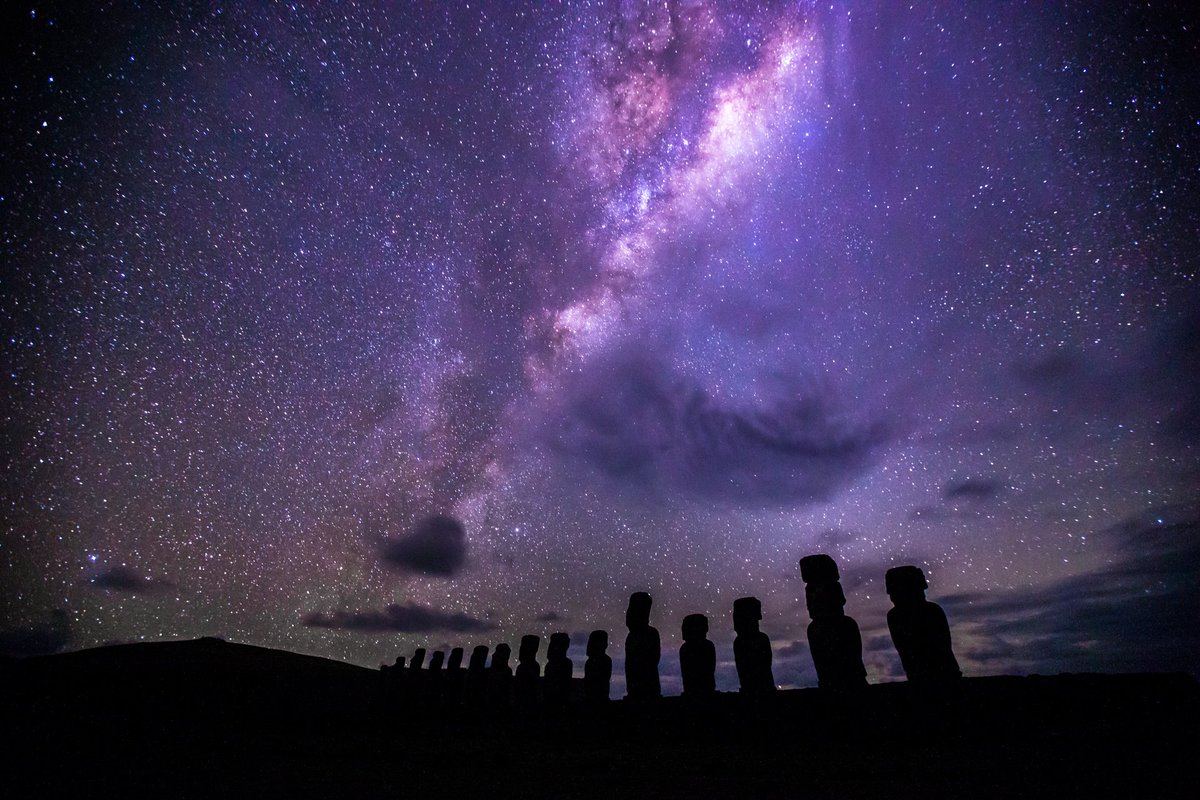
National Science Foundation tweeted this out:

National Science Foundation tweeted this out: “#photooftheday: Moai under the #MilkyWay. #space #galaxy #astronomy #science http://bit.ly/2ffTmVZ Image credit: Anne Dirkse”

More:


Issues you haven’t heard discussed in the campaign, 3: Clinton on national service

November 5, 2016

Part 3 of a series, listing policy issues we’ve heard too little about during this presidential campaign.

This is borrowed wholesale from the campaign website for Hillary Clinton (unless otherwise noted), just to try to get a little discussion going on the real issues of the campaign.

Millard Fillmore’s Bathtub is working on a series of issues not yet discussed, less than a week before the vote. Consider it public service, in the spirit of Fillmore, who remained ever conversant in public affairs and anxious to take a role to push for policies to improve America, as he saw it β€” and who, supported by his wives, founded the White House Library, the Buffalo and Erie County Historical Society, and the University of Buffalo (now SUNY-Buffalo) to further knowledge.

Beyond a military draft, which few people want in an era of a very successful all-volunteer military, should we ask more of our young people, ask them to serve the nation? How would such a scheme work?

Clinton’s policy paper introduction on national service:

There aren’t many places where people of all ages, all races, all backgrounds, all beliefs come together in common cause. But service is one of them, and that’s one of the reasons I think it’s so valuable, because in addition to the good work it does, it helps us reconnect with each other to feel more a part of our shared American life. I believe that one of the jobs of president is to encourage more service … .

Hillary, September 30, 2016

The generation of Americans coming of age today has changed our politics and our country. From racial justice and marriage equality to economic opportunity and climate change, they have put key issues at the top of the national agenda. Hillary Clinton believes we must do more to support activism and create pathways for Americans to serve and to lead.

As president, Hillary will:

  • Expand national service. Hillary will create more opportunities for Americans to participate in national service, creating economic and educational opportunities while improving communities. She will significantly expand AmeriCorps to allow hundreds of thousands of more Americans to serve their communities through organizations such as City Year, YouthBuild, American Red Cross, Habitat for Humanity, and other community organizations. To achieve this, Hillary will grow AmeriCorps to 250,000 members annually, fulfilling the goals of the Edward M. Kennedy Serve America Act. And she will create a National Service Reserve to enable millions of Americans across the country to engage in part-time volunteer service to their communities, taking on the most pressing challenges identified by state and local leaders and earning recognition for their contributions. ReadΒ more here.
  • Increase access to higher education. Hillary believes that if you serve your country through national and community service, you should be able to earn meaningful educational benefits. Her New College Compact will build on the current AmeriCorps Segal Education Award, on top of her plans to make debt-free college available to all by doubling the Segal Award and making it tax-free so that AmeriCorps members can earn more than $10,000 for college for every year of full-time service.
  • Strengthen international service. As secretary of state, Hillary saw firsthand the impact that Peace Corps Volunteers have around the world. That’s why, as president, she will continue to be a strong advocate for the Peace Corps. She will strengthen the program to provide more opportunities to send Americans abroad to work side by side with local leaders and address our most pressing global challenges.
  • Bring Americans together. Hillary strongly believes in the power of service to break down barriers by bringing together Americans from all backgrounds and uniting them in common purpose. She will ensure that national service remains at the top of her agenda as a broad-based solution to expand opportunity for people across America and strengthen our communities and our country.

Hillary has a strong record of supporting national service:

  • As first lady, Hillary advocated for Congress to reauthorize AmeriCorps so that tens of thousands more Americans would have opportunities to learn β€œhow much more we get when we give.”
  • As senator, Hillary fought to protect AmeriCorps from budget cuts, and in 2003 stood alongside 150 mayors and governors in requesting funding to secure and grow the program. She also co-sponsored a bill to base AmeriCorps Education Award on the average public college tuition as a way to reduce student debt and allow more Americans to attend college in a time of rising costs.
  • As secretary of state, Hillary re-established the Peace Corps’s relationship with Indonesia after a 45-year hiatus. The first program in 2010 sent 19 volunteers, and now that number has grown to more than 100. Also under her leadership, the State Department provided $1 million to the Peace Corps to advance renewable energy efforts.

Read the fact sheet

Related:

I must confess a bias.Β In my time in Washington I met many former Peace Corps volunteers, and others who volunteered for VISTA and other programs. I found them without exception to be great leaders of people, and committed workers (in and out of government) who put service to the nation before their own welfare, often — and almost always to the great benefit of American people.

I liked them. Service to America had made them better people, and easier to befriend and respect.

Programs that train such leaders are priceless, in my estimation.

More:

Save

Save

Save

Save


Issues you haven’t heard discussed in the campaign, 2: Clinton, on gun violence, with mothers of gun violence victims

November 4, 2016

Part 2 of a series, listing policy issues we’ve heard little about during this presidential campaign.

This is borrowed wholesale from the campaign website for Hillary Clinton (unless otherwise noted), just to try to get a little discussion going on the real issues of the campaign.

Millard Fillmore’s Bathtub may do an entire series on issues not yet discussed, less than a week before the vote. Consider it public service, in the spirit of Fillmore, who remained ever conversant in public affairs and anxious to take a role to push for policies to improve America, as he saw it β€” and who, supported by his wives, founded the White House Library, the Buffalo and Erie County Historical Society, and the University of Buffalo (now SUNY-Buffalo) to further knowledge.

What about gun violence?

Gun violence prevention

From the right: Former U.S. Rep. Gabby Giffords, Sec. Hillary Clinton, Sybrina Fulton (mother of Trayvon Martin),

I believe weapons of war have no place on our streets. We may have our disagreements on gun safety regulations, but we should all be able to agree on a few things. If the FBI is watching you for suspected terrorist links, you shouldn’t be able to just go buy a gun with no questions asked. You shouldn’t be able to exploit loopholes and evade criminal background checks by buying online or at a gun show. And yes, if you’re too dangerous to get on a plane, you are too dangerous to buy a gun in America.

Hillary, June 13, 2016

Too many families in America have sufferedβ€”and continue to sufferβ€”from gun violence. It’s the leading cause of death among young African American menβ€”more than the following nine causes combined. America cannot go on like this.

As president, Hillary will:

  • Expand background checks to more gun salesβ€”including by closing the gun show and internet sales loopholesβ€”and strengthen the background check system by getting rid of the so-called β€œCharleston Loophole.”
  • Take on the gun lobby by removing the industry’s sweeping legal protection for illegal and irresponsible actions (which makes it almost impossible for people to hold them accountable), and revoking licenses from dealers who break the law.
  • Keep guns out of the hands of domestic abusers, other violent criminals, and the severely mentally ill by supporting laws that stop domestic abusers from buying and owning guns, making it a federal crime for someone to intentionally buy a gun for a person prohibited from owning one, and closing the loopholes that allow people suffering from severe mental illness to purchase and own guns. She will also support work to keep military-style weapons off our streets.

Hillary has a record of advocating for commonsense approaches to reduce gun violence:

  • As first lady, she co-convened a White House Summit on School Violence after the Columbine tragedy, and strongly defended the Brady Bill, which instituted federal background checks on some gun sales.
  • As senator, she co-sponsored and voted for legislation that would close the gun show loophole, voted against the dangerous immunity protections for gun dealers and manufacturers, and co-sponsored legislation to extend and reinstate the assault weapons ban.
  • As a candidate, she is honored to have the endorsement of many groups working to take on the epidemic of violence, including the Brady Campaign to Prevent Gun Violence and its Million Mom March chapters, the Newtown Action Alliance, and Everytown for Gun Safetyβ€”including Moms Demand Action for Gun Sense in America.

Read the fact sheet

Related:

What do you think? Why didn’t we hear more about this in debates, and in news coverage of the campaign?


Issues you haven’t heard discussed in the campaign, 1: Clinton, on fair taxes

November 3, 2016

presidential-taxes-13-638

Slide from the Motley Fool on Clinton’s tax plan; slide is from 2015, Clinton’s position isn’t changed much. She knows what needs to be done.

With an assist from Warren Buffet.

This is wholly purloined from the campaign website for Hillary Clinton (unless otherwise noted), just to try to get a little discussion going on the real issues of the campaign.

Millard Fillmore’s Bathtub may do an entire series on issues not yet discussed, less than a week before the vote. Consider it public service, in the spirit of Fillmore, who remained ever conversant in public affairs and anxious to take a role to push for policies to improve America, as he saw it — and who, supported by his wives, founded the White House Library, the Buffalo and Erie County Historical Society, and the University of Buffalo (now SUNY-Buffalo) to further knowledge.

It’s outrageous that multi-millionaires and billionaires are allowed to play by a different set of rules than hardworking families, especially when it comes to paying their fair share of taxes.

Hillary, January 11, 2016

Hillary Clinton believes that we need an economy that works for everyone, not just those at the top. But when it comes to taxes, too often the wealthiest and the largest corporations are playing by a different set of rules than hardworking families.

Hillary is committed to restoring basic fairness in our tax code and ensuring that the wealthiest Americans and large corporations pay their fair share, while providing tax relief to working families. That’s not only fair, it’s good for economic growth, because she will use the proceeds to create good-paying jobs here in Americaβ€”and make bold investments that leave our economy more competitive over the long run.

As president, Hillary will:

  • Restore basic fairness to our tax code. Hillary will implement a β€œfair share surcharge” on multi-millionaires and billionaires and fight for measures like the Buffett Rule to ensure the wealthiest Americans do not pay a lower tax rate than hardworking middle-class families. She’ll close loopholes that create a private tax system for the most fortunate, and she’ll ensure multi-million-dollar estates are paying their fair share of taxes. Read the fact sheet.Β 
  • Close corporate and Wall Street tax loopholes and invest in America. Hillary will close tax loopholes like inversions that reward companies for shifting profits and jobs overseas. She will charge an β€œexit tax” for companies leaving the U.S. to settle up on their untaxed foreign earnings. She will close tax loopholes that let Wall Street money managers pay lower rates than some middle-class families. And she’ll reward businesses that invest in good-paying jobs here in the United States. Read the fact sheet.Β 
  • Simplify and cut taxes for small businesses so they can hire and grow. The smallest businesses, with one to five employees, spend 150 hours and $1,100 per employee on federal tax compliance. That’s more than 20 times higher than the average for far larger firms. We’ve got to fix that.
  • Provide tax relief to working families from the rising costs they face. For too many years, middle-class families have been squeezed by rising costs for everything from child care to health care to affording college. Hillary will offer relief from these rising costs, including tax relief for Americans facing excessive out-of-pocket health care costs and for those caring for an ill or elderly family member.
  • Pay for ambitious investments in a fiscally responsible way. Hillary believes that we can afford to pay for ambitious, progressive investments in good-paying jobs, debt-free college, and other measures to strengthen growth, broaden opportunity, and reduce inequality. Hillary will use the proceeds from ensuring the wealthiest and the largest corporations pay their fair share to pay for these investments without adding to the debt.

Read the fact sheet

Related:

What do you think? What do your numbers show?

More, not from Clinton’s campaign:


2016’s Dakota statehood days – fly your flags

November 2, 2016

North Dakota's commemorative quarter depicts the American bison, perhaps the quintessential prairie symbol.

North Dakota’s commemorative quarter depicts the American bison, perhaps the quintessential prairie symbol.

South Dakota's commemorative quarter interestingly focuses on human alterations to the area -- the carved presidential busts on Mt. Rushmore, wheat introduced by immigrant farmers, and the Chinese pheasant, an exotic species introduced for hunting.

South Dakota’s commemorative quarter interestingly focuses on human alterations to the area — the carved presidential busts on Mt. Rushmore, wheat introduced by immigrant farmers, and the Chinese pheasant, an exotic species introduced for hunting.

Residents of North Dakota and South Dakota should fly their U.S. flags today in honor of your states’ being admitted to the union, on November 2, 1889.

Most sites note simply that both states were admitted on the same day; some sites, especially those that lean toward North Dakota, claim that state is Number 39, because President Harrison signed their papers first, after shuffling to avoid playing favorites.

Does anyone really care?

How much do you really know about the Dakotas?

More:

Save


Global Warming is on the ballot; Bill Nye urges voting wisely

November 2, 2016

Bill Nye told Business Insider voters in 2016 can make a huge change, just voting for a president who will work on climate change.

Bill Nye told Business Insider voters in 2016 can make a huge change, just voting for a president who will work on climate change.

No secret that Bill Nye wants governments to act to slow and stop global warming.

Nothing if not hopeful, Nye explained to Mother Jones earlier that electing a president dedicated to making change could push Congress off the dime:

Electing a climate-friendly president is key, Nye says, because it could inject new life into Congress’ long-stagnant climate debate. “There are…many very reasonable people in Congress who are playing the hand they are dealt with these gerrymandered congressional districts,” he adds. “They have to please an extraordinary minority.” With the right leadership and timing, he says, the politicians just might take action.

A candidate rational about science and climate change is likely to be rational on other issues, too.

More:

Save

Save


November 2016 dates to fly the flag

November 1, 2016

An election day in Philadelphia, 1815. Display of the national flag runs to the earliest days of the U.S. republic.

An election day in Philadelphia, 1815. Display of the national flag runs to the earliest days of the U.S. republic. “John Lewis Krimmel, ELECTION DAY AT THE STATE HOUSE, (1815). Courtesy the Historical Society of Pennsylvania”

Eight events spread over six different days come with urgings to fly the U.S. flag in November: Six states celebrate statehood, Veterans Day falls as always on November 11, and Thanksgiving Day on November 24.

Did I say eight? 2016 is a federal election year; we fly flags at polling places on election day, so that makes nine events — but election day falls on Montana’s statehood day, so it’s still just six days.Β You may fly your flag at home on election day, too.

Two states, North Dakota and South Dakota, celebrate their statehood on the same date. Washington’s statehood day falls on Veterans Day, November 11 — so there are only six days covering eight events.

In calendar order for 2015, these are the seven days:

  • North Dakota statehood day, November 2 (1889, 39th or 40th state)
  • South Dakota statehood day, November 2 (1889, 39th or 40th state) (shared with North Dakota)
  • Election day, November 8 (nationwide)
  • Montana statehood day, November 8 (1889, 41st state)
  • Veterans Day, November 11
  • Washington statehood day, November 11 (1889, 42nd state) (shared with Veterans Day)
  • Oklahoma statehood day, November 16 (1907, 46th state)
  • North Carolina statehood day, November 21 (1789, 12th state)
  • Thanksgiving Day, fourth Thursday in November (November 24 in 2016)

Most Americans will concern themselves only with Veterans Day and Thanksgiving Day. Is flying the U.S. flag for statehood day a dying tradition?

More:

Yes, this is mostly an encore post. Fighting ignorance requires patience.

Yes, this is mostly an encore post. Fighting ignorance requires patience.

Save

Save


October 31, we remember the sinking of the Reuben James

October 31, 2016

U.S.S. Reuben James (D-245) on the Hudson River in April 1939, over two years before she was sunk in the Battle of the Atlantic.

U.S.S. Reuben James (DD-245) on the Hudson River in April 1939, over two years before she was sunk in the Battle of the Atlantic. Photo from the Ted Stone Collection, Marines Museum, Newport News, Virginia, via Wikipedia

It was a tragedy in 1941, but before the U.S. could develop a serious policy response to Germany’s action, Japan attacked Pearl Harbor.Β  Within a week after that, our policy towards Germany was set by Germany’s declaration of war on the U.S.

It’s important history for a couple of reasons.

  • The sinking was part of the massive, years-long Battle of the Atlantic, which the Allies won only by building ships faster than Germany could sink them.Β  Had the Allies lost this battle, the war would have been lost, too.
  • While the USS Reuben James was a Navy destroyer, the key weapons of the Battle of the Atlantic were Merchant Marine cargo ships, carrying goods and arms to Britain and other Allied nations.Β  “Civilians” played a huge role in World War II, supplying the soldiers, armies, navies and air forces.
  • Recently, politicians took to making claims that the U.S. declared war on Germany without any hostile action having passed between them, without Germany having perpetrated any hostilities toward the U.S.Β  Look at the dates, it’s not so.
  • Woody Guthrie wrote a song about the event, giving us a touchstone to remember.

Millard Fillmore’s Bathtub covered the event with longer, detailed articles in past years, including these, which you should see especially if you are a student in a history class or a teacher of one:

Europe has changed. The world has changed.Β  The U.S. has changed.Β  War has changed.Β  We should remember, especially those people who died defending the merchants who defended the idea of the Four Freedoms.

Where did the ship get its name? From a Barbary War hero:

Reuben James was born in Delaware, Ohio about 1776. He joined the U.S. Navy and served on various ships, including the frigate USS CONSTELLATION. It was during the infamous Barbary Wars that the American frigate PHILADELPHIA was captured by the Barbary pirates. Having run aground in the pirate capital of Tripoli on the southern shores of the Mediterranean Sea, the crew had to abandon ship and formulate a plan of attack. Lieutenant Stephen Decatur, along with a group of volunteers which included Boatswain’s Mate Reuben James, entered Tripoli harbor under the cover of darkness in an attempt to set the PHILADELPHIA to the torch so that the pirates could not make use of her.

The American volunteers boarded the PHILADELPHIA on 16 February 1804 and were met by a group of the savage Barbary pirates who were guarding their prize. A furious battle ensued, and during the bloody chaos of hand-to-hand combat, a villanous pirate made ready to end the life of Lieutenant Decatur. Reuben James, with both of his hands already wounded, in an act of selfless dedication and courage did throw his hand before the pirate’s cleaving blade! Willing to give his life in defense of his captain, Reuben James took the blow from the sword!

Having proved to the world over the courage and dedication of United States Sailors, Reuben James also hammered home the fact that US Sailors are undefeatable by not only surviving, but recovering from his wounds and continuing his career in the U.S. Navy! After spending many more years with Decatur, James was forced to retire in January 1836 because of declining health brought on because of past wounds. He died on 3 December 1838 at the U.S. Naval Hospital in Washington, D.C.

More:

Yes, this is mostly an encore post. Fighting ignorance requires patience.

Yes, this is mostly an encore post. Fighting ignorance requires patience.


George H. W. Bush’s letter to Bill Clinton reminds us what we have lost

October 28, 2016

Do they make Republicans so patriotic and thoughtful any more?

1992’s election was unnecessarily nasty, I thought. Incumbent George H. W. Bush had fallen from record approval ratings after Gulf War I, due to economic problems. GOP campaigning targeted Bill Clinton’s failings in personal life, and imaginary policies — much of what were real issues were ignored, I thought.

Transition was relatively smooth. GOP continued the tactic’s they’d adopted in 1977 against Jimmy Carter, constant harping on small issues, some refusal to cooperate.

George H. W. Bush is always gracious. In his last hours in office, he penned a personal letter to the man who had defeated him, Bill Clinton. He left the letter on the President’s Desk in the Oval Office, one of the first things Clinton would see after the ceremonies, and as the weight of his new job began dragging him into reality.

Bush’s grace, then, shines now as an example of a lost time, when despite deep divisions, Washington politicians understood the nation needed to run, and were willing to compromise to make the laws and appointments necessary to help America.

Bush wrote:

Letter from President George H. W. Bush to President Bill Clinton, January 20, 1993. Image via NBC News.

Letter from President George H. W. Bush to President Bill Clinton, January 20, 1993. Image via NBC News.

Bush wrote to Clinton:

You will be our president when you read this note. I wish you well. I wish your family well.

Your success is now our country’s success. I am rooting for you. Good Luck.

Are there any such Republicans left in the party? Does anyone make Republicans like that now?

We need that grace, and resolve to make America a better and happier place, back again. Send a thank-you letter to someone you know today.

More:

Save

Save