Hoax victims afraid to discuss their misplaced DDT & malaria anger . . .

July 20, 2015

We see it almost daily — probably because we’ve got searches set to find comments on malaria and DDT.

British robin, or robin redbreast. Image found on Pinterest, and also ironically used to illustrate Pointman's screed for DDT.

British robin, or robin redbreast. Image found on Pinterest, and also ironically used to illustrate Pointman’s screed for DDT. Ironic, because Britain didn’t use as much DDT, and European robins were not so badly affected as U.S. robins. Not sure if Pointman knew that and used the photo to intentionally mislead, or if he’s just really bad at identifying species.

Some well-meaning guy (or woman) writes a long piece about conscience, and then claims to have lost respect for science, or medicine professionals, or the World Health Organization (WHO), or Rachel Carson or environmentalists, or all of them at once, because Rachel Carson’s ban on DDT meant malaria infections and deaths exploded, and libruls just won’t allow anyone to fix it.

If you’re a regular reader, you know that story is impossible, because:

The standard rant against Rachel Carson in favor of DDT is impossible in three ways:

  1. EPA’s regulation cannot travel back in time to cause an end to WHO’s malaria eradication campaign (1963) nine years before the rule was made (1972); nor can history and international law be changed to make EPA’s campaign stop the use of DDT outside the U.S.
  2. Mosquitoes do not migrate thousands of miles, across oceans. EPA’s ban on spraying U.S. crops with DDT, chiefly cotton, did not cause mosquitoes to migrate from Arkansas to Africa to spread malaria.  Had they done so, DDT in Africa had a pretty good chance to getting them, anyway.
  3. A reduction of malaria deaths from 4 million to 584,000, is not an increase in deaths.

These impossibilities do not even act as speed bumps to people in a hurry to condemn science, Rachel Carson, malaria fighters and environmentalists, in a mad rush to praise DDT, a deadly poison that doesn’t do what we hoped it would, any more.

Those undeterred from slandering Rachel Carson and environmentalists often don’t want to be informed of any errors in their rant. And so, Pointman, with a nasty false indictment of science, law and environmentalists, refuses to allow my posts to correct his errors.

His screed here.  It contains at least 6 gross errors, repeating all the impossibilities listed above, and slandering both Rachel Carson and William Ruckelshaus as “mass murderers,” with the false claim that EPA stopped DDT use against malaria.

My response, dealing with a small part of the errors, below (and here at Pointman’s blog; but in moderation, so you can’t see it, at the time of this posting).

EPA’s order banning DDT use in the U.S., on crops, specifically lifted the court-imposed ban on DDT manufacture, and specifically allowed use of DDT in the U.S. or anywhere else on Earth to fight vector-borne diseases — that is, malaria.

DDT manufacture continued in the U.S. until late 1984, when a new law made DDT manufacturers responsible for not poisoning their neighbors and neighborhoods. Most DDT manufacturing arms of larger chemical companies were spun off as separate enterprises, and they declared bankruptcy rather than assume any liability for the poisons they made for huge profits.

See description of EPA order and links to the original documents here: https://timpanogos.wordpress.com/2014/10/29/oh-look-epa-ordered-ddt-to-be-used-to-fight-malaria-in-1972/

I waited several days, and send two notices asking to spring the comment from moderation. I don’t think “Pointman” is interested in discussion.

[Update]
Further reflection, a further thought — “Pointman” probably is not interested in discussion, not because he fears it — he’s probably armed, what does he have to fear? — but because he no longer caresHe’s seen the effects of good intentions gone wrong, and if it ever occurs to him it’s not his intentions, nor his going, that might be wrong, he’ll never let on.

More:


What dates do we fly the flag in July?

July 15, 2015

Austin (Texas) American Statesman blog, 2011: Left to right, Flo Gonzalez, 17, Sarah Lewis, 17, Tyler Soberanes, 15, and Jessica Knowles, 16, of the Georgetown High School ROTC Honor Guard, march down Main Street at the Fourth of July Parade. - See more at: http://photoblog.statesman.com/waving-the-flag-on-the-fourth-of-july#sthash.6a5xZKIo.dpuf

Austin (Texas) American-Statesman blog, 2011: Left to right, Flo Gonzalez, 17, Sarah Lewis, 17, Tyler Soberanes, 15, and Jessica Knowles, 16, of the Georgetown [Texas] High School ROTC Honor Guard, march down Main Street at the Fourth of July Parade. – See more at: http://photoblog.statesman.com/waving-the-flag-on-the-fourth-of-july#sthash.6a5xZKIo.dpuf – Photo surely is copyrighted by photographer Jay Janner and the American-Statesman

July 4. Surely everyone knows to fly the flag on Independence Day, the anniversary of the Declaration of Independence.*

In the month of the grand patriotic celebration, what other dates do we fly the U.S. flag? July 4 is the only date designated in the Flag Code for all Americans to fly the flag.  Three states joined the union in July, days on which citizens of those states should show the colors, New York, Idaho and Wyoming.

Plus, there is one date many veterans think we should still fly the flag, Korean War Veterans Armistice Day on July 27.  Oddly, the law designating that date urges flying the flag only until 2003, the 50th anniversary of the still-standing truce in that war.  But the law still exists.  What’s a patriot to do?

Patriots may watch to see whether the president issues a proclamation for the date.

Generally we don’t note state holidays or state-designated flag-flying events, such as Utah’s Pioneer Day, July 24, which marks the day in 1847 that the Mormon pioneers in the party of Brigham Young exited what is now Emigration Canyon into the Salt Lake Valley. But it’s a big day in Utah, where I spent a number of years and still have family. And I still have memories, not all pleasant, of that five-mile march for the Days of ’47 Parade, in that wool, long-sleeved uniform and hat, carrying the Sousaphone. Pardon my partisan exception. Utahns will fly their flags on July 24.

  • Idaho statehood, July 3 (1890, 43rd state)
  • Independence Day, July 4
  • Wyoming statehood, July 10 (1890, 44th state)
  • New York statehood, July 26 (1788, 11th state)
  • National Korean War Veterans Armistice Day, July 27 (flags fly at half-staff, if you are continuing the commemoration which was designated in law only until 2003)

More:

_____________

* July 4? But didn’t John Adams say it should be July 2?  And, yes, the staff at Millard Fillmore’s Bathtub sadly noted that, at the Georgetown, Texas, July 4 parade in 2011 pictured at top, it appears no one saluted the U.S. flag as it passed, as the Flag Code recommends. MFB’s been fighting flag etiquette ignorance since 2006. It’s taking much, much longer than we wished.


Milky Way at Joshua Tree National Park

July 10, 2015

Milky Way viewed from Joshua Tree National Park, via Department of Interior Twitter feed: There is some spectacular stargazing to be had @JoshuaTreeNP in #California. #MilkyWay

Milky Way viewed from Joshua Tree National Park, via Department of Interior Twitter feed: There is some spectacular stargazing to be had @JoshuaTreeNP in #California. #MilkyWay

The bucket list of places to watch stars just keeps growing.  Interior’s photo from Joshua Tree National Park should make you salivate, too.

Who is the photographer?

When you go, look up Chris Clarke and buy him a drink.

More:


July 10, 1850: Last of the Whigs, Millard Fillmore sworn in as president

July 10, 2015

Bust of Millard Fillmore as Vice President, by Robert Cushing. Fillmore served 17 months as Vice President and President of the Senate. Photo from the U.S. Senate

Bust of Millard Fillmore as Vice President, by Robert Cushing. Fillmore served 17 months as Vice President and President of the Senate. Photo from the U.S. Senate

Whig Party? Does anyone know what a Whig stood for any more?

Millard Fillmore was elected vice president riding the ticket with the very popular Gen. Zachary Taylor, hero of the Mexican War.  Fillmore was a capable, yeoman politicians from a northern state; with only one president’s death in the preceding 59 years, parties had not yet figured out that the vice presidential candidate probably ought to be able to serve as president. Regional balance of the ticket was enough.

About 15 months into his presidency, President Taylor took ill  after presiding over July 4 festivities in blazing heat.  He died on July 9, 1850; Vice President Millard Fillmore took the oath as president the next day, and served out the term.  165 years ago today, Millard Fillmore served his first day as President, July 10, 1850.

Fillmore became the second person to take the presidency of the U.S. without having been elected.  John Tyler was William Henry Harrison’s vice president when Harrison died of pneumonia a mere 31 days after being sworn in as president.

Millard Fillmore in an 1850 lithograph by Francis DAvignon after a photograph by Matthew Brady (unclear if this was before or after his ascending to the presidency) - Library of Congress image

Millard Fillmore in an 1850 lithograph by Francis D’Avignon after a photograph by Matthew Brady (unclear if this was before or after his ascending to the presidency) – Library of Congress image

As president, Zachary Taylor encouraged New Mexico and California to draw up state constitutions, which would have disallowed slavery in those states.  To southern leaders who threatened secession, Taylor promised to personally lead the army that would hold the union together by force, and personally hang those who had proposed rebellion.  Fillmore succeeded Taylor at a crucial time in the union’s history, on the knife-edge of states’ seceding over the issues of slavery.

Fillmore had presided over the Senate during months of furious debate on issues that always seemed to come down to slavery.  Because he didn’t hold to the views of the Whig Party which had elected the Taylor-Fillmore ticket, even more than Taylor had strayed, the cabinet resigned.  Fillmore appointed Daniel Webster as Secretary of State, and proceeded to push for compromise on issues to avoid war.  His machinations helped get California admitted as a free state, but left New Mexico as a territory.  Fillmore’s support of the Fugitive Slave Act alienated even more Whigs, and by 1852 the Whigs refused to nominate Fillmore for a term of his own.  He left office in 1853, succeeded by Franklin Pierce.

Fillmore’s greatest accomplishment as president, perhaps, was his sending a fleet of ships to Japan to force that nation to open up to trade from the U.S.  The political furor over the Fugitive Slave Act, the Missouri Compromise, and other issues around slavery, tend to eclipse the memory of the good that Fillmore did.

Nota bene:  Controversy surrounded the death of Taylor.  Because he had threatened southern secessionists and incurred anger from several other groups, from the time of his death there were rumors he had been poisoned with arsenic.  Officially, the cause of death was gastroenteritis; popular accounts note that he had, in the heat of July, drunk milk and eaten cherries and cucumbers.  Certainly strep, staph or other bacteria in the milk could have created a problem.  In 1991 a team led by George Washington University Law Professor James Starrs exhumed Taylor’s body from his Louisville, Kentucky burial plot, and tested his remains for arsenic at the Oak Ridge National Laboratory.  Analysis presented to the Kentucky medical examiner indicated arsenic levels way too low for a poisoning victim.

[This is an encore post, in parts.]

More:

"An Available Candidate: The One Qualific...

“An Available Candidate: The One Qualification for a Whig President”. Political cartoon about the 1848 presidential election which refers to Zachary Taylor or Winfield Scott, the two leading contenders for the Whig Party nomination in the aftermath of the Mexican-American War. Published by Nathaniel Currier in 1848, digitally restored. (Photo credit: Wikipedia)  Despite the cynicism of many , Zachary Taylor won the Whig Party nomination, and the presidency.  Taylor died just over a year after his inauguration.

Yes, this is mostly an encore post. Fighting ignorance requires patience.

Yes, this is mostly an encore post. Fighting ignorance requires patience.


Millard Fillmore’s ascent, July 9, 1850: Death of President Zachary Taylor

July 10, 2015

President Zachary Taylor died on July 9, 1850.  The cause is still not fully clear, but poisoning by arsenic has been ruled out.

What would have happened had Taylor lived?

At the blog of the National Constitution Center, we get a few details of his death and life immediately preceding:

President Zachary Taylor’s death on July 9, 1850 shocked a nation that was in a heated debate about issues that eventually led to the Civil War. But his sudden passing also sidestepped two constitutional crises.

zachary-taylorThe details about how and why President Taylor died are still in dispute today. The president attended a ceremony at the site of the Washington Monument on July 4th on a reportedly hot summer day.

He fell ill soon after with a stomach ailment. His doctors gave him relief medication that included opium and later bled the president. Taylor died five days later at the age of 65.

Officially, he died from cholera morbus, and today, the prevalent theory is that Taylor suffered from gastroenteritis, an illness exacerbated by poor sanitary conditions in Washington.

There are other theories, including one where Taylor was poisoned by people who supported the South’s pro-slavery position. (In recent years, Taylor’s body was exhumed and a small, non-lethal amount of arsenic was found in samples taken from his corpse.)

It was Taylor’s unexpected opposition to slavery (he was from the South and was the last president to own slaves) that had caused an immediate crisis in 1850.

Taylor ran as a Whig candidate in 1848 and he wasn’t a professional politician. Taylor was a career military man and a hero in the war with Mexico.

Once he took office in March 1849, it became clear that Taylor, the military man, was more interested in preserving the Union than the art of politics.

Taylor decided to press for statehood for the newly acquired territories of California and New Mexico, and to let the regions hold their own constitutional conventions. This guaranteed that California and New Mexico would join the Union as anti-slavery states, tipping the balance in the Senate to the North.

[more at the blog site]

In any case, Taylor died on July 9.

And on July 10, 1850, his vice president, Millard Fillmore, was sworn in as president.

No, that doesn’t mean the bathtub tale is true.

More:

Yes, this is mostly an encore post. Fighting ignorance requires patience.

Yes, this is mostly an encore post. Fighting ignorance requires patience.


Frank Hewlett, journalist/poet: The Battling Bastards of Bataan

July 7, 2015

Photos of Frank and Virginia Hewlett, and Frank's reporting colleague William MacDougall, in post-war life. Images found at The Downhold Project.

Photos of Frank and Virginia Hewlett, and Frank’s reporting colleague William McDougall, in post-war life. Images found at The Downhold Project.

Frank Hewlett told me all about Washington, D.C.  In my youth, in the potato fields of southern Idaho, and on the slopes of the towering Wasatch Front in Utah, Frank Hewlett came on the pages of the Salt Lake Tribune nearly every day, telling what happened in Washington and how that might affect us in the west.

Two doors north of our home on Conant Avenue in Burley was the home of Henry C. Dworshak. Though we rarely saw him at home, Dworshak’s work in Washington as U.S. Senator was detailed by Hewlett. (Irony never far away, when my older brother Wes won a competitive appointment to the U.S. Air Force Academy from Dworshak, the first they met was to pose for a picture for the local newspaper.)

Frank Hewlett told me, and a half-million other people, about the ins and outs of getting authorization and funding to build massive dams on the Colorado River, at Flaming Gorge, Utah, and at Glen Canyon.

In 1979 I moved to Washington, D.C., doing press work for a Utah senator.  First full day on the job, who strides into the office but Frank Hewlett.

I got there late in Frank’s career. He was nearing retirement, and he was battling cancer.  His wife, Virginia, still suffered from the effects of imprisonment in the Philippines by Japanese forces in the World War II.  Editors at the Tribune seemed to want to push him out of the job. That didn’t seem to phase him much.  He’d seen much worse.

Hewlett reported for UPI during World War II — UPI’s glory days, the same agency from which Edward R. Murrow hired some of his best reporters in London (including Walter Cronkite).  Frank had been a personal friend of Gen. Douglas MacArthur, close enough that when the U.S. got back to Manila and pushed the Japanese out, MacArthur loaned Frank his personal jeep, so Frank could drive around to the Japanese prison camps to try to find his wife, who’d been captured because she stayed behind to burn the U.S. flag from the embassy, when the Japanese invaded.  Hewlett found Virginia, weighing way under 100 pounds and needing years of loving care to get back to a semblance of the beautiful young bride the war stole from Frank.

As with every other veteran of World War II I ever knew, Frank Hewlett didn’t talk about the war much. Once over lunch, he told me I could go look up his reports, but he wasn’t going to rehash them.

You might wonder why I fondly recall a guy who could be so curt and acerbic, who wouldn’t tell me the stories I wanted to  hear from him about the war. There were other tales he was happy to talk about — from where comes the old political saw, “You can’t go back to Pocatello,” how Republicans and Democrats combined to make National Parks and great Bureau of Reclamation dams, how Dwight Eisenhower was so concerned about snow and cold messing up John Kennedy’s inauguration that he ordered troops with flamethrowers out in the early morning to melt the ice and dry the streets of Washington.  Great history, great stories.

Didn’t hurt when he learned I had lived in Burley, Idaho.  Two refugees from the spud fields, together in D.C.

When I made a goof in a press release, when our legislation ran into problems, Frank wouldn’t barge into the office and head to the coffee pot.  He’d poke his head through door, say, “Can I buy you a coffee?” Then in one of the Senate eateries he’d quietly tell me how he’d fix whatever problem I was having.  Most often he had good advice, but always he had great concern that the youngest press guy in the Senate get through the trouble.

Once I mentioned how “fighting the bastards” reminded me of war, and he corrected me: Organizational conflict is nothing like war, and the bastards, well, often they are the good guys.  He said he’d written a poem about that.  He was sure he had a copy, and he’d get it to me.  He couldn’t remember all the lines, he said — but he gave me a recitation of what he said he could remember: “The Battling Bastards of Bataan . . . No one gives a damn.”  He explained that soldiers at Bataan despaired that no one knew their faite

Virginia grew ill. Cancer eventually took her. Kathryn and I visited Frank at his Virginia home, intending to take him out to dinner. His own cancer and other ills bothered him, he didn’t want to go out — we ended up eating hot dogs he had in the refrigerator.  Frank reminded me he’d get me a copy of his poem.

Didn’t happen. At his funeral at that little Catholic Church in Alexandria, the eulogist told about Frank’s love for Virginia and how it survived the war, and said he’d been a correspondent in a lot of tight places.

Today, I found a website with poems about World War II, and in a quick scroll found Frank’s name.

Battling Bastards of Bataan

We’re the battling bastards of Bataan;
No mama, no papa, no Uncle Sam.
No aunts, no uncles, no cousins, no nieces,
No pills, no planes, no artillery pieces
And nobody gives a damn
Nobody gives a damn.

by Frank Hewlett  1942

Now I have a copy of Frank’s poem.

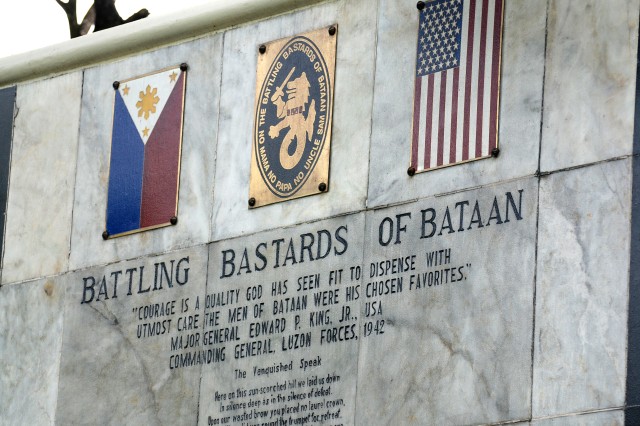
Bataan Memorial at Capas Concentration Camp, Philippines, photo by Rachael Tolliver

From Army.mil, the U.S. Army’s home page: Photo Credit: Rachael Tolliver/ The names and units of those U.S. military personal who died at, or in route to the Capas Concentration Camp during the Bataan Death March, are etched on marble and titled “Battling Bastards of Bataan.” The memorial is located at the Capas National Shrine, in Capas, Tarlac, Philippines. “Battling Bastards of Bataan” was a limerick poem penned by Frank Hewlett, Manila bureau chief for UP and the last reporter to leave Corregidor before it fell to the Japanese. “We’re the battling bastards of Bataan/No mama, no papa, no Uncle Sam/No aunts, no uncles, no cousins, no nieces/No pills, no planes, no artillery pieces/And nobody gives a damn.”

More:


Spreading the news: Environmental Health News says we can learn from saving eagles, to save honeybees now

July 5, 2015

Environmental Health News invites repostings of this story, with attribution and links back to EHN’s original story.

It’s a good article. Can’t improve on it much, so let’s save time and pass it directly.

Can we learn from the success in saving the bald eagle from extinction, to save our domestic bee industry and native American pollinators?

Unintended consequences

How a law that failed to protect eagles could offer a lesson to save honeybees

June 6, 2015

By Peter Dykstra
Environmental Health News

Spraying DDT on a beach

Historic photo from EPA

The Bald Eagle Protection Act, signed into law 75 years ago on June 8, 1940, was well-intended. A multi-pronged assault on the raptors was taking its toll — habitat loss, lead-shot poisoning, and bounty-hunting by ranchers and fishermen all contributed to a growing threat. (Click here to see how this played out in Alaska.)

Congress passed, and President Franklin D. Roosevelt signed, the act to outlaw the “taking” of eagles and their eggs, disruption of their nests, or sale or possession of eagle feathers or parts.

It didn’t work. Bald eagle populations accelerated their decline, for reasons that Congress, wildlife officials, and FDR couldn’t possibly anticipate.

Throughout the late 1930’s Swiss chemist Paul Müller labored to find the right mix of synthetic chemicals to control moths. Not only did dichlorodiphenyltrichloroethane do the trick, but Müller’s lab work found it was effective against lice, houseflies, beetles, and the dreaded mosquito. Müller’s employers, J.R. Geigy AG, applied for the first DDT permit about two months before the Eagle Act passed.

Pest Management Professional Hall of Fame

Swiss chemist Paul Muller, of A. G. Geigy corporation; the man who discovered DDT kills.  Pest Management Professional Hall of Fame

The rest is natural and human history. Cheap to produce and an effective defense against lice-borne typhus and mosquito-borne malaria, DDT quickly became a fixture in farm fields, living rooms, and World War II battle theaters. Müller became a science rock star, garnering a Nobel in 1948 and — wait for it — membership in the Pest Management Professional Hall of Fame in 2004.

But bald eagles continued to decline. So did hummingbirds, robins, ospreys, pelicans and peregrine falcons. Years of science, met with serious blowback from the chemical industry, eventually proved that DDT was thinning birds’ eggshells, not to mention causing impacts in fish, humans, and other mammals. Rachel Carson’s Silent Spring drew international attention to the threat, and in the U.S., DDT was outlawed on the last day of 1972. Bald eagles, ospreys, brown pelicans and peregrine falcons have all since staged remarkable comebacks from the Endangered Species list.

Which brings us to today’s threat to other ecologically priceless wildlife — pollinators. Honeybee populations have been in freefall for more than a decade. Like the threats to eagles, the potential causes are multiple: loss of habitat and native plants, parasites, and a mix of insecticides and fungicides. Newest, and most notable among the suspects, are neonicotinoid pesticides. Like DDT, neonics were developed in the 1980’s and 1990’s and welcomed as a step forward, since they were thought to be effective on insect pests but relatively benign on non-target wildlife and ecosystems. Today they are a billion-dollar agricultural product, ubiquitous on common crops like corn and soybeans.

But mounting evidence shows that neonicotinoids may be part of the frontal assault on bees and other pollinators. In 2013, the European Union banned the use of three of the most contentious types of neonicotinoids, citing a clear and immediate risk.

In 2014, President Obama ordered the creation of a federal pollinator strategy. Its first draft came out last month, calling for everything from creating bee-friendly habitat to further study on neonics and other agricultural chemicals. The first edition of the strategy, issued in May, outlines a multi-year process for re-examining use of neonics.

If the EPA and other federal agencies concur with other studies on the potential harm of neonicotinoids, the U.S. will issue assessments for neonics in 2016 and 2017, and may or may not take action until 2018 to 2020. All of this will take place under a new president who may or may not take interest in protecting bees.

That timetable may work. Or not. Or, with a president with little more than a year left in office and a hostile Congress, it may be a moot point.

But perhaps a more important point is that in 1940, the President and Congress took action on the known threats to eagles. They didn’t know about the chemical risk from DDT. If neonics are as big a threat as the science suggests, the current president and Congress won’t have ignorance as an excuse for waiting.


EHN welcomes republication of our stories, but we require that publications include the author’s name and Environmental Health News at the top of the piece, along with a link back to EHN’s version.

For questions or feedback about this piece, contact Brian Bienkowski at bbienkowski@ehn.org.

Prior to the 20th century, all eagles, including bald eagles were regarded as pest predators and pest carrion eaters.  Populations of the birds plunged between 1492 and 1900.  The first eagle protection law in 1918 did little to stop the decline in eagle populations.  A harder-toothed anti-hunting law in 1941 helped, as discussed above. Anti-environmentalists often seize on these historic facts to claim that DDT was not to blame for the failure of the eagles to recover after 1941.  But recovery of the birds started as soon as DDT was banned.  Fecundity of bald eagle populations rose in direct proportion to the drop in residual DDT and DDT breakdown products in the flesh and fat of eagles.

In Silent Spring Rachel Carson provided 53 pages of notes and citations to science journals, documenting the dangers and the unknowns of DDT and a variety of other chemicals. The book was published in 1962.  It is a tribute to Carson’s meticulous research that every study she pulled from is still accurate today. Later research only supported her conclusions, or in the case of bird damage and eggshell thinning, provided documentation of even more and greater harms.

Do we learn from history?


Fly your flag today, July 4, 2015

July 4, 2015

Follow the example of the young Gerald Ford.

1929: #President Gerald R Ford Jr holding flag with Eagle Scout Guard of Honor Mackinac Island State Park #Michigan. Tweet from America's Gallery

1929: #President Gerald R. Ford, Jr. holding flag with Eagle Scout Guard of Honor, Mackinac Island State Park, #Michigan. Tweet from America’s Gallery

Flags up in the morning, down at sunset.

Have a good, safe and joyful Fourth of July.


How could John Adams be so wrong about the Fourth of July?

July 2, 2015

“The Second Day of July 1776 will be the most memorable Epocha, in the History of America. . . . It ought to be solemnized with Pomp and Parade, with Shews, Games, Sports, Guns, Bells, Bonfires, and Illuminations from one End of this Continent to the other from this Time forward forever more.”
John Adams to Abigail Adams, July 3, 1776

Surely John Adams knew that July 4 would be Independence Day, didn’t he?

In writing to his wife Abigail on July 3, John Adams committed one of those grand errors even he would laugh at afterward. We’ll forgive him when the fireworks start firing.

1776 filled the calendar with dates deserving of remembrance and even celebration. John Adams, delegate from Massachusetts to the Second Continental Congress, wrote home to his wife Abigail that future generations would celebrate July 2, the date the Congress voted to approve Richard Henry Lee’s resolution declaring independence from Britain for 13 of the British colonies in America.

Continental congress DSC_0607

Scene of the crime — Independence Hall in Philadelphia, where the Second Continental congress approved the resolution to declare the colonies independent from Britain – (Photo credit: diablodale)

Two days later, that same Congress approved the wording of the document Thomas Jefferson had drafted to announce Lee’s resolution to the world.

Today, we celebrate the date of the document Jefferson wrote, and Richard Henry Lee is often a reduced to a footnote, if not erased from history altogether.

Who can predict the future?

(You know, of course, that Adams and Jefferson both died 50 years to the day after the Declaration of Independence, on July 4, 1826. In the 50 intervening years, Adams and Jefferson were comrades in arms and diplomacy in Europe, officers of the new government in America, opposing candidates for the presidency, President and Vice President, ex-President and President, bitter enemies, then long-distance friends writing almost daily about how to make a great new nation. Read David McCullough‘s version of the story, if you can find it.)

(Yes, this is mostly an encore post.)

More, and Related articles:

The Lee Resolution.

The Lee Resolution, passed by the Second Continental Congress on July 2, 1776 – Wikipedia image (Wait a minute: Are those numbers added correctly? What are they?)

Yes, this is mostly an encore post. Fighting ignorance requires patience.

Yes, this is mostly an encore post. Fighting ignorance requires patience.


Madison, Clay and Huxley: June 29 is a day of passings

June 29, 2015

Three great historical figures passed on June 29 — and I’ll wager there are others, but I stumbled on these three in the past day.

  • James Madison, Father of the Constitution, and our fourth president
  • Henry Clay, who many including himself thought should have been president
  • Thomas Huxley, the scientist perhaps best known for his spirited defense of evolution theory and Charles Darwin against an ungrateful Bishop Samuel Wilberforce

Historian Michael Beschloss noted Madison’s passing:

Madison was born in 1751.

Henry Clay falls into that history between the founding and the Civil War, when he won the name “the Great Compromiser” for his ability to put together agreements and laws that patched things up for a while — holding the south in the union, but not giving in to expansions of slavery, for example.  Clay wanted to preserve the union, but he wanted full support from citizens in all corners of the nation. He wrote words perhaps relevant to political contretemps of today:

I implore, as the best blessing which Heaven can bestow upon me upon earth, that if the direful and sad event of the dissolution of the Union shall happen, I may not survive to behold the sad and heart-rending spectacle.

“On the Compromise Resolutions,”
speech before the U.S. Senate,
February 5 and 6, 1850,
The Life and Speeches of Henry Clay (Littleton, Colorado: Fred B. Rothman, 1987), 2: 664.

Henry Clay died June 29, 1852, perhaps within weeks of this photo:

Henry Clay, photo by Mathew B. Brady between 1850 and 1852; Library of Congress archives.

Henry Clay, photo by Mathew B. Brady between 1850 and 1852; Library of Congress archives.

There’s a longer article on Clay’s amazing life and achievements at LOC’s “Today in History.” The Library of Congress also gives a brief summary of Clay’s history:

Republican Senator from Kentucky, 1806-1807, 1810-1811; Congressman, 1811-1814, 1815-1821, 1823-1825; U.S. Secretary of State, 1825-1829; Whig Senator, 1831-1842, 1849-1852; Democratic Republican candidate for President, 1824; National Republican candidate for President, 1832; Whig candidate for President, 1844.

Clay was born in 1777.

Thomas Huxley’s passing, on June 29, 1895, earns a spot on the calendar of events at Smithsonian.com

Thomas Henry Huxley, a British biologist and firm believer in evolution, dies at age 70. The greatest defender of Darwinism in Britain, he once said,

“The deepest sin against the human mind is to believe things without evidence.”

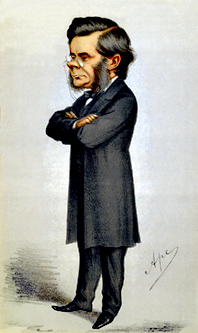
Thomas Henry Huxley, in an 1871 drawing by Carlo Pellegrini for Vanity Fair.

Thomas Henry Huxley, in an 1871 drawing by Carlo Pellegrini for Vanity Fair.

Huxley’s quote is one more indictment of people affected by the Dunning Kruger effect, something I just became aware of yesterday.  Yes, I need to source it better.

Upon reading Darwin’s big book, Origin of Species, Huxley wrote Darwin on November 23, 1859, one week after the book was published:

I finished your book yesterday. . . Since I read Von Baer’s Essays nine years ago no work on Natural History Science I have met with has made so great an impression on me & I do most heartily thank you for the great store of new views you have given me. . .
As for your doctrines I am prepared to go to the Stake if requisite. . .
I trust you will not allow yourself to be in any way disgusted or annoyed by the considerable abuse & misrepresentation which unless I greatly mistake is in store for you. . . And as to the curs which will bark and yelp — you must recollect that some of your friends at any rate are endowed with an amount of combativeness which (though you have often & justly rebuked it) may stand you in good stead —
I am sharpening up my claws and beak in readiness

  • Letter of T. H. Huxley to Charles Darwin, November 23, 1859, regarding the Origin of Species

Huxley, born in 1825, lived 70 great years in science.

Who else died on June 29 whom we should remember?


Wind power ready for its closeup?

June 27, 2015

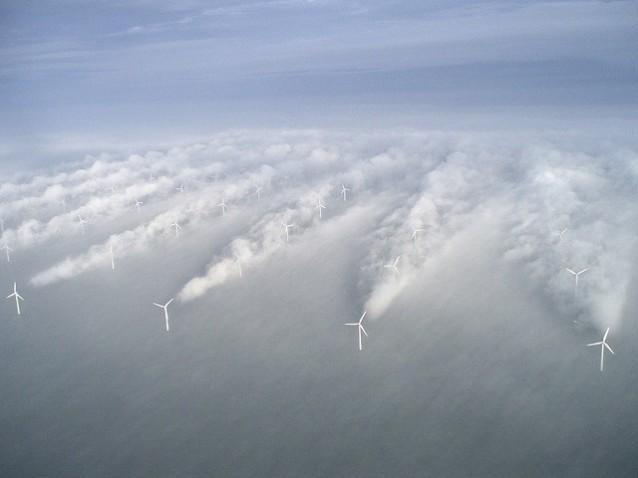
Climate Progress used this photo in a Tweet touting Denmark’s wind power progress:

Denmark sets world record for wind power production http://thkpr.gs/3608898   (No other photo information in Tweet)

Denmark sets world record for wind power production http://thkpr.gs/3608898 (Photo credit: flickr/Vattenfall)

Awesome photograph, a 21st century version of those photos of men, machines, bridges and other industrial objects admired for their symmetry and sharp shadows from the 1920s and 1930s. I would guess it was captured by an airplane passenger passing over the at-sea windfarms springing up around Europe’s Atlantic Coast, off the coast of Denmark, if Climate Progress editors were careful.

Scientifically, the photo shows what happens when windmills reduce the air pressure downwind of the blades — condensation can suddenly become visible.  Condensation trails from windmills (won’t that vex the hell out of chemtrails tinfoil hatters?).

The photo illustrates what should be good news:

Denmark has been long been a pioneer in wind power, having installed its first turbines in the mid-1970s when oil shocks sent the import-dependent nation on a quest for energy security. Thirty-seven years later, the country has set a new world record for wind production by getting 39.1 percent of its overall electricity from wind in 2014. This puts the Northern European nation well on track to meet its 2020 goal of getting 50 percent of its power from renewables.

The news of Denmark’s feat adds to the national records the U.K. and Germany set for 2014 and further establishes Europe as a leader in the wind power industry. This is especially true when it comes to offshore resources, as countries like Scotland, England, and Denmark build out their offshore wind farms. Wind generated enough electricity to power just over 25 percent of U.K. homes in 2014 — a 15 percent increase from 2013. In December, Germany generated more wind power, 8.9 terawatt-hours, than in any previous month.

A big source of the surge of Denmark’s wind production this year came from the addition of around 100 new offshore wind turbines. In January of 2014, the peninsular country got just over 61 percent of its power from wind. This is more than three times the overall production of 10 years ago, when wind only made up 18.8 percent of the energy supply. The country has a long-term goal of being fossil fuel-free by 2050.

Anti-greens, and rational conservationists, see trouble though. Anti-greens holler that the windmills “kill birds,” as if the coal power plants the windmills displace do less environmental damage.  They will bring this up in every discussion of alternative energy sources, and in every discussion of working to reduce carbon dioxide emissions to decrease pollution and damage from climate change.  I suppose they want us to throw up our hands and give up on conservation.  (Industry agents like CFACT have no compunction against giving half-truths on these issues.)

Conservationists, like Chris Clarke, see the dangers.  Bird kills do occur at wind farms, in greater numbers than any conservationist is comfortable with.  Off-shore wind farms could hammer migrating populations of songbirds and other migratory fowl, in addition to the sea-dwelling birds.  Few solid studies on bird damage exist.  We are particularly the dark about the songbirds, who migrate in enormous avian clouds at night.  An article in Nature sums up issues:

Wind turbines kill far fewer birds in general each year than do many other causes linked to humans, including domestic cats and collisions with glass windows. But wind power has a disproportionate effect on certain species that are already struggling for survival, such as the precarious US population of golden eagles (Aquila chrysaetos canadensis).

“The troubling issue with wind development is that we’re seeing a growing number of birds of conservation concern being killed by wind turbines,” says Albert Manville, a biologist with the US Fish and Wildlife Service in Arlington, Virginia.

It is good news that wind power can replace fossil fuels. But industrial-sized enterprises inherently create environmental problems. Our policy makers need to be alert to the issues involved, and create incentives for development of alternative energy sources that will prevent our falling into the rut of industrial development that comes at enormous costs pushed to future generations.

Who is looking out for the birds? Can there be anyone who argues we should give up on climate change because of problems from alternative energy, really?

Chris Clarke tells us the problems, that we need accurate, relevant information, and we don’t have a methodical process to get it:

The issue of eagles being harmed by wind turbines in the U.S. is a huge topic, to put it mildly. And yet a paper documenting two eagle mortalities at a wind turbine facility in the last 20 years is “conceptually novel” enough to merit publication in a prestigious wildlife science journal.

Put it this way: The scientific community has more information on deaths among marine mammals, which spend much of their time in places it’s hard for us to get to, than it does about injuries and deaths to rather conspicuous birds in industrial facilities. Hell, we have better, more solid data on planets outside our solar system than we do on eagle mortalities at wind energy plants in California.

One could ask the rhetorical question “why is that the case,” but it’s almost a waste of time: it’s because wind energy companies would strongly prefer that data never gets released to the public.

And that’s what peer-reviewed journals are, for all their abstruse language and incomprehensible math and absurd paywalls: public information. Once that data gets analyzed and put in context by independent biologists, it becomes available to us all.

[USGS research ecologist Jeffrey] Lovich puts it this way:

Minimizing wildlife mortality at wind farms is a major goal of conservation, although research on how best to do that is in short supply. Compiling and publishing accurate data on mortality of Golden Eagles over time is an important first step in efforts to protect these iconic birds.

And doing so in the clear light of day is crucial if we in the public are ever to make scientifically sound decisions about our energy policy, regardless of whether we put windpower or wildlife first.

Who will provide that information? Who will even ask for it? If we can’t get consensus on whether we should save humanity’s home on Earth, how can we get consensus on asking the questions about how to go about it, and how to learn how to do it?


Key part of Burwell decision: “Congress passed the Affordable Care Act to improve health insurance markets”

June 25, 2015

U.S. Supreme Court hearing oral arguments in King v. Burwell.  The decision issued on June 25, 2015. Image from Newsworks (who is the artist?)

U.S. Supreme Court hearing oral arguments in King v. Burwell. The decision issued on June 25, 2015. Image from Newsworks. [Continued search for credit information on this image turned up this caption; artist is Dana Verkouteren of Associated Press] “This courtroom artist rendering shows Michael Carvin, lead attorney for the petitioners, right, speaking before the Supreme Court in March. King v. Burwell, a major test of the Affordable Care Act, could halt health care premium subsidies in all the states where the federal government runs the insurance marketplaces. (AP Photo/Dana Verkouteren)

In all the rending of garments and gnashing of teeth about the Supreme Court’s decision in the Burwell case today, you’d be lucky to learn what the Court actually said.

Here are the key paragraphs of the majority’s decision (links added here), as written by Chief Justice John Roberts:

Reliance on context and structure in statutory interpretation is a “subtle business, calling for great wariness lest what professes to be mere rendering becomes creation and attempted interpretation of legislation becomes legislation itself.” Palmer v. Massachusetts, 308 U. S. 79, 83 (1939). For the reasons we have given, however, such reliance is appropriate in this case, and leads us to conclude that Section 36B allows tax credits for insurance purchased on any Exchange created under the Act. Those credits are necessary for the Federal Exchanges to function like their State Exchange counterparts, and to avoid the type of calamitous result that Congress plainly meant to avoid.

*    *    *

In a democracy, the power to make the law rests with those chosen by the people. Our role is more confined—“to say what the law is.” Marbury v. Madison, 1 Cranch 137, 177 (1803). That is easier in some cases than in others. But in every case we must respect the role of the Legislature, and take care not to undo what it has done. A fair reading of legislation demands a fair understanding of the legislative plan.

Congress passed the Affordable Care Act to improve health insurance markets, not to destroy them. If at all possible, we must interpret the Act in a way that is consistent with the former, and avoids the latter. Section 36B can fairly be read consistent with what we see as Congress’s plan, and that is the reading we adopt.

The judgment of the United States Court of Appeals for the Fourth Circuit is

Affirmed.

Go read the rest of the 47 pages (in the .pdf from the Supreme Court), if you wish to be well-informed.  The case probably isn’t at all what’s being reported in most venues.


June 25: Virginians fly flags to commemorate statehood, and Col. Van T. Barfoot

June 24, 2015

June 25 is Virginia Statehood Day.  The U.S. Flag Code urges Americans to fly the U.S. flag on the statehood date of their states.

Virginia is counted as the 10th state, by virtue of the Virginia ratifying convention’s having voted to ratify the U.S. Constitution on June 25, 1788 — over the strong objections of Gov. Patrick Henry, and with the skilled legislative work of James Madison.

The Constitution became effective upon the ninth state’s ratification, but Virginia, being the largest state in the union at the time, was considered a make-or-break vote.

June 25 is the last U.S. flag flying date in June 2015.

So, Virginians: Fly your U.S. flags on June 25, as Col. Van T. Barfoot did every day until his death.

From the Washington Post: Retired Col. Van T. Barfoot, a Medal of Honor recipient, and his daughter Margaret Nicholls lower the flag outside Barfoot's home in the Sussex Square subdivision in Henrico County, Va., in 2009. Barfoot died March 2 [2012] at a hospital in Richmond. He was 92. (Photo by Eva Russo/AP)

From the Washington Post: “Retired Col. Van T. Barfoot, a Medal of Honor recipient, and his daughter Margaret Nicholls lower the flag outside Barfoot’s home in the Sussex Square subdivision in Henrico County, Va., in 2009. Barfoot died March 2 [2012] at a hospital in Richmond. He was 92. (Photo by Eva Russo/AP)”

You may remember the story of Col. Barfoot. As a veteran of World War II, Korea and Vietnam, he flew Old Glory every day. In 2009 his Henrico County, Virginia homeowners association complained, ordered him to stop flying the U.S. flag and take down his flag pole, erected in violation of HOA “curb appeal” rules.

Col. Barfoot refused.  Eventually the public outcry, including pressure from President Barack Obama, got the HOA to back down.  Obama said Barfoot was a good example, and had earned the right to fly Old Glory.

Barfoot had a particularly compelling case to fly the flag. Barfoot was awarded the Congressional Medal of Honor for his service in Italy, against German troops, in 1944.  The Washington Post explained: 

Early in the war, he participated in the Army’s invasion of Italy. As his unit moved inland, the soldiers took up defensive positions near Carano.

On May 23, 1944, Col. Barfoot was ordered to lead an assault on German positions. He went out alone and crawled to within feet of a German bunker.

According to his Medal of Honor citation, he tossed a grenade inside, killing two Germans and wounding three others. He then moved to another bunker nearby and killed two more German soldiers with his submachine gun while taking three others prisoner. A third machine gun crew, watching Col. Barfoot’s methodical assault, surrendered to him. In all, 17 Germans gave themselves up to Col. Barfoot.

In retaliation, the Germans organized a counterattack on Col. Barfoot’s position, sending three tanks toward him.

Col. Barfoot grabbed a bazooka grenade launcher and stood 75 yards in front of the leading tank. His first shot stopped it in its tracks. He then killed three of the German tank crew members who had attempted to escape.

The other two tanks, witnessing the destruction, abruptly changed directions, moving away from Col. Barfoot. Returning to his platoon, he helped carry two wounded U.S. soldiers almost a mile to safety.

Commending his “Herculean efforts,” Col. Barfoot’s citation praised his “magnificent valor and aggressive determination in the face of pointblank fire.”

Col. Barfoot served in the Korean War and later in Vietnam as a helicopter pilot. His other military decorations included the Silver Star; two awards of the Legion of Merit; the Bronze Star; three awards of the Purple Heart; and 11 awards of the Air Medal.

So, Virginians, would it inconvenience you much to fly your U.S. flags today — in honor of Col. Van T. Barfoot, as well as in honor of your state’s entry into the Union?

What do we do to deserve the loyalty and service of such men?


Early history of EPA: Pesticides regulation and DDT

June 24, 2015

This is an excerpt from EPA’s official shorthand history, online since the 1990s.  I include this part here, dealing with the EPA’s famous regulation of the pesticide DDT, because I refer to it and link to it in several posts — and because over three different administrations, the URL has changed several times.  I fear it will one day go dark.  Here it is for history’s sake, found on June 24, 2015 at http://www2.epa.gov/aboutepa/guardian-epas-formative-years-1970-1973#pest.

Opening to the entire piece; links to subsections go to EPA’s site:

The Guardian: EPA’s Formative Years, 1970-1973

EPA 202-K-93-002
September 1993
by Dennis C. Williams

Table of Contents

The section on DDT hearings and regulation:

Pesticides and Public Health

Unlike the air controversy, which erupted after the agency’s establishment, EPA’s creation coincided with the culmination of the public debate over DDT (dichloro-diphenyl-trichloro-ethane). A chlorinated hydrocarbon, DDT proved to be a highly effective, but extremely persistent organic pesticide. Since the 1940s, farmers, foresters, and public health officials sprayed it across the country to control pests such as Mexican boll weevils, gypsy moths, and pesky suburban mosquitoes. Widespread public opposition to DDT began with the publication of Rachel Carson’s influential Silent Spring. Reporting the effects of DDT on wildlife, Carson demonstrated that DDT not only infiltrated all areas of the ecological system, but was exponentially concentrated as it moved to higher levels in the food web. Through Carson, many citizens learned that humans faced DDT-induced risks. By 1968 several states had banned DDT use. The Environmental Defense Fund, which began as a group of concerned scientists, spearheaded a campaign to force federal suspension of DDT registration–banning its use in the United States. Inheriting Department of Agriculture (USDA) pesticide registration functions, under the Federal Insecticide, Fungicide, and Rodenticide Act (FIFRA) of 1964, EPA was born in the midst of the DDT storm.

In January 1971, a tribunal of the U.S. Court of Appeals in the District of Columbia ordered Ruckelshaus to begin the process of suspending DDT’s registration, and to consider suspending its registration immediately. At the end of a sixty-day review process, the administrator reported that he had found no good reason to suspend DDT registration immediateIy. It and several other pesticides–including 2, 4, 5-T (Agent Orange), Dieldrin, Aldrin, and Mirex–did not appear to constitute imminent health threats. This action infuriated many environmentalists.

By 1971, the Environmental Defense Fund had mobilized effective public opposition to DDT. The furor created by Ruckelshaus’s refusal to stop DDT use prompted many to look for sinister political motivations. Some suggested that Mississippi Congressman Jamie Whitten had used his position as chairman of the agricultural appropriations subcommittee of the House Appropriations Committee to make Ruckelshaus conform to the interests of the agrichemical lobby. While actually, Ruckelshaus took his cautious stance for less menacing reasons.

At its creation, EPA not only inherited the function of pesticide registration from USDA, but also the staff that served that function. The USDA economic entomologists who designed the pesticide registration process in the first place preached the advantages of effective pesticides and minimized discussion of debatable health risks. The same staff that had backed USDA Secretary Clifford Hardin’s earlier claim that DDT was not “an imminent hazard to human health or to fish and wildlife” 8 provided Ruckelshaus with the same counsel.

Rachel Carson's Silent Spring led to banning DDT and other pesticides.

Rachel Carson’s Silent Spring led to banning DDT and other pesticides.

Between March 1971 and June 1972, American newspapers reported both sides of the pesticide debate. Some articles recalled the glory days when pesticides saved thousands of lives in World War II; how they had increased agricultural productivity and allowed relatively few farmers to feed the world’s growing population; and how the most besieged insecticides, such as DDT and Mirex, had little human toxicity. Other journalists praised alternative approaches to pest management such as biological controls (predator introduction, sterile males, and pheromone traps), integrated controls (crop rotation and carefully delimited pesticide use), and refinement of other, less persistent chemicals. Some reported the near panic of Northwestern fruit growers facing beeless, and therefore fruitless, seasons. They attributed the lack of pollinating insects to pesticide use.

Throughout the spring of 1972, Ruckelshaus reviewed the evidence EPA had collected during the agency’s hearings on DDT cancellation and the reports prepared by two DDT study groups, the Hilton and Mrak Commissions. Both studies suggested that DDT be phased out due to the chemical’s persistent presence in ecosystems and noted studies suggesting that DDT posed a carcinogenic risk to humans. In June, he followed the route already taken by several states he banned DDT application in the United States. Though unpopular among certain segments of EPA’s constituency, his decision did serve to enhance the activist image he sought to create for the agency, and without prohibitive political cost.

The DDT decision was important to EPA for several reasons. While it did not stop the debate over what constituted appropriate pesticide use, DDT demonstrated the effect public pressure could have on EPA policy decisions. It also made very visible the tightrope act a regulatory agency performs when it attempts to balance the demands for protection of human and environmental health against legitimate economic demands. Furthermore, EPA’s decision set a precedent for regulatory decision-making. As an advocate of the environment, Ruckelshaus and the agency chose to risk erring on the side of protecting human health at the expense of economic considerations–a course that would bring the agency under heavy criticism before the end of its first decade.


Tree bark, a catalog of unexpected beauty

June 23, 2015

You really should be following Maria Popova’s Tweets, and Brainpicker.

There you’ll learn of this marvelous book:

Brain Pickings: "French photographer Cedric Pollet travels the world to capture this beauty and has documented it in his gorgeous new book, Bark: An Intimate Look at the World’s Trees."

Brain Pickings: “French photographer Cedric Pollet travels the world to capture this beauty and has documented it in his gorgeous new book, Bark: An Intimate Look at the World’s Trees.”


Look at some of the photos. Wow.

Pollet’s view of the lowly ocotillo:

Cedric Pollet, Ocotillo tree bark

“Ocotillo tree, a shrub-like plant found in the Southeast United States”

Does one need to have a background in botany to think tree bark is interesting, and even beautiful?

Ms. Popova said Cedric Pollet traveled the world to find these great subjects to photograph.  One could do well trying to duplicate his tour.

What trees in your yard have outstanding bark?  Where are your photographs?

Cedric Pollet's photo, Mindanoan gum (or rainbow eucalyptus) found in the Philippines, where the bark is used as a traditional remedy against fatigue

“Mindanoan gum (or rainbow eucalyptus) found in the Philippines, where the bark is used as a traditional remedy against fatigue”

How often do we see the forest, but miss the details of the trees?