Typewriter of the moment: Ho Chi Minh

August 21, 2014

Ho Chi Minh at his typewriter.  Photo from EarthStation 1

Ho Chi Minh at his typewriter. Photo from EarthStation 1

The image looks to me to have been lifted off of a film or video; by the non-white color of his beard, this must have been taken sometime before 1955.  I’ve found no other details on the photo, especially nothing on the typewriter.  Anybody know the date of the photo, the occasion, the location, or the typewriter?

But there you go:  Ho Chi Minh, the leader of the Vietnam freedom fighters against the Japanese in World War II, then against the French colonialists (his forces then called Viet Minh, and later Viet Cong), and then of North Vietnam against South Vietnam and the United States after 1954, until his death in 1969.

Ha!  A second photo of Ho and a typewriter, from Greg Hocfell:

Ho Chi Minh at his typewriter.  Photo via Greg Hocfell

Ho Chi Minh at his typewriter. Photo via Greg Hocfell

Might those photos be from the same session?  Ho looks about the same age, his hair and beard are about the same color, and he’s wearing a dark shirt with white buttons in each.

More:


Millard Fillmore resources, from the Library of Congress

August 20, 2014

Found this wonderful page with a list of resources on Millard Fillmore, available on line from the Library of Congress.  The list was compiled by Library of Congress’s Virtual Services, Digital Reference Section.

Completely cribbed from that site:

Millard Fillmore: A Resource Guide

Millard Fillmore: whig candidate for Vice President of the United States
Millard Fillmore: whig candidate for Vice President of the United States.
1 print : lithograph.
New York : Published by N. Currier, c1848.
Prints & Photographs Division.
Reproduction Number:
LC-USZ62-7549

American Memory Historical Collections

Abraham Lincoln Papers at the Library of Congress

The complete Abraham Lincoln Papers from the Manuscript Division at the Library of Congress consist of approximately 20,000 documents. The Lincoln Papers contain more than fifty items to, from, or referring to Millard Fillmore. To find these documents, go to the collection’s search page, and search on the phrase Millard Fillmore (do not put quotation marks around the words).

Among the collection’s Fillmore-related materials are:

An American Time Capsule: Three Centuries of Broadsides and Other Printed Ephemera

The Printed Ephemera collection comprises 28,000 primary source items dating from the seventeenth century to the present and encompasses key events and eras in American history. Search the bibliographic records and the full-text option to find items related to Millard Fillmore.

A Century of Lawmaking for a New Nation: U.S. Congressional Documents and Debates, 1774-1875

This collection contains a large selection of congressional material related to Millard Fillmore’s political career as a member of the House of Representatives, vice president, and president. Search this collection by date and type of publication to find materials related to Fillmore.

From Slavery to Freedom: The African-American Pamphlet Collection, 1824-1909

The collection consists of 397 pamphlets, published from 1824 through 1909, by African-American authors and others who wrote about slavery, African colonization, Emancipation, Reconstruction, and related topics, including two items that reference Millard Fillmore.

“I Do Solemnly Swear…”: Presidential Inaugurations

This collection contains approximately 400 items relating to presidential inaugurations, including a lithograph of Millard Fillmore from 1850.

Map Collections

The focus of Map Collections is Americana and the cartographic treasures of the Library of Congress. These images were created from maps and atlases selected from the collections of the Geography and Map Division. Millard Fillmore’s personal collection of printed and manuscript maps is represented by sixteen maps.

Music for the Nation: American Sheet Music, 1820-1860 & 1870-1885

This collection contains more than 62,500 pieces of historical sheet music registered for copyright, including three songs related to Millard Fillmore.

The Nineteenth Century in Print: Periodicals

This collection presents twenty-three popular periodicals digitized by Cornell University Library and the Preservation Reformatting Division of the Library of Congress. Search the bibliographic records and the full-text options to find articles that discuss Millard Fillmore.

Among the collection’s Fillmore-related articles are:

Words and Deeds in American History: Selected Documents Celebrating the Manuscript Division’s First 100 Years

In honor of the Manuscript Division’s centennial, its staff selected approximately ninety representative documents spanning from the fifteenth to the mid-twentieth centuries. The following items reference Millard Fillmore:

Happy researching! Teachers, be sure to make your students aware of these sites (I presume other presidents are covered, too).


Bill of Rights is location restricted?

August 20, 2014

MoveOn.org posted this photo on their Facebook page:

First Amendment Area?

First Amendment Area?

I presume (the post doesn’t say) this is a photo from Ferguson, Missouri. I presumed incorrectly.  It’s a sign from the Bundy Ranch standoff.

My first thought was, “Do they have a 2nd Amendment area?”  My second thought was, if we put up signs saying “2nd Amendment Area” will cops enforce it?

It’s probably a violation of prior restraint law, of course.  The sign is an indication of just how bizarre and sick things are in Ferguson, Missouri, at the moment.  It’s also an indication of how bizarre things were at Bundy Ranch.

Tip of the old scrub brush to Randy Creath.


Millard Fillmore’s term ended, 1853; another shot in 1864?

August 20, 2014

PrintsOldandRare.com had a copy of an 1864 Illustrated News with Millard Fillmore on the cover.

Prints Old and Rare:

Prints Old and Rare: “1853 Portrait of Millard Fillmore. Antique engraved portrait of Fillmore from the May 28, 1853 issue of the Illustrated News, surrounded by text discussing the history of his administration. 11×16 in. SOLD”

What was the contemporary judgment on the last Whig President, whose own party refused to nominate him for a term of his own?

One wonders if there isn’t another copy of that newspaper floating around out there, or whether it might be available at the Library of Congress.

Just about a decade later, some people thought Fillmore might be a good nominee for the Democrats, against Lincoln.  In a look back in history in the Columbia (Missouri) Daily Tribune, we find this news report out of Fulton, Missouri, repeated by Rudi Keller:

FULTON — Former President Millard Fillmore was a tested leader who would preserve the Union and heal political divisions, Editor John Williams wrote, announcing his preference for the Democratic presidential nomination.

“We have tried him and we know that he will do us justice,” Williams wrote.

The Democratic National Convention was scheduled to begin Aug. 29 at Chicago. Fillmore, 64, was gaining some notice as a potential candidate, but most Democrats were focused on Maj. Gen. George McClellan. Nicknamed “The Young Napoleon,” McClellan was a meticulous officer who thoroughly organized the Army of the Potomac but was relieved of command because of his cautious approach to combat.

Missouri had 22 delegate seats at the convention, with U.S. Rep. William Hall of Randolph County, banker Weston Birch of Howard County and former U.S. Rep. Thomas Price of Cole County included in the delegation.

Williams wrote that while he preferred Fillmore, “McClellan will do — he is a Christian — a soldier and a patriot. Although a war man we believe he would favor peace at once, with the most liberal terms, and on the condition of the Union. If not McClellan, then some other good man…”

Democrats nominated McClellan.  Lincoln won.

More:


How is your little tyke welcomed to school?

August 20, 2014

This is how it’s done right:

“You are the reason we are here.”

No Common Core Standards, no testing schedule, just a genuine welcome. Bet there's a lot more learning that goes on behind that door than many others.

No Common Core Standards, no testing schedule, just a genuine welcome. Bet there’s a lot more learning that goes on behind that door than many others.

Tip of the old scrub brush to @Kiwigirl58, Sahila ChangeBringer.

Read the rest of this entry »


No air conditioning in your classroom? Maasai school in Tanzania

August 20, 2014

Maasai school in Tanzania. Photo by Noel Feans,

Maasai school in Tanzania. Photo by Noel Feans, “We rule the school.” September 2009; Creative Commons copyright, Wikimedia image; also on Flickr

Another photo illustrating classroom technology in different cultures.


Sunshine on Harry Truman’s place

August 20, 2014

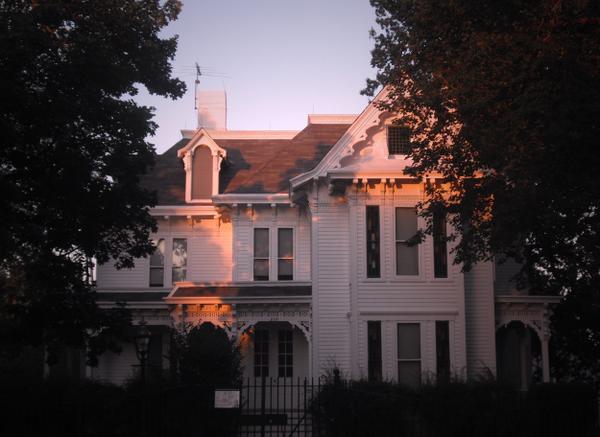
Sunset at the home of President Truman. @GoParks @Interior #POTUS

Sunset at the home of President Truman. @GoParks @Interior #POTUS

In the late afternoon light, one gets a better view of just why Harry Truman was so fond of this house.  Who wouldn’t be?

Something to visit when you’re next in Independence, Missouri.

More:


Colorado schoolhouse (1895 vintage)

August 18, 2014

A few miles from the New Mexico border, in Chromo, Colorado:

East of Durango, along U.S. Highway 160, a school building with a sign suggesting it was built in 1895.

East of Durango, along U.S. Highway 160 84, a school building with a sign suggesting it was built in 1895.  The map said it was Chromo, Colorado.  Photos by Ed Darrell; use with attribution is encouraged.

Difficult to tell how many rooms; it could have had up to four classrooms at one point, I reckon.  The belfry is still there, but the bell is long gone — a prize for some scavenger if it was not removed for re-use, or for a museum.

Bigger windows that many modern schools, windows students could use to actually look outdoors.  Modern school architects seem to want students to be unaffected by the outdoors, or light from outdoors, often.

Off in a field by itself, there was plenty of room for kids to run around, at recess.

Off in a field by itself, there was plenty of room for kids to run around, at recess.

In this photo the sign is legible:  "Colorado State Approved School, 1895."

In this photo the sign is legible: “State of Colorado 1895 Approved Standard School.”

Was this a standard design, or does “standard school” refer to the program of instruction offered?

There were a few homes and farms close by.  The community has always been small.  How many students learned to read, learned how to handle numbers, read the greats of American history and literature in these walls?  Who were they, and where did they go?

How big a mark can a school, or a teacher, actually make?

More:


Photographs for which there are no words: Some hurdles to Back-to-School in Gaza

August 18, 2014

Getty images. A young boy at the blackboard of a school in Gaza, August 2014. Via BBC.

Getty images. A young boy at the blackboard of a school in Gaza, August 2014. Via BBC.

Gaza got bombed 97 years ago when the British seized it, in World War I.

In the 21st century, things have not changed enough for the people who live in the area.

It’s even worse in Gaza than it was for the West Bank earlier.


Fallen Monarch: A Yosemite tree that dwarfs an entire mounted cavalry

August 13, 2014

Yosemite National Park, Facebook site:    About forty members of U.S. 6th Cavalry, Troop F, shown mounted on, or standing beside their horses, and lined up atop and beside the Fallen Monarch tree in the Mariposa Grove of Giant Sequoias, Yosemite, 1899.

Yosemite National Park, Facebook site: About forty members of U.S. 6th Cavalry, Troop F, shown mounted on, or standing beside their horses, and lined up atop and beside the Fallen Monarch tree in the Mariposa Grove of Giant Sequoias, Yosemite, 1899.

Giant sequoia trees can be found only in the United States, and only in or near the Sierra Mountains in California. 

How massive are they?  The tree above, with the 6th Cavalry’s F Troop posing on and around it with their horses, is 26 feet in diameter at its base, where it fell, and 285 feet long,   Redwood doesn’t rot like other woods.  The tree is still there, today, looking much like it did 115 years ago (Comments on Yosemite NP photo).

The Fallen Monarch, in Mariposa Grove, in 1907:

Fallen Monarch, Mariposa Grove of Yosemite NP, in 1907, with a stage coach and team of six horses posing on top.

Fallen Monarch, Mariposa Grove of Yosemite NP, in 1907, with a stage coach and team of six horses posing on top.

When did the tree fall?  Hundreds of years ago, perhaps?

More:

Yosemite NP Nature Notes 11: Big Trees


If great scientists had logos . . .

August 11, 2014

These are quite creative.  I wonder who invented them?

Other possibilities?

Maybe:

Edison's logo?

Edison’s logo?


Every major league pitcher needs a change up; in politics, too

August 11, 2014

I don’t generally post these posters, except to take issue . . . but this one made me chuckle.

Daily Edge poster,

Daily Edge poster, “Not Reagan, you idiot. Obama.”

Text, with English teacher editing:

He created 9.9 million jobs in a record 53-month stretch of uninterrupted job growth.
He reduced the deficit by $800 billion within 5 years, and grew the stock market by 142% within his first 2,000 days.

Not Reagan, you idiot:  Obama.


Abiquiu stars

August 11, 2014

Making those nice photographs of the Milky Way and stars isn’t so easy as it looks.

I made my most successful efforts on our recent swing through Colorado, New Mexico and West Texas.  Here’s a shot I got that almost shows the Milky Way, probably has Polaris in it, and because it was a timed exposure, also captured star movement and an airplane flying overhead.  Photo was taken from the Army Corps of Engineers campground at Abiquiu Reservoir, a few miles from Georgia O’Keefe’s home.

Abiquiu Stars - Time photograph of stars against a pinon pine, pointing north; Milky Way almost visible in the East.

Abiquiu Stars – Time photograph of stars against a pinon pine, pointing north; Milky Way almost visible in the East.


Remembering Warren Bennis isn’t enough. Read his books! DO what he says!

August 11, 2014

I come back from vacation, and no one tells me Warren Bennis passed on?

Why wasn’t that front page news, in every city with a corporation, a government, or a school?

Warren Bennis, in a publicity photo from the University of Southern California, the last of several academic institutions where he taught, or lead the entire school.

Warren Bennis, in a publicity photo from the University of Southern California, the last of several academic institutions where he taught, or lead the entire school.

We know why. Bennis, who some claim invented the study of leadership in the modern world, is too little read in corporations — and almost never read in government, and probably never read in education leadership.

Try this experiment, you teachers:  As you go back to school this month for the “in service” sessions that challenge your ability to stay awake, ask your principals and administrators what their favorite Warren Bennis book, or idea, is.  If you find one who knows who Warren Bennis was, will you send us that person’s name for a Wall of Honor here?

Bennis wrote too abstractly for many.  He was not one who would have ever thought about writing The One Minute Manager, not because there aren’t some good ideas in that book, but because he wrote to the higher levels of organizational thinking.  (Our good friend Perry W. Buffington used to point out in his lectures that you’d run from the waiting room if you heard your neurosurgeon was reading the One Minute Brain Surgeon.  Bennis would have put it more gracefully, and taken three pages to do it — but a serious reader would understand.)

With all the trouble we have in organizations these days, you’d think Bennis’s work would be on everybody’s bookshelf, and assigned to all incoming interns.

Hey, you MBAs:  What class did you read Bennis in?  Did you read Bennis at all?

Jena McGregor, who spoke with and corresponded with Bennis several times in the last decade, wrote a remembrance in the Washington Post:

Warren Bennis, who died Thursday in Los Angeles at age 89, was once called the “dean of leadership gurus,” a description that unfortunately stuck.

I say “unfortunately” because, for Bennis, there was never any kind of shtick. There was no silver bullet or four-box matrix or slide deck offering an oversimplified how-to guide to leadership. This giant among leadership experts — I take no exception to the “dean” part — was a thinker and an adviser, but not a guru. He wrote and talked about leadership as if the answers were still being shaped, even in his experienced mind.

He was a thoughtful, genuine, and always engaged man whom I came to know in these past eight years as a reporter covering management and leadership.

“I am as leery as anyone of the idea of leaping to conclusions, or making more of evidence than is demonstrably true,” Bennis wrote in his influential 1989 classic, On Becoming a Leader. “To an extent, leadership is like beauty: It’s hard to define, but you know it when you see it.”

For Bennis, leadership was a personal journey, something individual and introspective that must be learned through life’s experiences. He was a staunch believer that leaders are made not born, formed out of “crucible” moments and struggles that prepare them to lead. As he wrote in On Becoming a Leader — essential reading for anyone — leadership is about self-discovery and self-expression. “Before people can learn to lead, they must learn something about this strange new world.”

It may take me a few days to organize thoughts: Does it matter that he’s gone, if those who most need his work would never read it anyway?

Any guy who can look at a convention of high-paid CEOs and tell them that followers make them what they are, deserves much more than just a second thought.

What do others say?

http://twitter.com/RandyEdsall/status/489023102370586625

(Note that the comments above came before news of Dr. Bennis’s death.)

We would expect David Gergen to know Bennis, and his work.

http://twitter.com/martykaplan/status/495582539625398272

Larry Ferlazzo knows Bennis’s work?  But do Ferlazzo’s bosses know it?  There’s the question.

I once took a survey among teachers, and not one said they thought their principal would fight to defend them; it was a small survey, but it discouraged me from pursuing the question more.

http://twitter.com/EconEconomics/status/497472983402037248

http://twitter.com/EconBizFin/status/498567221535584257

http://twitter.com/EconBizFin/status/498651331583037441

http://twitter.com/EconBizFin/status/498671813250269185

http://twitter.com/EdDarrell/status/498686612666982400


Remembering Nagasaki, in 2014

August 9, 2014

A roundup of thoughts on Twitter and elsewhere.

From The Bulletin of Atomic Scientists:

At the end of the day, it can be worthwhile on the Hiroshima and Nagasaki anniversaries to think about the personal and the emotional—while keeping such clinical data in mind and ready to hand when it is necessary to debate proponents of ideas such as “battlefield nuclear weapons,” “limited nuclear war,” and the use of select nuclear strikes as a form of “de-escalation.”

Therefore, perhaps the most compelling of the stories in the Bulletin archive is a first-person recollection, Hiroshima Memories, by Hideko Tamura Friedman, who was just a young girl back on August 6, 1945. After moving to the United States and becoming a therapist in private practice and a part-time social worker in the Radiation Oncology Department at the University of Chicago Hospitals, Hideko excerpted this 1995 article  from a longer, unpublished manuscript she was working on.

Hideko describes how she was reading a book when “a huge band of white light fell from the sky down to the trees.” She jumped up and hid behind a large pillar as an explosion shook the earth and pieces of the roof fell about her.

Hideko survived; some members of her family did not. “My father,” she wrote in in a heart-rending statement of fact, “brought Mama’s ashes home in his army handkerchief.”

Editor’s note: The Bulletin’s archives from 1945 to 1998, complete with the original covers and artwork, can be found here.  http://books.google.ca/books?id=-wsAAAAAMBAJ&source=gbs_all_issues_r&cad=1. Anything after 1998 can be found via the search engine on the Bulletin’s home page.

http://twitter.com/wellerstein/status/498124471979745280

Even the cross was bent by the blast.