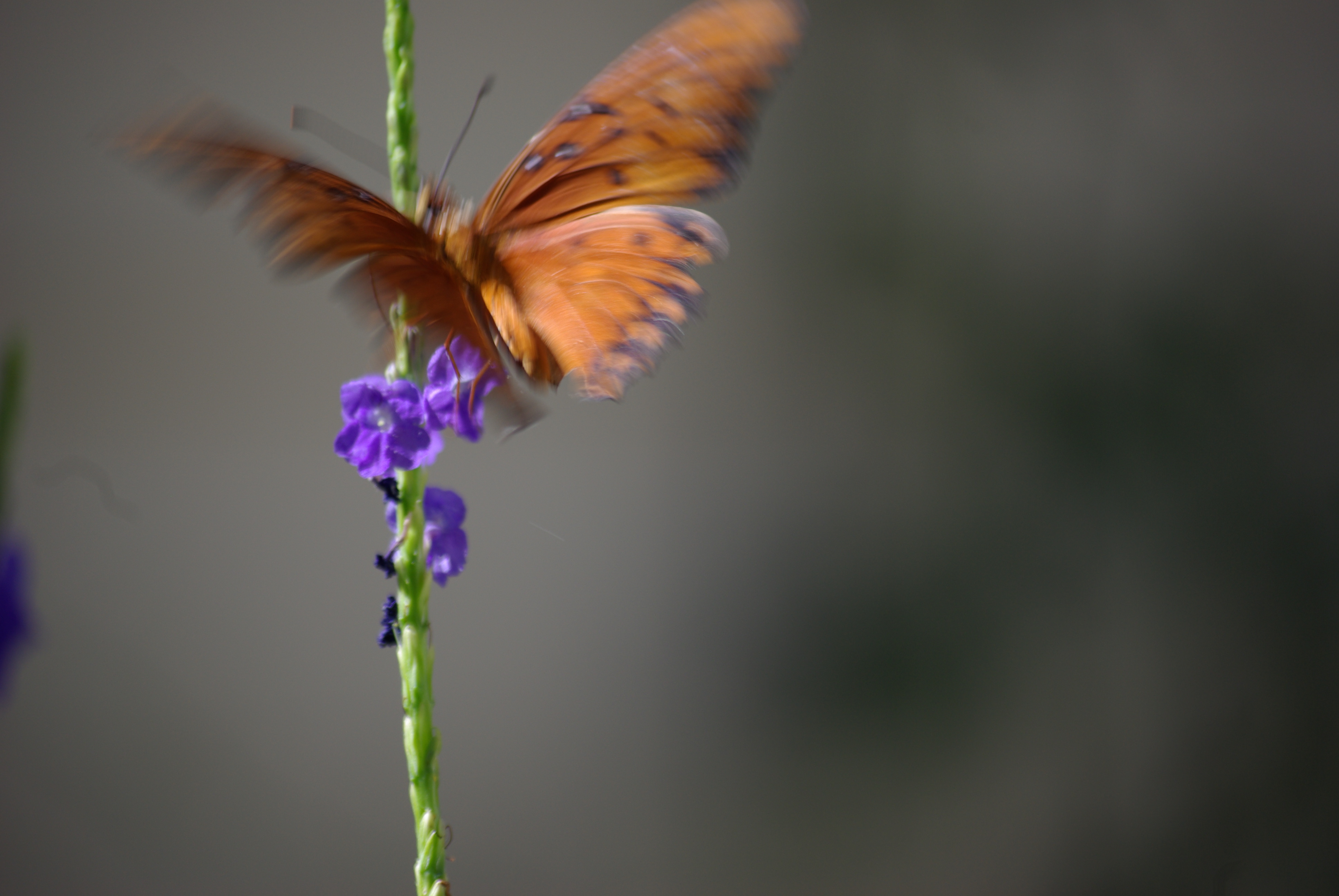
Gulf fritillary on blue porterweed

August 9, 2010

Gulf fritillary on blue porterweed - photo by Ed Darrell - copy free with attribution IMGP4824

Gulf fritillary butterfly on blue porterweed, Dallas, Texas — photo by Ed Darrell — use free with attribution

A gulf fritillary (Agraulis vanillae (Linnaeus, 1758)) on blue porterweed, Stachytarpheta urticifolia, also known as blue rats tail, or nettleleaf velvetberry.  Dallas, Texas, August 9, 2010.

Gulf fritillary on blue porterweed - photo by Ed Darrell, use permitted with attribution IMGP4820

This fritillary hung around for a few minutes.

Kathryn plants butterfly-attracting plants — a concept that was new to me when she introduced it at our home in Cheverly, Maryland, with several plants that acted like butterfly magnets, to my astonished delight.  We first ran into the brilliant orange gulf fritillaries in 1988 or 1989 here in Dallas.  For the past few summers, fritillaries have not been frequent visitors in our yard.

Kathryn stepped up the butterfly plantings this spring, including passion vine (Passiflora incarnata).  The passion vine twines toward one of the bird feeders, but in the past week or so has been losing leaves — to caterpillars of the gulf fritillary, it turns out.  Blue porterweed attracts all sorts of butterflies, but the fritillaries have been rather common, no doubt hoping to give their progeny a little boost with the passion vine, their favored food.

Butterfly afficianadoes in Dallas are urged to plant milkweed and butterfly bush to help the monarchs, whose populations are stressed by the recent cold winter, dramatic reductions in habitat, and destruction of their sanctuary trees in Mexico where they migrate each winter.  But all butterflies could use some habitat help, I think.  The rewards are great.
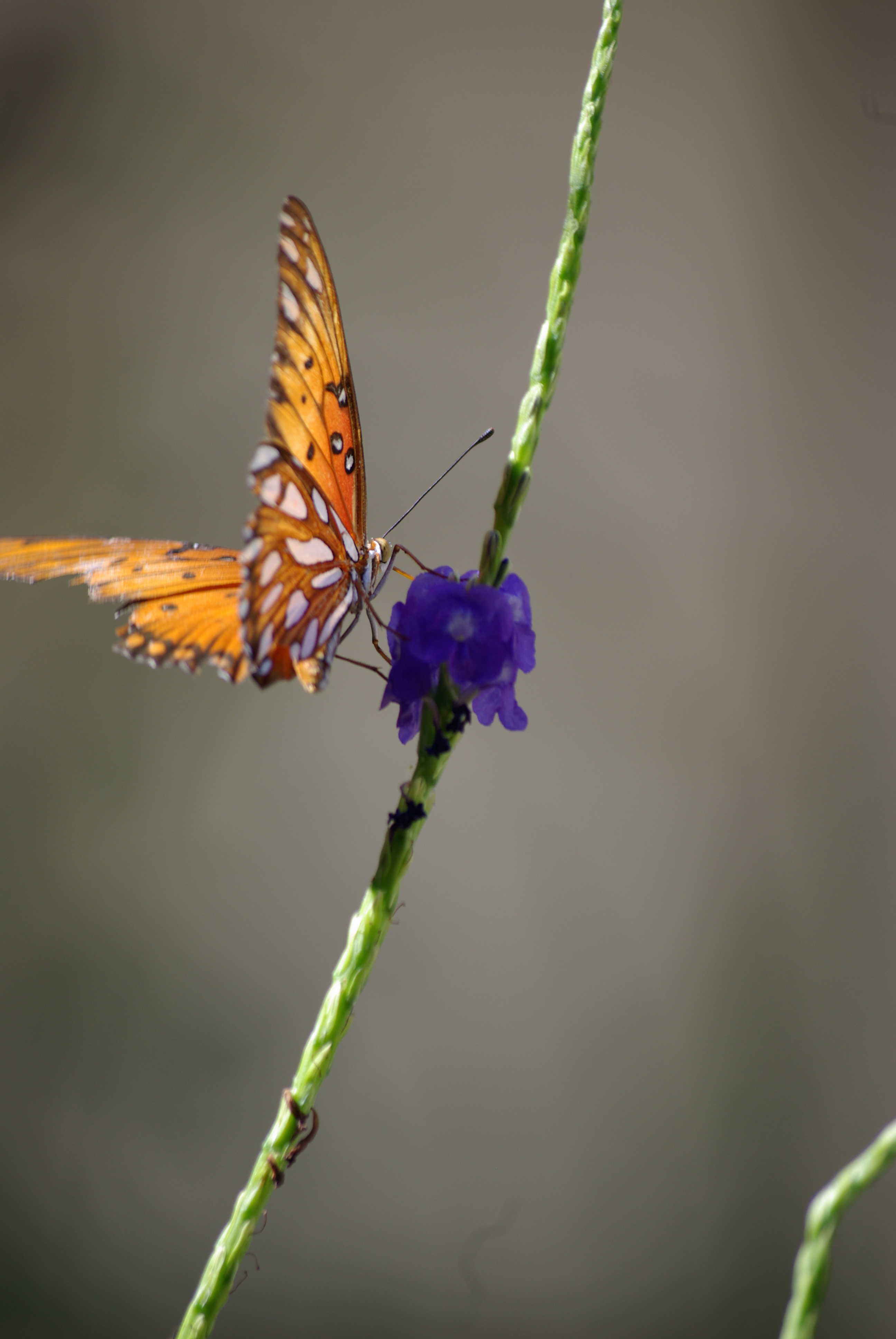
Gulf fritillary on blue porterweed - photo by Ed Darrell, use permitted with attribution - IMGP4822

Gulf fritillary on blue porterweed, catching the morning sun

Gulf fritillary butterfly on blue porterweed - photo by Ed Darrell, use permitted with attribution - IMGP4823

Butterfly plantings will attract butterflies, guaranteed. Gulf fritillary enjoys some blue porterweed nectar.


Vegetarian fireworks: Fruit and vegetable MRIs

July 19, 2010

Fireworks!

Broccoli, in an MRI

Broccoli, as seen by MRI

Looks like fireworks to me.

From Inside Insides, a site dedicated to MRIs of food.

Oddly beautiful.  Interesting.  Nerdy.

Tip of the old scrub brush to P. Z. Myers at Pharyngula.


Caucasian wingnuts

April 7, 2010

I’m stealing this one completely from P. Z. Myers’ Pharyngula. It’s just too good.

The daffodils are lovely — I recall when they’d bloom just about Easter in Utah, and Washington, D.C.  Here in Dallas, our daffies depart before March 15, often not bothering to stick around until Easter.

But the real treat is the tree in the background.  It’s just another tree early in the spring, not yet leafed out.  But this one is special.

Pterocarya fraxifolia (tree in the background) - common name, "caucasian wingnut"

Caucasian Wingnut Tree (Pterocarya fraxinifolia ) and native daffodils in Warley place Nature reserve. © Copyright Glyn Baker and licensed for reuse under this Creative Commons Licence.

Pterocarya fraxinifolia (tree in the background) – common name, “caucasian wingnut” – in the Warley Place Nature Preserve, in Essex, England. Photo by Glyn Baker.

Its common name is “caucasian wingnut.”  You can’t make this stuff up. Reality is always much more entertaining than fiction.

Wikipedia’s entry is primed for comedy:

Species

There are six species of wingnut.

Another species from China, the Wheel Wingnut with similar foliage but an unusual circular wing right round the nut (instead of two wings at the sides), previously listed as Pterocarya paliurus, has now been transferred to a new genus, as Cyclocarya paliurus.

Uses

Wingnuts are very attractive, large and fast-growing trees, occasionally planted in parks and large gardens. The most common in general cultivation outside Asia is P. fraxinifolia, but the most attractive is probably P. rhoifolia. The hybrid P. x rehderiana, a cross between P. fraxinifolia and P. stenoptera, is even faster-growing and has occasionally been planted for timber production. The wood is of good quality, similar to walnut, though not quite so dense and strong.

Japanese wingnuts?  Chinese wingnuts?  Tonkin wingnuts (for all you Vietnam war historians out there)?

Wow.  Just wow.

More, if you care:


Texas Forest Expo!

April 25, 2009

Are you out near Conroe on Sunday? April 26 is the third (and last) day of Texas Forest Expo 2009 at the Conroe Convention Center.

It’s free.  It’s kid friendly ( a great place to take Cub Scouts or a group of Boy Scouts working on the Forestry merit badge).  I’d be there if I could.

Get your name on the mailing list for notice for next year’s expo.


Waiting for the New President: Doctoring data on global warming

December 16, 2008

ArborDay.org map showing changes in hardiness zones between 1990 and 2006

ArborDay.org map showing changes in hardiness zones between 1990 and 2006, a map climate change denialists wish did not exist.

We need a new category of urban myth or urban legend.  Jan Brunvand’s inventions and development of the study of folk stories that people claim to be true long enough that they become legends, needs to be updated to include internet stupidity that just won’t die.  Especially, we need a good, two-word label for politically-motivated propaganda that should go away, but won’t.

Perhaps I digress.

One might be filled with hope at the prospect of the administration of President Obama. Science issues that have been ignored for too long may once again rise to due consideration.  Friends in health care worry that it will take four or eight terms of diligent work to undo the damage done to medical science by neglect of spending and budgeting during the last eight years.

I take a little hope in this:  Maybe we can get an update of the planting zones maps relied on by farmers, horticulturists, and backyard gardeners.

New maps were delayed through the Bush administration.  The last serious update, officially, was 1990.  Perhaps much has changed in climate in the last generation, and perhaps that is why the new maps were delayed, though they had been painstakingly prepared by the American Horticulture Society.

Why?

Plants cannot be fooled by newspaper reports.  Plants are not partisan in political issues. Plants both respond to and clearly demonstrate climate change.  To those who wished to suppress or deny climate change, suppressing the hardiness zone maps may have seemed like a good way to win a political debate.

Robust discussion based on the facts, a casualty of the past eight years, ready to be resurrected.

Resources:


Snow photos

December 13, 2008

Forecast is 70 degrees in Dallas on Sunday.

Meanwhile, Catherine Sherman has some photos of snow near Kansas City.  Nice stuff. (I don’t have her permission to copy the photo here — go see her blog.)

I particularly like her photo of the river birch tree.  It appeals to the botanist that still survives within me, plus it gives me hope about the proliferation of electronic cameras and the mass recording of things of interest to science.

Sherman writes that Kansas is the only state which has no native pines.  Is that accurate?  Does that count include Hawaii?  (What are the native pines of Hawaii?)

In short, it’s really cool.


Disaster in Yellowstone Park: 20 years after the fires, it’s healing

September 17, 2008

High school students weren’t alive when Yellowstone burned in 1988. Do you remember?

NASA infrared satellite photograph of Yellowstone fires in 1988

NASA infrared satellite photograph of Yellowstone fires in 1988

It was a conflagration that made hell look like good picnicking. 1988 was a particularly dry summer, and hot. Lightning and human carelessness ignited fires across western North America. Five huge fires raged out of control, and burned huge swaths out of forests in Yellowstone National Park that probably hadn’t seen fire in 80 years, maybe longer.

The Salt Lake Tribune featured several stories about the fires and Yellowstone’s recovery today, “Yellowstone: Back from the ashes,” how wildland firefighting changed, a great chart on fire succession stages, and another chart on the effects of the fire on larger animals in the Yellowstone system.

Old Faithfull erupts against background of smoke from 1988 fires - NPS photo by Deanna Marie Dulen

Old Faithfull erupts against background of smoke from 1988 fires - NPS photo by Deanna Marie Dulen

The 1988 fires made history in several ways; it was the first time so many fires had burned simultaneously. Ultimately some of the fires merged into even greater conflagrations. The fires forced the shutdown of tourism and other activities in the Park. Inadequacies in fire fighting equipment, staffing and policies were highlighted and displayed in newspapers and on television for weeks, forcing changes in policies by cities, states and the federal government.

Some good came out of the fires. Much undergrowth and dead wood had choked off plant diversity in some places in the Park. The fires opened new meadows and offered opportunities for some species to expand their ranges.

Scientifically, a lot of information came out of the fires. The mystery of when aspen would seed out was solved — new aspen seedlings appeared in areas where the fires had sterilized the ground with extremely high temperatures that seemed to trigger the seeds to germinate.

Our visits in 1989 offered a lot of opportunities to look at very bleak landscapes.

Yellowstone National Park in 1989, a year after the big fires - Copyright 1989 and 2008, Ed Darrell

Yellowstone National Park in 1989, a year after the big fires - Copyright 1989 and 2008, Ed Darrell

Recover of the forested areas began rather quickly, but will take time to cover over all the scars of the fires.

Other resources:


The $7 million dogwood blossom

April 29, 2008

Not perfect — there is a brown spot on it; but beautiful, surpassingly rare, a creature of the serendipity of nature, it is a natural dogwood blossom in Dallas County, Texas:

Dogwood blossom in Dogwood Canyon, Texas


What we came to see – the magical dogwood blossoms.

On April 5 Kathryn and I joined David Hurt and a jovial band of hikers for a trip into Dogwood Canyon in Cedar Hill, Texas. The physical formation of Cedar Hill upon which the city of the same name and several others stand, is one of the highest spots between the Mississippi River and the Rocky Mountains. It is an outcropping of chalk, a formation known as the Austin Chalk, that runs from Austin, north nearly to the Oklahoma border.

This rock formation creates a clear physical marker of the boundary between East and West. Dallas is east of the line, Fort Worth, Gateway to the Old West, is 30 miles farther west. On this outcropping is married the plains of the west with the oaks and forests of the east. Within a few miles of the line, the botanical landscape changes, cowboy prairie lands one way, forest lands the other.

On the chalk itself, the soil is thin and alkaline. The alkalinity is a function of the chemical composition of the chalk underneath it.

Dogwoods love the forests of East Texas with their acidic soils. Early spring produces fireworks-like bursts of white dogwood blossoms in the understory of East Texas forests. Dogwoods die out well east of Dallas as the soil changes acidity; driving from Dallas one can count on 30 to 60 miles before finding a dogwood.

Except in Dogwood Canyon. There, where entrepreneur David Hurt originally planned to build a family hideout and getaway, he found a stand of dogwoods defying botanists and the Department of Agriculture’s plant zone maps, blooming furiously in thin alkaline soil atop the Austin Chalk.

(continued below the fold)

Read the rest of this entry »
