We Are Science Probes

August 14, 2010

Still from

Still from “We Are Science Probes.” Full clip of movie below.

In animation, a parable about the dangers of being intentionally ignorant of science. In the not-distant-enough future, a probe from another planet arrives on Earth after the demise of human civilization. Unfortunately, the probes land in Kansas, the land of creationism and woo. The plot thickens.

[My apologies — the version I found did not come with a “pause” button.  It will play automatically when you open this post.  Fortunately, it’s almost perfectly safe-for-work.  If you don’t like the music, turn it off.  There is no spoken dialogue in the cartoon.  If you wish to pause the playing of the cartoon, right click to get to the Adobe Flash Player controls.  To pause the playing click the checkmark next to “play.”]

[Update August 18 — Okay, I give up — 100% of comments I’ve been getting ran against the video without the “start” or “pause” buttons.  You’ll have to go see it at another site — here, for example.]

[Years later, it’s on Youtube!]

Found it at a site called NewGrounds, which includes several other animation pieces.  The piece was created by a group that goes by the handle Billy Blob.

Sure would love this group to turn their creative faculties to hard history — say, the Progressive Movement and Gilded Age.  (Probably less chance of commercialization there, and perhaps less chance of awe-striking art, too.)

Tip of the old scrub brush to P. Z. Myers at Pharyngula.


What’s changed since August 2008?

July 13, 2010

Ben Hoffman drew this on August 2008:

Ben Hoffman cartoon, August 2008 - BenHoffman.WordPress.com

Ben Hoffman on the issues of August 2008 - what's changed? BenHoffman.WordPress.com

Replace half the “abortions” with “socialism,” it’s still accurate.

We could change that for the better in November, were we alert to the issues.

Change:

Add to FacebookAdd to NewsvineAdd to DiggAdd to Del.icio.usAdd to StumbleuponAdd to RedditAdd to BlinklistAdd to TwitterAdd to TechnoratiAdd to Furl


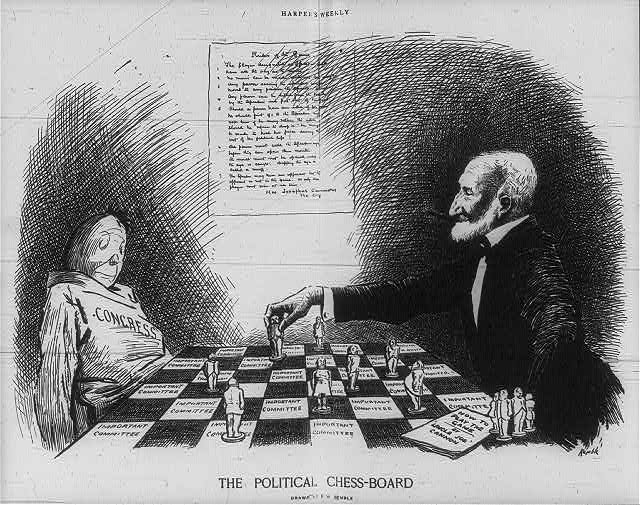
Chess games of the rich and famous: House Speaker Joe Cannon vs. Congress

July 7, 2010

Cartoon - Cannon, Joe, The Poltiical Chessboard, Harpers 2-05-1910 - 3b23316r

The Poltiical Chessboard, Harper's Magazine, February 5, 1910, by E. W. Kemble - Library of Congress image

Description from the Library of Congress:

Joseph Cannon playing chess with straw man labelled “Congress,” using toy men on chessboard with squares labelled “important committee” and “freak committee.”

Legendary House Speaker Joe Cannon — after whom the Cannon House Office Building is named — is remembered for the almost absolute power he held over the House of Representatives.  Here’s the generic description at Wikipedia:

House Speaker Joseph G. Cannon - Wikimedia image, photo from October 1915

House Speaker Joseph G. Cannon - Wikimedia image, photo from October 1915

Cannon wielded the office of Speaker with unprecedented power. At the time of Cannon’s election the Speaker of the House concurrently held the chair of the Rules Committee, which determined under what rules and restrictions bills could be debated, amended, and voted on, and in some cases whether they would be allowed on the floor at all. As such, Cannon effectively controlled every aspect of the House’s agenda: Bills reached the floor of the house only if Cannon approved of it, and then in whatever form he determined—with he himself deciding whether and to what extent the measures could be debated and amended.

Cannon also reserved to himself the right to appoint not only the chairs of the various House committees, but also all of committees’ members, and (despite the seniority system that had begun to develop) used that power to appoint his allies and proteges to leadership positions while punishing those who opposed his legislation. Crucially, Cannon exercised these powers to maintain discipline within the ranks of his own party: the Republicans were divided into the conservative “Old Guard,” led by Cannon, and the progressives, led by President Theodore Roosevelt. His committee assignment privileges ensured that the party’s Progressive element was essentially powerless in the House, and his control over the legislative process obstructed progressive legislation.

Progressives wished to break Cannon’s ability to control so completely the flow of legislation.  By early 1910, progressives in the Republican Party especially chafed under Cannon’s rule.  Anxious for revolt, they struck on March 17, just a few weeks after this cartoon appeared.

On March 17, 1910, after two failed attempts to curb Cannon’s absolute power in the House, Nebraska Representative George Norris [of Nebraska] led a coalition of 42 progressive Republicans and the entire delegation of 149 Democrats in a revolt. With many of Cannon’s most powerful allies absent from the Chamber, but enough Members on hand for a quorum, Norris introduced a resolution that would remove the Speaker from the Rules Committee and strip him of his power to assign committees.

While his lieutenants and the House sergeant-at-arms left the chamber to collect absent members in attempt to rally enough votes for Cannon, the Speaker’s allies initiated a filibuster in the form of a point of order debate. When Cannon supporters proved difficult to find (many of the staunchest were Irish and spent the day at various St. Patrick’s Day celebrations), the filibuster continued for 26 hours, with Cannon’s present friends making repeated motions for recess and adjournment. When Cannon finally ruled the resolution out of order at noon on March 19, Norris appealed the resolution to the full House, which voted to overrule Cannon, and then to adopt the Norris resolution.

Cannon managed to save some face by promptly requesting a vote to remove him as Speaker, which he won handily since the Republican majority would not risk a Democratic speaker replacing him. However, his iron rule of the House was broken, and Cannon lost the Speakership when the Democrats won a majority later that same year.

Instead of the Speaker’s wishes, committee assignments and chairs were selected by a seniority system.

Cannon lost his seat representing Illinois in the progressive tide of 1912, but regained it in 1914, and served another four terms in the House, to 1922.

I have found no information on whether Cannon actually played chess.

Norris’s star was on the rise at the same time.  Though he supported Theodore Roosevelt in the election of 1912, when Roosevelt bolted the Republican Party and ran as a Progressive or “Bullmoose Party” nominee for president, Norris stayed with the Republican Party and won election to the U.S. Senate in 1912.

Norris became an isolationist, and was one of six senators to vote against the declaration of war in 1917 that pushed the U.S. into World War I.  Norris also opposed the Versailles Treaty, and played an important role in keeping the treaty from U.S. ratification.  He supported Franklin Roosevelt’s New Deal Reforms a decade-and-a-half later, and one of the early dams of the Tennessee Valley Authority is named for him.  Norris’s role in the New Deal, and in pushing progressive reforms well into the 20th century, is not fully appreciated, for example:

In 1932, along with Rep. Fiorello H. La Guardia, Norris secured passage of the Norris-La Guardia Act, which outlawed the practice of requiring prospective employees not to join a labor union as a condition of employment (the so-called yellow-dog contract) and greatly limited the use of court injunctions against strikes.

A staunch supporter of President Roosevelt’s New Deal programs, Norris sponsored the Tennessee Valley Authority Act of 1933. In appreciation, the TVA Norris Dam and a new planned city in Tennessee were named after him.[3][4] Norris was also the prime Senate mover behind the Rural Electrification Act that brought electrical service to under-served and unserved rural areas across the United States.

Switching to the Democratic Party in 1936 when the Republicans fell into the minority, Norris generally supported New Deal efforts but did not fear to oppose ideas he found unworthy, regardless their source or party connection.  His opposition to President Franklin Roosevelt’s “court packing” plan helped smother the idea.  Norris finally lost election in 1942.  Norris is one of eight U.S. senators profiled in John F. Kennedy’s book, Profiles in Courage.


Quote of the moment: Books as lighthouses in the dark sea of time

July 3, 2010

Jeffrey Robbins, a human character in the animated cartoon series,

Jeffrey Robbins, a human character in the animated cartoon series, “The Gargoyles”

The written word is all that stands between memory and oblivion. Without books as our anchors, we are cast adrift, neither teaching nor learning. They are windows on the past, mirrors on the present, and prisms reflecting all possible futures. Books are lighthouses, erected in the dark sea of time.

Jeffrey Robbins, a character in the cartoon series, “The Gargoyles”

Now available on Youtube.  To get the quote above, to go to 21:30 in this video:

Tip of the old scrub brush to James Kessler.


Boy Scouts Centennial: Dan Beard and Ed Dodd

June 21, 2010

Dan Beard, a founder of Boy Scouts of America, and cartoonist Ed Dodd, photo dated (incorrectly) February 14, 1950 – Georgia State University Library Photography Collection, Atlanta Area Photographs from the Lane Brothers and Tracy O’Neal Collections

Dan Beard, a founder of Boy Scouts of America, and cartoonist Ed Dodd, photo dated (incorrectly) February 14, 1950 – Georgia State University Library Photography Collection, Atlanta Area Photographs from the Lane Brothers and Tracy O’Neal Collections

Daniel Carter Beard was best known as an illustrator of children’s adventure books.  He founded a group for boys, the Sons of Daniel Boone, in 1905.  That group was merged into the Boy Scouts of America at BSA’s founding in 1910.

Ed Dodd (November 7, 1902 – May 27, 1991) was an illustrator and cartoonist, probably best known for his comic strip “Mark Trail,” which is still carried in many newspapers today.

According to his listing at Wikipedia:

Ed Dodd went to work for Dan Beard, founder of the Boy Scouts of America, at the age of 16. Dodd worked at Beard’s camp in Pennsylvania for thirteen summers, where he honed his writing and illustration skills under Beard’s guidance. Dodd became a scoutmaster and the first paid Youth and Physical Education Director for the city of Gainesville, Georgia.

Another story of Scouting providing a career for a kid, another story of Scouting providing a career for an illustrator (see also Norman Rockwell, and the Csataris).

Dodd was a Georgian.  This photograph, dated February 14, 1950, shows a meeting of the two illustrators, with Dodd appearing older than the 16 he was when he first met Beard.  The photo is in the collections of the Georgia State University Library, in the Atlanta Area Photographs from the Lane Brothers and Tracy O’Neal Collections.  We might assume it was taken in Georgia, perhaps at Dodd’s “Lost Forest” home and workshop.

We know that can’t be the right date, however, since Dan Beard died in 1941.

Who can shed more light on this bit of history?

Updates:  See comments below — among other things, we know that the February 14, 1950 date was the date that a duplicate negative was made.  Please note in comments if you have further details.

More:

Mark Trail strip on NOAA's 200th-2D-MarkTrail650

Click on image: Marke Trail on NOAA’s 200th anniversary; King Features Syndicate

Ed Dodd and others in his studio at Lost Forest, Georgia, drawing the comic strip Mark Trail - Wikimedia

Dodd and others working on “Mark Trail”: The Mark Trail studio was on the second floor of Ed Dodd’s Frank Lloyd Wright-designed home in the Lost Forest at the Atlanta suburb of Sandy Springs, Georgia. At work are (l. to r.) Ed Dodd, Jack Elrod, Tom Hill and Rhett Carmichael. The 130-acre Lost Forest was the model for the fictional Lost Forest National Forest in the strip. Dodd’s house was located on Marsh Creek, a tributary of the Chattahoochee River. Wikimedia photo and caption

  • Sadly, Dodd’s Lost Forest was completely burned in 1996.  I can find no information on any of the studio surviving the fire (anyone know differently?).   Dodd was honored in 1991 with the naming of the Mark Trail Wilderness Area, in the Chattahoochee National Forest.
  • According to the official information at King Features Syndicate, Jack Elrod first assisted Dodd, then in 1978 took over the creative writing and drawing of the strip when Dodd retired and Tom Hill, who had done the Sunday strips, died.  Elrod was a Boy Scout when he first met Dodd, in Dodd’s role as Scoutmaster.  The Scouting links are strong in this strip.

Tip of the old scrub brush to Chamblee54, for showing the way to the Georgia State University photographs.

[Editor’s note: Georgia State Library keeps changing the link url on the photograph; if you find a higher resolution version, please, please let us know where it is!]


SBOE shames Texas, part I: Wilkinson on cutting the Enlightenment out

April 18, 2010

Signe Wilkinson, Philadelphia Daily News, March 17, 2010 - Texas education board cuts Enlightenment from curriculum

Signe Wilkinson, Philadelphia Daily News, March 17, 2010 - Texas education board cuts Enlightenment from curriculum

Signe Wilkinson cartoons for the Philadelphia Daily News.   She won a Pulitzer for political cartoons in 1992, the first woman to win that award (about time!).


Health care legislation as Waterloo – Oliphant (and Benson)

April 17, 2010

Pat Oliphant on health care legislation as Obama's Waterloo, March 23, 2010

Pat Oliphant on health care legislation as Obama's Waterloo, March 23, 2010 - Washington Post

How’s that “make health care Obama’s Waterloo” working out for you, Sen. Demint?

Didn’t expect Obama to be Wellington at Waterloo, eh?

See Steve Benson’s take, below the fold.

Read the rest of this entry »


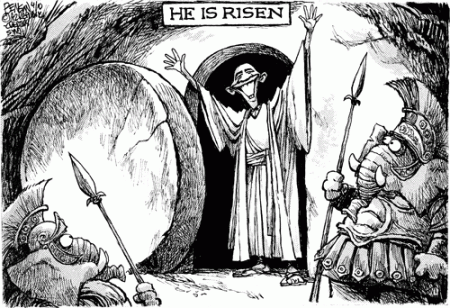
Benson courts controversy: Obama’s political resurrection

April 17, 2010

When he interned for our office, he was such a clean-cut, return-missionary sort of guy.  Steve Benson’s cartoons continually push the envelope for what is acceptable in an editorial cartoon, not exactly what I had come to expect from his early work with conservatives.  A welcome surprise.

This one was probably quite controversial in Phoenix, don’t you think?

Steve Benson in the Arizona Republic, on the Affordable Care Act and President Obama, April 2, 2010

Steve Benson in the Arizona Republic, on the Affordable Care Act and President Obama, April 2, 2010


SBOE shames Texas, part G: Toles in the Washington Post

April 11, 2010

Pulitzer Prize-winner Tom Toles in the Washington Post, March 19, 2010

Pulitzer Prize-winner Tom Toles in the Washington Post, March 19, 2010

It’s pretty embarrassing when the State Board of Education’s actions leave Texas open to jokes about whether Texans remember the Alamo.  Remembering the Alamo is as much a Texas monument or icon as anything else — maybe moreso.

Tom Toles demonstrates why Texas should be embarrassed by the Texas State Board of Education’s work on social studies standards.


SBOE shames Texas, part D: Mario Piperni and unintended consequences

April 10, 2010

Mario Piperni on Texas State Board of Education

Cartoon by Mario Piperni on the Texas State Board of Education, on any number of subjects

Have never seen this guy’s work before.  Does he publish in a newspaper that is lucky to have him?


Education board shames Texas: Nick Anderson’s view from 2009, part C

March 31, 2010

Nick Anderson of the Houston Chronicle on Texas SBOE social studies standards, in 2009

Nick Anderson of the Houston Chronicle on Texas SBOE social studies standards, in 2009


Great animation: “The Chesnut Tree”

March 14, 2010

Wonderful film from 2007, by Hyun-min Lee.  I found it on PBS World this weekend, and then found a YouTube version.

Watch it with your young children.

[Youtube=http://www.youtube.com/watch?v=VsS4Tk-lrxo]


Lurie/UN Award, 2nd place cartoon

January 10, 2010

2nd place cartoon in the 2009 Ranan Lurie/UN Awards -- by Silvan Wegmann, Sonntag (Switzerland)

2nd place cartoon in the 2009 Ranan Lurie/UN Awards -- by Silvan Wegmann, Sonntag (Switzerland)

What if Obama can’t live up to the hopes Europe has for him?  This cartoon won 2nd place, $5000, for Swiss cartoonist Silvan Wegmann in the Ranan Lurie/UN Cartoon competition.

(See first place cartoon here.)


Ranan Lurie 2009 cartoon winners – first place to Robert Ariail

December 28, 2009

My apologies for not being more timely.

The United Nations Correspondents Association and the UN Society of Writers and Artists announced the winners of the 2009 Ranan Lurie/UN Cartoon Awards earlier this month.  First place, and $10,000, went to Robert Ariail, cartooning in The State.

Ariail’s winner is a clever depiction of a commuter making the most of advertising for $4.00/gallon gasoline, becoming a bicycle commuter in the process.

Robert Ariail, First Place, 2009 Ranan Lurie UN Cartoon Award

Robert Ariail's First Place cartoon, 2009 Ranan Lurie UN Cartoon Award competition ($10,000)

Self portrait, Robert Ariail, cartoonist who won 2009 Ranan Lurie UN Cartoon Award

Ariail's self-portrait -- he is without portfolio at the moment

Sad news, too typical for cartoonists these days — Ariail was laid off from The State before the award announcements.  You can see Ariail’s work at his website. (This may be a better copy of his award-winning cartoon.)

Hey!  Mr. Murdoch! Want to do some public service and promote your news organizations?  Hire Ariail, and some of the other laid-off cartoonists whose visual opinions we sorely need in these complex and too-somber times.  (Anyone else who owns a newspaper, or edits one, should consider doing a favor for cartooning and the public, too.)

Go check out the other cartoons, all the way through honorable mention.  There are some spectactular, funny, and stinging works there.  I’ll post a few of them as we near 2010, but you can look now.

Top three:

  • First prize, $10,000 – Robert Ariail, The State (U.S.A.)
  • Second prize, $5,000 – Silvan Wegmann, Sonntag (Switzerland)
  • Third prize, $3,000 – Shlomo Cohen, Israel Hayom (Israel)

Citations for excellence:

  • Guy Badeaux, Le Droit (Canada)
  • Michael Kontouris, Eleftheros Tipos (Greece)
  • Agim Sulaj, Romagna Corriere (Italy)
  • David Pope, The Canberra Times (Australia)
  • Zhu Zizun, Jiaxing Daily (China)
  • Michael Keefe, The Denver Post (U.S.A.)
  • Xiaoqiang Hou, Cartoon Weekly (China)
  • Makhmud Eshonkulov, Himal (Republic of Nepal)
  • Rex Babin, The Sacramento Bee (U.S.A.)
  • Fruz Kutal, Amnesty International “Magasinet” (Norway)

Share these cartoons — keep cartoonists employed:

Add to FacebookAdd to NewsvineAdd to DiggAdd to Del.icio.usAdd to StumbleuponAdd to RedditAdd to BlinklistAdd to TwitterAdd to TechnoratiAdd to Furl


Who invented Santa Claus? Who really wrote the “Night Before Christmas?”

December 7, 2009

An encore post from 2007

Thomas Nast invented Santa Claus? Clement C. Moore didn’t write the famous poem that starts out, “‘Twas the night before Christmas, and all through the house . . . ?”

The murky waters of history from Millard Fillmore’s Bathtub soak even our most cherished ideas and traditions.

But isn’t that part of the fun of history?

Santa Claus delivers to Union soldiers, "Santa Claus in Camp" - Thomas Nast, Harper's Weekly, Jan 3, 1863
Thomas Nast’s first published drawing featuring Santa Claus; for Harper’s Weekly, “A Journal of Civilization,” January 3, 1863 Nast portrayed the elf distributing packages to Union troops: “Santa Claus in camp.” Nast (1840-1904) was 23 when he drew this image.

Yes, Virginia (and California, too)! Thomas Nast created the image of Santa Claus most of us in the U.S. know today. Perhaps even more significant than his campaign against the graft of Boss Tweed, Nast’s popularization of a fat, jolly elf who delivers good things to people for Christmas makes one of the great stories in commercial illustration. Nast’s cartoons, mostly for the popular news publication Harper’s Weekly, created many of the conventions of modern political cartooning and modeled the way in which an illustrator could campaign for good, with his campaign against the graft of Tammany Hall and Tweed. But Nast’s popular vision of Santa Claus can be said to be the foundation for the modern mercantile flurry around Christmas.

Nast is probably ensconced in a cartoonists’ hall of fame. Perhaps he should be in a business or sales hall of fame, too.  [See also Bill Casselman’s page, “The Man Who Designed Santa Claus.]

Nast’s drawings probably drew some inspiration from the poem, “Account of a Visit from St. Nicholas,” traditionally attributed to Clement C. Moore, a New York City lawyer, published in 1822. The poem is among the earliest to describe the elf dressed in fur, and magically coming down a chimney to leave toys for children; the poem invented the reindeer-pulled sleigh.

Modern analysis suggests the poem was not the work of Moore, and many critics and historians now attribute it to Major Henry Livingston, Jr. (1748-1828) following sleuthing by Vassar College Prof. Don Foster in 2000. Fortunately for us, we do not need to be partisans in such a query to enjoy the poem (a complete copy of which is below the fold).

The Library of Congress still gives Moore the credit. When disputes arise over who wrote about the night before Christmas, is it any wonder more controversial topics produce bigger and louder disputes among historians?

Moore was not known for being a poet. The popular story is that he wrote it on the spur of the moment:

Moore is thought to have composed the tale, now popularly known as “The Night Before Christmas,” on December 24, 1822, while traveling home from Greenwich Village, where he had bought a turkey for his family’s Christmas dinner.

Inspired by the plump, bearded Dutchman who took him by sleigh on his errand through the snow-covered streets of New York City, Moore penned A Visit from St. Nicholas for the amusement of his six children, with whom he shared the poem that evening. His vision of St. Nicholas draws upon Dutch-American and Norwegian traditions of a magical, gift-giving figure who appears at Christmas time, as well as the German legend of a visitor who enters homes through chimneys.

Again from the Library of Congress, we get information that suggests that Moore was a minor celebrity from a well-known family with historical ties that would make a good “connections” exercise in a high school history class, perhaps (”the link from Aaron Burr’s treason to Santa Claus?”): (read more, below the fold)

Clement Moore was born in 1779 into a prominent New York family. His father, Benjamin Moore, president of Columbia University, in his role as Episcopal Bishop of New York participated in the inauguration of George Washington as the nation’s first president. The elder Moore also administered last rites to Alexander Hamilton after he was mortally wounded in a tragic duel with Aaron Burr.

A graduate of Columbia, Clement Moore was a scholar of Hebrew and a professor of Oriental and Greek literature at the General Theological Seminary in Manhattan. [See comment from Pam Bumsted below for more on Moore.] He is said to have been embarrassed by the light-hearted verse, which was made public without his knowledge in December 1823. Moore did not publish it under his name until 1844.

Tonight, American children will be tucked in under their blankets and quilts and read this beloved poem as a last “sugarplum” before slipping into dreamland. Before they drift off, treat them to a message from Santa, recorded by the Thomas Edison Company in 1922.

Santa Claus Hides in Your Phonograph
By Arthur A. Penn, Performed by Harry E. Humphrey.
Edison, 1922.
Coupling date: 6/20/1922. Cutout date: 10/31/1929.
Inventing Entertainment: The Motion Pictures and Sound Recordings of the Edison Companies

Listen to this recording (RealAudio Format)

Listen to this recording (wav Format, 8,471 Kb)

But Henry Livingston was no less noble or historic. He hailed from the Livingtons of the Hudson Valley (one of whose farms is now occupied by Camp Rising Sun of the Louis August Jonas Foundation, a place where I spent four amazing summers teaching swimming and lifesaving). Livingston’s biography at the University of Toronto site offers another path for a connections exercise (”What connects the Declaration of Independence, the American invasion of Canada, the famous poem about a visit from St. Nick, and George W. Bush?”):

Henry Livingston Jr. was born in Poughkeepsie, New York, on Oct. 13, 1748. The Livingston family was one of the important colonial and revolutionary families of New York. The Poughkeepsie branch, descended from Gilbert, the youngest son of Robert Livingston, 1st Lord of Livingston Manor, was not as well off as the more well-known branches, descended from sons Robert and Philip. Two other descendants of Gilbert Livingston, President George Walker Herbert Bush and his son, President-Elect George W. Bush, though, have done their share to bring attention to this line. Henry’s brother, Rev. John Henry Livingston, entered Yale at the age of 12, and was able to unite the Dutch and American branches of the Dutch Reformed Church. At the time of his death, Rev. Livingston was president of Rutgers University. Henry’s father and brother Gilbert were involved in New York politics, and Henry’s granduncle was New York’s first Lt. Governor. But the law was the natural home for many of Henry’s family. His brother-in-law, Judge Jonas Platt, was an unsuccessful candidate for governor, as was his daughter Elizabeth’s husband, U.S. Supreme Court Justice Smith Thompson. Henry’s grandson, Sidney Breese, was Chief Justice of the Illinois Supreme Court.

Known for his encyclopedic knowledge and his love of literature, Henry Livingston was a farmer, surveyor and Justice of the Peace, a judicial position dealing with financially limited criminal and civil cases. One of the first New Yorkers to enlist in the Revolutionary Army in 1775, Major Henry Livingston accompanied his cousin’s husband, General Montgomery, in his campaign up the Hudson River to invade Canada, leaving behind his new wife, Sarah Welles, and their week-old baby, on his Poughkeepsie property, Locust Grove. Baby Catherine was the subject of the first poem currently known by Major Livingston. Following this campaign, Livingston was involved in the War as a Commissioner of Sequestration, appropriating lands owned by British loyalists and selling them for the revolutionary cause. It was in the period following Sarah’s early death in 1783, that Major Livingston published most of his poems and prose, anonymously or under the pseudonym of R. Ten years after the death of Sarah, Henry married Jane Patterson, the daughter of a Dutchess County politician and sister of his next-door neighbor. Between both wives, Henry fathered twelve children. He published his good-natured, often occasional verse from 1787 in many journals, including Political Barometer, Poughkeepsie Journal, and New-York Magazine. His most famous poem, “Account of a Visit from St. Nicholas,” was until 2000 thought to have been the work of Clement Clarke Moore (1779-1863), who published it with his collected poems in 1844. Livingston died Feb. 29, 1828.

More on Henry Livingston and his authorship of the Christmas poem here.

Thomas Nast, Merry Old Santa Claus, Harper's Weekly, Jan 1, 1881

Our views of Santa Claus owe a great deal also to the Coca-Cola advertising campaign. Coca-Cola first noted Santa’s use of the drink in a 1922 campaign to suggest Coke was a year-round drink (100 years after the publication of Livingston’s poem). The company’s on-line archives gives details:

In 1930, artist Fred Mizen painted a department store Santa in a crowd drinking a bottle of Coke. The ad featured the world’s largest soda fountain, which was located in the department store of Famous Barr Co. in St. Louis, Mo. Mizen’s painting was used in print ads that Christmas season, appearing in The Saturday Evening Post in December 1930.

1936 Coca-Cola Santa cardboard store display

  • 1936 Coca-Cola Santa cardboard store display

Archie Lee, the D’Arcy Advertising Agency executive working with The Coca-Cola Company, wanted the next campaign to show a wholesome Santa as both realistic and symbolic. In 1931, The Coca-Cola Company commissioned Michigan-born illustrator Haddon Sundblom to develop advertising images using Santa Claus — showing Santa himself, not a man dressed as Santa, as Mizen’s work had portrayed him.
1942 original oil painting - 'They Remembered Me'

  • 1942 original oil painting – ‘They Remembered Me’

For inspiration, Sundblom turned to Clement Clark Moore’s 1822 poem “A Visit From St. Nicholas” (commonly called “‘Twas the Night Before Christmas”). Moore’s description of St. Nick led to an image of Santa that was warm, friendly, pleasantly plump and human. For the next 33 years, Sundblom painted portraits of Santa that helped to create the modern image of Santa — an interpretation that today lives on in the minds of people of all ages, all over the world.

Santa Claus is a controversial figure. Debates still rage among parents about the wisdom of allowing the elf into the family’s home, and under what conditions. Theologians worry that the celebration of Christmas is diluted by the imagery. Other faiths worry that the secular, cultural impact of Santa Claus damages their own faiths (few other faiths have such a popular figure, and even atheists generally give gifts and participate in Christmas rituals such as putting up a decorated tree).

For over 100 years, Santa Claus has been a popular part of commercial, cultural and religious life in America. Has any other icon endured so long, or so well?

________________________
Below:
From the University of Toronto Library’s Representative Poetry Online

Major Henry Livingston, Jr. (1748-1828)

Account of a Visit from St. Nicholas

1 ‘Twas the night before Christmas, when all thro’ the house,
2 Not a creature was stirring, not even a mouse;
3 The stockings were hung by the chimney with care,
4 In hopes that St. Nicholas soon would be there;
5 The children were nestled all snug in their beds,
6 While visions of sugar plums danc’d in their heads,
7 And Mama in her ‘kerchief, and I in my cap,
8 Had just settled our brains for a long winter’s nap –
9 When out on the lawn there arose such a clatter,
10 I sprang from the bed to see what was the matter.
11 Away to the window I flew like a flash,
12 Tore open the shutters, and threw up the sash.
13 The moon on the breast of the new fallen snow,
14 Gave the lustre of mid-day to objects below;
15 When, what to my wondering eyes should appear,
16 But a miniature sleigh, and eight tiny rein-deer,
17 With a little old driver, so lively and quick,
18 I knew in a moment it must be St. Nick.
19 More rapid than eagles his coursers they came,
20 And he whistled, and shouted, and call’d them by name:
21 “Now! Dasher, now! Dancer, now! Prancer, and Vixen,
22 “On! Comet, on! Cupid, on! Dunder and Blixem;
23 “To the top of the porch! to the top of the wall!
24 “Now dash away! dash away! dash away all!”
25 As dry leaves before the wild hurricane fly,
26 When they meet with an obstacle, mount to the sky;
27 So up to the house-top the coursers they flew,
28 With the sleigh full of Toys — and St. Nicholas too:
29 And then in a twinkling, I heard on the roof
30 The prancing and pawing of each little hoof.
31 As I drew in my head, and was turning around,
32 Down the chimney St. Nicholas came with a bound:
33 He was dress’d all in fur, from his head to his foot,
34 And his clothes were all tarnish’d with ashes and soot;
35 A bundle of toys was flung on his back,
36 And he look’d like a peddler just opening his pack:
37 His eyes — how they twinkled! his dimples how merry,
38 His cheeks were like roses, his nose like a cherry;
39 His droll little mouth was drawn up like a bow.
40 And the beard of his chin was as white as the snow;
41 The stump of a pipe he held tight in his teeth,
42 And the smoke it encircled his head like a wreath.
43 He had a broad face, and a little round belly
44 That shook when he laugh’d, like a bowl full of jelly:
45 He was chubby and plump, a right jolly old elf,
46 And I laugh’d when I saw him in spite of myself;
47 A wink of his eye and a twist of his head
48 Soon gave me to know I had nothing to dread.
49 He spoke not a word, but went straight to his work,
50 And fill’d all the stockings; then turn’d with a jerk,
51 And laying his finger aside of his nose
52 And giving a nod, up the chimney he rose.
53 He sprung to his sleigh, to his team gave a whistle,
54 And away they all flew, like the down of a thistle:
55 But I heard him exclaim, ere he drove out of sight –
56 Happy Christmas to all, and to all a good night.

Online text copyright © 2005, Ian Lancashire for the Department of English, University of Toronto. Published by the Web Development Group, Information Technology Services, University of Toronto Libraries. Be sure to visit this site for more information on this poem, on Maj. Livingston, and on poetry in general.