Hey, Dallas: Warning labels for the pesticides being sprayed on you

August 18, 2012

Clarke Mosquito Control Co. kindly put up a .pdf of the sample warning label that accompanies Duet, the pesticide the company is spraying to cover all of the City of Dallas and most of Dallas County, in the continuing fight against West Nile virusRead the label at their site, here.

Duet pesticide warning label, from Clarke Mosquito Control Co.

Key information from the label (all links added here):

Active Ingredients

  • Prallethrin: (RS)-2-methyl-4-oxo-3-(2-propynyl) cyclopent-2-enyl-(1RS)-cis,trans-chrysanthemate……………………………………….1.00%
  • Sumithrin®: 3-Phenoxybenzyl-(1RS, 3RS; 1RS, 3SR)-2,2-dimethyl-3-(2-methylprop-1-enyl) cyclopropanecarboxylate ……..5.00%
  • Piperonyl Butoxide, Technical * ………………………………………………..5.00%
  • Other Ingredients ** …………………………………………………………….89.00%
  • 100.00%

Contains 0.085 pounds of Technical Prallethrin/Gallon, 0.37 pounds of Technical Sumithrin®/Gallon, and 0.37 pounds Technical Piperonyl Butoxide/Gallon
* Equivalent to 4.00% (butylcarbityl) (6-propylpiperonyl) ether and 1.00% related compounds.
** Contains petroleumdistillate

CAUTION
KEEP OUT OF REACH OF CHILDREN
PRECAUCION AL USUARIO: Si usted no lee ingles, no use este producto hasta que la etiqueta haya sido explicado ampliamente

FIRST AID
IF SWALLOWED: Immediately call a poison control center or doctor. Do not induce vomiting unless told to do so by a poison control center or a doctor. Do not give any liquid to the person. Do not give anything by mouth to an unconscious person. Have the product container or label with you when calling a poison control center or doctor, or going for treatment. For information regarding medical emergencies or pesticide incidents, call 1-888-740-8712.
NOTE TO PHYSICIAN: Contains petroleum distillate – vomiting may cause aspiration pneumonia.

PRECAUTIONARY STATEMENTS
HAZARDS TO HUMANS AND DOMESTIC ANIMALS
CAUTION. Harmful if swallowed. Wash thoroughly with soap and water after handling and before eating, drinking, chewing gum, or using tobacco. Remove and wash contaminated clothing before reuse.

ENVIRONMENTAL HAZARDS
This product is toxic to aquatic organisms, including fish and aquatic invertebrates. Runoff from treated areas or deposition of spray droplets into a body of water may be hazardous to fish and aquatic invertebrates. Do not apply over bodies of water (lakes, rivers, permanent streams, natural ponds, commercial fish ponds, swamps, marshes or estuaries), except when necessary to target areas where adult mosquitoes are present, and weather conditions will facilitate movement of applied material beyond the body of water in order to minimize incidental deposition into the water body. Do not contaminate bodies of water when disposing of equipment rinsate or wash waters.

BEE WARNING: This product is toxic to bees exposed to direct treatment on blooming crops or weeds. Do not apply to or allow drift onto blooming crops or weeds when bees are visiting the treatment area, except when applications are made to prevent or control a threat to public and/or animal health determined by a state, tribal or local health or vector control agency on the basis of documented evidence of disease causing agents in vector mosquitoes or the occurrence of mosquito-borne disease in animal or human populations, or if specifically approved by the state or tribe during a natural disaster recovery effort.

PHYSICAL OR CHEMICAL HAZARDS
Do not use or store near heat or open flame.

DIRECTIONS FOR USE
It is a violation of Federal Law to use this product in a manner inconsistent with its labeling.

For use only by federal, state, tribal or local government officials responsible for public health or vector control, or by persons certified in the appropriate category or otherwise authorized by the state or tribal lead pesticide regulatory agency to perform adult mosquito control applications, or by persons under their direct supervision.  Before making the first application in a season, it is advisable to consult with the state or tribal agency with primary responsibility for pesticide regulation to determine if other regulatory requirements exist.

IN CALIFORNIA: This product is to be applied by County Health Department, State Department of Health Services, Mosquito and Vector Control or Mosquito Abatement District personnel only.

PROHIBITION ON AERIAL USE: Not for aerial application in Florida unless specifically authorized by the Bureau of Entomology, Florida Department of Agriculture and Consumer Services. Do not contaminate food, feed or drinking water. Do not spray this product on or allow it to drift on pastureland, rangeland, cropland, poultry ranges, or potable water supplies. In treatment of corrals, feed lots, swine lots and zoos, cover any exposed drinking water, drinking water fountains and animal feed before application. Wear long sleeved shirt and long pants, socks and shoes.

DUET™ Dual-action Adulticide cannot be diluted in water. Dilute this product with light mineral oil if dilution is preferred.

USE AREAS: For use in mosquito adulticiding programs involving outdoor residential and recreational areas where adult mosquitoes are present in annoying numbers, and in vegetation surrounding parks, woodlands, swamps, marshes, overgrown areas and golf courses. For best results, apply when mosquitoes are most active and meteorological conditions are conducive to keeping the spray cloud close to the ground. Application in calm air conditions is to be avoided. Apply only when ground wind speed is greater than 1 mph. Air temperature should be greater than 50 F when conducting all types of applications. Do not treat a site with more than 0.0036 pounds of sumithrin or 0.0008 pounds of prallethrin per acre in a 7-day period. More frequent applications may be made if adult mosquitoes have reinfested the treatment area and to prevent or control a threat to public and/or animal health determined by a state, tribal, or local health or vector control agency on the basis of documented evidence of disease causing agents in vector mosquitoes or the occurrence of mosquito-borne disease in animal or human populations, or if specifically approved by the state or tribe during a natural disaster recovery effort. Do not exceed 0.094 pounds of sumithrin or 0.021 pounds of prallethrin in any site in a year.

SPRAY DROPLET SIZE DETERMINATION
Ground-based Application: Spray equipment must be adjusted so that the volume median diameter (VMD) is between 8 and 30 microns (Dv 0.5 < 30 um) and that 90% of the spray is contained in droplets smaller than 50 microns (Dv 0.9 < 50 um). Directions from the equipment manufacturer or vendor, pesticide registrant or a test facility using a laser-based measurement instrument must be used to adjust equipment to produce acceptable droplet size spectra. Application equipment must be tested at least annually to confirm that pressure at the nozzle and nozzle flow rate(s) are properly calibrated.

Aerial Application: Spray equipment must be adjusted so that the volume median diameter produced is less than 60 microns (Dv 0.5 < 60 um) and that 90% of the spray is contained in droplets smaller than 115 microns (Dv 0.9 < 115 um). The effects of flight speed and, for non-rotary nozzles, nozzle angle on the droplet size spectrum must be considered. Directions from the equipment manufacturer or vendor, pesticide registrant, or a test facility using a wind tunnel and laser-based measurement instrument must be used to adjust equipment to produce acceptable droplet size spectra. Application equipment must be tested at least annually to confirm that pressure at the nozzle and nozzle flow rate(s) are properly calibrated.

GROUND ULV APPLICATION
To control Mosquitoes and other listed insects, apply DUET™ Dual-action Adulticide at a flow rate of 2.5 to 7.5 fluid ounces per minute at an average vehicle speed of 10 mph using a swath width of 300 feet for acreage calculations (see chart below). Under normal residential conditions a flow rate of 4.5 fluid ounces per minute is recommended. If a different vehicle speed is used, adjust rate accordingly. These rates are equivalent to 0.0003 to 0.0008 pounds of Prallethrin and 0.0012 to 0.0036 pounds of Sumithrin® and piperonyl butoxide per acre. Vary flow rate according to vegetation density and mosquito population. Use higher flow rate in heavy vegetation or when populations are high. For proper application, mount the applicator so the nozzle is at least 41/2 feet above ground level and directed out the back of the vehicle. Failure to follow the above directions may result in reduced effectiveness. DUET™ Dual-action Adulticide may also be diluted with a suitable solvent such as mineral oil and applied by GROUND U.L.V. equipment so long as 1.24 fluid ounces per acre of DUET™ Dual-action Adulticide is not exceeded. Refer to the tables below for flow rate calculations for diluted end-use formulations of DUET™ Dual-action Adulticide.

Use the following table to calculate application rates:

[table viewable on the .pdf document]

DUET Dual-action Adulticide may also be applied undiluted with non-thermal, portable, motorized backpack equipment adjusted to deliver ULV particles of 50 to 100 microns VMD. Use 0.41 to 1.24 fl.oz. of the undiluted spray per acre (equal to 0.0012 to 0.0036 lb. sumithrin/acre) as a 50 ft (15.2 m) swath while walking at a speed of 2 mph (3.2 kph).

DUET Dual-action Adulticide may be applied for urban ULV mosquito control. For control of resting or flying adult mosquitoes, biting flies and biting midges in areas such as utility tunnels, sewers, storm drains and catch basins, pipe chases, underground basements, underground passages, parking decks, crawl spaces or uninhabited buildings. DUET Dual-action Adulticide may be applied using mechanical foggers, hand-held or truck mounted ULV equipment, non-thermal foggers or other spray equipment suitable for this application. Apply DUET Dual-action Adulticide at rates up to but not exceeding 0.0036 pounds sumithrin per acre in a 7-day period (not to exceed 0.094 pounds sumithrin per acre in any site in any  year).

AERIAL APPLICATION
Application shall be made when ground wind speed is equal to or greater than 1 mph. Applications shall be made when surface temperature exceeds 50ºF. Application shall be made at 75 feet to 300 feet for rotary aircraft and 100 to 300 feet for fixed-wing aircraft. Flow rate and swath width shall be set so as to achieve 0.41 to 1.24 fluid ounces of DUET™ Dual-action Adulticide per acre.  Appropriate spray systems include rotary atomizers, flat fan, high pressure, and high pressure impaction nozzles characterized and oriented to achieve the droplet characteristics above.
DUET™ Dual-action Adulticide may also be diluted with a suitable solvent such as mineral oil and applied by aerial U.L.V. equipment so long as 1.24 fluid ounces per acre of DUET™ Dual-action Adulticide is not exceeded. Refer to the tables below [on .pdf] for flow rate calculations for diluted end-use formulations of DUET™ Dual-action Adulticide.
* based on Sumithrin Concentration

[Dosage table at .pdf site]

DDILUTION CALCULATIONS
DUET™ Dual-action Adulticide (Prallethrin + Sumithrin® + PBO) Formulation Dilution Table
UNDILUTED DUET™ DUAL-ACTION ADULTICIDE

[See .pdf for dilution table]

STORAGE & DISPOSAL

Do not contaminate water, food or feed by storage or disposal.

PESTICIDE STORAGE: Store in a cool, dry place. Keep container closed.

PESTICIDE DISPOSAL:Wastes resulting from the use of this product may be disposed of on site or at an approved waste disposal facility.

CONTAINER DISPOSAL: Triple rinse (or equivalent). Then offer for recycling or reconditioning, or puncture and dispose of container in a sanitary landfill, or by other procedures approved by state and local authorities.

NOTICE: To the extent provided by law, seller makes no warranty, expressed or implied concerning the use of this product other than as indicated on the label. Buyer assumes all risk of use and/or handling of this material when use and/or handling is contrary to label instructions.

DUET™ is a Trademark of Clarke Mosquito Control Products, Inc.
Sumithrin™ is a Trademark of Sumitomo Company, Ltd.
FOR MORE INFORMATION CALL: 1-800-323-5727

Manufactured For
CLARKE MOSQUITO CONTROL PRODUCTS, INC.
Roselle, Illinois 60172 U.S.A.
EPA Reg. No.: 1021-1795-8329 Net Contents: 55 GAL
EPA Est. No.: 1021-MN-2 Lot/Batch:

Just FYI.

More:


Conference for women skeptics, in Dallas, September 15

August 17, 2012

Stealing the news completely, including most of the formatting, from P. Z. Myers:

On 15 September, you could attend the Feminine Faces of Freethought Conference in Dallas for only $20. Check it out!

Women of Reason–Dallas presents Feminine Faces of Freethought, a conference featuring women speaking about topics that affect the freethought community as a whole.

Join us for a day of talks by

Panels include

  • Secular Parenting,
  • Diversity in the Freethought Movement,
  • and What Atheist Women Really Want.

We welcome people of all genders.

Childcare will be provided. Please reserve childcare while purchasing your tickets.

Less than a month away.


EPA photograph exhibit in Dallas: Progress in environmental protection?

August 8, 2012

Let’s see what history shows.  EPA started a photographic record of environmental conditions, in 1971.  Recently the project gained light again with help of the National Archives.  Parts of the record are touring the country, and the display is available in Dallas for a week (photos added):

National “Documerica” Environmental Photo Exhibit Comes to Dallas

(DALLAS – August 7, 2012) The Environmental Protection Agency will open “Documerica” exhibit of photographs depicting environmental conditions of the past and present beginning August 7, 2012. The display arrives in Dallas after a quick stop in Austin at the Texas Environmental Superconference as part of its national tour. The exhibit will be open on the 7th Floor at Fountain Place in downtown Dallas through August 14, 2012.

(From the Documerica-1 Exhibition. For Other I...

One of the photos in the Documerica archives, looking to me to be from Texas, along Texas’s Colorado River (I have no idea whether this is one of the photographs displayed) (From the Documerica-1 Exhibition. For Other Images in This Assignment, See Fiche Numbers 27, 28, 31, 32, 33.) (Photo credit: The U.S. National Archives)

From its development in 1971, “Documerica” became the United States’ first serious pictorial examination of the environment. The project collected more than 15,000 images, documenting the environmental and human conditions of this country when EPA was starting its mission. The idea was to visually record the difference in conditions in later years, providing the public with a measurement of progress made to accomplish goals set by Congress.

Forty years later the project was rediscovered with the help of National Archives. “State of the Environment” launched Earth Day 2011 as an opportunity for the public to participate and engage in a modern revitalization of Documerica. There are more than 1,900 new images that have been submitted to EPA through Flickr.

The EPA photo project will continue accepting submissions through the end of 2013. Public entries will be considered for a larger exhibit of both projects set for March-September 2013 at the U.S. National Archives’ Lawrence F. O’Brien Gallery in Washington, D.C.

-30-

To learn more and to follow the project, visit: www.epa.gov/stateoftheenvironment
To match images near you, a selection of the full record is available on the National Archives Flickr photostream

More about activities in EPA Region 6 is available at http://www.epa.gov/aboutepa/region6.html

Can I make time to go?

Fountain Place, in Dallas; image from Dallas Architecture

EPA’s art exhibit is on the 7th floor of Fountain Place, this building, usually listed at 1445 Ross Avenue. It’s between the Woodall Rodgers Freeway and Ross Avenue, between North Field Street and North Akard Street, Metered parking may be available; it should be a not-too-difficult walk from the West End, if done before the temperature rises above 95 degrees (as it is predicted to do each day in the next week).

The building that houses the exhibit is a landmark in Dallas, designed by I. M. Pei; fountains and trees grace the base of the building.  If you’re not a denizen of daytime downtown Dallas, it might be worth a trip to see.

Alas, the fleeting nature of the stay in Dallas means it will be long gone before any environmental science classes can be assigned to view it.

Fortunately the photographs are available on Flickr — teachers, will you let us know what devious assignments you make out of this collection of historic photographs?

Additional Resources: 


Colorado’s Mike Miles named “sole finalist” for Dallas ISD Superintendent job

April 5, 2012

Four teachers mentioned to me last week their fear that Michelle Rhee might get the top education job in Dallas.  She didn’t, but is Mike Miles enough different to make them breathe easier?  Probably not.

Here’s the DISD video of his press conference, at which he was named sole finalist.  Under Texas law and regulation, a district must name a sole finalist, and then wait a period before confirming the appointment.

Miles, a former Army Ranger and Foreign Service officer, leads a school district serving part of Colorado Springs, Colorado, Harrison District #2.  He’s led the 11,000 student district since 2006; Dallas has 157,000 students.

Dallas ISD sent a notice to employees late Tuesday afternoon about Miles’s designation as superintendent-to-be:

Dallas Independent School District’s Board of Trustees have named Mike Miles as the lone finalist for the district’s superintendent position.

Trustees have been conducting a nationwide search for a new superintendent that included receiving input from several stakeholder groups.

Miles, 55, has served as Superintendent for the Harrison School District Two in Colorado Springs since fall 2006. He is known as an innovator and reformer who is changing the face of public education. His ideas and innovations around systems thinking, measuring teacher and principal effectiveness and building an adaptive organization have been recognized by national education institutes and have been adopted by numerous districts around the country.

Under his leadership, Harrison County District Two has experienced increased graduation rates and improved student achievement.

“The Dallas ISD Board of Trustees is thrilled with our selection of Mike Miles as the lone finalist for Superintendent of Schools,” said Lew Blackburn, President of the Board. “Mr. Miles has spent his entire life serving the public and has a proven track record of success. Not only will his life story serve as an inspiration to our students, he is a recognized leader who is focused on student results. Today is a great day for the Dallas Independent School District.”

Mike Miles is a former Army Ranger who graduated from West Point in 1978. He then entered the ranks of the officer corps at Ft. Lewis, Washington, where he served in the Army’s elite Ranger Battalion and commanded an Infantry Rifle Company.

After the Army, Miles studied Slavic languages and literature at the University of California at Berkeley and the University of Leningrad in Russia. Miles then pursued advanced study of Soviet affairs and public policy at Columbia University and earned a master’s degree in 1989. The same year, he joined the U. S. Department of State as a policy analyst at the Soviet desk, and then from 1990 to 1995 as diplomat in Moscow and Warsaw at the end of the Cold War.

Miles and his family returned home to Colorado Springs in 1995 where he started as a high school teacher in his alma mater school district – Fountain-Fort Carson School District 8. Miles continued to grow professionally and held other positions such as middle school principal, coordinator of administration services and from 2003 to 2006 served as Assistant Superintendent for Curriculum and Instruction, in the same school district.

Currently, Miles also serves as an educational consultant and motivational speaker for school districts and other public organizations around the state of Colorado. He is recognized as an accomplished practitioner of curriculum alignment, organizational effectiveness, and systems thinking.

Miles is married to Karen Miles, and they have three children.

The Dallas ISD School Board plans to officially approve hiring Miles on Thursday, April 26. If approved, Miles is slated to begin work Monday, July 2.

Miles’s experience at the Soviet desk may prove useful in his work to understand various bureaucracies inside DISD (I hope I’m being overly, cynically sarcastic).  One might wonder how a leader could come from an Army Ranger background, but turn around to advocate pay-for-performance for teachers, as he did in Colorado.  Miles said he has no plans to do anything like that in Dallas, at least not without studying Dallas’s situation more.

Maybe more comments here, later.  Still have too much in the in box to write a lot here.

More:


Possibly more ‘possum

March 19, 2012

More shots of our rather tame, wild neighbor.

Possum on the fence in Dallas IMGP8930 - Ed Darrell photo, creative commons

S/he may have been trying to reach the safety of the area under the heat pump -- but the dogs caught on, and "treed" it on the fence. I worried about rabies, but it seemed healthy.

I’m torn, really — are they cute, or really ugly?

Possum in Dallas IMGP8937 - Ed Darrell photo, creative commons

Walt Kelly would have been pleased at its familiarity with the idea of a mugwump, as it demonstrates, here.

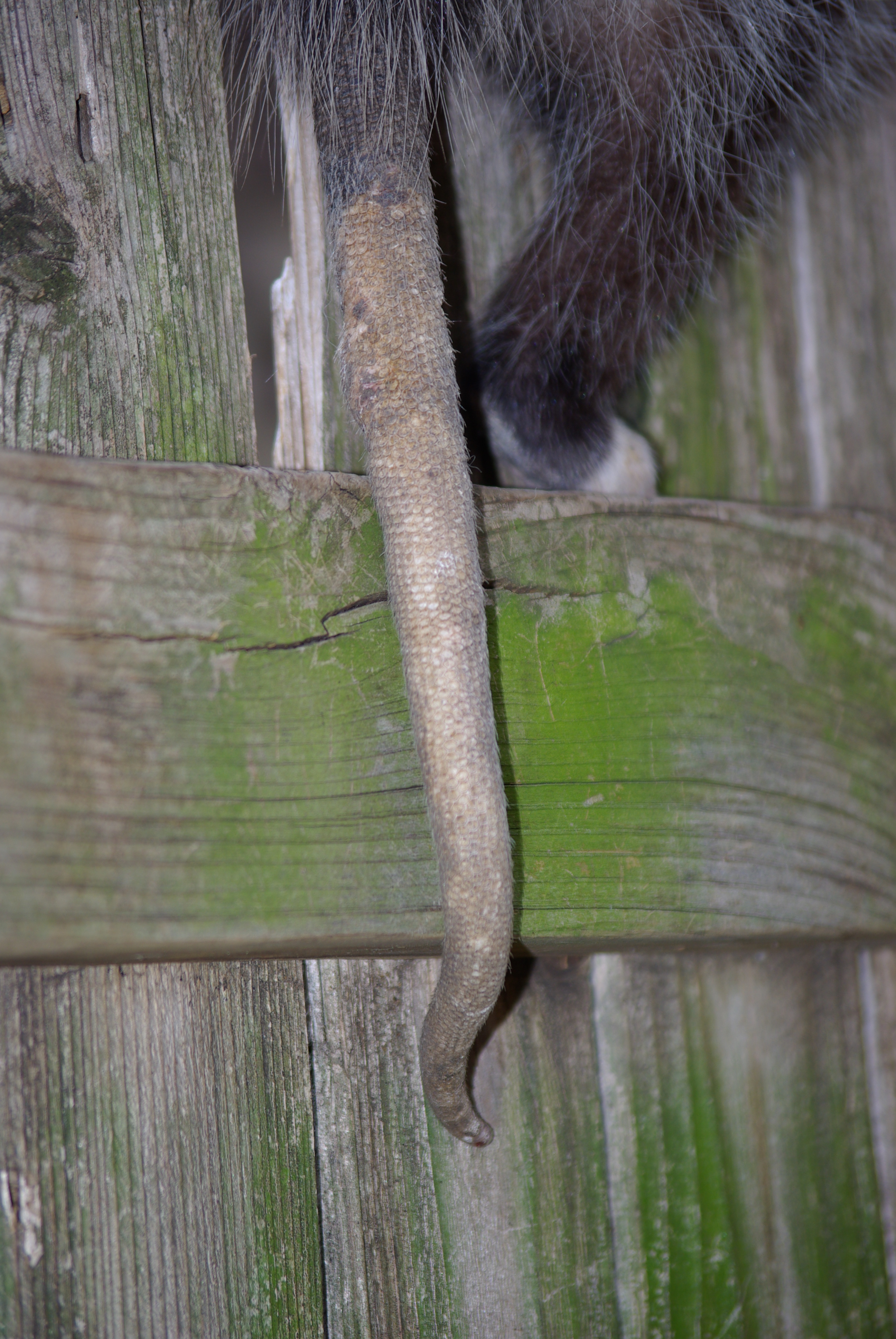
A possum's tail IMGP8935 - Ed Darrell photo, creative commons

The hairless, "rat" tail is one of the least attractive features. How much cuter would it be with a furry tail?

Possum on the fence - IMGP8933 Ed Darrell photo, creative commons

He does have a very cute, pink nose, however. You could get used to dealing with these little guys.


Playing with the ‘possum in the backyard

March 17, 2012

No, not “playing possum.”  Playing WITH the ‘possum.

The mostly-dachsund harasses any animal that may wish to take up residence under our shed — or, in some cases, under the heat pump.  The animals usually stick around for a while, though, because there is so much good stuff to dig up there.  For our part, we don’t mind when they dig up and dispose of the grubs, most of the time.

But these creatures — a possum, a raccoon a couple of years ago, armadilloes from time to time, or even rats (before Smokey the cat took them out, one by one) — eventually wander off, mostly unseen by us because they’re nocturnal.

Yesterday morning both dogs went nuts, and when I looked out, I realized they had something treed.  Between the mostly-dachsund and the border setter, they average out to a couple of beagles, and they can tree something if they want to.  Can’t get it, but they can tree it.

Possum on the fence IMGP2893 (2) photo by Ed Darrell creative commons copyright

It's an election year, so why shouldn't one of Pogo's cousins be on the fence?

It’s probably the same one I saw a few weeks ago when taking coffee grounds to the compost pile (maybe the caffeine is keeping this guy up days, eh?).  Kenny caught him crossing the alley late one night, in the headlights, of course.

I brought the dogs in, and turned them out an hour later, thinking the guy had plenty of time to get to his daytime hiding place.

They treed him again. (Actually, that’s the second treeing, pictured above.)

Later they got him on the fence in a different part of the yard.

Possum in dallas, peeking through the photinia

Possum caught in the early morning, peeking through the Chinese photinia (not red tip). Flash photography confuses the little guys, I think.

By this time I worried that the critter might be suffering from an illness — like rabies, which tends to make nocturnal animals come out in daylight, and be mean.

But there are no other symptoms.  I was relieved this morning to find new digs from the critter.  If he, or she, is digging for food, it’s probably not rabid.

In his jaunts around the world last year Kenny mentioned how ugly possums are, to one of his friends from Britain, who immediately took issue.  Cute?

Turns out Kenny’s friend was referring to the Australian possum, which is quite cute.

Australian ring-tailed possum, photo by kookr

Australian ring-tailed possum, photo by kookr. Australia has 27 different species of possum, all of them cuter and more cuddly than their American cousins.

Ours is not an Australian import.

I hope the bob whites come back, too.  Maybe it was just the drought that discouraged them last year.

It’s been a good year for wildlife, at least those with wings.  One day last week we had a tree full of cedar waxwings, passing through.  Blue jays and white-winged doves flew around them, and into the same tree.  There were a bunch of robins out — making eight weeks of sightings of the things, which leads me to understand some sizable population is staying in the Dallas area now, instead of just migrating through as they would, formerly.  On the live oak, the yellow-belly sapsucker probed for new grubs.  And on the trunk of the red oak the waxwings gathered in, another woodpecker, wholly oblivious to the cacophony, looked for emerging insects itself.   On local roads I’ve seen a bobcat — first for Texas, for me — and a few coyotes (while cousin-in-law Amanda has video of what looks to be wolves, in California!).  We haven’t gone out to look at the snowy owl in Rockwall, but there’s a chance of adding a rarity to the life-list.

With luck, we’ll get the toads, soon.  We should do well — Kathryn’s worked hard to make the yard a refuge for wildlife.  We’re mostly organic, so there should be no poisons to accumulate in any insect-eating critters.  We feed birds, several different species, and we have water for animals in front and back yard.  The National Wildlife Federation will certify your yard as a backyard wildlife habitat.  Working to get there is most of the fun; watching the wildlife is the gravy.

Backyard wildlife study is great fun.

More:


Oranges beat the freeze

December 7, 2011

We get our first freeze of the season in Dallas tonight.  I’m thinking of the heat of the summer.

Kathryn gambled a bit, bought a Satsuma orange tree for the patio plant menagerie this summer.  To her joy and my utter surprise, it fruited.

Kathryn's Satsuma oranges in Dallas

Kathryn's Satsuma oranges in Dallas -- oranges take a long time to ripen; photos from late October 2011

Green fruit approached its final size in late June, then tortured us as it just sat there, green and unripe.  They turned orange slowly, through August and September.  An occasional individual would give up and hit the ground.  So we had samples — bitter at first, hints of sugar in September.

Two weeks ago Kathryn harvested a score of the little beauties.

Oranges on the patio in Dallas

Through the summer the oranges rested there, teasing us with their sloth . . .

First freeze tonight, but we enjoyed the last of the oranges this morning.

Horticulture teaches patience.  Horticulture is fun.

More, Resources: 


6th Floor Museum, Dallas — go see it

November 23, 2011

The 6th Floor Museum in Dallas presents in-depth studies of the assassination of President John F. Kennedy, on November 22, 1963.

There’s a lot more to such a study than you might think.  It’s a relatively quick tour — you can view the museum’s displays and films in about two hours, comfortably, stopping to read exhibit cards and really analyze objects on display.  A couple of the films present a great deal of history quickly and well (Walter Cronkite narrates one).

One cannot avoid a great deal of history of the Civil Rights Movement, the Cuban Missile Crisis and the Cold War, and the start of the Vietnam conflict.  Kennedy’s administration covered only three years, but a very active and important three years in the 20th century.

Increasingly the 6th Floor Museum is a stop for researchers and scholars.  The recent addition of a good reading room for scholars is a great asset.

Curator Gary Mack offers a quick introduction in this video:

1,276

Plan to spend three or four hours.  You’ll find the place very interesting.  After the museum, most likely you’ll want to spend some time exploring Dealey Plaza, the road where Kennedy’s car was when he was shot, and the famous grassy knoll.  It’s a part of downtown that is almost always filled with people in daylight in all but the absolute worst weather.  (Check out the EarthCam at Dealey Plaza.)

Old Red, the old Dallas County Courthouse, with its own museum, is just a half block away.


Documentary film worth seeing: “The Other ‘F’ Word” at the Texas Theatre

November 20, 2011

Here’s the trailer:

Kathryn and I caught it last night at the renovated, historic Texas Theatre on Jefferson Avenue in Oak Cliff (formerly an independent town, now a sprawling neighborhood of Dallas).  The audience enthusiasm didn’t overpower the movie — the audience was much smaller than the film deserves.

It’s showing again this afternoon and Wednesday night at the Texas.

Advantages of seeing this at the Texas:

  1. Parking is easy and free after 4:00 p.m. on Jefferson Avenue.
  2. The bar has Mothership beer on tap (and a variety of other good libations).
  3. Popcorn is cheaper than at most megaplexes, plus it doesn’t taste as if made from petroleum by-product (which is not to say it is healthy, but that it may be less unhealthy).
  4. History point 1:  This is a near-Art Deco theatre built originally by Howard Hughes.
  5. History point 2:  This is the theatre in which Lee Harvey Oswald was captured in his flight from the scene of the assassination of President John F. Kennedy.
  6. It’s a great film.
  7. It’s a great theatre to view great films in.

Punk never made a great impression on me.  But at length, years later, I think I understand part of the angst and noise of the punkers, thanks to this film.  The description at the YouTube trailer:

THE OTHER F WORD
directed by Andrea Blaugrund Nevins
produced by Cristan Reilly and Andrea Blaugrund Nevins

IN THEATERS NOVEMBER 2ND, 2011
http://www.theotherfwordmovie.com/

This revealing and touching film asks what happens when a generation’s ultimate anti-authoritarians — punk rockers — become society’s ultimate authorities — dads. With a large chorus of punk rock’s leading men – Blink-182’s Mark Hoppus, Red Hot Chili Peppers’ Flea, Rise Against’s Tim McIlrath – THE OTHER F WORD follows Jim Lindberg, a 20-year veteran of the skate punk band Pennywise, on his hysterical and moving journey from belting his band’s anthem “F–k Authority,” to embracing his ultimately authoritarian role in mid-life: fatherhood.

Other dads featured in the film include skater Tony Hawk, Art Alexakis (Everclear), Mark Mothersbaugh (Devo), Tony Adolescent (The Adolescents), Fat Mike (NOFX), Lars Frederiksen (Rancid), and many others.

These are Tea Partiers with a cause and a brain, and a sense of social responsibility.  Lindberg said, near the end of the movie:

That’s what I want to hold on to, is that feeling that we can make a change out there.  Maybe the way we change the world is by raising better kids.

Readers of this blog may note the great irony in one of the chief profiles of the film being of Ron Reyes, a member of early West Coast punk band Black Flag, who quit the band in the middle of a set to protest the violence that afflicted the Los Angeles punk scene, and moved to Vancouver, British Columbia, to raise his kids well.

Heck, it’s probably a great film to see even if you can’t see it at the Texas.

(You know, I’ve got some shots of our tour of the Texas Theatre in August . . . hmm . . . where are those pictures?  Other computer?)


Teach for America: Savior of Dallas schools?

November 15, 2011

Lead editorial in today’s Dallas Morning News (page 14A):

Retaining Teachers

DISD should redouble efforts to support Teach for America recruits

In 2009, the Dallas Independent School District welcomed 80 Teach for America teachers to its campuses. These newly minted teachers were part of a competitive program that sends top college graduates to work in urban and rural public schools.

Two years later, only 45 teachers from that inaugural class remain in the district.

Where did the others go? DISD can’t say for sure.

Teach for America teachers make a two-year commitment. So, after fulfilling that obligation, they’re free to pursue other teaching opportunities, graduate school or entirely different careers.

Losing 43 percent of the first TFA class is somewhat troubling — particularly because that’s higher than the program’s national attrition rate in high-poverty schools. But that fact alone doesn’t mean that DISD and Teach for America aren’t a good fit.

One number doesn’t tell the whole story, and DISD would benefit from additional data as subsequent TFA classes complete their two-year stints. It would be useful for the district and Teach for America to know more about why these teachers are leaving and whether they are seeking out teaching jobs in other districts.

Still, the attrition rate raises important questions about what more DISD can do to support these young teachers — and encourage them to stay.

TFA is supplying the Dallas school district with teachers who were high achievers and leaders on their college campuses. And while they’re new to teaching, many are distinguishing themselves quickly. In 2010, DISD reported that the district’s TFA teachers were outperforming their peers in educating students in reading and math.

Even Teach for America’s critics, who often complain that TFA corps members don’t stay long enough to make a difference, would agree that these teachers will become even more effective with additional years of experience.

With all this in mind, DISD should refocus its efforts to ensure that TFA teachers who spend two years at a Dallas public school consider extending their stay. While this is still a relatively new program in DISD, the early numbers suggest that the district has not been a particularly welcoming place.

DISD should bolster its mentoring efforts and consider what other strategies could be employed to help TFA teachers succeed — and feel motivated to continue teaching.

There’s no doubt that some TFA corps members enter the program planning to teach only two years before embarking on another career. But Teach for America’s hope is that some will be inspired to continue in education.

Other districts with similar challenges have had more success retaining TFA corps members.

DISD should seize this opportunity to mentor and develop a unique group of teachers — instead of simply watching them walk out the door.

I work alongside several Teach for America people — to a person, great colleagues.  Some of them faced the same barriers to entry I did — Dallas was unhappy with my recommendations, for example, and held out my hiring for a few weeks because they didn’t want to take the recommendation of the chairman of the U.S. Senate Committee which deals with education policy, for whom I worked for a decade, but instead insisted I get a teacher  or someone from a local education establishment to write the letter (I got a person who assigned substitutes in a local district to comment — we knew each other on the phone).  Why they wouldn’t take the word of someone who knows me over someone in education, I don’t know — but there is a moral in that morass, somewhere.

Dallas ISD is generally not a teacher-friendly place these days.  After two rounds of layoffs, we have all been informed clearly that we are all on the maybe-needs-firing line.  TFA teachers can stay above that only partly — the poisonous atmosphere infects all faculty meetings and department tete-a-tetes.

There is a big difference between TFA teachers and others:  TFA is tough (sometimes stupidly too tough), but they let every one of their people know that each one is valuable, and expected to do great things.

Dallas ISD tried to do that once.  We had a kid give a great motivational speech at the fall welcome-back-teachers ball.

Then the district announced it had goofed, and a few hundred teachers would have to go.  Then word got out that the mother of the kid who gave the speech — a teacher — was on the chopping block.  Then word got out that the whole program the kid was in, was on the chopping block. Yeah, we believe in you, kid — we just don’t believe in education any more.

Is TFA the answer to Dallas’s woes?  What’s your view?  I’m still thinking about an appropriate, and informative response.

Also see this at the Dallas Morning News site:

Sidebar:

What is Teach for America?

Teach for America is an organization that works to recruit high-achieving college graduates for two-year teaching stints in urban and rural public schools. The hope is that many will continue to work in the field of education or an area that impacts student achievement.

The selection process is competitive — only 11 percent of this year’s 48,000 applicants were accepted.

The chart shows the number of Teach for America teachers in DISD, broken down by the school year they arrived. Many of those who started in 2009-10, the inaugural year in DISD, left after serving their two-year commitment.

School year TFA members received In DISD as of Sept. 26
2009-10 80 45
2010-11 107 102
2011-12 45 45
Total 232 192

SOURCES: Dallas ISD; Dallas Morning News research


2nd day of school in Dallas: Student asks, “Do you believe in me?”

August 23, 2011

It’s the second day of classes here in the Dallas Independent School District (Dallas ISD, or DISD).  Already we experience great trials from the loss of funding across the board in Texas education, as Gov. Rick Perry encouraged the state legislature to cut more than $4 billion from schools.  Cuts will be larger next fall.

At Molina High School we have about 25% more students, with 10% fewer teachers.  Classes strain the seams of the school — classrooms are crowded, desks and chairs are in short supply.  Computers promised for teachers, supposed to be delivered eight months ago, still are not delivered.  Printers, printing supplies, and paper, stand in conservation mode.  There are so few technical support people that those few new computers delivered often are not set up to operate yet.

Teachers need encouragement.  Here’s a bit of it.

What follows is mostly encore post, from 2008.

_____________

Taylor Mali is one of my usual suspects for inspiring teachers. He does a great job, with just a tinge of profanity (appropriately placed, many teachers argue – if they ask for it, you have to give it to them).

This year’s inspiration for Dallas teachers comes from Dalton Sherman, a fifth grader at Charles Rice Learning Center. Here’s a YouTube video of the presentation about 20,000 of us watched last Wednesday, a small point that redeemed the annual “convocation” exercise, for 2008:

Sherman’s presentation rescued what had been shaping up as another day of rah-rah imprecations to teachers who badly wanted, and in my case needed, to be spending time putting classrooms together.

(By the way, at the start of his presentation, you can see several people leap to their feet in the first row — Mom, Dad, and older brother. Nice built-in cheering section.)

Staff at DISD headquarters put the speech together for Dalton to memorize, and he worked over the summer to get it down. This background is wonderfully encouraging.

First, it makes a statement that DISD officials learn from mistakes. Last year the keynote was given by a speaker out of central casting’s “classic motivational speaker” reserves. As one teacher described it to me before the fete last Wednesday, “It was a real beating.”

Second, DISD’s planning ahead to pull this off suggests someone is looking a little bit down the road. This was a four or five month exercise for a less-than-10 minute presentation. It’s nice to know someone’s looking ahead at all.

Third, the cynical teachers gave Dalton Sherman a warm standing ovation. That it was delivered by a 10-year-old kids from DISD made a strong symbol. But the content was what hooked the teachers. Superintendent Michael Hinojosa provided a death-by-PowerPoint presentation leading up to the speech, one that was probably not designed solely as contrasting lead in. In other words, Dalton Sherman’s speech demonstrated as nothing else the district has done lately that someone downtown understands that the teachers count, the foot soldiers in our war on ignorance and jihad for progress.

The kids came back Monday, bless ’em. School’s in session, to anyone paying attention.

Resources:

Read the rest of this entry »


Teaching with original documents, at the 6th Floor Museum

July 29, 2011

6th Floor Museum Seminar - teachers in the Dallas Police Station, at Oswald's interrogation room

Teachers inspect the Dallas Police station, where accused assassin Lee Harvey Oswald was held. The door at left opens on the room where Oswald was interrogated by police. Panorama photo by Ed Darrell, use encouraged, with attribution; click for larger version

It’s been a good week of finding sources, for history issues across the spectrum, not just about the Kennedy assassination in Dallas.

Certainly one of the highlights was a bus tour that carried us from Dallas’s Love Field airport, along the route of Kennedy’s motorcade, to Parkland Hospital, and then through Oak Cliff along the route accused assassin Lee Oswald is believed to have traveled after the assassination to his capture at the much restored Texas Theatre on Jefferson Boulevard.

In the photo above we discuss the actions of Dallas Police after Oswald’s capture.  This room is in the old homicide division of the old Dallas Police Station, a building still in use for municipal offices and being renovated after the police department moved to a newer building a few years ago.  The door at the left leads to the room where Oswald was questioned about his actions and his knowledge of the day’s events.

Oswald's interrogation room in the old Dallas Police Department - photo by Ed Darrell, 6th Floor Museum teachers seminar

Cops and their desks departed years ago, but Oswald's interrogation room holds a fascinating, film noir atmosphere; view from inside the room, as teachers discuss events of November 22, 1963, in the larger office outside. Photo by Ed Darrell; click for larger view


Big bone sale in Dallas, part 2: Is P. Z. Myers bidding on this one?

June 12, 2011

It’s perfect for him.  Perfect.  Bidding stands at about $2,500 at the moment:

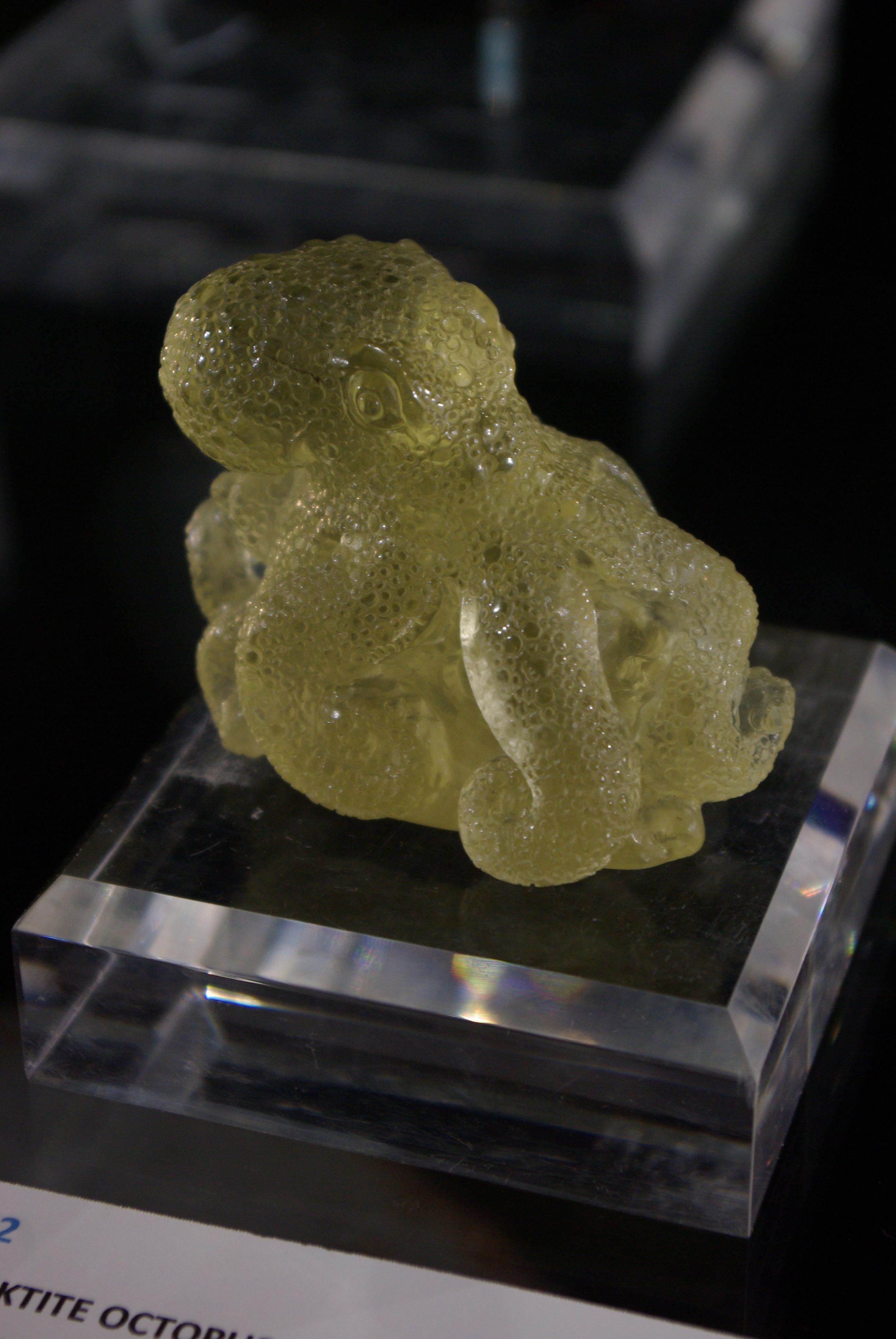
Gem tektite octopus - Heritage Auctions June 12, 2011 - IMGP6864 - copyright Ed Darrell, use permitted with attribution

Did our cephalopod overlords leave this for us, 29 million years ago? It's looking right at you, you know.

Is P. Z. Myers bidding on this thing?

According to the catalogue from Heritage Auctions, this piece of glass was formed in what is now the Libyan Sahara 29 million years ago when a meteoroid struck the sand, creating massive heat that fused sand into glass.  This light lemonade colored glass comes from only a small part of the Libyan sands.  Tektite is collectible by itself.  Some craftsman (unidentified and unplaced in time by Heritage Auctions) carved this piece into a cephalopod.

Taking an uncommonly large and clear specimen, the master lapidarist has carved the form of a malevolent-looking octopus, with superb rugose skin texture and a mass of curling tentacles. With a gorgeous translucence and lovely delicate green/yellow color, this exceptional sculpture measures 2¾ x 2 x 1¾ inches. Estimate: $2,800 – $3,200.

Compared to the giant articulated dinosaurs about 50 feet away from the display, one could easily overlook this little gem.  Still, bidding online looked to be pretty active.  Is P.Z. still in the British Isles?  Is he bidding by internet?  Is his Trophy Wife™ planning a Father’s Day surprise?

Tektites should pique your interest, Dear Reader.  Glass formed only when interplanetary objects smash into the planet, providing clues to the makeup of our solar system and universe, dating back well before recorded time, found in only a few fields around the Earth.  They are the perfect marriage-merger of geology, astronomy, geography, natural history, history and, in this case, art.   They are popular among collectors.    Who walks away with this one this afternoon?


Big bone sale in Dallas

June 11, 2011

Big bones.  Big sale.

Heritage Auction's triceratops, for Jun 12, 2011 auction

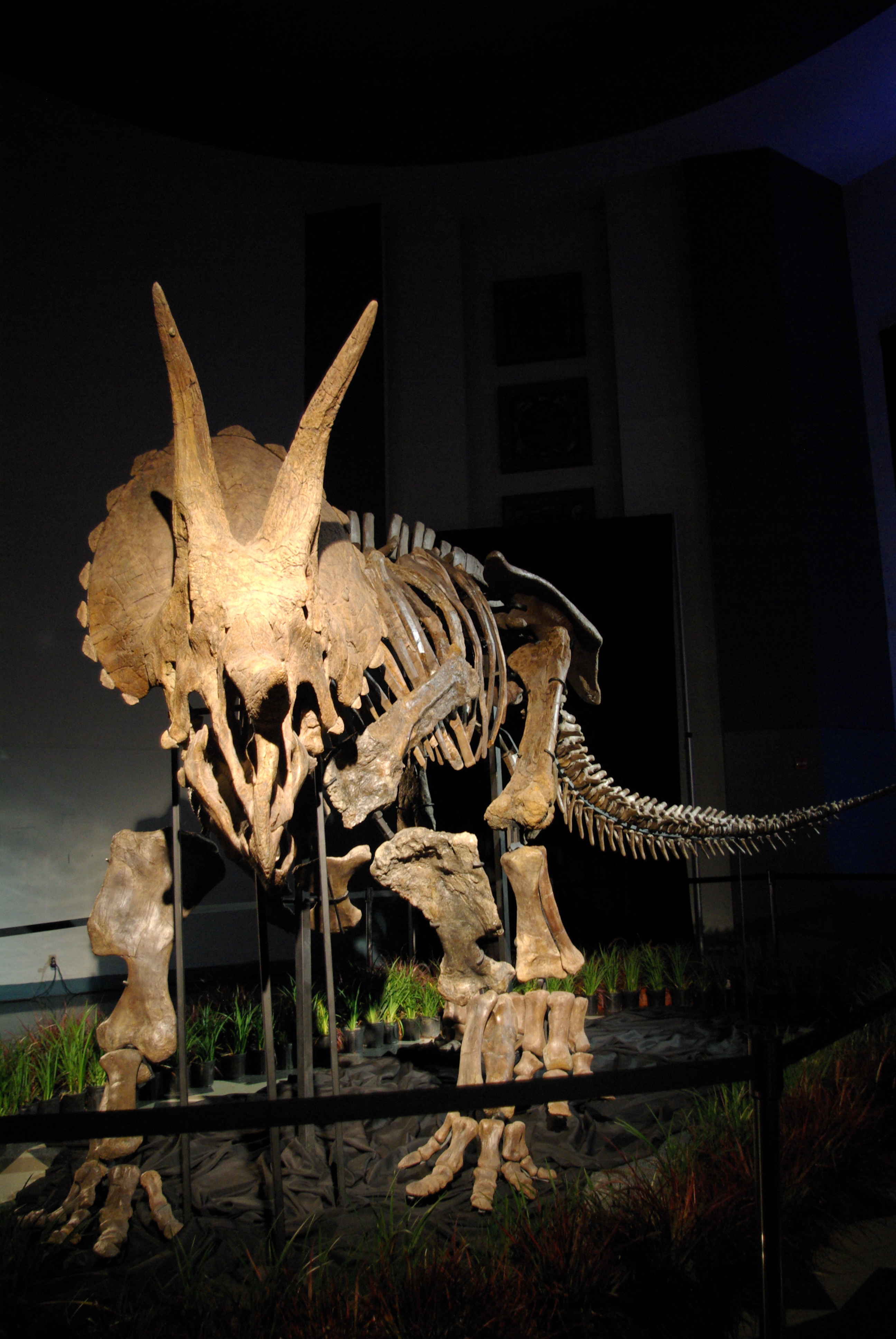
Triceratops welcomes bidders and gawkers to the Heritage Auction sale of fossils, gems, meteorites, and other national history ephemera. HA estimates this nearly-complete triceratops, mounted, to be worth about $700,000; less than 24 hours before the live auction, it has an online bid of $500,000 already.

Heritage Auctions set up a bug bunch of fossils, gems, meteorites, taxidermy, and art work from natural materials, for an auction on Sunday, June 12, 2011.

2011 June Dallas Signature Platinum Natural History Auction – Dallas, TX.  Auction #6061.

I can’t afford to bid, but they let me in to get photos.  Nice people.

Heritage Auctions' June special, a triceratops - IMGP6882 photo by Ed Darrell; use permitted with attribution

Heritage Auctions' June special, a triceratops - photo by Ed Darrell; use permitted with attribution

The triceratops greets visitors and bidders at the display site, the Tower Building at Dallas’s art deco gem, Fair Park.  (If you look at the ceiling above the triceratops, you can see where restorers have stripped away several layers of paint to reveal the original ceiling paintings — original artwork, including murals, was painted over in the years following the dramatic debut of the buildings; restoration work proceeds slowly because of lack of funding.)

Triceratops horridus
Cretaceous
Hell Creek formation, Harding County, South Dakota

Researchers dug this particular specimen out of the ground in 2004.  HA’s description just makes one’s science juices flow:

Triceratops has enjoyed much cultural publicity ever since its discovery. It is an iconic dinosaur that has appeared in movies ranging from black and white cinema to modern movies like “Jurassic Park.” It has also been in cartoons, such as the children’s classic “The Land before Time.” Triceratops is also the official state fossil of South Dakota and the official state dinosaur of Wyoming.

The present specimen was discovered in 2004 in two parts: First, the fossil hunters came upon pieces of dinosaur bone eroding down a gully. Following these bone fragments, they eventually came upon large bones that would indicate the presence of a large Ceratopsian dinosaur. While this large mass of bones was being excavated, other members of the team followed another bone trail which led them to an amazingly well preserved skull 750 feet away from the original discovery. Over the course of months, the specimens were carefully excavated in large blocks; each specimen was covered in plaster jackets and removed from the field to the lab. It was only during preparation that they discovered the dinosaur was a Triceratops, and it happened to be a Triceratops with an incredibly complete skull. The bones and skull were carefully removed from their field jackets and prepared using hand tools. Broken bones were professionally repaired and restored while a few missing elements were cast from other Triceratops skeletons. A custom made mount was created to support the bones and the skull; innovative bracket mounts were crafted for each bone so that no bones had to be damaged in order to mount them. The bones were mounted in osteologically correct position; making it comparable to and possibly surpassing the accuracy of older mounts in museum displays. Though it is impossible to say whether or not the skull is original to the specimen, being discovered 750 feet apart, it is certainly possible that the two elements are associated for a number of reasons: first, the size of the skull is consistent with the proportional size dimensions of the skeleton, and second, the surrounding matrix (host rock) was identical in composition.

The completed skeleton is enormous; measuring 19 feet long from head to tail, 11 feet across, and towering 12 feet tall. The skull itself measures 7 feet long with 3 ½ foot long horns; placing it near the top of the size range for Triceratops skulls. The leg bones stand 10 feet tall from toes to the top of the scapula; dwarfing many other Triceratops skeletons. Given that the skull represents about 30% of a dinosaur’s entire skeleton, the present specimen is about 75% original bone, with the right leg, pelvic region, several cervical vertebrae and a few tail vertebrae being cast reproductions.

Who owns the thing?  Who put it together?   Who is losing the specimen, should it go to a private collection (you got a living room that big?), and which museum really wants it?

But that’s just one of the specimens up for sale at this auction, and not necessarily the best.  Also up for bid:  A stegosaurus, and an allosaurus, posed as a “fighting pair.”

Fighting pair - allosaurus and stegosaurus, from Heritage Auctions' June 12, 2011 sale of fossils IMGP6839 - photo copyright by Ed Darrell, use permitted with attribution

The "fighting pair," an allosaurus (left) and stegosaurus (right) posed in combat positions. Photo by Ed Darrell, use permitted with attribution.

If it sells, the stegosaurus will cost a lucky bidder more than $1 million.  The allosaurus requires $1.6 million.

Am I jaded?  On the one hand you can’t look at these specimens without thinking they deserve to be seen by kids, and adults, and studied by paleontologists and biologist of all stripes — and so who has the right to sell these off?  On the other hand, this is a Second Gilded Age, and the search for prize fossil specimens is often financed by the proceeds from these auctions.  I enjoyed an hour’s browsing and photographing — a slide presentation on the wonders of America for some sleepy class next fall.

How many of these specimens will I get a chance to see again in the future?

Or, Dear Reader, how many of these will you ever get a chance to see?

HA will sell a lot more than just a few dinosaur fossils.  This same sale includes the largest shark jawbone ever found, stuffed Kodiak and polar bears (from the same hunter), gems, art from petrified wood and fossilized fish, and a large selection of meteorites, including the only meteoroid ever confirmed to have struck and killed a living creature (a cow in Argentine; you can’t toss a stone without hitting a cow in Argentina, I hear).

Giant shark jaw for Heritage Auctions' June 2011 sale

Requires a large wall and high ceilings to display

I don’t plan to go bid; there’s about an hour remaining for online bidding tonight, but if you’re interested and you’ve got your income tax refund burning a hole in your pocket, you can also bid by telephone and hotlink on the internet (go to the Heritage Auction site for details).   Frankly, I don’t think the sale will get the attention it deserves.  I hope these spectacular specimens will land where they can get  a great, admiring and studious audience.


It’s official: Dallas school Superintendent Hinojosa resigned today

June 6, 2011

Dallas Independent School District’s (DISD) Superintendent Michael Hinojosa resigned about an hour ago to accept the job in Cobb County, Georgia.  The board meets tonight, perhapsto appoint an interim superintendent.

Here’s the message sent out through the Dallas systems today, to teachers and administrators:

SUPERINTENDENT MICHAEL HINOJOSA RESIGNS FROM DALLAS ISD

Accepts Superintendent Position in Cobb County, Georgia

Superintendent of Schools Michael Hinojosa submitted his letter of resignation from the Dallas Independent School District today to accept a similar position in Cobb County, Georgia.

Dr. Hinojosa has served as the superintendent for the stateâs second-largest school district for six yearsâthe longest term since Linus Wright held the position in the 1980s. His last day with Dallas ISD will be Thursday, June 30, 2011.

“It has been an honor to serve as superintendent for the school district I attended as a child and where I started my teaching career,” said Hinojosa. “I am enormously proud of our shared accomplishmentsâthe biggest of which is that the number of students graduating from Dallas ISD schools is at its highest since 1983.”

This school year, Dallas ISD expects to graduate a total of 7,200 students, up from 5,800 four years ago. The number has steadily risen each of the last four years.

Under Dr. Hinojosaâs leadership, the school district implemented a systemwide curriculum that was developed by teachers. In addition, principals for schools that had vacancies during the last six years were selected through a collaborative process that allowed staff and the community to provide input.

A $1.37 billion bond program to build and improve school facilities that was approved by voters in 2002was implemented on schedule and under budget. Another $1.35 billion bond program that was approved by voters in 2008 will build 14 more schools, 13 additions, and provide renovations to more than 200 district facilities.

Dallas ISD also became known throughout the country for its leadership in arts education. The Wallace Foundation provided an $8 million grant for the district to partner with Big Thought and the City of Dallas to provide more arts opportunities for students both during and after school.

Under Dr. Hinojosa’s leadership, schools in the southern sector received a significant boost. Two early college high schools are now operating, an all-boys school will open this fall as will a New Tech High School, and three renovated/new schools will open in Wilmer-Hutchins signaling a rebirth of public education in that community.

Grants from the Michael and Susan Dell Foundation and Bill and Melinda Gates Foundation enabled the Dallas Independent School District to become a pioneer in the world of student data. The grants gave principals and teachers access to data dashboards, as well as established a Parent Portal for parents to monitor the progress of their students.

During his six-year tenure, Dr. Hinojosa responded to several crises, including the dissolution of neighboring Wilmer-Hutchins ISD and hurricanes Katrina and Rita, all of which caused an unexpected influx of additional students into Dallas ISD. The biggest crisis was a budget miscalculation that eventually forced the layoff of hundreds of staff during the 2008-09 school year.

Since then, the district has put in place a number of financial controls and rebuilt its fund balance to safer levels. The district now faces a significant cut in state funding because of a statewide budget shortfall.

“It certainly isn’t easy to be an urban school superintendent in todayâs environment, but I am proud of what this community has accomplished during the last six years,” said Hinojosa. “More students are graduating, more students are scoring at college-ready levels and our teachers and principals are better-trained. I hope whoever the board chooses as its next superintendent is provided the same opportunities to make improvements to continue the momentum on behalf of the students of this community. I am thankful to trustees, our staff and so many other leaders and stakeholders in Dallas who have been part of this experience.”

One of Dr. Hinojosaâs hallmarks was to make unannounced visits to the district’s 225 schools each Wednesday morning. He said the experiences kept him grounded on what was most important in the life of a large, urban school district.

“Every school has individuals who are devoted to helping our students succeed,” said Hinojosa. “I couldn’t help but be moved by the dedication of so many people, from custodians to food service workers, librarians to counselors, aides to front office staff and of course, principals and teachers. The Dallas Independent School District will continue to shine because of each of them. My address may soon be in Georgia, but a part of me will always be in Dallas. It has been a privilege.”

Dr. Hinojosa said he is moving to Georgia in part to be closer to his son whose wife is pregnant with their first child. He has two sons who have recently graduated from Hillcrest High School in Dallas who will be attending Ivy League colleges in the fall.

In Fort Worth, the board is expected to approve a separation agreement for Superintendent Melody Johnson, who is resigning to move to California to be closer to her aged mother.  Most people expect a tough fight to find a capable person to head either district.