Texas researchers tease out correlation between DDT exposure and late-onset Alzheimer’s

February 12, 2014

Press release from the University of Texas-Southwestern Medical Center in Dallas:

Research finds elevated levels of DDT metabolite in Alzheimer’s patients

Dr. Dwight German, Professor of Psychiatry

Dr. Dwight German, Professor of Psychiatry – UT-Southwestern photo

DALLAS – January 29, 2014 – Exposure to DDT may increase the likelihood of developing Alzheimer’s disease later in life, a study with researchers at UT Southwestern Medical Center suggests. While previous studies have linked chronic diseases such as cancer and diabetes to DDT, this is the first clinical study to link the U.S.-banned pesticide to Alzheimer’s disease.

The study, published online in JAMA Neurology, found elevated levels of the DDT metabolite, DDE, that were 3.8 times higher in patients diagnosed with Alzheimer’s disease in comparison to control subjects. The studies were conducted in partnership with researchers at Emory University School of Medicine and Rutgers Robert Wood Johnson Medical School.

“We have additional studies underway that will seek to directly link DDT exposure to Alzheimer’s disease,” said co-author Dr. Dwight German, Professor of Psychiatry at UT Southwestern. “If a direct link is made, our hope is to then identify the presence of DDE in blood samples from people at an early age and administer treatments to remove it.”

The study found elevated levels of DDE in blood samples of 86 patients with Alzheimer’s disease as compared to 79 control patients from the UT Southwestern Alzheimer’s Disease Center and the Emory University Alzheimer’s Disease Center.

Researchers made the link between DDE and Alzheimer’s by measuring three components – blood serum levels, severity of the patient’s Alzheimer’s disease as measured by the Mini-Mental State Examination (MMSE) and its relation to serum DDE levels, and the reaction of isolated nerve cells to DDE. Treatment of human nerve cells with DDE caused them to increase the production of the amyloid precursor protein that is directly linked to Alzheimer’s disease.

Participants in the study underwent preliminary testing to ensure that they didn’t have symptoms of other dementia-related diseases, and were an average age of 74, while the control subjects were on average 70 years old. These findings may help lead to the development of early biomarkers that can determine whether a person will develop Alzheimer’s disease later in life due to DDT exposure.

Alzheimer’s disease is the most common neurodegenerative disease worldwide and is expected to increase three-fold over the next 40 years, according to the researchers.

DDT (dichloro-diphenyl-trichloroethane) was used extensively as an insecticide in the 1940s, but has been banned in the United States since 1972 after scientists linked the compound to wildlife health and environmental concerns. DDT is still used in other countries to combat the spread of malaria.

About UT Southwestern Medical Center
UT Southwestern, one of the premier academic medical centers in the nation, integrates pioneering biomedical research with exceptional clinical care and education. The institution’s faculty includes many distinguished members, including five who have been awarded Nobel Prizes since 1985. Numbering more than 2,700, the faculty is responsible for groundbreaking medical advances and is committed to translating science-driven research quickly to new clinical treatments. UT Southwestern physicians provide medical care in 40 specialties to nearly 91,000 hospitalized patients and oversee more than 2 million outpatient visits a year.

###

Once again, research seems to demonstrates the wisdom of Rachel Carson, who warned us that we could not know the long-term damage done by untested pesticides applied with abandon in great abundance as if it were a solution to everything.

Carson’s book indicting pesticides regulation, Silent Spring, was published in 1962, with more than 50 pages of footnotes and citations to scientific studies.  In the 52 years since, none of that research has been rebutted by any further research.  Instead, more harms have been discovered, greater questions raised about the damage done by pesticides applied indiscriminantly.


No, Congress did not “overreact” to DDT

October 30, 2013

Looking for something else, I restumbled on the Constitution Club, where they continue to club the Constitution, its better principles, and especially the great nation that the document creates.

And one of those grotesquely inaccurate posts blaming liberals for everything sprang up — bedbugs, this time.  If only those liberals had let the good DDT manufacturers poison the hell out of the entire planet, the blog falsely claims, there would be no concern for bedbugs surging in hotels worldwide today, and especially not in Charlotte, North Carolina, back during the Democratic National Convention.

A meeting of a chapter of Constitution clubs? Wikipedia image

A meeting of a chapter of Constitution clubs? Wikipedia image

Looking through the archives, I now recall I dealt with most of this issue on this blog before.

The post’s author made a response I hadn’t seen.  God help me these idiots do need a trip to the intellectual woodshed.  He said “Congress overreacted on DDT, I think. It likes to do that.”

In reality, Congress did nothing at all, other than pass the law regulating pesticides, if we stick to the real history. The U.S. Environmental Protection Agency (EPA) issued the rule on DDT, which still stands today.  Over react?  Two federal courts had to twist EPA’s arm to get any action at all, and after delaying for nearly two years, EPA’s rule didn’t ban DDT except for outdoor use on crops, which by that time meant cotton in a handful of states in the U.S. — DDT has never been banned in Africa nor Asia, Persistent Organic Pollutants Treaty notwithstanding.

Oh, hell. Put it on the record.

I wrote:

Did Congress ever “react” to DDT?

EPA was tasked by the 1950s’s FIFRA to check out safety of pesticides, and did.  FIFRA had recently been amended to give EPA (USDA, before) power to ban a pesticide outright. Two federal courts found DDT eminently worthy of such an outright ban, but refrained from ordering it themselves as they saw the law to require, on the promise of EPA to conduct a thorough scientific review.  At some length, and irritation to the Eisenhower appointees to the courts, EPA got around to an administrative law hearing — several months and 9,000 pages.  In a panic, the DDT manufacturers proposed a new label for DDT before the hearings got started, calling DDT dangerous to wildlife, and saying it should be used only indoors to control health-threats.  Alas, under the law, if DDT were allowed to stay for sale over the counter, anyone could buy it and abuse it.  The hearing record clearly provided proof that DDT killed wildlife, and entire ecosystems.  But, it was useful to fight diseases, used as the proposed label suggested . . .

Administrator William Ruckelshaus took the cue the DDT manufacturers offered.  He issued a rule banning DDT from outdoor use on agricultural crops except in emergencies with a permit from EPA.  But he specifically allowed U.S. manufacturers to keep making the stuff for export to fight malaria in distant nations, and to allow DDT makers to keep making money.

“Over-reacted” on DDT?  Not Congress, and not EPA.  The rule was challenged in court, twice.  The appellate courts ruled that the scientific evidence, the mountains of it, fully justified the rule, and let it stand.  (Under U.S. law, agencies may not act on whim; if they over-react, they’ve violated the law.)

How bedbugs react to DDT today. Articulate.com

How bedbugs react to DDT today. Articulate.com

No study conducted carefully and judiciously, and passed through the gauntlet of peer review, since that time, has questioned the science conclusions of that rule in any significant way — if any study questioned the science at all (there are famous urban legends, but most of them lead back to people who didn’t even bother to do research, let alone do it well and publish it).

But so-called conservatives have faith that if Congress will just repeal the law of gravity, pigs can fly.  In the real world, things don’t work that way.

How bedbugs view DDT in the 21st century.

How bedbugs view DDT in the 21st century.

I’ve captured most of the earlier exchanges below the fold; one can never trust so-called conservatives to conserve a record of their gross errors.  They’re there for the record, and for your use and edification.

Read the rest of this entry »


Typewriters of the moment: Mitford and Carson, two environmental journalists

September 24, 2013

The great editorial cartoonist Bill Mauldin of the Chicago Sun-Times illustrates the gender dimension of the controversy over Carson and Silent Spring. In this 27 October 1963 cartoon he pairs her with Jessica Mitford, author of The American Way of Death, a scathing indictment of the funeral home industry. Men from both industries have been flattened under the platens of the women’s typewriters.  All rights reserved © 1963 by Bill Mauldin. Courtesy of Bill Mauldin Estate LLC

The great editorial cartoonist Bill Mauldin of the Chicago Sun-Times illustrates the gender dimension of the controversy over Carson and Silent Spring. In this 27 October 1963 cartoon he pairs her with Jessica Mitford, author of The American Way of Death, a scathing indictment of the funeral home industry. Men from both industries have been flattened under the platens of the women’s typewriters. All rights reserved © 1963 by Bill Mauldin. Courtesy of Bill Mauldin Estate LLC

Captured from Mark Stoll’s “Rachel Carson’s Silent Spring, a book that changed the world,” at the Environment and Society Portal.

A well-fitting image in the few days before the Society of Environmental Journalists (SEJ) opens its 2013 convention in Chattanooga, Tennessee (October 2-4).  It was the power of the typewriter in 1963; the power of the word processor in 2013, more likely.  In either case, it’s the hard work of environmental journalists, who are out to make the world a better place by showing us what it is, what shape it’s in, and how we might conserve it.

More:


Yes, DDT is deadly to humans, as suicides demonstrate

September 16, 2013

One of the anti-environmental, anti-green false myths kicking around is that DDT is not harmful to humans, and therefore it probably shouldn’t have been banned, “and Rachel Carson was wrong.”

This poster from the U.S. Fish and Wildlife Service illustrates bioaccumulation, theprocess by which larger animals can be killed by acute DDT poisoning.

This poster from the U.S. Fish and Wildlife Service illustrates bioaccumulation, the process by which larger animals can be killed by acute DDT poisoning.

Reality is that DDT is a poison, but acute poisoning of large animals tends to take a lot.  Insectivorous animals or their predators can get those fatal amounts, but humans generally don’t.  DDT as a toxin kills mammals and birds and amphibians and reptiles and fish with equal alacrity, slowed only by the size of the organism and whether the organism’s diet consists of other things that consume and accumulate DDT.

Often that misperception is coupled with a claim that DDT does not cause cancer, and so should have its ban lifted.

But, the facts:

  • DDT is a neurotoxin; in accumulates in fat, and if enough of it courses through the blood of an animal at a given point, it kills off parts of the neurosystem including the brain.
  • DDT kills mammals (humans are mammals); in fact the U.S. Army argued to keep DDT on the market to use against bats that infested barracks in training camps (bats are mammals, too).  Death depends on the dose, which depends on body size.  Takes a fair amount to kill off a large mammal, quickly.  DDT is implicated in the near extinction of different species of migratory free-tail bats in the Southwest.
  • DDT is carcinogenic.  Fortunately for humans, it’s a weak carcinogen for most cancers, though research points to a troubling link to some cancers (breast, reproductive organs) that appear very late relative to exposure, especially if exposure to DDT occurs in utero, or in infancy.
  • DDT was not banned as a hazard to human health; it was banned as a hazard to wildlife.  DDT in almost all concentrations becomes an indiscriminate killer of wildlife when used outdoors.
  • DDT can kill humans with acute poisoning.

That last point isn’t easy to document in the U.S.  During the go-go DDT years there was one case of a young girl who drank from a prepared DDT solution, and died a short time later.  The incident was a tragedy, but not unique for the 1950s and 1960s.  It was written off to lax safety standards, and because it occurred long before the origin of on-line databases, essentially it has fallen out of history.  Just try to find a reference to the death today.

Partly, this lack of information on human toxicity is due to the fact that DDT use was slowing dramatically by the late 1960s (it was becoming ineffective), and after the ban in 1972, there were few cases in the U.S. where humans were exposed to the stuff, except in emissions from DDT manufacturing plants.  EPA’s order banning DDT in the U.S. applied only to agricultural use, and the chief agricultural use remaining was on cotton.  Manufacturing was not banned, however, which meant U.S. DDT makers could continue to pump the stuff out and sell it overseas, in Africa, and Asia.  This continued right up to that day in 1984 that U.S. companies became subject to damage for the poisons they make under the Superfund law — almost every DDT maker declared bankruptcy to escape liability in the weeks before the Superfund became effective, saddling taxpayers with a few dozen Superfund sites to be cleaned up on the taxpayer’s dime.

DDT has never been banned in Africa or Asia, however.  And there we find a badly-documented history of people poisoning themselves with DDT, usually in suicides.

Whatever other pathologies these cases may exhibit, they reveal that DDT does, indeed, kill humans.

Like this recent case, from Ghana; yes, that’s the illustration used in the newspaper; from the Ghana Broadcasting Corporation:

Sep 11, 2013 at 11:52am
Man commits suicide over wife’s confession

Benjamin Kwaku Owusu, a 40-year-old former Manager of Unity Oil Filling Station in Suhum, has committed suicide by drinking DDT Gamullio 20 insecticide.

A family spokesperson who spoke to the Ghana News Agency on condition of anonymity said Owusu and his wife lived at Suhum and had been married for five years but never had a child.

He said the situation often developed into misunderstanding between them but later the wife got pregnant and left for her home town.

According to the spokesperson, whiles Owusu was preparing for the wife to deliver, he had a shocking message from the wife that the pregnancy belonged to another man and not him.

He said Owusu, who had a shock, rushed into his room and drunk the DDT Insecticide and fell unconscious.

“Owusu was rushed to the hospital but died soon after he was admitted,” he said.

When the police at Suhum was contacted, they confirmed the story and said the body of the deceased had since been buried after post mortem examination at the Suhum Government Hospital.

GNA

Not sure what “Gamullio 20” means, but it seems to be the brand name of the poison used.

More:


Rachel Carson project won first at National History Day competition

June 19, 2013

News from the San Ramon (California) Express [links added here, except for reporter’s contact]:

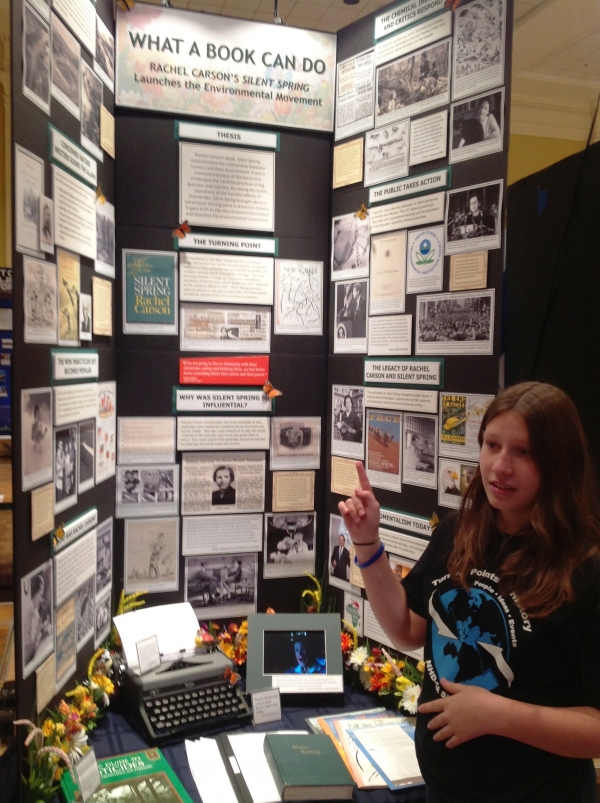
Julienne Sauer in front of her project,

Julienne Sauer in front of her project, “What a book can do — Rachel Carson‘s Silent Spring Launches the Environmental Movement.” (© 2013 San Ramon Express)

San Ramon student takes first at National History Day contest

by Jessica Lipsky

Windemere Ranch Middle School student was one of 30 recognized by the National Endowment for the Humanities (NEH) for their impressive use of historic newspapers in projects presented at National History Day.

Julienne Sauer, who graduated from eighth grade last week, took first place in NEH’s individual exhibit junior division for her project titled “What a book can do — Rachel Carson’s Silent Spring Launches the Environmental Movement.” This year’s National History Day theme was “Turning Points in History: People, Ideas, Events.”

Julienne was also named a National Endowment Humanities Scholar.

The annual event is the culmination of a year-long academic program in which students in middle and high school conduct original historical research for papers, exhibits, websites, documentaries and public performances. Each year more than 600,000 students compete in local, regional and state competitions for a chance to win a spot at the national finals.

This year was the first time NEH awarded prizes to students who incorporated into their projects research using Chronicling America, a free online database of 5 million pages of historic US newspapers dating from 1836 to 1922, digitized through a partnership between NEH and the Library of Congress.

Julienne won a national finalist award at the 2011 National History Day exhibit for her exhibit titled “The Cable Car Wars: A City Debates to Preserve its Character.”

Carson’s work was good enough that, even 49 years after her death, 51 years after the publication of Silent Spring, Carson and the book still inspire students to heights of excellence in study.

More:


Querying the Rachel Carson Critics (who turned out the light?)

June 19, 2013

Another question of mine that will probably never see the light of day.  This group has no answer, so why would they allow the question?

I stumbled across a blog-looking page from the American Council on Science and Health, an industry apologist propaganda site, on World Malaria Day, which was April 25.  You may recognize the name of the group as one of the industry-funded sites that constantly attacks Rachel Carson, and often the World Health Organization, with the unscientific and false claims that environmentalists bannned DDT and thereby condemned millions of Africans to die from malaria — which, ASCH claims, could have easily been eradicated with more DDT poisoning of Africa.

On World Malaria Day, ASCH took note, flirted with the facts (that DDT doesn’t work as it once was thought to work), but then backed away from the facts — that the ban on DDT in the U.S. came years AFTER WHO suspended the malaria eradication campaign in Africa when it was discovered DDT couldn’t kill DDT-adapted mosquitoes, already subject to years of abuse of DDT by agriculture and other industries.  ASCH said:

DDT kills mosquitoes, although not as well as it did 60 years ago. But it also irritates them and repels them, so the small amount sprayed inside homes effectively reduces the transmission of the malarial microbe substantially. The banning of DDT, based upon political anti-chemical bureaucrats and “environmentalists” inspired by Carson’s “Silent Spring” who ran our EPA in 1972, helped to impede the malaria control program led by the UN’s WHO.

Impede?  Impossible for a 1972 ban to have been responsible for the earlier suspension of the WHO campaign, not to mention EPA’s ban ended at the U.S. borders.  So I asked:

Screen capture of query to ACSH on how EPA's ban "impeded" WHO's campaign against malaria, ended years earlier.

Screen capture of query to ACSH on how EPA’s ban “impeded” WHO’s campaign against malaria, ended years earlier.

Ed Darrell Reply

June 19, 2013 at 5:16 am

Your comment is awaiting moderation.

I would be very interested in just how the 1972 ban on DDT in the U.S. “impeded” the UN’s antimalaria campaign, which stopped using DDT heavily seven years earlier, and was suspended in 1969.

After the ban on U.S. use of DDT, all of U.S. manufacture was dedicated to export to Africa and Asia, which greatly increased DDT supplies available there.

How did this impede?

Want to wager a guess as to whether they’ll ever allow the comment to see the light of day at their site, let alone answer it?

More:

Wall of Shame – Sites that continue to spread the pro-DDT hoax as fact:

DDT is good for me advertisement

“DDT is good for me advertisement” from circa 1955.  Photo image from the Crossett Library Bennington College.  This ad today is thought to be emblematic of the propaganda overkill that led to environmental disasters in much of the U.S. and the world.  DDT cleanups through the Superfund continue to cost American taxpayers millions of dollars annually.


Quote of the moment: Rachel Carson, on why her nature writing sounds so much like poetry

June 14, 2013

Rachel Carson said:

“If there is poetry in my book about the sea, it is not because I deliberately put it there, but because no one could write truthfully about the sea and leave out the poetry.”

Cover of The Gentle Subversive, by Mark Hamilton Lytle, for Oxford University Press.

Cover of The Gentle Subversive, by Mark Hamilton Lytle, for Oxford University Press.

Bug Girl wrote a fine review last year of an often over-looked book on Carson, The Gentle Subversive: Rachel Carson, Silent Spring, and the Rise of the Environmental Movement  (Mark Hamilton Lytle, 2007. Oxford Univ. Press.)  It’s worth your click over there to read a nice piece on Carson, on women in science, and on nature writing.

Bug Girl spends the necessary time and space answering critics of Carson, of Silent Spring, and those few odd but incredibly active and loud advocates who claim we can conquer disease if we can only spread enough DDT poison around the Earth.  Go see.

I find it impossible to stand in a place like Yosemite and not hear John Muir‘s voice — and it’s probably that John Muir found that, too.  Or stand on the shores of Waldon Pond and not hear Henry David Thoreau, or stand on sandy soil in Wisconsin and not hear Aldo Leopold, or sit on a redrock outcropping in southern Utah and not hear Ed Abbey.  They probably heard similar voices.  But they had the presence of mind to write down what they heard.

Writing wonderful prose, or poetry, must be easier when the subject sings of itself in your ears, and paints itself in glory for your eyes.

If Carson’s prose borders on poetry, does that add to, or subtract from its science value?

More:

U.S. President Theodore Roosevelt (left) and n...

U.S. President Theodore Roosevelt (left) and nature preservationist John Muir, founder of the Sierra Club , on Glacier Point in Yosemite National Park. In the background: Upper and lower Yosemite Falls. Wikipedia image


Why it’s important to have accurate history and science on the internet: Don’t lie to kids about DDT

June 6, 2013

Great accomplishment by this kid from Hudson, Massachusetts — but troubling, too.  He’s winning a persuasive speech competition, persuading people against history, law and science, calling for a return of DDT.

Andrew Brandt of Hudson MA, persuasive speaking champion

Andrew Brandt of Hudson holds his winning certificate at the regional speech and debate tournament in New Hampshire in April. He was one of seven to advance to the national competition. (Photo/submitted)

Hudson – Andrew Barndt, 13, from Hudson will be traveling to Tulsa, Okla., in June to join more than 500 students competing in a National Speech and Debate Tournament.

Andrew has qualified to compete in the Persuasive Speech category with the National Christian Forensics and Communications Association (NCFCA). Home-schooled students aged 12 to 18 compete at local and regional tournaments around the country in the winter and spring, culminating in the national tournament in June.

In April, at the regional tournament in Concord, N.H., 27 students competed in the Persuasive Speech category. Andrew’s speech, “DDT: What You Think You Know May Not Be So,” was one of seven chosen to move on the national competition.

According to the NCFCA, “a persuasive speech is an original platform speech that attempts to persuade the audience to adopt a particular point of view or course of action.”

A competitor will give a speech three times in front of different three-judge panels. Judges can be other parents, members of the community or former competitors. The judges rank them on 17 criteria, including: using outside evidence, relating a clear thesis, demonstrating a logical flow of ideas, incorporating proper vocal technique, having good energy level and making eye contact. The top candidates advance to a final round and the winners are decided. Winners receive a trophy and recognition on the NCFCA website.

Andrew will present his winning speech at the national competition held at Oral Roberts University June 18-22. His speech has three parts: debunking the myth of birds’ eggs being harmed due to DDT, disproving the claim that DDT causes cancer in humans, and pointing out that DDT has saved hundred of millions of lives by reducing mosquitoes that carry malaria. He concludes by urging his listeners to repeal the ban on DDT.

“I’m an avid birdwatcher,” Andrew said. “which is how I became familiar with DDT in the first place.”

According to his mother, Ann Barndt, Andrew also competes in debate. “This year he and his brother, Jonathan, 16, partnered together as a team,” she said. “However, their record was not high enough to advance.”

She said the brothers did enjoy preparing for the tournaments, researching various aspects of the this year’s topic, the United Nations. They plan to partner together again next year.

“As for my future, I’m still thinking about how to merge [bird watching] with a sustainable livelihood,” Andrew said.

For more information about the tournament, visit www.ncfca.org.

At the site of the Hudson Community Advocate, I offered what I hope is gentle but persuasive advice to the kid, from one old debater to another:

I commend the young man on his speaking prowess — but he needs a lot of help with his research chops.

1. Birds eggs are harmed by DDT; worse, that’s just one of four ways DDT kills birds. It also poisons chicks outright, in the eggs, poisons the adults (especially migratory birds), and it disrupts the nervous systems of chicks so that, even when they do hatch, they don’t survive.

2. Although it’s a weaker carcinogen, DDT is listed as a “suspected human carcinogen” by the American Cancer Society, CDC and WHO. DDT’s carcinogenic qualities were evidenced long after EPA banned its use because it kills wildlife systems.

3. While DDT played a role in defeating malaria in some countries, it was overused, and it ceased to be so effective as it was. However, malaria rates of infection and total deaths from malaria now are much, much lower than they ever were with DDT. Since malaria deaths are reduced by more than 75%, it’s incorrect math to claim millions died without DDT, wholly apart from the history.

3.1 DDT has never been banned for use against malaria, anywhere. The U.S. ban on DDT, in fact, allowed manufacturing to continue in the U.S., with all DDT dedicated to export. So the U.S. ban, which saved the bald eagle, osprey, peregrine falcon and brown pelican, among others, also multiplied the amount of DDT available to fight malaria in Africa and Asia.

Andrew must be very, very persuasive, to persuade people that DDT, a deadly and mostly useless pollutant, should be revived. Good luck to him in his tournament, and good luck finding better sources next year.

Mr. Brandt must be excused, partly, for his error.  There remains a dedicated and well-funded disinformation assault on the reputation of Rachel Carson, author of Silent Spring, on the World Health Organization, on malaria fighters, on scientists and “environmentalists,” and this assault largely succeeds in ruthlessly elbowing aside the facts in internet searches, and elsewhere.  Fox News still employs serial-prevaricator Steven Milloy whose assault hoaxes on Carson and science of DDT should be more legendary than they are.  So-called Christian organizations join the political fray, while Christians like the Methodists actually fight malaria with the Nothing But Nets campaign — the workers are too busy to crow, the crowers are too busy to fight malaria.  (One may wonder about this Christian debate group — it caters to the small band of home schoolers.  Their evidence standards aside — standards which would disqualify most of the claims against Rachel Carson and for DDT — one wonders how a speaker would fare in this competition,  who praised Rachel Carson and the EPA for banning DDT, and for keeping the ban.  Accuracy of information is not among the criteria to be used in judging.)

The problem with lying to kids is they often believe the lies.  This isn’t a case of scientific disputes, or conflicting studies or information.  Not a jot nor tittle of Rachel Carson’s research citations has ever been questioned.  What she wrote about DDT in 1962 remains valid today, supported by more than a thousand follow-up studies and contradicted by none.  The destructive nature of DDT on bird populations is not questioned by scientists nor experienced bird watchers.  Where did this well-intentioned kid get led so far astray?

Science communicators?  What’s the solution to this problem?

More:


Resources for World Malaria Day 2013

April 25, 2013

Not a word about condemning Rachel Carson.  No plea to use DDT to try to poison Africa or Asia to health.  That’s a great start.

More:

Mother and son under a protective bednet, the most efficient method to prevent malaria.  Columbia University MVSim image

Mother and son under a protective bednet, the most efficient method to prevent malaria. Columbia University MVSim image


Rachel Carson/DDT hoaxing from the Ayn Rand Institute

April 21, 2013

Welcome, refugees and truth-seekers from WUWT:  If this site seems a little unusual to you, you should know that at Millard Fillmore’s Bathtub we try to stick to science, and we don’t censor opposing opinions.  Genuinely interested in the DDT/Malaria issue?  See this collection.

______________

A couple of physicists get together in a podcast from the Ayn Rand Institute, Poke in Your Eye to Eye, and demonstrate that they don’t know biology well, they know less about history, but they don’t hesitate to tell whoppers about Rachel Carson and the value of DDT“Silent Spring 50 Years Later [a special Earth Day podcast].

English: An image of the main entrance of Rach...

A better indication of the legacy of Rachel Carson: Schools across America named after the woman, to inspire children to explore science, and to read and write. Here, the main entrance of Rachel Carson Middle School in Herndon, Virginia. (Photo: Wikipedia)

Earth Day must be coming up.  The usual suspects trot out their usual disinformation and hoax campaigns — and it will continue through Earth Day on April 22, International Malaria Day on April 25, through Rachel Carson’s birthday, and probably all summer.

Mencken warned us that hoaxes, once out of the bottle, can’t be put back.  Twain (and others) remind us that whopping falsehoods travel around the world “while truth is getting its boots on.”  Amanda Maxham, who is listed as an astrophysicist at the Rand site, interviewed physicist Keith Lockitch — and they repeat almost all the hoary old false fables invented by Gordon Edwards and Steven Milloy about malaria, DDT, and Rachel Carson.

A few of the errors committed by the polemicists at the Ayn Rand Institute:

  • ‘DDT doesn’t breed mosquitoes more resistant to the stuff, but instead weakens the population through reducing diversity.’  Absolutely wrong.  Turns out the new alleles mosquitoes pick up that makes them resistant and immune to DDT, are ALSO the alleles that make mosquitoes resistant to the whole class of chemicals, and thereby foul up efforts to develop new pesticides.

    Tanzania - Removing DDT

    Cleaning up DDT in Africa: 40 tons of 50 year old DDT were found in Menzel Bourguiba Hospital, Tanzania – FAO photo

  • ‘Rachel Carson didn’t account for the value of DDT in eradicating malaria.’  They start out claiming DDT ended malaria in the U.S. (it didn’t; CDC had won the fight will just mop up operations left, by 1939; DDT wasn’t even available for another seven years), and run through the false claim that DDT alone had almost eradicated malaria from Sri Lanka, but listening to Rachel Carson, the nation stopped spraying and malaria roared back (the nation stopped ALL of its malaria fighting efforts due to costs and civil war; when the fight was taken up again, DDT was not useful; largely without DDT, Sri Lanka has once again nearly wiped out malaria).
  • ‘Because of a lack of DDT use, malaria continues to ravage the world killing a million people a year.’  Actually, malaria is at the lowest level in human history, killing less than a million a year, with great progress being made against the disease using the methods Rachel Carson urged in 1962.  Had we listened to Carson earlier, we could have saved a few million more lives, and perhaps have eradicated malaria already.  Also, it’s important to remember that DDT was never banned in Africa nor Asia; the ban on use of DDT on cotton crops in the U.S. did not cause any increase in malaria anywhere; since the ban on DDT use in the U.S. malaria has constantly declined in incidence and deaths.
  • ‘DDT is very effective because it’s ALSO repellent to mosquitoes, after it ceases to kill them.’  So in the end, they urge the use of a poisonous-to-wildlife, mildly carcinogenic substance, because it repels mosquitoes?  Bednets are more effective, cheaper, not-poisonous to wildlife, and they aren’t even suspected of causing cancer.

Rachel Carson’s life is a model for budding scientists, aspiring journalists, and teachers of ethics.  That so many people spend so much time making up false claims against her, in favor of a deadly toxin, and against science, tells us much more about the subrosa intentions of the claim fakers than about Rachel Carson.

Want the facts about Rachel Carson?  Try William Souder’s marvelous biography from last year, On a Farther Shore.  Want facts on DDT?  Try EPA’s official DDT history online (or look at some of the posts here at Millard Fillmore’s Bathtub). Want the facts about malaria?  Check with the world’s longest running, most ambitious malaria fighting campaign operated by the good people at the World Health Organization, Roll Back Malaria,  or see Sonia Shah’s underappreciated history, The FeverHow malaria has ruled mankind for 500,000 years.

More:

Roll Back Malaria, World Malaria Day logo for 2013

Roll Back Malaria, World Malaria Day logo for 2013

Wall of Shame (hoax spreaders to watch out for this week):


Perpetuating Crichton’s version of the DDT hoax

April 16, 2013

If you needed turf grass, would you buy it from someone who doesn’t know beans about pesticides and ecosystems?  Shouldn’t a turf grass provider know a bit more about ecology?

Fairy ring in grass

“Fairy ring” in turf grass — created by the pattern of spores dropping out of the mushrooms, not by fairies. Don’t tell the Saskatchewan Turfgrass Association. They appear to believe in fairies. (No, DDT won’t cure ’em.) Photo from Wikipedia, from Brisbane, Australia

Found this in the on-line newsletter of the Saskatchewan Turfgrass Association:

“State of Fear” written around 2006 by author Michael Crichton had interesting things to say about the once popular insecticide DDT. He wrote that arguably the greatest tragedy of the 20th Century was the removal of DDT for control of mosquitoes. DDT was the best insecticide on the market. Despite reviews to the contrary, no other products were as efficient, or as safe. Since the removal of DDT, it has been estimated that 30 to 50 million people have died unnecessarily. Before the removal of DDT, malaria had become almost a minor illness with only 50,000 deaths per year throughout the world. Remember the figures above are from 2006.

Nope.  Crichton’s still wrong; he hasn’t corrected his errors since he died.

Malaria deaths are at historic lows, probably the lowest they’ve been in human history — thanks to Rachel Carson‘s integrated vector management methods and hard work by African malaria fighters working without DDT, mostly.

So, after the lie gets around the world before the truth gets its boots on, does the lie ever stop?  Probably not.

We’re coming up on World Malaria Day on April 25.  Corporately-funded hoaxsters will be spreading a lot of disinformation about malaria, about DDT, and about Rachel Carson, over the next month or so.  And, probably for years beyond that.

More:

Save


Eagles! We reduced DDT, and the eagles recovered

January 28, 2013

Love this photo, from the great folks at Yellowstone National Park:

Chris Daniel photo of a bald eagle in Yellowstone National Park, in the snow

From the Yellowstone NP Facebook site: An adult bald eagle perched along the Firehole River on New Year’s Day, near a trumpeter swan that it had either killed or was scavenging. Adult bald eagles usually remain in or near their nest territory throughout winter provided they have access to sufficient prey. Photo courtesy of Chris Daniel. (kd)

It’s a reminder of progress we’ve made in environmental protection.

While bald eagles may not have been the most endangered animal protected under the Endangered Species Act, or any other law, they became the most famous.  In the late 18th century Congress voted to designate the bald eagle as our national symbol.  At the time, the continent was still lousy with the creatures.  But from the arrival of Europeans after 1492, eagles had been hunted mercilessly.  By the early 20th century it was clear the animal was bound for extinction, like the great auk and other species (see here for technical information on the auk).

Ben Franklin complained the eagle was a dirty carrion eater, in a smart and funny polemic favoring the American turkey as the national bird.  Franklin couldn’t know how hunting and in-breeding would suck the nobility out of even wild turkeys over the next 200 years, until species protection laws and hunters pushed governments to invigorate stocks of wild turkeys again.  Compared to the eagle’s troubles, though, the turkey’s genetic torpor and limited habitat was almost nothing.

Americans tried to save the eagle.  After 1890, and during the run on great bird feathers that excited the fashion world and led to the senseless slaughter of millions of America’s most spectacular birds, we passed a federal law against hunting and shooting eagles for sport or no reason.  It was a toothless law, and the decline of eagle populations begun in the early 16th century continued unabated. Migratory bird treaties, providing more legal heft to bird protection, didn’t help the eagles either — not enough of them crossed borders, at least not that hunters and law enforcement could see.  The Bald Eagle Protection Act of 1940, kicking into action in 1941, provided teeth to eagle hunting restrictions, and hunters stopped shooting them so much.  Between 1940 and 1950, eagle populations stabilized, with a good bunch in Alaska, and a few nesting pairs spread from Oregon to Maine, Lake of the Woods to Florida Everglades.  There were so few eagles, and they were spread so far apart, that most Americans could not see one without major effort and travel.

Bird watchers noticed trouble in the 1950s.  Young eagles stopped showing up for the Audubon Christmas bird count, and at the Hawk Mountain migration counts.  Adults went through the motions, migrating, hunting, building nests, laying eggs for all anyone knew, and hatching young that had been seen, sometimes, to fledge — but then the young birds died.  Between leaving the nest, and returning to mate up and breed, the young birds simply disappeared.

Research showed deeper trouble.  On careful observation the birds were seen to be frustrated in hatching and raising chicks.  Sometimes the eggs wouldn’t hatch.  If they did hatch, the chicks died.  The few who lived to fly out, died soon after.

Rachel Carson called attention to the trouble in her 1962 claxon call on pesticide and chemical pollution, Silent Spring (50 years ago in 2012).

Doctor Science at Obsidian Wings wrote a paean to seeing bald eagles in the wild, with a brief and kind mention of this blog. You should go read it there.

Protecting birds?  The Steve Milloys, CEIs, AEIs, Heritage Foundations, CATO Institutes and other dens of smug cynicism and bad citizenship have it all wrong.  It’s not about power for environmentalists.  It’s nothing so cheap or mean.  Heck.  Often it’s not even about protecting the birds so much.

It’s about protecting our own dreams, and places we have to inspire those dreams.  Frederick Jackson Turner postulated that there is something mystical and magical in a frontier that helped form the American character and make us hard-working, smart, and noble.  He was right, of course.  Those frontiers are not simply frontiers of settlement in the wilderness anymore.  We have to work to find them, to declare Alaska the “Last Frontier,” or government reform and Cold War enterprise as the “New Frontier.”  But we still need frontiers.

Eagles still soar there.  Wherever eagles soar, in fact, we find those frontiers, those places to dream and inspire.  The Endangered Species Act isn’t about saving animals and plants.  It’s about saving our own souls.

More:


Swearing-in stew: Inauguration week olla podrida – Where are the dung beetles when you need them?

January 25, 2013

In no particular order, nor in any particular ardor, stuff of interest and consequence we should be talking about instead of soaking in Millard Fillmore’s bathtub and admiring the plumbing:

More:


Passing the 200 post mark on Rachel Carson, DDT and Malaria

January 13, 2013

I’m running behind in listing some of the articles, but since Utah Rep. Rob Bishop first alerted me to the stupidity raging on Rachel Carson‘s reputation, DDT‘s dangers and malaria, Millard Fillmore’s Bathtub hosted more than 200 articles on the topics.

Palau's stamp honoring Rachel Carson

Postage stamp honoring Rachel Carson, part of the “20th century environmental heroes” set from the South Pacific nation of Palau, PlanetPatriot image

Overwhelmingly, the evidence is that Rachel Carson was right, DDT is still dangerous and needs to be banned, but malaria still declines, even with declining DDT use.

You can look at the list of 200 articles, in reverse chronological order, here.

More:


World Malaria Report 2012: Malaria still declining, but more resources needed fast

January 4, 2013

Significant gains against malaria could be lost because funding for insecticide-treated bednets has dropped, and malaria parasites appear to be developing resistance to the pharmaceuticals used to clear the disease from humans, while insects that transmit the parasites develop resistance to insecticides used to hold their populations down.

Malaria room

African bedroom equipped with LLINs (insecticidal bednets) Photo: YoHandy/Flickr

UN’s World Health Organization (WHO) published its annual report on the fight against malaria last month, December 2012.  Accompanying the many page World Malaria Report 2012  were a press release and a FAQ; the fact-sheet appears unedited below.

Insecticidal bednets have proven to be a major, effective tool in reducing malaria infections.  Careful studies of several different projects produced a consensus that distributing the nets for free works best; people in malaria-infected areas simply cannot afford to pay even for life-saving devices, but they use the devices wisely when they get them.  Nets often get abbreviated in official documents to “LLINs,” an acronym for “long-lasting insecticidal nets.”

Generally, the report is good news.

Dramatic facts emerge from the report:  The “million-a-year” death toll from malaria has been whacked to fewer than 700,000, the lowest level in recorded human history.  More people may die, and soon, if aid does not come to replace worn bednets, distribute new ones, and if the drugs that cure the disease in humans, lose effectiveness.  Many nations where the disease is endemic cannot afford to wage the fight on their own.

Links in the Fact Sheet were added here, and do not come from the original report — except for the link to the WHO site itself.

Logo for World Health Organization

17 December 2012

World Malaria Report 2012

FACT SHEET

Malaria is a preventable and treatable mosquito-borne disease, whose main victims are children under five years of age in Africa.

The World Malaria Report 2012 summarizes data received from 104 malaria-endemic countries and territories for 2011. Ninety-nine of these countries had on-going malaria transmission.

According to the latest WHO estimates, there were about 219 million cases of malaria in 2010 and an estimated 660,000 deaths. Africa is the most affected continent: about 90% of all malaria deaths occur there.

Between 2000 and 2010, malaria mortality rates fell by 26% around the world. In the WHO African Region the decrease was 33%. During this period, an estimated 1.1 million malaria deaths were averted globally, primarily as a result of a scale-up of interventions.

Funding situation

International disbursements for malaria control rose steeply during the past eight years and were estimated to be US$ 1.66 billion in 2011 and US$ 1.84 billion in 2012. National government funding for malaria programmes has also been increasing in recent years, and stood at an estimated US$ 625 million in 2011.

However, the currently available funding for malaria prevention and control is far below the resources required to reach global malaria targets. An estimated US$ 5.1 billion is needed every year between 2011 and 2020 to achieve universal access to malaria interventions. In 2011, only US$ 2.3 billion was available, less than half of what is needed.

Disease burden

Malaria remains inextricably linked with poverty. The highest malaria mortality rates are being seen in countries that have the highest rates of extreme poverty (proportion of population living on less than US$1.25 per day).

International targets for reducing malaria cases and deaths will not be attained unless considerable progress can be made in the 17 most affected countries, which account for an estimated 80% of malaria cases.

  • The six highest burden countries in the WHO African region (in order of estimated number of cases) are: Nigeria, Democratic Republic of the Congo, United Republic of Tanzania, Uganda, Mozambique and Cote d’Ivoire. These six countries account for an estimated 103 million (or 47%) of malaria cases.
  • In South East Asia, the second most affected region in the world, India has the highest malaria burden (with an estimated 24 million cases per year), followed by Indonesia and Myanmar.  50 countries are on track to reduce their malaria case incidence rates by 75%, in line with World Health Assembly and Roll Back Malaria targets for 2015. These 50 countries only account for 3% (7 million) of the total estimated malaria cases.

At present, malaria surveillance systems detect only around 10% of the estimated global number of cases.  In 41 countries around the world, it is not possible to make a reliable assessment of malaria trends due to incompleteness or inconsistency of reporting over time.

This year, the World Malaria Report 2012 publishes country-based malaria case and mortality estimates (see Annex 6A). The next update on global and regional burden estimates will be issued in December 2013.

Malaria interventions

To achieve universal access to long-lasting insecticidal nets (LLINs), 780 million people at risk would need to have access to LLINs in sub-Saharan Africa, and approximately 150 million bed nets would need to be delivered each year.

The number of LLINs delivered to endemic countries in sub-Saharan Africa dropped from a peak of 145 million in 2010 to an estimated 66 million in 2012. This will not be enough to fully replace the LLINs delivered 3 years earlier, indicating that total bed net coverage will decrease unless there is a massive scale-up in 2013. A decrease in LLIN coverage is likely to lead to major resurgences in the disease.

In 2011, 153 million people were protected by indoor residual spraying (IRS) around the world, or 5% of the total global population at risk. In the WHO African Region, 77 million people, or 11% of the population at risk were protected through IRS in 2011.

The number of rapid diagnostic tests delivered to endemic countries increased dramatically from 88 million in 2010 to 155 million in 2011. This was complemented by a significant improvement in the quality of tests over time.

In 2011, 278 million courses of artemisinin-based combination therapies (ACTs) were procured by the public and private sectors in endemic countries – up from 182 million in 2010, and just 11 million in 2005. ACTs are recommended as the first-line treatment for malaria caused by Plasmodium falciparum, the most deadly Plasmodium species that infects humans. This increase was largely driven by the scale-up of subsidized ACTs in the private sector through the AMFm initiative, managed by the Global Fund to Fight AIDS, Tuberculosis and Malaria.

Drug and insecticide resistance

Antimalarial drug resistance is a major concern for the global effort to control malaria. P. falciparum resistance to artemisinins has been detected in four countries in South East Asia: in Cambodia, Myanmar, Thailand and Viet Nam. There is an urgent need to expand containment efforts in affected countries. For now, ACTs remain highly effective in almost all settings, so long as the partner drug in the combination is locally effective.

Mosquito resistance to at least one insecticide used for malaria control has been identified in 64 countries around the world. In May 2012, WHO and the Roll Back Malaria Partnership released the Global Plan for Insecticide Resistance Management in malaria vectors, a five-pillar strategy for managing the threat of insecticide resistance.

www.who.int/malaria

You were perceptive.  You noted there is no call from malaria fighters for more DDT, nor for any change in DDT policy.  This is a report from medical personnel, from public health experts, the real malaria fighters.  It’s not a political screed.

More, and related articles: