Tell Your Congress Member to Support Education over Politics
The Texas Freedom Network and the Texas Faith Network this week joined nearly two dozen national organizations in support of a resolution in the U.S. House of Representatives calling on the State Board of Education to stop playing politics with the education of Texas schoolchildren. We have signed on to a letter to U.S. Rep. Eddie Bernice Johnson, D-Dallas, supporting House Resolution 1593. Congresswoman Johnson introduced the resolution in the U.S. House on July 30. The resolution, which has four other co-sponsors from Texas, calls out the state board for disregarding nearly a year’s worth of work by teachers and scholars who wrote initial drafts of new social studies curriculum standards. It also notes that more than 1,200 history scholars have warned that the heavily revised standards, which the board adopted in May, “would undermine the study of the social sciences in public schools by misrepresenting and even distorting the historical record and the functioning of United States society.”
The House resolution is available here. The letter from TFN and other organizations supporting that resolution is available here.
Teachers and scholars should write curriculum standards and textbook requirements, not politicians.
Texas schools should give our schoolchildren an education based on sound scholarship that prepares them to succeed in college and their future careers. Decisions about curriculum and textbooks shouldn’t be based on the personal and political agendas of state board members.
Because of the size of Texas, publishers often write their textbooks to meet curriculum standards in this state and then sell them to schools across the country. Texas should be a model for good curriculum and textbooks, not a national laughingstock.
You can do three other things to stop radical members of the State Board of Education from promoting their political and personal agendas in our kids’ classrooms:
One of our more adventurous teachers spent the summer on a Fulbright-Hays program in Senegal, in West Africa.
No, that's not William Adkins. That's his lunch one day in Senegal.
William Adkins’ African adventure blog is here. Mine it for stuff you can use in economics, art, world history, world geography, or anything else. He’ll probably give you free reign to use the photos for classroom presentations.
What did you do on your summer vacation?
Spread the word; friends don't allow friends to repeat history.
Bill White, Linda Chavez-Thompson, Barbara Ann Radnofsky and others are clearly superior candidates running on a real, pro-Texas, pro-business, pro-family platform. Help Texas, help America, help yourself: Support them and give them your votes in November.
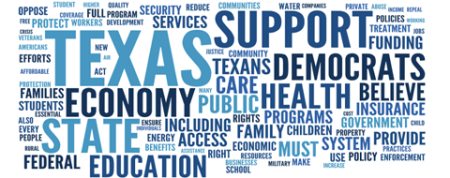
Texas Democratic Party platform word cloud
Spread the word; friends don't allow friends to repeat history.
These different cultures foster different types of learning. The great essayist Joseph Epstein once distinguished between being well informed, being hip and being cultivated. The Internet helps you become well informed — knowledgeable about current events, the latest controversies and important trends. The Internet also helps you become hip — to learn about what’s going on, as Epstein writes, “in those lively waters outside the boring mainstream.”
But the literary world is still better at helping you become cultivated, mastering significant things of lasting import. To learn these sorts of things, you have to defer to greater minds than your own. You have to take the time to immerse yourself in a great writer’s world. You have to respect the authority of the teacher.
Right now, the literary world is better at encouraging this kind of identity. The Internet culture may produce better conversationalists, but the literary culture still produces better students.
It’s better at distinguishing the important from the unimportant, and making the important more prestigious.
A bit on the right, but generally pointing to useful current stuff for economics teachers, the EconLib Newsletter for July 2010 is out — download it to your e-book for beach or desert reading:
Dear Readers,
Around the world in the last three decades, governments have made dramatic moves toward more economic freedom. While retaining most of the welfare state, governments have cut marginal tax rates from the Olympian heights they had reached in the 1960s and 1970s, deregulated whole industries, and privatized major swaths of the economy. Scott Sumner details the “neoliberal” movement and shows that countries that moved closest to economic freedom also made major gains in per capita income. Read it here:
Other recent podcasts include Caplan on Richter and Hayek, Sumner on growth and economic policy, and Blakley on fashion and intellectual property. Check them out at http://www.econtalk.org.
On EconLog, David Henderson discusses the EPA, Bryan Caplan reviews whether students like school, and Arnold Kling talks about green jobs. Read all the latest on EconLog at:
This month in the Concise Encyclopedia of Economics we feature “Fiscal Sustainability,” by Laurence J. Kotlikoff , and the biography of Milton Friedman, whose birthday is later this month. See
Just as a reminder about what we’re doing in education, I hope every teacher and administrator will take three minutes and view this video (that allows you some time to boggle).
Surely you know who Tom Peters is. (If not, please confess in comments, and I’ll endeavor to guide you to the information you need.)
You have the tools to compare the party platforms and determine for yourself which part supports education in Texas — I mean, really supports education, as opposed to using Doublespeak to profess support while angling to get a shiv in the back of education.
This post is tenth in a series on the education planks of the 2010 Texas Democratic Party Platform.
This is an unofficial version published in advance of the final version from the Texas Democrats, but I expect very few changes.
COMMUNITY COLLEGES
Democrats recognize and support the essential role of Texas community colleges, where almost 60% of Texas post-secondary students are enrolled. By combining affordability, high quality and responsiveness to community needs, these institutions provide an education to those who would be otherwise excluded.
Republicans have drastically reduced funding for community colleges and that burden has been shifted onto students, their families and property taxpayers. A significant funding increase would be needed just to restore Republican cuts to the 2002-3 state funding level, without adjusting for inflation. Not only do the Governor and Republican politicians again want to shift hundreds of millions of dollars in additional costs for employees’ group insurance onto students and local property taxpayers, they have already cut funding by 5% this year. And they are asking for an additional 10% in cuts to Republican budgets that currently allow only 4% of students eligible for Texas Equal Opportunity Grants to receive grants designated for community college students. To maintain community colleges’ role in providing lifelong education, we endorse:
full formula funding of the cost of instruction and of the growth in student enrollments;
fully state-funded full time employee group health insurance and proportional health benefits for adjunct instructors;
funding for new campuses and program expansions, especially in critical need programs, sufficient to meet Closing the Gaps goals;
rolling back tuition and fees that have increased over 50% under Republican control;
sufficient financial aid to cover 260,000 community college students who are eligible for grant assistance but receive none because state funding is inadequate; and
elimination of financial aid rules that penalize students who transfer to universities from community colleges.
To prevent further erosion of community colleges’ ability to serve their communities, Texas Democrats oppose:
proposals for “proportionality” that would shift group insurance costs onto students and property taxpayers;
shifting the basis of formula funding away from actual costs; and
“incentive programs that would discriminate against colleges and programs serving disadvantaged and non-traditional students or against non-degree skill-building and retraining programs.
Spread the word; friends don't allow friends to repeat history.
This post is ninth in a series on the education planks of the 2010 Texas Democratic Party Platform.
This is an unofficial version published in advance of the final version from the Texas Democrats, but I expect very few changes.
HIGHER EDUCATION
Texas Democrats believe all Texans should have the opportunity and be encouraged to pursue affordable higher education at public universities, community colleges, and technical schools. Republican “tuition deregulation” – cleverly named to imply an easing of burdens – has dramatically increased the financial burden and forced many students from middle income families to take on substantial debt to avoid being priced out of college. Tuition policies threaten our ability to meet state “Closing the Gaps” goals essential to our economic future. To offer affordable access to higher education, we support:
restoration of formula contact hour funding to the level prior to Republican cuts, adjusted for inflation and student growth;
legislative rollback of tuition and fees to affordable levels to reflect the restored funding;
federal income tax credits for college tuition;
full funding of TEXAS Grants and reforming and reopening the mismanaged state Prepaid Tuition Program, to provide higher education to more Texans without excessive debt burden;
legislation to reduce the inordinately high costs of college textbooks, technical manuals and other instructional materials;
adequate compensation, security, professional status, and benefits for all faculty and fair market wages for college employees;
weapon-free institutes of higher education;
higher education research funding to spur economic development, including sufficient funding to locate a Tier 1 research and teaching university in every region of the state;
collaborative public/higher education partnerships from pre-K-16 to enhance learning and teacher preparation;
enhanced, equitable funding for Prairie View A&M and Texas Southern University and for higher education in South Texas and all border communities;
efforts to place a voting student regent on the appointed governing board of each state supported four-year institution of higher education; and
the continuation of the Texas DREAM Act.
Spread the word; friends don't allow friends to repeat history.
This post is eighth in a series on the education planks of the 2010 Texas Democratic Party Platform.
This is an unofficial version published in advance of the final version from the Texas Democrats, but I expect very few changes.
MAKING OUR SCHOOLS SAFE HAVENS FOR LEARNING
Texas Democrats believe students, teachers and other school personnel should be safe from acts of violence, and students must be protected from bullying. School campuses and functions must be weapon-free and drug-free. We support swift and fair enforcement of disciplinary standards. Teachers deserve support when they exercise their right to remove a disruptive student from class.
Students referred to disciplinary alternative education programs should continue to receive strong academic instruction. When a student’s misconduct is serious enough to warrant disciplinary placement, the state should make sure that the disciplinary setting – whether a school district’s own disciplinary alternative program or a county’s juvenile-justice alternative education program – offers a full array of educational and social/behavioral services to help that student get back on track. School districts should be discouraged from indiscriminately placing students in disciplinary alternative education programs for trivial misconduct.
We support the Dignity for All Students Act to guarantee safety for all students.
Spread the word; friends don't allow friends to repeat history.
This post is seventh in a series on the education planks of the 2010 Texas Democratic Party Platform.
This is an unofficial version published in advance of the final version from the Texas Democrats, but I expect very few changes.
Generally I’ll not comment on these planks just yet, but I must say that I take delight in the perhaps unintentional commentary offered in the title of this plank. I suspect the intent was to point to the bias of the State Board of Education, an imbalance of political views, and not to the sanity of the board. But, I could be wrong — the title may be just an official Democratic labeling of the Board’s actions as unbalanced behavior.
REFORM OF THE UNBALANCED STATE BOARD OF EDUCATION
The right-wing Republican extremists who have dominated the State Board of Education have made a laughingstock of our state’s process for developing and implementing school curriculum standards that determine what our students learn. The damage they have done is no laughing matter. In rewriting the curriculum for social studies, English language arts, and science, they repeatedly have dismissed the sound advice of professional educators. Personal ideology, not high academic standards, has guided their work. Their skewed vision slights the contributions of racial and ethnic minorities. Their slanted versions of American history and of science mislead students and violate the separation of church and state. They use loaded language to favor the roles of right-wing organizations and activists. Led by a Rick Perry appointee as chair, this State Board of Education wants to indoctrinate, not educate, the schoolchildren of Texas. Their actions are unlikely to encourage a company to relocate and bring jobs to Texas. Any substantive changes to curriculum must be reviewed by non-partisan experts, and that review must be made public prior to any changes in curriculum by the State Board.
Texas Democrats will realign the State Board of Education with mainstream Texas values, will realign the state curriculum with objective reality and the facts of history and science, and will insist on the exercise of sober fiduciary responsibility for the Permanent School Fund, exposing and prohibiting conflicts of interest.
Spread the word; friends don't allow friends to repeat history.
This post is sixth in a series on the education planks of the 2010 Texas Democratic Party Platform.
This is an unofficial version published in advance of the final version from the Texas Democrats, but I expect very few changes.
EFFECTIVE TEACHERS FOR EVERY STUDENT
The most important factor in student success is having qualified teachers in our classrooms. Texas has a serious teacher shortage. Teacher pay and benefits are not competitive with private sector pay for occupations requiring comparable knowledge and skills. To recruit and retain our best to teach, Texas Democrats advocate the following:
raise teacher and support staff pay to levels exceeding the national average;
extend quality state funded health insurance to all education employees;
respect and safeguard the rights and benefits of education employees;
guarantee that every class has a teacher certified to teach that subject;
recruit and train teachers who reflect the state’s diversity;
provide a mentor (a master teacher) for every novice teacher;
base teacher pay and evaluations on multiple measures that give a full, rounded picture of student and teacher accomplishment, and oppose Republican plans to use narrow test results instead;
provide retired teachers a cost-of-living increase to restore their pensions’ purchasing power, which has eroded more than 20 percent under Rick Perry and the Republicans since the last increase in 2001;
repeal the federal government pension offset and windfall elimination provisions that unfairly reduce Social Security benefits for educational retirees and other public employees; and
provide tuition credits and financial assistance for college students who become certified public school teachers and teach for a specified period of time in public schools.
Spread the word; friends don't allow friends to repeat history.
Or, until that account is unsuspended by the forces supporting Donald Trump: Follow @FillmoreWhite, the account of the Millard Fillmore White House Library
We've been soaking in the Bathtub for several months, long enough that some of the links we've used have gone to the Great Internet in the Sky.
If you find a dead link, please leave a comment to that post, and tell us what link has expired.
Thanks!
Retired teacher of law, economics, history, AP government, psychology and science. Former speechwriter, press guy and legislative aide in U.S. Senate. Former Department of Education. Former airline real estate, telecom towers, Big 6 (that old!) consultant. Lab and field research in air pollution control.
My blog, Millard Fillmore's Bathtub, is a continuing experiment to test how to use blogs to improve and speed up learning processes for students, perhaps by making some of the courses actually interesting. It is a blog for teachers, to see if we can use blogs. It is for people interested in social studies and social studies education, to see if we can learn to get it right. It's a blog for science fans, to promote good science and good science policy. It's a blog for people interested in good government and how to achieve it.
BS in Mass Communication, University of Utah
Graduate study in Rhetoric and Speech Communication, University of Arizona
JD from the National Law Center, George Washington University


 Posted by Ed Darrell






 Millard Fillmore's Bathtub