Genius from Saturday Morning Breakfast Cereal:

Saturday Morning Breakfast Cereal, paying tribute to Abbott and Costello while educating us on the Periodic Table of the Elements.
Genius from Saturday Morning Breakfast Cereal:
Saturday Morning Breakfast Cereal, paying tribute to Abbott and Costello while educating us on the Periodic Table of the Elements.
 1 Comment |
  Cartoons, Education, History, Science, Science Education | Tagged: Cartoons, Education, Humor, Periodic Table, Saturday Morning Breakfast Cereal, Science |
  Permalink
 Posted by Ed Darrell
But, really: See what some students put up with, just to learn?
http://twitter.com/IntThings/status/374463839657803776
We usually had enough chairs in Dallas. Usually.
Those kids don’t have any.
Leave a Comment » | Classroom management, Classroom technology, Education, Learning, Student Life, Teaching Resources | Tagged: Classroom technology, Education, Learning, Students | Permalink
Posted by Ed Darrell
We had to fight to keep this stuff in Texas science books.
Then, out on the street, I see a U-Haul truck.

U-Haul truck features geographic information, and geology information, about Arkansas and its Crater of Diamonds State Park.

Detail: U-Haul truck features a graphic description of the geology and information about Arkansas’s Crater of Diamonds State Park.
Well played, U-Haul. Can Texas catch up?
Update, October 24, 2013: Turns out U-Haul has a website that features all of the graphics they use on their trucks. I sense a geography or state history assignment in here, somewhere, social studies teachers. Reminds me of the animals that used to (still do?) grace the tails of Frontier Airlines airplanes, the Native American on the tails of Alaska Airlines, and other specific destination promoting tricks businesses have used over the years. Wish more businesses would do that.
http://twitter.com/SuperGraphic/status/393408729388834816
More:
8 Comments | Geography - Physical, Geography - Political, geology, Science, Travel | Tagged: Arkansas, Crater of Diamonds State Park, Education, geography, geology, Science, Travel, U-Haul | Permalink
Posted by Ed Darrell

“A Swift Kick in the Butt $1.00,” A daily strip of the cartoon series “Calvin and Hobbes,” by Bill Watterson. Watterson appears to have an instinctual understanding of what motivation is not. It’s a topic he returned to with some frequency.
Educators don’t know beans about motivation I think. I still see courses offered on “how to motivate” students to do X, or Y, or Z — or how to motivate faculty members to motivate students to do X.
This view of motivation is all wrong, the industrial psychologists and experience say. A student must motivate herself.
A teacher can remove barriers to motivation, or help a student find motivation. But motivation cannot be external to the person acting.
Frederick Herzberg wrote a classic article for The Harvard Business Review several years back: “One More Time: How Do You Motivate Employees?” Herzberg would get a group of managers together and ask them, “If I have six week-old puppy, and I want it to move, how do I get it to move?” Inevitably, one of the wizened managers of people would say, “Kick him in the ass!” Is that motivation? Herzberg would ask? Managers would nod “yes.”

Frederick Herzberg, 1923-2000
Then, Herzberg would ask what about dealing with the pup six months later. To get the older pup to move, he’d offer a doggie yum, and the dog would come. “Is that motivation?” Herzberg would ask. Again, the managers would agree that it was motivation. (At AMR’s Committing to Leadership sessions, we tried this exercise several hundred times, with roughly the same results. PETA has changed sensitivities a bit, and managers are fearful of saying they want to kick puppies, but they’ll say it in different words.)
Herzberg called this “Kick In The Ass” theory, or KITA, to avoid profanity and shorten the phrase.
Herzberg would then chastise the managers. Neither case was motivation, he’d say. One was violence, a mugging; the other was a bribe. In neither case did the dog want to move, in neither case was the dog motivated. In both cases, it was the manager who was motivated to make the dog move.
Motivation is the desire to do something, the desire and drive to get something done.
Motivating employees is getting them to share the urgency a manager feels to do a task, to go out and do it on their own without being told how to do each and every step along the way.
Motivation is not simply coercing someone else to do what you want, on threat of pain, virtual or real.
Herzberg verified his theories with research involving several thousands of employees over a couple of decades. His pamphlet for HBR sold over a million copies.
Education is wholly ignorant of Herzberg’s work, so far as I can tell. How do I know?
See this, at TexasEd Spectator:
Death threat as a motivation technique
May 23rd, 2008
Education | MySanAntonio.comThe sad part about this is that I bet if a mere, ordinary teacher were to have made some similar statement, he or she would be treated more like the student rather than the principle.
Now imagine if some student at the school had said something along the same lines in a writing assignment. We would be hearing about zero tolerance all over the place. The student would be out of the regular classroom so fast it would make your head spin.
No charges will be brought against New Braunfels Middle School Principal John Burks for allegedly threatening to kill a group of science teachers if their students’ standardized test scores failed to improve, although all four teachers at the meeting told police investigators Burks made the statement.
Kick in the ass, knife in the back, knife in the heart — that ain’t motivation.
As God is my witness, you can’t make this stuff up.
I’m not sure who deserves more disgust, the principal who made the threat and probably didn’t know anything else to do, or the teachers who didn’t see it as a joke, or treat it that way to save the principal’s dignity — or a system where such things are regarded as normal.

Bill Watterson returned to the “Swift Kick in the Butt, $1.00” strip, but this time with the more lively Hobbes Calvin interacted with most often. What would motivate a cartoonist to do that? Watterson is said to have observed, “People will pay for what they want, but not what they need.” Can school administrators even figure out what teachers and students need? Which version do you prefer? Which one motivates you?
More:
1 Comment | Business, Business Ethics, Education, Education reform, Ethics, Motivation, Organizational leadership, psychology | Tagged: Business, Education, Ethics, Frederick Herzberg, How to, KITA, Motivation, psychology, Work | Permalink
Posted by Ed Darrell
You need to see these slides, from Will Richardson.
First, teachers should send a copy of this to their evaluators, principals, and all other admins up to the superintendent. Sure, it’s possible they’ll fire you for telling the truth. But if every teacher in your district did it, they might look at the slides and ponder: What in the hell do our evaluations and test scores have to do with this new future that is already upon us, and around us, and washing away the foundations of what the state legislature claims we must be doing?

Will Richardson
Second, this is a model presentation. Notice how few of the slides are cluttered with words. Notice those slides with words are easy to read, easy to grasp, and complement and are complemented by a lot of great images. (One of my students got a less-than-A grade on a PowerPoint presentation in another class, and brought me the evaluation: “Not enough text,” was one of the criticisms he’d gotten. That teacher is considered a model by too many administrators.) It’s not a perfect presentation. Garr Reynolds would have a lot to say about it. I’ll wager Richardson’s is better than any other presentation you’ve seen this week, in the content, the depth of information, and the way it’s packaged. (Would have loved to have seen the presentation . . .) That is particularly true if you’ve been the victim of teacher professional development sessions in the past week.
There are a lot of slides, partly because so few of them are cluttered by text. (Don’t know how long the presentation went.) This presentation would win a case against almost every other slide presentation I’ve ever seen from any law firm, who pay tens of thousands to lawyers to make slide presentations that defy understanding. The world would be ever so much better were lawyers required to watch this, and compare it with their last presentation.
Third (related to and justifying the first), you need to realize how things have changed in the past year, past five years, past decade, and how we as a society and nation failed to account for those changes, or keep up with them, especially in our public AND private elementary and secondary schools. Richardson understands the changes, and has some great leads on answers.
This presentation appears to have been a hit. It seems a few people asked Will Richardson for copies (@WillRich45, www.willrichardson.com), which is why it’s on Slideshare.
Richardson highlights the importance of these thoughts at his blog:
If the recent iPad debacle in Los Angeles teaches us anything it’s that no amount of money and technology will change anything without a modern vision of what teaching and learning looks like when every student and every teacher has access to the Internet. As many of us have been saying for far too long, our strategy to deal with the continuing explosion of technology and connections can’t be to simply layer devices on top of the traditional curriculum and engage in digital delivery. Unfortunately, far too few develop a vision that sees that differently.
* * * * *
Please note: Technology is integrated throughout these initiatives in ways that serve the vision, not the other way around. This isn’t “let’s give everyone an iPad filled with a lot of textbook and personalized learning apps aimed at improving test scores and then figure out how to manage it.” This is about having important conversations around complex, difficult questions:
- What will schools look like in the future?
- What kinds of spaces do we need to support instruction and collaborative work in 5-10 years?
- How will technology transform curriculum, instruction, and assessment?
And how does it work at your school, teachers? Students?
We missed the revolution. The kids are ahead of us.
Can we catch up?
More:
1 Comment | Classroom management, Education, Education reform, Teachers, Teaching, Teaching Resources, Technology in the classroom, War on Education, War on Teachers | Tagged: Classroom technology, Education, Garr Reynolds, Leadership, Technology, Will Richardson | Permalink
Posted by Ed Darrell
Before I was a teacher, I led a tough band of people at the Department of Education, and I plied corporate America (among other jobs). I spent a couple of years in American Airlines‘s corporate change project, facilitating leadership courses for more than 10,000 leaders in the company, as one of a team of about 20 inside consultants. I had a fine time in management consulting with Ernst & Young LLP (now EY).

W. Edwards Deming, Wikipedia image
Back then “quality” was a watchword. Tom Peters’s and Robert H. Waterman, Jr.‘s book, In Search of Excellence, showed up in everybody’s briefcase. If your company wasn’t working with Phillip Crosby (Quality is Free), you were working with Joseph Juran, or the master himself, W. Edwards Deming. If your business was highly technical, you learned more mathematics and statistics that you’d hoped never to have to use so you could understand what Six Sigma meant, and figure out how to get there.

Joseph Juran. Another exemplar of the mode of leadership that takes lawyers out of law, putting them to good work in fields not thought to be related.
For a few organizations, those were heady times. Management and leadership research of the previous 50 years seemed finally to have valid applications that gave hope for a sea change in leadership in corporations and other organizations. In graduate school I’d been fascinated and encouraged by the work of Chris Argyris and Douglas McGregor. “Theory X and Theory Y” came alive for me (I’m much more a Theory Y person).
Deming’s 14 Points could be a harsh checklist, harsh master to march to, but with the promise of great results down the line.
A lot of the work to get high quality, high performance organizations depended on recruiting the best work from each individual. Doing that — that is, leading people instead of bossing them around — was and is one of the toughest corners to turn. Tough management isn’t always intuitive.
For the salient example here, Deming’s tough statistical work panics workers who think they will be held accountable for minor errors not their doing. In a traditional organization, errors get people fired.
Deming’s frequent point was that errors are not the worker’s doing, but instead are caused by managers, or by managerial failure to support the worker in getting quality work. In any case, Deming comes down hard against firing people to try to get quality. One of his 14 points is, “Drive out fear.” In his seminars and speeches, that point was explained with, among other things, a drive to do away with annual performance reviews (wow, did that cause angst and cognitive dissonance at Ernst & Young!). Performance reviews rarely touch on what a person needs to do to create quality, and generally the review session becomes a nit-picking exercise that leaves ratees angry, and less capable and willing to do quality work. So Deming was against them as usually practiced.
Fast forward to today.
American schools are under fire — much of that fire unjustified, but that’s just one problem to be solved. Evaluations of teachers is a big deal because many people believe that they can fire their way to good schools. ‘Just fire the bad teachers, and the good ones will pull things out.’
Yes, that’s muddled thinking, and contrary to the requirements of the No Child Left Behind Act, there is no research to support the general idea, let alone specific applications.
Education leaders are trained in pedagogy, and not in management skills, most often — especially not in people leadership skills. Teacher evaluations? Oh, good lord, are they terrible.

Business adviser and healer, Tom Peters (from his website, photo by Allison Shirreffs)
In some search or other today I skimmed over to Tom Peters’s blog — and found this short essay, below. Every school principal in America should take the three minutes required to read it — it will be a solid investment.
dispatches from the new world of work
Deming & Me
W. Edwards Deming, the quality guru-of-gurus, called the standard evaluation process the worst of management de-motivators. I don’t disagree. For some reason or other, I launched several tweets on the subject a couple of days ago. Here are a few of them:
- Do football coaches or theater directors use a standard evaluation form to assess their players/actors? Stupid question, eh?
- Does the CEO use a standard evaluation form for her VPs? If not, then why use one for front line employees?
- Evaluating someone is a conversation/several conversations/a dialogue/ongoing, not filling out a form once every 6 months or year.
- If you (boss/leader) are not exhausted after an evaluation conversation, then it wasn’t a serious conversation.
- I am not keen on formal high-potential employee I.D. programs. As manager, I will treat all team members as potential “high potentials.”
- Each of my eight “direct reports” has an utterly unique professional trajectory. How could a standardized evaluation form serve any useful purpose?
- Standardized evaluation forms are as stupid for assessing the 10 baristas at a Starbucks shop as for assessing Starbucks’ 10 senior vice presidents.
- Evaluation: No problem with a shared checklist to guide part of the conversation. But the “off list” discussion will by far be the most important element.
- How do you “identify” “high potentials”? You don’t! They identify themselves—that’s the whole point.
- “High potentials” will take care of themselves. The great productivity “secret” is improving the performance of the 60% in the middle of the distribution.
Tom Peters posted this on 10/09/13.
I doubt that any teacher in a public elementary or secondary school will recognize teacher evaluations in that piece.
And that, my friends, is just the tip of the problem iceberg.
An enormous chasm separates our school managers in this nation from good management theory, training and practice. Walk into almost any meeting of school administrators, talk about Deming, Juran, Crosby, and you’re introducing a new topic (not oddly, Stephen Covey’s book, 7 Habits of Highly Effective People, sits on the shelf of many principals — probably unread, but certainly unpracticed).
Texas works to make one standardized evaluation form for every teacher in every grade, in every subject, in every school. Do you see anything in Peters’s advice to recommend that? In many systems, teachers may choose whether evaluators will make surprise visits to the classroom, or only scheduled visits. In either case, visits are limited, generally fewer than a dozen visits get made to a teacher’s classroom in a year. The forms get filled out every three months, or six weeks. Take each of Tom’s aphorisms, it will be contrary to the way teacher evaluations usually run.
Principals, superintendents, you don’t have to take this as gospel. It’s only great advice from a guy who charges tens of thousands of dollars to the greatest corporate leaders in the world, to tell them the same thing.
It’s not like you want to create a high-performing organization in your school, is it?
More:
58 Comments | Education, Education Administration, Quality, Teacher Evaluation, Teachers | Tagged: Education, Quality, Schools, Teacher Evaluation, Teaching, Tom Peters, w edwards deming | Permalink
Posted by Ed Darrell
edcamp offers exactly the sort of revolutionary information in a revolutionary format that raises opposition from education administrators and raises eyebrows among faux education reformers like the CSCOPE critics in Texas, or Texas State Sen. Dan Patrick, or the Broad Foundation.

Logo for edcamp Fort Worth; most edcamp logos feature some version of that wavy apple.
It’s teachers talking to teachers about what works in education, usually with a technology bent.
One of the organizers of edcamp in Dallas, Matt Gomez, sent me the link to a wiki page that features a calendar of upcoming edcamp events.
Upcoming events:
September 28, 2013 edcamp Citrus (Crystal River, FL)
September 28, 2013 edcamp Des Moines
September 28, 2013 edcamp West Texas (Abilene, TX)
September 30, 2013 edcamp Cville (Charlottesville, VA)
October 5, 2013 edcamp Arkansas
October 5, 2013 edcamp Del Norte (Crescent City, CA)
October 5, 2013 edcamp PGH (Pittsburgh, PA)
October 5, 2013 edcamp Netherlands (Netherlands)
October 12, 2013 edcamp Dallas
October 12, 2013 edcamp Minneapolis-St.Paul (Minnesota)
October 19, 2013 edcamp Green Bay (Denmark, WI)
October 19, 2013 edcamp Honolulu (Honolulu, HI)
October 19, 2013 edcamp Northern Michigan (Traverse City, MI)
October 19, 2013 edcamp Seacoast (NH)
October 20, 2013 JEdcamp Brooklyn (NY)
october 26, 2013 edcamp Chicago
October 26, 2013 edcamp Mumbai (India)
October 26, 2013 edcamp Online
October 26, 2013 edcampOU (Rochester, Michigan)
October 26, 2013 edcamp RI (Providence, RI)
October 26, 2013 edcamp Online (anywhere!)
October 27, 2013 jedcamp SFBay (San Francisco, CA)
October 30, 2013 edcamp Skolforum (Stockholm, Sweden)
November 2, 2013 HigherEdcamp Philly (PA)
November 2, 2013 edcamp Grand Rapids (Grand Rapids, MI)
November 2, 2013 edcamp Harrisburg (Harrisburg, PA)
November 2, 2013 edcamp Lesley (Cambridge/Boston, MA)
November 2, 2013 edcamp Fond du Lac (Fond du Lac, WI)
November 2, 2013 edcamp Okanagan (Kelowna, BC)
November 2, 2013 edcamp Edmonton (Edmonton, AB)
November 9, 2013 edcamp KC (Kansas City, MO)
November 9, 2013 edcamp Austin (Austin, TX)
November 9, 2013 edcamp Baltimore (Baltimore, MD)
November 16, 2013 edcamp Hagerstown (Hagerstown, MD)
November 16, 2013 edcamp Vermont
November 23, 2013 edcamp NJ (North Brunswick, NJ)
November 23, 2013 edcamp Ottawa (Ottawa, ON, Canada)
January 11, 2014 edcamp Imagine the Possibilities (Plymouth, MA)
February 1, 2014 edcamp Madison AL
February 1, 2014 edcamp Magnet (Minnesota)
February 1, 2014 edcamp Savannah, GA
February 1, 2014 edcamp Magnet– MN
March 8, 2014 edcamp Iowa
March 22, 2014 edcamp Grafton, MA
March 22, 2014 edcamp Rochester (NY)
April 12, 2013 edcamp Eau Claire (WI)
April 26, 2014 edcamp Houston, TX
When you attend, drop back here and let us know what you think.
More:
1 Comment | Education, Teachers, Teaching Resources | Tagged: edcamp, Education, teacher training | Permalink
Posted by Ed Darrell
This story caught my eye, partly because it’s from the town where I was born in southern Idaho, partly because it deals with education issues, specifically the Common Core State Standards on the ground — er, in the classroom — and partly because of the way it could be spun into silly and inaccurate controversy by radical right-wing people, who have spun similar stories worse.
In Burley, Idaho, junior high schools are teaching values. Not just any values, but “absolute values.” Just wait until the “values coalition” wackoes hear! (Somebody should alert Eric Bolling at Fox News!)
What? Well, yeah, it’s in math class. Still, absolute values? Do the parents know?
(Wish I could embed the video from KMVT television.)
Burley Teacher talks about Common Core
By Brittany CooperStory Created: Sep 8, 2013 at 9:50 PM MDT
Story Updated: Sep 8, 2013 at 11:57 PM MDT
Burley, Idaho ( KMVT-TV / KTWT-TV ) Classes are underway in the Cassia Joint School District. So what do teachers think about the Common Core Standards?
Math teacher Cindy Tolman enjoys Common Core because teachers can focus on specific areas. She tells us she can use more real life examples and show illustrations of how to do the problems.
In her seventh grade class, she is teaching about absolute values.
“And instead of just saying the absolute value of any number is positive, now we’re teaching them it’s the distance from zero and we actually got a string out and put it on a number line and we compared that the absolute value of a –3 is the same as the absolute of 3 because that’s the distance from zero on a number line,” adds Tolman who teaches at Burley Junior High School.
Tolman says sometimes what parents don’t understand is the Common Core builds a stronger foundation and as early as the kindergarten level, youngsters are receiving a more hands–on education than perhaps before.
Will anyone notice the teaching of absolute values in Burley, Idaho? If they notice, will they avoid embarrassing themselves with a demonstration of their ignorance of mathematics?
More, and related information:

Junior High School in Burley, Idaho; the building I presume the class in the story is taught. This is not the great gray, gothic building that existed when I lived there. Photo linked from Google Maps
1 Comment | Common Core State Standards, Education, Mathematics, Teachers, Teaching | Tagged: Absolute Values, Burley Idaho, Common Core State Standards Initiative, Education, KMVT, Mathematics | Permalink
Posted by Ed Darrell

Graphic from Colin Purrington, in commemoration of the kickoff of hearings at the Texas State Board of Education on science textbooks, September 18, 2013
Colin Purrington Tweeted, “Thanks, @ncse for helping keep Darwin in Texas science textbooks. #Whac-A-Mole #creationism #StandUp4Science pic.twitter.com/8dNYbqFELV.”
More:
7 Comments | Charles Darwin, Creationism, Education, Evolution, History, Religion, Science, State school boards, Texas, Texas Citizens for Science, Texas Freedom Network, Textbook Selection | Tagged: Creationism, Darwin, Education, Evolution, Politics, Religion, Texas, Texas State Board of Education, Textbooks | Permalink
Posted by Ed Darrell
Got a stack of banned books ready?
Banned Books Week is September 22-28 for 2013.

So THAT’s what Lady Liberty holds in her left hand. (Reading the Declaration of Indpendence can still get you into trouble in a few places — mostly not in the U.S., but even in the U.S.)
We still have banned books? Is that bad?
Consider, first, that on September 17, 2013, the Texas State Board of Education opened hearings on science textbooks to be “adopted” for Texas schools. Radical elements of the SBOE furiously organized to stack rating panels with people who want to censor science, to stop the teaching of Darwin’s work on evolution. (No, I’m not kidding.)
This comes in the middle of a rancorous fight in Texas over CSCOPE, a cooperative lesson-plan exchange set up by 800 Texas school districts to help teachers meet new Texas education standards adopted years ago (without new books!). Critics labeled reading lists and any reading on religions other than Christianity “socialist” or “Marxist,” and complained that Texas social studies books do not slander Islam.
Then there is the flap over Persepolis, in Chicago. With all the other trouble Chicago’s schools have several bluenoses worked to get this graphic “novel” banned (it’s not really a novel; it’s a memoir). They complained about graphic violence in what is a comic book. Persepolis tells the story of a young woman growing up in Iran during the Iranian Revolution.
The autobiographical graphic memoir Persepolis by Marjane Satrapi was pulled from Chicago classrooms this past May by Chicago Public Schools CEO Barbara Byrd-Bennett due to “inappropriate” graphic language and images, specifically, scenes of torture and rebellion. Parents, teachers, and First Amendment advocates protested the ban, and as a result — while still pulled from 7th grade — Persepolis is currently under review for use in grades 8-10. (For details, see CBLDF Rises to Defense of Persepolis.)
Persepolis is an important classroom tool for a number of reasons. First, it is a primary source detailing life in Iran during the Revolution and the Iran-Iraq War . Readers of all ages get a glimpse of what life is like under repressive regimes and relive this period in history from a different perspective. It also begs detailed discussion of the separation of church and state. Furthermore, this is a poignant coming-of-age story that all teens will be able to relate to and serves as a testament to the power of family, education, and sacrifice.
In America, textbooks get attacked for telling the truth about Islam and not claiming it is a violence-based faith; and supplemental reading gets attacked when it presents the violence the critics complain was left out of the texts.
We need to think this through.
What banned books have you read lately?
More:

Persepolis has been made into a movie.
Leave a Comment » | Banned Books, Books, Censorship, Education, First Amendment, History, Literature, State school boards, Texas, Textbooks | Tagged: Banned Book Week, Banned Books Week, Books, Censorship, Chicago Public Schools, Education, First Amendment, History, Literature, Persepolis, Texas State Board of Educaiton, Textbooks | Permalink
Posted by Ed Darrell
Anybody send this to you on Facebook (100 times, maybe?)

Hoax claims about the Pledge of Allegiance, found on Facebook and innumerable e-mails
Clever, eh? It repeats the McCarthy-era editing of the Pledge of Allegiance, and then comes up with this whopper:
. . . My generation grew up reciting this every morning in school, with my hand on my heart. They no longer do that for fear of offending someone!
Let’s see how many Americans will re-post and not care about offending someone!
Not quite so long-lived as the Millard Fillmore Bathtub Hoax — which started in 1917 — but a lot more common these days.
Just as false. Maybe more perniciously so.
Consider:
The creator of that poster is probably well under the age of 50, and may have grown up with the hand-over-heart salute used after World War II. That was not the original salute, and I’d imagine the author is wholly ignorant of the original and why it was changed.

Wikipedia image and caption: Students pledging to the flag, 1899, 8th Division, Washington, D.C. Part of the Frances Benjamin Johnston 1890 – 1900 Washington, D.C., school survey.
Wikipedia gives a concise history of the salute:
Swearing of the Pledge is accompanied by a salute. An early version of the salute, adopted in 1892, was known as the Bellamy salute. It started with the hand outstretched toward the flag, palm down, and ended with the palm up. Because of the similarity between the Bellamy salute and the Nazi salute, developed later, the United States Congress instituted the hand-over-the-heart gesture as the salute to be rendered by civilians during the Pledge of Allegiance and the national anthem in the United States, instead of the Bellamy salute. Removal of the Bellamy salute occurred on December 22, 1942, when Congress amended the Flag Code language first passed into law on June 22, 1942.

Students in an unnamed school in 1941, offering the Bellamy Salute for the Pledge of Allegiance. Wikipedia image.
One might understand why the Bellamy Salute was changed, during war with Nazi Germany.
Arrogance and ignorance combine to form many different kinds of prejudices, all of them ugly. The arrogant assumption that only “our generation” learned patriotism and that whatever goes on in schools today is not as good as it was “in our day,” regardless how many decades it’s been since the speaker was in a public school, compounds the ignorance of the fact that since 1980, forced patriotic exercises in schools have increased, not decreased.
Like much about our nation’s troubles, assumptions based on ignorance often are incorrect assumptions. Consequently, they give rise to what is today clinically known as the Dunning Kruger Effect (or syndrome), so elegantly summed by by Bertrand Russell in the 1930s:
The trouble with the world is that the stupid are cocksure and the intelligent are full of doubt.
Humorously summed up by “Kin” Hubbard:
It isn’t what we don’t know that gives us trouble, it’s what we know that ain’t so.
Ignorance is a terrible disease, but one easily cured, by reading. We can hope.
More:
42 Comments | Accuracy, Dunning-Kruger Effect, Education, First Amendment, Flag etiquette, History, Hoaxes, Law, Patriotism, Pledge to the flag, Public education, U.S. Flag | Tagged: Accuracy, Dunning-Kruger Effect, Education, First Amendment, Flag etiquette, History, Hoaxes, Law, Patriotism, Pledge of Allegiance, public schools, U.S. Flag | Permalink
Posted by Ed Darrell
This is a follow up on my earlier post on the Gulen schools, Cosmos Foundation, Harmony Schools.
A pro-education religious movement could be a good thing. Is it?
Leave a Comment » | Charter schools, Education, Texas | Tagged: 60 Minutes, Charter schools, Education, Gulen, Leslie Stahl, Texas | Permalink
Posted by Ed Darrell
I would have sworn I’d posted in these issues before, but looking back through the archives, I discover I haven’t.
An interesting, perhaps odd, religious cult with Islamic roots moved into the United States several years ago, and started setting up schools for the public. Hitching on the radical right wing’s creation of public school-killing charter programs, and riding a wave of donations from devotees of the sect, the Gulen movement set up at least one foundation, floated some bonds to build facilities, and established charter schools. There are 40 of these schools in Texas.
![Dallas Morning News photo: The Harmony School of Nature [on Camp Wisdom Road, west of Duncanville] still isn't ready to open for students.](https://i0.wp.com/cityhallblog.dallasnews.com/files/2013/08/Harmony.jpg)
Dallas Morning News photo: The Harmony School of Nature [on Camp Wisdom Road, west of Duncanville] still isn’t ready to open for students.
Texas Education Agency spokesperson DeEtta Culbertson said the TEA has not received any complaints or unfavorable reports about the schools, which have also received good reviews in U.S. News and World Report.
Local school district officials in Midland and Odessa seemed baffled by the claims. The flap died down. It was during one of the creationism eruptions in Texas curricula wars, though, and I called the schools to see what they taught in science. I got hold of a fellow in Houston who claimed to be the science coordinator for the dozen or so schools then existing in Texas. He said he was not Muslim, and he told me that the schools do not teach creationism. In high school, they use the Kenneth Miller-authored texts, and teach evolution.
At that time a facility being constructed near our home, which I had assumed was part of the Wycliff Bible Translating Institute nearby, put up a sign advertising that it would be opening as a charter school. The Harmony School of Nature and Science sits in the boundaries of Duncanville ISD, but was obviously aimed at pulling students from Dallas ISD and Grand Prairie — or anywhere else parents in Texas are willing to drive from. I know a few people whose children attend the school, and basically, they like it. The school seems particularly adept at dealing with very bright special-needs kids.
In efforts to provide a fully-rounded education, our local Harmony School helps sponsor a Cub Scout Pack, which is a program I fully support (don’t get me going on National PTA’s stabbing Scouting in the back . . .)
Not all is rosy. Officials of the foundation that supports and guides the Harmony schools say their sole intent is to improve education in the U.S., and it’s difficult to find any kind of unsavory indoctrination going on, the reality is that Harmony is becoming a large education system in Texas (and other places) — and some complaints unusual in the U.S. War on Education, or War on Teachers, or War on Children, create ripples. Some teachers have complained that Turkish nationals get out-of-proportion pay packages to teach in the schools, and that good teachers are being replaced with Turkish nationals. Some conjecture that this is being done solely to get a lot of Turkish nationals and followers of this particular sect into the U.S. — an enormous, elaborate, and U.S. taxpayer-funded scheme to get around U.S. immigration laws.
Diane Ravitch‘s education blog — the most important education news outlet in the nation right now — carried a post yesterday about more controversy; here’s part of the post (you should read it all at Ravitch’s blog)
Sharon R. Higgins is a parent activist in Oakland, California, who manages multiple websites as a concerned citizen. One is “charter school scandals.” Another is the Broad Report. Third is a compilation of articles about the Gulen movement.
Sharon has long wondered why so many districts, states, and the federal government have turned over a basic public responsibility to foreign nationals, who hire other foreign nationals, and export hundreds of millions of taxpayer dollars. Her concern is not nationalistic or xenophobic. It is about the civic and communal nature of public education.
She writes: “On Saturday I spoke at the “Expose the Gulen Movement” protest rally held on a farm in the rural, rolling hills around Saylorsburg, PA. We assembled less than two miles from the compound where Fethullah Gulen lives. Gulen is considered to be one of the two most powerful men in Turkey. This is the video of my speech, starting at 00:45 min.
http://new.livestream.com/…/AbdEylemVakti/videos/28766474
Earlier that day, Gulenist operatives had driven around to take down the signs that organizers had posted to help guide protesters to the rally. The day before, a man from “the camp” (Gulen’s compound) also attempted to bribe the owners of the farm in an effort to prevent us from using their place. [continued at Ravitch’s site]
I offered my experience in a comment there, but the links snagged it — so I’m repeating it here, with the links restored: My response at Dr. Ravitch’s blog:
Texas is wholly baffled by the Gulen movement, including especially the teacher-bashing GOP education “reformers.” Hypothetically, they favor the public-school-blood-sucking charters. But things are sometimes different on the ground.
In Texas, the schools are known as Harmony schools. We had a flap several years ago when some charter school advocates discovered, to their dismay, that the schools don’t teach creationism instead of evolution (point in favor of Harmony).
At the time, TEA and local district officials I spoke with were completely unaware of the size of the group establishing and backing the schools.
Today their website lists 40 schools across Texas ( http://www.harmonytx.org/default.aspx ) in Dallas, Houston, El Paso, Brownsville, Midland & Odessa, Fort Worth, Austin, San Antonio, Lubbock and Laredo. Parents I know have been happy with the attention their kids get, and the care paid to science and math education. Complaints in Odessa some time ago centered around the Muslim teachers, but that flap died down.
But — is this trouble? — at least one school in Dallas County (about two miles from me) has been unable to get an occupancy permit to start school this year. Students are being bused to other locations, I understand — but code officials think it may be months before the building can be certified. Does this demonstrate a lack of financial planning and ability on the part of the foundation? Does this indicate animosity from Dallas code officials (public schools in Texas are essentially exempt from local code enforcement, and some districts, like Dallas, take unfair advantage of this; what I know of the difficulties at the new Harmony building are common, never-fixed features of schools in Dallas ISD — I don’t have the full story).
Here’s the notice on the school’s web page [since removed, I think; can’t find it this morning, but this is direct quote, verbatim]:
Dear Parents/Guardians,
Even with all our best efforts, we have some additional inspections that will not be completed in time for the start of school Tuesday, September 3. Therefore, we have made alternative plans to accommodate our students for this week. Please drop off your students as you normally would here at the Harmony Nature Campus by 7:50 a.m. for elementary and 8:00 a.m. for middle and high school. We have reserved buses to safely transport students and staff members to the following Harmony Public Schools campuses within our district:
Grades K-3 students will have classes at Harmony Science Academy-Fort Worth.
Grades 4-6 students will have classes at the Harmony Science Academy-Euless.
Grade 7 students will have classes at Harmony Science Academy-Grand Prairie.
Grade 8 students will have classes at Harmony School of Innovation-Fort Worth
High School students will have classes at Hurst Conference Center.*Harmony Science Academy Fort Worth – 5651 Westcreek Dr. Fort Worth, TX – (817) 263-0700
*Harmony School of Innovation Fort Worth – 8100 S. Hulen St. Fort Worth, TX – (817) 386-5505
*Harmony Science Academy Euless & Harmony School of Innovation Euless – 701 S. Industrial Blvd. Euless, TX – (817) 354 – 3000
*Harmony Science Academy Grand Prairie -1102 NW 7th St, Grand Prairie – (972) 642-9911
Hurst Conference Center: 1601 Campus Drive Hurst, Texas 76054Dismissal will remain the same: elementary at 2:50pm and middle/ high school will be at 3:15pm at the Nature campus. There will be no afterschool club and aftercare this week.
Please complete and bring the attached permission slip tomorrow with your child. We will also have extra copies for you to sign in the morning. Students should not bring all their supplies tomorrow.
Some of those bus rides are about 30 miles.
Here’s information from the blog on city issues of the Dallas Morning News (this has not hit the education desk, I don’t think): http://cityhallblog.dallasnews.com/2013/09/southern-dallas-charter-school-that-failed-city-inspections-still-not-ready-to-open.html/
Interesting how this group from Turkey managed to figure out where below-radar-level is in all of these states.
Diane, with 40 — or more — schools in Texas, are you sure your total of 146 schools is correct? Has anyone checked the foundation’s 990 forms lately (I’ve not looked in a couple of years). Is there just one foundation, or several?
In Texas these schools are operated by the Cosmos Foundation. These schools have won explicit support from Texas right-wing “education reformers” like Sen. Dan Patrick, demonstrated by legislation passing the Texas Lege this year, and have implicit support from right-wing campaigns against Texas public schools which end up promoting Harmony Schools, which have a comparatively politics-free and religion-free curricula agenda. One might wonder whether the Texas CSCOPE controversy, and the McCarthy-esque witch hunt to find communists among Texas teachers, is not a well-designed campaign to allow expansion of Harmony Schools and other charter school organizations whose very existence might provoke higher scrutiny and public controversy, were there not other political shiny objects distracting people.
There will be more to come; check the blogs noted above, and please check back here.
Update: Harmony lists 40 schools in Texas with 24,247 students. In student enrollment, that makes Harmony the 51st largest school district in Texas (out of 933), larger than Denton ISD (23,994), Birdville ISD (23,545), Pflugerville ISD (22,763), Judson ISD (22,040), and Midland (21,736), but smaller than McKinney ISD (24,442), Lamar ISD (24,637), Laredo ISD (24,706), or McAllen ISD (25,622). Duncanville ISD is about half that size, at 12,902; Dallas ISD has 157,143 students, second to Houston ISD’s 204,245 students. (Schooldigger statistics)
Update, September 8: Cosmos Foundation — the group operating Harmony schools in Texas — showed 2011 income of just over $168 million, according to the IRS 990 form available through the Foundation Center.
Update 2, September 8: Harmony Nature and Science notified parents late Saturday that the school will be open Monday — which means no buses. Looking for news reports to confirm. Here’s a screen capture of the announcement at Harmony’s website:
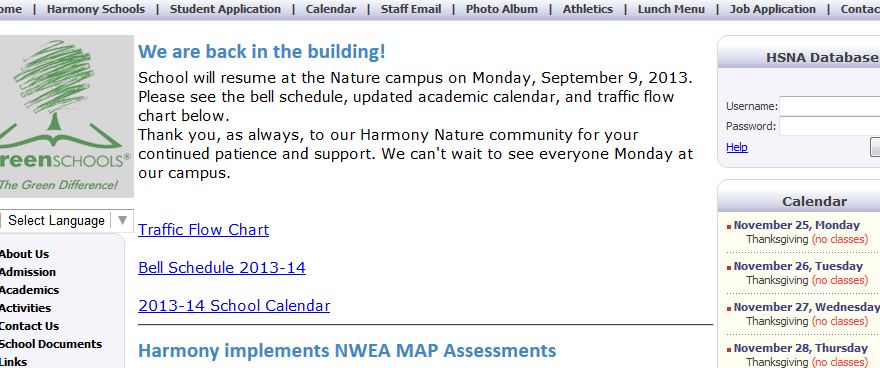
Screen capture of announcement that school will be held in the school building starting September 9, 2013.
More:
6 Comments | CSCOPE, Education, Education reform, Education spending, Texas | Tagged: Charter schools, CSCOPE, Dan Patrick, Education, Education reform, Gulen Movement, Harmony Schools, Immigration, public schools, School Finance, Texas Education | Permalink
Posted by Ed Darrell
These are pretty cool.
Can you use them in a classroom? Some of these Imagequilts pack a lot of information into a small space — such as the one for Cézanne.
Here, “Subatomic Particles“:

Subatomic particles, by Tufte and Schwartz; click image for a larger version
“Paul Cézanne“:

Paul Cezanne, Imagequilt by Tufte and Schwartz. Useful in art history? European history?
Super Advanced Placement (AP) history teacher John Irish created outstanding PowerPoints showing off art of European eras, or American eras, for use in introducing a unit of history (see a smattering of examples here). Could these Imagequilts substitute, or do it as well, and — especially — faster?
Here’s another, “Pablo Picasso“:

Imagequilt, Pablo Picasso, by Tufte and Schwartz
This one could be particularly useful in a physics course, or a unit on the history of science. Richard Feynman may be most famous, pedagogically at least, for his invention and use of Feynman Diagrams. Most discussions simply mention the things, though a few attempt short explanations. Rare is to find a good example of a Feynman Diagram, to see just what they are and how they work. Tufte and Schwartz offer a bunch:

Feynman Diagrams, an Imagequilt from Tufte and Schwartz
Imagequilts is a Chrome App, available for download so you can make your own. Of course, you’ll need to use Google Chrome to get full effect.
Got any Imagequilts you’d like to share?
More:
1 Comment | Art, History, Presentations, Technology, Technology in the classroom | Tagged: Art, Classroom Automation, Education, Edward Tufte, History, Imagequilts, Technology | Permalink
Posted by Ed Darrell

James Madison Building of the Library of Congress, the official James Madison Memorial for the nation
A popular Government, without popular information, or the means of acquiring it,
is but a Prologue to a Farce or a Tragedy; or perhaps both.
Knowledge will forever govern ignorance.And a people who mean to be their own governours,
must arm themselves with the power which knowledge gives.— James Madison in a letter to W. T. Barry, August 4, 1822
This is an encore post, partly.

Photo of inscription to the left (north) of the main entrance on Independence Ave., of the James Madison Building, Library of Congress, Washington, D.C.
More:
4 Comments | Accuracy, Education, Famous quotes, First Amendment, James Madison, Journalism, Quotes | Tagged: Education, Famous quotes, First Amendment, freedom, Information, James Madison, Quotes | Permalink
Posted by Ed Darrell


Ed Darrell on Texas's Colorado River


Come on in, the water's fine. Come often: Cleanliness is next to godliness.


 Millard Fillmore's Bathtub