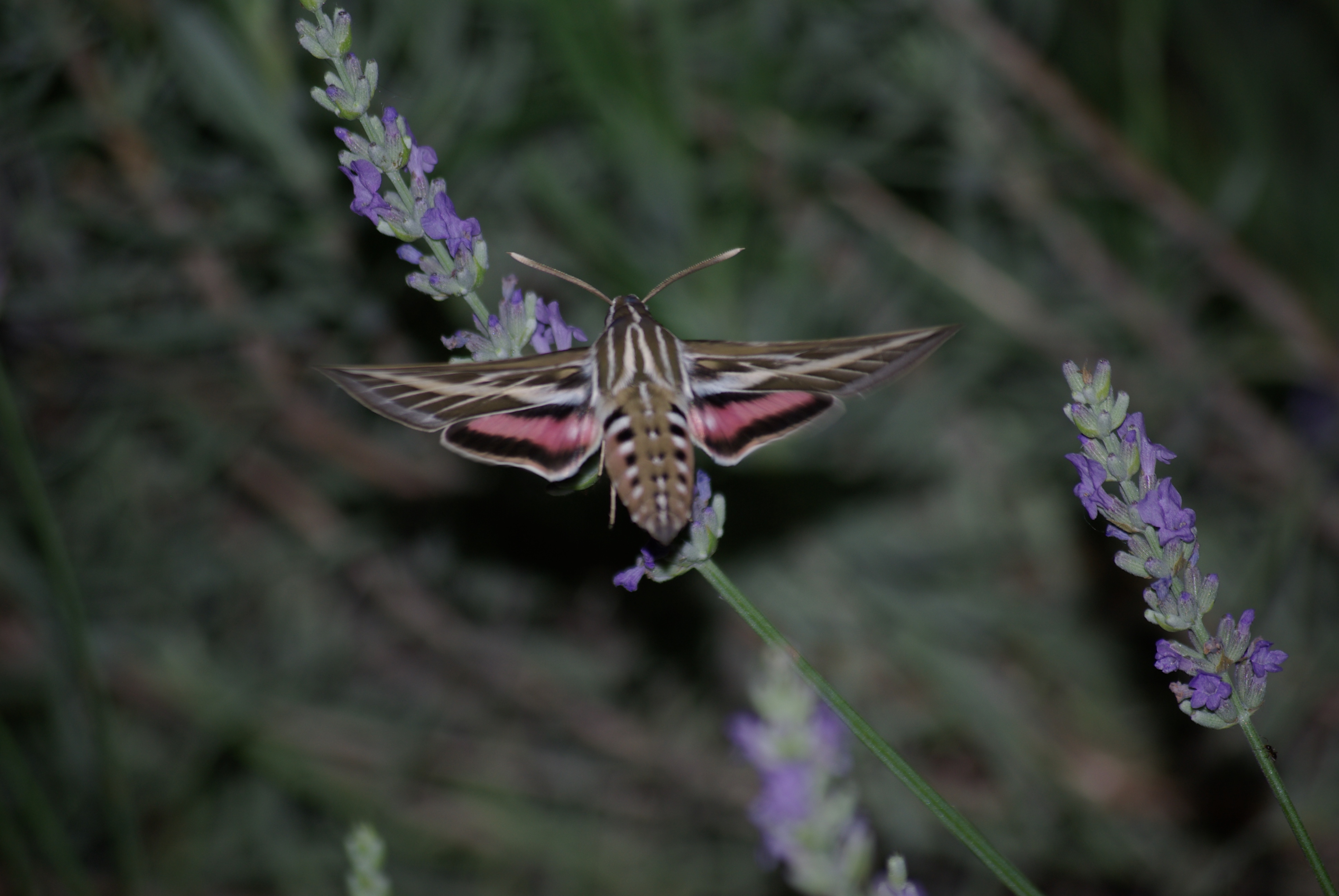
Hummingbird moth in the lavender at 6:00 a.m.

May 25, 2010

Hummingbird moth at the lavender, May 25, 2010

Hummingbird moth (Hyla lineata?) breakfasts at the lavender in the front yard - photo by Ed Darrell

Kathryn planted lavendar on the front walk.  It crowds the walk, so you have to brush by it coming in or going out of the house, and sometimes you get a great whiff of lavender.

On the way back from getting the newspaper this morning I was greeted by this hummingbird moth sipping its breakfast from the lavender blossoms.  It was too dark for natural lighting.  The flash froze the wings, and exposed colors that you can’t see as the little creature hovers.

Probably a Hyla lineata, no?

Hummingbird moth at the lavender, #2 - IMGP4107 - photo by Ed Darrell, all rights reservedHummingbird moth at the lavender, #2 - IMGP4107 - photo by Ed Darrell, all rights reserved

Hummingbird moth in the lavender in the morning


Rasberry Crazy Ants – where’s Godzilla when you need him?

September 12, 2009

Texas holds more than its share of nasty pests:  Imported Argentine Fire Ants, Canadian thistle, zebra mussels, creationists — and now, Rasberry Crazy Ants, Paratrechina sp. nr. pubens.

(Hey, Texas A&M spells it “Rasberry” without a “p,” so do I.  It’s named after Pearland, Texas, exterminator Tom Rasberry, who first identified the Texas pest.)

Remember the wonderful old Japanese monster movies, where monsters from past Tokyo ransackings would return to fight the new monsters?  Texas could use a good Godzilla or two.

Texas A&M’s Center for Urban and Structural Entomology has an extensive information and warning piece out on the beasts — reprinted for you below the fold.

Look what else you can find:

Read the rest of this entry »


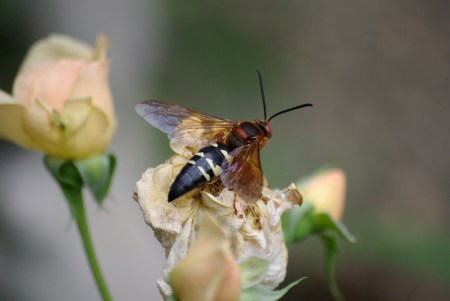
See? Cicada killer wasp

July 5, 2009

Got one in the camera sites this morning:

Cicada killer wasp and rose, Dallas, Texas, 7-5-2009 - image copyright 2009, Ed Darrell

Cicada killer wasp and rose, Dallas, Texas, 7-5-2009 - image copyright 2009, Ed Darrell (free use with attribution)


Heartland on bedbugs: DDT stupidity, all the way to 11

May 25, 2009

The Heartland Institute is charitably called a “think tank” sometimes.  In their latest screed against science and people who wish to protect the environment, there is no evidence of thinking, however.  It’s all tank.

The headline says it all: “Bedbug Outbreak Hits All 50 States Thanks to DDT Ban.”

With all their reading on bedbugs, they never noticed the many notes that DDT stopped working against bedbugs more than 50 years ago? Who is going to tell them that DDT doesn’t work? Or, is this a talisman, an understanding that none of the solutions proposed by Heartland Institute will work? First they flirt with intelligent design, then they lose their senses altogether.  There’s an omen there.

Remember the scene in “Spinal Tap?” Heartland Institute on bedbugs is stupid, turned up to 11.  Heartland Institute doesn’t allow comments, probably because they can’t stand the laughter.


Using evolutionary science to fight fire ants

May 17, 2009

No real Texan would ever entertain the slightest doubt about the accuracy of evolution theory, once that Texan understood how evolution helps fight the imported Argentine fire ant, Solenopsis invictaAnd, who could invent flies that turn the tiny ants into zombies as their larva eat the brains of the ants?

Evolution theory suggests that predators, or at least a parasite, exists for almost every species on Earth.  Fire ants, though seemingly invincible (hence the species name, invicta), also have predators and parasites.  Control of the ants may be a function of finding the right natural enemy of the ant.

Caption from TAES:  As the eggs of a new type of phorid fly develops inside the heads of red imported fire ants, it takes over the control of the host, said Dr. Scott Ludwig, Texas AgriLife Extension Service integrated pest management specialist. Ludwig released fire ants infested with the parasite at the Texas AgriLife Research and Extension Center at Overton on April 29. (Texas AgriLife Extension photo by Robert Burns)

Caption from TAES: As the egg of a new type of phorid fly develops inside the heads of red imported fire ants, it takes over the control of the host, said Dr. Scott Ludwig, Texas AgriLife Extension Service integrated pest management specialist. Ludwig released fire ants infested with the parasite at the Texas AgriLife Research and Extension Center at Overton on April 29. (Texas AgriLife Extension photo by Robert Burns)

Bill Hannah reduces the science to a good lay explanation in the Fort Worth Star-Telegram:

It sounds like something out of science fiction: zombie fire ants. But it’s all too real.

Fire ants wander aimlessly away from the mound.

Eventually their heads fall off, and they die.

The strange part is that researchers at the University of Texas at Austin and Texas A&M’s AgriLife Extension Service say making “zombies” out of fire ants is a good thing.

“It’s a tool — they’re not going to completely wipe out the fire ant, but it’s a way to control their population,” said Scott Ludwig, an integrated pest management specialist with the AgriLife Extension Service in Overton, in East Texas.

The tool is the tiny phorid fly, native to a region of South America where the fire ants in Texas originated. Researchers have learned that there are as many as 23 phorid species along with pathogens that attack fire ants to keep their population and movements under control.

Resources:


WikiMedia’s appropriate pic of the day

April 30, 2008

Well, it woulda been more appropriate in April 25, perhaps — though the species is not a malaria-carrying mosquito.

Still, you gotta love it, Wikimedia’s Picture of the Day for April 30, 2008:


Culex spp., larva, near the surface of a body of water.

This would make a great background for a PowerPoint presentation with just a bit of work, I think. The browns are about the same intensity as the blues and greens. Nice background for a presentation on mosquitoes — outstanding background for slide of a chart on mosquito populations or somesuch.

Warm up for biology class:  Invert the photo, ask kids to explain what it is.


Cicadas, cicada-killer wasps are back!

July 20, 2007

Cicada killer wasp, from Purdue University

Extensive rains delayed them a bit, but our annual cicada cycle started up with vigor sometime in the last ten days. For the past three years, we get the announcement at our house, not from the cicadas singing from the trees, but from the cicada-killer wasps that buzz our back patio area, scouting the yard for good places to bury their prey.

It started with one female burying cicadas under the patio; perhaps another joined her by the end of the first season. But last year, we had about a dozen buzzing about the yard. We have plenty of cicadas, so it should be good pickings for the wasps — so long as no one sprays insecticide on them.

These wasps are larger than most wasps, as long as 2.5 inches, and big enough to muscle a cicada around. The cicadas are twice as big, volume wise, but I suspect they weigh less. In any case, the wasps show outstanding strength and coordination in zooming around carrying their paralyzed victims to their holes — yesterday I saw a wasp rocket into a hole in the garden without the usual stop to drop the cicada and tug it in. The hole was a perfect fit. Jet air delivery.

The wasps leave us alone as we watch. We’ve never been stung, and I don’t know that these guys sting humans (unless attacked, and I assume they’d fight back).

Their ability to move dirt is amazing. We usually get a pile of soil about a foot around and three to six inches high at each hole.

So far as I know, down here in Dallas we don’t get any massive infestations of the the 13- or 17-year cicadas. I cannot imagine how such a feast might affect these industrious little guys, other than they might fly themselves to death. We lived through a double hatching of the 13- and 17-year cicadas in Maryland. Corpses of the cicadas made some streets slick enough they were dangerous to drive. Man, what I wouldn’t have given for a few thousand cicada killers then!

Cicada killers, or cicada hawks, sting and paralyze cicadas, then inter the still-living cicada with one egg laid in it for male larvae, or one egg with two cicadas, for female larvae. The wasp egg hatches and the larva consumes the fresh cicada; some of the wasps survive the winter, and I don’t know if the cicada is kept fresh the entire time, or if a few of the wasps hatch and go dormant.

My photos didn’t turn out as well as those from Purdue and Michigan State — the buggers are fast and restless. The photos could easily have come from our yard, with the massive blossoming of the yellow composites right now (“DYCs” in local horticultural parlance).

Watch your yard — you probably have these tiny “True Life Adventures” going on in your own backyard. You can encourage them with careful plantings, and especially by not spraying poisons (did I mention that between the predatory insects and the now-large geckoes that have taken up residence here, we don’t have cockroaches and other nasty house pests?).

The photo below shows a wasp carrying a cicada.

Cicada killer carrying cicada, from Michigan State U Extension

Update on resources (7-30-2008):

Add to FacebookAdd to NewsvineAdd to DiggAdd to Del.icio.usAdd to StumbleuponAdd to RedditAdd to BlinklistAdd to TwitterAdd to TechnoratiAdd to Furl